REVIEW 3 major objections 5 minor 62 references
Balanced electron and phonon heat transport in metallic $\varepsilon$-TaN
T0 review · 3 major / 5 minor · reviewed 2026-08-14 · deepseek-v4-flash
Pith's one-line read Metallic ε-TaN is predicted to conduct heat at 273 W m−1 K−1 in single crystals, with 79 percent carried by lattice vibrations.
desk verdict Credible ab initio prediction for ε-TaN, but the experimental confirmation rests on one psTTR point matched by an adjustable grain size and an inconsistent binder explanation. read the letter →
The pith
A machine-rendered reading of the paper's core claim, the machinery that carries it, and where it could break.
The reading
What carries the argument
The load-bearing object is a two-descriptor scaling law for balanced heat transport in metals. From the Wiedemann-Franz electron picture and Fermi-golden-rule electron-phonon scattering, the paper derives $\kappa_{\mathrm{el}} \sim v_F^2/(g^2 \hbar\omega)$ and an upper bound $\kappa_{\mathrm{ph}} \lesssim v_F^2/(g^2 N_{F,\mathrm{at}})\,(v_s/v_F)$; balanced transport requires a large acoustic-optical gap plus large $v_F^2$ and large $N_{F,\mathrm{at}}^{-1}v_s/v_F$. ε-TaN is the material where both descriptors are favorable, and the wide phonon gap suppresses three-phonon scattering. The paper also uses an averaged scattering-rate decomposition, weighted by the phonon Boltzmann kernel, to identify which scattering channel limits the lattice conductivity.
What would settle it
Measure the thermal conductivity of a binder-free ε-TaN polycrystal whose grain size is independently determined; if it comes out near 70 W m−1 K−1 rather than about 145 W m−1 K−1 at 300 K, the claimed agreement is coincidental. A single-crystal measurement along the $c$ axis would directly settle the 273 W m−1 K−1 prediction.
Extended reading notes
Core claim
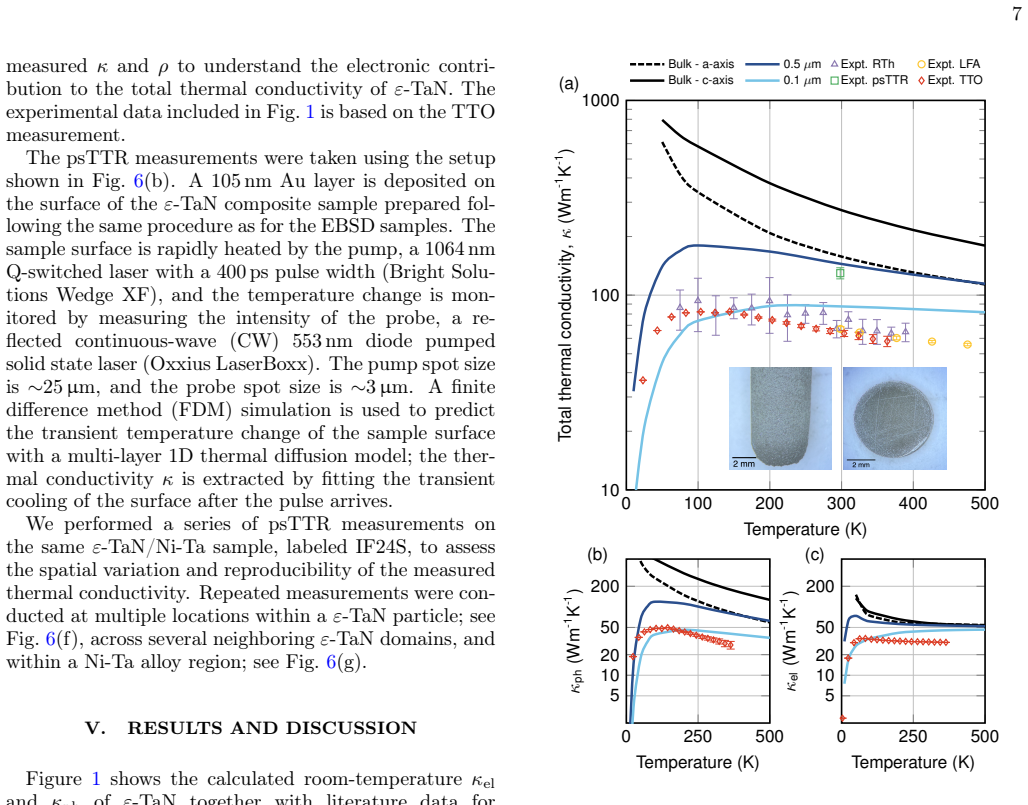
The central claim is that ε-TaN simultaneously satisfies the normally conflicting conditions for large electronic and lattice thermal conductivity. On the electronic side it has a large average Fermi velocity ($0.7\times10^6$ m/s) and a small density of states at the Fermi level ($0.085$ eV$^{-1}$/atom), which keeps electron-phonon scattering weak ($\lambda = 0.07$). On the lattice side it has a high speed of sound ($6.5\times10^3$ m/s) and a wide phonon gap ($39.6$ meV) that blocks the dominant three-phonon scattering channel; the gap opens because ε-TaN is a distorted $\sqrt{3}\times\sqrt{3}\times1$ supercell of θ-TaN, folding acoustic and optical branches into lower and upper manifolds. The paper predicts a total thermal conductivity of $273\pm5$ W m$^{-1}$ K$^{-1}$ in single crystals, with $\kappa_{\mathrm{ph}} = 215\pm5$ and $\kappa_{\mathrm{el}} = 58\pm5$ along the $c$ axis, and reports measured values of 60 to 70 W m$^{-1}$ K$^{-1}$ for bulk composites, 130±9 W m$^{-1}$ K$^{-1}$ for a local ε-TaN domain, and 15 W m$^{-1}$ K$^{-1}$ for the Ni-Ta binder, which together support sizable contributions from both channels.
Load-bearing premise
The agreement between theory and experiment rests on treating one local thermoreflectance measurement of a micrometer-sized ε-TaN domain, fit with a one-dimensional multilayer heat-diffusion model, as representative of intrinsic polycrystalline ε-TaN, and on using 0.5 micrometers as the grain size for the matching calculation.
Editorial extensions
If this is right
- Single crystals of ε-TaN, if grown, should show a room-temperature thermal conductivity near 273 W m−1 K−1 along the $c$ axis, exceeding aluminum.
- Reducing binder and grain-boundary content should push polycrystalline ε-TaN from the measured 60 to 70 W m−1 K−1 toward the computed 145 W m−1 K−1 for 0.5-micrometer grains.
- The two descriptors can rank other metallic compounds before expensive full calculations, identifying candidates where phonons and electrons both contribute.
- In ε-TaN, electron-phonon scattering cuts the lattice thermal conductivity by about 50 percent at room temperature while still leaving a phonon-dominated metal; by contrast, δ-TaN is electron-dominated with only 11 W m−1 K−1 from phonons.
Reading between the lines
- If the scaling law proves robust, the obvious next move is to screen early-transition-metal nitrides and carbides with flat Fermi pockets and large acoustic-optical gaps.
- Because the phonon fraction dominates, isotope engineering or strain tuning of the phonon gap may move the conductivity more than alloying the metal site.
- A direct test that avoids the current composite complication would be a binder-free polycrystal with independently measured grain size, compared against the 0.5-micrometer curve across temperature.
Editorial analysis
A structured set of objections, weighed in public.
Referee Report
Summary. The paper reports a combined computational and experimental study of metallic epsilon-TaN. The authors derive scaling laws for electronic and lattice thermal conductivities in metals and then use state-of-the-art ab initio Boltzmann transport equation (BTE) calculations to predict a room-temperature thermal conductivity of 273±5 W/m/K in single crystals (kappa_ph = 215±5, kappa_el = 58±5 along the c axis) and 145±5 W/m/K in polycrystals with 0.5 micron grains. They synthesize epsilon-TaN composites with Ni, Co, and Fe binders and measure thermal conductivity by laser flash analysis, differential resistance thermometry, thermal transport option, and picosecond transient thermoreflectance. Bulk measurements give 60-70 W/m/K, while one local psTTR measurement on an epsilon-TaN domain in the Ni-based composite gives 130±9 W/m/K. The paper claims agreement between this local value and the 0.5 micron-grain calculation and attributes the lower bulk values to the metallic binder.
Significance. If the predictions are confirmed, epsilon-TaN would occupy a rare regime of balanced electron and phonon heat transport in a metal, with a lattice contribution exceeding that of aluminum, and the two-descriptor scaling law would provide a useful search strategy. The computational methodology is a clear strength: full phonon BTE including three-phonon, four-phonon, electron-phonon, and isotope scattering; an independent electronic BTE from EPW; and extensive convergence tests in Appendices B and C. The scaling prefactors (pi/36 and 1/pi) are derived in Appendix A rather than fitted, so the scaling analysis is not circular. However, the experimental confirmation is currently partial and does not yet securely establish the central claim of experimental realization, and the single-crystal prediction remains untested.
major comments (3)
- [Sec. V, Fig. 7(a); Sec. IVB and IVC] The claimed agreement between theory and experiment rests on a single local psTTR measurement of 130±9 W/m/K compared with the calculated curve for 0.5 micron grains. The EBSD analysis (Fig. 5(e)) only counts grains larger than 1 square micron and explicitly states that many smaller grains are not resolved, so the 0.5 micron grain size used for the matching curve is an unconstrained post-hoc choice rather than a measured value. Because the calculated thermal conductivity depends strongly on grain size (Fig. 7(a)), this comparison does not robustly confirm the polycrystalline prediction. In addition, the psTTR measurement uses a 25 micron pump spot on a composite with micrometer-sized domains and binder regions, and the analysis assumes a homogeneous 1D multilayer model, so the measured value may include contributions from surrounding Ni-Ta and grain boundaries. The abstract's statement that the polycrystalline value is in agreement with the local transient thermoreflectance measurements therefore overstates the strength of the evidence, and the single-crystal prediction of 273 W/m/K remains untested.
- [Sec. V; Tables III and V] The bulk measurements are not quantitatively reconciled with the binder explanation. IF24L contains 92 wt% epsilon-TaN but has a TTO thermal conductivity of 60±2 W/m/K, essentially the same as IF24S with 70 wt% epsilon-TaN (63±3), and IF28 with 96 wt% Co-Ta gives 58±2. If the low-conductivity Ni-Ta binder (kappa approximately 15 W/m/K) were responsible for the factor-of-two reduction from the predicted 145 W/m/K, the bulk conductivity should increase markedly with epsilon-TaN fraction; the data do not show this trend. No effective-medium calculation is presented, so the statement in Sec. V that the lower bulk average can be explained in terms of the Ni-Ta alloy is unsupported and appears inconsistent with the phase-fraction data.
- [Sec. V; Fig. 12(b)] The separation of measured kappa into electronic and lattice contributions uses kappa_el = sigma T L0 with the Sommerfeld Lorenz number, justified by the claim that grain-boundary scattering makes the Lorenz number close to L0. However, the paper's own calculation in Fig. 12(b) shows that the Lorenz ratio for bulk epsilon-TaN is below L0 at room temperature, and the measured composites contain a range of grain sizes, with IF24L having the largest grains. Using L0 may therefore overestimate kappa_el and underestimate kappa_ph, and the reported uncertainties on the experimental decomposition do not include this systematic error. The authors should either quantify this bias from their calculated Lorenz ratios or soften the quantitative comparison in Figs. 7(b) and 7(c).
minor comments (5)
- [Fig. 1 caption] The caption contains the typo 'episilon-TaN' and should read 'epsilon-TaN'.
- [Sec. IVA] The sentence 'The diameter of the synthesized rod ranges from 4mm to 8mm, an the length reaches up to 80mm' should read 'and the length reaches up to 80 mm'.
- [Figs. 12(b) and 13(d); Appendix D] There are several typos: 'Temperapture' should be 'Temperature' in Fig. 12(b), '4rd order' should be '4th order' in Fig. 13(d), and 'condutivity' should be 'conductivity' in Appendix D.
- [Table IV] The table header contains the incomplete sentence 'In all cases we report values.'; it should specify which values are reported.
- [Appendix B1] The sentence 'In the case of delta-TaN, we employ 9 Wannier functions...' appears twice in succession; one occurrence should be removed.
Circularity Check
No significant circularity: the central ab initio BTE predictions are self-contained, and the scaling laws are derived approximations checked against, not used to construct, the BTE results.
full rationale
The paper's central quantitative claims (κ = 273±5 W m−1 K−1 in single crystals, with κ_ph = 215±5 and κ_el = 58±5; and 145±5 in polycrystals with 0.5 µm grains) come from solving the phonon and electronic Boltzmann transport equations using ab initio electron-phonon matrix elements, third- and fourth-order interatomic force constants, Wannier interpolation, and convergence-tested grids (Secs. III and V, Appendices B and D). These BTE calculations do not take the scaling laws of Sec. II as input. The scaling laws are derived in Appendix A from the microscopic Fan–Migdal and phonon self-energy expressions, with the free-electron nesting function, and the quoted prefactors (π/36 and 1/π) are obtained analytically rather than fitted. The comparison between the scaling estimates (e.g., 55, 31, 69 W m−1 K−1 for κ_el) and the full BTE values (57, 40, 64 W m−1 K−1) is a consistency check of the approximate scaling expression, not a derivation of the BTE result from itself. The experimental psTTR measurement (130±9 W m−1 K−1) is independent of the calculation; comparing it with the calculated curve for 0.5 µm grains is a physical choice, though the EBSD data only set an upper limit below the resolution limit, so this confirmation is weaker than a direct grain-size measurement. That is a validation limitation, not circularity. The cited θ-TaN results are independently established, and the only self-citation, Ref. [15], concerns a computational convention for θ-TaN that is supported by the convergence tests in Appendix B rather than being load-bearing for the ε-TaN predictions. Overall, no step reduces by construction to its own input.
Assumptions & free parameters
free parameters (1)
- Grain size for polycrystalline calculation =
0.5 μm
assumptions (5)
- domain assumption LDA provides accurate electronic structure, phonons, and electron-phonon couplings for TaN polymorphs.
- domain assumption Matthiessen's rule is valid for combining three-phonon, four-phonon, isotope, and electron-phonon scattering rates.
- domain assumption The Wiedemann-Franz law with the Sommerfeld value L0 applies to the measured polycrystalline samples for separating κ_el and κ_ph.
- domain assumption The free-electron nesting function χ_q = N_F Ω/(2 ℏ v_F |q|) is a valid approximation for deriving the lattice thermal conductivity scaling law.
- domain assumption The ε-TaN phonon dispersion can be interpreted as zone folding of θ-TaN modes, making the wide phonon gap the key suppressor of three-phonon scattering.
Cite this review
Pith. "Pith review of Balanced electron and phonon heat transport in metallic $\varepsilon$-TaN." pith.science (2026). https://pith.science/paper/QT2BRXTB
@misc{pith2026260810243,
  author       = {Pith},
  title        = {Pith review of: Balanced electron and phonon heat transport in metallic $\varepsilon$-TaN},
  year         = {2026},
  howpublished = {\url{https://pith.science/paper/QT2BRXTB}},
  note         = {Machine review of arXiv:2608.10243}
}
abstract
Most materials with high thermal conductivity belong to one of two classes: metals, where heat is carried predominantly by electrons, and insulators, where heat transport is dominated by the phonon contribution. Materials that combine substantial electronic thermal conductivity and lattice thermal conductivity are rare, because the mechanisms that favor electron transport typically suppress phonon transport, and vice versa. Here, we report the theoretical prediction and experimental realization of such a material, metallic $\varepsilon$-TaN. Our calculations predict a total thermal conductivity at room-temperature of 273$\pm$5Wm$^{-1}$K$^{-1}$ in single crystals and 145$\pm$5Wm$^{-1}$K$^{-1}$ in polycrystals with 0.5$\mu$m grains, with an unusually large lattice contribution (79%) for a metal. The latter value is in agreement with our local transient thermoreflectance measurements on polycrystalline samples yielding $\sim$130Wm$^{-1}$K$^{-1}$. We show that the balanced electronic and lattice thermal conductivities of $\varepsilon$-TaN originate from a combination of large Fermi velocity and small Fermi density of states on the electron side, and large speed of sound and wide phonon gap on the lattice side.
Figures


Figures from the paper (10 more)




Reference graph
Works this paper leans on
-
[1]
Electron relaxation time from electron-phonon coupling The relaxation timeτ nk of an electron in the Kohn- Sham state with band indexnand wavevectorkis ob- tained from the imaginary part of the Fan-Midgal self- energy and is given by [22]: 1 τnk = 2π ℏ X mν Z dq ΩBZ |gnmν(k,q)| 2 ×[(1−f mk+q +n qν)δ(εnk −ℏω qν −εmk+q) + (f mk+q +n qν)δ(ε nk +ℏω qν −εmk+q)...
-
[2]
Phonon relaxation time from electron-phonon coupling The relaxation timeτqν of a phonon with wavevectorq and branch indexνis obtained from the imaginary part of the phonon self-energy and is given by [22]: 1 τqν = 2π ℏ 2 X mn Z dk ΩBZ |gmnν(k,q)| 2 ×(f nk −f mk+q)δ(εmk+q −ε nk −ℏω qν),(A5) where the meaning of the symbols is the same as in the previous se...
-
[3]
The labels for the Ta atoms are indicated in Fig
W annier interpolation For the Wannier-Fourier interpolation in theEPW code, we employ 9 Wannier functions forε-TaN, start- ing fromd z2,d xz, andd yz orbitals on one Ta1 atom, dz2,d x2−y2, andd xy orbitals on one Ta2 atom, andp orbitals on one N atom. The labels for the Ta atoms are indicated in Fig. 2. In the case ofδ-TaN, we employ 9 Wannier functions,...
work page 2010
-
[4]
Electronic thermal conductivity Figure 12(a) reports the convergence of the electronic thermal conductivityκ el inε-TaN,δ-TaN, andθ-TaN as a function of the electronic Brillouin-zone sampling used to evaluate the transport integrals within the electronic BTE. The calculations show that96×96×160,1203, and 1003 k-point grids are sufficient to convergeκel wi...
-
[5]
Lattice thermal conductivity In Fig. 13 we analyze the convergence of the lattice thermal conductivityκ ph with respect to the number of neighbors in calculations of third-order force constants, number ofk-points in calculations of phonon relaxation times, and number ofq-points. In particular, Fig. 13(a) reports the convergence of the lattice thermal cond...
- [6]
-
[7]
D. G. Onn, A. Witek, Y. Z. Qiu, T. R. Anthony, and W. F. Banholzer, Some aspects of the thermal conductiv- ity of isotopically enriched diamond single crystals, Phys. Rev. Lett.68, 2806 (1992)
work page 1992
-
[8]
J. R. Olson, R. O. Pohl, J. W. Vandersande, A. Zoltan, T. R. Anthony, and W. F. Banholzer, Thermal conduc- tivity of diamond between 170 and 1200K and the isotope effect, Phys. Rev. B47, 14850 (1993)
work page 1993
Show all 62 references
-
[9]
L. Wei, P. K. Kuo, R. L. Thomas, T. R. Anthony, and W. F. Banholzer, Thermal conductivity of isotopically modified single crystal diamond, Phys. Rev. Lett.70, 3764 (1993)
1993
-
[10]
A. Ward, D. A. Broido, D. A. Stewart, and G. Deinzer, Ab initio theory of the lattice thermal conductivity in diamond, Phys. Rev. B80, 125203 (2009)
2009
-
[11]
Lindsay, D
L. Lindsay, D. A. Broido, and T. L. Reinecke, First- principles determination of ultrahigh thermal conductiv- 17 ity of boron arsenide: A competitor for diamond?, Phys. Rev. Lett.111, 025901 (2013)
2013
-
[12]
Kundu, X
A. Kundu, X. Yang, J. Ma, T. Feng, J. Carrete, X. Ruan, G. K. H. Madsen, and W. Li, Ultrahigh thermal conduc- tivity ofθ-phase tantalum nitride, Phys. Rev. Lett.126, 115901 (2021)
2021
-
[13]
F. Tian, B. Song, X. Chen, N. K. Ravichandran, Y. Lv, K. Chen, S. Sullivan, J. Kim, Y. Zhou, T.-H. Liu, M. Goni, Z. Ding, J. Sun, G. A. G. U. Gamage, H. Sun, H. Ziyaee, S. Huyan, L. Deng, J. Zhou, A. J. Schmidt, S. Chen, C.-W. Chu, P. Y. Huang, D. Broido, L. Shi, G. Chen, and ...
2018
-
[14]
Dames, Ultrahigh thermal conductivity confirmed in boron arsenide, Science361, 549 (2018)
C. Dames, Ultrahigh thermal conductivity confirmed in boron arsenide, Science361, 549 (2018)
2018
-
[15]
J. S. Kang, M. Li, H. Wu, H. Nguyen, and Y. Hu, Ex- perimental observation of high thermal conductivity in boron arsenide, Science361, 575 (2018)
2018
-
[16]
S. Li, Q. Zheng, Y. Lv, X. Liu, X. Wang, P. Y. Huang, D. G. Cahill, and B. Lv, High thermal conductivity in cubic boron arsenide crystals, Science361, 579 (2018)
2018
-
[17]
Lindsay and D
L. Lindsay and D. A. Broido, Three-phonon phase space and lattice thermal conductivity in semiconductors, J. Phys. Condens. Matter20, 165209 (2008)
2008
-
[18]
Kundu, Y
A. Kundu, Y. Chen, X. Yang, F. Meng, J. Carrete, M. Kabir, G. K. H. Madsen, and W. Li, Electron-induced nonmonotonic pressure dependence of the lattice ther- mal conductivity ofθ-TaN, Phys. Rev. Lett.132, 116301 (2024)
2024
-
[19]
N. Kuge, T. Sekiya, M. Enoki, H. Yamane, and T. Ya- mada, Preparation of faceted TaN grains by heating ta- containing oxides in BN crucible with Na, Ceram. Int. 48, 10817 (2022)
2022
-
[20]
H. Lee, Y. Zhou, S. Jung, H. Li, Z. Cheng, J. He, J. Chen, P. Sokalski, A. Dolocan, R. Gearba-Dolocan, K. C. Matthews, F. Giustino, J. Zhou, and L. Shi, High-pressure synthesis and thermal conductivity of semimetallicθ-tantalum nitride, Adv. Funct. Mater.33, 2212957 (2023)
2023
-
[21]
Y. Liu, Q. Li, Y. Qian, Y. Yang, S. Wang, W. Li, and B. Sun, Thermal conductivity of high-temperature high-pressure synthesizedθ-TaN, Appl. Phys. Lett.122, 222201 (2023)
2023
-
[22]
S. Li, C. Su, Z. Qin, A. Alatas, M. Kunz, T. Yamada, S.D.Kelly, M.H.Upton, A.Gironda, J.Zhao, B.Kalkan, W. Yang, T. Aoki, and Y. Hu, Metallicθ-phase tantalum nitride has a thermal conductivity triple that of copper, Science391, 707 (2026)
2026
-
[23]
Y. Chen, G. Pang, F. Meng, and W. Li, Origin of the high lattice thermal conductivity of beryllium among the elemental metals, Phys. Rev. B109, L220302 (2024)
2024
-
[24]
Z. Tong, S. Li, X. Ruan, and H. Bao, Comprehensive first-principles analysis of phonon thermal conductivity and electron-phonon coupling in different metals, Phys. Rev. B100, 144306 (2019)
2019
-
[25]
Kundu, J
A. Kundu, J. Ma, J. Carrete, G. Madsen, and W. Li, Anomalously large lattice thermal conductivity in metal- lic tungsten carbide and its origin in the electronic struc- ture, Mater. Today Phys.13, 100214 (2020)
2020
-
[26]
Kittel, Introduction to solid state physics, New York: Wiley (1976)
C. Kittel, Introduction to solid state physics, New York: Wiley (1976)
1976
-
[27]
Giustino, Electron-phonon interactions from first prin- ciples, Rev
F. Giustino, Electron-phonon interactions from first prin- ciples, Rev. Mod. Phys.89, 015003 (2017)
2017
-
[28]
Y. Liu, X. Zhou, G. Pang, C. Gu, G. Song, J. Chen, J. Carrete, L. Fang, S. Wang, W. Li, and B. Sun, High thermal conductivity in metallicθ-TaN single crystals, Natl. Sci. Rev.13, nwag106 (2026)
2026
-
[29]
Momma and F
K. Momma and F. Izumi,VESTA3for three-dimensional visualization of crystal, volumetric and morphology data, J. Appl. Crystallogr.44, 1272 (2011)
2011
-
[30]
Giannozzi, O
P. Giannozzi, O. Andreussi, T. Brumme, O. Bunau, M. Buongiorno Nardelli, M. Calandra, R. Car, C. Cavaz- zoni, D. Ceresoli, M. Cococcioni, N. Colonna, I. Carn- imeo, A. Dal Corso, S. de Gironcoli, P. Delugas, R. A. DiStasio, A. Ferretti, A. Floris, G. Fratesi, G. Fugallo, R. Ge...
2017
-
[31]
D. M. Ceperley and B. J. Alder, Ground state of the electron gas by a stochastic method, Phys. Rev. Lett. 45, 566 (1980)
1980
-
[32]
J. P. Perdew and A. Zunger, Self-interaction correction to density-functional approximations for many-electron systems, Phys. Rev. B23, 5048 (1981)
1981
-
[33]
D. R. Hamann, Optimized norm-conserving vanderbilt pseudopotentials, Phys. Rev. B88, 085117 (2013)
2013
-
[34]
van Setten, M
M. van Setten, M. Giantomassi, E. Bousquet, M. Ver- straete, D. Hamann, X. Gonze, and G.-M. Rignanese, The pseudodojo: Training and grading a 85 element op- timized norm-conserving pseudopotential table, Comput. Phys. Commun.226, 39 (2018)
2018
-
[35]
Baroni, P
S. Baroni, P. Giannozzi, and A. Testa, Green’s-function approach to linear response in solids, Phys. Rev. Lett. 58, 1861 (1987)
1987
-
[36]
Giannozzi, S
P. Giannozzi, S. de Gironcoli, P. Pavone, and S. Baroni, Ab initio calculation of phonon dispersions in semicon- ductors, Phys. Rev. B43, 7231 (1991)
1991
-
[37]
Gonze and C
X. Gonze and C. Lee, Dynamical matrices, born effective charges, dielectric permittivity tensors, and interatomic force constants from density-functional perturbation the- ory, Phys. Rev. B55, 10355 (1997)
1997
-
[38]
Baroni, S
S. Baroni, S. de Gironcoli, A. Dal Corso, and P. Gi- annozzi, Phonons and related crystal properties from density-functional perturbation theory, Rev. Mod. Phys. 73, 515 (2001)
2001
-
[39]
Zacharias and F
M. Zacharias and F. Giustino, Theory of the special dis- placement method for electronic structure calculations at finite temperature, Phys. Rev. Res.2, 013357 (2020)
2020
-
[40]
Zacharias, G
M. Zacharias, G. Volonakis, F. Giustino, and J. Even, Anharmonic lattice dynamics via the special displace- ment method, Phys. Rev. B108, 035155 (2023)
2023
-
[41]
H. Lee, S. Poncé, K. Bushick, S. Hajinazar, J. Lafuente- Bartolome, J. Leveillee, C. Lian, J.-M. Lihm, F. Macheda, H. Mori, H. Paudyal, W. H. Sio, S. Tiwari, M. Zacharias, X. Zhang, N. Bonini, E. Kioupakis, E. R. Margine, and F. Giustino, Electron–phonon physics from first pri...
2023
-
[42]
A. Togo, L. Chaput, T. Tadano, and I. Tanaka, Imple- mentation strategies in phonopy and phono3py, J. Phys. Condens. Matter35, 353001 (2023)
2023
-
[43]
Togo, First-principles phonon calculations with 18 phonopy and phono3py, J
A. Togo, First-principles phonon calculations with 18 phonopy and phono3py, J. Phys. Soc. Jpn.92, 012001 (2023)
2023
-
[44]
W. Li, J. Carrete, N. A. Katcho, and N. Mingo, Sheng- bte: A solver of the boltzmann transport equation for phonons, Comput. Phys. Commun.185, 1747 (2014)
2014
-
[45]
Z. Han, X. Yang, W. Li, T. Feng, and X. Ruan, Four- phonon: An extension module to shengbte for computing four-phonon scattering rates and thermal conductivity, Comput. Phys. Commun.270, 108179 (2022)
2022
-
[46]
Marzari and D
N. Marzari and D. Vanderbilt, Maximally localized gen- eralized wannier functions for composite energy bands, Phys. Rev. B56, 12847 (1997)
1997
-
[47]
I.Souza, N.Marzari,andD.Vanderbilt,Maximallylocal- ized wannier functions for entangled energy bands, Phys. Rev. B65, 035109 (2001)
2001
-
[48]
Giustino, M
F. Giustino, M. L. Cohen, and S. G. Louie, Electron- phonon interaction using wannier functions, Phys. Rev. B76, 165108 (2007)
2007
-
[49]
Pizzi, V
G. Pizzi, V. Vitale, R. Arita, S. Blügel, F. Freimuth, G. Géranton, M. Gibertini, D. Gresch, C. Johnson, T. Koretsune, J. Ibañez-Azpiroz, H. Lee, J.-M. Lihm, D. Marchand, A. Marrazzo, Y. Mokrousov, J. I. Mustafa, Y. Nohara, Y. Nomura, L. Paulatto, S. Poncé, T. Pon- weiser, J. ...
2020
-
[50]
Feng and X
T. Feng and X. Ruan, Quantum mechanical prediction of four-phonon scattering rates and reduced thermal con- ductivity of solids, Phys. Rev. B93, 045202 (2016)
2016
-
[51]
T. Feng, L. Lindsay, and X. Ruan, Four-phonon scatter- ing significantly reduces intrinsic thermal conductivity of solids, Phys. Rev. B96, 161201 (2017)
2017
-
[52]
B. Liao, B. Qiu, J. Zhou, S. Huberman, K. Esfarjani, and G. Chen, Significant reduction of lattice thermal conductivity by the electron-phonon interaction in sili- con with high carrier concentrations: A first-principles study, Phys. Rev. Lett.114, 115901 (2015)
2015
-
[53]
G. K. Madsen and D. J. Singh, Boltztrap. a code for cal- culating band-structure dependent quantities, Comput. Phys. Commun.175, 67 (2006)
2006
-
[54]
Rodríguez-Carvajal, Recent advances in magnetic structure determination by neutron powder diffraction, Physica B Condens
J. Rodríguez-Carvajal, Recent advances in magnetic structure determination by neutron powder diffraction, Physica B Condens. Matter192, 55 (1993)
1993
-
[55]
Y. Zhou, C. Li, D. Broido, and L. Shi, A differential thin film resistance thermometry method for peak ther- mal conductivity measurements of high thermal conduc- tivity crystals, Rev. Sci. Instrum.92, 094901 (2021)
2021
-
[56]
Maldonado, Pulse method for simultaneous measure- ment of electric thermopower and heat conductivity at low temperatures, Cryogenics32, 908 (1992)
O. Maldonado, Pulse method for simultaneous measure- ment of electric thermopower and heat conductivity at low temperatures, Cryogenics32, 908 (1992)
1992
-
[57]
Jeong, X
J. Jeong, X. Meng, A. K. Rockwell, S. R. Bank, W.-P. Hsieh, J.-F. Lin, and Y. Wang, Picosecond transient ther- moreflectance for thermal conductivity characterization, Nanoscale Microscale Thermophys. Eng.23, 211 (2019)
2019
-
[58]
Z. Ye, J. Park, Y. Zhang, X. Meng, M. Disiena, S. K. Banerjee, J.-F. Lin, and Y. Wang, Simultaneous determi- nation of thermal conductivity and heat capacity in thin films with picosecond transient thermoreflectance and pi- cosecond laser flash, Nanoscale Microscale Thermophys...
2023
-
[59]
Kawamura, Fermisurfer: Fermi-surface viewer pro- viding multiple representation schemes, Comput
M. Kawamura, Fermisurfer: Fermi-surface viewer pro- viding multiple representation schemes, Comput. Phys. Commun.239, 197 (2019)
2019
-
[60]
P. B. Allen, Neutron spectroscopy of superconductors, Phys. Rev. B6, 2577 (1972)
1972
-
[61]
E. I. Isaev, S. I. Simak, I. A. Abrikosov, R. Ahuja, Y. K. Vekilov, M. I. Katsnelson, A. I. Lichtenstein, and B. Jo- hansson, Phonon related properties of transition metals, their carbides, and nitrides: A first-principles study, J. Appl. Phys.101, 123519 (2007)
2007
-
[62]
Yan, X.-L
G.-Q. Yan, X.-L. Cheng, and H. Zhang, Phase stabil- ity and mechanical response of tantalum nitrides to elec- tronic excitation effect, Mater. Res. Express7, 066508 (2020)
2020
Reviewed August 14, 2026 · model on record in the stance chip above.
Discussion (0). Continue with ORCID to comment.