REVIEW 5 major objections 4 minor 46 references
Event-by-event analysis of chiral charge separation in $p^{\uparrow}+$Au collisions within an improved AMPT model
T0 review · 5 major / 4 minor · reviewed 2026-08-15 · deepseek-v4-flash
Pith's one-line read The paper claims that a difference between two impact-parameter schemes of polarized proton–gold collisions yields an essentially background-free chiral magnetic effect signal that survives the full quark–gluon plasma evolution.
desk verdict The stage-by-stage survival analysis is the real contribution; the quantitative signal size rests on a 7% calibration that the authors do not stress-test. read the letter →
The pith
A machine-rendered reading of the paper's core claim, the machinery that carries it, and where it could break.
The reading
What carries the argument
The mechanism carries through three ingredients: (1) four collision-geometry schemes defined by the reaction-plane orientation relative to the proton polarization axis, which pick out well-separated values of the magnetic-field strength $B^2$; (2) an event-by-event CME source in which the fraction of quark pairs whose transverse momentum is exchanged scales as $f = 7\% \times |\mathbf{B}|_{\mathrm{event}}/|\mathbf{B}|_{\mathrm{max}}$, capped at the value calibrated to the Au+Au $\gamma_{\mathrm{SS}}$ correlator; and (3) an impact-parameter-dependent hadron formation-time delay that reduces the peak energy density to a physical $\sim 0.3\,\mathrm{GeV/fm^3}$. The observable is the three-point correlator $\gamma_{\alpha\beta} = \langle \cos(\phi_\alpha + \phi_\beta - 2\Psi_{\mathrm{RP}})\rangle$ and its charge-dependent difference $\Delta\gamma = \gamma_{\mathrm{OS}} - \gamma_{\mathrm{SS}}$; the key identity is that the scheme difference $\Delta\gamma_{\mathrm{IV}} - \Delta\gamma_{\mathrm{II}}$ cancels flow-driven backgrounds because the background is small in p+Au, leaving $\Delta\gamma^{\mathrm{CME}}_{\mathrm{IV}} - \Delta\gamma^{\mathrm{CME}}_{\mathrm{II}}$.
What would settle it
Measure $\Delta\gamma_{\mathrm{IV}} - \Delta\gamma_{\mathrm{II}}$ in $0$–$5\%$ central $p^\uparrow$+Au at $\sqrt{s_{NN}} = 200\,\mathrm{GeV}$ using zero-degree calorimeters to tag the impact-parameter orientation; if the difference is consistent with zero within the expected $1$–$2\times 10^{-4}$ band, the paper's central claim would be ruled out.
Extended reading notes
Core claim
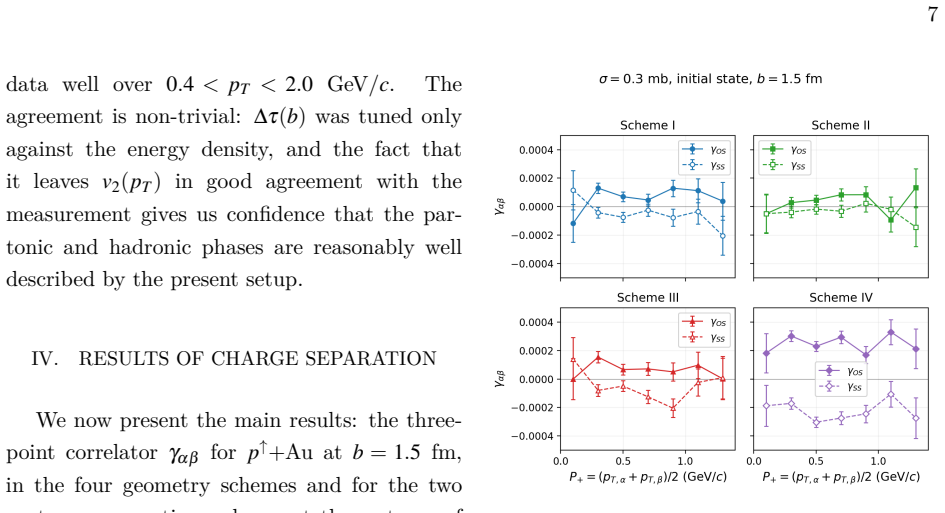
The central claim is that the inter-scheme difference $\Delta\gamma_{\mathrm{IV}} - \Delta\gamma_{\mathrm{II}}$ — the difference in the charge-dependent azimuthal correlator between two impact-parameter orientations of a polarized proton–gold collision — is an essentially pure CME observable. The paper shows with its improved transport model that while the initial correlator displays a clear hierarchy $|\Delta\gamma|_{\mathrm{IV}} \gg |\Delta\gamma|_{\mathrm{I}} \approx |\Delta\gamma|_{\mathrm{III}} > |\Delta\gamma|_{\mathrm{II}}$ tracking $B^2$, the parton cascade preserves $80$–$90\%$ of the signal, and it is the subsequent hadron-coalescence and hadronic-rescattering stages that dissipate the bulk, leaving roughly $10$–$30\%$ in the final state. Despite this, the $\gamma_{\mathrm{OS}}/\gamma_{\mathrm{SS}}$ splitting remains visible and the central-value hierarchy survives, so $\Delta\gamma_{\mathrm{IV}} - \Delta\gamma_{\mathrm{II}}$ is predicted to remain nonzero (order $1$–$2\times 10^{-4}$) after full evolution. The paper also reports that the correlator is essentially flat in pseudorapidity gap, consistent with a long-range CME source, and that the result is robust against varying the parton cross section by a factor of two.
Load-bearing premise
The magnitude of the predicted signal rests on a single calibration: the $7\%$ ceiling on the quark-exchange fraction, set by reproducing the Au+Au $\gamma_{\mathrm{SS}}$ correlator in $30$–$50\%$ centrality — if that ceiling does not represent the true CME fraction in p+Au, all predicted $\Delta\gamma$ values scale with it, although the scheme ordering itself would survive.
Editorial extensions
If this is right
- The difference $\Delta\gamma_{\mathrm{IV}} - \Delta\gamma_{\mathrm{II}}$ is predicted to remain nonzero, at the level of $1$–$2\times 10^{-4}$, after full partonic and hadronic evolution, making it measurable with impact-parameter tagging.
- The scheme hierarchy $|\Delta\gamma|_{\mathrm{IV}} > |\Delta\gamma|_{\mathrm{I,III}} > |\Delta\gamma|_{\mathrm{II}}$ should be visible in the final-state correlator, not only at the initial state.
- The correlator is essentially flat in pseudorapidity gap, distinguishing a long-range CME source from short-range $v_2$-related backgrounds.
- The result is robust to a factor-of-two change in the parton cross section, suggesting that the pattern is dictated by the magnetic-field geometry.
- The bulk of the CME signal is lost in the hadronic rescattering phase, so the final-state observable carries only $\sim10$–$30\%$ of the initial charge separation.
Reading between the lines
- If the scheme difference survives in real data, the same geometric tagging could be applied to other small systems such as d+Au or $^3$He+Au, where the field geometry differs, sharpening the test across collision systems.
- A dedicated experimental limit on $\Delta\gamma_{\mathrm{IV}} - \Delta\gamma_{\mathrm{II}}$ could independently bound the $7\%$ calibration: a null result would either put an upper limit on the CME strength in small systems or force a lower ceiling.
- Because the hadronic phase is the dominant source of dilution, the prediction specifically targets improved hadronic-transport models; hybrid hydrodynamics-plus-cascade codes could confirm whether the $\sim10$–$30\%$ survival is model-specific or generic.
- The flat $\Delta\eta$ profile at the final state is a distinctive signature that event-shape engineering in existing p+Au data could search for even without polarization tagging.
Signed reviews
Editorial analysis
A structured set of objections, weighed in public.
Referee Report
Summary. The paper studies CME-induced charge separation in transversely polarized p+Au collisions at 200 GeV using an AMPT string-melting model with two additions: an impact-parameter-dependent hadron formation-time delay, tuned to reduce the peak Bjorken energy density to about 0.3 GeV/fm3 and to reproduce the PHENIX v2(pT) data, and an event-by-event CME source in which the fraction of quark momentum-exchange scales as |B|_event/|B|_max and is capped at a 7% value calibrated to the Au+Au γSS correlator. The authors define four collision-geometry schemes via the reaction-plane orientation relative to the proton polarization axis, and they report an initial scheme hierarchy tracking B^2, a parton-cascade survival of about 80–90%, a hadronic-phase reduction to about 10–30% of the initial signal, and a final-state inter-scheme difference ΔγIV − ΔγII of order 1–2×10^-4, which they propose as an essentially background-free CME observable.
Significance. If the final-state hierarchy and the inter-scheme difference survive realistic partonic and hadronic evolution, the proposal of using p↑+Au inter-scheme differences as a background-suppressed CME probe is interesting and experimentally testable. The paper has concrete strengths: the model is checked against the PHENIX v2(pT) data and the Bjorken energy-density target; the result is robust to a factor-of-two variation in the parton cross section; and the authors are transparent about the ART hadronic cascade being the dominant source of model dependence. However, the central quantitative claim scales linearly with the externally calibrated 7% CME ceiling, which is anchored to an observable that the authors themselves note is background-dominated, and the paper provides no sensitivity analysis, no control run without CME injection, and no statistical uncertainties on the final-state correlators. The significance of the quantitative prediction is therefore contingent on additional robustness checks.
major comments (5)
- [Sec. II C / Sec. IV C, Eq. (6)] The quantitative claim that ΔγIV − ΔγII is of order 1–2×10^-4 and 'clearly non-zero' after full evolution scales linearly with the 7% ceiling in Eq. (6). That ceiling is fixed by reproducing the γSS correlator in 30–50% Au+Au [29,43,44], an observable the authors themselves describe as background-dominated, citing the STAR isobar result [25]. If the isobar-constrained CME fraction is smaller than 7%, all quoted Δγ values scale down proportionally and the predicted difference may fall below experimental sensitivity. The paper gives no sensitivity scan over f_max and no isobar-informed upper bound; without such an analysis the central quantitative claim is not established.
- [Sec. IV C, Eq. (8)] The assertion that ΔγIV − ΔγII is an 'essentially pure CME observable' is not demonstrated in the improved model. No control run without the CME exchange is presented, and no explicit estimate is given of the v2-related background contribution to the inter-scheme difference. Because the formation-time delay and the reduced parton cross sections modify the hadronic phase relative to Ref. [29], the small-background conclusion from that earlier setup does not automatically carry over; a no-CME control run or an explicit background calculation should be added to support Eq. (8).
- [Sec. IV, Figs. 7–18] The central claims of a 'clearly visible' γOS/γSS splitting and a preserved hierarchy after full evolution are based on central values only; no statistical uncertainties, event counts, or significance tests are reported. Since the final-state effect is at the 10^-4 level, statistical errors are essential to support the word 'clearly' and the 'non-zero' statement in Sec. IV C. Please add error bars or state the number of events and the resulting uncertainty before the detectability claim can be evaluated.
- [Sec. IV A / Sec. II C] The initial-state scheme hierarchy |Δγ|IV ≫ |Δγ|I,III > |Δγ|II is largely built in by construction: Eq. (6) makes the exchange fraction f proportional to |B|_event, and the four schemes are defined so that they pick out different |B| distributions. The final paragraph of Sec. V acknowledges this ('By construction...'), but Sec. IV still presents the hierarchy as a physics message. It should be reframed as a consistency check of the injection mechanism rather than as independent validation of the CME geometry.
- [Sec. II B / Sec. IV C] The formation-time delay parameters (A, B, C) are hand-tuned to the energy-density target, and no sensitivity study is presented. Because the delay shifts the onset of the hadronic phase, it can affect the ART-stage dilution that is responsible for most of the signal loss; the final-state survival fraction and the visibility of scheme IV could therefore depend on this tuning. A scan over at least A and C, within values still consistent with the PHENIX v2 data, would show whether the final-state conclusions are robust to this choice.
minor comments (4)
- [Throughout] Please correct typos: Abstract 'illiptic' → 'elliptic'; Sec. II B 'standand' → 'standard' and 'magnetude' → 'magnitude'; Sec. II A and IV A 'oritation' → 'orientation'; Sec. I 'difficulty' → 'difficulty'.
- [Sec. IV A] The pair transverse momentum P+ is defined only in the running text; please display it as an equation, e.g. P+ = (pT,α + pT,β)/2, so that the P+ projections in Figs. 7–12 are self-contained.
- [Sec. III B] The event-plane resolution correction is described briefly; please specify whether the shown v2 values are already corrected for the FVTX event-plane resolution and provide the resolution magnitude, since this is needed to compare the model output directly with the PHENIX data points.
- [Sec. II C] Eq. (6) is the key normalization of the paper, but the text does not state the centrality or event-selection details of the Au+Au calibration beyond '30–50%'; please add the relevant kinematic cuts and the statistical precision of that calibration, since the final prediction inherits it linearly.
Circularity Check
Partial circularity: the initial scheme hierarchy is injected by construction through Eq. (6), the absolute Δγ scale is calibrated to Au+Au γSS, and the 'background-free' interpretation leans on a self-citation; only the hadronic-phase survival dynamics are independent outputs.
-
self definitional
[Sec. II C, Eq. (6); Sec. IV A; Sec. IV C]
"The fraction f of such quark pairs that is exchanged in a given event is taken to scale linearly with the magnitude of the magnetic field at the overlap centre, f = 7% × |B|_event/|B|_max ... Because the four schemes pick out very different distributions of |B|, Eq. (6) automatically generates four distinct average exchange fractions ... We find that the initial correlator shows a clear scheme hierarchy tracking B^2."
By Eq. (6), the injected charge-separation strength is proportional to |B| at the overlap centre, and the four schemes are defined by the orientation of b relative to the polarization axis, i.e., by which part of the |B| distribution is selected. The initial-state hierarchy |Δγ|_IV ≫ |Δγ|_I ≈ |Δγ|_III > |Δγ|_II therefore reproduces the B^2 hierarchy that was put in as the source. The paper itself concedes this in Sec. IV C: the implementation 'automatically inherits the geometric hierarchy of B^2 across the four schemes'. The initial 'finding' is thus a restatement of the input field geometry, not a derived result.
-
fitted input called prediction
[Sec. II C, Eq. (6); Sec. IV C; Sec. V]
"The 7% ceiling is fixed by reproducing the γSS correlator in 30–50% Au+Au collisions at √sNN = 200 GeV [29,43,44] ... Our results show that this difference remains clearly non-zero after full evolution, with ΔγIV − ΔγII of order 1–2 × 10⁻⁴."
The normalization f = 7% × |B|/|B|_max is chosen so that the most magnetized events match the Au+Au γSS correlator. Because the injected py-exchange fraction and, in this linear setup, the resulting Δγ scale linearly with that 7% ceiling, the reported absolute magnitude of the p+Au inter-scheme difference is essentially a re-expression of the calibration constant, not an independent prediction. Moreover, the paper itself notes in Sec. I, citing the STAR isobar measurement, that the Au+Au γSS correlator is strongly background-dominated, so the 1–2×10^{-4} number inherits all the uncertainty of the assumed CME fraction in that calibrated observable.
1 more flagged steps
-
self citation load bearing
[Sec. IV C, Eq. (8); Introduction]
"because the background contribution to Δγ in p+Au is small [29], the difference ΔγIV − ΔγII ≈ Δγ^CME_IV − Δγ^CME_II isolates an essentially pure CME observable."
The step that turns the computed correlator difference into an 'essentially pure CME observable' relies entirely on the claim, cited to Ref. [29] (the authors' own previous paper), that the flow-driven background in p+Au is negligible. The present paper performs no independent background subtraction or estimate beyond this citation, so the core interpretive premise is imported from the authors' prior work rather than established by the present analysis.
full rationale
The paper contains a genuine dynamical core: the decomposition of the dissipation into a small ZPC-stage loss (~10–20%) and a large hadronic-phase loss (leaving ~10–30% final survival) is a real simulation output that is not encoded in Eq. (6), and the preservation of the scheme ordering through full evolution is not logically forced. However, the quantitative 'prediction' of the inter-scheme difference is substantially circular in three places. First, the initial-state hierarchy is definitional: f is defined to scale with |B|, the schemes are defined to select different |B| distributions, so the initial ordering necessarily tracks B^2. Second, the absolute scale of ΔγIV − ΔγII (1–2×10^{-4}) is set by the 7% ceiling fitted to the background-dominated Au+Au γSS correlator, so the reported magnitude is a linear rescaling of a fitted input rather than an independent prediction. Third, the interpretation of this difference as 'essentially pure CME' is borrowed from the authors' previous work via Ref. [29], with no independent background estimate in this paper. The self-citations and the by-construction hierarchy weaken the claim that the result is a first-principles prediction, but the hadronic survival dynamics provide independent content, so the appropriate score is 6 rather than 8 or 10.
Assumptions & free parameters
free parameters (5)
- Formation-time delay amplitude A =
1.20 fm/c (sigma=0.3 mb), 1.05 fm/c (sigma=0.7 mb)
- Formation-time delay inflection parameter B =
0.0143 (both cross sections)
- Formation-time delay scale C =
0.60 fm (sigma=0.3 mb), 0.50 fm (sigma=0.7 mb)
- CME exchange ceiling f_max =
7%
- Parton cross section sigma =
0.3 mb and 0.7 mb
assumptions (4)
- domain assumption AMPT string-melting (HIJING initial conditions, ZPC, coalescence, ART) is an adequate dynamical description of p+Au at 200 GeV for these observables.
- ad hoc to paper The CME can be represented by swapping py of a fraction f of co-moving quark-antiquark pairs.
- domain assumption The 7% ceiling calibrated to Au+Au gamma_SS correctly fixes the CME strength in p+Au.
- domain assumption Background contribution to Delta_gamma is negligible in p+Au.
Cite this review
Pith. "Pith review of Event-by-event analysis of chiral charge separation in $p^{\uparrow}+$Au collisions within an improved AMPT model." pith.science (2026). https://pith.science/paper/KACBZRPY
@misc{pith2026260810496,
  author       = {Pith},
  title        = {Pith review of: Event-by-event analysis of chiral charge separation in $p^\uparrow+$Au collisions within an improved AMPT model},
  year         = {2026},
  howpublished = {\url{https://pith.science/paper/KACBZRPY}},
  note         = {Machine review of arXiv:2608.10496}
}
abstract
We study the charge separation induced by chiral magnetic effect (CME) in $p^{\uparrow}$+Au collisions at $\sqrt{s_{NN}}=200$ GeV event-by-event with an improved string-melting AMPT model. In this model, an impact-parameter-dependent formation-time delay is introduced to reduce the peak Bjorken energy density from $\sim$2 to $\sim$0.3 GeV/fm$^3$ and reproduces the illiptic flow $v_2(p_T)$ measured by PHENIX in $p+$Au simultaneously. The event-by-event CME source, whose quark momentum-exchange fraction scales with $|\mathbf{B}|_{\mathrm{event}}/|\mathbf{B}|_{\mathrm{max}}$ and is capped at the 7\% value from Au+Au, transmits the field geometry directly to the observable. We find that the initial correlator shows a clear scheme hierarchy tracking $B^2$. The parton cascade preserves $\sim$80--90\% of the signal, while coalescence and ART hadronic rescattering dissipate the bulk, leaving $\sim$10--30\% in the final state. The $\gamma_{OS}/\gamma_{SS}$ splitting remains visible. These results support the use of the inter-scheme difference $\Delta\gamma_{\mathrm{IV}}-\Delta\gamma_{\mathrm{II}}$ as an essentially background-free CME observable as we proposed in previous work.
Figures


Figures from the paper (11 more)




Reference graph
Works this paper leans on
-
[29]
Y. Xu, C. Gao, S.-X. Zhang, and W.-T. Deng, Phys. Rev. C 112, 034904 (2025) , arXiv:2502.17232 [hep-ph]
arXiv 2025
-
[25]
M. Abdallah et al. (STAR), Phys. Rev. C 105, 014901 (2022) , arXiv:2109.00131 [nucl-ex]
arXiv 2022
-
[1]
Rafelski and B
J. Rafelski and B. Muller, Phys. Rev. Lett. 36, 517 (1976)
1976
- [2]
-
[3]
A. Bzdak and V. Skokov, Phys. Lett. B 710, 171 (2012), arXiv:1111.1949 [hep-ph]
arXiv 2012
-
[4]
V. Voronyuk, V. D. Toneev, W. Cassing, E. L. Bratkovskaya, V. P. Konchakovski, and S. A. Voloshin, Phys. Rev. C 83, 054911 (2011) , arXiv:1103.4239 [nucl-th]
arXiv 2011
-
[5]
W.-T. Deng and X.-G. Huang, Phys. Rev. C 85, 044907 (2012) , arXiv:1201.5108 [nucl-th]
arXiv 2012
-
[6]
W.-T. Deng and X.-G. Huang, Phys. Lett. B 742, 296 (2015) , arXiv:1411.2733 [nucl-th]
arXiv 2015
Show all 46 references
-
[7]
Inghirami, L
G. Inghirami, L. Del Zanna, A. Beraudo, M. H. Moghaddam, F. Becattini, and M. Bleicher, Eur. Phys. J. C 76, 659 (2016) , arXiv:1609.03042 [hep-ph]
2016 arXiv
-
[8]
Yan and X.-G
L. Yan and X.-G. Huang, Phys. Rev. D 107, 094028 (2023) , arXiv:2104.00831 [nucl-th]
2023 arXiv
-
[9]
Kharzeev, R
D. Kharzeev, R. D. Pisarski, and M. H. G. Tyt- gat, Phys. Rev. Lett. 81, 512 (1998) , arXiv:hep- ph/9804221
1998
- [10]
-
[11]
D. E. Kharzeev, L. D. McLerran, and H. J. Warringa, Nucl. Phys. A 803, 227 (2008) , arXiv:0711.0950 [hep-ph]
2008 arXiv
-
[12]
Fukushima, D
K. Fukushima, D. E. Kharzeev, and H. J. Warringa, Phys. Rev. D 78, 074033 (2008) , arXiv:0808.3382 [hep-ph]
2008 arXiv
-
[13]
D. E. Kharzeev, J. Liao, S. A. Voloshin, and G. Wang, Prog. Part. Nucl. Phys. 88, 1 (2016) , arXiv:1511.04050 [hep-ph]
2016 arXiv
-
[14]
Liu and X.-G
Y.-C. Liu and X.-G. Huang, Nucl. Sci. Tech. 31, 56 (2020) , arXiv:2003.12482 [nucl-th]
2020 arXiv
-
[15]
D. E. Kharzeev, Annals Phys. 325, 205 (2010) , arXiv:0911.3715 [hep-ph]
2010 arXiv
-
[16]
Fukushima, D
K. Fukushima, D. E. Kharzeev, and H. J. War- ringa, Phys. Rev. Lett. 104, 212001 (2010) , arXiv:1002.2495 [hep-ph]
2010 arXiv
-
[17]
Basar, G
G. Basar, G. V. Dunne, and D. E. Kharzeev, Phys. Rev. Lett. 104, 232301 (2010) , arXiv:1003.3464 [hep-ph]
2010 arXiv
-
[18]
S. A. Voloshin, Nucl. Phys. A 749, 287 (2005) , arXiv:nucl-th/0410024
2005 arXiv
-
[19]
Bloczynski, X.-G
J. Bloczynski, X.-G. Huang, X. Zhang, and J. Liao, Nucl. Phys. A 939, 85 (2015) , arXiv:1311.5451 [nucl-th]
2015 arXiv
-
[20]
H.-J. Xu, X. Wang, H. Li, J. Zhao, Z.-W. Lin, C. Shen, and F. Wang, Phys. Rev. Lett. 121, 022301 (2018) , arXiv:1710.03086 [nucl-th]
2018 arXiv
-
[21]
Adamczyk et al
L. Adamczyk et al. (STAR), Phys. Rev. C 89, 044908 (2014) , arXiv:1303.0901 [nucl-ex]
2014 arXiv
-
[22]
Wang and J
F. Wang and J. Zhao, Phys. Rev. C 95, 051901 (2017), arXiv:1608.06610 [nucl-th]
2017 arXiv
-
[23]
N. N. Ajitanand, R. A. Lacey, A. Taranenko, and J. M. Alexander, Phys. Rev. C 83, 011901 (2011), arXiv:1009.5624 [nucl-ex]
2011 arXiv
-
[24]
Deng, X.-G
W.-T. Deng, X.-G. Huang, G.-L. Ma, and G. Wang, Phys. Rev. C 94, 041901 (2016) , arXiv:1607.04697 [nucl-th]
2016 arXiv
-
[26]
Khachatryan et al
V. Khachatryan et al. (CMS), Phys. Rev. Lett. 118, 122301 (2017) , arXiv:1610.00263 [nucl-ex]
2017 arXiv
-
[27]
Zhang, X.-Z
Z.-W. Zhang, X.-Z. Cen, and W.-T. Deng, Chin. Phys. C 46, 084103 (2022) , arXiv:2108.09910 [hep-ph]
2022 arXiv
-
[28]
Wu, Z.-W
G.-Z. Wu, Z.-W. Zhang, C. Gao, Y. Xu, and W.-T. Deng, Phys. Rev. C 110, L061901 (2024) , arXiv:2408.02939 [hep-ph]
2024 arXiv
-
[30]
Aidala et al
C. Aidala et al. (PHENIX), Nature Phys. 15, 214 (2019) , arXiv:1805.02973 [nucl-ex]
2019
-
[31]
J. D. Orjuela Koop, A. Adare, D. McGlinchey, and J. L. Nagle, Phys. Rev. C 92, 054903 (2015) , arXiv:1501.06880 [nucl-th]
2015 arXiv
-
[32]
Zhao, Z.-W
X.-L. Zhao, Z.-W. Lin, Y. Zhou, C. Zhang, and G.-L. Ma, Phys. Lett. B 874, 140254 (2026) , arXiv:2404.09780 [nucl-th] . 14
2026
-
[33]
Zhang, L
C. Zhang, L. Zheng, S. Shi, and Z.-W. Lin, Phys. Rev. C 104, 014908 (2021) , arXiv:2103.10815 [nucl-th]
2021 arXiv
-
[34]
Zhang, C
B. Zhang, C. M. Ko, B.-A. Li, and Z.-w. Lin, Phys. Rev. C 61, 067901 (2000) , arXiv:nucl- th/9907017
2000
-
[35]
Z.-W. Lin, C. M. Ko, B.-A. Li, B. Zhang, and S. Pal, Phys. Rev. C 72, 064901 (2005) , arXiv:nucl-th/0411110
2005 arXiv
-
[36]
Wang and M
X.-N. Wang and M. Gyulassy, Phys. Rev. D 44, 3501 (1991)
1991
-
[37]
Gyulassy and X.-N
M. Gyulassy and X.-N. Wang, Comput. Phys. Commun. 83, 307 (1994) , arXiv:nucl- th/9502021
1994
- [38]
-
[39]
Z.-w. Lin, C. M. Ko, and S. Pal, Phys. Rev. Lett. 89, 152301 (2002) , arXiv:nucl-th/0204054
2002 arXiv
- [40]
- [41]
- [42]
-
[43]
B. I. Abelev et al. (STAR), Phys. Rev. Lett. 103, 251601 (2009) , arXiv:0909.1739 [nucl-ex]
2009 arXiv
-
[44]
B. I. Abelev et al. (STAR), Phys. Rev. C 81, 054908 (2010) , arXiv:0909.1717 [nucl-ex]
2010 arXiv
- [45]
-
[46]
W. Chen, S. Cao, T. Luo, L.-G. Pang, and X.-N. Wang, Phys. Lett. B 777, 86 (2018) , arXiv:1704.03648 [hep-ph]
2018 arXiv
Reviewed August 15, 2026 · model on record in the stance chip above.
Discussion (0). Continue with ORCID to comment.