REVIEW 3 major objections 5 minor 45 references
Oscillation modes of skyrmion strings in a ferromagnetic film
T0 review · 3 major / 5 minor · reviewed 2026-08-12 · deepseek-v4-flash
Pith's one-line read A skyrmion string in an N-layer ferromagnetic film bends at eigenfrequencies $(4J'S/\hbar)\sin^2(\pi m/(2N))$, as derived and confirmed by simulation.
desk verdict Useful analytical result for skyrmion-string flexural modes; the clean BP-skyrmion formula in the abstract needs a caveat, and the numerics need quantitative reporting, but the core derivation is solid. read the letter →
The pith
A machine-rendered reading of the paper's core claim, the machinery that carries it, and where it could break.
The reading
What carries the argument
The machinery is a discrete chain of skyrmion-center displacements $d_n=R_n-R_{n+1}$ governed by linearized Thiele equations. Interlayer exchange contributes an energy $U=(T/2)\sum_n|d_n|^2$, with tension $T=J'a^2D\sigma^2$, and the gyrovector $G_0=4\pi\hbar Q\sigma$ turns the restoring force into circular motion rather than simple relaxation. Diagonalizing the discrete Laplacian with free boundaries gives eigenvectors $\sin(\pi mn/N)$ and eigenvalues $\lambda_m=4\sin^2[\pi m/(2N)]$; substituting those into the Thiele equation yields $\Omega_m=-T\lambda_m/G_0$, and using $D=4\pi|Q|$ produces the final formula. This maps the many-spin problem onto the normal modes of a one-dimensional lattice of coupled gyroscopes.
What would settle it
Measure the flexural resonance peaks of a single skyrmion string while tuning the DMI strength (or any parameter that changes $D/Q$) with $J'$ and $N$ fixed: Eq. (22) predicts no shift, whereas Eq. (21) predicts every peak moving proportionally to $D/(4\pi|Q|)$. A numerical run with a skyrmion profile whose $D/Q$ is, say, half of $4\pi$ should show all peaks at half the frequencies of Eq. (22).
Extended reading notes
Core claim
The central claim is that flexural oscillations of a skyrmion string in a ferromagnetic film are discrete sinusoidal modes of the relative displacement between neighboring layers, with eigenfrequencies given by Eq. (22): $|\omega_m|=(4J'S/\hbar)\sin^2[\pi m/(2N)]$. The derivation starts from the general expression $|\Omega_m|=(J'S D/(\pi \hbar Q))\sin^2[\pi m/(2N)]$, where $D$ is the gradient energy of the in-layer skyrmion and $Q$ its topological charge. For a pure-exchange Belavin-Polyakov skyrmion, $D=4\pi|Q|$, and the general expression reduces to the parameter-free form. The paper verifies this analytic ladder numerically for up to ten atomic layers, both for a single skyrmion string and for a lattice of skyrmion strings, using the skyrmion-center displacement as the dynamical variable.
Load-bearing premise
The clean spectrum relies on every layer's skyrmion being a pure-exchange Belavin-Polyakov profile whose gradient energy is exactly $4\pi$ times its topological charge; for conventional DMI-stabilized skyrmions that relation fails and the resonance frequencies shift.
Editorial extensions
If this is right
- Every flexural mode $m=1,\dots,N-1$ can be excited by a surface spin-orbit torque applied to the bottom layer, with resonant growth of the displacement and resonant microwave absorption at the predicted frequencies.
- In synthetic multilayers the resonance ladder can be tuned by choosing the interlayer coupling $J'$, and the spacing between successive modes is set by the layer number $N$ through $\sin^2[\pi m/(2N)]$.
- The flexural modes provide an interface-addressable channel of microwave absorption distinct from perpendicular standing spin waves, with absorbed power per unit area depending only weakly on skyrmion size.
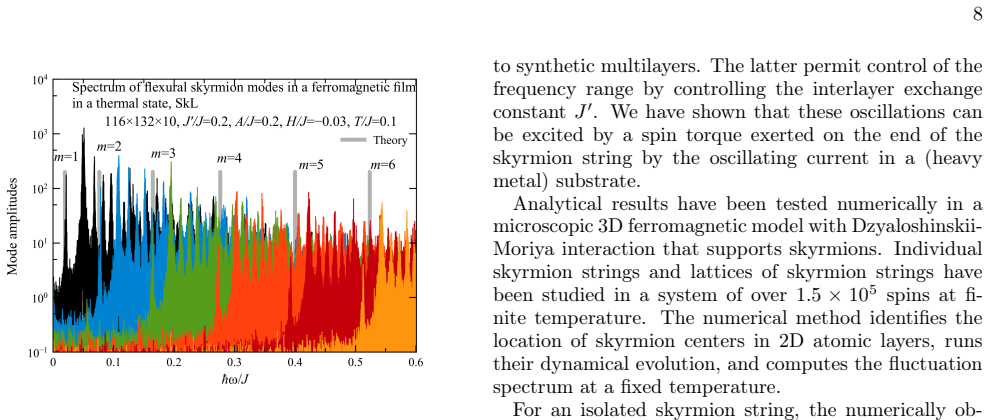
- At low temperature the analytic spectrum survives in a skyrmion-string lattice; at elevated temperature the low-lying modes remain identifiable while higher modes hybridize with lattice and spin-wave excitations.
- Undamped resonant driving makes the oscillation amplitude grow linearly in time and the pumped energy grow as $t^2$, which can destabilize the string unless dissipation limits the amplitude.
Reading between the lines
- An implication the paper leaves implicit is that any measured deviation from the $\sin^2$ ladder in a DMI-stabilized skyrmion directly measures the ratio $D/(4\pi|Q|)$, effectively turning the flexural spectrum into a probe of the skyrmion's internal profile.
- The same coupled-gyroscope chain should describe bending of other columnar magnetic textures, such as bubble strings, with the only input changing being the ratio $D/Q$ that sets the effective tension.
- One could extend the analysis to asymmetric multilayers with different spin densities in different layers; the derivation shows the effective circling frequency then depends on $1/G_1+1/G_2$, so the symmetric formula Eq. (22) would acquire a layer-dependent correction.
Editorial analysis
A structured set of objections, weighed in public.
Referee Report
Summary. The paper derives flexural oscillation modes of a skyrmion string spanning N ferromagnetic atomic layers. Starting from Thiele equations for skyrmion centers and a nearest-layer coupling energy, the authors obtain Eq. (21), a discrete spectrum Ω_m = -(4T/G0) sin²(πm/(2N)), and then specialize to Belavin-Polyakov (BP) skyrmions, for which the gradient energy D equals 4π|Q|, yielding the headline formula |ω_m| = (4J'S/ℏ) sin²(πm/(2N)) (Eq. (22)). They also derive driven oscillations, resonant growth, damping saturation, and spin-orbit-torque excitation. Numerical spin-lattice simulations for a DMI-stabilized skyrmion string and skyrmion-string lattices (N=10) are presented as support, with fluctuation spectra of excited displacements shown in Figs. 2-4, 6-7.
Significance. The analytical derivation is transparent and uses standard tools: Thiele dynamics, a harmonic interlayer tension, and diagonalization of the discrete Laplacian. No parameters are fitted to the predicted frequencies, and the spin-lattice simulations are an independent numerical test. The general result, Eq. (21), is a useful and testable dispersion relation for flexural modes of skyrmion strings. The BP special case, Eq. (22), is clean, parameter-free, and potentially important for experiments on synthetic multilayers. However, the paper's headline claim applies Eq. (22) to 'conventional ferromagnets possessing skyrmions' in the abstract and Section IV, which is not justified by the derivation unless the skyrmion profile is of BP type with D=4π|Q|. The numerical confirmation is also reported only qualitatively. With appropriate restriction of the claim and quantitative comparisons, the paper would be a solid contribution.
major comments (3)
- [Section IIB, Eqs. (21)-(22); Section IV; Abstract] Eq. (21) reads Ω_m = -4T/G0 sin²(πm/(2N)) = -(J'S D/(πℏ Q)) sin²(πm/(2N)) after inserting T=J'a²Dσ², G0=4πℏQσ, and σ=S/a². Eq. (22) follows only when D=4π|Q|, which, as stated after Eq. (5), holds for a pure-exchange Belavin-Polyakov skyrmion. DMI-stabilized skyrmions in a conventional ferromagnet have a different profile, so D generally differs from 4π|Q| and the frequencies are not universal. The abstract and Section IV therefore overstate the result: Eq. (22) should be presented as the BP-skyrmion special case, with Eq. (21) as the general expression, and the phrase 'rigorous analytical result ... applies to conventional ferromagnets possessing skyrmions' should be amended accordingly.
- [Section III, Eq. (55) and Figures 2-4, 6-7] The numerical verification is described only as 'good agreement'; the manuscript does not report the numerical peak frequencies, does not give the value of the uniaxial anisotropy D/J appearing in Eq. (55) (the main parameter set lists only J'/J, A/J, and H/J), and does not measure D of the relaxed skyrmion profile. Since the simulated skyrmion is DMI-stabilized and therefore not a BP skyrmion, agreement with Eq. (22) could instead be agreement with Eq. (21) for a D close to 4πQ. The authors should provide a table comparing computed peak positions with Eqs. (21) and (22) and report a numerical estimate of D for the relaxed skyrmion; without these data the confirmation claim is not quantitatively established.
- [Abstract and Section IV; Figures 6-7] The abstract states that the result is 'confirmed numerically for ... skyrmion-string lattices at finite temperature,' but Section IV states that at elevated temperature 'only the lowest flexural resonances remain clearly identifiable, while higher modes are obscured by hybridization with lattice and spin-wave excitations,' and Fig. 7 indeed shows additional peaks to the right of the theoretical positions. This is an inconsistency between the abstract's confirmation claim and the actual numerical evidence; the abstract should be qualified to state that at finite temperature only the low-m modes are confirmed for the lattice case.
minor comments (5)
- [Introduction] The sentence 'Bending of skyrmion strings under a thermal gradient has been observed by Ran et al. [30]' is duplicated.
- [Introduction vs. Abstract and Eq. (22)] The Introduction includes m=0 in the range m=0,1,...,N-1, while the abstract and Eq. (22) state m=1,...,N-1; since the m=0 mode is the zero-frequency rigid translation, the range should be stated consistently.
- [After Eq. (28)] The text 'k_m = mπ/ℏ' appears to be a typo; the continuous wave number for a film of thickness b should be k_m = mπ/b, and with a=b=1 this is mπ/N.
- [Eq. (58)] The skyrmion-locator formula is typeset in a way that obscures the intended ratio; it should read R = Σ_{s_{i,z}>0} r_i s_{i,z}^2 / Σ_{s_{i,z}>0} s_{i,z}^2.
- [Eq. (43)] The notation in Eq. (43) uses j both as the current-density vector and as a free index; the expression should be written with an explicit summation over the Cartesian index, e.g., I_{ij}[e_n × j(t)]_j.
Circularity Check
No significant circularity: the central mode spectrum is derived from Thiele dynamics and a discrete Laplacian, with the spin-lattice simulation serving as an independent numerical test.
full rationale
The derivation chain is self-contained. Section IIA defines the stiffness D by Eq. (5), obtains the interlayer energy U12 = (1/2)J'a^2 D sigma1 sigma2 d^2 (Eq. 4), and combines it with the Thiele equations and the gyrovector G0 = 4 pi hbar Q sigma to produce Eq. (11). Inserting the known Belavin-Polyakov identity D = 4 pi |Q| gives the two-layer frequency, Eq. (12). Section IIB extends this to N layers through the tension T = J'a^2 D sigma^2 (Eq. 14) and the standard discrete-Laplacian eigenfunctions (Eqs. 19-20), yielding the general expression Eq. (21) and, only when D = 4 pi Q, the quoted spectrum Eq. (22). No parameter is fitted to the predicted frequencies, and the numerical spin-lattice check is an independent computation from a DMI microscopic Hamiltonian that directly excites modes and reads off resonances; the theory and the simulation do not share fitted inputs. The self-citations, including Refs. [23, 24, 25, 31-33], provide numerical methodology, locator formulas, and earlier applications of the same formalism, but the central formula is derived in the text from standard Thiele and Laplace equations rather than imported as an unverified premise. The concern that Eq. (22) is stated as universal whereas it is proven for D = 4 pi Q is a domain-of-validity or correctness issue, not a circularity: the derivation explicitly displays the D-dependence in Eq. (21), so the conclusion is not assumed by the derivation. The paper therefore does not reduce to its inputs by construction.
Assumptions & free parameters
free parameters (5)
- Interlayer exchange ratio J'/J =
0.2
- DMI strength A/J =
0.2
- Zeeman field H/J =
-0.03
- Uniaxial anisotropy D/J in Eq. (55) =
not stated
- Temperature T/J for thermal runs =
0.1
assumptions (6)
- domain assumption Thiele equation for skyrmion center dynamics
- domain assumption Delta-function approximation for interlayer exchange
- standard math Small-displacement quadratic expansion of the interlayer energy
- ad hoc to paper Belavin-Polyakov skyrmion shape with D=4π|Q|
- domain assumption Equal spin densities in all layers
- domain assumption Free-end boundary conditions d0=dN=0
Cite this review
Pith. "Pith review of Oscillation modes of skyrmion strings in a ferromagnetic film." pith.science (2026). https://pith.science/paper/F2TCCJ6B
@misc{pith2026260810902,
  author       = {Pith},
  title        = {Pith review of: Oscillation modes of skyrmion strings in a ferromagnetic film},
  year         = {2026},
  howpublished = {\url{https://pith.science/paper/F2TCCJ6B}},
  note         = {Machine review of arXiv:2608.10902}
}
abstract
It is shown that a skyrmion string in a ferromagnetic film consisting of $N$ atomic layers exhibits flexural oscillations at eigenfrequencies $|\omega_{m}|=(4J'S/\hbar)\sin^{2}[\pi m/(2N)]$, where $J'$ is the interlayer exchange coupling, $S$ is the length of the atomic spin, and $m=1,...,N-1$. This result is confirmed numerically for individual skyrmion strings in a discrete microscopic spin-lattice model of up to ten atomic layers, as well as for skyrmion-string lattices at finite temperature.
Figures


Figures from the paper (3 more)


Reference graph
Works this paper leans on
-
[1]
A. N. Bogdanov and C. Panagopoulos, Physical founda- tions and basic properties of magnetic skyrmions, Nature Reviews Physics2, 492-498 (2020)
work page 2020
-
[2]
The same for a larger system with an SkL con- taining 12 skyrmion strings
In this case, the skyrmion size computed with the 7 Figure 3. The same for a larger system with an SkL con- taining 12 skyrmion strings. Computations performed on two different computers show peaks in accordance with the the- ory and with each other, as well as additional non-coinciding peaks that can be interpreted as noise. Figure 4. Spectrum of the fle...
- [3]
-
[4]
A. Bogdanov and A. Hubert, Thermodynamically stable magnetic vortex states in magnetic crystals, J. Magn. Magn. Mater.138, 255-269 (1994)
work page 1994
-
[5]
U. K. R¨oßler, N. Bogdanov, and C. Pfleiderer, Sponta- neousskyrmiongroundstatesinmagneticmetals, Nature 442, 797-801 (2006)
work page 2006
-
[6]
S.Heinze, K.vonBergmann, M.Menzel, J.Brede, A.Ku- betzka, R. Wiesendanger, G. Bihlmayer, and S. Blügel, Spontaneous atomic-scale magnetic skyrmion lattice in two dimensions, Nature Physics7, 713-718 (2011)
work page 2011
-
[7]
O. Boulle, J. Vogel, H. Yang, S. Pizzini, D. de Souza Chaves, A. Locatelli, T. O. Mentes, A. Sala, L. D. Buda- Prejbeanu, O. Klein, M. Belmeguenai, Y. Roussigné, A. Stahkevich, S. M. Chérif, L. Aballe, M. Foerster, M. Chshiev, S. Auffret, I. M. Miron, and G. Gaudin, Room- temperature chiral magnetic skyrmions in ultrathin mag- netic nanostructures, Nature...
work page 2016
-
[8]
A. O. Leonov, T. L. Monchesky, N. Romming, A. Kubet- zka, A. N. Bogdanov, and R. Wiesendanger, The prop- erties of isolated chiral skyrmions in thin magnetic films, New Journal of Physics18, 065003-(16) (2016)
work page 2016
Show all 45 references
-
[9]
A. O. Leonov and M. Mostovoy, Multiply periodic states and isolated skyrmions in an anisotropic frustrated mag- net, Nature Communications6, 8275-(8) (2015)
2015
-
[10]
Zhang, J
X. Zhang, J. Xia, Y. Zhou, X. Liu, H. Zhang, and M. Ezawa, Skyrmion dynamics in a frustrated ferromagnetic film and current-induced helicity locking-unlocking tran- sition, Nature Communications81717-(10) (2017)
2017
-
[11]
B. A. Ivanov, A. Y. Merkulov, V. A. Stepanovich, C. E. Zaspel, Finite energy solitons in highly anisotropic two dimensional ferromagnets, Physical Review B74, 224422-(17) (2006)
2006
-
[12]
Lin and S
S.-Z. Lin and S. Hayami, Ginzburg-Landau theory for skyrmions in inversion-symmetric magnets with com- peting interactions, Physical Review B93, 064430-(16) (2016)
2016
-
[13]
E. M. Chudnovsky and D. A. Garanin, Skyrmion glass in a 2D Heisenberg ferromagnet with quenched disorder, New Journal of Physics20033006-(9) (2018)
2018
-
[14]
Moutafis, S
C. Moutafis, S. Komineas, and J. A. C. Bland, Dynamics and switching processes for magnetic bubbles in nanoele- ments, Physical Review B79, 224429-(8) (2009)
2009
-
[15]
A. Fert, N. Reyren, and V. Cros, Magnetic skyrmions: advances in physics and potential applications. Nature Review Materials2, 17031-(17) (2017)
2017
-
[16]
Luo and L
S. Luo and L. You, Skyrmion devices for memory and logic applications, APL Materials9, 050901 (2021)
2021
-
[17]
Mochizuki, Spin-wave modes and their intense excita- tion effects in skyrmion crystals, Physical Review Letters 108, 017601-(5) (2012)
M. Mochizuki, Spin-wave modes and their intense excita- tion effects in skyrmion crystals, Physical Review Letters 108, 017601-(5) (2012)
2012
-
[18]
Y. Onose,Y. Okamura, S. Seki, S. Ishiwata, and Y. Tokura, Observation of magnetic excitations of skyrmion crystal in a helimagnetic insulator Cu2OSeO3, Physical Review Letters109, 037603-5 (2012)
2012
-
[19]
D. A. Garanin, R. Jaafar, and E. M. Chudnovsky, Breathing mode of a skyrmion on a lattice, Physical Re- view B101, 014418 (2020)
2020
-
[20]
Aqeel, J
A. Aqeel, J. Sahliger, T. Taniguchi, S. Mändl, D. Mettus, H. Berger, A. Bauer, M. Garst, C. Pfleiderer, and C. H. Back, Microwave Spectroscopy of the Low-Temperature Skyrmion State in Cu2OSeO3, Physical Review Letters 126, 017202-(7) (2021)
2021
-
[21]
Satywali, V
B. Satywali, V. P. Kravchuk, L. Pan, M. Raju, S. He, F. Ma, A. P. Petrović, M. Garst, and C. Panagopoulos, Nature Communications12, 1909-(8) (2021)
2021
-
[22]
O. Lee, J. Sahliger, A. Aqeel , S. Khan, S. Seki, H. Kure- bayashi, and C. H. Back, Tunable gigahertz dynamics of low-temperature skyrmion lattice in a chiral magnet, Journal of Physics: Condensed Matter34, 095801-(10) (2022)
2022
-
[23]
Journal of Physics: Condensed Matter35, 105801-(7) (2023)
Y.Li, X.Wang, andL.Ma, Instabilityofskyrmionlattice under microwave magnetic field due to single-q helimag- netic excitation mode. Journal of Physics: Condensed Matter35, 105801-(7) (2023)
2023
-
[24]
D. A. Garanin and E. M. Chudnovsky, Skyrmion crystal in a microwave field, Physical Review B112, 024422-(13) (2025)
2025
-
[25]
E. M. Chudnovsky and D. A. Garanin, Skyrmion cy- clotron resonance in ferromagnets, Physical Review B 113, 224414-(8) (2026)
2026
-
[26]
D. A. Garanin and E. M. Chudnovsky, Massive dynam- ics of skyrmions in ferrimagnetic films, Journal of Mag- netism and Magnetic Materials654, 174226-(13) (2026)
2026
-
[27]
Yokouchi, S
T. Yokouchi, S. Hoshino, N. Kanasawa, A. Kikkawa, D. Morikawa, K. Shibata, T.-h. Arima, Y. Taguchi, F. Ka- gawa, N. Nagaosa, and Y. Tokura, Current-induced dy- namics of skyrmion strings, Science Advances4, 1115-(7) (2018)
2018
-
[28]
S. Seki, M. Garst, J. Waizner, R. Takagi, N. D. Khanh, Y. Okamura, K. Kondou, F. Kagawa, Y. Otani, and Y. Tokura, Propagation dynamics of spin excitations along skyrmion strings, Nature Communications11, 256-(7) (2020)
2020
-
[29]
S. Seki, M. Suzuki, M. Ishibashi, R. Takagi, N. D. Khanh, Y. Shiota, K. Shibata, W. Koshibae, Y. Tokura, and T. Ono, Direct visualization of the three-dimensional shape ofskyrmionstringsinanoncentrosymmetricmagnet, Na- ture Materials21, 181-187 (2022)
2022
-
[30]
V. P. Kravchuk, Nonlinear dynamics of skyrmion strings, Physical Review B108, 144412-(18) (2023)
2023
-
[31]
K. Ran, W. Tan, X. Sun, Y. Liu, R. M. Dalgllesh, N.-J. Steinke, G. van der Laan, S. Langridge, T. Hes- jedal, andS.Zhang, Bendingskyrmionstringsundertwo- dimensional thermal gradients, Nature Communications 15, 4860-8 (2024)
2024
-
[32]
Panigrahy, S
S. Panigrahy, S. Mallick, J. Sampaio, and S. Rohart, Skyrmion inertia in synthetic antiferromagnets, Physical Review B106, 144405-(8) (2022)
2022
-
[33]
Weißenhofer and U
M. Weißenhofer and U. Nowak, Temperature dependence of current-driven and Brownian skyrmion dynamics in ferrimagnets with compensation point, Physical Review B107, 0644423-(9) (2023)
2023
-
[34]
M. Lau, W. Häusler, and M. Thorwart, Moving skyrmions in antiferromagnets by sublattice displace- ments, Physical Review B111, 144411-(10) (2025)
2025
-
[35]
A. A. Belavin and A. M. Polyakov, Metastable states of two-dimensional isotropic ferromagnets, Pis’ma Zh. Eksp. Teor. Fiz.22, 503-5-6 (1975) [JETP Letters22, 245-248 (1975)]
1975
-
[36]
A. A. Thiele, Steady-state motion of magnetic domains, Physical Review Letters30, 230-233 (1973)
1973
-
[37]
Strang, The discrete cosine transform, SIAM Review 41, 135-147 (1999)
G. Strang, The discrete cosine transform, SIAM Review 41, 135-147 (1999)
1999
-
[38]
Göbel and I Mertig, Skyrmion ratchet propagation: utilizing the skyrmion Hall effect in AC racetrack storage devices, Nature Scientific Reports11, 3020-((11) (2021)
B. Göbel and I Mertig, Skyrmion ratchet propagation: utilizing the skyrmion Hall effect in AC racetrack storage devices, Nature Scientific Reports11, 3020-((11) (2021)
2021
-
[39]
S. Yang, Y. Zhao, K. Wu, Z. Chu, X. Xu, X. Li, J. Akerman, and Y. Zhou, Reversible conversion between skyrmions and skyrmioniums, Nature Communications 14, 3406-(8) (2023)
2023
-
[40]
D. A. Garanin, Energy minima and ordering in ferromag- nets with static randomness, Journal of Physics: Con- densed Matter,37, 385803 (2025)
2025
-
[41]
D. A. Garanin and E. M. Chudnovsky, Solid–liquid tran- sition in a skyrmion matter, Journal of Magnetism and Magnetic Materials,606, 172395 (2024)
2024
-
[42]
Kachkachi and D
H. Kachkachi and D. A. Garanin, Boundary and finite- size effects in small magnetic systems, Physics A,300, 487 (2001)
2001
-
[43]
Liufei Cai, E. M. Chudnovsky, and D. A. Garanin, Col- lapse of skyrmions in two-dimensional ferromagnets and antiferromagnets, Physical Review B86, 024429 (2012)
2012
-
[44]
Eriksson, On the Measure of Solid Angles, Mathemat- ics Magazine,63, 184-18 (1990)
F. Eriksson, On the Measure of Solid Angles, Mathemat- ics Magazine,63, 184-18 (1990). 10
1990
-
[45]
D. A. Garanin, Energy balance and energy correction in dynamics of classical spin systems, Physical Review E, 104, 055306 (2021)
2021
Reviewed August 12, 2026 · model on record in the stance chip above.
Discussion (0). Continue with ORCID to comment.