REVIEW 3 major objections 6 minor 52 references
Steady-state phase transition in one-dimensional hybrid contact process
T0 review · 3 major / 6 minor · reviewed 2026-08-12 · deepseek-v4-flash
Pith's one-line read The one-dimensional hybrid contact process shows a continuous absorbing-to-active transition whose critical exponent, estimated at about 0.79, lies outside the directed percolation universality class.
desk verdict A well-executed but numerically fragile study of a new hybrid contact process; the claimed new universality class is plausible but not established with the current cluster sizes. read the letter →
The pith
A machine-rendered reading of the paper's core claim, the machinery that carries it, and where it could break.
The reading
What carries the argument
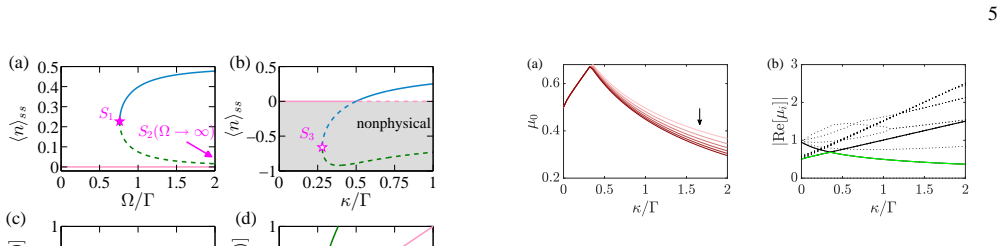
The central object is the Lindblad master equation for a spin-1/2 chain, with a coherent Hamiltonian $\hat H = \Omega \sum_j (\hat\sigma^x_j \hat n_{j+1} + \hat n_j \hat\sigma^x_{j+1})$, correlated incoherent jump operators at rate $\kappa$, and local decay at rate $\Gamma$. The load-bearing analysis is the coherent anomaly method (CAM): cluster mean-field (CMF) solutions of increasing size $L$ give pseudo-critical points $\kappa_c(L)$ and order-parameter amplitudes $n_0(L)$, and CAM assumes $n_0(L) \sim C_0 [(\kappa^* - \kappa_c(L))/\kappa^*]^{-(\beta^* - \beta_{\rm mf})}$ with $\beta_{\rm mf}=1$, then fits this relation to extract the true $\kappa^*$ and $\beta^*$. The CMF self-consistent effective-field condition captures both stable and unstable steady states, and the Liouvillian spectrum is used to characterize the relaxation dynamics.
What would settle it
Run a direct steady-state simulation of the one-dimensional hybrid contact process at $\Omega/\Gamma = 0.1$ and fit the order parameter against $\kappa$ near $\kappa^* \approx 0.9884\,\Gamma$; if the measured exponent is the directed percolation value $\beta \approx 0.276$ rather than about $0.79$, the coherent anomaly extrapolation is wrong. Equivalently, compute cluster mean-field results for $L = 12, 14, 16$ and check whether the CAM estimates of $\beta^*$ remain stable near $0.79$.
Extended reading notes
Core claim
On its own terms, the paper establishes that the steady state of the one-dimensional hybrid contact process has three regimes: an absorbing phase, an active phase, and a bistable region. The boundary between the absorbing phase and the bistable region is a saddle-node bifurcation, so that transition is discontinuous, while the absorbing-to-active boundary is continuous. Combining cluster mean-field results for cluster sizes $L=5$ through $10$ with the coherent anomaly ansatz, the paper estimates the true critical points $\kappa^*/\Gamma = 0.9884$ and $0.9862$ for $\Omega/\Gamma = 0.1$ and $0.4$, respectively, and the true order-parameter exponents $\beta^* = 0.7962$ and $0.7865$. Since those exponents are very close to each other and clearly differ from both the classical mean-field value $1$ and the one-dimensional directed percolation value, the paper concludes that the continuous transition likely defines its own universal critical behavior, while noting that larger clusters are needed for a more precise exponent.
Load-bearing premise
The extraction of $\beta^*$ assumes the coherent anomaly scaling relation (Eq. 23) and the exponential finite-size form for $\kappa_c(L)$ correctly describe how the cluster mean-field results approach the true transition, and the fits use only five or six cluster sizes from $L=5$ to $10$, so the reported exponents inherit that assumption's validity.
Editorial extensions
If this is right
- For small coherent coupling, sweeping the incoherent rate $\kappa$ at fixed $\Omega$ crosses a continuous absorbing-to-active transition, while sweeping $\Omega$ at fixed $\kappa$ crosses a discontinuous absorbing-to-bistable boundary.
- The two estimated exponents, $\beta^* = 0.7962$ and $0.7865$, are close enough that the continuous transition appears to belong to a single universality class across coherent coupling strengths.
- That universality class is not directed percolation: the extracted $\beta^*$ differs from the one-dimensional DP value and from the classical mean-field value $1$.
- The CAM critical points agree with the direct exponential finite-size extrapolation of the cluster mean-field critical points, giving consistent locations for the transition.
Reading between the lines
- A decisive test would be a direct large-system simulation of the steady-state density (quantum-jump Monte Carlo or tensor network) at $\Omega/\Gamma = 0.1$; if the measured exponent returns to the directed percolation value rather than staying near $0.79$, the coherent anomaly extrapolation is the source of the apparent new class.
- If the exponent stays near $0.79$ as $\Omega/\Gamma \to 0$, the universality change would persist in the weak-coherence limit; if it instead approaches the DP value, coherence must exceed a threshold to alter the class.
- The absence of metastability and the nonmonotonic Liouvillian gap suggest the continuous transition is genuinely second-order, making the HCP a clean testbed for coherent anomaly extrapolations in open quantum systems.
Editorial analysis
A structured set of objections, weighed in public.
Referee Report
Summary. The paper studies the one-dimensional hybrid contact process (HCP), where coherent (Ω) and incoherent (κ) coagulation and branching coexist with local decay (Γ). It derives single-site mean-field (MF) Bloch equations, identifies stable absorbing, active, and bistable steady states, and shows that the absorbing-to-active transition along κ is continuous while the absorbing-to-bistable transition can be discontinuous via a saddle-node bifurcation. Finite-size Liouvillian spectra show a decreasing gap and a nonmonotonic κ dependence. The authors then use cluster mean-field (CMF) theory with self-consistent effective fields to compute critical points κ_c(L) for cluster sizes L=5–10, and the coherent anomaly method (CAM) to extract thermodynamic-limit critical points κ*/Γ≈0.988 and exponents β*≈0.7962 and 0.7865 for Ω/Γ=0.1 and 0.4. The paper concludes that the continuous transition is non-DP and likely defines a new universality class.
Significance. The strength of the paper is the transparent MF and CMF construction: the Bloch equations, stability analysis, phase diagram, Liouvillian spectrum, and self-consistent effective-field CMF are all clearly laid out and internally consistent. If the CAM result β*≈0.79 were established, it would be a significant finding because it would place the HCP continuous absorbing transition outside the directed-percolation universality class, with implications for how quantum coherence modifies absorbing-state criticality. However, the central exponent claim is not yet supported at the required level: it relies on five or six CMF cluster sizes, an ad hoc exponential-size scaling, no uncertainty quantification, and no independent check. The paper's own caveat that larger clusters are needed is appropriate, but it is in tension with the abstract and conclusion presenting β*≈0.79 as the main quantitative result.
major comments (3)
- [Section VI, Eq. (23), Fig. 6] The central claim that β*≈0.79 defines a new universality class rests entirely on a three-parameter fit of n0(L) to Eq. (23) using only L=5,...,10 (and L=6,...,10 for Ω/Γ=0.4). No residuals, confidence intervals, or χ² values are reported, and the fit is not tested for stability under removal of the smallest or largest L. With this number of points, the extracted β* is statistically indistinguishable from a wide range of values, and the statement 'the true critical exponents are estimated' overstates what the data can support. The authors themselves note that larger clusters are required; the abstract and conclusion should reflect this limitation, or the fits should be augmented with error bars and a convergence test.
- [Section V, Fig. 5(c)] The exponential finite-size scaling κ_c(L)/Γ = κ_c/Γ − A exp(−bL) is assumed with no derivation or empirical justification. If the convergence is actually power-law, or if there is an even-odd size effect as the authors report for the QCP, the extrapolated κ_c will be biased. Since β* in Eq. (23) is very sensitive to the value of κ*, a small bias in κ_c can produce a large shift in β*. The agreement between the direct extrapolation and the CAM critical point is not an independent confirmation because both analyses use the same CMF data and related assumptions.
- [Section VI, Eq. (22)] The analysis assumes that the CMF order parameter has the classical exponent β_mf=1 and that the coherent anomaly scaling form Eq. (23), taken from previous work, applies to this model. The paper gives no evidence that L=5–10 is in the asymptotic regime for either the CMF critical points or the amplitude n0(L). This is a load-bearing assumption: if Eq. (23) is not the correct scaling form for the HCP, the extracted β* is not the true critical exponent. The authors should either provide a numerical check of the scaling collapse or present the CAM result as a preliminary estimate only.
minor comments (6)
- [Section II] The word 'self-desctruction' should be 'self-destruction'.
- [Section IV] The text contains 'Lioullian' in several places; this should be 'Liouvillian'.
- [Section III D] The phrase 'lower brach' should be 'lower branch'.
- [Eq. (7)] The notation 2Ω⟨σx⟩⟨σx⟩ in the second Bloch equation is confusing; please write 2Ω(⟨σx⟩)^2.
- [Fig. 5(c)] The x-axis is labeled 1/L, but the exponential fit is performed in L; please clarify in the caption that the extrapolation to 1/L=0 is made after fitting κ_c(L) as a function of L.
- [Section VI] The fit parameters A, b, C0 and the values of n0(L) and κ_c(L) should be provided in a table or in supplementary material so that the CAM extrapolation can be reproduced and assessed.
Circularity Check
No significant circularity: the CAM-based exponents are fit outputs of an established extrapolation method, not predictions that reduce to the input data.
full rationale
The central claim, beta* about 0.79 for the absorbing-to-active transition, comes from fitting the paper's own cluster mean-field data to the standard coherent anomaly scaling form, Eqs. (22)-(23). This is a fit and extrapolation procedure, not a derivation in which a target quantity is defined in terms of the claimed result. No equation in the paper reduces one predicted quantity to another by construction, and no fitted parameter is renamed as an independent prediction. The CAM scaling form is imported from the established coherent anomaly literature and the authors' earlier generalization [48]; this is a normal citation of a published method whose assumptions do not include the HCP critical exponents, so the self-citation is not load-bearing in a circular sense. The agreement between the CAM critical points and the direct 1/L extrapolation of kappa_c(L) uses the same underlying CMF data, so it is not an independent confirmation, but the two fits use different quantities and functional forms, so the agreement is not forced by construction. The acknowledged limitations (only L=5 to 10, no confidence intervals, an assumed exponential finite-size form, and the stated need for larger clusters) are reliability issues for the extrapolation, not circularity. Therefore no circular step is identified.
Assumptions & free parameters
free parameters (4)
- Exponential fit parameters A and b =
Not reported numerically
- CAM critical point κ* =
0.9884 (Ω/Γ=0.1), 0.9862 (Ω/Γ=0.4)
- CAM exponent β* =
0.7962 (Ω/Γ=0.1), 0.7865 (Ω/Γ=0.4)
- CAM coefficient C0 =
Not reported
assumptions (6)
- domain assumption The system is Markovian and described by the Lindblad master equation (1).
- domain assumption The thermodynamic limit is taken as lim t→∞ lim L→∞, and the two limits do not commute.
- domain assumption The density matrix factorizes into product states (Gutzwiller ansatz) for MF and into identical clusters for CMF.
- domain assumption In the CMF effective-field parameterization, only the density field F_n is retained; solutions with nonzero ⟨σ_x⟩ are discarded as nonphysical.
- standard math The coherent anomaly scaling forms, Eqs. (22) and (23), hold for this model.
- ad hoc to paper The CMF critical points follow an exponential finite-size scaling κ_c(L)/Γ = κ_c/Γ - A exp(-bL).
Cite this review
Pith. "Pith review of Steady-state phase transition in one-dimensional hybrid contact process." pith.science (2026). https://pith.science/paper/BUL6A3VN
@misc{pith2026260810948,
  author       = {Pith},
  title        = {Pith review of: Steady-state phase transition in one-dimensional hybrid contact process},
  year         = {2026},
  howpublished = {\url{https://pith.science/paper/BUL6A3VN}},
  note         = {Machine review of arXiv:2608.10948}
}
read the original abstract
We investigate the steady-state phase transition in a one-dimensional hybrid contact process. We implement the single-site and cluster mean-field approximations based on the effective fields and present all the possible steady states of the system. We show the existence of the stable absorbing and active phases, and the bistable region in the long-time limit. The saddle-node bifurcation is observed at the boundary between the absorbing phase and the bistable region, suggesting a discontinuous phase transition. While the absorbing to active phase transition is continuous. To characterize the nonclassical scaling behavior of the continuous phase transition, we extract the true critical points and exponents by means of the coherent anomaly method.
Figures


Figures from the paper (2 more)


Reference graph
Works this paper leans on
-
[1]
Carusotto and C
I. Carusotto and C. Ciuti, Quantum fluids of light, Rev. Mod. Phys.85, 299 (2013)
2013
- [2]
-
[3]
A. J. Daley, Quantum trajectories and open many-body quan- tum systems, Adv. Phys.63, 77 (2014)
work page 2014
-
[4]
H.-P. Breuer and F. Petruccione,The Theory of Open Quantum Systems(2007)
work page 2007
-
[5]
Rivas, Strong coupling thermodynamics of open quantum systems, Phys
A. Rivas, Strong coupling thermodynamics of open quantum systems, Phys. Rev. Lett.124, 160601 (2020)
2020
-
[6]
A. L. Boit ´e, G. Orso, and C. Ciuti, Steady-state phases and tunneling-induced instabilities in the driven dissipative bose- hubbard model, Phys. Rev. Lett.110, 233601 (2013)
work page 2013
-
[7]
T. E. Lee, H. H ¨affner, and M. C. Cross, Antiferromagnetic phase transition in a nonequilibrium lattice of Rydberg atoms, Phys. Rev. A84, 031402 (2011)
work page 2011
-
[8]
Fitzpatrick, N
M. Fitzpatrick, N. M. Sundaresan, A. C. Y . Li, J. Koch, and A. A. Houck, Observation of a dissipative phase transition in a one-dimensional circuit qed lattice, Phys. Rev. X7, 011016 (2017)
2017
Show all 52 references
-
[9]
M. C. Collodo, A. Poto ˇcnik, S. Gasparinetti, J.-C. Besse, M. Pechal, M. Sameti, M. J. Hartmann, A. Wallraff, and C. Eichler, Observation of the crossover from photon ordering to delocalization in tunably coupled resonators, Phys. Rev. Lett. 122, 183601 (2019)
2019
-
[10]
L. M. Sieberer, M. Buchhold, J. Marino, and S. Diehl, Uni- versality in driven open quantum matter, Rev. Mod. Phys.97, 025004 (2025)
2025
-
[11]
Baumann, R
K. Baumann, R. Mottl, F. Brennecke, and T. Esslinger, Explor- ing symmetry breaking at the dicke quantum phase transition, Phys. Rev. Lett.107, 140402 (2011)
2011
-
[12]
Baumann, C
K. Baumann, C. Guerlin, F. Brennecke, and T. Esslinger, Dicke quantum phase transition with a superfluid gas in an optical cav- ity, Nature464, 1301 (2010)
2010
-
[13]
Bloch, J
I. Bloch, J. Dalibard, and S. Nascimbene, Quantum simulations with ultracold quantum gases, Nat. Phys.8, 267 (2012)
2012
-
[14]
Gross and I
C. Gross and I. Bloch, Quantum simulations with ultracold atoms in optical lattices, Science357, 995 (2017)
2017
-
[15]
Browaeys and T
A. Browaeys and T. Lahaye, Many-body physics with individ- ually controlled rydberg atoms, Nat. Phys.16, 132 (2020)
2020
-
[16]
Bernien, S
H. Bernien, S. Schwartz, A. Keesling, H. Levine, A. Omran, H. Pichler, S. Choi, A. S. Zibrov, M. Endres, M. Greiner, V . Vuleti´c, and M. D. Lukin, Probing many-body dynamics on a 51-atom quantum simulator, Nature551, 579 (2017)
2017
-
[17]
Zhang, G
J. Zhang, G. Pagano, P. W. Hess, A. Kyprianidis, P. Becker, H. Kaplan, A. V . Gorshkov, Z.-X. Gong, and C. Monroe, Ob- servation of a many-body dynamical phase transition with a 53- qubit quantum simulator, Nature551, 601 (2017)
2017
-
[18]
T. E. Harris, Contact interactions on a lattice, Ann. Probab.2, 969 (1974)
1974
-
[19]
T. M. Liggett,Interacting Particle Systems, Grundlehren der mathematischen Wissenschaften, V ol. 276 (Springer, New York, 1985)
1985
-
[20]
Mollison, Spatial contact models for ecological and epi- 9 demic spread, J
D. Mollison, Spatial contact models for ecological and epi- 9 demic spread, J. R. Statist. Soc. B39, 283 (1977)
1977
-
[21]
Grassberger, On the critical behavior of the general epi- demic process and dynamical percolation, Math
P. Grassberger, On the critical behavior of the general epi- demic process and dynamical percolation, Math. Biosci.63, 157 (1983)
1983
-
[22]
Marro and R
J. Marro and R. Dickman,Nonequilibrium Phase Transitions in Lattice Models(Cambridge University Press, Cambridge, 1999)
1999
-
[23]
Grassberger and K
P. Grassberger and K. Sundermeyer, Reggeon field theory and markov processes, Phys. Lett. B77, 220 (1978)
1978
-
[24]
H. K. Janssen, On the nonequilibrium phase transition in reaction-diffusion systems with an absorbing stationary state, Z. Phys. B42, 151 (1981)
1981
-
[25]
Grassberger, On phase transitions in Schl¨ogl’s second model, Z
P. Grassberger, On phase transitions in Schl¨ogl’s second model, Z. Phys. B47, 365 (1982)
1982
-
[26]
Hinrichsen, Non-equilibrium critical phenomena and phase transitions into absorbing states, Adv
H. Hinrichsen, Non-equilibrium critical phenomena and phase transitions into absorbing states, Adv. Phys.49, 815 (2000)
2000
-
[27]
´Odor, Universality classes in nonequilibrium lattice systems, Rev
G. ´Odor, Universality classes in nonequilibrium lattice systems, Rev. Mod. Phys.76, 663 (2004)
2004
-
[28]
Henkel, H
M. Henkel, H. Hinrichsen, and S. L ¨ubeck,Non-Equilibrium Phase Transitions, V olume 1: Absorbing Phase Transitions (Springer, Dordrecht, 2008)
2008
-
[29]
J.-T. Kuhr, M. Leisner, and E. Frey, Range expansion with mutation and selection: Dynamical phase transition in a two- species Eden model, New J. Phys.13, 113013 (2011)
2011
-
[30]
Durrett and S
R. Durrett and S. Levin, The importance of being discrete (and spatial), Theor. Popul. Biol.46, 363 (1994)
1994
-
[31]
Castellano, S
C. Castellano, S. Fortunato, and V . Loreto, Statistical physics of social dynamics, Rev. Mod. Phys.81, 591 (2009)
2009
-
[32]
Marcuzzi, M
M. Marcuzzi, M. Buchhold, S. Diehl, and I. Lesanovsky, Ab- sorbing state phase transition with competing quantum and classical fluctuations, Phys. Rev. Lett.116, 245701 (2016)
2016
-
[33]
Buchhold, B
M. Buchhold, B. Everest, M. Marcuzzi, I. Lesanovsky, and S. Diehl, Nonequilibrium effective field theory for absorbing state phase transitions in driven open quantum spin systems, Phys. Rev. B95, 014308 (2017)
2017
-
[34]
Roscher, S
D. Roscher, S. Diehl, and M. Buchhold, Phenomenology of first-order dark-state phase transitions, Phys. Rev. A98, 062117 (2018)
2018
-
[35]
Carollo, E
F. Carollo, E. Gillman, H. Weimer, and I. Lesanovsky, Critical Behavior of the Quantum Contact Process in One Dimension, Phys. Rev. Lett.123, 100604 (2019)
2019
-
[36]
Gillman, F
E. Gillman, F. Carollo, and I. Lesanovsky, Numerical simu- lation of critical dissipative non-equilibrium quantum systems with an absorbing state, New J. Phys.21, 093064 (2019)
2019
-
[37]
Gillman, F
E. Gillman, F. Carollo, and I. Lesanovsky, Nonequilibrium phase transitions in (1+1)-dimensional quantum cellular au- tomata with controllable quantum correlations, Phys. Rev. Lett. 125, 100403 (2020)
2020
-
[38]
M. Jo, J. Lee, K. Choi, and B. Kahng, Absorbing phase transi- tion with a continuously varying exponent in a quantum contact process: A neural network approach, Phys. Rev. Res.3, 013238 (2021)
2021
-
[39]
Shang, S
L. Shang, S. Geng, X. Li, and J. Jin, Steady-state phase tran- sition in one-dimensional quantum contact process, Phys. Rev. Lett.136, 050402 (2026)
2026
-
[40]
P ´erez-Espigares, M
C. P ´erez-Espigares, M. Marcuzzi, R. Guti ´errez, and I. Lesanovsky, Epidemic dynamics in open quantum spin systems, Phys. Rev. Lett.119, 140401 (2017)
2017
-
[41]
J. Jin, A. Biella, O. Viyuela, L. Mazza, J. Keeling, R. Fazio, and D. Rossini, Cluster mean-field approach to the steady-state phase diagram of dissipative spin systems, Phys. Rev. X6, 031011 (2016)
2016
-
[42]
Minganti, A
F. Minganti, A. Biella, N. Bartolo, and C. Ciuti, Spectral theory of liouvillians for dissipative phase transitions, Phys. Rev. A98, 042118 (2018)
2018
-
[43]
Mori and T
T. Mori and T. Shirai, Resolving a discrepancy between liou- villian gap and relaxation time in boundary-dissipated quantum many-body systems, Phys. Rev. Lett.125, 230604 (2020)
2020
-
[44]
Shirai and T
T. Shirai and T. Mori, Symmetrized liouvillian gap in marko- vian open quantum systems, Phys. Rev. Lett.130, 230404 (2023)
2023
-
[45]
Suzuki, Statistical mechanical theory of cooperative phe- nomena
M. Suzuki, Statistical mechanical theory of cooperative phe- nomena. i. general theory of fluctuations, coherent anomalies and scaling exponents with simple applications to critical phe- nomena, J. Phys. Soc. Jpn.55, 4205 (1986)
1986
-
[46]
Suzuki, M
M. Suzuki, M. Katori, and X. Hu, Coherent anomaly method in critical phenomena. i. mean-field singularities and critical ex- ponents, J. Phys. Soc. Jpn.56, 3092 (1987)
1987
-
[47]
Park and H
S.-C. Park and H. Park, Cluster mean-field approximations with the coherent-anomaly-method analysis for the driven pair con- tact process with diffusion, Phys. Rev. E71, 016137 (2005)
2005
-
[48]
Jin, W.-B
J. Jin, W.-B. He, F. Iemini, D. Ferreira, Y .-D. Wang, S. Chesi, and R. Fazio, Determination of the critical exponents in dissipa- tive phase transitions: Coherent anomaly approach, Phys. Rev. B104, 214301 (2021)
2021
-
[49]
J. Jin, D. Rossini, R. Fazio, M. Leib, and M. J. Hartmann, Pho- ton solid phases in driven arrays of nonlinearly coupled cavities, Phys. Rev. Lett.110, 163605 (2013)
2013
-
[50]
J. Jin, A. Biella, O. Viyuela, C. Ciuti, R. Fazio, and D. Rossini, Phase diagram of the dissipative quantum Ising model on a square lattice, Phys. Rev. B98, 241108 (2018)
2018
-
[51]
Xie, Z.-Y
X.-D. Xie, Z.-Y . Xue, and D.-B. Zhang, Variational quantum algorithm for solving the liouvillian gap, Chin. Phys. Lett.42, 080605 (2025)
2025
-
[52]
Fazio, J
R. Fazio, J. Keeling, L. Mazza, and M. Schir`o, Many-body open quantum systems, SciPost Phys. Lect. Notes , 99 (2025)
2025
Reviewed August 12, 2026 · model on record in the stance chip above.
Discussion (0). Continue with ORCID to comment.