REVIEW 3 major objections 5 minor 67 references
Discriminating superconducting fluctuations from the pseudogap in Bi$_2$Sr$_2$Ca$_{n-1}$Cu$_n$O$_{2n+4+\delta} (n = 2,3)$: A magnetotransport study
T0 review · 3 major / 5 minor · reviewed 2026-08-15 · deepseek-v4-flash
Pith's one-line read The paper claims that in Bi-2212 and Bi-2223 single crystals the pseudogap onset temperature is clearly distinct from and well above the superconducting fluctuation onset, ruling out a superconducting-fluctuation origin for the strong…
desk verdict A genuinely useful wide-doping transport dataset that probably shows the pseudogap and superconducting fluctuations are distinct, but Tscf needs stronger justification before the conclusion is sold as unambiguous. read the letter →
The pith
A machine-rendered reading of the paper's core claim, the machinery that carries it, and where it could break.
The reading
What carries the argument
The central object is the modified Kohler's rule MR ∝ $tan^{2}$θH (= $ξ_AF^{4}$ $B^{2}$/$ρ_ab^{2}$), derived in the current-vertex-correction (CVC) theory of strongly antiferromagnetically fluctuating Fermi liquids. Because MR is independent of the antiferromagnetic correlation length ξ_AF within this framework, the scaling curve supplies a fixed baseline: as long as data fall on a single MR-vs-$tan^{2}$θH curve, superconducting fluctuations are absent; the temperature where the curve breaks identifies Tscf. The Hall-angle identity cotθH ∝ $T^{2}$ plays the supporting role of showing that the strange-metal transport laws persist across the pseudogap, so the pseudogap does not disrupt the single-scattering-rate phenomenology.
What would settle it
A direct test would be to measure the in-plane magnetoresistance in pulsed fields high enough to reach the upper critical field Bc2 just above Tc; if the slope MR/$tan^{2}$θH saturates to the high-temperature line at temperatures still far below T**, the separate onset is confirmed, whereas if the deviation persists even when superconducting fluctuations are fully suppressed, the interpretation fails. Alternatively, observing a field-induced change in the antiferromagnetic correlation length ξ_AF inside the pseudogap that produces a similar MR deviation would eliminate the uniqueness of the superconducting-fluctuation explanation.
Extended reading notes
Core claim
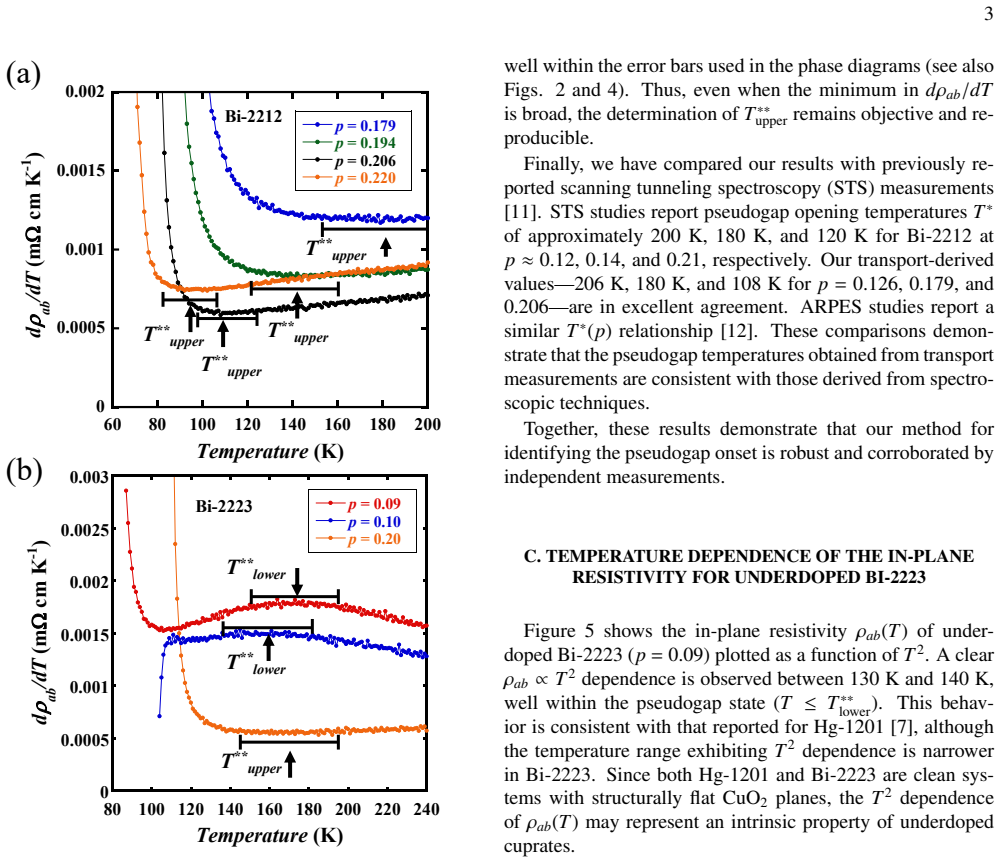
The central discovery is that the pseudogap and superconducting fluctuations are separate temperature scales in Bi-based cuprates. Using the slope of MR versus $tan^{2}$θH to define Tscf (the point where the slope rises 10% above its high-temperature value), and a 1% deviation of ρab from linear-T (or the minimum of dρab/dT) to define T**, the authors construct doping-dependent phase diagrams for Bi-2212 and Bi-2223 in which T** sits distinctly above Tscf at every doping. They also show that cotθH ∝ $T^{2}$ and MR ∝ $tan^{2}$θH hold across T**, while below Tscf an extra magnetoresistance contribution emerges that they attribute to the Aslamazov-Larkin superconducting fluctuation term. The pairing gap Δ0 from ARPES scales with T** with 2Δ0/kBT** ≈ 5.0, close to the d-wave mean-field value 2Δ0/kBTc ≈ 4.3, which they read as evidence that T** marks pair formation while Tc marks phase coherence.
Load-bearing premise
The whole separation rests on the claim that the low-temperature rise of MR/$tan^{2}$θH is caused by superconducting fluctuations; if that deviation instead comes from a field-sensitive change in the magnetic correlations or from a breakdown of the current-vertex-correction baseline, the distinction between T** and Tscf loses its meaning.
Editorial extensions
If this is right
- T** and Tscf are separate lines in the phase diagrams of Bi-2212 and Bi-2223, so any theory that derives the strong pseudogap directly from Gaussian superconducting fluctuations above Tc cannot account for these data.
- Because MR/tan^2θH stays constant across T**, the CVC strange-metal description remains valid inside the pseudogap region, meaning the pseudogap does not destroy the spin-fluctuation scattering picture.
- The ratio 2Δ0/kBT** ≈ 5.0, matching the d-wave mean-field gap ratio, implies that T** is a pairing temperature rather than an ordering temperature of a competing phase.
- The pseudogap region likely represents preformed Cooper pairs that condense at Tc, i.e., BCS-BEC crossover behavior, with pair formation and phase coherence as separate energy scales.
- The Fermi-liquid-like behavior seen in Hg-1201 (ρab∝T^2, conventional Kohler's rule) is the same strange-metal phenomenology observed locally in underdoped Bi-2223 when ξ_AF is nearly temperature-independent, unifying seemingly different normal-state behaviors.
Reading between the lines
- If T** is a pairing temperature and superconductivity in these systems is BCS-BEC crossover-like, then other probes that couple to pairing amplitude (Nernst effect, diamagnetism, THz conductivity) should see fluctuation signals at T** rather than at Tscf, a testable extension.
- The distinction may reconcile the Hg-1201 result (conventional Kohler, Fermi liquid) with the Bi-based results: the presence of a structurally flat inner CuO2 plane makes the antiferromagnetic correlation length nearly temperature-independent, so both phenomenologies come from the same CVC framework rather than from different physics.
- Extending this analysis to single-layer Bi-2201 and to electron-doped cuprates would test whether the T**/Tscf separation is universal or specific to multi-layer Bi families.
- If Tscf marks the onset of Aslamazov-Larkin fluctuations, then measurements at fields exceeding the upper critical field just above Tc should make the MR slope saturate to the high-temperature modified-Kohler line, a prediction that higher-field facilities can check.
Signed reviews
Editorial analysis
A structured set of objections, weighed in public.
Referee Report
Summary. The manuscript reports in-plane magnetotransport measurements on Bi-2212 and Bi-2223 single crystals across a wide doping range, and combines them with previously reported out-of-plane and spectroscopic data. The authors show that the Hall angle follows cot θ_H ∝ T^2 and that the modified Kohler rule MR ∝ tan^2 θ_H holds down to a doping- and material-dependent temperature T_scf, which they identify as the onset of superconducting fluctuations. The pseudogap onset temperatures T**_upper and T**_lower, extracted from resistivity and its derivative, lie well above T_scf in most of the phase diagram. The central claim is that the pseudogap is clearly distinct from superconducting fluctuations, and the authors suggest that the pseudogap may instead reflect preformed Cooper pairing in the BCS-BEC crossover regime.
Significance. If the central claim holds, the paper provides an important experimental constraint: transport signatures of superconducting fluctuations set in far below the pseudogap onset, making a simple superconducting-fluctuation origin of the strong pseudogap unlikely in Bi-2212 and Bi-2223. The manuscript is data-rich, covers two compounds and multiple dopings, and includes several genuine cross-checks: the T**_upper determination is accompanied by a threshold sensitivity analysis, corroborated by ρ_c minima and by comparison with STS and ARPES, and the two independent estimators of T_scf (modified-Kohler slope and field-dependent dρ_ab/dT) agree with each other. The observation that the modified Kohler collapse persists across T**_upper is a striking empirical result in its own right. However, the identification of the low-temperature MR excess specifically with Aslamazov-Larkin superconducting fluctuations rests on the CVC/FLEX framework, and the thresholds defining T_scf are not tested for sensitivity; the admitted lack of saturation at 14 T leaves the SCF interpretation short of being unambiguous.
major comments (3)
- [Supplemental Sec. E, Figs. 7 and 8] T_scf is defined by two hand-chosen thresholds—a 10% rise in MR/tan^2 θ_H above its high-temperature plateau and a 1% deviation between dρ_ab/dT at 0 T and 9 T—and no sensitivity analysis or error bars are reported for either threshold. This is not merely a presentation issue: at the overdoped endpoint Bi-2212 p=0.220, T**_upper ≈ 95 K while T_scf is 86–90 K, so the claimed separation is comparable to plausible threshold-induced shifts. I ask the authors to report T_scf for thresholds such as 5%, 10%, and 15% (and correspondingly for the dρ/dT criterion), to state uncertainties in T_scf, and to show explicitly that the T**-T_scf separation survives across the whole doping range.
- [Supplemental Sec. E, final paragraph, and main-text Fig. 3] The identification of the low-temperature MR excess with Aslamazov-Larkin superconducting fluctuations is asserted rather than demonstrated quantitatively. The final Supplemental paragraph concedes that 14 T does not fully suppress SCF, so the excess MR is never saturated against a normal-state baseline, and the field dependence is not compared with AL or Hikami-Larkin predictions. Moreover, the dρ/dT cross-check is not independent: any field-suppressed conductivity correction below T** would reduce dρ_ab/dT at 9 T relative to 0 T in the same qualitative way. Fitting MR(B,T) to a specific SCF field dependence, or at least showing the predicted B/T scaling over an extended range, would convert the coincidence of the two threshold criteria into a genuine identification.
- [Supplemental Sec. E and Eqs. (1)-(4)] The rebuttal to CDW-based alternatives is framework-internal. The statement "within the CVC framework, the magnetoresistance MR does not depend on ξ_AF" presupposes the validity of Eqs. (1)-(4) in the pseudogap state, but those relations (ρ_ab ∝ ξ_AF^2 T^2, R_H ∝ ξ_AF^2, MR ∝ ξ_AF^4 B^2/ρ_ab^2) are exactly the CVC predictions whose regime of validity is in question, as the manuscript itself notes in citing high-field work on Bi-2201, Tl-2201, and LSCO (Refs. 22 and 23). An independent validation of the modified-Kohler baseline below T**, for example a demonstration that the MR deviation appears with the same temperature onset for several fields and follows the SCF field dependence, is needed before the concluding paragraph's claim to "unambiguously demonstrate" the distinction is justified.
minor comments (5)
- [Main text near Fig. 1(a)] "temperture" is a typo for "temperature".
- [Supplemental Sec. A] The nominal and actual Pb contents appear inconsistent: Bi-2212 is described as Bi_1.6Pb_0.4Sr_2CaCu_2O_8+δ with nominal composition Bi_1.6Pb_0.6Sr_2CaCu_2O_8+δ, and the same discrepancy appears for the underdoped composition; please clarify which formula corresponds to the crystal actually used.
- [Main text Fig. 4] The linear fit giving 2Δ_0/k_B T**_upper ≈ 5.0 is presented without uncertainties or goodness-of-fit information, and the Δ_0 values are taken from a closely related ARPES paper; adding error bars or a table of individual values would make the scaling claim more robust.
- [Main text Fig. 3(d)] The text states that Kohler's rule is satisfied at 130 K and 140 K, but the panel shows many other temperatures; the caption and text should explicitly explain why only those two temperatures collapse onto the conventional Kohler curve, since the visual impression may otherwise confuse readers.
- [References] Reference [49] contains a typo ("S, Ideta" should be "S. Ideta"), and an editorial pass over the reference list is recommended.
Circularity Check
No significant circularity: T** and Tscf are independently defined and cross-checked; the central pseudogap/SCF comparison is not forced by construction.
full rationale
The central claim is a comparison between independently determined temperatures, not a prediction derived from a fitted parameter. T** is defined from resistivity features: a 1% deviation from the high-temperature T-linear extrapolation for underdoped samples and the minimum of d(rho_ab)/dT for near-optimal and overdoped samples, with corroboration from rho_c(T) minima and published STS/ARPES pseudogap temperatures. Tscf is defined from the temperature where the MR/tan^2(theta_H) slope rises 10% above its high-temperature modified-Kohler plateau, and independently from the 1% field-induced suppression of d(rho_ab)/dT at 9 T. These two independent estimates coincide across doping, so the distinction between T** and Tscf is not imposed by definition. The modified-Kohler/CVC baseline is an external theoretical framework (Kontani, Ref. 14), not a parameter fitted to the pseudogap data; reliance on it is a model-dependence/correctness concern, not a circular reduction of the paper's equations. The self-cited ARPES gap values (Ref. 49) enter only as supporting evidence for the BCS-BEC suggestion and are independent experimental measurements, not outputs of this paper's transport data. The Supplemental admission that 14 T does not fully suppress SCF is a stated limitation on direct Bc2 determination, but it does not make any derivation equivalent to its inputs. No step in the paper sets one claimed result in terms of another by construction, and no fitted parameter is renamed as a prediction.
Assumptions & free parameters
free parameters (4)
- Tscf detection threshold (slope of MR/tan^2θH) =
10% increase above high-T constant
- Tscf detection threshold (dρab/dT at 9T) =
1% decrease relative to 0 T
- T** upper deviation threshold =
1% below T-linear extrapolation
- Slope 2Δ0/kBT**upper =
5.0
assumptions (6)
- domain assumption CVC/FLEX theory (Kontani) provides the transport relations ρab ∝ ξ_AF^2 T^2, RH ∝ ξ_AF^2, cotθH ∝ T^2, and modified Kohler's rule MR ∝ tan^2θH.
- domain assumption The low-temperature enhancement of MR relative to the modified Kohler curve is caused by Aslamazov-Larkin superconducting fluctuations.
- domain assumption The longitudinal magnetoresistance is negligible relative to the transverse (orbital) contribution.
- domain assumption Empirical parabolic Tc(p) relation for Bi-2212: Tc/Tmax = 1 - 82.6(p-0.16)^2.
- domain assumption ARPES Fermi-surface volume gives doping p for Bi-2223 via a weighted average of inner and outer plane dopings.
- standard math d-wave mean-field relation 2Δ0/kBTc ≈ 4.3 from Won and Maki applies for comparison.
Cite this review
Pith. "Pith review of Discriminating superconducting fluctuations from the pseudogap in Bi$_2$Sr$_2$Ca$_{n-1}$Cu$_n$O$_{2n+4+\delta} (n = 2,3)$: A magnetotransport study." pith.science (2026). https://pith.science/paper/MQY7FVEJ
@misc{pith2026260811284,
  author       = {Pith},
  title        = {Pith review of: Discriminating superconducting fluctuations from the pseudogap in Bi$_2$Sr$_2$Ca$_n-1$Cu$_n$O$_2n+4+\delta (n = 2,3)$: A magnetotransport study},
  year         = {2026},
  howpublished = {\url{https://pith.science/paper/MQY7FVEJ}},
  note         = {Machine review of arXiv:2608.11284}
}
abstract
Understanding the normal state is essential for uncovering the mechanism of high-$T_c$ superconductivity. We investigate magnetotransport in Bi$_2$Sr$_2$CaCu$_2$O$_{8+\delta}$ and Bi$_2$Sr$_2$Ca$_2$Cu$_3$O$_{10+\delta}$ single crystals over a wide doping range. While the in-plane resistivity and Hall coefficient show strong pseudogap-induced temperature dependence, the $T^2$ Hall-angle behavior and the modified Kohler's rule remain robust across all dopings. The onset temperatures of the pseudogap are clearly distinct from superconducting fluctuations, although they scale with the pseudogap magnitudes with a factor consistent with a $d$-wave superconductor. These results demonstrate that the pseudogap does not arise from superconducting fluctuations and instead suggest that it may originate from preformed Cooper pairing in the BCS-BEC crossover regime.
Figures


Figures from the paper (9 more)



Reference graph
Works this paper leans on
- [1]
-
[2]
L. Li, Y . Wang, S. Komiya, S. Ono, Y . Ando, G. D. Gu, and N. P. Ong, Diamagnetism and Cooper pairing aboveTc in cuprates, Phys. Rev. B81, 054510 (2010)
work page 2010
-
[3]
Y . Wang, L. Li, and N. P. Ong, Nernst effect in high-T c super- conductors, Phys. Rev. B73, 024510 (2006)
work page 2006
- [4]
-
[5]
J. M. Tranquada, B. J. Sternlieb, J. D. Axe, Y . Nakamuya, and S. Uchida, Evidence for stripe correlations of spins and holes in copper oxide superconductors, Nature375, 561 (1995)
work page 1995
-
[6]
G. Ghiringhelli, M. L. Tacon, M. Minola, S. Blanco-Canosa, C. Mazzoli, N. B. Brookes, G. M. D. Luca, A. Frano, D. G. Hawthorn, F. He, T. Loew, M. M. Sala, D. C. Peets, M. Sal- luzzo, E. Schierle, R. Sutarto, G. A. Sawatzky, E. Weschke, B. Keimer, and L. Braicovich, Long-range incommensurate charge fluctuations in (Y ,Nd)Ba2Cu3O6+x, Science337, 821 (2012)
work page 2012
-
[7]
R. Daou, J. Chang, D. LeBoeuf, O. Cyr-Choini `ere, F. Laliber´e, N. Doiron-Leyraud, B. J. Ramshaw, R. Liang, D. A. Bonn, W. N. Hardy, and L. Taillefer, Broken rotational symmetry in the pseudogap phase of a high-Tc superconductor, Nature463, 519 (2010)
work page 2010
-
[8]
T. Timusk and B. W. Statt, The pseudogap in high temperature superconductors: an experimental survey, Rep. Prog. Phys.62, 61 (1999)
work page 1999
Show all 67 references
-
[9]
H ¨ufner, M
S. H ¨ufner, M. A. Hossain, A. Damascelli, and G. A. Sawatzky, Two gaps make a high-temperature superconductor?, Rep. Prog. Phys.71, 715 (2008)
2008
-
[10]
A. A. Kordyuk, Pseudogap from ARPES experiment: three gaps in cuprates and topological superconductivity, Low Temp. Phys.41, 319 (2015)
2015
-
[12]
T. R. Chien, Z. Z. Wang, and N. P. Ong, Effect of Zn impuri- ties on the normal-state Hall angle in single-crystal YBa2Cu3−x Znx07−δ, Phys. Rev. Lett.67, 2088 (1991)
1991
-
[13]
P. W. Anderson, Hall effect in the two-dimensional Luttinger liquid, Phys. Rev. Lett.67, 2092 (1991)
1991
-
[14]
Kontani, Anomalous transport phenomena in Fermi liquids with strong magnetic fluctuations, Rep
H. Kontani, Anomalous transport phenomena in Fermi liquids with strong magnetic fluctuations, Rep. Prog. Phys.71, 026501 (2008)
2008
-
[15]
Moriya and K
T. Moriya and K. Ueda, Spin fluctuations and high temperature superconductivity, Adv. Phys.49, 555 (2000)
2000
-
[16]
Moriya, Y
T. Moriya, Y . Takahashi, and K. Ueda, Antiferromagnetic spin fluctuations and superconductivity in two-dimensional metals- A possible model for high-Tc oxides, J. Phys. Soc. Jpn.59, 2905 (1990)
1990
-
[17]
See, for example, J
There has been considerable debate regarding theT-linear be- havior ofρ ab. See, for example, J. Zaanen, Why the temperature is high, Nature430, 512 (2004)
2004
-
[18]
J. M. Harris, Y . F. Yan, P. Matl, N. P. Ong, P. W. Ander- son, T. Kimura, and K. Kitazawa, Violation of Kohler’s rule in the normal-state magnetoresistanee of YBa 2Cu3O7−δ and La2−xSrxCuO4, Phys. Rev. Lett.75, 1391 (1995)
1995
-
[19]
Kimura, S
T. Kimura, S. Miyasaka, H. Takagi, K. Tamasaku, H. Eisaki, S. Uchida, K. Kitazawa, M. Hiroi, M. Sera, and N. Kobayashi, In-plane and out-of-plane magnetoresistance in La 2−xSrxCuO4 single crystals, Phys. Rev. B53, 8733 (1996)
1996
-
[20]
Malinowski, Marta Z
A. Malinowski, Marta Z. Cieplak, S. Guha, Q. Wu, B. Kim, A. Krickser, A. Perali, K. Karpi´nska, M. Berkowski, C. H. Shang, and P. Lindenfeld, Magnetotransport in the normal state of La1.85Sr0.15Cu1−yZnyO4 films, Phys. Rev. B66, 104512 (2002)
2002
-
[21]
C. M. Duffy, S. J. Tu, Q. H. Chen, J. S. Zhang, A. Cuoghi, R. D. H. Hinlopen, T. Sarkar, R. L. Greene, K. Jin, and N. E. Hussey, Evidence for spin-fluctuation-mediated superconduc- tivity in electron-doped cuprates, arXiv: 2502.13612
-
[22]
Ayres, M
J. Ayres, M. Berben, M. ˇCulo, Y .-T. Hsu, E. van Heumen, Y . Huang, J. Zaanen, T. Kondo, T. Takeuchi, J. R. Cooper, C. Putzke, S. Friedemann, A. Carrington, and N. E. Hussey, Inco- herent transport across the strange-metal regime of overdoped cuprates, Nature595, 661 (2021)
2021
-
[23]
Ayres, M
J. Ayres, M. Berben, C. Duffy, R. D. H. Hinlopen, Y .-T. Hsu, A. Cuoghi, M. Leroux, I. Gilmutdinov, M. Massoudzadegan, D. Vignolles, Y . Huang, T. Kondo, T. Takeuchi, S. Friedemann, A. Carrington, C. Proust, and N. E. Hussey, Universal corre- lation betweenH-linear magnetoresi...
2024
-
[24]
Kontani, Nernst coefficient and magnetoresistance in high- Tc superconductors: The role of superconducting fluctuations, Phys
H. Kontani, Nernst coefficient and magnetoresistance in high- Tc superconductors: The role of superconducting fluctuations, Phys. Rev. Lett.89, 237003 (2002)
2002
-
[26]
M. K. Chan, M. J. Veit, C. J. Dorow, Y . Ge, Y . Li, W. Tabis, Y . Tang, X. Zhao, N. Bariˇsi´c, and M. Greven, In-plane magnetore- sistance obeys Kohler’s rule in the pseudogap phase of cuprate 6 superconductors, Phys. Rev. Lett.113, 177005 (2014)
2014
-
[29]
See Supplemental Material at [URL] for details on sample preparation and the determination of the doping level, the pro- cedures used to identify the pseudogap temperatures, the tem- perature dependence of the in-plane resistivity for underdoped Bi-2223, additional magnetoresi...
-
[30]
Heine, W
G. Heine, W. Lang, X. L. Wang, and S. X. Dou, Positive in-plane and negative out-of-plane magnetoresistance in the overdoped high-temperature superconductor Bi2Sr2CaCu2O8+x, Phys. Rev. B59, 11179 (1999)
1999
-
[31]
Watanabe and A
T. Watanabe and A. Matsuda, Magnetoresistance and high- temperature resistivity of Bi2.1Sr1.9Ca1.0Cu2O8+δ single crystals, Physica C263, 313 (1996)
1996
-
[33]
spin gap
T. Watanabe, T. Fujii, and A. Matsuda, Anisotropic resistivities of precisely oxygen controlled single-crystal Bi2Sr2CaCu2O8+δ: Systematic study on “spin gap” effect, Phys. Rev. Lett.79, 2113 (1997)
1997
-
[34]
T. Usui, D. Fujiwara, S. Adachi, H. Kudo, K. Murata, H. Kushibiki, T. Watanabe, K. Kudo, T. Nishizaki, N. Kobayashi, S. Kimura, K. Yamada, T. Naito, T. Noji, and Y . Koike, Doping dependencies of onset temperatures for the pseudogap and superconductive fluctuation in Bi 2Sr2Ca...
2014
-
[36]
T. Sato, H. Matsui, S. Nishina, T. Takahashi, T. Fujii, T. Watan- abe, and A. Matsuda, Low energy excitation and scaling in Bi2Sr2Can−1CunO2n+4 (n=1–3): Angle-resolved photoemis- sion spectroscopy, Phys. Rev. Lett.89, 067005 (2002)
2002
-
[37]
Yamada, K
Y . Yamada, K. Anagawa, T. Shibauchi, T. Fujii, T. Watanabe, A. Matsuda, and M. Suzuki, Interlayer tunneling spectroscopy and doping-dependent energy-gap structure of the trilayer supercon- ductor Bi2Sr2Ca2Cu3O10+δ, Phys. Rev. B68, 054533 (2003)
2003
-
[38]
Suzuki, T
M. Suzuki, T. Hamatani, K. Anagawa, and T. Watanabe, Evolu- tion of interlayer tunneling spectra and superfluid density with doping in Bi2Sr2CaCu2O8+δ, Phys. Rev. B85, 214529 (2012)
2012
-
[39]
Tajima, Y
S. Tajima, Y . Itoh, K. Mizutamari, S. Miyasaka, M. Nakajima, N. Sasaki, S. Yamaguchi, K. Harada, and T. Watanabe, Cor- relation betweenT c and the pseudogap observed in the optical spectra of highT c superconducting cuprates, J. Phys. Soc. Jpn. 93, 103701 (2024)
2024
-
[40]
Y . Ando, Y . Kurita, S. Komiya, S. Ono, and K. Segawa, Evolu- tion of the Hall Coefficient and the Peculiar Electronic Structure of the Cuprate Superconductors, Phys. Rev. Lett.92, 197001 (2004)
2004
-
[41]
Y . Ando, Y . Hanaki, S. Ono, T. Murayama, K. Segawa, N. Miyamoto, and S. Komiya, Carrier concentrations in Bi2Sr2−zLazCuO6+δ single crystals and their relation to the Hall coefficient and thermopower, Phys. Rev. B61, R14956 (2000)
2000
-
[42]
Bariˇsi´cet al., Evidence for a universal Fermi-liquid scattering rate throughout the phase diagram of the copper-oxide super- conductors, New J
TheT 2 Hall-angle behavior is consistent with the findings of N. Bariˇsi´cet al., Evidence for a universal Fermi-liquid scattering rate throughout the phase diagram of the copper-oxide super- conductors, New J. Phys.21, 113007 (2019)
2019
-
[43]
The discrepancy between the region of superconducting fluc- tuations and the pseudogap region has also been reported in microwave absorption measurements; see M. S. Grbi ´cet al., Temperature range of superconducting fluctuations aboveT c in YBa2Cu3O7−δ single crystals, Phys. ...
2011
-
[44]
The reason why the antiferromagnetic correlation lengthξ AF becomes temperature-independent is currently unknown; how- ever, the nodal-metal state in the inner CuO 2 plane of the un- derdoped sample [49] or the presence of charge-density-wave (CDW) order (or CDW fluctuations) ...
-
[45]
Comin, A
R. Comin, A. Frano, M. M. Yee, Y . Yoshida, H. Eisaki, E. Schierle, E. Weschke, R. Sutarto, F. He, A. Soumyanarayanan, Yang He, M. Le Tacon, I. S. Elfimov, Jennifer E. Hoffman, G. A. Sawatzky, B. Keimer, and A. Damascelli, Charge Order Driven by Fermi-Arc Instability in Bi2Sr2...
2014
-
[46]
Loret, N
B. Loret, N. Auvray, G. D. Gu, A. Forget, D. Colson, M. Caza- yous, Y . Gallais, I. Paul, M. Civelli, and A. Sacuto, Universal relationship between the energy scales of the pseudogap phase, the superconducting state, and the charge-density-wave order in copper oxide supercondu...
2020
-
[47]
Y . Y . Peng, M. Salluzzo, X. Sun, A. Ponti, D. Betto, A. M. Ferretti, F. Fumagalli, K. Kummer, M. Le Tacon, X. J. Zhou, N. B. Brookes, L. Braicovich, and G. Ghiringhelli, Direct ob- servation of charge order in underdoped and optimally doped Bi2(Sr,La)2LaxCuO6+δ by resonant i...
2016
-
[48]
Guo-qing Zheng, P. L. Kuhns, A. P. Reyes, B. Liang and C. T. Lin, Critical point and the nature of the pseudogap of single-layered copper oxide Bi 2Sr2−xLaxCuO6+δ superconduc- tors, Phys. Rev. Lett.94, 047006 (2005)
2005
-
[50]
Ando and T
Y . Ando and T. Murayama, Nonuniversal power law of the Hall scattering rate in a single-layer cuprate Bi2Sr2−xLaxCuO6, Phys. Rev. B60, R6991 (1999)
1999
-
[51]
Won and K
H. Won and K. Maki, d-wave superconductor as a model of high-Tc superconductors, Phys. Rev. B49, 1397 (1994)
1994
-
[52]
M. Oda, K. Hoya, R. Kubota, C. Manabe, N. Momono, T. Nakano, and M. Ido, Strong pairing interactions in the under- doped region of Bi2Sr2CaCu2O8+δ, Physica C281, 135 (1997)
1997
-
[53]
Kugler, Ø
M. Kugler, Ø. Fischer, Ch. Renner, S. Ono and Y . Ando, Scan- ning Tunneling Spectroscopy of Bi2Sr2CuO6+δ: New Evidence for the Common Origin of the Pseudogap and Superconductiv- ity, Phys. Rev. Lett.86, 4911 (2001)
2001
-
[54]
Nozi `eres and S
P. Nozi `eres and S. Schmitt-Rink, Bose condensation in an at- tractive fermion gas: From weak to strong coupling supercon- ductivity, J. Low Temp. Phys.59, 195 (1985)
1985
-
[55]
Trivedi and M
N. Trivedi and M. Randeria, Deviations from Fermi-liquid be- havior aboveT c in 2D short coherence length superconductors, 7 Phys. Rev. Lett.75, 312 (1995)
1995
-
[56]
Q. Chen, J. Stajic, S. Tan, and K. Levin, BCS–BEC crossover: From high temperature superconductors to ultracold superflu- ids, Physics Reports412, 1 (2005)
2005
-
[57]
Q. Chen, Z. Wang, R. Boyack, S. Yang, and K. Levin, When superconductivity crosses over: from BCS to BEC, Rev. Mod. Phys.96, 025002 (2024)
2024
-
[58]
Q. Chen, Z. Wang, R. Boyack, and K. Levin,, Test for BCS- BEC crossover in the cuprate superconductors, npj quantum materials9, 27 (2024)
2024
-
[59]
Shibauchi, T
T. Shibauchi, T. Hanaguri, and Y . Matsuda, Exotic Supercon- ducting States in FeSe-based Materials, J. Phys. Soc. Jpn.89, 102002 (2020)
2020
-
[60]
Kurosawa, T
T. Kurosawa, T. Yoneyama, Y . Takano, M. Hagiwara, R. Inoue, N. Hagiwara, K. Kurusu, K. Takeyama, N. Momono, M. Oda, and M. Ido, Large pseudogap and nodal superconducting gap in Bi2Sr2−xLaxCuO6+δ and Bi2Sr2CaCu2O8+δ: Scanning tunneling microscopy and spectroscopy, Phys. Rev. B...
2010
-
[61]
J. Sous, Y . He, and S. A. Kivelson, Absence of a BCS-BEC crossover in the cuprate superconductors, npj quantum materi- als8, 25 (2023). Discriminating superconducting fluctuations from the pseudogap in Bi2Sr2Can−1CunO2n+4+δ(n=2,3): A magnetotransport study Shunpei Yamaguchi,1...
2023
-
[62]
Harada, Y
K. Harada, Y . Teramoto, T. Usui, K. Itaka , T. Fujii, T. Noji, H. Taniguchi, M. Matsukawa, H. Ishikawa, K. Kindo, D. S. Dessau, and T. Watanabe, Revised phase diagram of the high-Tc cuprate superconductor Pb-doped Bi2Sr2CaCu2O8+δ re- vealed by anisotropic transport measuremen...
2022
-
[63]
S. D. Obertelli, J. R. Cooper, and J. L. Tallon, Systematics in the thermoelectric power of high-T c oxides, Phys. Rev. B46, 14928 (1992)
1992
-
[64]
Fujii, T
T. Fujii, T. Watanabe, and A. Matsuda, Single-crystal growth of Bi 2Sr2Ca2Cu3O10+δ (Bi-2223) by TSFZ method, J. Cryst. Growth223, 175 (2001)
2001
-
[65]
Adachi, T
S. Adachi, T. Usui, K. Takahashi, K. Kosugi, T. Watanabe, T. Nishizaki, T. Adachi, S. Kimura, K. Sato, K. M. Suzuki, M. Fujita, K. Yamada, and T. Fujii, Single-crystal growth of under- doped Bi-2223, Physics Procedia65, 53 (2015)
2015
-
[66]
Fujii, I
T. Fujii, I. Terasaki, T. Watanabe, and A. Matsuda, Doping de- pendence of anisotropic resistivities in the trilayered supercon- ductor Bi2Sr2Ca2Cu3O10+δ, Phys. Rev. B66, 024507 (2002)
2002
-
[67]
Adachi, T
S, Ideta, S. Adachi, T. Noji, S. Yamaguchi, N. Sasaki, S. Ishida, S. Uchida, T. Fujii, T. Watanabe, W. O. Wang, B. Moritz, T. P. Devereaux, M. Arita, C.-Y . Mou, T. Yoshida, K. Tanaka, T.- K. Lee, and A. Fujimori, Proximity-induced nodal metal in an extremely underdoped CuO2 p...
2025
-
[68]
Bari ˇsi´c, M
N. Bari ˇsi´c, M. K. Chan, Y . Li, G. Yu, X. Zhao, M. Dressel, A. Smontara, and M. Greven, Universal sheet resistance and revised phase diagram of the cuprate high-temperature super- conductors, Proc Natl Acad Sci USA110, 12235 (2013)
2013
-
[69]
T. Ito, K. Takenaka, and S. Uchida, Systematic deviation from T-linear behavior in the in-plane resistivity of YBa 2Cu3O7−y: Evidence for dominant spin scattering, Phys. Rev. Lett.70, 3995 (1993)
1993
-
[70]
Carrington, D
A. Carrington, D. Colson, Y . Dumont, C. Ayache, A. Bertinotti, and J. F. Marucco, Transport properties of single-crystal HgBa2Ca2Cu3O8+δ, Physica C234, 1 (1994)
1994
-
[71]
Y . Ando, S. Komiya, K. Segawa, S. Ono, and Y . Kurita, Elec- tronic phase diagram of high-T c cuprate superconductors from a mapping of the in-plane resistivity curvature, Phys. Rev. Lett. 93, 267001 (2004)
2004
-
[72]
R. M. Dipasupil, M. Oda, N. Momono and M. Ido, Energy 6 (a) (f)(e)(d) (c)(b) 0 0.1 0.2 0.3 0 0.5 1 1.5 2 90 K 100 K 110 K 120 K 140 K 160 K MR (%) tan2H (10-4) Bi-2212 p = 0.126 0 0.1 0.2 0.3 0.4 0.5 0.6 0.7 0 2 4 6 8 10 12 100 K 105 K 115 K 130 K 140 K 160 K 180 K 200 K 260 ...
2002
-
[73]
I. M. Vishik, Photoemission perspective on pseudogap, super- conducting fluctuations, and chargeorder: a review of recent progress, Rep. Prog. Phys.81, 062501 (2018)
2018
-
[74]
Loret, N
B. Loret, N. Auvray, G. D. Gu, A. Forget, D. Colson, M. Caza- yous, Y . Gallais, I. Paul, M. Civelli, and A. Sacuto, Universal relationship between the energy scales of the pseudogap phase, the superconducting state, and the charge-density-wave order in copper oxide supercondu...
2020
Reviewed August 15, 2026 · model on record in the stance chip above.
Discussion (0). Continue with ORCID to comment.