REVIEW 3 major objections 5 minor 75 references
Particle Production, Equilibration, and Quantum Recurrences from Classical Fields
T0 review · 3 major / 5 minor · reviewed 2026-08-15 · deepseek-v4-flash
Pith's one-line read The paper shows that particle production from highly occupied classical fields in lattice $\lambda\phi^4$ theory can be simulated directly on a quantum computer, and that the produced excitations equilibrate to the diagonal ensemble…
desk verdict Solid proof-of-principle on small lattices; the missing truncation-dependence check keeps the plateau claim from being physics yet. read the letter →
The pith
A machine-rendered reading of the paper's core claim, the machinery that carries it, and where it could break.
The reading
What carries the argument
The central object is the coherent initial state $|\psi(0)\rangle=\bigotimes_p |\alpha_p\rangle$, with Glauber coherent-state parameters fixed so that $\langle\hat\phi\rangle$ and $\langle\hat\pi\rangle$ equal the classical field and momentum configurations; the zero-momentum mode carries all the initial occupation. The mechanism is quantum dephasing: under unitary time evolution, relative phases among energy eigenstates erase off-diagonal contributions to expectation values, so observables settle to the diagonal ensemble $\rho_{\rm eq}=\sum_n |c_n|^2 |E_n\rangle\langle E_n|$ even though the true state stays pure. Numerically, the analysis uses exact Hamiltonian exponentiation in a truncated harmonic-oscillator basis, digital quantum-circuit simulation with $n_Q$ qubits per lattice site and second-order Trotter steps, and, for larger systems, time-dependent variational-principle evolution of matrix-product states with a maximum bond dimension $\chi_{\rm max}=25$. The algorithm's resource count, $\mathrm{CNOT}$ gates $O(N\,n_Q^4\,t^{1+1/p}/\varepsilon^{1/p})$, is what makes the authors' first-principles programme scalable in principle.
What would settle it
Re-run the same protocol at fixed $N=5$ while increasing $n_Q$ from 6 to 8 to 10 (and the harmonic-oscillator cutoff accordingly): if the diagonal-ensemble plateau values shift, shorten, or disappear, the claimed equilibration is an artifact of the truncated spectrum rather than a property of the lattice field theory. The companion check is the $\lambda=0$ control, where the paper itself predicts no relaxation; any observed damping there would signal dephasing from numerical error rather than physical particle production.
Extended reading notes
Core claim
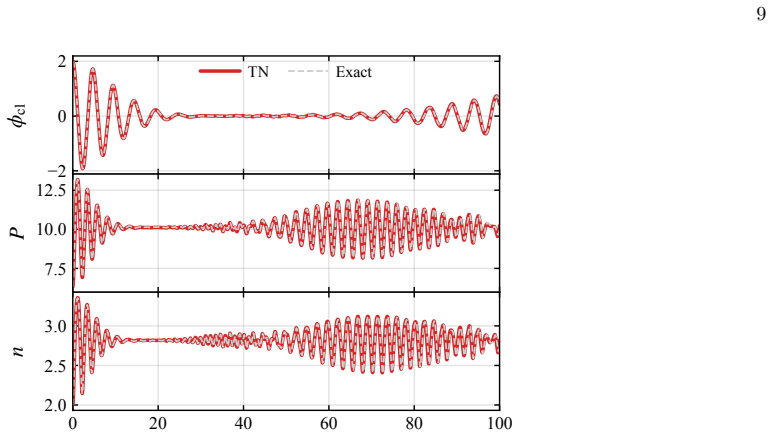
Starting from a spatially homogeneous coherent state with $\phi_{\rm cl}(0)=5$ and $\pi_{\rm cl}(0)=0$ on a two-site lattice with $a=0.25$, $m=1$, and $\lambda=1$, the field expectation value relaxes to zero, the pressure rises from $-37.78$ to $19.20$, and the occupation numbers grow from $f_{p_0}=6.5$ to $17.03$ and from $f_{p_1}=0$ to $3.3\times10^{-3}$; by $t\approx10\,m^{-1}$ all match the diagonal ensemble $\rho_{\rm eq}=\sum_n |c_n|^2 |E_n\rangle\langle E_n|$, although the underlying many-body state remains pure. Relaxation is sequential in momentum space—the zero mode equilibrates before the higher-momentum mode—and for $\phi_{\rm cl}(0)=2,5,10$ the same pattern holds, with residual oscillations shrinking at larger amplitude. The equilibration interval runs from $t=11.8$ to $18.5\,m^{-1}$ for $\phi_{\rm cl}(0)=5$ and from $14.2$ to $63.2\,m^{-1}$ for $\phi_{\rm cl}(0)=10$; for $\phi_{\rm cl}(0)=2$ a first recurrence is identified at $t\simeq411.6\,m^{-1}$. In larger one-dimensional lattices ($N=5,7,9,11$), the equilibration stage lengthens and recurrence effects move to later times as the Hilbert-space dimension grows.
Load-bearing premise
The load-bearing premise is that a small, hard-truncated system—up to eleven lattice sites with six qubits per site or a truncated harmonic-oscillator basis—faithfully reproduces the quantum field theory, and the paper does not demonstrate convergence in truncation, continuum, or volume.
Editorial extensions
If this is right
- Equilibration in this setting is intrinsically quantum and interaction-driven: at $\lambda=0$ a coherent state stays coherent and follows the classical periodic solution, so the observed relaxation and particle production require the quartic interaction and quantum dephasing.
- Observables relax to diagonal-ensemble values within a finite time window without explicit long-time averaging, and the equilibration plateau lasts several times the initial relaxation time.
- For more highly occupied initial states the plateau is longer and residuals smaller; for $\phi_{\rm cl}(0)=10$ the 1% equilibration interval is about 4.5 times longer than for $\phi_{\rm cl}(0)=5$.
- Larger lattices display longer-lived equilibration stages and later recurrences, consistent with recurrence times growing with Hilbert-space dimension, and the plateau values converge as $N$ increases.
- An effective equation of state can emerge from only a few particles, which is directly relevant to searches for the smallest locally equilibrated quark-gluon droplets at hadron colliders.
Reading between the lines
- If the plateau persists with increasing truncation and volume, the phenomenon is dephasing in a finite spectrum rather than thermalisation in the thermodynamic sense; the paper's own open questions about the Gibbs ensemble and eigenstate thermalisation point exactly there.
- Because equilibration proceeds mode by mode from low to high momentum, a testable extension is to measure the droplet-size dependence of momentum-mode equilibration in small collision systems predicted by kinetic theory.
- Starting from multi-mode or squeezed coherent states would test whether the plateau length and recurrence times depend on the number of initially populated modes, which the single-mode homogeneous initial states do not probe.
- The pressure plateau suggests a practical observable: if such systems occur in heavy-ion collisions, the early equation of state may be measurable from hadron momentum anisotropies in small systems.
Signed reviews
Editorial analysis
A structured set of objections, weighed in public.
Referee Report
Summary. The paper studies particle production and equilibration starting from highly occupied coherent states in lattice λφ^4 theory in 1+1 dimensions. Numerically, it uses exact diagonalization for two- and five-site lattices, ideal quantum-circuit simulation (Qiskit) for two sites, and tensor-network (TDVP) evolution for up to eleven sites. The central observation is that the field expectation value, pressure, and occupation numbers relax to the diagonal-ensemble values on a timescale of order tens of m^{-1}, remain close to these values for an interval several times longer, and then display revivals interpreted as quantum recurrences; with increasing system size the residual oscillations become weaker. The paper also provides a resource estimate for a fault-tolerant quantum algorithm for the same dynamics.
Significance. Taken as statements about the finite truncated models actually simulated, the paper is a clean proof of principle: it benchmarks a quantum-circuit construction against exact evolution, validates TDVP against exact diagonalization at N=5, and makes a parameter-free comparison with the diagonal ensemble. The qualitatively new observation—dephasing to the diagonal ensemble followed by recurrences in a relativistic scalar lattice theory with high occupancy—is potentially interesting for the discussion of thermalization in small systems relevant to heavy-ion physics. However, the extrapolation from these small, fixed-cutoff lattices to lattice λφ^4 quantum field theory proper and to quark-gluon droplets is not yet supported; the missing convergence tests are the main gap.
major comments (3)
- [Equilibration and quantum recurrences in small systems (Fig. 2)] All quantitative results in Fig. 2—the 1% equilibration windows (t=11.8–18.5 for φ=5, t=14.2–63.2 for φ=10) and the recurrence at t≈411.6 for φ=2—are computed at a single local truncation (n_Q=6 qubits per site for the exact/qubit calculations, and an unspecified fixed N_max in the HO-basis runs), with no convergence study in the truncation level. Any finite closed quantum system dephases to its diagonal ensemble on a timescale set by its discrete spectrum, so the physical statement that this is the dynamics of lattice λφ^4 rather than an artifact of the cutoff requires showing that the plateau boundaries and recurrence time are stable as n_Q (or N_max) is increased. Without such a check, the quoted timescales cannot be claimed as properties of the lattice model.
- [Quantum equilibration in larger systems (Fig. 3)] The N=7, 9, and 11 results rely entirely on TDVP with fixed maximal bond dimension χ_max=25, and no bond-dimension convergence test or discarded-weight/truncation-error estimate is reported. Since bond truncation removes Schmidt weight and can mimic dissipation by damping residual oscillations, the reported trend of progressively weaker oscillations and longer-lived equilibration with increasing N could be an artifact of fixed χ_max. The N=5 benchmark in Supplemental Fig. 7 validates only one system size and one parameter set; it does not certify χ_max=25 for N=11, where entanglement is larger. The authors should provide χ_max scans (e.g., 25, 50, 100) and report quantitative equilibration intervals for the larger systems rather than relying on visual inspection.
- [Supplemental Material, Eq. (S16)] The displacement-operator circuit uses the Baker–Campbell–Hausdorff approximation e^{A+B} ≈ e^A e^B, and the text states that the omitted commutator terms are 'numerically negligible for the parameters considered' without showing the magnitude. Because the truncated finite-dimensional operators do not satisfy canonical commutation relations exactly, this step should be quantified (e.g., by reporting the fidelity between the approximate and exact displacement operators, or the size of the leading commutator correction as a function of n_Q and α). The exact quantum-circuit benchmark at N=2, n_Q=6 provides some validation, but it does not establish that the approximation remains valid for the larger n_Q values envisioned in the resource estimate.
minor comments (5)
- [After Eq. (9)] The phrase 'values predicted by the diagonal ensemble' could be misread as an independent prediction; since ρ_eq is constructed from the same Hamiltonian and initial state used for the evolution, the late-time agreement is a diagnostic of dephasing in the truncated spectrum rather than a test of a thermal ensemble. Please rephrase to make this distinction explicit and to connect with the Gibbs-ensemble question already listed as open in the Conclusion.
- [Fig. 3 and text below it] The statements that residual oscillations 'become progressively weaker' and that the equilibration stage 'persists for longer times' as N increases are made without quantitative definitions. Please provide the same kind of numerical equilibration windows used for the N=2 case, or clearly state the criterion applied to the tensor-network data.
- [Setup and Supplemental Material] The local Hilbert-space dimensions used for the N=5 exact diagonalization and for the HO-basis tensor-network runs are not specified; please state the N_max values used per momentum mode (and whether they are mode-dependent) so that the truncation is reproducible.
- [Recurrence discussion, paragraph after Fig. 2] What is identified at t≈411.6 for φ=2 is a revival of a single observable (φ_cl) within a 10% window, not a true Poincaré recurrence of the quantum state. Calling it 'the first recurrence' is acceptable if clearly defined, but the text should distinguish this partial observable revival from a full state recurrence to avoid overstatement.
- [Abstract and Conclusion] The abstract's phrase 'first-principles framework for nonequilibrium quantum-field dynamics' is stronger than what is demonstrated, given the small lattices and fixed truncations; the Conclusion already appropriately lists larger volumes and the continuum limit as open. Qualifying the claim with 'on small lattices' would better match the evidence.
Circularity Check
No significant circularity: the equilibration and recurrence results are direct dynamical simulations with no fitted parameters; the diagonal-ensemble comparison is a standard non-tautological dephasing benchmark.
full rationale
The paper's central results are obtained by direct unitary time evolution of the fixed lattice Hamiltonian (Eqs. (1)-(2)) from coherent states (Eq. (4)); no parameter is fitted to the reported observables, and the diagonal ensemble (Eq. (9)) is constructed from the Hamiltonian and initial state independently of the time-dependent expectation values. The observed finite-time relaxation to the diagonal ensemble is therefore a genuine dynamical finding, not an identity. The paper's statement that the diagonal-ensemble values agree with long-time averages is a mathematical consistency check rather than an independent prediction, but it is not load-bearing for the main numerical claim. The Poincaré-recurrence times are direct observations in the same finite truncated model, not derived from a fitted input. The self-citations ([18], [26], [52], [62]) are contextual background or open-question references and are not load-bearing for the central calculation. The lack of convergence checks in the qubit/oscillator truncation and bond dimension is a validity and robustness concern about the model, not a circularity. No specific reduction of a prediction to its own input can be exhibited from the paper's equations.
Assumptions & free parameters
free parameters (7)
- mass m =
1
- quartic coupling lambda =
1
- lattice spacing a =
0.25
- initial field amplitude phi_cl(0) =
2, 5, 10
- qubits per site n_Q =
6
- MPS bond dimension chi_max =
25
- time step delta_t =
0.01
assumptions (6)
- domain assumption The lattice Hamiltonian in Eq. (1) with periodic boundary conditions is a valid regularization of lambda phi^4 quantum field theory.
- ad hoc to paper The finite-dimensional qubit or harmonic-oscillator truncation preserves the relevant nonequilibrium dynamics.
- domain assumption Coherent states with only the zero-momentum mode populated represent the classical field initial conditions faithfully.
- domain assumption The diagonal ensemble in Eq. (9) describes the late-time values of the observables.
- ad hoc to paper Tensor-network time evolution with bond dimension 25 is accurate for the N=7,9,11 results.
- ad hoc to paper The Baker-Campbell-Hausdorff commutator terms are negligible in the coherent-state displacement operator.
Cite this review
Pith. "Pith review of Particle Production, Equilibration, and Quantum Recurrences from Classical Fields." pith.science (2026). https://pith.science/paper/AANRYTH6
@misc{pith2026260811316,
  author       = {Pith},
  title        = {Pith review of: Particle Production, Equilibration, and Quantum Recurrences from Classical Fields},
  year         = {2026},
  howpublished = {\url{https://pith.science/paper/AANRYTH6}},
  note         = {Machine review of arXiv:2608.11316}
}
abstract
We investigate particle production from classical fields, a phenomenon central to the pre-equilibrium dynamics of relativistic heavy-ion collisions and the reheating epoch of the early Universe. Using lattice $\lambda\phi^4$ theory as a proof of principle, we show that this problem is naturally amenable to quantum computation, providing a first-principles framework for nonequilibrium quantum-field dynamics beyond existing approximations. We perform simulations on small spatial lattices, exhausting our available classical computational resources while maintaining a direct mapping to future quantum-computing implementations. We find that particle production is accompanied by equilibration of observables, including the field expectation value, occupation-number distribution, and pressure. The observed equilibration persists for timescales several times longer than the initial equilibration time before the observables resume oscillatory behavior associated with quantum Poincar\'e recurrences. Our results establish a route toward first-principles studies of equilibration in nonequilibrium quantum field theory and provide insight into the search for the smallest possible locally equilibrated quark-gluon systems at hadron colliders.
Figures


Figures from the paper (7 more)


Reference graph
Works this paper leans on
-
[1]
L. D. McLerran and R. Venugopalan, Phys. Rev. D49, 2233 (1994), arXiv:hep-ph/9309289. 6
arXiv 1994
-
[2]
L. D. McLerran and R. Venugopalan, Phys. Rev. D49, 3352 (1994), arXiv:hep-ph/9311205
arXiv 1994
-
[3]
J. Jalilian-Marian, A. Kovner, L. D. McLerran, and H. Weigert, Phys. Rev. D55, 5414 (1997), arXiv:hep- ph/9606337
arXiv 1997
-
[4]
Y. V. Kovchegov and A. H. Mueller, Nucl. Phys. B529, 451 (1998), arXiv:hep-ph/9802440
arXiv 1998
- [5]
- [6]
- [7]
- [8]
Show all 75 references
-
[9]
E. A. Calzetta and B.-L. B. Hu,Nonequilibrium Quantum Field Theory(Oxford University Press, 2009)
2009
-
[10]
Alexandru, G
A. Alexandru, G. Basar, P. F. Bedaque, and N. C. Warrington, Rev. Mod. Phys.94, 015006 (2022), arXiv:2007.05436 [hep-lat]
2022 arXiv
- [11]
- [12]
-
[13]
Berges and D
J. Berges and D. Sexty, Phys. Rev. Lett.108, 161601 (2012), arXiv:1201.0687 [hep-ph]
2012 arXiv
-
[14]
Berges, S
J. Berges, S. Schlichting, and D. Sexty, Phys. Rev. D 86, 074006 (2012), arXiv:1203.4646 [hep-ph]
2012 arXiv
- [15]
- [16]
-
[17]
Berges, K
J. Berges, K. Boguslavski, S. Schlichting, and R. Venugopalan, Phys. Rev. D89, 074011 (2014), arXiv:1303.5650 [hep-ph]
2014 arXiv
-
[18]
Epelbaum, F
T. Epelbaum, F. Gelis, N. Tanji, and B. Wu, Phys. Rev. D90, 125032 (2014), arXiv:1409.0701 [hep-ph]
2014 arXiv
-
[19]
A. H. Mueller and D. T. Son, Phys. Lett. B582, 279 (2004), arXiv:hep-ph/0212198
2004 arXiv
-
[20]
Jeon, Phys
S. Jeon, Phys. Rev. C72, 014907 (2005), arXiv:hep- ph/0412121
2005
-
[21]
Dusling, T
K. Dusling, T. Epelbaum, F. Gelis, and R. Venugopalan, Nucl. Phys. A850, 69 (2011), arXiv:1009.4363 [hep-ph]
2011 arXiv
-
[22]
Epelbaum and F
T. Epelbaum and F. Gelis, Nucl. Phys. A872, 210 (2011), arXiv:1107.0668 [hep-ph]
2011 arXiv
-
[23]
Jackiw, Phys
R. Jackiw, Phys. Rev. D9, 1686 (1974)
1974
-
[24]
Epelbaum and F
T. Epelbaum and F. Gelis, Phys. Rev. Lett.111, 232301 (2013), arXiv:1307.2214 [hep-ph]
2013 arXiv
-
[25]
U. W. Heinz and R. Snellings, Ann. Rev. Nucl. Part. Sci. 63, 123 (2013), arXiv:1301.2826
2013 arXiv
-
[26]
Epelbaum, F
T. Epelbaum, F. Gelis, and B. Wu, Phys. Rev. D90, 065029 (2014), arXiv:1402.0115 [hep-ph]
2014 arXiv
-
[27]
Berges, K
J. Berges, K. Boguslavski, S. Schlichting, and R. Venu- gopalan, JHEP05, 054 (2014), arXiv:1312.5216 [hep-ph]
2014 arXiv
- [28]
-
[29]
Arrizabalaga and J
A. Arrizabalaga and J. Smit, Phys. Rev. D66, 065014 (2002), arXiv:hep-ph/0207044
2002 arXiv
-
[30]
S. P. Jordan, K. S. M. Lee, and J. Preskill, Science336, 1130 (2012), arXiv:1111.3633 [quant-ph]
2012 arXiv
-
[31]
S. P. Jordan, K. S. M. Lee, and J. Preskill, Quant. Inf. Comput.14, 1014 (2014), arXiv:1112.4833 [hep-th]
2014 arXiv
-
[32]
Klco and M
N. Klco and M. J. Savage, Phys. Rev. A99, 052335 (2019), arXiv:1808.10378 [quant-ph]
2019 arXiv
-
[33]
Barata, N
J. Barata, N. Mueller, A. Tarasov, and R. Venugopalan, Phys. Rev. A103, 042410 (2021), arXiv:2012.00020 [hep- th]
2021 arXiv
-
[34]
Macridin, A
A. Macridin, A. C. Y. Li, S. Mrenna, and P. Spentzouris, Phys. Rev. A105, 052405 (2022), arXiv:2108.10793 [quant-ph]
2022 arXiv
-
[35]
A. C. Y. Li, A. Macridin, S. Mrenna, and P. Spentzouris, Phys. Rev. A107, 032603 (2023), arXiv:2210.07985 [quant-ph]
2023 arXiv
-
[36]
Hardyet al., PRX Quantum7, 010343 (2026), arXiv:2407.13819 [quant-ph]
A. Hardyet al., PRX Quantum7, 010343 (2026), arXiv:2407.13819 [quant-ph]
2026
-
[37]
Ingoldby, M
J. Ingoldby, M. Spannowsky, T. Sypchenko, S. Williams, and M. Wingate, (2025), arXiv:2505.03878 [quant-ph]
2025 arXiv
-
[38]
S. Abel, M. Spannowsky, and S. Williams, (2025), arXiv:2506.17388 [quant-ph]
2025
-
[39]
Cao, Y.-Y
Q.-H. Cao, Y.-Y. Li, X. Liu, L.-Q. Zhang, and K. Zhao, (2026), arXiv:2604.26226 [hep-ph]
2026 arXiv
-
[40]
N. A. Zemlevskiy, Phys. Rev. D112, 034502 (2025), arXiv:2411.02486 [quant-ph]
2025 arXiv
-
[41]
R. C. Farrell, N. A. Zemlevskiy, M. Illa, and J. Preskill, (2025), arXiv:2505.03111 [quant-ph]
2025
-
[42]
C. W. Bauer, M. Freytsis, and B. Nachman, Phys. Rev. Lett.127, 212001 (2021), arXiv:2102.05044 [hep-ph]
2021 arXiv
-
[43]
J. C. Halimeh, N. Mueller, J. Knolle, Z. Papic, and Z. Davoudi, (2025), arXiv:2509.03586 [quant-ph]
2025 arXiv
-
[44]
R. J. Glauber, Phys. Rev.131, 2766 (1963)
1963
- [45]
-
[46]
Bagherimehrab, Y
M. Bagherimehrab, Y. R. Sanders, D. W. Berry, G. K. Brennen, and B. C. Sanders, PRX Quantum3, 020364 (2022), arXiv:2110.05708 [quant-ph]
2022 arXiv
-
[47]
Preskill, Quantum2, 79 (2018), arXiv:1801.00862 [quant-ph]
J. Preskill, Quantum2, 79 (2018), arXiv:1801.00862 [quant-ph]
2018 arXiv
-
[48]
Peruzzo, J
A. Peruzzo, J. McClean, P. Shadbolt, M.-H. Yung, X.-Q. Zhou, P. J. Love, A. Aspuru-Guzik, and J. L. O’Brien, Nature Communications5, 4213 (2014)
2014
-
[49]
J. R. McClean, J. Romero, R. Babbush, and A. Aspuru- Guzik, New Journal of Physics18, 023023 (2016)
2016
-
[50]
Qiskit: An open-source framework for quantum computing,
Qiskit Community, “Qiskit: An open-source framework for quantum computing,”https://github.com/Qiskit/ qiskit(2017), official citation available athttps:// github.com/Qiskit/qiskit/blob/master/Qiskit.bib
2017
-
[51]
Kurkela and E
A. Kurkela and E. Lu, Phys. Rev. Lett.113, 182301 (2014), arXiv:1405.6318 [hep-ph]
2014 arXiv
-
[52]
S. B. Cabodevila, C. A. Salgado, and B. Wu, JHEP06, 145 (2024), arXiv:2311.07450 [hep-ph]
2024 arXiv
-
[53]
Reimann, Phys
P. Reimann, Phys. Rev. Lett.101, 190403 (2008)
2008
-
[54]
A. J. Short and T. C. Farrelly, New J. Phys.14, 013063 (2012)
2012
-
[55]
Rigol, V
M. Rigol, V. Dunjko, and M. Olshanii, Nature452, 854 (2008)
2008
-
[56]
Polkovnikov, K
A. Polkovnikov, K. Sengupta, A. Silva, and M. Vengalat- tore, Rev. Mod. Phys.83, 863 (2011)
2011
-
[57]
Gogolin and J
C. Gogolin and J. Eisert, Reports on Progress in Physics 79, 056001 (2016), arXiv:1503.07538 [quant-ph]
2016 arXiv
-
[58]
Bocchieri and A
P. Bocchieri and A. Loinger, Physical Review107, 337 (1957)
1957
-
[59]
Or´ us, Ann
R. Or´ us, Ann. Phys.349, 117 (2014)
2014
-
[60]
Fishman, S
M. Fishman, S. R. White, and E. M. Stoudenmire, Sci- Post Phys. Codebases , 4 (2022)
2022
-
[61]
J. L. Nagle and W. A. Zajc, Ann. Rev. Nucl. Part. Sci. 68, 211 (2018), arXiv:1801.03477 [nucl-ex]
2018 arXiv
-
[62]
Cunt´ ın, W
I. Cunt´ ın, W. Qian, and B. Wu, PoSICHEP2024, 630 (2025), arXiv:2411.19601 [quant-ph]. 7
2025 arXiv
-
[63]
J. M. Deutsch, Phys. Rev. A43, 2046 (1991)
1991
-
[64]
Srednicki, Phys
M. Srednicki, Phys. Rev. E50(1994), 10.1103/Phys- RevE.50.888, arXiv:cond-mat/9403051
1994 arXiv
-
[65]
D’Alessio, Y
L. D’Alessio, Y. Kafri, A. Polkovnikov, and M. Rigol, Advances in Physics65, 239 (2016)
2016
-
[66]
Peruzzo, J
A. Peruzzo, J. McClean, P. Shadbolt, M.-H. Yung, X.-Q. Zhou, P. J. Love, A. Aspuru-Guzik, and J. L. O’Brien, Nature Commun.5, 4213 (2014), arXiv:1304.3061 [quant-ph]
2014 arXiv
-
[67]
Kohda, R
M. Kohda, R. Imai, K. Kanno, K. Mitarai, W. Mizukami, and Y. O. Nakagawa, Phys. Rev. Res.4, 033173 (2022)
2022
-
[68]
Haegeman, J
J. Haegeman, J. I. Cirac, T. J. Osborne, I. Pizorn, H. Ver- schelde, and F. Verstraete, Phys. Rev. Lett.107, 070601 (2011), arXiv:1103.0936 [cond-mat.str-el]
2011 arXiv
-
[69]
Haegeman, C
J. Haegeman, C. Lubich, I. Oseledets, B. Vanderey- cken, and F. Verstraete, Phys. Rev. B94, 165116 (2016), arXiv:1408.5056 [quant-ph]. 1 Simulating particle production from classical fields using quantum computation Supplemental Material Iv´ an Cunt´ ın, Wenyang Qian, and Bin ...
2016 arXiv
-
[70]
Fx exp −iµ2 ˆϕ2 x 2 aδt ! F−1 x # exp
Digital quantum simulation using field operator basis The real-time evolution for theϕ 4 theory can be implemented on the quantum circuit in the trotterized form by knowing the Pauli term decomposition for the field and conjugate field operators. Here, we demonstrate the circu...
-
[71]
Measurement and extraction of expectation values In terms of measurements, sinceσ z matrices are diagonal in the computational basis, repeated measurements of theσ z operator on a state|ψ⟩= P ici|i⟩yield the probability distributions pi = counts(i) shots =|c i|2 =|⟨i|ψ⟩| 2,(S1...
-
[72]
The cost is dominated by the 4th power ofn Q due toϕ 4 terms, whereas, the cost of qFT is onlyO(Nn 2 Q)
Resource estimation and scaling in digital quantum simulation For the real-time evolution, each trotter step simulation ofe −iHδt costsO(Nn 4 Q) CNOT gates, whereNis the number of lattice sites, andn Q is the number of qubits used per lattice site. The cost is dominated by the...
-
[73]
Coherent state preparation via variational quantum eigensolver Here, we consider the preparation of the ground state of the free (non-interacting) Hamiltonian [35], before the application of a displacement operator to construct a coherent state. Rather than approximating the g...
-
[74]
This provides a controlled and systematically improvable representation of the bosonic Hilbert space
Matrix product state simulation in harmonic oscillator basis To formulate the latticeϕ 4 theory within a finite-dimensional tensor network framework, we represent the local scalar field degree of freedom at each lattice site in a truncated harmonic oscillator (HO) basis [32, 3...
-
[75]
Analytical derivation for initial conditions for fixed energy density Lastly, we provide analytical derivations for initial conditions at fixed initial energy density. In our setup, the initial energy density is ε0 = E0 Na = 1 2 m2⟨ˆϕ2(0)⟩+⟨ˆπ2(0)⟩+ 1 a2⟨∇ˆϕ(0)⟩ + λ 4!⟨ˆϕ4(0)⟩...
Reviewed August 15, 2026 · model on record in the stance chip above.
Discussion (0). Continue with ORCID to comment.