REVIEW 3 major objections 6 minor 54 references
Robust Quantum Machine Learning for Collider Event Selection under Detector Variability
T0 review · 3 major / 6 minor · reviewed 2026-08-15 · deepseek-v4-flash
Pith's one-line read Parameterised quantum circuits provide a robustness inductive bias for collider-event selection, shifting their scores less than classical neural networks when detector-induced smearing is applied.
desk verdict The empirical robustness result is real for the specific models tested, but the stronger claim of a quantum-specific inductive bias is not yet supported by the unmatched classical baselines. read the letter →
The pith
A machine-rendered reading of the paper's core claim, the machinery that carries it, and where it could break.
The reading
What carries the argument
The objects that carry the argument are two parameterised quantum circuit families. The first is the quantum autoencoder, whose per-event anomaly score is $1 - f_{\mathrm{vac}}(x;\phi)$, the infidelity of the trash register with the vacuum state after a learned unitary compresses background states into a one-qubit latent register; because the score comes from a quantum compression map measured by a swap test, it has a different functional form from classical reconstruction error. The second is the data-reuploading classifier, which alternates trainable angle-encoding layers (affine maps $w x + b$ feeding $R_Y$ and $R_Z$ rotations), a fixed cyclic entangling layer, and trainable single-qubit rotations, then reads out local and nearest-neighbour qubit correlations through a classical sigmoid. Repeated reuploading layers enlarge the accessible frequency spectrum of the decision function without adding qubits, giving a controlled dial for expressivity. The mechanism proposed is that the restricted, structured hypothesis class of these circuits limits how sensitively the learned output can track small input perturbations, so detector drift produces smaller score displacements while discrimination is retained.
What would settle it
Train the classical autoencoder and multilayer perceptron on the same number of events as the quantum models and with matched parameter counts, apply the same smearing with frozen preprocessing, and compare the mean-squared score shifts; if the classical models then shift as little as the quantum models, the claimed quantum-specific robustness inductive bias is refuted.
Extended reading notes
Core claim
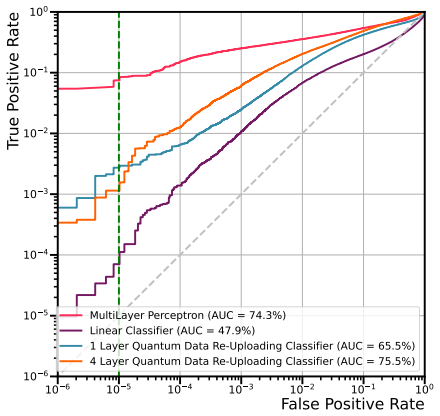
The central claim is that compact parameterised quantum models provide a useful robustness inductive bias for collider-event selection. In the unsupervised study, quantum autoencoders trained on 500 background events with 16 circuit parameters, against a classical autoencoder with 312 parameters trained on $10^6$ events, achieve competitive anomaly detection, especially at the low false-positive rates relevant to triggers, and under smearing their anomaly-score distributions move far less than the classical baselines' while their ROC AUC stays stable. In the supervised study, a four-layer data-reuploading classifier trained on 1000 labelled events reaches a clean-input AUC of 75.5% versus 74.3% for the multilayer perceptron trained on $10^6$ events, yet its output scores shift less under smearing and it retains the largest AUC in the strongly shifted regime, whereas the MLP degrades steadily. The paper reads these results as evidence that the hypothesis class of parameterised quantum circuits, through its encoding, entangling geometry, and fidelity-based compression, resists detector-induced shifts better than highly flexible classical models.
Load-bearing premise
The claim rests on the assumption that the robustness gap comes from the quantum circuit structure and not from the fact that the classical baselines were trained on roughly a thousand times more data and with many more parameters; the paper's appendix checks training-set size only for the unsupervised case, and does not match parameter counts or the supervised training sets.
Editorial extensions
If this is right
- Compact quantum autoencoders with only local entangling connectivity match the discrimination and robustness of all-to-all connected circuits, pointing toward hardware-efficient trigger implementations.
- A four-layer data-reuploading classifier reaches clean-input AUC comparable to a multilayer perceptron while degrading less under strong smearing, placing quantum classifiers in a favourable robustness-performance trade-off.
- Collider trigger models, which cannot be retrained frequently as detector conditions drift, could benefit from models whose event-level scores shift less under calibration changes.
- Robustness under distribution shift should be reported alongside accuracy when comparing quantum and classical models for high-energy physics.
Reading between the lines
- If the stability comes from low effective model complexity rather than quantum mechanics itself, then classical models with strong regularisation or early stopping might reproduce the robustness; this is testable and would not diminish the operational relevance.
- The same smearing protocol should be repeated with a realistic detector-response model, finite measurement shots, and device noise, since the simulations here are noiseless and the robustness ordering could change under those conditions.
- Because the fidelity-based quantum anomaly score and the reuploading classifier are structurally different, observing robustness in both suggests the effect is tied to quantum hypothesis classes broadly; testing other encodings would sharpen that conclusion.
Signed reviews
Editorial analysis
A structured set of objections, weighed in public.
Referee Report
Summary. The manuscript reports two empirical studies comparing parameterized quantum models with classical baselines for collider-event selection under detector-induced smearing. In the unsupervised setting, quantum autoencoders (QAEs) trained on 500 embedded background events are compared with classical and variational autoencoders trained on 10^6 events; in the supervised setting, one- to four-layer data-reuploading classifiers trained on 1000 labelled events are compared with linear and multilayer-perceptron classifiers trained on 10^6 events. All models are evaluated on clean test data and on features smeared multiplicatively, with model parameters and preprocessing transformations held fixed. The paper finds competitive clean-data AUC for the quantum models and generally smaller mean-squared score shifts under smearing, and interprets this as evidence for a quantum-specific robustness inductive bias.
Significance. Robustness under distribution shift is practically important for collider triggers, and the paper provides a clearly described benchmark protocol with public datasets, exact circuit simulation, and a useful Appendix A sample-size scan. If the central attribution were supported, the result would be significant for quantum machine learning in high-energy physics. However, the experiments as presented support only the weaker statement that the specific quantum models tested are less sensitive than the specific classical baselines; the causal attribution to the parameterized-quantum-circuit hypothesis class is confounded by unequal training-set sizes, parameter counts, and regularization. The paper is well structured and the measurements are transparently reported, but the central claim needs additional matched classical controls before it can be accepted.
major comments (3)
- [Section 2.2, Appendix A] The unsupervised robustness comparison does not control for model capacity or training-data size. Each QAE has 16 trainable circuit parameters and is trained on 500 embedded background events, while the AE has 312 parameters and is trained on 10^6 events (Section 2.2). Appendix A retrains the AE on 500 events, but parameter count and regularization remain unmatched, so the smaller score shifts in Figure 13 remain fully consistent with the explanation that a lower-capacity or smoother model is more stable. A classical AE matched in parameter count and trained on 500 events, or a classical model with equivalent implicit regularization, is needed before the robustness can be attributed to the quantum model family rather than to the training configuration.
- [Section 3.2] The statement that the four-layer data-reuploading classifier is 'approximately parameter-matched' to the MLP is inaccurate. The L=4, nq=7 circuit contains 7Lnq = 196 circuit parameters plus 15 readout parameters, for 211 total, while the MLP has 81 parameters, and the quantum model is trained on 1000 labelled events versus 10^6 for the MLP. The linear classifier, with eight parameters, exhibits the smallest score shift but has near-random AUC, demonstrating that low sensitivity can simply reflect weak input dependence. The supervised comparison therefore requires classical baselines matched in parameter count, training-sample size, and regularization before the observed robustness can be attributed to a quantum inductive bias.
- [Section 3.3] The smearing protocol in the supervised study applies the multiplicative perturbation to the pT observables but does not recompute the derived kinematic inputs EmissT, MTR, and MTDelta, even though these are kinematically derived from the smeared momenta. The shifted input vectors therefore mix smeared low-level features with reference-derived features, which is not a consistent detector-variability scenario and may artificially reduce the measured score shift. The authors should either recompute the derived variables from the smeared momenta or explicitly characterize the test as a partial-feature perturbation and limit the robustness claim accordingly.
minor comments (6)
- [Equation (5)] The product upper limit 'j=1+1' appears to be a typo for 'j=i+1'; please correct this and check the surrounding index notation.
- [Throughout] The word 'ansätz' should be 'Ansatz' in the text and figure captions.
- [Section 2.3] The text says 'each unmasked input feature' is smeared, but the description immediately before Equation (16) refers specifically to pT features; please clarify precisely which features are perturbed in the unsupervised study.
- [Section 3.2] The abbreviations MTR and MTDelta are used without definition; a one-sentence definition of these SUSY kinematic variables would improve accessibility.
- [Figures 4, 5, 9, and 11] The shaded bands represent variation across smearing realizations only; the paper does not report variation across independent training seeds or initializations, so it is unclear whether the qualitative ordering of the models is stable. Please state this limitation or add a multiple-seed analysis.
- [Data availability] No code or data-availability statement is provided; given the exact-simulation pipeline and public datasets, releasing code would substantially aid reproducibility.
Circularity Check
No circularity: the robustness result is an empirical measurement on external datasets, not a consequence of the model definitions.
full rationale
No circular step is present. The paper's central claim, that quantum models exhibit smaller score shifts and retain discrimination under smearing, is a direct measurement of quantities defined in Eqs. (17) and (28) on the public ADC2021 and SUSY datasets. The QAE anomaly score is defined through the learned vacuum fidelity (Eq. (12)), and the classifier score is a sigmoid readout of circuit observables (Eq. (26)); neither definition encodes the smeared-input robustness metric. The model parameters and preprocessing constants are held fixed during evaluation, and the smeared samples are never used for training, so the robustness comparison is not forced by construction. Self-citations appear only as architecture or background references (e.g., Refs. [10, 11, 17]) and do not supply the load-bearing evidence for the empirical robustness observation. The asymmetric training-set sizes and parameter counts between quantum and classical models raise a legitimate control concern, but that is a question of experimental fairness and attribution, not of circularity. The claimed result is therefore self-contained with respect to its empirical inputs.
Assumptions & free parameters
free parameters (5)
- Embedding dimension =
8
- QAE trash-qubit count nt =
3
- Quantum training sample size =
500 background events (QAE); 500 signal plus 500 background (classifier)
- Classical training sample size =
10^6 events
- Data-reuploading depth L =
1, 2, 3, 4
assumptions (5)
- standard math The swap-test vacuum fidelity (Eq. 10) is a valid anomaly score for QAE training and inference.
- domain assumption Multiplicative Gaussian smearing on pT features with clipping and zero-masking (Eq. 16) represents detector-induced distribution shift.
- domain assumption Exact noiseless circuit simulation captures the relevant behavior of parameterised quantum models for robustness.
- ad hoc to paper The robustness difference between quantum and classical models is attributable to the quantum model family rather than to model capacity or training data size.
- domain assumption Holding derived kinematic variables fixed while smearing their inputs still provides a meaningful shift test.
Cite this review
Pith. "Pith review of Robust Quantum Machine Learning for Collider Event Selection under Detector Variability." pith.science (2026). https://pith.science/paper/R3Z6LBJW
@misc{pith2026260811330,
  author       = {Pith},
  title        = {Pith review of: Robust Quantum Machine Learning for Collider Event Selection under Detector Variability},
  year         = {2026},
  howpublished = {\url{https://pith.science/paper/R3Z6LBJW}},
  note         = {Machine review of arXiv:2608.11330}
}
read the original abstract
Robust machine-learning methods are becoming increasingly important for high-energy physics data analysis as experiments enter the era of higher luminosity and future higher-energy colliders. Detector degradation, changing running conditions and calibration drift can shift data distributions, causing models trained on clean reference samples to degrade after deployment. We investigate whether parameterised quantum models provide a useful inductive bias for robust collider-event selection in two complementary settings. In the unsupervised study, quantum autoencoders trained on background events are compared with classical and variational autoencoders for anomaly detection. In the supervised study, quantum classifiers with data reuploading are trained to distinguish a supersymmetric signal from background and are compared with linear and multilayer-perceptron classifiers. All models are trained under reference conditions and subsequently evaluated under controlled feature-level smearing while their parameters and preprocessing transformations are held fixed. On clean inputs, the quantum autoencoders achieve competitive anomaly-detection performance, including in the low-false-positive-rate regime relevant for triggering, while the deeper data-reuploading classifier attains discrimination comparable to the non-linear classical baseline. Under smearing, the quantum models generally exhibit smaller shifts in their output scores and retain their discrimination more effectively than the expressive classical baselines. These results suggest that parameterised quantum models can provide a useful robustness inductive bias for collider-event selection and motivate further studies with realistic detector systematics, finite-shot statistics and quantum-device noise.
Figures


Figures from the paper (10 more)




Reference graph
Works this paper leans on
-
[1]
Learning to Pivot with Adversarial Networks,
G. Louppe, M. Kagan, and K. Cranmer, “Learning to Pivot with Adversarial Networks,” [arXiv:1611.01046 [stat.ML]]
-
[2]
Machine Learning Uncertainties with Adversarial Neural Networks,
C. Englert, P. Galler, P. Harris, and M. Spannowsky, “Machine Learning Uncertainties with Adversarial Neural Networks,” Eur. Phys. J. C79no. 1, (2019) 4, [arXiv:1807.08763 [hep-ph]]
arXiv 2019
-
[3]
Parameterized quantum circuits as machine learning models,
M. Benedetti, E. Lloyd, S. Sack, and M. Fiorentini, “Parameterized quantum circuits as machine learning models,” Quantum Science and Technology4no. 4, (Nov., 2019) 043001. http://dx.doi.org/10.1088/2058-9565/ab4eb5
-
[4]
Supervised learning with quantum-enhanced feature spaces,
V. Havlicek, A. D. Córcoles, K. Temme, A. W. Harrow, A. Kandala, J. M. Chow, and J. M. Gambetta, “Supervised learning with quantum-enhanced feature spaces,” Nature567 (2019) 209–212, [arXiv:1804.11326 [quant-ph]]
arXiv 2019
-
[5]
Supervised quantum machine learning models are kernel methods,
M. Schuld, “Supervised quantum machine learning models are kernel methods,” 1, 2021
work page 2021
-
[6]
Unsupervised event classification with graphs on classical and photonic quantum computers,
A. Blance and M. Spannowsky, “Unsupervised event classification with graphs on classical and photonic quantum computers,” JHEP21(2020) 170, [arXiv:2103.03897 [hep-ph]]
arXiv 2020
-
[7]
Quantum Machine Learning for Particle Physics using a Variational Quantum Classifier,
A. Blance and M. Spannowsky, “Quantum Machine Learning for Particle Physics using a Variational Quantum Classifier,” JHEP02(2021) 212, [arXiv:2010.07335 [hep-ph]]
arXiv 2021
-
[8]
Quantum machine learning in high energy physics,
W. Guan, G. Perdue, A. Pesah, M. Schuld, K. Terashi, S. Vallecorsa, and J.-R. Vlimant, “Quantum machine learning in high energy physics,” Machine Learning: Science and Technology2no. 1, (Mar, 2021) 011003.https://doi.org/10.1088/2632-2153/abc17d
Show all 54 references
-
[9]
Quantum computing for data analysis in high energy physics,
A. Delgado, K. E. Hamilton, P. Date, J.-R. Vlimant, D. Magano, Y. Omar, P. Bargassa, A. Francis, A. Gianelle, L. Sestini,et al., “Quantum computing for data analysis in high energy physics,” 2022.https://arxiv.org/abs/2203.08805
2022 arXiv
-
[10]
Event classification with quantum machine learning in high-energy physics,
K. Terashi, M. Kaneda, T. Kishimoto, M. Saito, R. Sawada, and J. Tanaka, “Event classification with quantum machine learning in high-energy physics,” Computing and Software for Big Science5no. 1, (2021) 2
2021
-
[11]
Anomaly detection in high-energy physics using a quantum autoencoder,
V. S. Ngairangbam, M. Spannowsky, and M. Takeuchi, “Anomaly detection in high-energy physics using a quantum autoencoder,” Phys. Rev. D105no. 9, (2022) 095004, [arXiv:2112.04958 [hep-ph]]
2022 arXiv
-
[12]
One particle - one qubit: Particle physics data encoding for quantum machine learning,
A. Bal, M. Klute, B. Maier, M. Oughton, E. Pezone, and M. Spannowsky, “One particle - one qubit: Particle physics data encoding for quantum machine learning,” Phys. Rev. D 112(Oct, 2025) 076004.https://link.aps.org/doi/10.1103/l8y2-87vq
2025 doi
-
[13]
Continuous-variable photonic quantum extreme learning machines for fast collider-data selection,
B. Maier, M. Spannowsky, and S. Williams, “Continuous-variable photonic quantum extreme learning machines for fast collider-data selection,” EPJ Quant. Technol.13no. 1, (2026) 70, [arXiv:2510.13994 [quant-ph]]
2026 arXiv
-
[14]
Machine Learning on Heterogeneous, Edge, and Quantum Hardware for Particle Physics (ML-HEQUPP),
J. Gonskiet al., “Machine Learning on Heterogeneous, Edge, and Quantum Hardware for Particle Physics (ML-HEQUPP),” 2, 2026. 27
2026
-
[15]
Vulnerability of quantum classification to adversarial perturbations,
N. Liu and P. Wittek, “Vulnerability of quantum classification to adversarial perturbations,” Phys. Rev. A101no. 6, (2020) 062331, [arXiv:1905.04286 [quant-ph]]
2020 arXiv
-
[16]
Adversarial robustness guarantees for quantum classifiers,
N. Dowling, M. T. West, A. Southwell, A. C. Nakhl, M. Sevior, M. Usman, and K. Modi, “Adversarial robustness guarantees for quantum classifiers,” npj Quantum Inf.12no. 1, (2026) 16, [arXiv:2405.10360 [quant-ph]]
2026
-
[17]
Quantum autoencoders for efficient compression of quantum data,
J. Romero, J. P. Olson, and A. Aspuru-Guzik, “Quantum autoencoders for efficient compression of quantum data,” Quantum Science and Technology2no. 4, (Aug., 2017) 045001.http://dx.doi.org/10.1088/2058-9565/aa8072
2017 doi
-
[18]
Data re-uploading for a universal quantum classifier,
A. Pérez-Salinas, A. Cervera-Lierta, E. Gil-Fuster, and J. I. Latorre, “Data re-uploading for a universal quantum classifier,” Quantum4(Feb., 2020) 226. https://doi.org/10.22331/q-2020-02-06-226
2020 doi
-
[19]
Effect of data encoding on the expressive power of variational quantum-machine-learning models,
M. Schuld, R. Sweke, and J. J. Meyer, “Effect of data encoding on the expressive power of variational quantum-machine-learning models,” Phys. Rev. A103no. 3, (2021) 032430, [arXiv:2008.08605 [quant-ph]]
2021 arXiv
-
[20]
Quantum algorithms for quantum field theories,
S. P. Jordan, K. S. M. Lee, and J. Preskill, “Quantum algorithms for quantum field theories,” Science336no. 6085, (2012) 1130–1133. http://dx.doi.org/10.1126/science.1217069
2012 doi
-
[21]
Digitization of scalar fields for quantum computing,
N. Klco and M. J. Savage, “Digitization of scalar fields for quantum computing,” Phys. Rev. A99no. 5, (2019) 052335, [arXiv:1808.10378 [quant-ph]]
2019 arXiv
-
[22]
Simulating quantum field theory with a quantum computer,
J. Preskill, “Simulating quantum field theory with a quantum computer,” PoS LA TTICE2018(2018) 024, [arXiv:1811.10085 [hep-lat]]
2018 arXiv
-
[23]
Simulating Lattice Gauge Theories within Quantum Technologies,
M. C. Bañulset al., “Simulating Lattice Gauge Theories within Quantum Technologies,” Eur. Phys. J. D74no. 8, (2020) 165, [arXiv:1911.00003 [quant-ph]]
2020 arXiv
-
[24]
Quantum simulation for high-energy physics,
C. W. Bauer, Z. Davoudi, A. B. Balantekin, T. Bhattacharya, M. Carena, W. A. de Jong, P. Draper, A. El-Khadra, N. Gemelke, M. Hanada,et al., “Quantum simulation for high-energy physics,” PRX Quantum4(May, 2023) 027001. https://link.aps.org/doi/10.1103/PRXQuantum.4.027001
2023 doi
-
[25]
Enhancing quantum field theory simulations on NISQ devices with Hamiltonian truncation,
J. Ingoldby, M. Spannowsky, T. Sypchenko, and S. Williams, “Enhancing quantum field theory simulations on NISQ devices with Hamiltonian truncation,” Phys. Rev. D110no. 9, (2024) 096016, [arXiv:2407.19022 [quant-ph]]
2024 arXiv
-
[26]
Simulating quantum field theories on continuous-variable quantum computers,
S. Abel, M. Spannowsky, and S. Williams, “Simulating quantum field theories on continuous-variable quantum computers,” Phys. Rev. A110no. 1, (2024) 012607, [arXiv:2403.10619 [quant-ph]]
2024 arXiv
-
[27]
Quantum computing for high-energy physics: State of the art and challenges,
A. Di Meglio, K. Jansen, I. Tavernelli, C. Alexandrou, S. Arunachalam, C. W. Bauer, K. Borras, S. Carrazza, A. Crippa, V. Croft,et al., “Quantum computing for high-energy physics: State of the art and challenges,” PRX Quantum5(Aug, 2024) 037001. https://link.aps.org/doi/10.110...
2024 doi
-
[28]
False vacuum decay in a two-dimensional quantum spin system,
L. Pavešić, I. G. Moss, and S. Montangero, “False vacuum decay in a two-dimensional quantum spin system,” [arXiv:2607.01994 [quant-ph]]. 28
-
[29]
Real-time dynamics of lattice gauge theories with a few-qubit quantum computer,
E. A. Martinezet al., “Real-time dynamics of lattice gauge theories with a few-qubit quantum computer,” Nature534(2016) 516–519, [arXiv:1605.04570 [quant-ph]]
2016 arXiv
-
[30]
Quantum computation of scattering in scalar quantum field theories,
S. P. Jordan, K. S. M. Lee, and J. Preskill, “Quantum computation of scattering in scalar quantum field theories,” 2019.https://arxiv.org/abs/1112.4833
2019 arXiv
-
[31]
Real-time scattering in Ising field theory using matrix product states,
R. G. Jha, A. Milsted, D. Neuenfeld, J. Preskill, and P. Vieira, “Real-time scattering in Ising field theory using matrix product states,” Phys. Rev. Res.7no. 2, (2025) 023266, [arXiv:2411.13645 [hep-th]]
2025 arXiv
-
[32]
Real-time scattering processes with continuous-variable quantum computers,
S. Abel, M. Spannowsky, and S. Williams, “Real-time scattering processes with continuous-variable quantum computers,” Phys. Rev. A112no. 1, (2025) 012614, [arXiv:2502.01767 [quant-ph]]
2025 arXiv
-
[33]
Scalable quantum simulations of scattering in scalar field theory on 120 qubits,
N. A. Zemlevskiy, “Scalable quantum simulations of scattering in scalar field theory on 120 qubits,” Phys. Rev. D112(Aug, 2025) 034502. https://link.aps.org/doi/10.1103/qr72-51v1
2025 doi
-
[34]
Real-Time Scattering on Quantum Computers via Hamiltonian Truncation,
J. Ingoldby, M. Spannowsky, T. Sypchenko, S. Williams, and M. Wingate, “Real-Time Scattering on Quantum Computers via Hamiltonian Truncation,” [arXiv:2505.03878 [quant-ph]]
-
[35]
Quantum algorithm for Feynman loop integrals,
S. Ramírez-Uribe, A. E. Rentería-Olivo, G. Rodrigo, G. F. R. Sborlini, and L. Vale Silva, “Quantum algorithm for Feynman loop integrals,” JHEP05(2022) 100, [arXiv:2105.08703 [hep-ph]]
2022 arXiv
-
[36]
Loop Feynman integration on a quantum computer,
J. J. M. de Lejarza, L. Cieri, M. Grossi, S. Vallecorsa, and G. Rodrigo, “Loop Feynman integration on a quantum computer,” Phys. Rev. D110no. 7, (2024) 074031, [arXiv:2401.03023 [hep-ph]]
2024 arXiv
-
[37]
A general approach to quantum integration of cross sections in high-energy physics,
I. Williams and M. Pellen, “A general approach to quantum integration of cross sections in high-energy physics,” Quantum Sci. Technol.10no. 4, (2025) 045017, [arXiv:2502.14647 [quant-ph]]
2025 arXiv
-
[38]
Quantum Algorithm for High Energy Physics Simulations,
C. W. Bauer, W. A. de Jong, B. Nachman, and D. Provasoli, “Quantum Algorithm for High Energy Physics Simulations,” Phys. Rev. Lett.126no. 6, (2021) 062001, [arXiv:1904.03196 [hep-ph]]
2021 arXiv
-
[39]
Towards a quantum computing algorithm for helicity amplitudes and parton showers,
K. Bepari, S. Malik, M. Spannowsky, and S. Williams, “Towards a quantum computing algorithm for helicity amplitudes and parton showers,” Phys. Rev. D103no. 7, (2021) 076020, [arXiv:2010.00046 [hep-ph]]
2021 arXiv
-
[40]
Quantum walk approach to simulating parton showers,
K. Bepari, S. Malik, M. Spannowsky, and S. Williams, “Quantum walk approach to simulating parton showers,” Phys. Rev. D106no. 5, (2022) 056002, [arXiv:2109.13975 [hep-ph]]
2022 arXiv
-
[41]
Collider events on a quantum computer,
G. Gustafson, S. Prestel, M. Spannowsky, and S. Williams, “Collider events on a quantum computer,” JHEP11(2022) 035, [arXiv:2207.10694 [hep-ph]]
2022 arXiv
-
[42]
Quantum simulation of colour in perturbative quantum chromodynamics,
H. A. Chawdhry and M. Pellen, “Quantum simulation of colour in perturbative quantum chromodynamics,” SciPost Phys.15no. 5, (2023) 205, [arXiv:2303.04818 [hep-ph]]. 29
2023 arXiv
-
[43]
Quantum simulation of scattering amplitudes and interferences in perturbative QCD,
H. A. Chawdhry, M. Pellen, and S. Williams, “Quantum simulation of scattering amplitudes and interferences in perturbative QCD,” The European Physical Journal C86 no. 8, (Aug., 2026) 961.https://doi.org/10.1140/epjc/s10052-026-16121-0
2026 doi
-
[44]
Solving a higgs optimization problem with quantum annealing for machine learning,
A. Mott, J. Job, J.-R. Vlimant, D. Lidar, and M. Spiropulu, “Solving a higgs optimization problem with quantum annealing for machine learning,” Nature550no. 7676, (2017) 375–379
2017
-
[45]
Autoencoders on field-programmable gate arrays for real-time, unsupervised new physics detection at 40 MHz at the Large Hadron Collider,
E. Govorkovaet al., “Autoencoders on field-programmable gate arrays for real-time, unsupervised new physics detection at 40 MHz at the Large Hadron Collider,” Nature Mach. Intell.4(2022) 154–161, [arXiv:2108.03986 [physics.ins-det]]
2022 arXiv
-
[46]
Classical Hardware Acceleration of Quantum Autoencoders for Real-Time Anomaly Detection in Collider Experiments,
I. Ge, S. Addepalli, A. Dave, and J. Gonski, “Classical Hardware Acceleration of Quantum Autoencoders for Real-Time Anomaly Detection in Collider Experiments,” [arXiv:2607.20302 [cs.LG]]
-
[47]
Lhc physics dataset for unsupervised new physics detection at 40 mhz,
E. Govorkova, E. Puljak, T. Aarrestad, M. Pierini, K. A. Woźniak, and J. Ngadiuba, “Lhc physics dataset for unsupervised new physics detection at 40 mhz,” Scientific Data9no. 1, (2022) 118.https://doi.org/10.1038/s41597-022-01187-8
2022 doi
-
[48]
Whiteson, “SUSY.” Uci machine learning repository, 2014
D. Whiteson, “SUSY.” Uci machine learning repository, 2014. DOI: https://doi.org/10.24432/C54606
2014 doi
-
[49]
Unsupervised beyond-standard-model event discovery at the lhc with a novel quantum autoencoder,
C. Duffy, M. Hassanshah, M. Jastrzebski, and S. Malik, “Unsupervised beyond-standard-model event discovery at the lhc with a novel quantum autoencoder,” 2024.https://arxiv.org/abs/2407.07961
2024 arXiv
-
[50]
Anomaly-preserving contrastive neural embeddings for end-to-end model-independent searches at the lhc,
K. Metzger, L. Xu, M. Sodini, T. K. Årrestad, K. Govorkova, G. Grosso, and P. Harris, “Anomaly-preserving contrastive neural embeddings for end-to-end model-independent searches at the lhc,” Phys. Rev. D112(Oct, 2025) 072011. https://link.aps.org/doi/10.1103/5n77-ynsp
2025 doi
-
[51]
Anomaly detection with AXOL1TL at the CMS Level-1 Trigger in 2024 and 2025,
CMSCollaboration, CMS Collaboration, “Anomaly detection with AXOL1TL at the CMS Level-1 Trigger in 2024 and 2025,”.https://cds.cern.ch/record/2942560
2024
-
[52]
Pennylane: Automatic differentiation of hybrid quantum-classical computations,
V. Bergholm, J. Izaac, M. Schuld, C. Gogolin, S. Ahmed, V. Ajith, M. S. Alam, G. Alonso-Linaje, B. AkashNarayanan, A. Asadi,et al., “Pennylane: Automatic differentiation of hybrid quantum-classical computations,” 2022. https://arxiv.org/abs/1811.04968
2022 arXiv
-
[53]
Variational Autoencoders for New Physics Mining at the Large Hadron Collider,
O. Cerri, T. Q. Nguyen, M. Pierini, M. Spiropulu, and J.-R. Vlimant, “Variational Autoencoders for New Physics Mining at the Large Hadron Collider,” JHEP05(2019) 036, [arXiv:1811.10276 [hep-ex]]
2019 arXiv
-
[54]
Scikit-learn: Machine learning in Python,
F. Pedregosa, G. Varoquaux, A. Gramfort, V. Michel, B. Thirion, O. Grisel, M. Blondel, P. Prettenhofer, R. Weiss, V. Dubourg,et al., “Scikit-learn: Machine learning in Python,” Journal of Machine Learning Research12(2011) 2825–2830. 30
2011
Reviewed August 15, 2026 · model on record in the stance chip above.
Discussion (0). Continue with ORCID to comment.