REVIEW 2 major objections 6 minor 70 references
Quantum Anomalous Hall Effect in $d^{10}$ Oxide Monolayers
T0 review · 2 major / 6 minor · reviewed 2026-08-16 · deepseek-v4-flash
Pith's one-line read Oxygen 2p magnetism yields Chern number 4 in oxide monolayers
desk verdict A clean, internally consistent PBE prediction of O-2p-driven C=4 QAHE in deintercalated oxides; the physics is credible but the 7 meV gap and lack of functional cross-checks leave the central claim fragile. read the letter →
The pith
A machine-rendered reading of the paper's core claim, the machinery that carries it, and where it could break.
The reading
What carries the argument
The mechanism is a symmetry-constrained filling of an E-type O-$2p$ doublet: in the nonmagnetic parent, the last two valence electrons occupy a twofold-degenerate representation at the Fermi level and, by Hund's rule, align their spins, producing an O-$2p$-driven ferromagnet without cation moments. The topological machinery is the set of eight spin-polarized Dirac points related by $C_3$ symmetry; an effective two-band $k\cdot p$ model expanded around each crossing shows that spin-orbit coupling adds a Dirac mass $d_z$, and each gapped Dirac point contributes a local Chern number $C_{\rm loc}\approx 1/2$. Summing the eight contributions gives the total Chern number $\mathcal{C}=4$.
What would settle it
A hybrid-functional or DFT+U calculation of monolayer Zn2TeO6 would settle the point: if the oxygen 2p ferromagnetic state is not the ground state, or if the spin-orbit gap closes or changes sign under the corrected functional, the predicted C=4 plateau would not survive. Experimentally, measuring the anomalous Hall conductance of an exfoliated monolayer and finding no plateau at $4e^{2}$/h in the gap would falsify the claim.
Extended reading notes
Core claim
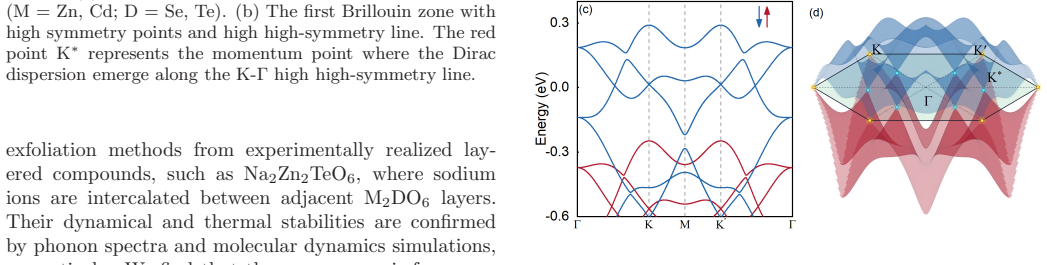
The central claim is that monolayer M2DO6 realizes an intrinsic high-Chern-number quantum anomalous Hall phase with $\mathcal{C}=4$, driven by spontaneous ferromagnetism of half-filled O-$2p$ orbitals rather than partially filled $d$ or $f$ shells. Removing the intercalated alkali cations injects two holes per unit cell into the oxygen framework; because the metal cations keep closed-shell $d^{10}$ configurations, the holes reside on oxygen and spin-polarize into an easy-axis ferromagnetic state with a moment of about $2\,\mu_B$ per unit cell. In the spin-polarized band structure, two inequivalent Dirac crossings appear, at $K/K'$ and along $\Gamma$–$K$, and $C_3$ symmetry generates eight symmetry-related Dirac points. Spin-orbit coupling opens a global gap of about 7 meV in Zn2TeO6; each massive Dirac point carries a local Chern number of approximately 1/2, so the total Chern number is $\mathcal{C}=4$ and the anomalous Hall conductance is quantized at $4e^2/h$, with four chiral edge modes in a ribbon geometry.
Load-bearing premise
The prediction rests on the assumption that the standard density-functional approximation (PBE, without Hubbard U or self-interaction corrections) correctly describes the oxygen 2p holes and the ~7 meV spin-orbit gap; if self-interaction error artificially stabilizes the hole ferromagnetism, the Chern number 4 phase could change or disappear.
Editorial extensions
If this is right
- Monolayer Zn2TeO6 should show a quantized anomalous Hall plateau of $4e^2/h$ inside its ~7 meV spin-orbit gap, with four chiral edge channels.
- Applying ~2.5% tensile strain to Cd2TeO6 aligns the eight Dirac points in energy and turns the monolayer into a $\mathcal{C}=4$ high-Chern-number quantum anomalous Hall insulator.
- Cation deintercalation is predicted to activate O-$2p$ ferromagnetism in more than twenty closed-shell oxides, including compounds with $d^0$, $d^{10}$, and main-group cations.
- Several other deintercalated monolayers (Cd2SbO6, Cd2BiO6, Mg2SbO6, InO3) are predicted to be Chern insulators with Chern numbers 4, 3, 1, and 1, respectively.
Reading between the lines
- If O-$2p$ ferromagnetism survives in real samples, the mechanism could widen the search for magnetic topological materials beyond transition-metal compounds, since oxygen-based frameworks are abundant and already synthesized as battery materials.
- Because the predicted topological gap is only about 7 meV, confirming the phase experimentally will likely require high-quality exfoliated monolayers and measurement temperatures well below ~80 K; strain or dielectric screening may be needed to stabilize the gap.
- A direct testable extension would be to measure the anomalous Hall conductivity as a function of gate voltage in a monolayer device; a plateau at $4e^2/h$ would confirm the half-Chern-number counting, while a different plateau would indicate that the eight Dirac points are not all aligned.
- The same deintercalation logic could be applied computationally to other parent compounds with removable cations, such as lithium or potassium analogues, to search for O-$2p$ topological phases with larger gaps.
Signed reviews
Editorial analysis
A structured set of objections, weighed in public.
Referee Report
Summary. The manuscript proposes that monolayers M2DO6 (M=Zn,Cd; D=Se,Te), derived by deintercalating A cations from honeycomb layered oxides A2M2DO6, realize a quantum anomalous Hall effect driven by O-2p ferromagnetism. Using PBE-based DFT, phonon, and Wannier-interpolation calculations, the authors find a ferromagnetic half-metallic state with two holes in an O-2p E doublet, spin-polarized Dirac points at K/K' and along Γ–K, and, upon spin-orbit coupling, a global gap of about 7 meV with Berry curvature concentrated at the eight gapped Dirac points. Each gapped Dirac point contributes a local Chern number Cloc ≈ 0.5, yielding a quantized anomalous Hall conductance of 4e^2/h. Cd2TeO6 requires about 2.5% tensile strain to align the Dirac points and achieve C=4. The authors generalize the cation-deintercalation strategy to more than 20 oxides, reporting O-2p ferromagnetism and nonzero Chern numbers for several additional slabs including Cd2SbO6 (C=4), Mg2SbO6 (C=1), Cd2BiO6 (C=3), and InO2 (C=1).
Significance. If correct, the paper would establish a new route to the QAHE based on oxygen 2p rather than transition-metal d magnetism, and a high-Chern-number phase C=4 with multiple chiral edge modes. The proposed cation deintercalation strategy for activating O-2p ferromagnetism is an attractive design principle for oxide-based magnetic topology. The paper includes explicit first-principles evidence for phonon stability, magnetic ground-state competition, Berry curvature distributions, and edge-state spectra, and the central Chern number is computed by direct integration of the Wannier-interpolated Berry curvature rather than inferred from the fitted k·p model. The main fragility is that all results rest on a single exchange-correlation functional (PBE) with no +U or hybrid cross-check, and the topological gap of about 7 meV is below typical DFT accuracy.
major comments (2)
- [Origin of Magnetism; Band Structures and Topological Properties (Figs. 2-3)] The central prediction of C=4 QAHE rests entirely on PBE (Ref. [63]) calculations. The O-2p hole ferromagnetism and the 7 meV spin-orbit gap in Fig. 3(a) are both quantities that PBE is known to treat poorly for oxides; self-interaction error can artificially stabilize hole localization on oxygen. Since the Berry curvature, local Chern numbers, and edge states are all computed on this PBE Hamiltonian, a more accurate functional could close the gap or change its sign and invalidate the C=4 phase. Please provide PBE+U or hybrid-functional (e.g., HSE06) calculations for at least Zn2TeO6 and Cd2TeO6, reporting the magnetic moment per O, the size and sign of the SOC gap, and the Chern number. If such checks cannot be performed, the paper should state this limitation explicitly and moderate the claim.
- [Summary; Effect of Strain] The Summary states 'monolayer M2DO6 realizes a high-Chern-number QAHE phase with C=4' without qualification, but the Effect of Strain section states that the other three compounds remain gapless even with spin-orbit coupling and require biaxial strain to align the Dirac points. Only Cd2TeO6 under 2.5% tensile strain is explicitly demonstrated to reach C=4. Please state in the Summary and Abstract which members of the family are intrinsic QAH insulators and which require strain, and give the strained results for Zn2SeO6 and Cd2SeO6 in the main text (or explicitly cite the corresponding supplemental figures).
minor comments (6)
- [Abstract; Origin of Magnetism] The phrase 'half-filled O-2p orbital' is imprecise: the two holes occupy the two components of an E doublet at Γ. Please say 'half-filled O-2p doublet' or 'half-filled O-2p manifold'.
- [Fig. 1(b) caption] The caption contains the redundant phrase 'high high-symmetry line'; please correct.
- [References] Several references appear in the journal 'Coshare Science' (Refs. [4], [8], and [18]), which is not a standard recognized physics venue; please replace them with more conventional sources or verify their existence. Also, Ref. [35] lists the first author as 'Doung' which is likely a typographical error for 'Duong'.
- [Effect of Strain] The main text says that the other three compounds require strain to align the Dirac points, but the strain values are only given for Cd2TeO6 (2.5% tensile). Please list the required strain for each compound in the main text or refer explicitly to the relevant supplemental figures.
- [k·p model, Eqs. (1)-(3)] The k·p parameters are fitted to the Wannier-interpolated bands, so the local Chern number Cloc ≈ 0.5 is a consistency check rather than an independent derivation. Please emphasize that the C=4 result is obtained from the full Berry curvature integration of the Wannier Hamiltonian (Fig. 3) and not from the fitted model.
- [Generalization of O-2p-induced ferromagnetism; Table II] The statement that 'more than 20' oxides exhibit O-2p ferromagnetism is supported only by a reference to Table S2; please add a brief summary in the main text of the screening protocol, the number of materials with and without ferromagnetism, and representative data, so that the generality claim is testable without accessing the supplement.
Circularity Check
No significant circularity: the C=4 QAHE claim is computed by direct Berry-curvature integration of the DFT/Wannier Hamiltonian, with the fitted k·p model used only as a diagnostic, not as the source of the Chern number.
full rationale
The paper's derivation chain is self-contained against external benchmarks. The central claim that M2DO6 monolayers host a C=4 QAHE is established by (i) DFT (PBE) band structures giving O-2p half-metallic ferromagnetism; (ii) symmetry-identified Dirac crossings; (iii) spin-orbit coupling opening a global gap; and (iv) a direct calculation of Berry curvature and anomalous Hall conductance, yielding a quantized plateau of 4e^2/h (Fig. 3(b)). The two-band k·p model is fitted to the Wannier-projected bands ('The effective models accurately reproduce the low-energy dispersions near the Dirac points'), but this fit is not the source of the Chern number; it is a post-hoc explanation of topology already obtained by integration. The local Chern number C_loc ≈ 0.5 is evaluated from the Berry-curvature integral in Eq. (3), not imposed by the k·p parameters. Self-citations (Refs. 28, 29, 31) are background on high-Chern-number engineering and are not load-bearing. The PBE functional choice and the small 7 meV SOC gap are legitimate correctness risks, but they concern numerical accuracy, not circularity; the paper does not define its target in terms of fitted parameters or import a uniqueness theorem from the authors' prior work.
Assumptions & free parameters
assumptions (4)
- domain assumption PBE/GGA exchange-correlation functional adequately describes O-2p ferromagnetism and band topology.
- domain assumption Complete removal of A+ cations from layered A2M2DO6 yields the free-standing M2DO6 monolayer with exactly two holes per unit cell.
- domain assumption The monolayer is dynamically and thermally stable as computed by phonons and MD, and is experimentally accessible via exfoliation and deintercalation.
- domain assumption The two-band k.p expansion to linear order in q is sufficient near each crossing point; higher-order terms are negligible.
Cite this review
Pith. "Pith review of Quantum Anomalous Hall Effect in $d^{10}$ Oxide Monolayers." pith.science (2026). https://pith.science/paper/XBCOY2ZK
@misc{pith2026260811855,
  author       = {Pith},
  title        = {Pith review of: Quantum Anomalous Hall Effect in $d^10$ Oxide Monolayers},
  year         = {2026},
  howpublished = {\url{https://pith.science/paper/XBCOY2ZK}},
  note         = {Machine review of arXiv:2608.11855}
}
abstract
Quantum anomalous Hall effect (QAHE) arises from the interplay between magnetic order and spin-orbit coupling, which opens up a topologically nontrivial band gap to host chiral edge states in the absence of magnetic field. So far, magnetic order of QAHE usually originates from partially filled transition-metal $d$ orbitals or correlation-driven moir\'e bands. Here, we propose an experimentally accessible family of two-dimensional oxides, M$_2$DO$_6$ (M = Zn, Cd; D = Se, Te), that can realize QAHE from the half-filled O-$2p$ orbital induced spontaneous ferromagnetism. In M$_2$DO$_6$ monolayers, spin-polarized Dirac points appear at K/K$^{\prime}$ valleys and along $\Gamma$-K/$\Gamma$-K$^{\prime}$ lines. $C_3$ rotational symmetry then generates eight symmetry-related crossings in the first Brillouin zone. Upon gap opening by spin-orbit coupling, each massive Dirac point contributes half Chern number, resulting in a high-Chern-number QAHE phase with $\mathcal{C}=4$. We establish cation deintercalation as a general strategy to activate O-$2p$ ferromagnetism in oxides. Our finding provides a route to realize QAHE from O-$2p$ ferromagnetism and offers design principles applicable to oxygen-based magnetic topology platforms beyond conventional $d$-electron systems.
Figures


Figures from the paper (1 more)

Reference graph
Works this paper leans on
-
[63]
J. P. Perdew, K. Burke, and M. Ernzerhof, Phys. Rev. Lett. 77, 3865 (1996)
1996
-
[1]
K. V. Klitzing, G. Dorda, and M. Pepper, Phys. Rev. Lett. 45, 494 (1980)
1980
-
[2]
F. D. M. Haldane, Phys. Rev. Lett. 61, 2015 (1988)
1988
-
[3]
K. He, Y. Wang, and Q.-K. Xue, Annu. Rev. Condens. Matter Phys. 9, 329 (2018)
2018
- [4]
-
[5]
R. Yu, W. Zhang, H. J. Zhang, S. C. Zhang, X. Dai, and Z. Fang, Science 329, 61 (2010)
2010
- [6]
-
[7]
S. Qi, Z. Qiao, X. Deng, E. D. Cubuk, H. Chen, W. Zhu, E. Kaxiras, S. B. Zhang, X. Xu, and Z. Zhang, Phys. Rev. Lett. 117, 056804 (2016)
2016
Show all 70 references
-
[8]
Liu, Coshare Science 01, 03 (2023)
F. Liu, Coshare Science 01, 03 (2023)
2023
-
[9]
Z. Qiao, S. A. Yang, W.-X. Feng, W.-K. Tse, J. Ding, Y. G. Yao, J. Wang, and Q. Niu, Phys. Rev. B 82, 161414(R) (2010)
2010
-
[10]
Z. Qiao, W. Ren, H. Chen, L. Bellaiche, Z. Zhang, A.H. MacDonald, and Q. Niu, Phys. Rev. Lett. 112, 116404 (2014)
2014
-
[11]
Z. Wang, C. Tang, R. Sachs, Y. Barlas, and J. Shi, Phys. Rev. Lett. 114, 016603 (2015)
2015
-
[12]
M. M. Otrokov, I. P. Rusinov, M. Blanco-Rey, M. Hoff- mann, A. Y. Vyazovskaya, S. V. Eremeev, A. Ernst, P. M. Echenique, A. Arnau, and E. V. Chulkov, Phys. Rev. Lett. 122, 107202 (2019)
2019
-
[13]
J. Li, Y. Li, S. Du, Z. Wang, B.-L. Gu, S.-C. Zhang, K. He, W. Duan, and Y. Xu, Sci. Adv. 5, eaaw5685 (2019)
2019
-
[14]
Zhang, M
D. Zhang, M. Shi, T. Zhu, D. Xing, H. Zhang, and J. Wang, Phys. Rev. Lett. 122, 206401 (2019)
2019
-
[15]
Y. Deng, Y. Yu, M. Z. Shi, J. Wang, X. H. Chen, and Y. Zhang, Science 367, 895 (2020)
2020
-
[16]
Z. Lian, Y. Wang, Y. Wang, W.-H. Dong, Y. Feng, Z. Dong, M. Ma, S. Yang, L. Xu, Y. Li, B. Fu, Y. Li, W. Jiang, Y. Xu, C. Liu, J. Zhang, and Y. Wang, Nature (London) 641, 70 (2025)
2025
-
[17]
Y. Gong, J. Guo, J. Li, K. Zhu, M. Liao, X. Liu, Q. Zhang, L. Gu, L. Tang, X. Feng, D. Zhang, W. Li, C. Song, L. Wang, P. Yu, X. Chen, Y. Wang, H. Yao, W. Duan, Y. Xu, S.-C. Zhang, X. Ma, Q.-K. Xue, and K. He, Chin. Phys. Lett. 36, 076801 (2019)
2019
-
[18]
Hasegawa, Coshare Science 03, 01 (2025)
S. Hasegawa, Coshare Science 03, 01 (2025)
2025
-
[19]
G. Chen, A. L. Sharpe, E. J. Fox, Y.-H. Zhang, S. Wang, L. Jiang, B. Lyu, H. Li, K. Watanabe, T. Taniguchi, Z. Shi, T. Senthil, D. Goldhaber-Gordon, Y. Zhang, and F. Wang, Nature (London) 579, 56 (2020)
2020
-
[20]
Serlin, C
M. Serlin, C. Tschirhart, H. Polshyn, Y. Zhang, J. Zhu, K. Watanabe, T. Taniguchi, L. Balents, and A. Young, Science 367, 900 (2020)
2020
-
[21]
T. Li, S. Jiang, B. Shen, Y. Zhang, L. Li, Z. Tao, T. De- vakul, K. Watanabe, T. Taniguchi, L. Fu, J. Shan, and K. F. Mak, Quantum anomalous Hall effect from inter- twined moir´ e bands, Nature (London) 600, 641 (2021)
2021
-
[22]
T. Han, Z. Lu, Y. Yao, J. Yang, J. Seo, C. Yoon, K. Watanabe, T. Taniguchi, L. Fu, F. Zhang, and L. Ju, Large quantum anomalous Hall effect in spin-orbit proximitized rhombohedral graphene, Science 384, 647 (2024)
2024
-
[23]
J. Ge, Y. Liu, J. Li, H. Li, T. Luo, Y. Wu, Y. Xu, and J. Wang, Natl. Sci. Rev. 7, 1280 (2020)
2020
-
[24]
Y.-F. Zhao, R. Zhang, R. Mei, L.-J. Zhou, H. Yi, Y.-Q. Zhang, J. Yu, R. Xiao, K. Wang, N. Samarth, M. H. W. Chan, C.-X. Liu, and C.-Z. Chang, Nature (London) 6 588, 419 (2020)
2020
-
[25]
G. Xu, H. Weng, Z. Wang, X. Dai, and Z. Fang, Phys. Rev. Lett. 107, 186806 (2011)
2011
-
[26]
Jiang, H Wang, and J Wang, Phys
Y. Jiang, H Wang, and J Wang, Phys. Rev. Lett. 136, 036601 (2026)
2026
-
[27]
Y. Li, J. Li, Y. Li, M. Ye, F. Zheng, Z. Zhang, J. Fu, W. Duan, and Y. Xu, Phys. Rev. Lett. 125, 086401 (2020)
2020
-
[28]
Jiang, Z
H. Jiang, Z. Qiao, H. Liu, and Q. Niu, Phys. Rev. B 85, 045445 (2012)
2012
-
[29]
J. Zeng, Y. Ren, K. Zhang, and Z. Qiao, Phys. Rev. B 95, 045424 (2017)
2017
-
[30]
C. Fang, M. J. Gilbert, and B. A. Bernevig, Phys. Rev. Lett. 112, 046801 (2014)
2014
-
[31]
Z. Li, Y. Han, and Z. Qiao, Phys. Rev. Lett. 129, 036801 (2022)
2022
-
[32]
X. Feng, Y. Bai, Z. Chen, Y. Dai, B. Huang, and C. Niu, Adv. Funct. Mater. 35 2501934 (2025)
2025
-
[33]
Zhang, R
Y. Zhang, R. Li, Y. Bai, Z. Zhang, B. Huang, Y. Dai, and C. Niu, Nano Lett. 25, 4180 (2025)
2025
-
[34]
Z. Dai, X. Zhu, and L. He Phys. Rev. Lett. 135, 256401 (2025)
2025
-
[35]
Doung, L. Q., H. Lin, W. F. Tsai, and Y. P. Feng, Phys. Rev. B 92, 115205 (2015)
2015
-
[36]
Sheng and B
X.-L. Sheng and B. K. Nikoli´ c, Phys. Rev. B 95, 201402(R) (2017)
2017
-
[37]
H. P. Wang, W. Luo, and H. J. Xiang, Phys. Rev. B 95, 125430 (2017)
2017
-
[38]
Huang, J
C. Huang, J. Zhou, H. Wu, K. Deng, P. Jena, and E. J. Kan, Phys. Rev. B 95, 045113 (2017)
2017
-
[39]
Mellaerts, R
S. Mellaerts, R. Meng, V. Afanasiev, J. W. Seo, M. Houssa, and J.-P. Locquet, Phys. Rev. B 103, 155159 (2021)
2021
-
[40]
Z. Liu, G. Zhao, B. Liu, Z. F. Wang, J. Yang, and F. Liu, Phys. Rev. Lett. 121, 246401 (2018)
2018
-
[41]
Spanton, Alexander A
Eric M. Spanton, Alexander A. Zibrov, Haoxin Zhou, Takashi Taniguchi, Kenji Watanabe, Michael P. Zaletel, and Andrea F. Young, Science 360, 62 (2018)
2018
-
[42]
Y. Sha, J. Zheng, K. Liu, H. Du, K. Watanabe, T. Taniguchi, J. Jia, Z. Shi, R. Zhong, and G. Chen, Sci- ence 384, 414 (2024)
2024
-
[43]
F. Xu, Z. Sun, T. Jia, C. Liu, C. Xu, C. Li, Y. Gu, K. Watanabe, T. Taniguchi, B. Tong, J. Jia, Z. Shi, S. Jiang, Y. Zhang, X. Liu, and T. Li, Phys. Rev. X 13, 031037 (2023)
2023
-
[44]
Kerelsky, C
A. Kerelsky, C. Rubio-Verd´ u, L. Xian, D. M. Kennes, D. Halbertal, N. Finney, L. Song, S. Turkel, L. Wang, K. Watanabe, T. Taniguchi, J. Hone, C. Dean, D. N. Basov, A. Rubio, and A. N. Pasupathy, Proc. Natl. Acad. Sci. USA 118, e2017366118 (2021)
2021
-
[45]
I. S. Elfimov, S. Yunoki, and G. A. Sawatzky, Phys. Rev. Lett. 89, 216403 (2002)
2002
-
[46]
Fischer, N
G. Fischer, N. Sanchez, W. Adeagbo, M. L¨ uders, Z. Szotek, W. M. Temmerman, A. Ernst, W. Hergert, and M. C. Mu˜ noz, Phys. Rev. B 84, 205306 (2011)
2011
-
[47]
H. Peng, H. J. Xiang, S.-H. Wei, S.-S. Li, J.-B. Xia, and J. Li, Phys. Rev. Lett. 102, 017201 (2009)
2009
-
[48]
Venkatesan, C
M. Venkatesan, C. B. Fitzgerald, and J. M. D. Coey, Nature (London) 430, 630 (2004)
2004
-
[49]
R. Oja, M. Tyunina, L. Yao, T. Pinomaa, T. Kocourek, A. Dejneka, O. Stupakov, M. Jelinek, V. Trepakov, S. van Dijken, and R. M. Nieminen, Phys. Rev. Lett. 109, 127207 (2012)
2012
-
[50]
Brinkman, M
A. Brinkman, M. Huijben, M. Van Zalk, J. Huijben, U. Zeitler, J. C. Maan, W. G. Van Der Wiel, G. Rijnders, D. H. A. Blank, and H. Hilgenkamp, Nature Mater. 6, 493 (2007)
2007
-
[51]
D. Xiao, W. Zhu, Y. Ran, N. Nagaosa, and S. Okamoto, Nat. Commun. 2, 596 (2011)
2011
-
[52]
G. M. Kanyolo, T. Masese, N. Matsubara, C.-Y. Chen, Josef Rizell, O. K. Forslund, E. Nocerino, K. Papadopou- los, A. Zubayer, M. Kato, K. Tada, K. Kubota, H. Senoh, Z.-D. Huang, Y. Sassa, M. M ˚ ansson, and H. Matsumoto, Chem. Soc. Rev. 50, 3990 (2021)
2021
-
[53]
M. A. Evstigneeva, V. B. Nalbandyan, A. A. Petrenko, B. S. Medvedev, and A. A. Kataev, Chem. Mater. 23, 1174 (2011)
2011
-
[54]
Y. Li, Z. Deng, J. Peng, E. Chen, Y. Yu, X. Li, J. Luo, Y. Huang, J. Zhu, C. Fang, Q. Li, J. Han, Y. Huang, Chem. Eur. J. 2018, 24, 1057
2018
-
[55]
C. Zhao, Q. Wang, Z. Yao, J. Wang, B S´ anchez- Lengeling, F. Ding, X. Qi, Y. Lu, X. Bai, B. Li, H. Li, A. Aspuru-Guzik, X. Huang, C. Delmas, M. Wagemaker, L. Chen, and Y.-S. Hu, Science 370, 708 (2020)
2020
-
[56]
Y. Guo, R. Jin, M. Fan, W. Wang, S. Xin, L. Wan, and Y. Guo, Chem. Soc. Rev. 53, 7828 (2024)
2024
-
[57]
[ 62–70]
See Supplemental Material for the computational meth- ods, magnetic configurations, strain effect, the topolog- ical properties of monolayer Zn 2SeO6 and Cd 2TeO6,the details of the effective model of monolayer Zn 2TeO6, and the investigation of cation-deintercalatable oxides, wh...
-
[58]
W. E. Pickett and J. S. Moodera, Phys. Today 54, 39 (2001)
2001
-
[59]
ˇZuti´ c, J
I. ˇZuti´ c, J. Fabian, and S. D. Sarma, Rev. Mod. Phys. 76, 323 (2004)
2004
-
[60]
Z. Li, Y. Lv, L. Ren, J. Li, L. Kong, Y. Zeng, Q. Tao, R. Wu, H. Ma, B. Zhao, D. Wang, W. Dang, K. Chen, L. Liao, X. Duan, X. Duan, and Y. Liu, Nat. Commun. 11, 1151 (2020)
2020
-
[61]
G. H. Ahn, M. Amani, H. Rasool, D. H. Lien, J. P. Ma- standrea, J. W. Ager, M. Dubey, D. C. Chrzan, A. M. Minor, and A. Javey, Nat. Commun. 8, 608 (2017)
2017
-
[62]
Kresse and J
G. Kresse and J. Furthm¨ uller, Phys. Rev. B 54, 11169 (1996)
1996
-
[64]
H. J. Monkhorst and J. D. Pack, Phys. Rev. B 13, 5188 (1976)
1976
-
[65]
Togo and I
A. Togo and I. Tanaka, Scr. Mater. 108, 1 (2015)
2015
-
[66]
L. Wang, T. Maxisch, and G. Ceder, Phys. Rev. B 73, 195107 (2006)
2006
-
[67]
A. A. Mostofi, J. R. Yates, Y.-S. Lee, I. Souza, D. Van- derbilt, and N. Marzari, Comput. Phys. Commun. 178, 685 (2008)
2008
-
[68]
X. Wang, J. R. Yates, I. Souza, and D. Vanderbilt, Phys. Rev. B 74, 195118 (2006)
2006
-
[69]
Q. S. Wu, S. N. Zhang, H.-F. Song, M. Troyer, and A. A. Soluyanov, Comput. Phys. Commun. 224, 405 (2018)
2018
-
[70]
J. Gao, Q. Wu, C. Persson, and Z. Wang, Computer Physics Communications 261, 107760 (2021)
2021
Reviewed August 16, 2026 · model on record in the stance chip above.
Discussion (0). Continue with ORCID to comment.