REVIEW 2 major objections 4 minor 23 references
Higgs Mass and CP violating Phases Implications on the SUSY Breaking Scale in MSSM
T0 review · 2 major / 4 minor · reviewed 2026-08-16 · deepseek-v4-flash
Pith's one-line read The paper argues that the 125 GeV Higgs mass and current electron, neutron, and proton EDM bounds can be satisfied together in the MSSM with order-one CP-violating phases, provided squark masses lie around 13-17 TeV and the gluino mass…
desk verdict A competent but incremental MSSM-EDM scan; the specific 13-17 TeV squark window is fragile because the one-loop Higgs mass is quoted without theory uncertainty. read the letter →
The pith
A machine-rendered reading of the paper's core claim, the machinery that carries it, and where it could break.
The reading
What carries the argument
The load-bearing mechanism is the one-loop top-stop corrected Higgs effective potential, whose CP-violating phase dependence enters through the combination $\gamma_t = \alpha_t + \theta_\mu$ and induces phases $\chi_1, \chi_2$ in the Higgs VEVs. These corrections raise the lightest Higgs mass from below $M_Z$ to about 125 GeV and simultaneously produce the seven phase combinations that appear in the EDM amplitudes. The EDM analysis then combines one-loop gluino, chargino, and neutralino electric dipole operators, chromoelectric dipole operators, and the two-loop purely gluonic dimension-six operator to constrain the same soft masses.
What would settle it
Compute $m_h$ for benchmark points BP1-BP4 using a full two-loop MSSM Higgs-mass calculation; if the correction shifts $m_h$ by more than about 1 GeV, those points no longer reproduce the observed 125 GeV mass. Alternatively, tighten the electron EDM limit by a factor of five and recompute the allowed regions, which would place the high-phase edge of the surviving parameter space above the new experimental bound.
Extended reading notes
Core claim
The paper's central claim is that the complete set of MSSM CP-violating phases can remain naturally large, of order one, while satisfying both the measured 125 GeV Higgs mass and the current experimental bounds on the electron, neutron, and proton EDMs. The mechanism is kinematic: the same multi-TeV squark masses that lift $m_h$ above $M_Z$ through top-stop radiative corrections also suppress the EDM loop contributions. The paper identifies seven independent phase combinations, built from gaugino phases, trilinear phases, the mu phase, and Higgs VEV phases, that enter the EDMs, and shows numerically that benchmark points with squarks near 13-17 TeV, a gluino at 2.7 TeV, and phases of order one reproduce $m_h \approx 125$ GeV while keeping all three EDMs below their experimental limits.
Load-bearing premise
The lightest Higgs mass is computed from the one-loop top-stop effective potential with no higher-order corrections and no estimated theory uncertainty, yet the paper quotes $m_h$ to 0.01 GeV; if two-loop corrections shift $m_h$ by 1-2 GeV, the benchmark points may no longer reproduce the measured value.
Editorial extensions
If this is right
- Squark and stop masses must lie around 13-17 TeV, with the gluino near 2.7 TeV, in the parameter regions that survive both constraints.
- Order-one CP-violating phases remain compatible with the current electron, neutron, and proton EDM bounds, so the MSSM does not require fine-tuned small phases.
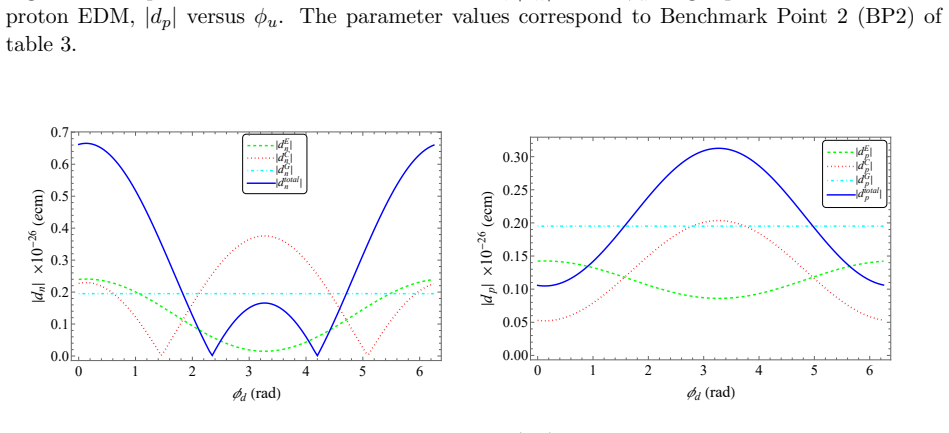
- The purely gluonic dimension-six contribution dominates the neutron and proton EDMs at all four benchmark points, while the electric and chromoelectric pieces interfere constructively or destructively depending on the phases.
- The projected proton EDM sensitivity of 1-3 percent of the current limit would further probe or exclude the surviving regions, making proton EDM measurements a complementary test of multi-TeV SUSY.
- EDM experiments can probe the existence of SUSY partners whose masses are too high for direct production at current colliders.
Reading between the lines
- If the electron EDM limit improves by roughly a factor of five, the allowed squark masses would likely shift above 20 TeV, pushing the scenarios further out of collider reach.
- The seven phase combinations identified here should appear in any EDM analysis of the MSSM, suggesting a model-independent classification that could be applied to other CP-violating observables such as B-meson or muon physics.
- All benchmark points feature a light neutralino at 0.20 TeV, so the viable scenarios imply a stable dark-matter candidate near the kinematic floor; relic-density and direct-detection calculations could test that corollary.
- A full two-loop Higgs-mass calculation, which the paper does not include, could shift the quoted $m_h$ values by 1-2 GeV and would likely relocate the allowed regions or close them entirely.
Signed reviews
Editorial analysis
A structured set of objections, weighed in public.
Referee Report
Summary. The manuscript investigates the combined impact of the measured 125 GeV Higgs mass and the experimental upper bounds on the electron, neutron, and proton EDMs on MSSM soft parameters with generic CP-violating phases. The authors compute m_h from the one-loop top-stop effective potential including CP phases (Section 2), decompose the EDM phase dependence into seven combinations (Section 3), and perform scans in selected slices of parameter space. They identify regions with squark masses around 13-17 TeV and a gluino mass of 2.7 TeV, and present four benchmark points (Tables 2-4) that simultaneously give m_h around 125 GeV and EDMs below the current limits, concluding that the combined constraints severely restrict the MSSM parameter space while allowing O(1) phases.
Significance. If the numerical results were reliable, the paper would provide a useful demonstration that multi-TeV squarks and a 2.7 TeV gluino can simultaneously accommodate the 125 GeV Higgs mass and the EDM limits without fine-tuned phases. Its strengths are the use of established EDM formulas from Ibrahim and Nath, a clear identification of the seven phase combinations, and the explicit benchmark tables with decomposed EDM contributions. The main weakness is that the quantitative claims rest on a one-loop top-stop Higgs mass with no uncertainty estimate and on restricted scans, so the specific 13-17 TeV window is not yet firmly established.
major comments (2)
- [Section 2, Table 2] The lightest Higgs mass is computed from the one-loop top-stop effective potential only, Eqs. (4)-(24), with no higher-order corrections and no estimated theory uncertainty, yet Table 2 quotes m_h to 0.01 GeV (e.g., 125.07 GeV for BP1). For multi-TeV stops with |A_t|=60 TeV, giving X_t/M_S approximately 4, two-loop corrections to m_h in the MSSM are known to shift the result by 1-3 GeV. If the true m_h at the benchmark points is 122-124 GeV, these points no longer reproduce the measured Higgs mass, and the specific 13-17 TeV squark window derived from the m_h contours in Figure 2 loses its numerical support. The authors should either include a state-of-the-art two-loop Higgs-mass calculation (e.g., FeynHiggs or SUSYHD) or, at minimum, assign a +/-2 GeV uncertainty and demonstrate that the benchmark points and the quoted squark window remain viable within that uncertainty.
- [Section 4, Figure 2] The scans shown in Figure 2 are performed on narrow slices: the (M_X, M_Y) plane at fixed tan beta and |mu| with the ad hoc relations M_Rl=2M_X, M_Ll=6M_Y, |A_u|=|A_d|=|A_e|=2M_X, |A_t|=2(M_X+M_Y), and the (tan beta, |mu|) plane at fixed squark masses; the CP phases are fixed to specific O(1) values throughout. The conclusion that the combined constraints leave only regions that satisfy both conditions is therefore stronger than what the scan can support. A full or randomized scan over the soft masses and the seven phases would be needed to establish that these are the only allowed regions rather than examples of allowed regions.
minor comments (4)
- [Section 4, Table 2] Because the benchmark points are chosen from the allowed region after applying both constraints, the agreement in Table 2 is a consistency check rather than a prediction; the text should state this explicitly to avoid the impression of circularity.
- [Section 3, Eqs. (29)-(33)] The SU(6) quark model and naive dimensional analysis estimates for the chromoelectric and purely gluonic contributions carry O(1) hadronic uncertainties, and the paper does not quantify how these would shift the allowed regions in Figure 2. Since the neutron EDM values are within a factor of a few of the experimental bound, the authors should at least discuss the robustness of the benchmark points under such hadronic uncertainties.
- [Global] There are numerous typographical errors, including 'invistigate' in the abstract, 'chagino', 'diople', 'breakig', 'exteded', and 'minimual' in the text; a careful proofreading pass is needed.
- [Eq. (28)] In the chargino contribution to the electron EDM, the denominator is written as sin^2 theta m^2_{nu_e}; please define theta (presumably the weak mixing angle theta_W) and verify the overall normalization, since the current notation is ambiguous.
Circularity Check
No significant circularity: the benchmark points are selected to satisfy the constraints, not presented as predictions, and the self-citations carry standard formulas that are also written out in the paper.
full rationale
The paper's central claim is a parameter-space survey: it scans MSSM soft masses with fixed phase combinations, imposes the experimental EDM upper limits, and selects benchmark points that also lie on the m_h~125 GeV contours. The agreement in Tables 2-4 is therefore built into the selection, but the paper explicitly says the benchmark points 'are chosen from the allowed parameter space' and 'satisfy the Higgs boson mass constraint' rather than claiming independent prediction of m_h or the EDMs. No fitted parameter is renamed as a prediction. The Higgs-mass formulas are derived from the one-loop effective potential given in Eqs. (4)-(24), and the EDM formulas are restated in Appendix A, so the central derivation is self-contained even though notation and earlier results are attributed to the authors' previous papers. Those self-citations are not load-bearing in a circular way: the cited formulas are parameter-free, standard, and do not contain the benchmark-specific outputs. The weaker point, that the one-loop Higgs mass has no quoted theory uncertainty, is a correctness or robustness concern, not a circularity concern. Overall, the derivation chain does not reduce to its own inputs.
Assumptions & free parameters
free parameters (8)
- M_X (common M_U, M_D) =
12.5 to 17 TeV (BP1 to BP4)
- M_Y (M_Q) =
13 to 17.5 TeV (BP1 to BP4)
- |A_u| = |A_d| = |A_e| =
25 to 34 TeV
- |A_t| =
60 TeV
- tan beta =
10, 10, 20, 35
- |mu| =
0.5, 0.5, 1, 3 TeV
- Gaugino and m_A masses (|M_1|, |M_2|, m_g, m_A) =
0.2, 2, 2.7, 0.5 TeV
- Seven CP phases (phi1, phi2, phi3, phi_u, phi_d, phi_t, phi_e) =
1.7, 3.2, 1.7, 0.7, 0.7, 1.7, 1.2 rad
assumptions (5)
- domain assumption MSSM with softly broken supersymmetry and complex parameters is a valid framework for the analysis.
- domain assumption The one-loop effective potential with top-stop loops captures the Higgs mass to the quoted precision.
- domain assumption The EDM formulas in Ref. [17] and the loop functions A, B, C are correct.
- domain assumption The nonrelativistic SU(6) quark model gives reliable neutron and proton EDMs from quark EDMs.
- domain assumption Naive dimensional analysis with eta approximately 3.4 relates the CEDM and gluonic operators to nucleon EDMs.
Cite this review
Pith. "Pith review of Higgs Mass and CP violating Phases Implications on the SUSY Breaking Scale in MSSM." pith.science (2026). https://pith.science/paper/RLXVVRRQ
@misc{pith2026260811869,
  author       = {Pith},
  title        = {Pith review of: Higgs Mass and CP violating Phases Implications on the SUSY Breaking Scale in MSSM},
  year         = {2026},
  howpublished = {\url{https://pith.science/paper/RLXVVRRQ}},
  note         = {Machine review of arXiv:2608.11869}
}
abstract
The large Higgs mass $m_h \approx 125 GeV$ can raise the values of the SUSY breaking parameters in the Minimal Supersymmetric Standard Model MSSM to the range of several TeV scale. The CP violating phases in the MSSM can induce EDMs of the fermions in the theory already in conflict with the current experimental upper limit unless the masses of the SUSY partners are on the heavy side. We invistigate the implications of both constraints, the Higgs Mass and the complete set of SUSY CP violating phases in the analysis of the electric dipole moments EDMs on the SUSY breaking parameters and thus on the SUSY mass spectrum. We use the electric dipole moments of the electron, the neutron and the proton as our probes in this study.
Figures


Figures from the paper (4 more)



Reference graph
Works this paper leans on
-
[1]
S. Coleman and E. Weinberg, Phys. Rev. D7, 1888(1973); S. Weinberg, ibid.,7, 2887(1973)
work page 1973
-
[2]
R. Arnowitt and P. Nath, Phys. Rev. D46, 3981(1992); G. Gamberini, G. Roidolfi and F. Zwirner, Nucl. Phys. B331, 331(1990)
work page 1992
- [3]
-
[4]
A. Pilaftsis, Phys. Rev. D58, 096010(1998); D. A. Demir, Phys. Rev. D60, 055006(1999)
work page 1998
- [5]
- [6]
- [7]
-
[8]
Roussy et al., arXiV:2212.11841, Science V 381, Issue 6653, 46-50 (2023); T
Tanya S. Roussy et al., arXiV:2212.11841, Science V 381, Issue 6653, 46-50 (2023); T. Banno et al., JHEP V 2026 Issue 5, Article Number 277 (2026); ACME Collaboration, Na- ture 562(2018) 7727, 352-360; C. Abel et al., Phys. Rev. Lett. 124(2020) 081803, arXiv: 2001.11966; Christopher B. Crawford, Advancing Physics APS meeting Arhive, March 20, 2025; C. Dus...
arXiv 2023
Show all 23 references
-
[9]
ATLAS collaboration, Phys. Lett. B 716(2012)1. 18
2012
-
[10]
CMS collaboration, Phys. Lett. B 716(2012) 30
2012
-
[11]
Bagnaschi et al., Eur
E. Bagnaschi et al., Eur. Phys. J. C 79 (2019) 149
2019
-
[12]
Ellis et al., Eur
J. Ellis et al., Eur. Phys. J. C 80(2020) 332
2020
-
[13]
Ellis, K
J. Ellis, K. A. Olive, V. C. Spanos and I. D. Stamou, LUX-ZEPLIN, Fermi-LAT, H.E.S.S. and Ice cube, arXiv:2210.16337
-
[14]
For reviews see, P. Nath, R. Arnowitt and A. H. Chamseddine, ”Applied N=1 Supergravity” (World Scientific, Singapore, 1984); H. P. Nilles, Phys.Rep. 110, 1(1984); H. E.Haber and G.Kane, Phys. Rep. 117, 195(1985)
1984
-
[15]
Ibrahim and P
T. Ibrahim and P. Nath, Phys. Rev. D 63(3), 035009(2001)
2001
-
[16]
Ibrahim and P
T. Ibrahim and P. Nath, Phys. Rev. D61(9), 093004(2000)
2000
-
[17]
Ibrahim and P
T. Ibrahim and P. Nath, Phys. Rev. D58, 111301(1998)
1998
-
[18]
Lopez and D
R.Arnowitt, J. Lopez and D. V. Nanopoulos, Phys. Rev. D 42(1990) 2423; E. Braaten, C. S. Li and T. C. Yuan, Phy. Rev. Lett. 64(1990) 1709
1990
-
[19]
J. Dai, H. Dykstra, R. G. Leigh, S. Paban, D. A. Dicus, Phys. Lett. B237 (1990) 216; A. Dicus, Phys. Rev. D41(1990)999
1990
-
[20]
Aad et al
G. Aad et al. (ATLAS Collaboration), Search for squarks and gluinos inppcollisions at √s= 13 TeV and 13.6 TeV in events withτ-leptons, jets and missing transverse momentum using the ATLAS detector, Eur. Phys. J. C85, 1 (2025)
2025
-
[21]
Aad et al
G. Aad et al. (ATLAS Collaboration), Search for direct pair production of top squarks inpp collisions at√s= 13 TeV and 13.6 TeV in events with two oppositely charged leptons using the ATLAS detector, arXiv:2603.16191 [hep-ex]
-
[22]
Hayrapetyan et al
A. Hayrapetyan et al. (CMS Collaboration), Search for top squarks in final states with many light-flavor jets and 0, 1, or 2 charged leptons in proton-proton collisions at √s= 13 TeV, J. High Energy Phys.10, 236 (2025)
2025
-
[23]
Aghanim et al
N. Aghanim et al. (Planck Collaboration), Planck 2018 results. VI. Cosmological parameters, Astron. Astrophys.641, A6 (2020). 19
2020
Reviewed August 16, 2026 · model on record in the stance chip above.
Discussion (0). Continue with ORCID to comment.