REVIEW 3 major objections 4 minor 140 references
Spin-polarized supercurrents and Josephson diode effect in altermagnets
T0 review · 3 major / 4 minor · reviewed 2026-08-16 · deepseek-v4-flash
Pith's one-line read In a strongly spin-polarized altermagnet junction, a noncoplanar exchange-field profile gives rise to a Josephson diode effect, with charge diode efficiency above 30% and a perfect 100% spin diode efficiency.
desk verdict A competent extension of the group's quantum-geometric diode machinery to altermagnets, with specific testable predictions, but the headline efficiency rests on an unverified truncation and omitted S-matrix algebra. read the letter →
The pith
A machine-rendered reading of the paper's core claim, the machinery that carries it, and where it could break.
The reading
What carries the argument
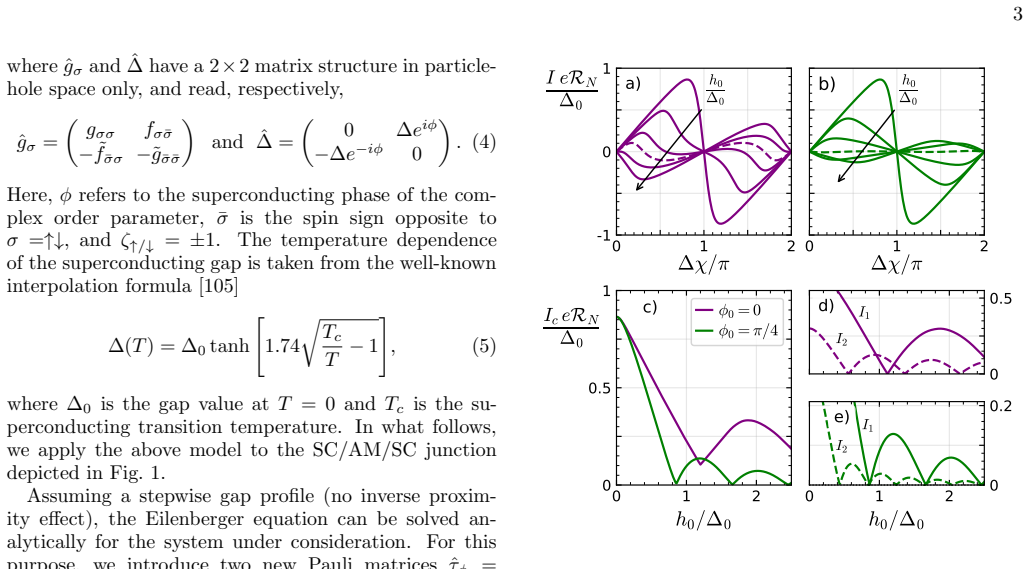
The load-bearing object is the quantum geometric phase difference $\Delta\varphi=\varphi_R-\varphi_L$, the relative azimuthal angle between the exchange-field vectors of the two spin-active interfacial layers around the altermagnet quantization axis. Noncoplanarity, $(\mathbf{J}_L\times\mathbf{J}_R)\cdot\mathbf{h}\neq 0$, makes $\Delta\varphi$ enter the spin-resolved Josephson current–phase relation like a second phase variable: a process transferring $\mu$ $\uparrow\uparrow$ pairs and $\nu$ $\downarrow\downarrow$ pairs acquires the effective phase $\psi_{\mu\nu}=(\mu+\nu)\Delta\chi-(\mu-\nu)\Delta\varphi$. For $\Delta\varphi=n\pi$ the profile is coplanar and inversion symmetry is restored, while for noncoplanar $\Delta\varphi$ the CPR has no inversion center. In the strongly spin-polarized regime the system is described by two decoupled spin-scalar Eilenberger equations with band-specific Fermi velocities and densities of states, and the diode effect is enhanced by the half-metallic Fermi-surface region of the altermagnet.
What would settle it
Solve the same superconductor/altermagnet/superconductor junction with a full two-band calculation that keeps the mixed-spin propagator, and compare the charge and spin diode efficiencies at $\Delta\varphi\approx 0.65\pi$ and $h_0=0.5E_F$; a substantial change in the asymmetry would show the strong-polarization truncation is the weak link. Alternatively, measure the critical currents of a clean junction with two ferromagnetic-insulator barriers while rotating one exchange field azimuthally and look for $\eta_{\mathrm{ch}}\approx 33.7\%$ with the $d_{x^2-y^2}$ orientation.
Extended reading notes
Core claim
For a strongly spin-polarized altermagnet, with exchange field comparable to the Fermi energy, Josephson transport is carried by equal-spin triplet pairs in two decoupled spin bands. When two spin-active interfaces have noncoplanar exchange-field vectors, the current–phase relation has no inversion center: $I(-\Delta\chi)\neq -I(\Delta\chi)$, so the positive and negative critical currents differ. For the $d_{x^2-y^2}$ orientation at geometric phase $\Delta\varphi\approx 0.65\pi$ the charge diode efficiency reaches $\eta_{\mathrm{ch}}\approx 33.7\%$, and near $\Delta\varphi=n\pi$ the spin diode efficiency reaches $\eta_{\mathrm{sp}}=100\%$ for suitable altermagnet orientations. The effect is amplified by the half-metallic contribution to the supercurrent and vanishes for the $d_{xy}$ orientation.
Load-bearing premise
The argument assumes that in a strongly spin-polarized altermagnet the mixed-spin pairing correlations decay so quickly that they can be discarded, leaving only equal-spin correlations; if that length-scale separation fails, the two spin bands would hybridize and the diode efficiencies could change.
Editorial extensions
If this is right
- A Josephson diode can be realized in an altermagnet-based junction without spin-orbit coupling by engineering two spin-active interfaces with a relative azimuthal twist.
- Charge transport becomes nonreciprocal, with more than 30% diode efficiency for the $d_{x^2-y^2}$ orientation, while the same junction acts as a near-perfect spin-current rectifier in other parameter regions.
- In weakly spin-polarized altermagnets the junction remains reciprocal and undergoes $0$–$\pi$ transitions, so nonreciprocity is a signature of the strongly spin-polarized regime.
- Rotating the altermagnet from $d_{x^2-y^2}$ toward $d_{xy}$ continuously weakens and finally switches off the diode effect, providing orientational control.
- Two spin-active interfaces make all CPR harmonics long-ranged, whereas one spin-active and one non-spin-active interface admit only even harmonics.
Reading between the lines
- If mixed-spin correlations decay only on lengths much longer than the Fermi wavelength, short junctions could show noticeably lower diode efficiencies than the quoted $33.7\%$.
- The $100\%$ spin diode efficiency suggests a practical superconducting spin rectifier: a device that lets spin-up supercurrent pass preferentially in one direction and spin-down current in the opposite direction.
- The same quantum-geometric mechanism is likely to transfer to other strongly spin-polarized magnets with anisotropic Fermi surfaces; the altermagnet's $d$-wave symmetry adds a clean orientational knob.
- Because the paper states no fundamental upper bound on the charge efficiency, a wider parameter search around $h_0\sim 0.4E_F$ and intermediate temperatures may push $\eta_{\mathrm{ch}}$ beyond $33.7\%$.
Signed reviews
Editorial analysis
A structured set of objections, weighed in public.
Referee Report
Summary. This manuscript develops a quasiclassical Green's-function theory for superconductor/altermagnet/superconductor (SC/AM/SC) Josephson junctions with spin-active interfaces, treating separately a weakly spin-polarized regime (exchange field much smaller than the Fermi energy) and a strongly spin-polarized regime (exchange field comparable to the Fermi energy). In the weak regime the authors find a normal Josephson effect with 0-pi transitions, with the d_{x^2-y^2} orientation behaving ferromagnet-like and the d_xy orientation antiferromagnet-like. In the strong regime, for coplanar interfacial exchange fields they find a normal Josephson effect with long-range higher harmonics, and for noncoplanar exchange fields they predict a Josephson diode effect with a charge diode efficiency up to eta_ch ~ 33.7% and a spin diode efficiency up to eta_sp = 100%. The technical framework combines Riccati parametrization of the Eilenberger equation, S-matrix boundary conditions, and Fermi-surface averaging over spin-split altermagnetic bands.
Significance. If the quantitative predictions hold, the paper shows a route to spin-polarized supercurrents and a Josephson diode effect in altermagnets without spin-orbit coupling, controlled by the azimuthal misalignment of two spin-active interfaces. The main strengths are the coherent analytical structure, the explicit treatment of two distinct spin-polarization regimes, the orientation-dependent Fermi-surface effects, and the absence of any fitting to experimental data. The paper also provides a transparent harmonic expansion in terms of coherent transport of equal-spin pairs, which is falsifiable. However, the central quantitative results rest on an approximation whose accuracy is not benchmarked and on S-matrix expressions that are not given, so the 33.7% and 100% efficiency values cannot currently be independently verified.
major comments (3)
- [Sec. V D and Sec. III B/C (Eqs. (43), (44))] The central quantitative claims, including eta_ch ≈ 33.7% and eta_sp = 100%, are computed from the equal-spin-only equation, Eq. (44), after dropping the mixed-spin equation, Eq. (43). The justification in Sec. V D is a bulk length-scale argument: mixed-spin correlations decay over the exchange coherence length ~ hbar v_F / h0, which for h0 ~ E_F is comparable to the Fermi wavelength. However, the S-matrix boundary condition in Eq. (33) contains off-diagonal spin-flip elements, and the iterative boundary-condition procedure scatters between spin channels at each interface. The bulk decay of the mixed-spin propagator does not by itself bound the mixed-spin amplitudes generated by repeated interface scattering and Andreev reflection over the finite junction length d = xi used in Figs. 4-6. Because the diode efficiencies are extracted from the critical currents, even a small mixed-spin admixture could shift the harmonic coefficients in Fig. 7 and thus eta_ch and eta_sp. The manuscript should either solve the coupled Eqs. (43) and (44) with the full spin-dependent boundary conditions for the same parameters, or provide a quantitative estimate showing that the interface-generated mixed-spin amplitudes are exponentially small at d = xi.
- [Sec. V A and Supporting Information Sec. I (Eq. (33))] The S-matrix in Eq. (33) is the key input to the boundary-condition iteration and therefore controls all numerical results in Sec. III, including the quoted diode efficiencies. Yet the main text states that the S-matrix expression is 'straightforward and lengthy' and refers to the Supplemental Material, while the Supporting Information says only that the final expressions are lengthy and 'obtained straightforwardly' without presenting them. Without explicit formulas for R_1, T_12, T_13, r_22, r_23, r_32, and r_33, or a documented and accessible code implementing them, the reader cannot reproduce Figs. 4-6 or check the half-metallic transmission criterion that is essential for the diode effect. This is not a presentation issue; it directly affects the verifiability of the paper's central quantitative claims.
- [Sec. III B, noncoplanarity condition and Sec. III C] The noncoplanarity condition is stated as h J_L J_R sin(alpha_L) sin(alpha_R) cos(varphi_R - varphi_L) != 0. With the parametrization J_i = J_i [sin(alpha_i) cos(varphi_i), sin(alpha_i) sin(varphi_i), cos(alpha_i)]^T and h = h e_z, the scalar triple product h . (J_L x J_R) is proportional to sin(varphi_R - varphi_L), not cos(varphi_R - varphi_L). The displayed condition as written implies that Delta_phi = pi/2 is coplanar, which contradicts the geometric definition. This is also inconsistent with the statement in Sec. III B that the JDE is absent for Delta_phi = n pi, and with the later claim in Sec. III C that the JDE vanishes for Delta_phi = k pi/2. The correct condition and the symmetry responsible for the vanishing of eta_ch at Delta_phi = pi/2 (if indeed it vanishes) should be stated explicitly, since the range of Delta_phi over which the diode effect exists is central to the paper's message.
minor comments (4)
- [Fig. 1 caption vs Supporting Information Fig. 1] The main-text Fig. 1 caption says the altermagnet is shown in the d_xy orientation with phi_0 = pi/4, but the Supporting Information Fig. 1 caption states 'd_{x^2-y^2} orientation (phi_0 = pi/4)' while the main text defines phi_0 = 0 as the d_{x^2-y^2} orientation. Please correct the inconsistency.
- [Abstract and Sec. IV] The abstract and Sec. III C quote the maximum charge diode efficiency as 'larger than 30%' and eta_ch ≈ 33.7%, while Sec. IV states eta_ch ≈ 32%. These numbers should be made consistent for the same parameter set.
- [Sec. V D] The text says the thermal coherence length for equal-spin triplets is ~ hbar v_F/(k_B T); the standard clean-limit length scale is hbar v_F/(2 pi k_B T), and the numerical factor should be checked.
- [Eqs. (26)-(28)] The harmonic expansion for I_sigma with coefficients I_mu,nu is stated to be suggested by numerical study; a brief derivation or a statement of the symmetry assumptions underlying I_{-mu,-nu} = I_mu,nu would help the reader assess the completeness of the expansion.
Circularity Check
No circular reduction: CPRs and diode efficiencies are computed outputs; self-citations are contextual, not load-bearing.
full rationale
The derivation chain is self-contained in the sense required by this pass. The CPRs and diode efficiencies are outputs of the stated model: the interface angles (α_i, φ_i), Δφ, thickness d, h0/EF, and T/Tc are inputs; I_ch(Δχ, Δφ) is computed from the strongly spin-polarized Eilenberger equation [Eq. (53)] with Riccati parametrization and S-matrix boundary conditions; η_ch and η_sp are read off the computed CPR via Eq. (23). No parameter is fitted to the predicted efficiencies, so the 'fitted input called prediction' pattern does not occur. The harmonic expansion in Eqs. (26)-(28) is introduced as a post hoc Fourier representation, numerically confirmed in Fig. 7, not as an input that forces the CPR. Self-citations (Refs. [50,71,72,103,104,125]) supply the ferromagnet formalism and the 'quantum geometric phase' vocabulary, but the altermagnet-specific quantities—the d-wave momentum dependence h(p_F, φ0), orientation dependence, Fermi-surface mismatch, and half-metallic channels—are evaluated in the present calculation, so there is no exhibited reduction of the central result to those prior papers. The main caveat is the stated truncation in Sec. V D, where Eq. (43) is dropped and only Eq. (44) is kept because mixed-spin correlations decay on the exchange length; this is a physical approximation with a length-scale argument, not a circularity. The paper itself flags the regime where the model is not quantitatively valid (green hatched area in Fig. 5(d)) and notes that conclusions remain qualitative for d ≫ ξ. If residual mixed-spin correlations were significant at d = ξ, the efficiencies could shift, but that is a correctness or robustness risk, not a circular-input risk. The absence of the S-matrix algebra and code from the text limits independent reproducibility but does not make the derivation circular.
Assumptions & free parameters
free parameters (6)
- h0/EF (altermagnetic exchange field strength) =
0.25, 0.375, 0.5, 0.625, 0.75 in Fig. 5(c,d); h0/EF=0.5 in Fig. 4
- Interface barrier parameters V_i, J_i =
V_i=0.2, J_i=0.1 (dimensionless BTK-like); J_L=0 or J_R=0 in the bilayer case
- Quantum geometric phase Delta_phi =
Scanned from 0 to 2 pi; maximum charge efficiency near 0.65 pi, spin efficiency near pi
- Altermagnet orientation phi0 =
0 (dx2-y2), pi/8, pi/4 (dxy)
- Junction thickness d =
d=xi (one superconducting coherence length)
- Temperature T/Tc =
0.1 in main figures; varied from 0 to 1 in Fig. 5(c)
assumptions (6)
- domain assumption BCS superconducting gap has a stepwise profile, with no inverse proximity effect at the SC/AM interfaces.
- domain assumption In the strongly spin-polarized regime, mixed-spin correlations decay on the Fermi-wavelength scale and can be neglected relative to equal-spin triplets on mesoscopic lengths.
- domain assumption The system is a clean ballistic 2D film; no impurity or other scattering processes in the altermagnet, so Sigma_sigma=0.
- domain assumption The SC/AM interfaces are modeled by spin-dependent delta potentials and S-matrix boundary conditions.
- domain assumption The altermagnetic exchange field has the d-wave even-parity momentum dependence given in Eq. (30), with Fermi surfaces differing per spin band.
- domain assumption The effective Josephson phase for multiple equal-spin pair transfer is (mu+nu)Delta_chi - (mu-nu)Delta_phi, with Delta_phi the quantum geometric phase.
Cite this review
Pith. "Pith review of Spin-polarized supercurrents and Josephson diode effect in altermagnets." pith.science (2026). https://pith.science/paper/TA7FEFPN
@misc{pith2026260811906,
  author       = {Pith},
  title        = {Pith review of: Spin-polarized supercurrents and Josephson diode effect in altermagnets},
  year         = {2026},
  howpublished = {\url{https://pith.science/paper/TA7FEFPN}},
  note         = {Machine review of arXiv:2608.11906}
}
abstract
We present a systematic theoretical study of the Josephson effect in junctions consisting of a d-wave altermagnet (AM) placed between two BCS superconductors (SC). In general, the SC/AM interfaces are spin-active and modeled by spin-dependent $\delta$ potentials, allowing for an arbitrary direction of the local exchange field vector. The model is formulated within the fully quantum (Gor'kov) and quasiclassical (Eilenberger) Green's function technique, applied to two distinct cases of (i) a weakly spin-polarized AM (exchange field much smaller compared to the Fermi energy) and (ii) a strongly spin-polarized AM (exchange field comparable to the Fermi energy). We apply our model to the SC/AM/SC geometry, accounting for the Josephson current-phase relation (CPR). In the weakly spin-polarized regime, the CPR displays the normal Josephson effect. Irrespective of the orientation of the altermagnet, the junction undergoes the $0-\pi$ transition. Depending on the orientation, the system displays the features similar to those of a ferromagnetic or an antiferromagnetic junction. To investigate the spin-polarized currents and nonreciprocal transport as the central results of the present work, we put the main focus on the strongly spin-polarized regime. Within this regime, we distinguish two cases. A coplanar exchange field profile across the junctions displays the normal Josephson effect; however, with a pure and stable long-range second harmonic in the CPR. In contrast, a noncoplanar exchange field profile gives rise to the so-called quantum geometric phases across the junction, leading to the absence of the phase-inversion center in the Josephson CPR. As a result, a Josephson diode effect emerges with a significant charge diode efficiency larger than 30% and a perfect spin diode efficiency of 100%.
Figures


Figures from the paper (7 more)


Reference graph
Works this paper leans on
-
[1]
In addition, the critical current decreases monotonically withα R until it completely diminishes forα R = 0, due to the absence of equal-spin triplets in this regime
Remarkably, the CPR contains only even harmonics. In addition, the critical current decreases monotonically withα R until it completely diminishes forα R = 0, due to the absence of equal-spin triplets in this regime. To quantify the effect, in Fig. 3(d), we present the Fourier coefficients,I n, obtained from Eq. (22) for the trilayer (violet bars) and the...
-
[2]
Eschrig, J
M. Eschrig, J. Kopu, A. Konstandin, J. Cuevas, M. Fo- gelstr¨ om, and G. Sch¨ on, Singlet-Triplet Mixing in Superconductor–Ferromagnet Hybrid Devices, inAd- vances in Solid State Physics, edited by B. Kramer (Springer Berlin Heidelberg, Berlin, Heidelberg, 2004) pp. 533–545
2004
-
[3]
A. I. Buzdin, Proximity effects in superconductor- ferromagnet heterostructures, Reviews of Modern Physics77, 935 (2005)
2005
-
[4]
F. S. Bergeret, A. F. Volkov, and K. B. Efetov, Odd triplet superconductivity and related phenomena in superconductor-ferromagnet structures, Reviews of Modern Physics77, 1321 (2005)
2005
-
[5]
Eschrig, Spin-polarized supercurrents for spintron- ics, Physics Today64, 43 (2011)
M. Eschrig, Spin-polarized supercurrents for spintron- ics, Physics Today64, 43 (2011)
2011
-
[6]
Eschrig, Spin-polarized supercurrents for spintron- ics: A review of current progress, Reports on Progress in Physics78, 104501 (2015)
M. Eschrig, Spin-polarized supercurrents for spintron- ics: A review of current progress, Reports on Progress in Physics78, 104501 (2015)
2015
-
[7]
Linder and J
J. Linder and J. W. A. Robinson, Superconducting spin- tronics, Nature Physics11, 307 (2015)
2015
-
[8]
N. O. Birge, Spin-triplet supercurrents in Josephson junctions containing strong ferromagnetic materials, Philosophical Transactions of the Royal Society A: Mathematical, Physical and Engineering Sciences376, 20150150 (2018)
2018
Show all 140 references
-
[9]
Linder and A
J. Linder and A. V. Balatsky, Odd-frequency super- conductivity, Reviews of Modern Physics91, 045005 (2019)
2019
-
[10]
G. Yang, C. Ciccarelli, and J. W. A. Robinson, Boosting spintronics with superconductivity, APL Materials9, 050703 (2021)
2021
-
[11]
R. Cai, I. ˇZuti´ c, and W. Han, Superconduc- tor/Ferromagnet Heterostructures: A Platform for Su- perconducting Spintronics and Quantum Computation, Advanced Quantum Technologies6, 2200080 (2023)
2023
-
[12]
Tokuyasu, J
T. Tokuyasu, J. A. Sauls, and D. Rainer, Proximity ef- fect of a ferromagnetic insulator in contact with a su- perconductor, Physical Review B38, 8823 (1988)
1988
-
[13]
E. A. Demler, G. B. Arnold, and M. R. Beasley, Super- conducting proximity effects in magnetic metals, Phys- ical Review B55, 15174 (1997)
1997
-
[14]
F. S. Bergeret, A. F. Volkov, and K. B. Efe- tov, Long-Range Proximity Effects in Superconductor- Ferromagnet Structures, Physical Review Letters86, 4096 (2001)
2001
-
[15]
Eschrig, T
M. Eschrig, T. L¨ ofwander, T. Champel, J. C. Cuevas, J. Kopu, and G. Sch¨ on, Symmetries of Pairing Correla- tions in Superconductor–Ferromagnet Nanostructures, Journal of Low Temperature Physics147, 457 (2007)
2007
-
[16]
Tanaka and A
Y. Tanaka and A. A. Golubov, Theory of the Proximity Effect in Junctions with Unconventional Superconduc- tors, Physical Review Letters98, 037003 (2007)
2007
-
[17]
R. S. Keizer, S. T. B. Goennenwein, T. M. Klapwijk, G. Miao, G. Xiao, and A. Gupta, A spin triplet su- percurrent through the half-metallic ferromagnet CrO2, Nature439, 825 (2006)
2006
-
[18]
T. S. Khaire, M. A. Khasawneh, W. P. Pratt, and N. O. Birge, Observation of Spin-Triplet Superconductivity in Co-Based Josephson Junctions, Physical Review Letters 104, 137002 (2010)
2010
-
[19]
M. S. Anwar, F. Czeschka, M. Hesselberth, M. Porcu, and J. Aarts, Long-range supercurrents through half- metallic ferromagnetic CrO2, Physical Review B82, 100501 (2010)
2010
-
[20]
J. W. A. Robinson, J. D. S. Witt, and M. G. Blamire, Controlled Injection of Spin-Triplet Supercurrents into a Strong Ferromagnet, Science329, 59 (2010)
2010
-
[21]
J. A. Glick, V. Aguilar, A. B. Gougam, B. M. Niedziel- ski, E. C. Gingrich, R. Loloee, W. P. Pratt, and N. O. Birge, Phase control in a spin-triplet squid, Science Ad- vances4, eaat9457 (2018)
2018
-
[22]
Caruso, D
R. Caruso, D. Massarotti, G. Campagnano, A. Pal, H. G. Ahmad, P. Lucignano, M. Eschrig, M. G. Blamire, and F. Tafuri, Tuning of magnetic activity in spin- filter josephson junctions towards spin-triplet transport, Physical Review Letters122, 047002 (2019)
2019
-
[23]
Aguilar, D
V. Aguilar, D. Korucu, J. A. Glick, R. Loloee, W. P. Pratt, and N. O. Birge, Spin-polarized triplet super- current in josephson junctions with perpendicular ferro- magnetic layers, Physical Review B102, 024518 (2020)
2020
-
[24]
ˇSmejkal, J
L. ˇSmejkal, J. Sinova, and T. Jungwirth, Beyond Con- ventional Ferromagnetism and Antiferromagnetism: A Phase with Nonrelativistic Spin and Crystal Rotation Symmetry, Physical Review X12, 031042 (2022)
2022
-
[25]
ˇSmejkal, J
L. ˇSmejkal, J. Sinova, and T. Jungwirth, Emerging Re- search Landscape of Altermagnetism, Physical Review X12, 040501 (2022)
2022
-
[26]
Z. Feng, X. Zhou, L. ˇSmejkal, L. Wu, Z. Zhu, H. Guo, R. Gonz´ alez-Hern´ andez, X. Wang, H. Yan, P. Qin, X. Zhang, H. Wu, H. Chen, Z. Meng, L. Liu, Z. Xia, J. Sinova, T. Jungwirth, and Z. Liu, An anomalous Hall effect in altermagnetic ruthenium dioxide, Nature Elec- tronics5,...
2022
-
[27]
Brinkman and R
W. Brinkman and R. J. Elliott, Space Group Theory for Spin Waves, Journal of Applied Physics37, 1457 (1966)
1966
-
[28]
W. F. Brinkman and R. J. Elliott, Theory of Spin-Space Groups, Proceedings of the Royal Society of London. 15 Series A, Mathematical and Physical Sciences294, 343 (1966), 2415409
1966
-
[29]
D. B. Litvin and W. Opechowski, Spin groups, Physica 76, 538 (1974)
1974
-
[30]
Litvin, Spin point groups, Acta Crystallographica Section A - ACTA CRYSTALLOGR A33, 279 (1977)
D. Litvin, Spin point groups, Acta Crystallographica Section A - ACTA CRYSTALLOGR A33, 279 (1977)
1977
-
[31]
P. Liu, J. Li, J. Han, X. Wan, and Q. Liu, Spin-Group Symmetry in Magnetic Materials with Negligible Spin- Orbit Coupling, Physical Review X12, 021016 (2022)
2022
-
[32]
ˇSmejkal, R
L. ˇSmejkal, R. Gonz´ alez-Hern´ andez, T. Jungwirth, and J. Sinova, Crystal time-reversal symmetry breaking and spontaneous Hall effect in collinear antiferromagnets, Sci. Adv.6, 10.1126/sciadv.aaz8809 (2020)
2020 doi
-
[33]
H. Bai, L. Han, X. Y. Feng, Y. J. Zhou, R. X. Su, Q. Wang, L. Y. Liao, W. X. Zhu, X. Z. Chen, F. Pan, X. L. Fan, and C. Song, Observation of Spin Splitting Torque in a Collinear Antiferromagnet RuO2, Physical Review Letters128, 197202 (2022)
2022
-
[34]
H. Bai, Y. C. Zhang, Y. J. Zhou, P. Chen, C. H. Wan, L. Han, W. X. Zhu, S. X. Liang, Y. C. Su, X. F. Han, F. Pan, and C. Song, Efficient Spin-to-Charge Conver- sion via Altermagnetic Spin Splitting Effect in Antifer- romagnet RuO2, Physical Review Letters130, 216701 (2023)
2023
-
[35]
Baltz, A
V. Baltz, A. Manchon, M. Tsoi, T. Moriyama, T. Ono, and Y. Tserkovnyak, Antiferromagnetic spintronics, Re- views of Modern Physics90, 015005 (2018)
2018
-
[36]
A. A. Golubov, M. Yu. Kupriyanov, and E. Il’ichev, The current-phase relation in Josephson junctions, Review of Modern Physics76, 411 (2004)
2004
-
[37]
V. B. Geshkenbein and A. I. Larkin, The josephson ef- fect in superconductors with heavy fermions, Pis’ma Zh. Eksp. Teor. Fiz.43, 306 (1986)
1986
-
[38]
Yip, Josephson current-phase relationships with un- conventional superconductors, Physical Review B52, 3087 (1995)
S. Yip, Josephson current-phase relationships with un- conventional superconductors, Physical Review B52, 3087 (1995)
1995
-
[39]
Sigrist, Time-reversal symmetry breaking states in high-temperature superconductors, Progress of Theo- retical Physics99, 899 (1998)
M. Sigrist, Time-reversal symmetry breaking states in high-temperature superconductors, Progress of Theo- retical Physics99, 899 (1998)
1998
-
[40]
Buzdin, Direct coupling between magnetism and su- perconducting current in the josephsonφ 0 junction, Physical Review Letters101, 107005 (2008)
A. Buzdin, Direct coupling between magnetism and su- perconducting current in the josephsonφ 0 junction, Physical Review Letters101, 107005 (2008)
2008
-
[41]
Nadeem, M
M. Nadeem, M. S. Fuhrer, and X. Wang, The super- conducting diode effect, Nature Reviews Physics5, 558 (2023)
2023
-
[42]
Shaffer and A
D. Shaffer and A. Levchenko, Theories of Su- perconducting Diode Effects, arXiv:2510.25864 https://doi.org/10.48550/arXiv.2510.25864 (2025)
2025 doi
-
[43]
F. Ando, Y. Miyasaka, T. Li, J. Ishizuka, T. Arakawa, Y. Shiota, T. Moriyama, Y. Yanase, and T. Ono, Ob- servation of superconducting diode effect, Nature584, 373 (2020)
2020
-
[44]
Baumgartner, L
C. Baumgartner, L. Fuchs, A. Costa, S. Reinhardt, S. Gronin, G. C. Gardner, T. Lindemann, M. J. Manfra, P. E. Faria Junior, D. Kochan, J. Fabian, N. Paradiso, and C. Strunk, Supercurrent rectification and magne- tochiral effects in symmetric Josephson junctions, Na- ture Nanot...
2022
-
[45]
Costa, C
A. Costa, C. Baumgartner, S. Reinhardt, J. Berger, S. Gronin, G. C. Gardner, T. Lindemann, M. J. Man- fra, J. Fabian, D. Kochan, N. Paradiso, and C. Strunk, Sign reversal of the Josephson inductance magnetochi- ral anisotropy and 0–π-like transitions in supercurrent diodes, Na...
2023
-
[46]
Gutfreund, H
A. Gutfreund, H. Matsuki, V. Plastovets, A. Noah, L. Gorzawski, N. Fridman, G. Yang, A. Buzdin, O. Millo, J. W. A. Robinson, and Y. Anahory, Direct observation of a superconducting vortex diode, Nature Communications14, 1630 (2023)
2023
-
[47]
Y. Hou, F. Nichele, H. Chi, A. Lodesani, Y. Wu, M. F. Ritter, D. Z. Haxell, M. Davydova, S. Ili´ c, O. Glezakou- Elbert, A. Varambally, F. S. Bergeret, A. Kamra, L. Fu, P. A. Lee, and J. S. Moodera, Ubiquitous Superconduct- ing Diode Effect in Superconductor Thin Films, Physi-...
2023
-
[48]
Strambini, M
E. Strambini, M. Spies, N. Ligato, S. Ili´ c, M. Rouco, C. Gonz´ alez-Orellana, M. Ilyn, C. Rogero, F. S. Berg- eret, J. S. Moodera, P. Virtanen, T. T. Heikkil¨ a, and F. Giazotto, Superconducting spintronic tunnel diode, Nature Communications13, 2431 (2022)
2022
-
[49]
Trahms, L
M. Trahms, L. Melischek, J. F. Steiner, B. Mahendru, I. Tamir, N. Bogdanoff, O. Peters, G. Reecht, C. B. Winkelmann, F. von Oppen, and K. J. Franke, Diode ef- fect in Josephson junctions with a single magnetic atom, Nature615, 628 (2023)
2023
-
[50]
Reinhardt, T
S. Reinhardt, T. Ascherl, A. Costa, J. Berger, S. Gronin, G. C. Gardner, T. Lindemann, M. J. Manfra, J. Fabian, D. Kochan, C. Strunk, and N. Paradiso, Link between supercurrent diode and anomalous Josephson effect re- vealed by gate-controlled interferometry, Nature Com- munic...
2024
-
[51]
Grein, M
R. Grein, M. Eschrig, G. Metalidis, and G. Sch¨ on, Spin- Dependent Cooper Pair Phase and Pure Spin Super- currents in Strongly Polarized Ferromagnets, Physical Review Letters102, 227005 (2009)
2009
-
[52]
Daido, Y
A. Daido, Y. Ikeda, and Y. Yanase, Intrinsic Super- conducting Diode Effect, Physical Review Letters128, 037001 (2022)
2022
-
[53]
Ya. V. Fominov and D. S. Mikhailov, Asymmetric higher-harmonic SQUID as a Josephson diode, Physi- cal Review B106, 134514 (2022)
2022
-
[54]
Halterman, M
K. Halterman, M. Alidoust, R. Smith, and S. Starr, Su- percurrent diode effect, spin torques, and robust zero- energy peak in planar half-metallic trilayers, Physical Review B105, 104508 (2022)
2022
-
[55]
J. J. He, Y. Tanaka, and N. Nagaosa, A phenomeno- logical theory of superconductor diodes, New Journal of Physics24, 053014 (2022)
2022
-
[56]
Ili´ c and F
S. Ili´ c and F. S. Bergeret, Theory of the Supercurrent Diode Effect in Rashba Superconductors with Arbitrary Disorder, Physical Review Letters128, 177001 (2022)
2022
-
[57]
Karabassov, I
T. Karabassov, I. V. Bobkova, A. A. Golubov, and A. S. Vasenko, Hybrid helical state and superconducting diode effect in superconductor/ferromagnet/topological insulator heterostructures, Physical Review B106, 224509 (2022)
2022
-
[58]
A. A. Kopasov, A. G. Kutlin, and A. S. Mel’nikov, Ge- ometry controlled superconducting diode and anoma- lous Josephson effect triggered by the topological phase transition in curved proximitized nanowires, Physical Review B103, 144520 (2021)
2021
-
[59]
Misaki and N
K. Misaki and N. Nagaosa, Theory of the nonreciprocal Josephson effect, Physical Review B103, 245302 (2021)
2021
-
[60]
Tanaka, B
Y. Tanaka, B. Lu, and N. Nagaosa, Theory of giant diode effect in d -wave superconductor junctions on the surface of a topological insulator, Physical Review B 106, 214524 (2022). 16
2022
-
[61]
N. F. Q. Yuan and L. Fu, Supercurrent diode effect and finite-momentum superconductors, Proceedings of the National Academy of Sciences119, e2119548119 (2022)
2022
-
[62]
Zhang, Y
Y. Zhang, Y. Gu, P. Li, J. Hu, and K. Jiang, Gen- eral Theory of Josephson Diodes, Physical Review X 12, 041013 (2022)
2022
-
[63]
Zinkl, K
B. Zinkl, K. Hamamoto, and M. Sigrist, Symmetry con- ditions for the superconducting diode effect in chiral superconductors, Physical Review Research4, 033167 (2022)
2022
-
[64]
R. S. Souto, M. Leijnse, and C. Schrade, Josephson Diode Effect in Supercurrent Interferometers, Physical Review Letters129, 267702 (2022)
2022
-
[65]
J. F. Steiner, L. Melischek, M. Trahms, K. J. Franke, and F. Von Oppen, Diode Effects in Current-Biased Josephson Junctions, Physical Review Letters130, 177002 (2023)
2023
-
[66]
Costa, J
A. Costa, J. Fabian, and D. Kochan, Microscopic study of the Josephson supercurrent diode effect in Josephson junctions based on two-dimensional electron gas, Phys- ical Review B108, 054522 (2023)
2023
-
[67]
A. A. Kopasov, Zh. Devizorova, H. Meng, S. V. Mironov, A. S. Mel’nikov, and A. I. Buzdin, Adiabatic phase pumping in S/F/S hybrids with noncoplanar magnetization, Physical Review B108, 224511 (2023)
2023
-
[68]
J. S. Meyer and M. Houzet, Josephson diode effect in a ballistic single-channel nanowire, Applied Physics Let- ters125, 022603 (2024)
2024
-
[69]
A. V. Putilov, S. V. Mironov, and A. I. Buzdin, Nonre- ciprocal electron transport in finite-size superconduc- tor/ferromagnet bilayers with strong spin-orbit cou- pling, Physical Review B109, 014510 (2024)
2024
-
[70]
J. B. Tjernshaugen, M. Amundsen, and J. Linder, Su- perconducting phase diagram and spin diode effect via spin accumulation, Physical Review B109, 094516 (2024)
2024
-
[71]
Patil, G
S. Patil, G. Tang, and W. Belzig, Spin-split andreev bound states and diode effect in an ising superconductor josephson junction, Physical Review B111, L060502 (2025)
2025
-
[72]
N. L. Schulz, D. Nikoli´ c, and M. Eschrig, Quantum- geometric spin and charge Josephson diode effects, Physical Review B112, 104514 (2025)
2025
-
[73]
N. L. Schulz, D. Nikoli´ c, and M. Eschrig, Theory of quantum-geometric charge and spin Josephson diode ef- fects in strongly spin-polarized hybrid structures with noncoplanar spin textures, Physical Review B112, 104515 (2025)
2025
-
[74]
Chourasia, A
S. Chourasia, A. Svetogorov, A. Kamra, and W. Belzig, Thermodynamic properties of a superconductor inter- faced with an altermagnet, Physical Review B111, 224503 (2025)
2025
-
[76]
Papaj, Andreev reflection at the altermagnet- superconductor interface, Physical Review B108, L060508 (2023)
M. Papaj, Andreev reflection at the altermagnet- superconductor interface, Physical Review B108, L060508 (2023)
2023
-
[77]
Zhang, L.-H
S.-B. Zhang, L.-H. Hu, and T. Neupert, Finite- momentum Cooper pairing in proximitized altermag- nets, Nature Communications15, 1801 (2024)
2024
-
[78]
M. M. Vasiakin and A. S. Mel’nikov, Disorder-enhanced superconductivity in altermagnet-superconductor hy- brids, Physical Review B111, L100502 (2025)
2025
-
[79]
P. O. Sukhachov, E. W. Hodt, and J. Linder, Thermo- electric effect in altermagnet-superconductor junctions, Physical Review B110, 094508 (2024)
2024
-
[80]
O. Alam, A. Pal, P. Dutta, and A. Saha, Proximity- induced superconductivity and emerging topological phases in altermagnet-based heterostructures, Phys. Rev. B113, 155429 (2026)
2026
-
[81]
Maeda, Y
K. Maeda, Y. Fukaya, K. Yada, B. Lu, Y. Tanaka, and J. Cayao, Classification of pair symmetries in supercon- ductors with unconventional magnetism, Physical Re- view B111, 144508 (2025)
2025
-
[82]
Chakraborty and A
D. Chakraborty and A. M. Black-Schaffer, Constraints on superconducting pairing in altermagnets, Physical Review B112, 014516 (2025)
2025
-
[83]
Fukaya, B
Y. Fukaya, B. Lu, K. Yada, Y. Tanaka, and J. Cayao, Superconducting phenomena in systems with unconven- tional magnets, Journal of Physics: Condensed Matter 37, 313003 (2025)
2025
-
[84]
J. A. Ouassou, A. Brataas, and J. Linder, dc joseph- son effect in altermagnets, Physical Review Letters131, 076003 (2023)
2023
-
[85]
Sun, S.-B
H.-P. Sun, S.-B. Zhang, C.-A. Li, and B. Trauzettel, Tunable second harmonic in altermagnetic josephson junctions, Physical Review B111, 165406 (2025)
2025
-
[86]
Cheng and Q.-F
Q. Cheng and Q.-F. Sun, Orientation- dependent josephson effect in spin-singlet superconductor/altermagnet/spin-triplet supercon- ductor junctions, Physical Review B109, 024517 (2024)
2024
-
[87]
Li, J.-X
C. Li, J.-X. Hou, F.-C. Zhang, S.-B. Zhang, and L.- H. Hu, Spin-Polarized Josephson Supercurrent in Node- less Altermagnets, Physical Review Letters136, 116701 (2026)
2026
-
[88]
B. Lu, K. Maeda, H. Ito, K. Yada, and Y. Tanaka,φ josephson junction induced by altermagnetism, Physical Review Letters133, 226002 (2024)
2024
-
[89]
Alipourzadeh and Y
M. Alipourzadeh and Y. Hajati, Andreev bound states and supercurrent in an unconventional superconductor- altermagnet Josephson junction, Physical Review B 111, 214515 (2025)
2025
-
[90]
Fukaya, K
Y. Fukaya, K. Maeda, K. Yada, J. Cayao, Y. Tanaka, and B. Lu, Josephson effect and odd-frequency pairing in superconducting junctions with unconventional mag- nets, Physical Review B111, 064502 (2025)
2025
-
[91]
Sharma and M
L. Sharma and M. Thakurathi, Tunable josephson diode effect in singlet superconductor-altermagnet-triplet su- perconductor junctions, Physical Review B112, 104506 (2025)
2025
-
[92]
Boruah, S
A. Boruah, S. Acharjee, and P. K. Saikia, Physical Re- view B112, 054505 (2025)
2025
-
[93]
Chakraborty and A
D. Chakraborty and A. M. Black-Schaffer, Perfect su- perconducting diode effect in altermagnets, Physical Re- vieq Letters135, 026001 (2025)
2025
-
[94]
Banerjee and M
S. Banerjee and M. S. Scheurer, Altermagnetic super- conducting diode effect, Physical Review B110, 024503 (2024)
2024
-
[95]
Jiang, H.-L
Y. Jiang, H.-L. Liu, and J. Wang, Josephson diode effect in altermagnet-based s-wave superconductor junction, Chinese Physics B34, 107803 (2025)
2025
-
[96]
Debnath, A
D. Debnath, A. Saha, and P. Dutta, Spin polar- ization and diode effect in thermoelectric current through altermagnet-based superconductor heterostruc- tures, Physical Review B113, 104508 (2026). 17
2026
-
[97]
B. K. Sahoo and A. Soori, Giant field-free transverse josephson diode effect in altermagnets, Physical Review B (2026)
2026
-
[98]
Sharma, B
L. Sharma, B. Ghimire, and M. Thaku- rathi,$p$-wave magnet driven field-free Josephson diode effect, arXiv:2602.16677 https://doi.org/10.48550/arXiv.2602.16677 (2026)
2026 doi
-
[99]
Mondal and J
S. Mondal and J. Cayao, Spin-polarized Andreev molecules and anomalous nonlocal Josephson ef- fects in altermagnetic junctions, arXiv:2603.04954 https://doi.org/10.48550/arXiv.2603.04954 (2026)
2026 doi
-
[100]
Z. Yang, Z. P. Niu, and X. Liu, Perfect spin Joseph- son diode effect in unconventional p-wave magnet, Eu- rophysics Letters153, 56001 (2026)
2026
-
[101]
H. G. Giil, B. Brekke, J. Linder, and A. Brataas, Quasi- classical theory of superconducting spin-splitter effects and spin-filtering via altermagnets, Physical Review B 110, L140506 (2024)
2024
-
[102]
Kokkeler, I
T. Kokkeler, I. Tokatly, and F. S. Bergeret, Quantum transport theory for unconventional magnets: Interplay of altermagnetism and p-wave magnetism with super- conductivity, SciPost Physics18, 178 (2025)
2025
-
[103]
de las Heras, T
R. de las Heras, T. Kokkeler, S. Ili´ c, I. V. Tokatly, and F. S. Bergeret, Interplay between Superconductiv- ity and Altermagnetism in Disordered Materials and Heterostructures (2025), 2512.04819
2025 arXiv
-
[104]
Nikoli´ c, N
D. Nikoli´ c, N. L. Schulz, A. I. Buzdin, and M. Eschrig, Spin-resolved Josephson diode effect through strongly spin-polarized conical magnets, Physical Review B112, 224507 (2025)
2025
-
[105]
Nikoli´ c, N
D. Nikoli´ c, N. L. Schulz, and M. Eschrig, Absence of a Phase-Inversion Center as a Necessary Condition for the Josephson Diode Effect and Application to Strongly Spin-Polarized Magnets, Journal of Low Temperature Physics222, 97 (2026)
2026
-
[106]
M¨ uhlschlegel, Die thermodynamischen Funktionen des Supraleiters, Zeitschrift f¨ ur Physik155, 313 (1959)
B. M¨ uhlschlegel, Die thermodynamischen Funktionen des Supraleiters, Zeitschrift f¨ ur Physik155, 313 (1959)
1959
-
[107]
Nikoli´ c, W
D. Nikoli´ c, W. Belzig, and J. C. Cuevas, Local den- sity of states in clean two-dimensional superconductor– normal metal–superconductor heterostructures, Physi- cal Review Research1, 033031 (2019)
2019
-
[108]
Radovi´ c, L
Z. Radovi´ c, L. Dobrosavljevi´ c-Gruji´ c, and B. Vujiˇ ci´ c, Coexistence of stable and metastable 0 andπstates in Josephson junctions, Physical Review B63, 214512 (2001)
2001
-
[109]
Zhuang, D
Z. Zhuang, D. Shaffer, J. Hasan, and A. Levchenko, He- lical phases and bogoliubov fermi surfaces probed by superconducting diode effects, Physical Review B113, 174501 (2026)
2026
-
[110]
B. M. Andersen, I. V. Bobkova, P. J. Hirschfeld, and Yu. S. Barash, 0 -πTransitions in Josephson Junc- tions with Antiferromagnetic Interlayers, Physical Re- view Letters96, 117005 (2006)
2006
-
[111]
Schopohl and K
N. Schopohl and K. Maki, Quasiparticle spectrum around a vortex line in a d-wave superconductor, Phys. Rev. B52, 490 (1995)
1995
-
[112]
Schopohl, Transformation of the Eilenberger Equa- tions of Superconductivity to a Scalar Riccati Equation (1998)
N. Schopohl, Transformation of the Eilenberger Equa- tions of Superconductivity to a Scalar Riccati Equation (1998)
1998
-
[113]
Eschrig, Distribution functions in nonequilibrium theory of superconductivity and Andreev spectroscopy in unconventional superconductors, Physical Review B 61, 9061 (2000)
M. Eschrig, Distribution functions in nonequilibrium theory of superconductivity and Andreev spectroscopy in unconventional superconductors, Physical Review B 61, 9061 (2000)
2000
-
[114]
M. Eschrig, Scattering problem in nonequilibrium quasi- classical theory of metals and superconductors: General boundary conditions and applications, Physical Review B80, 134511 (2009)
2009
-
[115]
G. E. Blonder, M. Tinkham, and T. M. Klapwijk, Tran- sition from metallic to tunneling regimes in supercon- ducting microconstrictions: Excess current, charge im- balance, and supercurrent conversion, Physical Review B25, 4515 (1982)
1982
-
[116]
Braude and Yu
V. Braude and Yu. V. Nazarov, Fully Developed Triplet Proximity Effect, Physical Review Letters98, 077003 (2007)
2007
-
[117]
Eschrig and T
M. Eschrig and T. L¨ ofwander, Triplet supercurrents in clean and disordered half-metallic ferromagnets, Nature Physics4, 138 (2008)
2008
-
[118]
Houzet, Ferromagnetic Josephson Junction with Precessing Magnetization, Physical Review Letters101, 057009 (2008)
M. Houzet, Ferromagnetic Josephson Junction with Precessing Magnetization, Physical Review Letters101, 057009 (2008)
2008
-
[119]
Trifunovic and Z
L. Trifunovic and Z. Radovi´ c, Long-range spin-triplet proximity effect in Josephson junctions with multi- layered ferromagnets, Physical Review B82, 020505 (2010)
2010
-
[120]
Pajovi´ c, M
Z. Pajovi´ c, M. Boˇ zovi´ c, Z. Radovi´ c, J. Cayssol, and A. Buzdin, Josephson coupling through ferromag- netic heterojunctions with noncollinear magnetizations, Physical Review B74, 184509 (2006)
2006
-
[121]
Trifunovic, Z
L. Trifunovic, Z. Popovi´ c, and Z. Radovi´ c, Josephson ef- fect and spin-triplet pairing correlations insf 1f2sjunc- tions, Physical Review B84, 064511 (2011)
2011
-
[122]
Trifunovic, Long-range superharmonic josephson cur- rent, Physical Review Letters107, 047001 (2011)
L. Trifunovic, Long-range superharmonic josephson cur- rent, Physical Review Letters107, 047001 (2011)
2011
-
[123]
A. S. Mel’nikov, A. S. Samokhvalov, S. M. Kuznetsova, and A. I. Buzdin, Interference phenomena and long-range proximity effect in clean superconductor- ferromagnet systems, Physical Review Letters109, 237006 (2012)
2012
-
[124]
Richard, M
C. Richard, M. Houzet, and J. S. Meyer, Superharmonic long-range triplet current in a diffusive josephson junc- tion, Physical Review Letters110, 217004 (2013)
2013
-
[125]
Nikoli´ c, M
D. Nikoli´ c, M. Vanevi´ c, A. I. Buzdin, and Z. Radovi´ c, Interference phenomena in Josephson junctions with fer- romagnetic bilayers: Spin-triplet correlations and reso- nances, Physical Review B106, 054513 (2022)
2022
-
[126]
N. L. Schulz, D. Nikolic, and M. Eschrig, Purely even harmonic Josephson current due to crossed pair trans- mission across strongly spin-polarized materials, Su- perconductor Science and Technology 10.1088/1361- 6668/ae89f2 (2026)
2026 doi
-
[127]
L. P. Gor’kov, On the energy spectrum of superconduc- tors, Sov. Phys. - JETP (Engl. Transl.); (United States) 7(1958)
1958
-
[128]
J. W. Serene and D. Rainer, The quasiclassical approach to superfluid 3He, Physics Reports101, 221 (1983)
1983
-
[129]
A. I. Larkin and Y. N. Ovchinnikov, Quasiclassical Method in the Theory of Superconductivity, Journal of Experimental and Theoretical Physics28(1969)
1969
-
[130]
Belzig, F
W. Belzig, F. K. Wilhelm, C. Bruder, G. Sch¨ on, and A. D. Zaikin, Quasiclassical Green’s function approach to mesoscopic superconductivity, Superlattices and Mi- crostructures25, 1251 (1999)
1999
-
[131]
G. D. Eilenberger, Transformation of Gorkov’s equation for type II superconductors into transport-like equa- tions, Zeitschrift f¨ ur Physik A Hadrons and nuclei214, 195 (1968). 18
1968
-
[132]
1− h0 µ cos(2ϕ0) # + h0 µ !2 −1 k2y+ + h0 sin(2ϕ0) µ−h 0 cos(2ϕ0) ky,(6) k± ↓≡k± 3 = ±µ µ+h 0 cos(2ϕ0) s 2m ℏ2 (µ+E)
N. B. Kopnin,Theory of Nonequilibrium Superconduc- tivity(Clarendon, Oxford, 2001). Supporting Information for Spin-polarized supercurrents and Josephson diode effect in altermagnets Janus F. Niebuhr, 1 Matthias Eschrig, 1 and Danilo Nikoli ´c1 1Institut f¨ ur Physik, Universi...
2001
-
[133]
ˇSmejkal, J
L. ˇSmejkal, J. Sinova, and T. Jungwirth, Beyond Conventional Ferromagnetism and Antiferromagnetism: A Phase with Nonrelativistic Spin and Crystal Rotation Symmetry, Physical Review X12, 031042 (2022)
2022
-
[134]
ˇSmejkal, J
L. ˇSmejkal, J. Sinova, and T. Jungwirth, Emerging Research Landscape of Altermagnetism, Physical Review X12, 040501 (2022)
2022
-
[135]
C. Sun, A. Brataas, and J. Linder, Andreev reflection in altermagnets, Physical Review B108, 054511 (2023)
2023
-
[136]
Eschrig, Scattering problem in nonequilibrium quasiclassical theory of metals and superconductors: General boundary conditions and applications, Physical Review B80, 134511 (2009)
M. Eschrig, Scattering problem in nonequilibrium quasiclassical theory of metals and superconductors: General boundary conditions and applications, Physical Review B80, 134511 (2009)
2009
-
[137]
Grein, M
R. Grein, M. Eschrig, G. Metalidis, and G. Sch ¨on, Spin-Dependent Cooper Pair Phase and Pure Spin Supercurrents in Strongly Polarized Ferromagnets, Physical Review Letters102, 227005 (2009)
2009
-
[138]
Grein, T
R. Grein, T. L ¨ofwander, G. Metalidis, and M. Eschrig, Theory of superconductor-ferromagnet point-contact spectra: The case of strong spin polarization, Physical Review B81, 094508 (2010)
2010
-
[139]
N. L. Schulz, D. Nikoli ´c, and M. Eschrig, Quantum-geometric spin and charge Josephson diode effects, Physical Review B112, 104514 (2025)
2025
-
[140]
N. L. Schulz, D. Nikoli´c, and M. Eschrig, Theory of quantum-geometric charge and spin Josephson diode effects in strongly spin-polarized hybrid structures with noncoplanar spin textures, Physical Review B112, 104515 (2025)
2025
-
[141]
Nikoli ´c, N
D. Nikoli ´c, N. L. Schulz, A. I. Buzdin, and M. Eschrig, Spin-resolved Josephson diode effect through strongly spin-polarized conical magnets, Physical Review B112, 224507 (2025)
2025
Reviewed August 16, 2026 · model on record in the stance chip above.
Discussion (0). Continue with ORCID to comment.