REVIEW 3 major objections 3 minor 64 references
Measurement of the $\bar \nu_\mu-$Hydrogen Charged-Current Quasi-Elastic Cross Section using the NOvA Near Detector
T0 review · 3 major / 3 minor · reviewed 2026-08-16 · deepseek-v4-flash
Pith's one-line read Muon antineutrinos scattering on free protons in the NOvA near detector give a total charged-current quasi-elastic cross section of $0.538 \pm 0.009 \pm 0.010 \pm 0.055 \times 10^{-38}$ cm$^2$ at 1.9 GeV, the most precise measurement of…
desk verdict First genuinely precise total cross section for antineutrino-hydrogen CCQE; a solid measurement whose main soft spot is the untested transfer of the 30% control-region background correction. read the letter →
The pith
A machine-rendered reading of the paper's core claim, the machinery that carries it, and where it could break.
The reading
What carries the argument
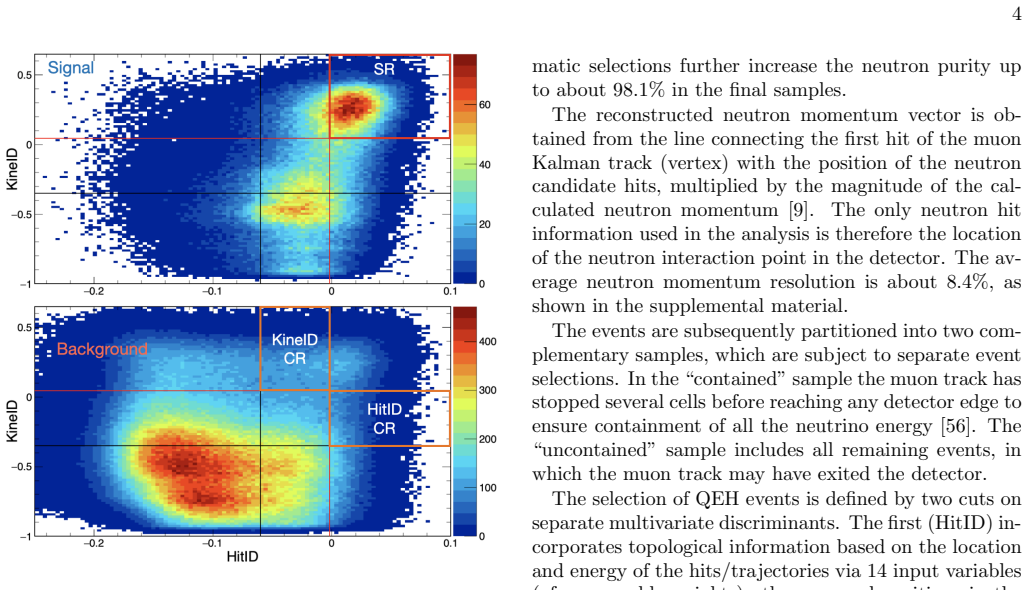
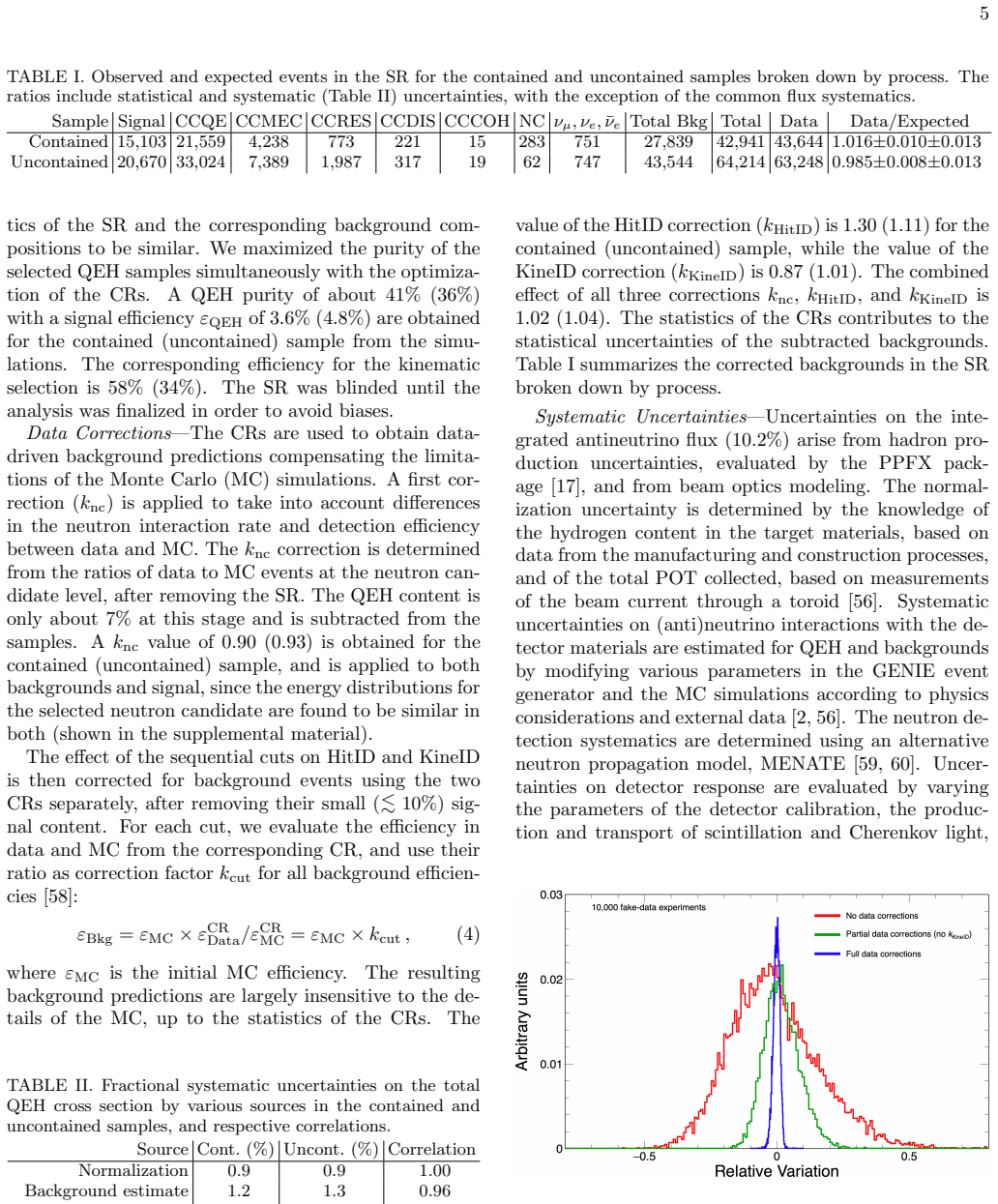
The analysis is carried by a signal-region/control-region design built on two boosted-decision-tree discriminants. HitID encodes topological information about hit patterns and energy deposits near the vertex and around the neutron candidate, while KineID encodes global event kinematics derived from the assumed two-body final state, including transverse momentum balance and the opening angle between the muon and the neutron. Control regions with background compositions similar to the signal region are used to measure in data the efficiencies of the sequential cuts, and correction factors $\kappa = \varepsilon_{Data}^{CR}/\varepsilon_{MC}^{CR}$ are applied to the simulated background efficiencies in Eq. (4). These correction factors are anticorrelated with Monte Carlo variations, so that systematic shifts of up to about 60% in the simulation are compensated and the background systematic uncertainty is reduced by roughly an order of magnitude.
What would settle it
Move the signal-region boundaries in the HitID-KineID plane and check that the extracted cross section stays constant within quoted uncertainties; a significant drift would indicate that the control-region corrections do not transfer, and the background composition difference between the regions could be tested directly against an independent high-statistics simulation.
Extended reading notes
Core claim
The central claim is that the NOvA near detector has observed $\bar\nu_\mu$-hydrogen charged-current quasi-elastic scattering, $\bar\nu_\mu \mathrm{H} \to \mu^+ n$, in a $1.2 \times 10^{21}$ proton-on-target exposure and measured its total cross section with the highest statistics and best precision achieved for this process. After background subtraction, 35,509 signal events remain, and the flux-averaged cross section at 1.9 GeV is $\sigma(\bar\nu_\mu \mathrm{H} \to \mu^+ n) = 0.538 \pm 0.009 \pm 0.010 \pm 0.055 \times 10^{-38}$ cm$^2$, where the uncertainties are statistical, non-flux systematic, and flux, respectively. The combined statistical and non-flux systematic uncertainty of 2.5% is more than four times smaller than the 10.2% integrated-flux uncertainty, so the measurement is limited by knowledge of the beam rather than by the extraction of the signal.
Load-bearing premise
The load-bearing premise is that each control region has a background composition similar enough to the signal region that efficiency corrections measured there apply to the signal background; if the compositions differ, the corrections (notably $k_{\rm HitID} = 1.30$ for contained events) would bias the subtracted background and shift the cross section.
Editorial extensions
If this is right
- The new cross-section value replaces a 13-event bubble-chamber measurement as the reference point for $\bar\nu_\mu$-hydrogen charged-current quasi-elastic scattering near 2 GeV.
- The 2.5% combined statistical and non-flux systematic precision makes the measurement a usable absolute-flux constraint for future neutrino oscillation analyses, as the paper expressly states.
- The demonstrated stability of the data corrections against large Monte Carlo variations supports applying the same control-region technique to other channels and to detectors with composite targets.
- Comparison of the measured value with generator predictions based on the Llewellyn-Smith model with a $z$-expansion axial form factor tests the modeling of the free-nucleon axial current at this energy.
Reading between the lines
- A direct extension would be to apply the same selection to neutrino-beam-mode data and extract the $\nu_\mu$ hydrogen cross section; the ratio of the two measurements would test the $q^2$ dependence of the axial form factor in a way that largely cancels flux uncertainty.
- If the control-region similarity assumption holds, a larger exposure could push the non-flux uncertainty below 2%, making the hydrogen cross section one of the sharpest handles on the neutrino energy scale in long-baseline detectors.
- The result implicitly sharpens nuclear-model constraints: any generator that matches this free-proton point while mismodeling events on carbon and chlorine is forced to attribute the difference to nuclear effects, separating free-nucleon from in-medium physics.
- A natural cross-check is to move the signal-region boundaries in the HitID-KineID plane and confirm the extracted cross section is stable; a drift would indicate the background corrections do not transfer from control to signal regions.
Signed reviews
Editorial analysis
A structured set of objections, weighed in public.
Referee Report
Summary. The paper reports a measurement of the total cross section for the exclusive charged-current quasi-elastic process antineutrino-muon on hydrogen, \bar\nu_\mu H -> \mu^+ n, using the NOvA near detector with a 1.2x10^21 proton-on-target exposure. Events are selected in two mutually exclusive samples (contained and uncontained muons) using two BDT discriminants, HitID and KineID, with a blinded signal region and control regions used to derive data-driven corrections to simulated backgrounds. After background subtraction, the combined sample yields 35,509 signal events, and the cross section is extracted from a simple counting formula. The final flux-averaged result is 0.538 +/- 0.009 (stat) +/- 0.010 (syst) +/- 0.055 (flux) x 10^-38 cm^2 at an average energy of 1.9 GeV, claimed as the most precise measurement of this process to date.
Significance. This measurement is scientifically valuable: it provides the highest-statistics sample of (anti)neutrino-hydrogen interactions measured to date and a nuclear-model-free cross-section benchmark at 1.9 GeV, complementing the existing BNL and MINERvA measurements. The authors have blinded the signal region, repeated the full analysis for each systematic variation, and provided a data release, all of which strengthen reproducibility. The main limitation in the current manuscript is the unquantified transfer of data-driven correction factors from control regions to the signal region; because the signal purity is modest (41% contained, 36% uncontained), the precision of the final result rests on this assumption.
major comments (3)
- [Data Corrections; Eq. (4); Table II] The assumption that the control-region corrections transfer to the signal region is not quantitatively validated. For the contained sample, k_HitID = 1.30 and backgrounds outnumber signal by 27,839 to 15,103; a 2% error in the transferred correction factor would shift the subtracted background by about 3.7% of the signal, which is comparable to the 10.2% flux uncertainty and far larger than the quoted 1.2% background systematic. The fake-data tests in Fig. 3 and Fig. S6 generate both control and signal regions from the same simulation, so they verify compensation of model variations but cannot detect a data-MC mismatch in the relative background composition between the regions. Please add a quantitative similarity metric (e.g., a composition-weighted closure test), vary the control-region definitions, or assign an explicit systematic uncertainty to the transfer.
- [Event Selection; Eqs. (1)-(3)] The momentum reconstruction for the uncontained sample is not described. The text quotes a 3.5% range-based momentum resolution only for tracks stopping in the detector, while uncontained muons exit the detector; nevertheless the uncontained sample provides 20,670 of the 35,509 signal events and KineID and the calculated neutron kinematics depend on the muon momentum p_mu. Please specify how the muon momentum and its resolution are obtained for exiting tracks, including any use of the downstream muon detector, and how the associated uncertainties enter Table II.
- [Data Corrections; Eq. (5)] The k_HitID and k_KineID corrections are applied only to background efficiencies, while the signal efficiency epsilon_QEH in Eq. (5) is taken from Monte Carlo without a data-driven correction. Because epsilon_QEH is only 3.6% (contained) and 4.8% (uncontained), a small data-MC difference in the BDT response for signal events propagates directly into the measured cross section. The quoted QEH modeling uncertainty and the fake-data tests do not directly constrain this data-MC difference; please provide a validation of the signal efficiency using a signal-enriched sideband or add an explicit systematic uncertainty.
minor comments (3)
- [Supplemental Material] In the supplemental text, the reference to 'Figure S6' for the efficiency and purity plots appears to be a typo; the corresponding caption is FIG. S5, while FIG. S6 shows the correlation plot.
- [References] Reference [62], cited for the best linear unbiased estimator, is unusual (D. S. Huang, Regression and econometric methods, Wiley, 1930) and should be replaced with a standard citation for BLUE or Gauss-Markov estimation.
- [Event Selection] The acronyms CCQE and QEH are both used throughout; please define QEH at first use and consistently distinguish it from charged-current quasi-elastic interactions on nuclear targets.
Circularity Check
No significant circularity: the cross section is defined from observed event counts, background estimates, efficiency, flux, and target mass, none of which is the target result by construction.
full rationale
The derivation chain is self-contained against external benchmarks. Equation (5), sigma_QEH = (N_Data - N_Bkg)/(epsilon_QEH * Phi * N_H), defines the measured cross section directly from data counts in the signal region, a background estimate obtained from data control regions, a simulated signal efficiency, the integrated flux, and the number of hydrogen atoms in the fiducial volume. The target result is not an input to this equation: the GENIE/Llewellyn-Smith model enters only through the signal efficiency and background shape, and the BNL measurement [12] is used only for comparison. The data-driven corrections k_nc, k_HitID, and k_KineID are ratios of data-to-MC efficiencies measured in control regions and are then applied to MC background predictions; this is a standard data-side background normalization, not a fitted parameter renamed as a prediction. The possible imperfection of transferring these corrections from control regions to the signal region, noted in the Event Selection section ('the corresponding background compositions to be similar'), is a systematic-uncertainty concern, not a circularity, because the central number is not defined by that transfer. The citation of the selection technique [9] by overlapping authors is method reuse: the cited work provides a previously published event-selection idea, but the cross-section extraction does not reduce to that citation. No uniqueness claim, ansatz smuggling, or renaming of a known result was found. Therefore the paper warrants a circularity score of 0.
Assumptions & free parameters
free parameters (4)
- k_nc neutron detection correction =
0.90 (contained), 0.93 (uncontained)
- k_HitID topological correction =
1.30 (contained), 1.11 (uncontained)
- k_KineID kinematic correction =
0.87 (contained), 1.01 (uncontained)
- GENIE MEC and FSI reweight parameters =
central values from NOvA inclusive CC tune [45]
assumptions (5)
- domain assumption The QEH signal and its selection efficiency are described by GENIE v3.0.6 with the Llewellyn-Smith model and z-expansion axial form factor.
- domain assumption Background compositions in the control regions match those in the signal region, so the k_cut corrections transfer.
- domain assumption The NuMI flux prediction from Geant4 plus PPFX gives an unbiased absolute antineutrino flux with a 10.2% uncertainty.
- domain assumption The reconstructed muon momentum and angle are unbiased within the quoted scales of 1.2% and 2.5 mrad.
- domain assumption The target proton is at rest, so Eqs. (1)-(3) define the correct neutron line-of-flight.
Cite this review
Pith. "Pith review of Measurement of the $\bar \nu_\mu-$Hydrogen Charged-Current Quasi-Elastic Cross Section using the NOvA Near Detector." pith.science (2026). https://pith.science/paper/K43P6K3H
@misc{pith2026260812293,
  author       = {Pith},
  title        = {Pith review of: Measurement of the $\bar \nu_\mu-$Hydrogen Charged-Current Quasi-Elastic Cross Section using the NOvA Near Detector},
  year         = {2026},
  howpublished = {\url{https://pith.science/paper/K43P6K3H}},
  note         = {Machine review of arXiv:2608.12293}
}
abstract
We report a measurement of the total cross section for muon antineutrino charged-current quasi-elastic scattering on hydrogen, $\bar \nu_\mu {\rm H} \to \mu^+ n$, in the NOvA near detector using a $1.2\times10^{21}$ proton-on-target exposure in the NuMI beam. A selection based on topological and kinematic constraints yields 35,509 signal events in the hydrogen-rich ($10.8\%$) detector, providing the highest statistics of (anti)neutrino--hydrogen interactions measured to date. Backgrounds from (anti)neutrino interactions on heavier nuclei are constrained using dedicated data control samples, significantly reducing the related systematic uncertainties. We obtain a value $\sigma (\bar \nu_\mu {\rm H} \to \mu^+ n) = 0.538 \pm 0.009 ({\rm stat}) \pm 0.010 ({\rm syst}) \pm0.055 ({\rm flux}) \times 10^{-38}$ cm$^2$ for the total cross section at an average energy of 1.9 GeV, the most precise total cross-section measurement of this process to date. The combined statistical and non-flux systematic uncertainty is more than four times smaller than the flux uncertainty, allowing a future use of this measurement to constrain the absolute $\bar \nu_\mu$ flux.
Figures

Figures from the paper (1 more)

Reference graph
Works this paper leans on
- [9]
-
[1]
Abubakaret al.(T2K, NOvA), Nature646, 818 (2025), arXiv:2510.19888 [hep-ex]
S. Abubakaret al.(T2K, NOvA), Nature646, 818 (2025), arXiv:2510.19888 [hep-ex]
arXiv 2025
-
[2]
S. Abubakaret al.(NOvA), Phys. Rev. Lett.136, 011802 (2026), arXiv:2509.04361 [hep-ex]
arXiv 2026
-
[3]
K. Abeet al.(T2K), Eur. Phys. J. C83, 782 (2023), arXiv:2303.03222 [hep-ex]
arXiv 2023
-
[4]
Abiet al.(DUNE), JINST15, T08008 (2020), arXiv:2002.02967 [physics.ins-det]
B. Abiet al.(DUNE), JINST15, T08008 (2020), arXiv:2002.02967 [physics.ins-det]
arXiv 2020
-
[5]
Abeet al.(Hyper-Kamiokande), (2018), arXiv:1805.04163 [physics.ins-det]
K. Abeet al.(Hyper-Kamiokande), (2018), arXiv:1805.04163 [physics.ins-det]
arXiv 2018
-
[6]
Probing Free Nucleons with (Anti)neutrinos
R. Petti, Phys. Lett. B834, 137469 (2022), arXiv:2205.10396 [hep-ph]
work page Pith review arXiv 2022
- [7]
Show all 64 references
-
[8]
Petti, R
R. Petti, R. J. Hill, and O. Tomalak, Phys. Rev. D109, L051301 (2024), arXiv:2309.02509 [hep-ph]
2024 arXiv
-
[10]
Navaset al.(Particle Data Group), Phys
S. Navaset al.(Particle Data Group), Phys. Rev. D110, 030001 (2024)
2024
-
[11]
Lyubushkinet al.(NOMAD), Eur
V. Lyubushkinet al.(NOMAD), Eur. Phys. J. C63, 355 (2009), arXiv:0812.4543 [hep-ex]
2009 arXiv
-
[12]
Fanourakis, L
G. Fanourakis, L. K. Resvanis, G. Grammatikakis, P. Tsilimigras, A. Vayaki, U. Camerini, W. F. Fry, R. J. Loveless, J. H. Mapp, and D. D. Reeder, Phys. Rev. D 21, 562 (1980)
1980
-
[13]
Caiet al.(MINERvA), Nature614, 48 (2023)
T. Caiet al.(MINERvA), Nature614, 48 (2023)
2023
-
[14]
Adamsonet al., Nucl
P. Adamsonet al., Nucl. Instrum. Meth. A806, 279 (2016), arXiv:1507.06690 [physics.acc-ph]
2016 arXiv
-
[15]
Mufsonet al., Nucl
S. Mufsonet al., Nucl. Instrum. Meth. A799, 1 (2015)
2015
-
[16]
Agostinelliet al., Nucl
S. Agostinelliet al., Nucl. Instrum. Meth. A506, 250 (2003)
2003
-
[17]
Aliagaet al.(MINERvA), Phys
L. Aliagaet al.(MINERvA), Phys. Rev. D94, 092005 (2016), [Addendum: Phys. Rev. D95039903 (2017)], arXiv:1607.00704 [hep-ex]
2016 arXiv
-
[18]
J. M. Paleyet al.(MIPP), Phys. Rev. D90, 032001 (2014), arXiv:1404.5882 [hep-ex]
2014 arXiv
-
[19]
Altet al.(NA49), Eur
C. Altet al.(NA49), Eur. Phys. J. C49, 897 (2007), arXiv:hep-ex/0606028
2007 arXiv
-
[20]
Abgrallet al.(NA61/SHINE), Phys
N. Abgrallet al.(NA61/SHINE), Phys. Rev. C84, 034604 (2011), arXiv:1102.0983 [hep-ex]
2011 arXiv
-
[21]
D. S. Bartonet al., Phys. Rev. D27, 2580 (1983)
1983
-
[22]
S. M. Seun,Measurement ofπ−Kratios from the NuMI target, Ph.D. thesis, Harvard U. (2007)
2007
-
[23]
G. M. Tinti,Sterile neutrino oscillations in MINOS and hadron production in pC collisions, Ph.D. thesis, Univer- sity of Oxford (2010)
2010
-
[24]
A. V. Lebedev,Ratio of pion kaon production in proton carbon interactions, Ph.D. thesis, Harvard U. (2007)
2007
-
[25]
Baataret al.(NA49), Eur
B. Baataret al.(NA49), Eur. Phys. J. C73, 2364 (2013), arXiv:1207.6520 [hep-ex]
2013 arXiv
-
[26]
Skubicet al., Phys
P. Skubicet al., Phys. Rev. D18, 3115 (1978)
1978
-
[27]
S. P. Denisov, S. V. Donskov, Y. P. Gorin, R. N. Kras- nokutsky, A. I. Petrukhin, Y. D. Prokoshkin, and D. A. Stoyanova, Nucl. Phys. B61, 62 (1973)
1973
-
[28]
A. S. Carrollet al., Phys. Lett. B80, 319 (1979)
1979
-
[29]
Abeet al.(T2K), Phys
K. Abeet al.(T2K), Phys. Rev. D87, 012001 (2013), [Addendum: Phys. Rev. D87, 019902 (2013)], arXiv:1211.0469 [hep-ex]
2013 arXiv
-
[30]
T. K. Gaisser, G. B. Yodh, V. D. Barger, and F. Halzen, in14th International Cosmic Ray Conference(1975)
1975
-
[31]
J. W. Cronin, R. Cool, and A. Abashian, Phys. Rev. 107, 1121 (1957)
1957
-
[32]
J. V. Allabyet al.(IHEP-CERN), Phys. Lett. B30, 500 (1969)
1969
-
[33]
M. J. Longo and B. J. Moyer, Phys. Rev.125, 701 (1962)
1962
-
[34]
B. M. Bobchenkoet al., Sov. J. Nucl. Phys.30, 805 (1979)
1979
-
[35]
V. B. Fedorov, Y. G. Grishuk, M. V. Kosov, G. A. Leksin, N. A. Pivnyuk, S. V. Shevchenko, V. L. Stolin, A. V. Vlasov, and L. S. Vorobev, Sov. J. Nucl. Phys.27, 222 (1978)
1978
-
[36]
R. J. Abrams, R. L. Cool, G. Giacomelli, T. F. Kycia, B. A. Leontic, K. K. Li, and D. N. Michael, Phys. Rev. D1, 1917 (1970)
1970
-
[37]
Tena-Vidalet al.(GENIE), Phys
J. Tena-Vidalet al.(GENIE), Phys. Rev. D104, 072009 (2021), arXiv:2104.09179 [hep-ph]
2021 arXiv
-
[38]
C. H. Llewellyn Smith, Phys. Rept.3, 261 (1972)
1972
-
[39]
A. S. Meyeret al., Phys. Rev. D93, 113015 (2016), arXiv:1603.03048 [hep-ph]
2016 arXiv
-
[40]
Nieves, I
J. Nieves, I. Ruiz Simo, and M. J. Vicente Vacas, Phys. Rev. C83, 045501 (2011), arXiv:1102.2777 [hep-ph]
2011 arXiv
-
[41]
R. Gran, J. Nieves, F. Sanchez, and M. J. Vicente Vacas, Phys. Rev. D88, 113007 (2013), arXiv:1307.8105 [hep- ph]
2013 arXiv
-
[42]
Berger and L
C. Berger and L. M. Sehgal, Phys. Rev. D76, 113004 (2007), arXiv:0709.4378 [hep-ph]
2007 arXiv
-
[43]
Bodek and U
A. Bodek and U. K. Yang, Nucl. Phys. B Proc. Suppl. 112, 70 (2002), arXiv:hep-ex/0203009
2002 arXiv
-
[44]
Andreopoulos, C
C. Andreopoulos, C. Barry, S. Dytman, H. Gallagher, T. Golan, R. Hatcher, G. Perdue, and J. Yarba, (2015), arXiv:1510.05494 [hep-ph]
2015 arXiv
-
[45]
M. A. Aceroet al.(NOvA, R. Group), Eur. Phys. J. C 80, 1119 (2020), arXiv:2006.08727 [hep-ex]
2020
-
[46]
M. A. Aceroet al.(NOvA), Phys. Rev. D111, 052009 (2025), arXiv:2410.05526 [hep-ex]
2025 arXiv
-
[47]
B. W. Allardyceet al., Nucl. Phys. A209, 1 (1973)
1973
-
[48]
Saunders, S
A. Saunders, S. Hoeibraten, J. J. Kraushaar, B. J. Kriss, 8 R. J. Peterson, R. A. Ristinen, J. T. Brack, G. Hofman, E. F. Gibson, and C. L. Morris, Phys. Rev. C53, 1745 (1996)
1996
-
[49]
Meirav, E
O. Meirav, E. Friedman, R. R. Johnson, R. Olszewski, and P. Weber, Phys. Rev. C40, 843 (1989)
1989
-
[50]
S. M. Levensonet al., Phys. Rev. C28, 326 (1983)
1983
-
[51]
Ashery, I
D. Ashery, I. Navon, G. Azuelos, H. K. Walter, H. J. Pfeiffer, and F. W. Schleputz, Phys. Rev. C23, 2173 (1981)
1981
-
[52]
Asheryet al., Phys
D. Asheryet al., Phys. Rev. C30, 946 (1984)
1984
-
[53]
E. S. Pinzon Guerraet al.(DUET), Phys. Rev. C95, 045203 (2017), arXiv:1611.05612 [hep-ex]
2017 arXiv
-
[54]
Aurisano, C
A. Aurisano, C. Backhouse, R. Hatcher, N. Mayer, J. Musser, R. Patterson, R. Schroeter, and A. Sousa (NOvA),Proceedings, 21st International Conference on Computing in High Energy and Nuclear Physics (CHEP 2015): Okinawa, Japan, April 13-17, 2015, J. Phys. Conf. Ser.664, 072002 (2015)
2015
-
[55]
Bairdet al.,Proceedings, 21st International Confer- ence on Computing in High Energy and Nuclear Physics (CHEP 2015): Okinawa, Japan, April 13-17, 2015, J
M. Bairdet al.,Proceedings, 21st International Confer- ence on Computing in High Energy and Nuclear Physics (CHEP 2015): Okinawa, Japan, April 13-17, 2015, J. Phys. Conf. Ser.664, 072035 (2015)
2015
-
[56]
M. A. Aceroet al.(NOvA), Phys. Rev. D107, 052011 (2023), arXiv:2109.12220 [hep-ex]
2023 arXiv
-
[57]
Hoecker, P
A. Hoecker, P. Speckmayer, J. Stelzer, J. Therhaag, E. von Toerne, and H. Voss, PoSACA T, 040 (2007), arXiv:physics/0703039
2007 arXiv
-
[58]
Astieret al.(NOMAD), Nucl
P. Astieret al.(NOMAD), Nucl. Phys. B611, 3 (2001), arXiv:hep-ex/0106102
2001 arXiv
-
[59]
Eurisol design study,
B. Roeder, “Eurisol design study,” Report No. 10-25- 2008-006
2008
-
[60]
Kohleyet al., Nucl
Z. Kohleyet al., Nucl. Instrum. Meth. A682, 59 (2012)
2012
-
[61]
Strait, S
M. Strait, S. Bending, K. Kephart, and P. Lukens (NOvA), (2019), arXiv:1902.02805 [physics.ins-det]
2019 arXiv
-
[62]
D. S. Huang,Regression and econometric methods(Wi- ley, New York, 1930)
1930
-
[63]
Talukdar, Ph.D
N. Talukdar, Ph.D. thesis, University of South Carolina, USA (2026)
2026
-
[64]
NOvA Data Release Webpage,
M. Aceroet al.(NOvA), “NOvA Data Release Webpage,”https://novaexperiment.fnal.gov/ data-releases/. S1 SUPPLEMENT AL MA TERIAL FOR THE MEASUREMENT OF THE¯ν µ−HYDROGEN CHARGED-CURRENT QUASI-ELASTIC CROSS SECTION USING THE NOV A NEAR DETECTOR This supplemental material provides a...
Reviewed August 16, 2026 · model on record in the stance chip above.
Discussion (0). Continue with ORCID to comment.