REVIEW 3 major objections 5 minor 79 references
Stabilizer complexity and the Python's lunch
T0 review · 3 major / 5 minor · reviewed 2026-08-16 · deepseek-v4-flash
Pith's one-line read This paper claims that the relative Wigner negativity of the right reduced density matrix of a fixed-energy PET state equals $\exp[(A_{\mathrm{out}}-A_{\mathrm{min}})/8G_N]$, so a python's lunch exponentially enhances the boundary…
desk verdict Clean formula for Wigner negativity in PET states, but the load-bearing Haar-randomness assumption is only tested at the level of marginals; worth review, not yet citable as established fact. read the letter →
The pith
A machine-rendered reading of the paper's core claim, the machinery that carries it, and where it could break.
The reading
What carries the argument
The machinery has three tiers. First, the discrete Wigner function $W_\rho(u)=D^{-1}\operatorname{Tr}(\rho A(u))$ and its sum negativity define a magic monotone; the paper studies the ratio $\mathcal{N}(\rho|\rho^{(0)})$ to remove the universal divergence with Hilbert-space dimension. Second, averaging over uniform random unitaries applied to the overlap matrix $U_{q,i}=\langle q|E_i\rangle$ turns the absolute-value problem into a replica computation in which only pairwise contractions survive at large $D$, yielding $N(\rho_R)\simeq\sqrt{2/\pi}\sqrt{D/e^{S_2(\rho_R)}}$. Third, the second-order entropy $S_2(\rho)=-\log\operatorname{Tr}(\rho^2)$ is evaluated by treating the state as a random tensor network, with $\operatorname{Tr}\rho_R^2=e^{-S(E_L^*)}+e^{-S(E_R^*)}$, so $S_2(\rho_R)=\min(S_L,S_R)$, which is the minimal area $A_{\mathrm{min}}/4G_N$ at leading order. The ratio of negativities cancels the dimension $D$, leaving the area-gap exponential.
What would settle it
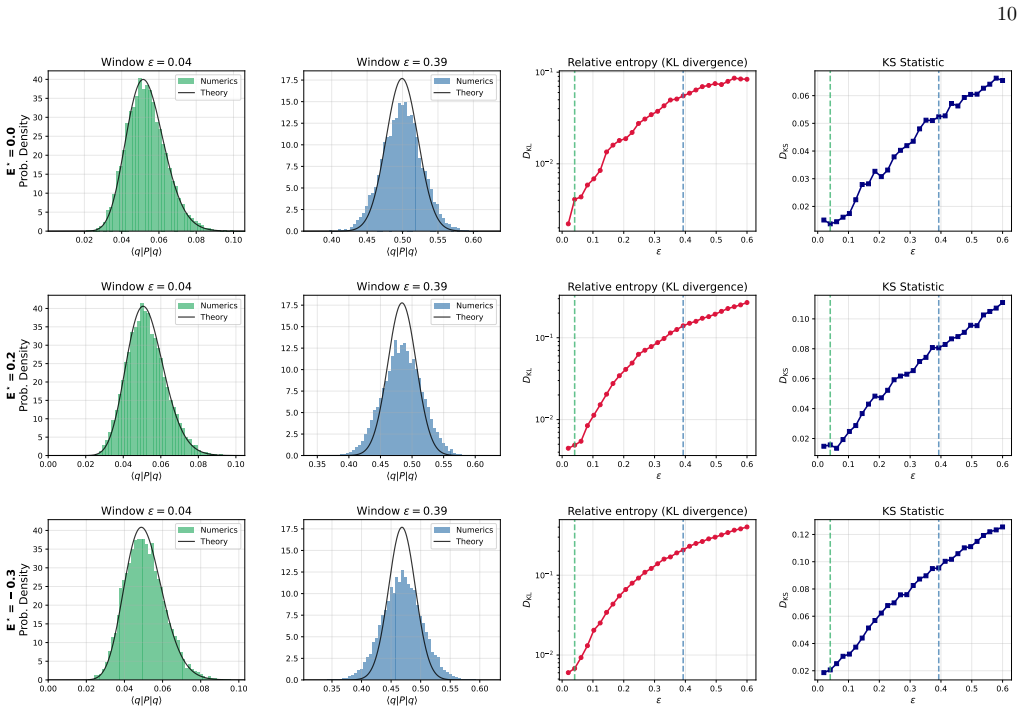
In the same random-coupling fermion model used in the paper's Appendix B, restrict to a microcanonical window narrower than the random-matrix scale and test the off-diagonal statistics of the overlap matrix $\langle q|E_i\rangle$, along with the predicted Wigner negativity $\sqrt{2/\pi}\sqrt{D/e^{S_2(\rho_R)}}$ of a fixed-energy PET state; a statistically significant deviation from the uniform-random-unitary prediction in either test would falsify the central formula.
Extended reading notes
Core claim
On the paper's own terms, the discovery is a quantitative link between geometry and magic: for a fixed-energy PET state with pseudorandom Hamiltonian and Gaussian heavy-operator matrix elements, $N(\rho_R|\rho_R^{(0)}) \sim \exp[(A_{\mathrm{out}}-A_{\mathrm{min}})/8G_N]$. Here $\rho_R$ is the right reduced density matrix, $\rho_R^{(0)}$ is the maximally mixed microcanonical state in the same energy window, and the area gap is computed between the outer extremal surface of the right wedge and the smallest-area extremal surface. The relative Wigner negativity is basis-independent at the random-matrix energy scale, does not depend on the microscopic Hilbert-space dimension, and is exponentially large precisely when the entanglement wedge contains a python's lunch. Consequently the stabilizer complexity of the subregion is trivial without the lunch and exponentially enhanced with it.
Load-bearing premise
The entire calculation rests on the premise that, inside a small energy window, the energy eigenstates are spread over the computational basis exactly as a random unitary drawn uniformly from the group of all unitaries would spread them; if that randomness fails, the negativity formula and its area interpretation do not follow.
Editorial extensions
If this is right
- If the central formula holds, the stabilizer complexity of the right subregion is $O(1)$ whenever the outer extremal surface is already the minimal one, so a featureless black-hole wedge is computationally cheap to prepare from the microcanonical ensemble.
- When a python's lunch is present, the relative Wigner negativity is $\exp[(A_{\mathrm{out}}-A_{\mathrm{min}})/8G_N]$, and any stabilizer circuit that attempts to prepare $\rho_R$ from the microcanonical state fails with probability at least $1-\exp[-(A_{\mathrm{out}}-A_{\mathrm{min}})/8G_N]$.
- The result is independent of the computational basis and of the microscopic Hilbert-space dimension, provided the energy window is at the random-matrix scale.
- With appropriate pseudorandomness assumptions, the same argument extends to PET states with multiple operator insertions, fixed-area states, and multi-boundary black holes in three-dimensional gravity.
- The quantity computed is a property of the boundary reduced state, not the bulk reconstruction map; its area dependence differs from the original python's lunch complexity formula, so the two should not be conflated.
Reading between the lines
- If unitary-group randomness at the level of a two-design is sufficient, then the negativity formula should be reproducible with any operator basis that forms a two-design on the microcanonical subspace; this gives a concrete route to testing basis-independence in small chaotic systems.
- The paper's numerical check only tests the diagonal distribution of $\langle q|P|q\rangle$; an off-diagonal test of the full overlap matrix $\langle q|E_i\rangle$ would probe the higher moments that enter the replica computation, and is likely where a breakdown of the randomness assumption would appear first.
- If the fidelity bound is qualitatively tight, the formula converts the area gap into a statement about state preparation: any stabilizer protocol that prepares the right reduced state from the microcanonical ensemble must fail with probability close to one when $A_{\mathrm{out}}-A_{\mathrm{min}}$ is of order $G_N^{-1}$.
- Projecting onto a microcanonical window at the random-matrix scale makes the relative time-shift mode highly uncertain, so it is worth checking whether the same area-gap formula survives when a semiclassical time-shift coherent state is used instead; the paper does not address this.
Signed reviews
Editorial analysis
A structured set of objections, weighed in public.
Referee Report
Summary. The manuscript studies the stabilizer complexity—quantified by Wigner negativity—of the reduced density matrix obtained from one side of a fixed-energy partially entangled thermal (PET) state in a holographic CFT. Under two explicit randomness assumptions (Assumption 1: the energy eigenbasis is Haar-random relative to a computational basis; Assumption 2: the heavy-operator matrix elements are i.i.d. Gaussian), the authors derive the relative Wigner negativity N(ρ_R|ρ_R^(0)) ~ exp[(A_out − A_min)/(8G_N)] (Eq. (46)). The derivation reproduces the Haar-random-state formula N ~ sqrt(D/e^{S_2}) using a replica trick, gives an alternative integral-representation derivation in Appendix A, computes the second Rényi entropy of the PET state by random tensor network arguments, and presents SYK numerics in Appendix B testing the diagonal projection statistic ⟨q|P|q⟩. The main result is interpreted as exponential enhancement of stabilizer complexity exactly when the bulk entanglement wedge contains a python's lunch.
Significance. If the result holds, it provides a concrete boundary quantity—the relative Wigner negativity—that is exponentially large precisely in the presence of a python's lunch, and it is claimed to be independent of the computational basis within the random-matrix window. The paper is clearly written and does useful work in reducing the negativity computation to a second-Rényi computation, with a second derivation in Appendix A and a numerical check in Appendix B. The main caveat is that the central formula is conditional on two strong randomness assumptions; the evidence for the more important one, Assumption 1, is only partial. The result is significant as a conjectural bridge between quantum magic and holographic complexity, but it is not yet a proof.
major comments (3)
- [Section III (Assumption 1) and Appendix B] The numerical evidence for Assumption 1 tests only the distribution of x = ⟨q|P|q⟩ = Σ_i |U_{q,i}|^2 (Eq. (B2)), which depends only on the row norms of U. The derivation of Eq. (38), in contrast, uses the full Weingarten formula (29) and the contraction rules (33)–(37), which require the joint Haar distribution of all entries of U, including phases and higher-order correlations. A matrix can reproduce the Beta row-norm marginals exactly without being Haar-distributed, and a state with the same second Rényi entropy can have zero Wigner negativity if it is a stabilizer state in the chosen basis. The paper should either test higher-order Haar statistics (for example off-diagonal entry distributions, four-point correlators, or unitary k-design measures) or explicitly state that Assumption 1 remains unverified beyond the diagonal marginal, and correspondingly weaken the basis-independence claim.
- [Section III.A and III.B] The Haar average is performed with ρ_R held fixed, as in Eqs. (26) and (38), but in the actual CFT ρ_R and U both originate from the same Hamiltonian: U is the energy-eigenvector matrix of H_R, while ρ_R is constructed from matrix elements of the heavy operator in that same energy eigenbasis (Eqs. (10)–(11)). The paper does not address the joint statistics of U and ρ_R. If the eigenvector matrix and the heavy-operator matrix elements are correlated, the Haar-averaged negativity may not be representative of the actual fixed PET state. The authors should either provide a randomness-independence argument or test the joint distribution numerically.
- [Section III.A.2 (Variance)] The main result is for an individual PET state, not for a Haar-averaged ensemble, so the variance suppression is load-bearing. The transition from Eq. (39) to the claim σ² ~ O(1/(D e^{S_2})) is only sketched: the counting factor S(m,n), the analytic continuation in m and n, and the final phase-space sum are not exhibited. A more detailed derivation or a quantitative bound on the higher moments is needed to justify replacing the Haar average ⟨N⟩_U by the actual N(ρ_R).
minor comments (5)
- [Section III.A, text before Eq. (27)] The word 'resporting' should be 'resorting'.
- [Section II.C and Appendix B] The Wigner function is defined for qudits of odd prime dimension, but the SYK numerics in Appendix B use a qubit computational basis (d = 2, Hilbert space dimension 2^{N/2}). This does not invalidate the test of Assumption 1 as a statement about random eigenvectors, but it is not a direct test of the Wigner-negativity calculation; the authors should clarify whether the qubit test is intended only as heuristic support.
- [Eq. (29)] The Weingarten contraction formula contains index typos: the second line should involve δ_{j_a j'_{τ(a)}} for a = 1,...,2n, with the correct parentheses in the permutation labels.
- [Section IV, Discussion] The word 'eqaution' in the second paragraph should be 'equation'.
- [References] Reference [39] is cited only as 'Talk at Strings 2026'; this should be replaced by a published source or a more complete citation.
Circularity Check
No significant circularity: eq. (46) follows from explicit pseudorandomness assumptions and an independently supported Haar-random negativity formula; self-citations to [20,30] are technical, not load-bearing.
full rationale
The central result N(rho_R|rho_R^(0)) ~ exp[(1/8G_N)(A_out - A_min)] is obtained by substituting the microcanonical and PET-state second Renyi entropies into the derived relative-negativity formula (42), which follows from eq. (38). Eq. (38) is derived in Sec. III A and Appendix A under Assumption 1 (Haar-random U_{q,i}) rather than being merely quoted, and it reproduces the independent White-Wilson result [29]. The D-dependence cancels in the ratio because both numerator and denominator share the same universal factor, so this is a normalization choice, not a fitted input. Assumptions 1 and 2 are explicit model assumptions; whether the SYK numerics in Appendix B fully validate the joint Haar statistics is a correctness question, not a circularity. The self-citations [20,30] supply technical facts (Weingarten factorization, phase-point-operator traces, resummation details), but the same formula is independently available in [29] and is re-derived in the paper, so the self-citations are not load-bearing. The final exponential enhancement is equivalent to the purity deficit between rho_R and the microcanonical ensemble, and this equivalence is a consequence of the derivation under the stated assumptions, not an input. No step was found in which a fitted parameter is renamed a prediction, a known result is merely renamed, or a uniqueness/ansatz claim is imported solely through self-citation.
Assumptions & free parameters
assumptions (5)
- domain assumption Assumption 1: the microcanonical subspace H(E*_R) is a random subspace relative to the computational basis; U_{q,i} = <q|E_i> are Haar random.
- domain assumption Assumption 2: the matrix elements R_ij of the heavy operator are i.i.d. Gaussian random variables with zero mean and unit variance.
- domain assumption The Wigner negativity formula N(ρ) = sqrt(2/π)(D/e^{S_2})^{1/2} for Haar-random states.
- domain assumption Holographic dictionary: at leading order in 1/G_N, the Renyi-2 entropy of the microcanonical ensemble equals the area of the outermost extremal surface, A(γ_out)/4G_N, and the Renyi-2 entropy of the PET state is the minimal extremal area.
- domain assumption E_RMT ~ 1/log(1/G_N) for holographic theories.
Cite this review
Pith. "Pith review of Stabilizer complexity and the Python's lunch." pith.science (2026). https://pith.science/paper/JETASFJ5
@misc{pith2026260812472,
  author       = {Pith},
  title        = {Pith review of: Stabilizer complexity and the Python's lunch},
  year         = {2026},
  howpublished = {\url{https://pith.science/paper/JETASFJ5}},
  note         = {Machine review of arXiv:2608.12472}
}
abstract
In this note, we study the stabilizer complexity of the reduced density matrix corresponding to one side of a partially entangled thermal (PET) state with fixed energy boundary conditions in a holographic CFT. In particular, we study Wigner negativity, an operationally meaningful magic monotone which can be interpreted as the complexity of classically simulating any quantum circuit preparation of the reduced state on the subregion. Using assumptions on the pseudorandomness of the CFT spectrum and the heavy operator insertion, we observe that the Wigner negativity of the PET state relative to the microcanonical density matrix at the given energy is given by $\exp\left[\frac{1}{8G_N}(A_{\text{out}} - A_{\text{min}})\right]$, where $A_{\text{out}}$ is the area of the outer extremal surface, while $A_{\text{min}}$ is the area of the minimal extremal surface. Thus, the stabilizer complexity of the reduced density matrix on the boundary subregion is $O(1)$ in the absence of a python's lunch, but gets exponentially enhanced in the presence of a python's lunch in the bulk geometry.
Figures


Reference graph
Works this paper leans on
-
[1]
Haar averaging To begin, we consider 2ncopies of the diagram shown in 25. For the purposes of this discussion, the detailed structure ofρ R in equation (25) is not important and may be represented schematically by a blob. Hence, pic- torially, we have: 6 W 2n = 1 D2n ρR AR U U† × ρR AR U U† ×······ × ρR AR U U† (28) We now perform the Haar average using t...
-
[2]
Ob- servers, wormholes and complex saddles in cosmology
Variance Having computed the averaged Wigner negativity, we will now argue that fluctuations around this average are suppressed in the largeDlimit. To quantify these fluc- tuations, we consider the variance,σ 2 =⟨N 2⟩U−⟨N⟩ 2 U. Using the same replica-trick reasoning as before, this quantity can be expressed as, σ2 = X u X v lim m→ 1 2 lim n→ 1 2 h ⟨W 2m(u...
work page 2026
-
[3]
Penington, JHEP09, 002, arXiv:1905.08255 [hep-th]
G. Penington, JHEP09, 002, arXiv:1905.08255 [hep-th]
arXiv 1905
-
[4]
A. Almheiri, N. Engelhardt, D. Marolf, and H. Maxfield, JHEP12, 063, arXiv:1905.08762 [hep-th]
arXiv 1905
-
[5]
A. Almheiri, R. Mahajan, J. Maldacena, and Y. Zhao, JHEP03, 149, arXiv:1908.10996 [hep-th]
arXiv 1908
-
[6]
G. Penington, S. H. Shenker, D. Stanford, and Z. Yang, JHEP03, 205, arXiv:1911.11977 [hep-th]
arXiv 1911
-
[7]
A. Almheiri, T. Hartman, J. Maldacena, E. Shaghoulian, and A. Tajdini, JHEP05, 013, arXiv:1911.12333 [hep- th]
arXiv 1911
- [8]
Show all 79 references
-
[9]
A. R. Brown, H. Gharibyan, G. Penington, and L. Susskind, JHEP2020(8), 121, arXiv:1912.00228 [hep- th]
1912 arXiv
-
[10]
I. H. Kim, E. Tang, and J. Preskill, JHEP06, 031, arXiv:2003.05451 [hep-th]
2003 arXiv
-
[11]
Engelhardt, G
N. Engelhardt, G. Penington, and A. Shahbazi- Moghaddam, Class. Quant. Grav.38, 234001 (2021), arXiv:2102.07774 [hep-th]
2021 arXiv
-
[12]
Akers, N
C. Akers, N. Engelhardt, D. Harlow, G. Penington, and S. Vardhan, JHEP06, 155, arXiv:2207.06536 [hep-th]
-
[13]
Balasubramanian, A
V. Balasubramanian, A. Kar, C. Li, and O. Parrikar, JHEP07, 189, arXiv:2203.01961 [hep-th]
-
[14]
Gottesman, The heisenberg representation of quan- tum computers (1998), arXiv:quant-ph/9807006 [quant- ph]
D. Gottesman, The heisenberg representation of quan- tum computers (1998), arXiv:quant-ph/9807006 [quant- ph]
1998 arXiv
-
[15]
Aaronson and D
S. Aaronson and D. Gottesman, Phys. Rev. A70, 052328 (2004), arXiv:quant-ph/0406196
2004 arXiv
-
[16]
Hostens, J
E. Hostens, J. Dehaene, and B. D. Moor, Phys. Rev. A 71, 042315 (2005), arXiv:quant-ph/0408190
2005 arXiv
-
[17]
Mari and J
A. Mari and J. Eisert, Physical Review Letters109, 10.1103/physrevlett.109.230503 (2012)
2012 doi
-
[18]
Bravyi and A
S. Bravyi and A. Kitaev, Physical Review A71, 10.1103/physreva.71.022316 (2005)
2005 doi
-
[19]
Pashayan, J
H. Pashayan, J. J. Wallman, and S. D. Bartlett, Phys. Rev. Lett.115, 070501 (2015)
2015
-
[20]
Veitch, C
V. Veitch, C. Ferrie, D. Gross, and J. Emerson, New Journal of Physics14, 113011 (2012)
2012
-
[21]
Veitch, S
V. Veitch, S. Hamed Mousavian, D. Gottesman, and J. Emerson, New Journal of Physics16, 013009 (2014), arXiv:1307.7171 [hep-th]
2014 arXiv
-
[22]
R. Basu, O. Parrikar, S. Paul, and H. Rajgadia, On the stabilizer complexity of Hawking radiation (2025), arXiv:2510.18967 [hep-th]
2025 arXiv
-
[23]
A. Goel, H. T. Lam, G. J. Turiaci, and H. Verlinde, JHEP 02, 156, arXiv:1807.03916 [hep-th]
-
[24]
W. K. Wootters, Annals of Physics176, 1 (1987)
1987
-
[25]
Leonhardt, Phys
U. Leonhardt, Phys. Rev. Lett.74, 4101 (1995)
1995
-
[26]
Heiss and S
S. Heiss and S. Weigert, Phys. Rev. A63, 012105 (2000)
2000
-
[27]
Miquel, J
C. Miquel, J. P. Paz, and M. Saraceno, Phys. Rev. A65, 062309 (2002)
2002
-
[28]
K. S. Gibbons, M. J. Hoffman, and W. K. Woot- ters, Physical Review A70, 10.1103/physreva.70.062101 (2004)
2004 doi
-
[29]
Gross, Journal of Mathematical Physics47, 10.1063/1.2393152 (2006)
D. Gross, Journal of Mathematical Physics47, 10.1063/1.2393152 (2006)
2006 doi
-
[30]
Cormick, E
C. Cormick, E. F. Galv˜ ao, D. Gottesman, J. P. Paz, and A. O. Pittenger, Phys. Rev. A73, 012301 (2006)
2006
-
[31]
C. D. White and J. H. Wilson, Mana in haar-random states (2020), arXiv:2011.13937 [quant-ph]
2020 arXiv
-
[32]
R. Basu, P. Chowdhury, A. Ganguly, S. Nath, O. Par- rikar, and S. Paul, Wigner negativity, random matrices and gravity (2025), arXiv:2506.02110 [hep-th]
2025
- [33]
-
[34]
Sasieta, JHEP03, 158, arXiv:2211.11794 [hep-th]
M. Sasieta, JHEP03, 158, arXiv:2211.11794 [hep-th]
-
[35]
Balasubramanian, A
V. Balasubramanian, A. Lawrence, J. M. Magan, and M. Sasieta, Phys. Rev. X14, 011024 (2024), arXiv:2212.02447 [hep-th]
2024 arXiv
- [36]
-
[37]
J. D. Brown and J. W. York, Jr., Phys. Rev. D47, 1420 (1993), arXiv:gr-qc/9209014
1993 arXiv
-
[38]
Marolf, JHEP09, 114, arXiv:1808.00394 [hep-th]
D. Marolf, JHEP09, 114, arXiv:1808.00394 [hep-th]
-
[39]
Chandrasekaran, G
V. Chandrasekaran, G. Penington, and E. Witten, JHEP 04, 009, arXiv:2209.10454 [hep-th]
-
[40]
Gharibyan, M
H. Gharibyan, M. Hanada, S. H. Shenker, and M. Tezuka, 12 JHEP07, 124, [Erratum: JHEP 02, 197 (2019)], arXiv:1803.08050 [hep-th]
2019 arXiv
-
[41]
Yang, Talk at Strings 2026
Z. Yang, Talk at Strings 2026
2026
-
[42]
Swingle, Constructing holographic spacetimes using entanglement renormalization (2012), arXiv:1209.3304 [hep-th]
B. Swingle, Constructing holographic spacetimes using entanglement renormalization (2012), arXiv:1209.3304 [hep-th]
2012 arXiv
- [43]
-
[44]
Miyaji, T
M. Miyaji, T. Takayanagi, and K. Watanabe, Phys. Rev. D95, 066004 (2017), arXiv:1609.04645 [hep-th]
2017 arXiv
-
[45]
N. Bao, G. Penington, J. Sorce, and A. C. Wall, JHEP 11, 069, arXiv:1812.01171 [hep-th]
-
[46]
Caputa, J
P. Caputa, J. Kruthoff, and O. Parrikar, JHEP05, 009, [Erratum: JHEP 09, 112 (2022)], arXiv:2012.05247 [hep- th]
2022 arXiv
-
[47]
Akers, R
C. Akers, R. M. Soni, and A. Y. Wei, SciPost Phys. Core 7, 070 (2024), arXiv:2404.03651 [hep-th]
2024 arXiv
-
[48]
Hayden, S
P. Hayden, S. Nezami, X.-L. Qi, N. Thomas, M. Walter, and Z. Yang, JHEP11, 009, arXiv:1601.01694 [hep-th]
- [49]
-
[50]
Veitch, S
V. Veitch, S. A. H. Mousavian, D. Gottesman, and J. Emerson, New Journal of Physics16, 013009 (2014)
2014
-
[51]
C. D. White, C. Cao, and B. Swingle, Phys. Rev. B103, 075145 (2021), arXiv:2007.01303 [quant-ph]
2021 arXiv
- [52]
-
[53]
C. Cao, G. Cheng, A. Hamma, L. Leone, W. Munizzi, and S. F. Oliviero, PRX Quantum6, 040375 (2025), arXiv:2403.07056 [hep-th]
2025
-
[54]
Malvimat, M
V. Malvimat, M. Sarkis, Y. Suk, and J. Yoon, Mul- tipartite Non-local Magic and SYK Model (2026), arXiv:2601.03076 [hep-th]
2026
-
[55]
Bettaque and B
V. Bettaque and B. Swingle, Magic and Wormholes in the Sachdev-Ye-Kitaev Model (2026), arXiv:2602.12339 [hep-th]
2026 arXiv
-
[56]
Benedetti, A
V. Benedetti, A. Dabholkar, and M. Dalmonte, Univer- sality of Magic in Local Quantum Field Theory (2026), arXiv:2607.16403 [hep-th]
2026 arXiv
- [57]
-
[58]
Sachdev and J
S. Sachdev and J. Ye, Physical Review Letters70, 3339–3342 (1993)
1993
-
[59]
Kitaev, A simple model of quantum holography 1, https://online.kitp.ucsb.edu/online/entangled15/ kitaev/(2015)
A. Kitaev, A simple model of quantum holography 1, https://online.kitp.ucsb.edu/online/entangled15/ kitaev/(2015)
2015
-
[60]
Kitaev, A simple model of holography 2,https:// online.kitp.ucsb.edu/online/entangled15/kitaev2/ (2015)
A. Kitaev, A simple model of holography 2,https:// online.kitp.ucsb.edu/online/entangled15/kitaev2/ (2015)
2015
-
[61]
Maldacena and D
J. Maldacena and D. Stanford, Phys. Rev. D94, 106002 (2016), arXiv:1604.07818 [hep-th]
2016 arXiv
-
[62]
M. V. Berry, J. Phys. A10, 2083 (1977)
1977
-
[63]
Lu and T
T.-C. Lu and T. Grover, Phys. Rev. E99, 032111 (2019), arXiv:1709.08784 [cond-mat.stat-mech]
2019 arXiv
-
[64]
Srednicki, Phys
M. Srednicki, Phys. Rev. E50(1994), arXiv:cond- mat/9403051
1994
-
[65]
D’Alessio, Y
L. D’Alessio, Y. Kafri, A. Polkovnikov, and M. Rigol, Adv. Phys.65, 239 (2016), arXiv:1509.06411 [cond- mat.stat-mech]
2016 arXiv
-
[66]
P. Kos, M. Ljubotina, and T. Prosen, Phys. Rev. X8, 021062 (2018), arXiv:1712.02665 [nlin.CD]
2018 arXiv
-
[67]
A. Chan, A. De Luca, and J. T. Chalker, Phys. Rev. Lett. 121, 060601 (2018), arXiv:1803.03841 [cond-mat.stat- mech]
2018 arXiv
-
[68]
Schiulaz, E
M. Schiulaz, E. J. Torres-Herrera, and L. F. Santos, Phys. Rev. B99, 174313 (2019), arXiv:1807.07577 [cond- mat.stat-mech]
2019 arXiv
-
[69]
Winer and B
M. Winer and B. Swingle, Phys. Rev. X12, 021009 (2022), arXiv:2012.01436 [cond-mat.stat-mech]
2022 arXiv
-
[70]
Y. Chen, V. Ivo, and J. Maldacena, JHEP04, 124, arXiv:2310.11617 [hep-th]
-
[71]
X. Dong, D. Harlow, and D. Marolf, JHEP10, 240, arXiv:1811.05382 [hep-th]
- [72]
-
[73]
Balasubramanian, P
V. Balasubramanian, P. Hayden, A. Maloney, D. Marolf, and S. F. Ross, Class. Quant. Grav.31, 185015 (2014), arXiv:1406.2663 [hep-th]
2014 arXiv
-
[74]
Belin and J
A. Belin and J. De Boer, Class. Quant. Grav.38, 164001 (2021), arXiv:2006.05499 [hep-th]
2021 arXiv
-
[75]
Chandra, S
J. Chandra, S. Collier, T. Hartman, and A. Maloney, JHEP12, 069, arXiv:2203.06511 [hep-th]
-
[76]
R. Basu, A. Ganguly, S. Nath, and O. Parrikar, JHEP05, 264, [Erratum: JHEP 03, 202 (2026)], arXiv:2402.13694 [hep-th]
2026
-
[77]
Balasubramanian, P
V. Balasubramanian, P. Caputa, O. Parrikar, and V. Singh, Wigner negativity in Krylov space and emer- gent semiclassicality (2026), arXiv:2607.01351 [hep-th]
2026 arXiv
-
[78]
Basu, The Normalised Wigner Negativity Rate as a Second-Moment Probe of Infall in AdS 3 (2026), arXiv:2607.04065 [hep-th]
R. Basu, The Normalised Wigner Negativity Rate as a Second-Moment Probe of Infall in AdS 3 (2026), arXiv:2607.04065 [hep-th]
2026 arXiv
-
[79]
Zyczkowski and H.-J
K. Zyczkowski and H.-J. Sommers, J. Phys. A33, 10.1088/0305-4470/33/10/307 (2000)
2000 doi
Reviewed August 16, 2026 · model on record in the stance chip above.
Discussion (0). Continue with ORCID to comment.