REVIEW 3 major objections 6 minor 36 references
Learning the Mathematical Property for Designing Low Mutual Coherence Binary Sensing Matrices
T0 review · 3 major / 6 minor · reviewed 2026-08-15 · deepseek-v4-flash
Pith's one-line read A lightweight neural network, trained only on the mutual-coherence property, generates binary sensing matrices with lower worst-case column correlation than Gaussian or Bernoulli random matrices.
desk verdict A data-free neural network for binary sensing matrices with lower coherence than random baselines is a solid, modest idea, held back by a surrogate loss that omits absolute values and by missing recovery experiments. read the letter →
The pith
A machine-rendered reading of the paper's core claim, the machinery that carries it, and where it could break.
The reading
What carries the argument
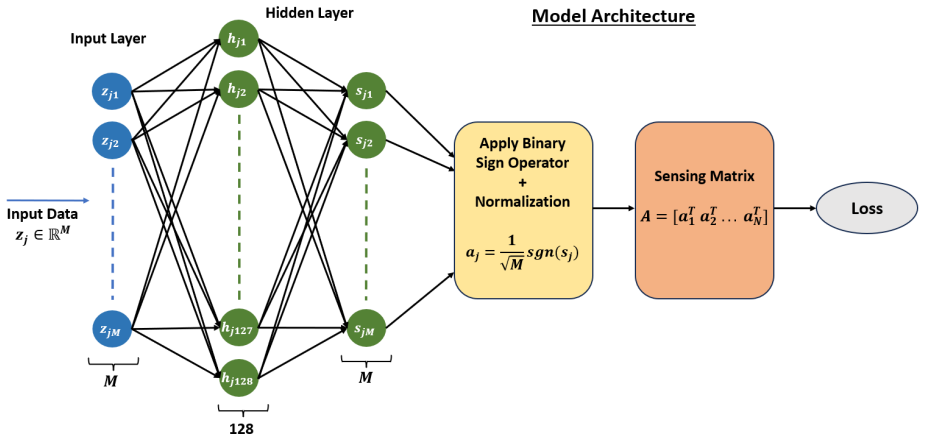
The central object is the shared-rule neural generator together with a coherence surrogate loss. A small feedforward network maps each latent vector $z_j$ to a real vector, and the sign function turns it into a $\{-1/\sqrt{M}, 1/\sqrt{M}\}$ column; because the same network weights produce all $N$ columns, the matrix is reproducible and can be stored as a few network parameters. The loss approximates the non-differentiable maximum absolute off-diagonal Gram entry with an $\ell^p$ norm, a LogSumExp smooth maximum, and a tight-frame term that pushes $AA^T$ toward $\frac{N}{M}I$, steering the binary matrix toward the incoherent structure that the classical coherence-to-sparsity bound connects to exact recovery.
What would settle it
Retrain the same generator with the LogSumExp term changed to $\frac{1}{\xi}\log\sum_{i\ne j} e^{\xi |G_{ij}|}$; if the maximum absolute coherence falls below 0.281 at $M=64$, $N=128$, the original loss was not minimizing mutual coherence. Separately, run OMP or Basis Pursuit on random $k$-sparse signals with the learned matrix; failure near the sparsity level allowed by the coherence bound would show the claimed link to perfect recovery is not demonstrated.
Extended reading notes
Core claim
The central claim is that the mutual incoherence property can serve as the entire training signal for sensing-matrix design, replacing both random draws and data-driven optimization. The learned matrix $A_\theta$ is generated column-wise by $a_j = \frac{1}{\sqrt{M}}\operatorname{sgn}(\mathcal{N}_\theta(z_j))$, so the network acts as a compact, reproducible generator rather than a per-entry search. Training minimizes a combined Gram-matrix loss: an $\ell^p$ norm over off-diagonal entries, a LogSumExp smooth-max term, and a tight-frame penalty $\|AA^T - \frac{N}{M}I\|_F^2$. In the reported experiments, these three terms drive maximum mutual coherence down to about 0.281 from about 0.481 (Gaussian) and 0.496 (Bernoulli) at $M=64$, $N=128$, with average and total coherence also dropping across all tested sizes. The paper takes these results as evidence that a property-focused, data-free learning framework yields better incoherence guarantees than conventional random constructions.
Load-bearing premise
The load-bearing assumption is that the training loss actually shrinks the worst column correlation; the LogSumExp term omits the absolute-value bars, so a strongly negative off-diagonal Gram entry would not be penalized, and the reported coherence gains may come from a loss that is not minimizing what the paper claims.
Editorial extensions
If this is right
- If the coherence gains persist at other sizes, compressive sensing systems can store the network weights instead of a dense random matrix and regenerate the sensing matrix on demand.
- Lower maximum coherence widens the sparsity range for which recovery is guaranteed by the classical bound $k < \frac{1}{2}(1/\mu(A)+1)$, so the reported values promise recovery of less sparse signals than random matrices of the same dimensions.
- Binary entries turn acquisition and reconstruction operations into additions and sign flips, which simplifies hardware implementation and reduces storage costs.
- Because training uses no signal data, the resulting matrix is not tied to any signal class, so the same generator could be reused across applications without retraining.
- A deterministic shared rule makes the construction reproducible: the same network parameters always produce the same sensing matrix.
Reading between the lines
- The same template could be applied to other matrix properties, converting theoretical guarantees such as RIP or null-space property surrogates into trainable loss functions.
- If the LogSumExp term were replaced with $\frac{1}{\xi}\log\sum_{i\ne j} e^{\xi |G_{ij}|}$, retraining might yield a lower maximum absolute coherence than the reported 0.281, which would indicate the current loss is not minimizing exactly what the tables report.
- The paper's inference that lower coherence supports perfect recovery relies on the coherence-to-sparsity bound, but actual recovery was never measured; running OMP or Basis Pursuit on random sparse signals would settle whether the coherence gains translate into reconstruction gains.
- Since the generator is continuous in the latent vectors, the same trained network could produce sensing matrices of other dimensions by changing the number or size of the latent inputs, a scalability claim the paper leaves implicit.
Signed reviews
Editorial analysis
A structured set of objections, weighed in public.
Referee Report
Summary. The paper proposes a data-free neural-network framework for designing binary sensing matrices (entries ±1/√M) with low mutual coherence. A small fully connected network maps M-dimensional latent vectors to columns of the sensing matrix; a sign activation with a straight-through estimator enforces the binary constraint. The training objective combines an Lp-norm penalty on off-diagonal Gram entries, a LogSumExp approximation to the maximum off-diagonal entry, and a tight-frame penalty. Experiments for (M,N) = (64,128), (64,256), (128,256) report lower maximum, average, and total mutual coherence than Gaussian and Bernoulli random matrices, and the paper argues this leads to better sparse-signal recovery via the Donoho–Elad bound.
Significance. If substantiated, the method offers a lightweight, storage-efficient alternative to random sensing matrices, with the notable feature of learning from a mathematical property rather than from data. The shared-column generator is simple and the coherence gains over random matrices are non-trivial. However, the current evaluation is limited to coherence values that are closely related to the training objective, with no sparse-recovery experiments and no comparison against established deterministic or optimization-based construction methods; hence the significance for compressive sensing practice remains to be established.
major comments (3)
- [Section 5.3, LLogSum definition] The LogSumExp loss is defined as LLogSum(Aθ) = (1/ξ) log Σ_{i≠j} exp(ξ Gij), which as ξ→∞ converges to max_{i≠j} Gij, not to the maximum absolute mutual coherence max_{i≠j} |Gij| used in Eq. (4) and Table 1. With ξ=30, a negative off-diagonal entry of magnitude 0.28 contributes e^{-8.4}≈2.2e-4 to the sum whereas a positive entry of the same magnitude contributes e^{8.4}≈4.4e3, so the gradient is overwhelmingly dominated by positive entries and the worst negative correlations are effectively invisible to this loss term. Since the reported maximum coherence is absolute, this is a load-bearing mismatch. The authors should either replace Gij by |Gij| inside the LSE (or use an equivalent sign-symmetric formulation), or report the sign of the largest off-diagonal entries in the Table 1 runs to demonstrate that the omission does not affect the final matrices.
- [Section 6.4, Table 1] The evaluation is circular in the sense that the reported metric µ(A) is also the quantity that the combined loss is explicitly designed to reduce, and Section 6.2 states that hyperparameters were selected by monitoring µ(A). Consequently, Table 1 largely confirms that the optimization achieved its objective. To support the claim that the learned matrices 'consistently outperform' random matrices for compressive sensing, the paper needs independent validation: sparse-signal recovery experiments with Basis Pursuit or OMP on synthetic and real data, comparisons against deterministic or optimized constructions (e.g., Elad's coherence minimization, alternating projection methods, or ETF-based bounds), and error bars or standard deviations over the 20 independent runs. Without these, the lower coherence numbers cannot be interpreted as improved recovery performance.
- [Abstract and Section 7] The paper repeatedly claims that the low-coherence matrices enable 'perfect recovery' of sparse signals (Abstract, Section 7), but no recovery experiment is reported anywhere. The only indirect link is the Donoho–Elad bound in Eq. (5), but the paper never checks whether the actual sparsity level k for which recovery is guaranteed is relevant to any realistic signal model, nor whether the learned matrices actually recover signals in practice. A small set of recovery comparisons (e.g., phase transitions for Basis Pursuit) would make the claim testable.
minor comments (6)
- [Section 5.2] The statement 'Finally, the generated vectors are transposed and stacked column-wise to construct the sensing matrix of size 64×256' contradicts the experimental matrix dimensions (M,N) = (64,128) and (128,256) used in Section 6.4; please clarify whether this line refers only to one configuration.
- [Section 5.3, LogSumExp paragraph] The sentence 'Instead of considering maximum absolute value of G, we considered smoother approximation to the maximum' is ambiguous; unless |Gij| is inserted, the LSE is not an approximation of the absolute maximum, so the text should be corrected to match the definition.
- [Section 2.2] The definition of total mutual coherence, µtotal(A) = Σ_{i≠j} |gij|, is missing parentheses and does not clearly state that the diagonal is excluded; the same applies to the average coherence formula.
- [Table 1] All numerical entries are prefixed with '≈' and no standard deviations are reported despite 20 independent runs; please provide mean ± std and the number of seeds.
- [Introduction and Conclusion] The claim that the use of a mathematical property as a loss function is 'for the first time in literature' is an overstatement; coherence-based penalties appear in earlier dictionary-learning and sensing-matrix optimization literature (e.g., Elad 2007, Duarte-Carvajalino and Sapiro 2009), so the novelty should be more narrowly stated.
- [Section 6.3] The complexity comparison states that the network storage is 'almost equal to that of the random sensing matrix,' but this is only true for one specific N; for larger N the fixed-size network would be smaller, and for very small N it would be larger. Please state the storage cost as a function of M and N.
Circularity Check
The reported coherence improvements are the loss objective and the hyperparameter-selection metric, making the central claim partly an optimization tautology.
-
fitted input called prediction
[Section 5.3 (Loss Function), Problem (6), and Table 1]
"However, directly minimizing the maximum off-diagonal entry is challenging because the corresponding objective function is non-differentiable and thus unsuitable for gradient-based optimization methods. To address this limitation, differentiable surrogate loss functions are commonly employed to approximate the minimization of the worst-case pairwise correlation. In this work, we adopt a combined loss function that simultaneously minimizes the overall coherence of the sensing matrix while penalizing the largest pairwise column correlations."
The loss function is defined directly on the Gram off-diagonal statistics that Table 1 reports: L_{p-norm} is stated to converge to max_{i!=j} |Gij| = mu(A), L_{LogSum} is a smooth maximum surrogate, and L_{tight} enforces ETF structure. The network is trained by minimizing these surrogates, and then the paper's main evidence of success is the value of the same coherence statistics. Thus the reported 'lower mutual coherence than random matrices' is largely the objective being optimized, not an independent prediction. The result is not fully forced, because reaching low coherence under the binary shared-rule constraint is nontrivial, but in the absence of sparse-recovery experiments or another external benchmark the central claim substantially restates the training goal.
-
fitted input called prediction
[Section 6.2 (Hyperparameter Tuning) and Table 1]
"During the search process, both the total loss L(·) and the maximum µ(·) mutual coherence were monitored, since the primary objective of the proposed approach is to minimize the maximum mutual coherence of the resulting sensing matrix. ... the final configuration was selected for its ability to simultaneously minimize both the total loss and the maximum mutual coherence."
The evaluation statistic reported in Table 1, the maximum mutual coherence mu(A), was itself used as a model-selection criterion. The reported values are therefore selected by the metric, not predicted by the method. The random Gaussian and Bernoulli baselines received no equivalent coherence-based hyperparameter tuning, so the comparison is a fit-to-metric rather than an unbiased evaluation. This is precisely the fitted-input-called-prediction pattern: the quantity used for selection is the quantity presented as the outcome.
full rationale
The central claim is that a neural network trained only on the coherence property produces binary sensing matrices with lower mutual coherence than random matrices. That claim is partially circular because the training loss in Section 5.3 is a differentiable surrogate of the same Gram-matrix statistics used in Table 1, and Section 6.2 explicitly selects hyperparameters by monitoring the reported maximum coherence. Hence the reported improvement over random matrices is in part the outcome of optimizing and tuning on the evaluation metric itself. I did not find a self-citation chain or an imported uniqueness theorem; the paper contains no load-bearing self-citations. I also do not count the LogSumExp sign omission as circularity: the LSE term omits absolute values and therefore may not target the reported max-absolute coherence, which is a correctness risk rather than a reduction to the input. The paper additionally claims support for perfect recovery but provides no sparse-recovery experiments, and its comparison is limited to random matrices rather than the 'several existing sensing matrix construction methods' mentioned in the introduction; these are missing-support issues, not circularity. The binary shared-rule architecture and the actual optimization dynamics give the work some independent algorithmic content, so a score of 6 rather than 8 or 10 is appropriate.
Assumptions & free parameters
free parameters (3)
- Loss weighting coefficients alpha_1, alpha_2, alpha_3 =
3, 1, 0.5
- Surrogate loss parameters p and xi =
p=8, xi=30
- Network architecture and training hyperparameters =
128 and 64 hidden neurons, learning rate 0.0001, 1000 epochs
assumptions (4)
- standard math Mutual coherence bound (Donoho-Elad) guarantees recovery for k < (1/mu + 1)/2.
- domain assumption Minimizing the proposed combined loss leads to a matrix with low true maximum coherence and improved recovery.
- domain assumption The straight-through estimator provides valid gradients for the sign function during training.
- ad hoc to paper A binary matrix generated by a shared small network can achieve near-optimal coherence.
Cite this review
Pith. "Pith review of Learning the Mathematical Property for Designing Low Mutual Coherence Binary Sensing Matrices." pith.science (2026). https://pith.science/paper/OXMIKL7O
@misc{pith2026260812982,
  author       = {Pith},
  title        = {Pith review of: Learning the Mathematical Property for Designing Low Mutual Coherence Binary Sensing Matrices},
  year         = {2026},
  howpublished = {\url{https://pith.science/paper/OXMIKL7O}},
  note         = {Machine review of arXiv:2608.12982}
}
read the original abstract
In this research work, we are constructing the sensing matrix, which is essential for the success of the compressive sensing technique. We have chosen a learning-based technique for the construction of the sensing matrix. The novelty and uniqueness of the proposed technique is that it does not use any data set and also does not use a specific application. It uses the mathematical property/constraint for the construction of the sensing matrix for the perfect recovery of the signal. The perfect recovery of signals is an old and still very challenging problem in real-world applications. In late 2000, compressive sensing became a popular mathematical tool for the perfect recovery of sparse signals. The core of the compressive technique is the construction of the sensing matrix, which satisfies certain special properties such as restricted isometry property (RIP), null space property (NSP), and spark property (SP). All these properties are NP-hard problems and hence computationally challenging to solve. For all practical purposes, the construction of the sensing matrix needs to achieve low mutual coherence to achieve the perfect recovery of the signals. We have used a neural network for the construction of the sensing matrix, and this framework constructs a binary sensing matrix with low mutual coherence. The entries in the matrix are generated through a shared underlying rule. The proposed architecture is simple and does not use large-scale training data sets. Such uniqueness and novelty bring a drastic reduction in computational cost, and also, for the first time in literature, the use of a mathematical property for defining the loss function. In this proposed research work, the mutual coherence property has been used in the neural network framework. Such a neural network framework brings generality, robustness, and reduces storage requirements.
Figures


Figures from the paper (5 more)


Reference graph
Works this paper leans on
-
[1]
Compressed learning: A deep neural network approach.arXiv preprint arXiv:1610.09615, 2016
Amir Adler, Michael Elad, and Michael Zibulevsky. Compressed learning: A deep neural network approach.arXiv preprint arXiv:1610.09615, 2016
arXiv 2016
-
[2]
Pablo Arbelaez, Michael Maire, Charless Fowlkes, and Jitendra Malik. Contour detec- tion and hierarchical image segmentation.IEEE transactions on pattern analysis and machine intelligence, 33(5):898–916, 2010
work page 2010
-
[3]
Richard Baraniuk, Mark Davenport, Ronald DeVore, and Michael Wakin. A simple proof of the restricted isometry property for random matrices.Constructive approxi- mation, 28:253–263, 2008
work page 2008
-
[4]
A fast iterative shrinkage-thresholding algorithm for linear inverse problems.SIAM journal on imaging sciences, 2(1):183–202, 2009
Amir Beck and Marc Teboulle. A fast iterative shrinkage-thresholding algorithm for linear inverse problems.SIAM journal on imaging sciences, 2(1):183–202, 2009
2009
-
[5]
Compressed sensing using generative models
Ashish Bora, Ajil Jalal, Eric Price, and Alexandros G Dimakis. Compressed sensing using generative models. InInternational conference on machine learning, pages 537–
-
[6]
Explicit constructions of rip matrices and related problems.Duke Mathematical Jour- nal, 2011
Jean Bourgain, Stephen Dilworth, Kevin Ford, Sergei Konyagin, and Denka Kutzarova. Explicit constructions of rip matrices and related problems.Duke Mathematical Jour- nal, 2011
work page 2011
-
[7]
Sparse signal and image recovery from compressive samples
Emmanuel Candes, Nathaniel Braun, and Michael Wakin. Sparse signal and image recovery from compressive samples. In2007 4th IEEE International Symposium on Biomedical Imaging: From Nano to Macro, pages 976–979. IEEE, 2007
work page 2007
-
[8]
Sparsity and incoherence in compressive sam- pling.Inverse problems, 23(3):969–985, 2007
Emmanuel Candes and Justin Romberg. Sparsity and incoherence in compressive sam- pling.Inverse problems, 23(3):969–985, 2007
work page 2007
Show all 36 references
-
[9]
The restricted isometry property and its implications for com- pressed sensing.Comptes rendus mathematique, 346(9-10):589–592, 2008
Emmanuel J Candes. The restricted isometry property and its implications for com- pressed sensing.Comptes rendus mathematique, 346(9-10):589–592, 2008
2008
-
[10]
Robust uncertainty princi- ples: Exact signal reconstruction from highly incomplete frequency information.IEEE Transactions on information theory, 52(2):489–509, 2006
Emmanuel J Cand` es, Justin Romberg, and Terence Tao. Robust uncertainty princi- ples: Exact signal reconstruction from highly incomplete frequency information.IEEE Transactions on information theory, 52(2):489–509, 2006
2006
-
[11]
Emmanuel J Candes, Justin K Romberg, and Terence Tao. Stable signal recovery from incomplete and inaccurate measurements.Communications on Pure and Applied Mathematics: A Journal Issued by the Courant Institute of Mathematical Sciences, 59(8):1207–1223, 2006
2006
-
[12]
Decoding by linear programming.IEEE trans- actions on information theory, 51(12):4203–4215, 2005
Emmanuel J Candes and Terence Tao. Decoding by linear programming.IEEE trans- actions on information theory, 51(12):4203–4215, 2005. 23
2005
-
[13]
Near-optimal signal recovery from random projections: Universal encoding strategies?IEEE transactions on information theory, 52(12):5406–5425, 2006
Emmanuel J Candes and Terence Tao. Near-optimal signal recovery from random projections: Universal encoding strategies?IEEE transactions on information theory, 52(12):5406–5425, 2006
2006
-
[14]
Compressed sensing and best k-term approximation.Journal of the American mathematical society, 22(1):211–231, 2009
Albert Cohen, Wolfgang Dahmen, and Ronald DeVore. Compressed sensing and best k-term approximation.Journal of the American mathematical society, 22(1):211–231, 2009
2009
-
[15]
Introduction to compressed sensing., 2012
Mark A Davenport, Marco F Duarte, Yonina C Eldar, and Gitta Kutyniok. Introduction to compressed sensing., 2012
2012
-
[16]
Deterministic constructions of compressed sensing matrices.Journal of complexity, 23(4-6):918–925, 2007
Ronald A DeVore. Deterministic constructions of compressed sensing matrices.Journal of complexity, 23(4-6):918–925, 2007
2007
-
[17]
Compressed sensing.IEEE Transactions on information theory, 52(4):1289–1306, 2006
David L Donoho. Compressed sensing.IEEE Transactions on information theory, 52(4):1289–1306, 2006
2006
-
[18]
Optimally sparse representation in general (nonorthogonal) dictionaries viaℓ 1 minimization.Proceedings of the National Academy of Sciences, 100(5):2197–2202, 2003
David L Donoho and Michael Elad. Optimally sparse representation in general (nonorthogonal) dictionaries viaℓ 1 minimization.Proceedings of the National Academy of Sciences, 100(5):2197–2202, 2003
2003
-
[19]
Learning to sense sparse signals: Simultaneous sensing matrix and sparsifying dictionary optimization.IEEE Transac- tions on Image Processing, 18(7):1395–1408, 2009
Julio Martin Duarte-Carvajalino and Guillermo Sapiro. Learning to sense sparse signals: Simultaneous sensing matrix and sparsifying dictionary optimization.IEEE Transac- tions on Image Processing, 18(7):1395–1408, 2009
2009
-
[20]
Optimized projections for compressed sensing.IEEE Transactions on Signal Processing, 55(12):5695–5702, 2007
Michael Elad. Optimized projections for compressed sensing.IEEE Transactions on Signal Processing, 55(12):5695–5702, 2007
2007
-
[21]
Imagenet classification with deep convolutional neural networks.Advances in neural information processing systems, 25, 2012
Alex Krizhevsky, Ilya Sutskever, and Geoffrey E Hinton. Imagenet classification with deep convolutional neural networks.Advances in neural information processing systems, 25, 2012
2012
-
[22]
Gradient-based learn- ing applied to document recognition.Proceedings of the IEEE, 86(11):2278–2324, 1998
Yann LeCun, L´ eon Bottou, Yoshua Bengio, and Patrick Haffner. Gradient-based learn- ing applied to document recognition.Proceedings of the IEEE, 86(11):2278–2324, 1998
1998
-
[23]
Deep learning face attributes in the wild
Ziwei Liu, Ping Luo, Xiaogang Wang, and Xiaoou Tang. Deep learning face attributes in the wild. InProceedings of the IEEE international conference on computer vision, pages 3730–3738, 2015
2015
-
[24]
Convolutional neural networks for noniterative reconstruction of compressively sensed images.IEEE Transactions on Computational Imaging, 4(3):326–340, 2018
Suhas Lohit, Kuldeep Kulkarni, Ronan Kerviche, Pavan Turaga, and Amit Ashok. Convolutional neural networks for noniterative reconstruction of compressively sensed images.IEEE Transactions on Computational Imaging, 4(3):326–340, 2018
2018
-
[25]
Algorithm unrolling: Interpretable, ef- ficient deep learning for signal and image processing.IEEE Signal Processing Magazine, 38(2):18–44, 2021
Vishal Monga, Yuelong Li, and Yonina C Eldar. Algorithm unrolling: Interpretable, ef- ficient deep learning for signal and image processing.IEEE Signal Processing Magazine, 38(2):18–44, 2021. 24
2021
-
[26]
A deep learning approach to structured signal recovery
Ali Mousavi, Ankit B Patel, and Richard G Baraniuk. A deep learning approach to structured signal recovery. In2015 53rd annual allerton conference on communication, control, and computing (Allerton), pages 1336–1343. IEEE, 2015
2015
-
[27]
Compressed sens- ing: A simple deterministic measurement matrix and a fast recovery algorithm.IEEE Transactions on Instrumentation and Measurement, 64(12):3405–3413, 2015
Andrianiaina Ravelomanantsoa, Hassan Rabah, and Amar Rouane. Compressed sens- ing: A simple deterministic measurement matrix and a fast recovery algorithm.IEEE Transactions on Instrumentation and Measurement, 64(12):3405–3413, 2015
2015
-
[28]
Ima- genet large scale visual recognition challenge.International journal of computer vision, 115(3):211–252, 2015
Olga Russakovsky, Jia Deng, Hao Su, Jonathan Krause, Sanjeev Satheesh, Sean Ma, Zhiheng Huang, Andrej Karpathy, Aditya Khosla, Michael Bernstein, et al. Ima- genet large scale visual recognition challenge.International journal of computer vision, 115(3):211–252, 2015
2015
-
[29]
Image compressed sensing using convolutional neural network.IEEE Transactions on Image Processing, 29:375– 388, 2019
Wuzhen Shi, Feng Jiang, Shaohui Liu, and Debin Zhao. Image compressed sensing using convolutional neural network.IEEE Transactions on Image Processing, 29:375– 388, 2019
2019
-
[30]
On the existence of equiangular tight frames.Linear Algebra and its applications, 426(2-3):619– 635, 2007
M´ aty´ as A Sustik, Joel A Tropp, Inderjit S Dhillon, and Robert W Heath Jr. On the existence of equiangular tight frames.Linear Algebra and its applications, 426(2-3):619– 635, 2007
2007
-
[31]
Andreas M Tillmann and Marc E Pfetsch. The computational complexity of the re- stricted isometry property, the nullspace property, and related concepts in compressed sensing.IEEE Transactions on Information Theory, 60(2):1248–1259, 2013
2013
-
[32]
A novel complex-valued gaussian measurement matrix for image compressed sensing.Entropy, 25(9):1248, 2023
Yue Wang, Linlin Xue, Yuqian Yan, and Zhongpeng Wang. A novel complex-valued gaussian measurement matrix for image compressed sensing.Entropy, 25(9):1248, 2023
2023
-
[33]
Learning a compressed sensing measurement matrix via gradient unrolling
Shanshan Wu, Alex Dimakis, Sujay Sanghavi, Felix Yu, Daniel Holtmann-Rice, Dmitry Storcheus, Afshin Rostamizadeh, and Sanjiv Kumar. Learning a compressed sensing measurement matrix via gradient unrolling. InInternational Conference on Machine Learning, pages 6828–6839. PMLR, 2019
2019
-
[34]
Optimized projection matrix for compressive sensing.EURASIP Journal on Advances in Signal Processing, 2010:1–8, 2010
Jianping Xu, Yiming Pi, and Zongjie Cao. Optimized projection matrix for compressive sensing.EURASIP Journal on Advances in Signal Processing, 2010:1–8, 2010
2010
-
[35]
A new method of measurement matrix optimization for compressed sensing based on alternating minimization.Mathematics, 9(4):329, 2021
Renjie Yi, Chen Cui, Biao Wu, and Yang Gong. A new method of measurement matrix optimization for compressed sensing based on alternating minimization.Mathematics, 9(4):329, 2021
2021
-
[36]
Ista-net: Interpretable optimization-inspired deep network for image compressive sensing
Jian Zhang and Bernard Ghanem. Ista-net: Interpretable optimization-inspired deep network for image compressive sensing. InProceedings of the IEEE conference on computer vision and pattern recognition, pages 1828–1837, 2018. 25
2018
Reviewed August 15, 2026 · model on record in the stance chip above.
Discussion (0). Continue with ORCID to comment.