REVIEW 4 major objections 5 minor 91 references
Critical behavior and critical exponents of rotating QCD matter
T0 review · 4 major / 5 minor · reviewed 2026-08-14 · deepseek-v4-flash
Pith's one-line read Near the chiral critical endpoint, rotating quark matter displays the same mean-field scaling exponents as non-rotating matter, with angular velocity shifting only the endpoint's location.
desk verdict A solid, workmanlike mean-field NJL extraction of effective critical exponents in the (T,ω) plane that confirms expected Landau values; the main caveat is the asserted rather than derived identification of rotational polarization as the scaling order parameter. read the letter →
The pith
A machine-rendered reading of the paper's core claim, the machinery that carries it, and where it could break.
The reading
What carries the argument
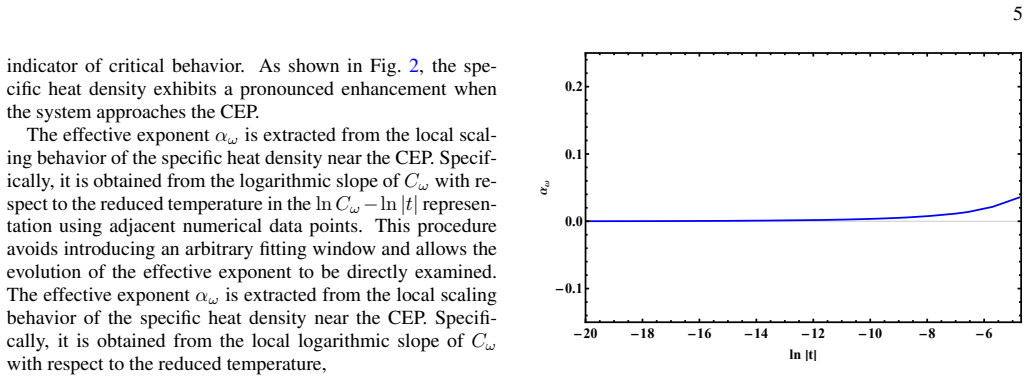
The central object is the rotational polarization $J=-\partial\Omega/\partial\omega$, the thermodynamic conjugate of the angular velocity. It is not the chiral condensate, but the paper argues it couples to the chiral critical mode through the mixed dependence of $\Omega$ on the constituent mass $M$ and $\omega$, so its discontinuity, susceptibility, and isotherm response are claimed to inherit the order-parameter scaling. The companion identity is the rotational susceptibility $\chi_\omega=\partial J/\partial\omega$, evaluated as a total derivative along the gap-equation trajectory; it splits into a direct response $-\partial^2\Omega/\partial\omega^2$ plus a chiral-fluctuation term $(\partial^2\Omega/\partial\omega\,\partial M)^2\,(\partial^2\Omega/\partial M^2)^{-1}$. The singular amplification of $\chi_\omega$ near the endpoint is driven by the vanishing curvature $\partial^2\Omega/\partial M^2\to 0$, which softens the chiral mode. Each exponent is read off from a local logarithmic slope in $\ln|t|$ or $\ln|\tilde\omega|$ between adjacent numerical points, a procedure chosen to avoid arbitrary fitting windows.
What would settle it
Extract the same exponents from the chiral condensate itself, for instance $\beta$ from the jump $\Delta M$ along the first-order line, $\gamma$ from the curvature $\partial^2\Omega/\partial M^2$, and $\delta$ from the isotherm of $M$, and compare with the values obtained from $J$; unequal exponents would show that $J$ is not a faithful order-parameter proxy. A second, purely numerical check is to rerun the extraction with a larger angular-momentum cutoff $n$ and several radial positions $r$, and test whether the plateau regions of $\alpha$, $\beta$, $\gamma$, $\delta$ and the endpoint location itself survive.
Extended reading notes
Core claim
Working in a co-rotating frame, the authors add the rotation to the NJL Lagrangian through orbital and spin couplings linear in $\omega$, so the quasiparticle energies become $\varepsilon_n = E_k + (n+\tfrac12)\omega$, and derive the mean-field thermodynamic potential $\Omega(T,\omega,M)$. The stationary condition $\partial\Omega/\partial M=0$ defines the equilibrium trajectory, and the chiral critical endpoint is found at $T_{\mathrm{CEP}}\simeq 0.0202339062$ GeV and $\omega_{\mathrm{CEP}}\simeq 0.6440126597$ GeV, where the curvature $\partial^2\Omega/\partial M^2$ vanishes. Approaching the endpoint along four distinct thermodynamic paths, the paper extracts effective exponents from local logarithmic slopes: the specific heat density $C_\omega=-T\,\partial^2\Omega/\partial T^2$ gives $\alpha_\omega\simeq 0$; the jump $\Delta J$ of the rotational polarization $J=-\partial\Omega/\partial\omega$ across the first-order line gives $\beta_\omega\simeq 1/2$; the rotational susceptibility $\chi_\omega=\partial J/\partial\omega$ diverges with $\gamma_\omega\simeq 1$; and the critical-isotherm response $\tilde J\sim|\tilde\omega|^{1/\delta}$ at $T=T_{\mathrm{CEP}}$ gives $\delta_\omega\simeq 3$. The four exponents obey $\alpha+2\beta+\gamma=2$ and $\alpha+\beta(1+\delta)=2$, the relations expected for Landau mean-field Ising behavior. The paper concludes that rotation extends the control-parameter space and moves the phase boundary, but does not change the mean-field critical scaling structure.
Load-bearing premise
The load-bearing premise is that the rotational polarization $J=-\partial\Omega/\partial\omega$ inherits the full singular behavior of the chiral order parameter near the endpoint, so that its jump, susceptibility, and isotherm scaling genuinely measure the chiral critical exponents; the paper asserts this coupling rather than deriving it.
Editorial extensions
If this is right
- Angular velocity joins temperature as a genuine control parameter: the $(T,\omega)$ plane contains its own critical endpoint, and rotation shifts the phase boundary without erasing the critical point.
- The rotational susceptibility $\chi_\omega$ diverges at the endpoint, so the response of vortical matter to changes in angular velocity offers a new probe of criticality in rotating systems.
- The four exponents are extracted independently and still satisfy both standard scaling relations, an internal consistency check that supports the mean-field identification.
- The rotation-induced endpoint belongs to the same mean-field Ising scaling class as the conventional $(T,\mu_B)$ endpoint, so methods developed for the chemical-potential plane carry over to the rotational control parameter.
- The work supplies a systematic characterization of rotation-induced critical phenomena, which the paper frames as the baseline for extending rotating QCD studies beyond the mean-field approximation.
Reading between the lines
- A direct internal test suggests itself: extract $\beta$ from the jump of the constituent quark mass $M$ itself and $\gamma$ from $\partial^2\Omega/\partial M^2$, then compare with the values obtained from $J$; agreement would confirm that the rotational polarization inherits the chiral singular part rather than contributing a singular behavior of its own.
- The fixed radial coordinate $r=0.1$ GeV$^{-1}$ and angular-momentum cutoff $n=5$ are used without convergence checks; repeating the extraction at larger $n$ and several $r$ would show whether the exponent plateaus are numerical artifacts or genuine scaling.
- If $J$ is a faithful critical proxy, higher-order cumulants of the rotational polarization, analogues of the kurtosis used in beam-energy scans, should diverge near the endpoint with exponents tied to $\gamma$ and $\delta$; that would amount to a sharper, possibly measurable rotational signature of the critical point.
- A fluctuation-corrected treatment could either confirm the mean-field Ising class or expose rotation-sensitive corrections, and the present calculation fixes the baseline such a comparison needs, a step the authors themselves flag.
Editorial analysis
A structured set of objections, weighed in public.
Referee Report
Summary. The manuscript studies rotating two-flavor QCD matter in the two-flavor NJL model at mean-field level. Working in a rotating frame, the authors write down a thermodynamic potential, solve the gap equation, and locate a critical endpoint in the temperature–angular-velocity (T, ω) plane, reporting T_CEP ≈ 0.0202339062 GeV and ω_CEP ≈ 0.6440126597 GeV for fixed radial coordinate r = 0.1 GeV^-1 and angular-momentum cutoff n = 5. They define effective critical exponents α_ω, β_ω, γ_ω, and δ_ω from the specific heat density, the discontinuity of the rotational polarization J = −∂Ω/∂ω, the rotational susceptibility χ_ω = ∂J/∂ω, and the critical-isotherm response of J, respectively. From numerical logarithmic slopes they report α_ω ≈ 0, β_ω ≈ 1/2, γ_ω ≈ 1, and δ_ω ≈ 3, which satisfy the mean-field scaling relations α + 2β + γ = 2 and α + β(1 + δ) = 2. The paper concludes that rotation shifts the location of the CEP but does not change the underlying mean-field Ising scaling class.
Significance. If the claimed results are correct, the paper would provide a systematic critical-exponent analysis for rotating QCD matter in a widely used effective model, with explicit expressions for the specific heat, rotational polarization, and rotational susceptibility. The extracted exponents are consistent with each other through the standard scaling relations, and the authors are appropriately explicit that the calculation is confined to the mean-field approximation and that fluctuations are neglected. The paper also identifies concrete extensions beyond mean field. However, the central identification of J as an order-parameter-like quantity is asserted rather than derived, and the δ_ω extraction rests on an unverified assumption about the direction of the ordering field in the (T, ω) plane. These points are load-bearing for the claim that the exponents characterize the chiral CEP, so the significance of the paper will be established only after those gaps are closed.
major comments (4)
- [Eq. (9) and Eq. (10)] The statement in Eq. (9) that the stationarity condition removes the implicit M(T) dependence from the second temperature derivative is not correct. One has dΩ/dT = ∂Ω/∂T at the stationary point, but d²Ω/dT² = ∂²Ω/∂T² + 2∂²Ω/∂T∂M dM/dT + ∂²Ω/∂M² (dM/dT)², so the correct specific heat is C_ω = −T[∂²Ω/∂T² − (∂²Ω/∂T∂M)²/∂²Ω/∂M²]. The correction term shown in Eq. (10), which has a numerator involving (2n+1) ε f_+f_- and a denominator involving (2n+1)²(f_+² + f_-²), does not match the required ∂²Ω/∂T∂M and ∂²Ω/∂M², the latter being 1/(2G) − B with B defined in Eq. (18). Please derive Eq. (10) explicitly and state which expression was actually used in the α_ω extraction.
- [Eqs. (11)–(14), Sec. III] The assertion that the rotational polarization J is 'coupled to the chiral critical mode' and therefore inherits the chiral order-parameter scaling is not derived. For β_ω to equal the chiral order-parameter exponent, the singular part of ΔJ must be proportional to ΔM; this requires, at minimum, that ∂J/∂M evaluated at the CEP is nonzero, or that a different argument establishes the proportionality when M_c ≠ 0. The paper provides no proof and no numerical check of this condition. Please show explicitly that J = J_c + A(M − M_c) + ... with A ≠ 0 in the critical region, or demonstrate numerically that ΔJ/ΔM is finite and nonzero as the CEP is approached.
- [Eq. (20) and Fig. 9] Extracting δ_ω by varying pure ω at T = T_CEP implicitly assumes that the pure-ω direction coincides with the 'magnetic' scaling field of the CEP. In general, the two relevant scaling fields near the CEP are linear combinations of δT and δω; if the chosen path has a nonzero thermal component, the apparent exponent tends to 1/β = 2 in mean-field theory rather than δ = 3. The paper should determine the mixing angle, for example from the tangent direction of the first-order transition line in the (T, ω) plane at the CEP, and extract δ along the orthogonal ordering-field direction, or show explicitly that the pure-ω direction is the magnetic direction. Without this step, the agreement δ_ω ≈ 3 cannot yet be taken as evidence for the mean-field Ising class.
- [Sec. III, numerical setup] The exponents are quoted from visual plateaus without quantitative uncertainties, and the two truncation parameters — the angular-momentum cutoff n = 5 and the fixed radial coordinate r = 0.1 GeV^-1 — are not varied. The CEP coordinates are quoted to ten significant digits, which is not meaningful without a convergence study in n and a test of sensitivity to r. Please report a sensitivity analysis (for example n = 3, 5, 7, 10 and r = 0.05, 0.1, 0.2 GeV^-1) and give the resulting ranges for the CEP location and for each exponent.
minor comments (5)
- [Eq. (2)] Equation (2) contains an unexplained γ^0 μ term in the Lagrangian even though the thermodynamic potential is evaluated at zero chemical potential; please either define μ or remove the term.
- [Eq. (12)] The sign in Eq. (12) appears inconsistent with the definition J = −∂Ω/∂ω. From Eq. (4), ∂Ω/∂ω is proportional to (f_+ − f_-), so J should be proportional to (f_- − f_+); please check the sign and the corresponding expressions in Eqs. (15)–(17).
- [Eq. (17)] The direct term in Eq. (17), −∂²Ω/∂ω², evaluated from Eq. (4) gives N_f N_c/(2π² T) Σ ∫ J_n (n+1/2)² f_+f_-, whereas Eq. (17) has N_f N_c/(4π² T); please verify the prefactors in Eqs. (10), (12), and (17) for consistency.
- [Figs. 3, 4, 7, 9] For each quoted exponent, the paper should specify the range of ln|t| or ln|ω̃| over which the plateau value was averaged, together with the resulting statistical or numerical uncertainty.
- [General presentation] There are several typographical and editorial issues, including a duplicated paragraph defining α_ω in Sec. III, 'Sezionedi' in the affiliation, 'V .' in the reference list, and the capitalization in the first sentence of the Conclusions; these should be corrected.
Circularity Check
No significant circularity: the effective exponents are read off from derivatives of the model's thermodynamic potential, not fitted to the claimed values, and the mean-field scaling conclusion is an internal consistency check rather than a reduction of input to output.
full rationale
The paper's derivation chain does not reduce to its inputs. The input is the two-flavor NJL thermodynamic potential (Eq. 4), taken from the standard rotating-frame formalism [28,33]. The CEP is located by the stationary condition (Eq. 5), and the observables C_omega, J, and chi_omega are defined as derivatives of this potential (Eqs. 8-20). The effective exponents alpha_omega, beta_omega, gamma_omega, and delta_omega are extracted as local logarithmic slopes of these derivatives near the CEP, not obtained by fitting parameters to the claimed mean-field values. The statements that J inherits the chiral critical scaling and that the CEP shows mean-field Ising exponents are consequences of the mean-field Landau form of the potential; they are model predictions, not premises. The identification of J as order-parameter-like is an assumption that could fail if the coupling between J and the chiral mode vanished, but that is a validity/correctness concern rather than circularity, and the reported divergence of chi_omega and vanishing of Delta J are consistent with a nonzero coupling. Self-citations [28,33,40] support the rotating-NJL formalism and do not carry the exponent result; no uniqueness theorem or fitted input is invoked. The central claim is therefore self-contained against the mean-field benchmark values (alpha about 0, beta about 1/2, gamma about 1, delta about 3).
Assumptions & free parameters
free parameters (5)
- current quark mass m =
0.005 GeV
- four-fermion coupling G =
3.672 GeV^-2
- three-momentum cutoff Lambda =
0.6816 GeV
- radial coordinate r =
0.1 GeV^-1
- angular momentum cutoff n =
5
assumptions (5)
- domain assumption Mean-field approximation: the thermodynamic potential is evaluated at the stationary point of the gap equation and fluctuations are neglected.
- domain assumption The rotating-frame Lagrangian keeps only terms linear in angular velocity (Eq. 2).
- ad hoc to paper The system is treated at a fixed radial coordinate rather than integrated over a finite cylinder with boundary conditions.
- ad hoc to paper The rotational polarization J is assumed to inherit the critical scaling of the chiral order parameter.
- standard math Standard finite-temperature field theory with Matsubara sums and Bessel-mode decomposition is used to derive the thermodynamic potential.
Cite this review
Pith. "Pith review of Critical behavior and critical exponents of rotating QCD matter." pith.science (2026). https://pith.science/paper/PEAG6URO
@misc{pith2026260813469,
  author       = {Pith},
  title        = {Pith review of: Critical behavior and critical exponents of rotating QCD matter},
  year         = {2026},
  howpublished = {\url{https://pith.science/paper/PEAG6URO}},
  note         = {Machine review of arXiv:2608.13469}
}
abstract
We investigate the thermodynamic properties and critical behavior of rotating strongly interacting matter within the two-flavor Nambu--Jona-Lasinio (NJL) model in the mean-field approximation. The phase structure and the critical endpoint (CEP) are determined in the temperature--angular velocity \((T,\omega)\) plane. By analyzing the singular behavior of thermodynamic observables near the CEP, we extract the corresponding effective critical exponents characterizing the scaling behavior of the specific heat density, the rotational polarization discontinuity, the rotational susceptibility, and the critical-isotherm behavior of the rotational polarization. The obtained exponents approach the expected mean-field values and satisfy the corresponding scaling relations, indicating that the rotational degree of freedom does not alter the underlying mean-field critical scaling behavior within the present framework. These results provide a systematic characterization of rotation-induced critical phenomena and establish a basis for further studies of rotating QCD matter beyond the mean-field approximation.
Figures


Figures from the paper (4 more)


Reference graph
Works this paper leans on
-
[1]
K. Fukushima and T. Hatsuda, Rept. Prog. Phys.74, 014001 (2011), arXiv:1005.4814 [hep-ph]
arXiv 2011
-
[2]
M. G. Alford, A. Schmitt, K. Rajagopal, and T. Sch ¨afer, Rev. Mod. Phys.80, 1455 (2008), arXiv:0709.4635 [hep-ph]. 8
arXiv 2008
-
[3]
P. Braun-Munzinger, V . Koch, T. Sch¨afer, and J. Stachel, Phys. Rept.621, 76 (2016), arXiv:1510.00442 [nucl-th]
arXiv 2016
-
[4]
A. Bazavov and others, Phys. Rev. D95, 054504 (2017), arXiv:1701.04325 [hep-lat]
arXiv 2017
-
[5]
S. J. Barnett, Phys. Rev.6(1915)
1915
-
[6]
S. J. Barnett, Rev. Mod. Phys.7, 129 (1935)
1935
-
[7]
Z.-T. Liang and X.-N. Wang, Phys. Rev. Lett.94, 102301 (2005), [Erratum: Phys.Rev.Lett. 96, 039901 (2006)], arXiv:nucl-th/0410079
arXiv 2005
-
[8]
L. Adamczyk et al. (STAR), Nature548, 62 (2017), arXiv:1701.06657 [nucl-ex]
arXiv 2017
Show all 91 references
-
[9]
Adam et al
J. Adam et al. (STAR), Phys. Rev. C98, 014910 (2018), arXiv:1805.04400 [nucl-ex]
2018 arXiv
-
[10]
Adam et al
J. Adam et al. (STAR), Phys. Rev. Lett.126, 162301 (2021), [Erratum: Phys.Rev.Lett. 131, 089901 (2023)], arXiv:2012.13601 [nucl-ex]
2021
-
[11]
Acharya et al
S. Acharya et al. (ALICE), Phys. Rev. Lett.125, 012301 (2020), arXiv:1910.14408 [nucl-ex]
2020 arXiv
-
[12]
V . V . Braguta, A. Y . Kotov, D. D. Kuznedelev, and A. A. Roenko, Pisma Zh. Eksp. Teor. Fiz.112, 9 (2020)
2020
-
[13]
V . V . Braguta, A. Y . Kotov, D. D. Kuznedelev, and A. A. Roenko, Phys. Rev. D103, 094515 (2021), arXiv:2102.05084 [hep-lat]
2021 arXiv
-
[14]
V . V . Braguta, A. Kotov, A. Roenko, and D. Sychev, PoSLA T- TICE2022, 190 (2023), arXiv:2212.03224 [hep-lat]
2023 arXiv
-
[15]
M. N. Chernodub, V . A. Goy, and A. V . Molochkov, Phys. Rev. D107, 114502 (2023), arXiv:2209.15534 [hep-lat]
2023 arXiv
-
[16]
V . V . Braguta, M. N. Chernodub, A. A. Roenko, and D. A. Sychev, Phys. Lett. B852, 138604 (2024), arXiv:2303.03147 [hep-lat]
2024 arXiv
-
[17]
V . V . Braguta, M. N. Chernodub, and A. A. Roenko, Phys. Lett. B855, 138783 (2024), arXiv:2312.13994 [hep-lat]
2024 arXiv
- [18]
-
[19]
V . V . Braguta, M. N. Chernodub, Y . A. Gershtein, and A. A. Roenko, JHEP09, 079 (2025), arXiv:2411.15085 [hep-lat]
2025 arXiv
-
[20]
Braguta, M
V . Braguta, M. Chernodub, E. Eremeev, I. Kudrov, A. Roenko, and D. Sychev (2025) arXiv:2512.04070 [hep-lat]
2025
-
[21]
H.-T. Ding, O. Kaczmarek, R. Luo, and H.-T. Shu, (2026), arXiv:2607.26939 [hep-lat]
2026 arXiv
-
[22]
Liu and I
Y . Liu and I. Zahed, Phys. Rev. Lett.120, 032001 (2018), arXiv:1711.08354 [hep-ph]
2018 arXiv
- [23]
-
[24]
Chen, X.-G
H.-L. Chen, X.-G. Huang, and K. Mameda, JHEP02, 216 (2024), arXiv:1910.02700 [nucl-th]
2024 arXiv
-
[25]
Zhang, D
H. Zhang, D. Hou, and J. Liao, Chin. Phys. C44, 111001 (2020), arXiv:1812.11787 [hep-ph]
2020 arXiv
- [26]
-
[27]
H.-L. Chen, K. Fukushima, X.-G. Huang, and K. Mameda, Phys. Rev. D93, 104052 (2016), arXiv:1512.08974 [hep-ph]
2016 arXiv
-
[28]
Jiang and J
Y . Jiang and J. Liao, Phys. Rev. Lett.117, 192302 (2016), arXiv:1606.03808 [hep-ph]
2016 arXiv
-
[30]
M. N. Chernodub and S. Gongyo, JHEP01, 136 (2017), arXiv:1611.02598 [hep-th]
2017 arXiv
-
[31]
M. N. Chernodub and S. Gongyo, Phys. Rev. D95, 096006 (2017), arXiv:1702.08266 [hep-th]
2017 arXiv
-
[32]
X. Wang, M. Wei, Z. Li, and M. Huang, Phys. Rev. D99, 016018 (2019), arXiv:1808.01931 [hep-ph]
2019 arXiv
- [33]
-
[34]
K. Xu, F. Lin, A. Huang, and M. Huang, Phys. Rev. D106, L071502 (2022), arXiv:2205.02420 [hep-ph]
2022 arXiv
-
[35]
F. Sun, K. Xu, and M. Huang, Phys. Rev. D108, 096007 (2023), arXiv:2307.14402 [hep-ph]
2023 arXiv
-
[36]
X. Chen, L. Zhang, D. Li, D. Hou, and M. Huang, JHEP07, 132 (2021), arXiv:2010.14478 [hep-ph]
2021 arXiv
-
[37]
Chen, Z.-B
H.-L. Chen, Z.-B. Zhu, and X.-G. Huang, Phys. Rev. D108, 054006 (2023), arXiv:2306.08362 [hep-ph]
2023 arXiv
-
[38]
N. R. F. Braga and O. C. Junqueira, (2023), arXiv:2306.08653 [hep-th]
2023 arXiv
-
[39]
V . E. Ambrus ¸ and M. N. Chernodub, (2023), arXiv:2304.05998 [hep-th]
2023 arXiv
-
[40]
F. Sun, J. Shao, R. Wen, K. Xu, and M. Huang, Phys. Rev. D 109, 116017 (2024), arXiv:2402.16595 [hep-ph]
2024 arXiv
-
[41]
Wang and S.-Q
J.-H. Wang and S.-Q. Feng, Phys. Rev. D109, 066019 (2024), arXiv:2403.01814 [hep-ph]
2024 arXiv
- [42]
-
[43]
Y .-Q. Zhao, S. He, D. Hou, L. Li, and Z. Li, JHEP04, 115 (2023), arXiv:2212.14662 [hep-ph]
2023 arXiv
-
[44]
A. A. Golubtsova and N. S. Tsegelnik, Phys. Rev. D107, 106017 (2023), arXiv:2211.11722 [hep-th]
2023 arXiv
-
[45]
Y . Chen, D. Li, and M. Huang, Phys. Rev. D106, 106002 (2022), arXiv:2208.05668 [hep-ph]
2022 arXiv
-
[46]
S. Chen, K. Fukushima, and Y . Shimada, Phys. Rev. Lett.129, 242002 (2022), arXiv:2207.12665 [hep-ph]
2022 arXiv
- [47]
-
[48]
N. R. F. Braga, L. F. Faulhaber, and O. C. Junqueira, Phys. Rev. D105, 106003 (2022), arXiv:2201.05581 [hep-th]
2022 arXiv
-
[49]
Cartwright, M
C. Cartwright, M. G. Amano, M. Kaminski, J. Noronha, and E. Speranza, (2021), arXiv:2112.10781 [hep-th]
2021 arXiv
-
[50]
A. A. Golubtsova, E. Gourgoulhon, and M. K. Usova, Nucl. Phys. B979, 115786 (2022), arXiv:2107.11672 [hep-th]
2022 arXiv
-
[51]
M. N. Chernodub, Phys. Rev. D103, 054027 (2021), arXiv:2012.04924 [hep-ph]
2021 arXiv
-
[52]
Fujimoto, K
Y . Fujimoto, K. Fukushima, and Y . Hidaka, Phys. Lett. B816, 136184 (2021), arXiv:2101.09173 [hep-ph]
2021 arXiv
-
[53]
F. Sun, S. Li, R. Wen, A. Huang, and W. Xie, (2023), arXiv:2310.18942 [hep-ph]
2023 arXiv
-
[54]
Costa, M
P. Costa, M. C. Ruivo, and C. A. de Sousa, Phys. Rev. D77, 096001 (2008), arXiv:0801.3417 [hep-ph]
2008 arXiv
-
[55]
DeWolfe, S
O. DeWolfe, S. S. Gubser, and C. Rosen, Phys. Rev. D83, 086005 (2011), arXiv:1012.1864 [hep-th]
2011 arXiv
-
[56]
Y .-L. Du, Y . Lu, S.-S. Xu, Z.-F. Cui, C. Shi, and H.-S. Zong, Int. J. Mod. Phys. A30, 1550199 (2015), arXiv:1506.04368 [hep-ph]
2015 arXiv
-
[57]
J. Chen, S. He, M. Huang, and D. Li, JHEP01, 165 (2019), arXiv:1810.07019 [hep-ph]
2019 arXiv
-
[58]
X. Chen, D. Li, and M. Huang, Chin. Phys. C43, 023105 (2019), arXiv:1810.02136 [hep-ph]
2019 arXiv
-
[59]
W.-j. Fu, J. M. Pawlowski, and F. Rennecke, Phys. Rev. D101, 054032 (2020), arXiv:1909.02991 [hep-ph]
2020 arXiv
-
[60]
Gao and J
F. Gao and J. M. Pawlowski, Phys. Lett. B820, 136584 (2021), arXiv:2010.13705 [hep-ph]
2021 arXiv
-
[61]
P. J. Gunkel and C. S. Fischer, Phys. Rev. D104, 054022 (2021), arXiv:2106.08356 [hep-ph]
2021 arXiv
-
[62]
Y .-Q. Zhao, S. He, D. Hou, L. Li, and Z. Li, Phys. Rev. D109, 086015 (2024), arXiv:2310.13432 [hep-ph]
2024 arXiv
-
[63]
Q. Fu, S. He, L. Li, and Z. Li, (2024), arXiv:2404.12109 [hep- ph]
2024 arXiv
-
[64]
Chen, W.-j
H.-L. Chen, W.-j. Fu, X.-G. Huang, and G.-L. Ma, Phys. Rev. Lett.135, 032302 (2025), arXiv:2410.20704 [hep-ph]
2025
-
[65]
R.-G. Cai, S. He, L. Li, and H.-A. Zeng, (2024), arXiv:2406.12772 [hep-th]. 9
2024
-
[66]
F. Sun, X. Chen, S. Li, and A. Watanabe, (2025), arXiv:2503.17642 [hep-ph]
2025 arXiv
-
[67]
Z. Li, D. Li, and M. Huang, (2026), arXiv:2607.19149 [hep- ph]
2026 arXiv
-
[68]
W.-j. Fu, C. Huang, J. M. Pawlowski, F. Rennecke, R. Wen, and S. Yin, (2026), arXiv:2603.13455 [hep-ph]
2026
-
[69]
Adam et al
J. Adam et al. (STAR), Phys. Rev. Lett.126, 092301 (2021), arXiv:2001.02852 [nucl-ex]
2021
- [70]
-
[71]
D. A. Clarke, P. Dimopoulos, F. Di Renzo, J. Goswami, C. Schmidt, S. Singh, and K. Zambello, Phys. Rev. D112, L091504 (2025), arXiv:2405.10196 [hep-lat]
2025 arXiv
-
[72]
H. Shah, M. Hippert, J. Noronha, C. Ratti, and V . V ovchenko, Phys. Rev. C113, L012201 (2026), arXiv:2410.16206 [hep-ph]
2026
-
[73]
Borsanyi, Z
S. Borsanyi, Z. Fodor, J. N. Guenther, P. Parotto, A. Pasztor, C. Ratti, V . V ovchenko, and C. H. Wong, Phys. Rev. D112, L111505 (2025), arXiv:2502.10267 [hep-lat]
2025 arXiv
-
[74]
A. Adam, S. Bors ´anyi, Z. Fodor, J. N. Guenther, P. Kumar, P. Parotto, A. P ´asztor, and C. H. Wong, Phys. Rev. D113, 074525 (2026), arXiv:2507.13254 [hep-lat]
2026 arXiv
-
[75]
Nambu and G
Y . Nambu and G. Jona-Lasinio, Phys. Rev.122, 345 (1961)
1961
-
[76]
Nambu and G
Y . Nambu and G. Jona-Lasinio, Phys. Rev.124, 246 (1961)
1961
-
[77]
S. P. Klevansky, Rev. Mod. Phys.64, 649 (1992)
1992
-
[78]
Hatsuda and T
T. Hatsuda and T. Kunihiro, Phys. Rept.247, 221 (1994), arXiv:hep-ph/9401310
1994 arXiv
-
[79]
Buballa, Phys
M. Buballa, Phys. Rept.407, 205 (2005), arXiv:hep- ph/0402234
2005
-
[80]
Kohyama, D
H. Kohyama, D. Kimura, and T. Inagaki, Nucl. Phys. B906, 524 (2016), arXiv:1601.02411 [hep-ph]
2016 arXiv
-
[81]
Braun, B
J. Braun, B. Klein, and H. J. Pirner, Phys. Rev. D72, 034017 (2005)
2005
-
[82]
Klein, Phys
B. Klein, Phys. Rept.707–708, 1 (2017)
2017
-
[83]
Ebihara, K
S. Ebihara, K. Fukushima, and K. Mameda, Phys. Lett. B764, 94 (2017), arXiv:1608.00336
2017 arXiv
-
[84]
Xu and M
K. Xu and M. Huang, Phys. Rev. D101, 074001 (2020)
2020
-
[85]
E. B. S. Corr ˆea and M. S. R. Sarges, Nucl. Phys. A1040, 122749 (2023)
2023
-
[86]
P. N. Meisinger and M. C. Ogilvie, Phys. Lett. B379, 163 (1996), arXiv:hep-lat/9512011
1996 arXiv
-
[87]
P. N. Meisinger, T. R. Miller, and M. C. Ogilvie, Phys. Rev. D 65, 034009 (2002), arXiv:hep-ph/0108009
2002 arXiv
-
[88]
Fukushima, Phys
K. Fukushima, Phys. Lett. B591, 277 (2004), arXiv:hep- ph/0310121
2004
-
[89]
Mocsy, F
A. Mocsy, F. Sannino, and K. Tuominen, Phys. Rev. Lett.92, 182302 (2004), arXiv:hep-ph/0308135
2004 arXiv
-
[90]
Megias, E
E. Megias, E. Ruiz Arriola, and L. L. Salcedo, Phys. Rev. D 74, 065005 (2006), arXiv:hep-ph/0412308
2006 arXiv
-
[91]
Ratti, M
C. Ratti, M. A. Thaler, and W. Weise, Phys. Rev. D73, 014019 (2006), arXiv:hep-ph/0506234
2006 arXiv
-
[92]
Fukushima, Phys
K. Fukushima, Phys. Rev. D77, 114028 (2008), [Erratum: Phys.Rev.D 78, 039902 (2008)], arXiv:0803.3318 [hep-ph]
2008 arXiv
Reviewed August 14, 2026 · model on record in the stance chip above.
Discussion (0). Continue with ORCID to comment.