REVIEW 3 major objections 6 minor 1 cited by
Thermal Static Potential and Pseudo-Scalar Quarkonium Spectral Functions from 2+1 Flavor Lattice QCD
T0 review · 3 major / 6 minor · reviewed 2026-08-15 · deepseek-v4-flash
Pith's one-line read In the quark–gluon plasma, pseudoscalar charmonium $\eta_c(1S)$ is close to melting at 293 MeV with a thermal width of 300–600 MeV, while $\eta_b(1S)$ stays well-defined at 20–60 MeV.
desk verdict A serious, transparent lattice-QCD study whose headline eta_c melting result is controlled by an assumed spectral ansatz for the Wilson line correlator, so the quantitative widths are model-dependent rather than definitive. read the letter →
The pith
A machine-rendered reading of the paper's core claim, the machinery that carries it, and where it could break.
The reading
What carries the argument
The load-bearing object is the thermal complex potential $V(r)=V_{\mathrm{re}}(r)-iV_{\mathrm{im}}(r)$, extracted from the Coulomb-gauge Wilson line correlator (the Euclidean product of two static quark lines at fixed separation) through the ansatz of Eq. (13): the logarithm of the Euclidean correlator is written as a linear term in $\tau$ plus a periodic term whose spectral weight behaves as $1/\omega^2$, with coefficients fixed by the Bose distribution. That structure guarantees the long-time limit defining the potential exists and turns the correlator into a nonzero imaginary part $V_{\mathrm{im}}$ that grows with distance and temperature. This potential is then inserted into a Schrodinger equation for the point-split pseudoscalar correlator, whose solution gives the spectral function near the two-quark threshold; the threshold spectral function is smoothly matched to the vacuum perturbative spectral function at high frequency, and the resulting full spectral function is compared with lattice correlators through effective masses.
What would settle it
Fit the same Wilson line correlator data with an alternative ansatz that satisfies the long-time limit but does not impose the $1/\omega^2$ periodic term, and check whether it describes the data equally well with $V_{\mathrm{im}}=0$; if it does, the quoted $\eta_c$ width is an artifact of the chosen ansatz. A more direct check would be a model-independent reconstruction of the pseudoscalar spectral function from the same lattice correlators at finer lattice spacing, looking for a peak whose width is compatible with zero at 293 MeV.
Extended reading notes
Core claim
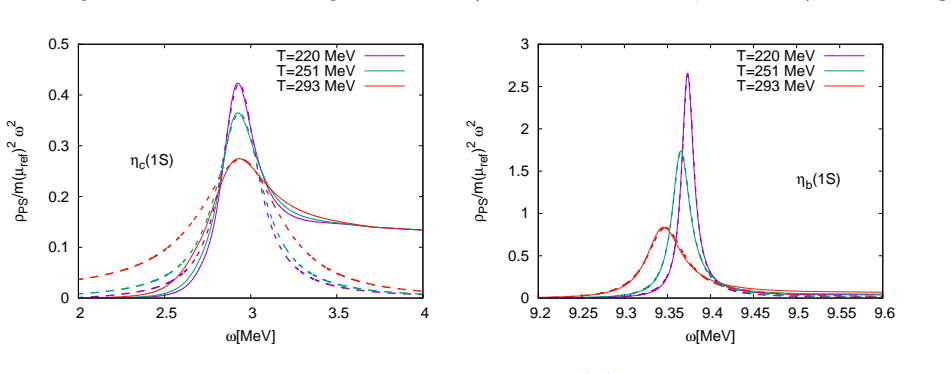
On its own terms, the paper claims that the pseudoscalar charmonium ground state $\eta_c(1S)$ is already close to dissolution at $T=293$ MeV ($1.6\,T_{pc}$), with a thermal width in the range 300–600 MeV, while the bottomonium ground state $\eta_b(1S)$ keeps a small width of 20–60 MeV, about 10–15 times smaller, and remains a well-defined peak in the spectral function at the same temperatures. The width comes from the imaginary part of a non-perturbatively extracted complex static potential, and the paper further claims that the spectral function assembled from the threshold region (Schrodinger equation with this potential) and the ultraviolet region (vacuum perturbation theory) reproduces the lattice pseudoscalar correlator at large Euclidean times at all three temperatures, with $\chi^2/\mathrm{ndf}$ between 0.1 and 0.9.
Load-bearing premise
The whole extraction of the imaginary part and hence the thermal width rests on the assumed spectral shape of the Wilson line correlator in Eq. (13), namely the linear-plus-periodic form with $1/\omega^2$ spectral weight; if the true spectral function has a different shape that still fits the lattice data, the imaginary part, and with it the claim that $\eta_c$ is near melting, does not follow.
Editorial extensions
If this is right
- The $\eta_c(1S)$ width grows with temperature and reaches 300–600 MeV at 293 MeV, implying pseudoscalar charmonium is strongly modified or dissolving in the quark–gluon plasma at 1.6 $T_{pc}$.
- The $\eta_b(1S)$ width stays at 20–60 MeV, so bottomonium remains a well-defined state at the same temperatures and should survive as a probe of the plasma.
- Because the pseudoscalar channel has no low-frequency transport peak, the full spectral function built from threshold plus ultraviolet contributions already matches the lattice correlator ($\chi^2/\mathrm{ndf}$ 0.1–0.9), confirming that no extra low-frequency structure is needed.
- Excited quarkonium states melt already at the lowest plasma temperature studied, 220 MeV, leaving only the ground-state peak.
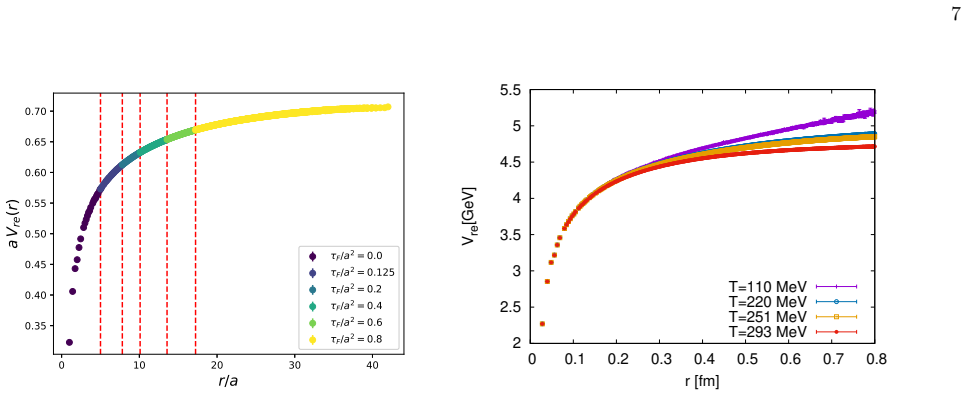
- The thermal mass behavior differs: the $\eta_c$ mass stays near its zero-temperature value while the $\eta_b$ mass drops with temperature, reflecting that the imaginary part dominates for charm and the real part for bottom.
Reading between the lines
- If this picture holds, charmonium suppression in heavy-ion collisions should be visible already at temperatures just above the crossover, and the pseudoscalar $\eta_c$ channel is a cleaner diagnostic than the vector channel because it is not contaminated by a low-frequency transport peak.
- A testable extension is to repeat the same threshold-plus-ultraviolet construction for the vector channel by adding a transport contribution; the comparison between $\eta_c$ and $J/\psi$ widths would show whether the near-melting result is channel-specific.
- The strong dependence of the imaginary part on the chosen ansatz means the decisive check is a genuinely model-independent spectral reconstruction at finer lattice spacing; until then, the 300–600 MeV width should be read as conditional on Eq. (13).
- The method can be carried to nonzero baryon density or to include relativistic corrections to the static potential, where the authors expect the qualitative hierarchy (charm broad, bottom narrow) to persist but with modified numerical widths.
Signed reviews
Editorial analysis
A structured set of objections, weighed in public.
Referee Report
Summary. The paper presents a calculation of pseudoscalar quarkonium (η_c and η_b) spectral functions in 2+1 flavor lattice QCD at T = 220, 251, and 293 MeV. The authors extract a complex static potential from Coulomb-gauge Wilson line correlators using the HTL-motivated parametrization in Eq. (13), then solve the Schrödinger equation (4) in the threshold region and match the resulting spectral function to the vacuum perturbative spectral function in the ultraviolet via Eq. (22). The resulting spectral functions are used to compute Euclidean correlators and are compared with directly measured lattice correlators in Figs. 13 and 14. The central phenomenological claims are that η_c(1S) acquires a thermal width Γ ≈ 300–600 MeV and is close to dissolution at 293 MeV, while η_b(1S) remains narrow with Γ ≈ 20–60 MeV.
Significance. If the central claims hold, this is a valuable non-perturbative input for quarkonium suppression phenomenology: it provides temperature-dependent masses and widths for pseudoscalar charmonium and bottomonium, and the correlator comparison demonstrates that a screened complex potential is at least consistent with lattice data. The paper is also careful to restrict attention to the pseudoscalar channel, where no transport contribution complicates the analysis, and to confront the reconstructed spectral function with the lattice correlator in a ratio that removes the unknown renormalization constant. The main caveat is that the extracted imaginary part of the potential—and therefore the reported widths—is controlled by the assumed spectral ansatz in Eq. (13), a limitation the paper itself acknowledges. The quantitative claims are thus interesting but not yet uniquely supported.
major comments (3)
- [Section IV, Eq. (13), and p. 7] The non-zero imaginary part of the potential, which is the dominant source of the large η_c width, is not directly measurable from the Euclidean Wilson line correlator; it emerges from the assumed form of the spectral function σ(r,ω) in Eq. (12) and the resulting parametrization Eq. (13). The 1/ω^2 behavior in Eq. (12) is motivated by HTL, but the inversion of Eq. (8) is ill-posed, and the paper explicitly notes on p. 7 that the alternative analysis of ref. [35] finds no color screening. Because V_im ≈ 0 is compatible with the same correlators under a different but equally plausible physics input, the reported width Γ(η_c) = 300–600 MeV and the statement that η_c is near melting at 293 MeV are not uniquely determined by the lattice data. This ansatz uncertainty is not included in the error budget of Fig. 12: the systematic variation in Appendix B changes the number of terms in Eq. (13) and the fit range, but not the form of Eq. (13) itself. The manuscript should either (i) implement an alternative inversion, for example the model of ref. [35], and show that it is statistically disfavored by the Wilson line data, or (ii) reframe the width and dissolution claims as conditional on the ansatz.
- [Section VII, Eq. (26), Figs. 13 and 14] The claimed consistency with the lattice correlators does not by itself select the extracted V_im. In Eq. (26) an overall multiplicative constant A is fitted to the correlator comparison, and the comparison is restricted to τ > τ_min (0.22 fm for η_c and 0.28 fm for η_b). The renormalization constant cancels in the effective-mass ratio Eq. (24), but the remaining comparison is a shape comparison whose normalization is free. Since the spectral shape below and near the peak is already fixed by V_im through the Schrödinger equation, the agreement in Figs. 13 and 14 reflects the internal consistency of the reconstruction chain rather than an independent confirmation of V_im. To make the validation informative, the authors should show the correlator predictions and χ²/ndf for a spectral function with V_im = 0, or with the ref. [35] potential, demonstrating that such alternatives are actually excluded by the lattice correlators.
- [Section VI, Eq. (22), and the ω < 2M_q paragraph] The reconstruction in the threshold region contains two additional model choices whose impact on the extracted widths is not quantified: the ad hoc factor exp((2M_q − ω)/T) multiplying the imaginary part below threshold, and the choice of matching point ω0 and normalization A0 in Eq. (22). The text states A0 ≈ 1 and that matching is performed where the thermal spectral function has no temperature dependence, but the sensitivity of Γ(1S) and M(1S) to these choices is not reported. Because the spectral function is a prediction of the model rather than of the lattice correlator alone, these uncertainties should be included in the error budget of Fig. 12 or shown to be negligible.
minor comments (6)
- [Section V] The charm pole mass is quoted as 1.35 ± 0.01 MeV; the unit should evidently be GeV.
- [Section IV] In the text following Fig. 2, the sentence 'The real part of the potential ... is shown in Figure 2' should read Figure 3, since Figure 2 shows fit-range stability rather than flow-time dependence.
- [Section VIII] The sentence 'In Section VIII, it is shown that these spectral functions can predict the lattice correlator' should refer to Section VII, where the comparison is actually presented.
- [Title and Introduction] The title contains a spelling artifact ('Spe ctral') and the Introduction contains typographical errors such as 'qurkonia' and 'foucs'; these should be corrected in the published version.
- [Section IV, Fig. 1 caption] The caption says the fit excludes the contributions from 'c0 and c1', but Eq. (13) contains no c0 term; presumably only c1 was meant.
- [Section VII, Eq. (25)] The reported χ²/ndf values of 0.1–0.9 are quite low; a comment on whether the systematic errors are correlated or conservative would help the reader interpret the quality of the comparison.
Circularity Check
No load-bearing circularity: the thermal-width result is model-dependent through the explicitly labeled HTL-motivated ansatz, but the pseudoscalar-correlator comparison is an independent check.
full rationale
The derivation chain is transparent: (i) a complex potential is extracted from Wilson line correlators using the HTL-motivated ansatz in Eq. (13); (ii) the Schrödinger equation in Eq. (4) is solved with that complex potential to obtain the threshold spectral function; (iii) the threshold result is matched to vacuum perturbation theory via Eq. (22); and (iv) the resulting correlator is compared with independently measured pseudoscalar correlators in Section VII. The only self-citations in this pipeline are [33,53] for the Wilson-line-correlator ansatz and [29] for preliminary results. These are not load-bearing: the paper explicitly labels Eq. (13) as an ansatz ('This parametrization is our ansatz for the calculation of the thermal potential from the lattice data'), re-derives its linear-plus-periodic structure in Eqs. (9)-(13), and supports the structure with the Appendix A LO calculation, while the HTL physics originates from the external reference [23]. The admitted ill-posedness of the inversion and the existence of a no-screening alternative in ref. [35] ('The contradiction serves as an indication of the inversion problem's ill-posed nature... and the physics input required for meaningful spectral reconstruction') mean that the magnitude of V_im, and therefore of Gamma(eta_c), is model-dependent. That is a correctness/robustness concern, not circularity. The pseudoscalar correlator is not used to fix V_im, so the Section VII consistency check—made with a fitted overall normalization A—provides non-trivial, though partial, independent validation. No equation reduces the final width to the fitted parameter by construction; the width is obtained by solving the Schrödinger equation and then fitting the resulting spectral function with the skewed Breit-Wigner form in Eq. (23).
Assumptions & free parameters
free parameters (6)
- Overall normalization A in correlator comparison =
A ~ 11 (eta_c), A ~ 7 (eta_b)
- Imaginary potential parametrization coefficients a1, a2, a3, m_i =
not tabulated in the text
- KMS potential parameters alpha(T), sqrt(sigma(T)), m_r(T), C(T) =
See Table III
- Spectral matching parameters A0 and omega0 =
A0 ~ 1; omega0 ~ 2.7 M_c, 2.2 M_b
- Charm pole mass =
1.35 ± 0.01 GeV
- Wilson line correlator ansatz coefficients c1, c2 =
varied; not quoted
assumptions (6)
- ad hoc to paper The Wilson line correlator at large tau takes the form Eq (13): log W = -V_re tau + periodic terms, with spectral weight sigma ~ n_b(omega)(beta V_im/(2 pi omega) + odd powers).
- domain assumption The pseudoscalar spectral function near threshold is obtained from the Schrodinger equation with the static complex potential.
- domain assumption No transport contribution exists in the pseudoscalar channel near omega ~ 0.
- domain assumption Vacuum perturbative spectral function is reliable for omega >> 2M_q and temperature effects are suppressed there.
- domain assumption The Coulomb-gauge-fixed Wilson line correlator yields the same thermal potential as the Wilson loop.
- domain assumption Renormalon subtraction at mu_r = 1 GeV makes the perturbative potential match the lattice potential.
Cite this review
Pith. "Pith review of Thermal Static Potential and Pseudo-Scalar Quarkonium Spectral Functions from 2+1 Flavor Lattice QCD." pith.science (2026). https://pith.science/paper/2CIPNLN3
@misc{pith2026250511313,
  author       = {Pith},
  title        = {Pith review of: Thermal Static Potential and Pseudo-Scalar Quarkonium Spectral Functions from 2+1 Flavor Lattice QCD},
  year         = {2026},
  howpublished = {\url{https://pith.science/paper/2CIPNLN3}},
  note         = {Machine review of arXiv:2505.11313}
}
abstract
Quarkonia, which are bound states of a heavy quark and antiquark, play a key role in probing the quark-gluon plasma (QGP). The dynamics of quarkonia in the QGP are encoded in their finite-temperature spectral functions. In this work, we estimate the quarkonium spectral functions in the pseudo-scalar channel using 2+1 flavor lattice QCD with a pion mass of $320\,\text{MeV}$, at temperatures of $220\,\text{MeV}\,(1.2\,T_{pc}),\,251\,\text{MeV}\,(1.4\,T_{pc})\,\text{and}\,293\,\text{MeV}\,(1.6\,T_{pc})$. Reconstructing the spectral function from the Euclidean lattice correlator is a well-known ill-posed problem, requiring additional physics-motivated input. We address this by smoothly matching contributions from different frequency regions of the spectral function, using appropriate physics valid for each region. The spectral function around $\omega \sim 2\,M_q$ is obtained using a non-perturbative complex potential, while for $\omega \gg 2\,M_q$ it is modeled using results from vacuum perturbation theory. Since the pseudoscalar channel does not receive a transport contribution near $\omega \sim 0$, we find that the combination of these two regions already provides a good description of the relativistic lattice pseudoscalar correlator. We observe a substantial thermal width in the $\eta_c(1S)$ state, indicating that pseudoscalar charmonium ($\eta_c$) is nearing dissolution at the studied temperatures. In comparison, the $\eta_b$ ground state exhibits little change and remains well-defined.
Figures


Figures from the paper (15 more)




Forward citations
Cited by 1 Pith paper
-
Lattice study of spin interactions between heavy quarks in the quark-gluon plasma
The spin-dependent heavy-quark potential in the quark-gluon plasma is complex, with a channel-dependent imaginary part first extracted from lattice QCD.
Reference graph
Works this paper leans on
-
[35]
Nonperturbative potential for study of quarkonia in QGP
D. Bala and S. Datta, Phys. Rev. D 101, 034507 (2020) , arXiv:1909.10548 [hep-lat]
work page Pith review arXiv 2020
-
[1]
Matsui and H
T. Matsui and H. Satz, Phys. Lett. B 178, 416 (1986)
1986
-
[2]
A. M. Sirunyan et al. (CMS), Phys. Lett. B 790, 270 (2019) , arXiv:1805.09215 [hep-ex]
arXiv 2019
-
[3]
B. Krouppa, A. Rothkopf, and M. Strick- land, Phys. Rev. D 97, 016017 (2018) , arXiv:1710.02319 [hep-ph]
arXiv 2018
-
[4]
L. Dong, Y. Guo, A. Islam, A. Rothkopf, and M. Strick- land, JHEP 09, 200 (2022) , arXiv:2205.10349 [hep-ph]
arXiv 2022
-
[5]
S. Kajimoto, Y. Akamatsu, M. Asakawa, and A. Rothkopf, Phys. Rev. D 97, 014003 (2018) , arXiv:1705.03365 [nucl-th]
arXiv 2018
-
[6]
N. Brambilla, M. A. Escobedo, A. Islam, M. Strick- land, A. Tiwari, A. Vairo, and P. Vander Griend, JHEP 08, 303 (2022) , arXiv:2205.10289 [hep-ph]
arXiv 2022
-
[7]
N. Brambilla, M. A. Escobedo, A. Islam, M. Strickland, A. Tiwari, A. Vairo, and P. Van- der Griend, Phys. Rev. D 108, L011502 (2023) , arXiv:2302.11826 [hep-ph]
arXiv 2023
Show all 63 references
-
[8]
Sharma and A
R. Sharma and A. Tiwari, Phys. Rev. D 101, 074004 (2020) , arXiv:1912.07036 [hep-ph]
2020 arXiv
-
[9]
V. B. R and R. Sharma, (2025), arXiv:2504.19348 [hep-ph]
2025
-
[10]
Asakawa and T
M. Asakawa and T. Hatsuda, Phys. Rev. Lett. 92, 012001 (2004) , arXiv:hep-lat/0308034
2004 arXiv
-
[11]
Datta, F
S. Datta, F. Karsch, P. Petreczky, and I. Wetzorke, Phys. Rev. D 69, 094507 (2004) , arXiv:hep-lat/0312037
2004 arXiv
-
[12]
H. T. Ding, A. Francis, O. Kaczmarek, F. Karsch, H. Satz, and W. Soeld- ner, Phys. Rev. D 86, 014509 (2012) , 22 arXiv:1204.4945 [hep-lat]
2012 arXiv
-
[13]
S. Kim, P. Petreczky, and A. Rothkopf, JHEP 11, 088 (2018) , arXiv:1808.08781 [hep-lat]
2018 arXiv
-
[14]
Aarts, C
G. Aarts, C. Allton, T. Harris, S. Kim, M. P. Lombardo, S. M. Ryan, and J.-I. Skullerud, JHEP 07, 097 (2014) , arXiv:1402.6210 [hep-lat]
2014 arXiv
-
[15]
Larsen, S
R. Larsen, S. Meinel, S. Mukherjee, and P. Petreczky, Phys. Rev. D 100, 074506 (2019) , arXiv:1908.08437 [hep-lat]
2019 arXiv
-
[16]
Larsen, S
R. Larsen, S. Meinel, S. Mukherjee, and P. Petreczky, Phys. Lett. B 800, 135119 (2020) , arXiv:1910.07374 [hep-lat]
2020 arXiv
-
[17]
H. T. Ding, W. P. Huang, R. Larsen, S. Meinel, S. Mukherjee, P. Petreczky, and Z. Tang, (2025), arXiv:2501.11257 [hep-lat]
2025 arXiv
-
[18]
S. Y. F. Liu and R. Rapp, Phys. Rev. C 97, 034918 (2018) , arXiv:1711.03282 [nucl-th]
2018 arXiv
-
[19]
Z. Tang, S. Mukherjee, P. Petreczky, and R. Rapp, (2024), arXiv:2411.09132 [nucl-th]
2024 arXiv
-
[20]
Z. Tang, B. Wu, A. Hanlon, S. Mukherjee, P. Petreczky, and R. Rapp, (2025), arXiv:2502.09044 [nucl-th]
2025
-
[21]
Mocsy and P
A. Mocsy and P. Petreczky, Phys. Rev. D 77, 014501 (2008) , arXiv:0705.2559 [hep-ph]
2008 arXiv
-
[22]
Kaczmarek, F
O. Kaczmarek, F. Karsch, P. Petreczky, and F. Zantow, Phys. Lett. B 543, 41 (2002) , arXiv:hep-lat/0207002
2002 arXiv
-
[23]
We find that color screening is weaker in the non-perturbative potential than in the perturbative one
given by, V re T (r) = −g(T )2 4π CF [ md + exp(−mdr) r ] (18) We used the two-loop formula for the thermal coupling and Debye Mass from [ 58]. We find that color screening is weaker in the non-perturbative potential than in the perturbative one. We close the discussion of this...
-
[24]
Brambilla, J
N. Brambilla, J. Ghiglieri, A. Vairo, and P. Petreczky, Phys. Rev. D 78, 014017 (2008) , arXiv:0804.0993 [hep-ph]
2008 arXiv
-
[25]
Laine, O
M. Laine, O. Philipsen, P. Romatschke, and M. Tassler, JHEP 03, 054 (2007) , arXiv:hep-ph/0611300
2007 arXiv
-
[26]
Burnier, M
Y. Burnier, M. Laine, and M. Vepsalainen, JHEP 01, 043 (2008) , arXiv:0711.1743 [hep-ph]
2008 arXiv
-
[27]
Laine, JHEP 05, 028 (2007) , arXiv:0704.1720 [hep-ph]
M. Laine, JHEP 05, 028 (2007) , arXiv:0704.1720 [hep-ph]
2007 arXiv
-
[28]
H.-T. Ding, O. Kaczmarek, A.-L. Lorenz, H. Ohno, H. Sandmeyer, and H.- T. Shu, Phys. Rev. D 104, 114508 (2021) , arXiv:2108.13693 [hep-lat]
2021 arXiv
-
[29]
Burnier, H
Y. Burnier, H. T. Ding, O. Kaczmarek, A. L. Kruse, M. Laine, H. Ohno, and H. Sandmeyer, JHEP 11, 206 (2017) , arXiv:1709.07612 [hep-lat]
2017 arXiv
-
[30]
Burnier, O
Y. Burnier, O. Kaczmarek, and A. Rothkopf, JHEP 12, 101 (2015) , arXiv:1509.07366 [hep-ph]
2015 arXiv
-
[31]
D. Bala, S. Ali, O. Kaczmarek, and Pavan (HotQCD), J. Subatomic Part. Cosmol. 3, 100042 (2025) , arXiv:2412.17570 [hep-lat]
2025 arXiv
-
[32]
pole-mass
to models of spectral function that are fitted to the lattice data [33–36]. Some models even suggest that there is no screening of the real part of the potential [ 34, 35]. However, given the ill-conditioned nature of this inverse problem, this could very well be due to the lac...
-
[33]
Rothkopf, T
A. Rothkopf, T. Hatsuda, and S. Sasaki, Phys. Rev. Lett. 108, 162001 (2012) , arXiv:1108.1579 [hep-lat]
2012 arXiv
-
[34]
Burnier, O
Y. Burnier, O. Kaczmarek, and A. Rothkopf, Phys. Rev. Lett. 114, 082001 (2015) , arXiv:1410.2546 [hep-lat]
2015 arXiv
-
[36]
D. Bala, O. Kaczmarek, R. Larsen, S. Mukherjee, G. Parkar, P. Petreczky, A. Rothkopf, and J. H. Weber (HotQCD), Phys. Rev. D 105, 054513 (2022) , arXiv:2110.11659 [hep-lat]
2022 arXiv
-
[37]
Bazavov, D
A. Bazavov, D. Hoying, R. N. Larsen, S. Mukher- jee, P. Petreczky, A. Rothkopf, and J. H. We- ber (HotQCD), Phys. Rev. D 109, 074504 (2024) , arXiv:2308.16587 [hep-lat]
2024 arXiv
-
[38]
R. N. Larsen, G. Parkar, A. Rothkopf, and J. H. Weber, Phys. Rev. D 110, 114501 (2024) , arXiv:2402.10819 [hep-lat]
2024 arXiv
-
[39]
Caron-Huot, Phys
S. Caron-Huot, Phys. Rev. D 79, 125009 (2009) , arXiv:0903.3958 [hep-ph]
2009 arXiv
-
[40]
Banerjee, S
D. Banerjee, S. Datta, R. Gavai, and P. Majumdar, Phys. Rev. D 85, 014510 (2012) , arXiv:1109.5738 [hep-lat]
2012 arXiv
-
[41]
Banerjee, S
D. Banerjee, S. Datta, R. V. Gavai, and P. Majumdar, Nucl. Phys. A 1038, 122721 (2023) , arXiv:2206.15471 [hep-ph]
2023 arXiv
-
[42]
Banerjee, S
D. Banerjee, S. Datta, and M. Laine, JHEP 08, 128 (2022) , arXiv:2204.14075 [hep-lat]
2022 arXiv
-
[43]
Altenkort, A
L. Altenkort, A. M. Eller, O. Kacz- marek, L. Mazur, G. D. Moore, and H.- T. Shu, Phys. Rev. D 103, 014511 (2021) , arXiv:2009.13553 [hep-lat]
2021 arXiv
-
[44]
Brambilla, V
N. Brambilla, V. Leino, J. Mayer-Steudte, and P. Pe- treczky (TUMQCD), Phys. Rev. D 107, 054508 (2023) , arXiv:2206.02861 [hep-lat]
2023 arXiv
-
[45]
Pandey, S
H. Pandey, S. Schlichting, and S. Sharma, Phys. Rev. Lett. 132, 222301 (2024) , arXiv:2312.12280 [hep-lat]
2024
-
[46]
Sommer, PoS LATTICE2013, 015 (2014) , arXiv:1401.3270 [hep-lat]
R. Sommer, PoS LATTICE2013, 015 (2014) , arXiv:1401.3270 [hep-lat]
2014 arXiv
-
[47]
Altenkort, O
L. Altenkort, O. Kaczmarek, R. Larsen, S. Mukher- jee, P. Petreczky, H.-T. Shu, and S. Stende- bach (HotQCD), Phys. Rev. Lett. 130, 231902 (2023) , arXiv:2302.08501 [hep-lat]
2023 arXiv
-
[48]
Follana, Q
E. Follana, Q. Mason, C. Davies, K. Hornbostel, G. P. Lepage, J. Shigemitsu, H. Trottier, and K. Wong (HPQCD, UKQCD), Phys. Rev. D 75, 054502 (2007) , arXiv:hep-lat/0610092
2007 arXiv
-
[49]
Luscher and P
M. Luscher and P. Weisz, Commun. Math. Phys. 98, 433 (1985) , [Erratum: Commun.Math.Phys. 98, 433 (1985)]
1985
-
[50]
Altenkort, D
L. Altenkort, D. de la Cruz, O. Kaczmarek, R. Larsen, G. D. Moore, S. Mukherjee, P. Pe- treczky, H.-T. Shu, and S. Stendebach (HotQCD), Phys. Rev. Lett. 132, 051902 (2024) , arXiv:2311.01525 [hep-lat]
2024 arXiv
-
[51]
S. Ali, D. Bala, A. Francis, G. Jackson, O. Kacz- marek, J. Turnwald, T. Ueding, and N. Wink (HotQCD), Phys. Rev. D 110, 054518 (2024) , arXiv:2403.11647 [hep-lat]
2024 arXiv
-
[52]
Navas et al
S. Navas et al. (Particle Data Group), Phys. Rev. D 110, 030001 (2024)
2024
-
[53]
Burnier and A
Y. Burnier and A. Rothkopf, Phys. Rev. D 87, 114019 (2013) , arXiv:1304.4154 [hep-ph]
2013 arXiv
-
[54]
Philipsen and M
O. Philipsen and M. Wag- ner, Phys. Rev. D 89, 014509 (2014) , arXiv:1305.5957 [hep-lat]
2014 arXiv
-
[55]
Bala and S
D. Bala and S. Datta, Phys. Rev. D 103, 014512 (2021) , arXiv:2009.00773 [hep-lat]
2021 arXiv
-
[56]
A. V. Smirnov, V. A. Smirnov, and M. Stein- hauser, Phys. Rev. Lett. 104, 112002 (2010) , arXiv:0911.4742 [hep-ph]
2010 arXiv
- [57]
-
[58]
Herzog, B
F. Herzog, B. Ruijl, T. Ueda, J. A. M. Ver- maseren, and A. Vogt, JHEP 02, 090 (2017) , arXiv:1701.01404 [hep-ph]
2017 arXiv
-
[59]
Karsch, M
F. Karsch, M. T. Mehr, and H. Satz, Z. Phys. C 37, 617 (1988) . 23
1988
- [60]
-
[61]
Y. Guo, L. Dong, J. Pan, and M. R. Moldes, Phys. Rev. D 100, 036011 (2019) , arXiv:1806.04376 [hep-ph]
2019 arXiv
-
[62]
Mazur et al
L. Mazur et al. (HotQCD), Comput. Phys. Commun. 300, 109164 (2024) , arXiv:2306.01098 [hep-lat]
2024 arXiv
-
[63]
M. A. Clark, R. Babich, K. Barros, R. C. Brower, and C. Rebbi (QUDA), Comput. Phys. Commun. 181, 1517 (2010) , arXiv:0911.3191 [hep-lat]
2010 arXiv
Reviewed August 15, 2026 · model on record in the stance chip above.
Discussion (0). Continue with ORCID to comment.