REVIEW 3 major objections 7 minor 2 cited by
Narrowing RIFT: Focused simulation-based-inference for interpreting exceptional GW sources
T0 review · 3 major / 7 minor · reviewed 2026-08-15 · deepseek-v4-flash
Pith's one-line read The latest RIFT release claims efficient, accurate inference for loud, precessing, and eccentric gravitational-wave sources by switching to an adaptive-volume Monte Carlo integrator.
desk verdict A solid, honest methods paper: RIFT's new AV-based operating point is likely a real win for loud/precessing/eccentric GW sources, but the empirically patched XPHM frame convention needs an end-to-end test before I'd fully trust the precessing demonstrations. read the letter →
The pith
A machine-rendered reading of the paper's core claim, the machinery that carries it, and where it could break.
The reading
What carries the argument
The adaptive-volume (AV) integrator is the load-bearing object: following an adaptive volume-sampling strategy, it partitions the integration domain into hypercubes, discards cells with negligible probability, estimates the enclosed probability via likelihood thresholds and live points, and sets the next refinement scale from the Monte Carlo uncertainty in the sampled volume. It replaces the earlier adaptive-cartesian and Gaussian-mixture integrators as the default for both the extrinsic marginalization step (ILE) and the posterior-generation step (CIP). Supporting machinery includes the factorized likelihood built from inner products Q, U, V of spherical-harmonic modes with detector data, GPU-accelerated evaluation, dithering plus puffball jitter that now includes transverse spin components, and a corrected L-frame spherical-harmonic convention for the IMRPhenomXPHM interface.
What would settle it
Run the paper's modal-reconstruction comparison across a dense grid of precessing configurations, varying mass ratio, spin magnitude, and orientation, and compare the reconstructed h(t) against the waveform generator's direct output; any orientation with a systematic phase or amplitude offset larger than numerical tolerance would show the empirical rotation correction is incomplete. A complementary test is to run the paper's precessing PP test using a different waveform interface and check whether spin parameters remain unbiased.
Extended reading notes
Core claim
The paper's central claim is that the latest RIFT release can efficiently and reliably interpret exceptional compact binaries -- sources with very high signal-to-noise, large mass ratio with strongly misaligned spins, or measurable eccentricity -- by replacing the default integrators with an adaptive-volume Monte Carlo integrator and adjusting the exploration defaults. The AV integrator recursively subdivides the extrinsic-parameter integration volume into hypercubes, keeps only cells containing significant probability, and refines the grid based on the Monte Carlo uncertainty in the enclosed volume, giving high sampling efficiency on sharply peaked likelihoods. The paper also fixes a frame-convention error in the IMRPhenomXPHM interface, adds transverse-spin jitter to exploration, disables automatic mode filtering that could bias loud sources, and reports end-to-end PP tests and cross-code comparisons that agree with an independent sampler. The reported practical gain is about an order of magnitude in cost per marginal-likelihood evaluation for typical problems.
Load-bearing premise
The whole precessing and eccentric inference chain assumes that RIFT's L-frame spherical-harmonic convention matches every external waveform interface; the one known mismatch was repaired with an empirically determined phase correction, and if that correction is wrong for any supported waveform, all likelihoods and posteriors built on it are silently biased.
Editorial extensions
If this is right
- The default operating point now handles loud sources, including those with signal-to-noise above roughly 30, and edge-on, high-mass-ratio binaries without manual adaptation of extrinsic sampling.
- Production analyses can use costly time-domain waveforms for precessing and eccentric binaries at roughly an order of magnitude lower cost per likelihood evaluation.
- Probability-probability tests with both zero-spin and precessing injections pass, so the AV integrator is claimed to be safe as the sole integrator for both ILE and CIP.
- Previous RIFT analyses that used the IMRPhenomXPHM interface with the old frame convention inherit a bias that the new release corrects.
- Automated cross-code comparisons over many events are now feasible out of the box, making disagreements between samplers easier to diagnose.
- The eccentricity reanalysis of selected O3 events with a uniform eccentricity prior yields upper limits rather than detections, so the pipeline is ready for the stronger eccentricity candidates that were explicitly left out.
Reading between the lines
- If the AV integrator's efficiency holds in higher-dimensional settings, RIFT could become a low-latency alternative to neural posterior estimators, since it needs no pretraining and returns calibrated posterior samples.
- The empirical J-to-L frame correction should be revalidated against an independent waveform family or numerical-relativity surrogate before it is trusted for discovery-level claims; the paper's check uses a limited set of examples.
- The same AV machinery could be applied to generic Bayesian integrals outside gravitational waves, where the paper's generalized inference path already points toward non-GW applications.
- Excluding the strongest eccentricity candidate from the eccentric-waveform reanalyses leaves open whether the new settings will support or challenge that claim; running the same pipeline on that event is a direct next test.
Signed reviews
Editorial analysis
A structured set of objections, weighed in public.
Referee Report
Summary. This methods paper reports a set of algorithmic and operational upgrades to the RIFT gravitational-wave parameter-estimation code, aimed at making the pipeline efficient and reliable for 'exceptional' sources: loud, precisely measured, precessing, or eccentric binaries. The main technical contributions are a new adaptive-volume (AV) Monte Carlo integrator, a portfolio integrator, normalizing-flow and unreliable-oracle samplers, updates to the external waveform interfaces (including a J-to-L frame correction for IMRPhenomXPHM), a transverse-spin 'puffball' proposal, disabling of automatic mode filtering, and integration with the asimov reproducibility framework. The paper validates these changes with closed-form Gaussian and Rosenbrock toy problems, two end-to-end PP tests (N=99 each, global p=0.26 and p=0.34), timing benchmarks, reanalyses of selected O3 events with eccentric SEOBNRv5EHM, and head-to-head comparisons with bilby on O3 events using IMRPhenomXPHM. The central claim is that the new RIFT operating point is both faster and trustworthy for precessing and eccentric binaries, with roughly an order-of-magnitude improvement in integrator efficiency for typical problems.
Significance. If the claims hold, this is a practically important contribution: it changes RIFT's recommended default operating point and extends its demonstrated range to precessing and eccentric sources with costly time-domain waveforms. The paper's strengths include genuine end-to-end PP testing with production settings, closed-form toy problems with known answers, reproducible asimov-based analyses, and direct cross-code comparisons with bilby. The order-of-magnitude efficiency gain for the AV integrator, if confirmed with the benchmarks, would be valuable to the gravitational-wave inference community. However, the central claim for precessing IMRPhenomXPHM analyses is currently supported only by waveform-level agreement and anecdotal event comparisons, not by an end-to-end test of the repaired frame-convention path; this is a correctness-risk point that needs to be addressed before the paper can serve as the standard reference for the new operating point.
major comments (3)
- [Section III A and Appendix A] The J-to-L frame correction for IMRPhenomXPHM is load-bearing for the precessing and bilby-comparison claims, but it is validated only at the waveform level. Section III A states that the old interface used a frame convention inconsistent with all other interfaces, and Appendix A repairs it with a J-to-L rotation plus an 'empirically found' alpha-to-alpha-plus-pi correction (footnote 1). The only validation shown is the h(t) comparison in Figure 17, whose caption reports an 'overall difference in polarization convention' and 'small amplitude disagreements' due to data conditioning. The precessing PP test in Figure 13 uses IMRPhenomPv2, whose mode extraction does not pass through the ChooseFDModes J-frame workaround; therefore no PP or injection-recovery test exercises the repaired XPHM path. Because an incorrect empirical correction could silently bias every XPHM likelihood, the Figure 1/2 demonstrations, and the Section VII C bilby comparisons, I ask the authors to add an end-to-end validation (e.g., an XPHM PP test or a set of injection-recovery runs) or otherwise demonstrate that the empirical rotation is exact across the precessing parameter space.
- [Figure 13] The precessing PP test shows a per-parameter p-value of 0.017 for the mass ratio q, which is well below the 5% level. Since this PP test is the principal end-to-end evidence that the new operating point is unbiased for precessing binaries, the authors need to address this outlier directly. If they interpret it as an expected multiple-comparisons fluctuation, they should show that the number of parameters and their correlations make such a value unremarkable; otherwise the result suggests a small but real miscalibration in the ILE/CIP treatment of q for precessing systems. Reporting only the global p-values (0.26 and 0.34) is insufficient, because they aggregate over parameters and can hide a localized deviation.
- [Section VII B and Figure 16] The eccentricity results are presented as a demonstration that RIFT can 'efficiently analyze events with multiple costly models including the effects of precession or eccentricity,' but the eccentric path is not validated end-to-end. Figure 16 verifies only that the modal reconstruction and the direct h(t) interface agree for SEOBNRv5EHM, and Table I reports posteriors for real events without any injection-recovery or PP test. Given that the same appendix-level empirical conventions are used for the gwsignal phase shift, I recommend adding at least one end-to-end validation for the eccentric interface, or explicitly stating in Section VII B that the eccentric reanalyses are preliminary proof-of-concept demonstrations that do not yet establish unbiased inference for eccentric binaries.
minor comments (7)
- [Eq. (5)] The sentence introducing Eq. (5) contains a duplicated 'where where' that should be corrected.
- [Section II F] The citation breaks as '[40?]' in the text; the reference number and the bibliography entry should be reconciled.
- [Section V A] The claim of 'roughly an order of magnitude improvement' is based on a comparison with benchmarks reported in a previous paper (Appendix B of [23]), not on a same-hardware, same-input reproduction. A direct side-by-side benchmark on identical data and hardware would make this quantitative claim easier to verify.
- [Figures 12 and 13] The captions describe the precessing PP plot as 'precessing spin extrinsic' and the nonspinning plot as 'zero spin and extrinsic,' but both panels include intrinsic parameters such as chirp mass and mass ratio; please reword the captions to reflect the full parameter set.
- [Table I] The column labeled 'BE/QC' is not defined anywhere in the text or caption; please define the abbreviation and explain how the Bayes factor was computed.
- [Figure 17 caption] The caption says the J-to-L corrected IMRPhenomXPHM implementation agrees with the conventional implementation 'Except for an overall difference in polarization convention.' Since the purpose of the correction is to match conventions, please clarify whether this difference is a known residual, an artifact of the plotting convention, or an indication that the correction is incomplete.
- [Throughout] There are numerous typographical errors that should be cleaned up, including 'culiminating' (Introduction), 'techniues' (Section II C), 'ewn contributions' (Section IV), 'ananlysis' (Section V A), 'Becuase' (Section VI B), 'inlcudes' (Table II), 'unphyiscal' (Section VI C), and 'rquire' (Section II J).
Circularity Check
No significant circularity: AV integrator validity rests on independent known-answer tests and injection-recovery PP tests; self-citations and the empirical XPHM frame fix are not load-bearing derivations.
full rationale
The central claims are efficiency and trustworthiness of RIFT's new operating point for precessing/eccentric binaries. The efficiency claim is supported by benchmark comparisons (Rosenbrock problem, Gaussian mixtures) against known answers, not by fitting a parameter and then predicting that same parameter. The correctness claim is supported by end-to-end PP tests where sources are drawn from the prior with known true parameters and the fraction of posterior below truth is checked against the expected distribution (Figures 12-13). These are externally grounded validation procedures, not circular reductions. The paper's self-citations -- Wofford et al. [23] for the prior RIFT operating point, Tiwari et al. [64] for VARAHA, Fernando et al. [25] for asimov -- are provenance and implementation references; none is invoked as an unverified uniqueness theorem or as the sole justification for a central result. The one admitted empirical element is the Appendix A frame-convention repair for IMRPhenomXPHM: Section III A states the old interface used a frame convention inconsistent with RIFT's assumptions, and footnote 1 says 'We empirically find this expression reproduces for example SEOBNRv4PHM precessional dynamics of the outgoing radiation.' Figure 17 itself reports residual 'small amplitude disagreements' and an 'overall difference in polarization convention.' This is an important correctness/robustness risk -- the repaired XPHM path is not separately exercised in the precessing PP test, which uses IMRPhenomPv2 -- but it is not circularity: the correction is checked against an external lalsuite implementation, and the agreement is not presented as a prediction derived from the fit. No equation in the paper reduces by construction to its own input, and no fitted parameter is renamed as a prediction. The score is 1 only because several techniques originate from the same group and one convention correction is empirically tuned; these elements are not load-bearing in the logical derivation of the paper's main validation claims.
Assumptions & free parameters
free parameters (3)
- Portfolio integrator hyperparameters =
ad hoc (weight floor 0.05/Ns, last-batch adaptation)
- Mode-filtering threshold epsilon =
default 0, previously 1e-4
- CIP worker count heuristic N_cip =
2 + 2(rho/15)^1.3/q
assumptions (5)
- domain assumption The detector noise is stationary and Gaussian with known PSD in all injections and likelihood evaluations
- domain assumption The waveform models used (IMRPhenomXPHM, SEOBNRv5PHM, SEOBNRv5EHM, IMRPhenomPv2, IMRPhenomD) are accurate in the regime of application
- standard math The VARAHA adaptive-volume integrator converges as described in the original paper [64]
- domain assumption The asimov settings encode the standard LVK analysis choices used in prior work
- standard math The PP test confidence intervals follow the binomial distribution assumed in the plots
Cite this review
Pith. "Pith review of Narrowing RIFT: Focused simulation-based-inference for interpreting exceptional GW sources." pith.science (2026). https://pith.science/paper/2F67VGJ3
@misc{pith2026250511655,
  author       = {Pith},
  title        = {Pith review of: Narrowing RIFT: Focused simulation-based-inference for interpreting exceptional GW sources},
  year         = {2026},
  howpublished = {\url{https://pith.science/paper/2F67VGJ3}},
  note         = {Machine review of arXiv:2505.11655}
}
read the original abstract
The Rapid Iterative FiTting (RIFT) parameter inference algorithm provides a simulation-based inference approach to efficient, highly-parallelized parameter inference for GW sources. Previous editions of RIFT have conservatively optimized for robust inference about poorly constrained observations. In this paper, we summarize algorithm enhancements and operating point choices to enable inference for more exceptional compact binaries. Using the previously-reported RIFT/asimov interface to efficiently perform analyses on events with reproducible settings consistent with past work, we demonstrate that the latest version of RIFT can efficiently analyze events with multiple costly models including the effects of precession or eccentricity.
Figures

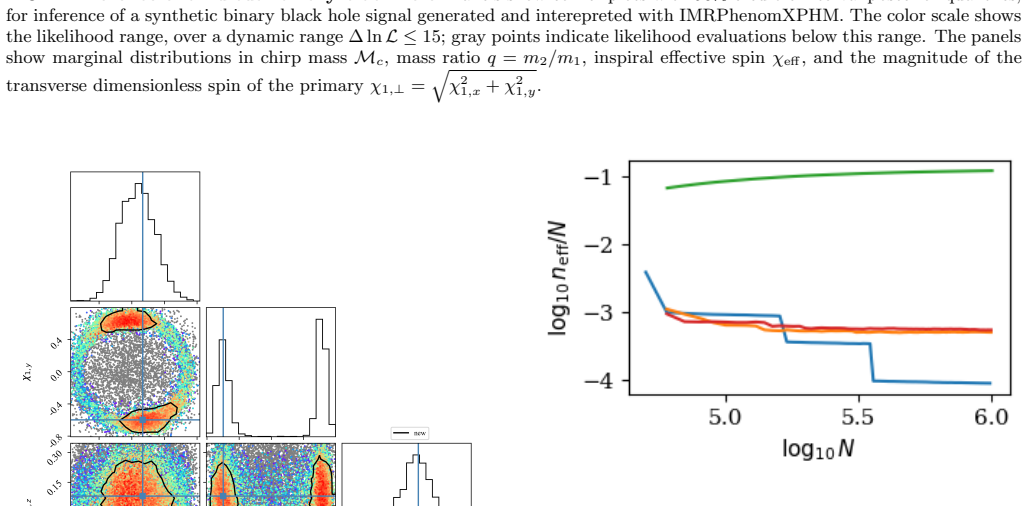

Figures from the paper (11 more)


Forward citations
Cited by 2 Pith papers
-
Impact of eccentricity and higher-modes on neutron star-black hole parameter estimation
Eccentric NSBH signals like GW200105 contain much more information about masses, mass ratio, and effective spin per unit SNR than circular signals, but not about sky position or distance.
-
Assessing the waveform systematics from parameter estimation to population inference with eccentricity
Eccentric waveform-model differences, small per event, accumulate across the GWTC-4 catalog and alter inferred redshift evolution and effective-spin population distributions.
Reference graph
Works this paper leans on
-
[1]
Working with J frame modes One class of waveforms provided by the ChooseFDModesroutine returnh lm in a different 21 coordinate frame: the ˆzaxis and polarization basis are associated with theJframe. When documenting the conventions for this approach, we closely follow Appendix C of [79] and the lalsuite documentation for ChooseFDModes. According to that d...
-
[2]
T. Accadia and et al, Virgo: a laser interferometer to detect gravitational waves, Journal of Instrumentation7 (03), P03012
-
[3]
F. Acernese, M. Agathos, K. Agatsuma, D. Aisa, N. Alle- mandou, A. Allocca, J. Amarni, P. Astone, G. Balestri, G. Ballardin, and et al., Advanced Virgo: a second- generation interferometric gravitational wave detector, Classical and Quantum Gravity32, 024001 (2015), arXiv:1408.3978 [gr-qc]
arXiv 2015
-
[4]
T. Akutsu, M. Ando, K. Arai, Y. Arai, S. Araki, A. Araya, N. Aritomi, Y. Aso, S. Bae, Y. Bae, L. Baiotti, R. Bajpai, M. A. Barton, K. Cannon, E. Capocasa, M. Chan, C. Chen, K. Chen, Y. Chen, H. Chu, Y. K. Chu, S. Eguchi, Y. Enomoto, R. Flaminio, Y. Fujii, M. Fukunaga, M. Fukushima, G. Ge, A. Hagiwara, S. Haino, K. Hasegawa, H. Hayakawa, K. Hayama, Y. Hime...
arXiv 2021
-
[5]
LIGO Scientific Collaboration, J. Aasi, B. P. Abbott, R. Abbott, T. Abbott, M. R. Abernathy, K. Ack- ley, C. Adams, T. Adams, P. Addesso, and et al., Advanced LIGO, Classical and Quantum Gravity32, 074001 (2015), arXiv:1411.4547 [gr-qc]
arXiv 2015
-
[6]
B. Abbott et al. (The LIGO Scientific Collaboration and the Virgo Collaboration), Binary black hole mergers in the First Advanced LIGO observing run, PRX6, 041015 (2016), arXiv:1606.04856 [gr-qc]
arXiv 2016
-
[7]
The LIGO Scientific Collaboration, the Virgo Collabora- tion, B. P. Abbott, R. Abbott, T. D. Abbott, F. Acer- nese, K. Ackley, C. Adams, T. Adams, P. Addesso, and et al., GW170817: Observation of gravitational waves from a binary neutron star inspiral, Phys. Rev. Lett.119, 161101 (2017). 24
work page 2017
- [8]
Show all 82 references
-
[9]
Abbott et al
B. Abbott et al. (The LIGO Scientific Collaboration and the Virgo Collaboration), Observation of Gravitational Waves from a Binary Black Hole Merger, Phys. Rev. Lett. 116, 061102 (2016)
2016
-
[10]
The LIGO Scientific Collaboration, the Virgo Collabora- tion, B. P. Abbott, R. Abbott, T. D. Abbott, S. Abra- ham, F. Acernese, K. Ackley, C. Adams, V. B. Adya, and et al., GWTC-2.1: Deep Extended Catalog of Compact Binary Coalescences Observed by LIGO and Virgo Dur- ing the F...
2021
-
[11]
B. P. Abbott, R. Abbott, T. D. Abbott, F. Acernese, K. Ackley, C. Adams, T. Adams, P. Addesso, R. X. Adhikari, V. B. Adya, and et al., GW170104: Obser- vation of a 50-Solar-Mass Binary Black Hole Coalescence at Redshift 0.2, Phys. Rev. Lett.118, 221101 (2017), arXiv:1706.01812 [gr-qc]
2017 arXiv
-
[12]
The LIGO Scientific Collaboration, the Virgo Collabo- ration, B. P. Abbott, R. Abbott, T. D. Abbott, F. Ac- ernese, K. Ackley, C. Adams, T. Adams, P. Addesso, R. X. Adhikari, V. B. Adya, and et al., GW170814: A Three-Detector Observation of Gravitational Waves from a Binary Bl...
2017 arXiv
-
[13]
The LIGO Scientific Collaboration, the Virgo Collabora- tion, B. P. Abbott, R. Abbott, T. D. Abbott, S. Abra- ham, F. Acernese, K. Ackley, C. Adams, V. B. Adya, and et al., GWTC-3: Compact Binary Coalescences Ob- served by LIGO and Virgo During the Second Half of the Third Obs...
-
[14]
The LIGO Scientific Collaboration, The Virgo Collabo- ration, B. P. Abbott, R. Abbott, T. D. Abbott, F. Acer- nese, K. Ackley, C. Adams, T. Adams, P. Addesso, and et al., GWTC-1: A Gravitational-Wave Transient Cata- log of Compact Binary Mergers Observed by LIGO and Virgo duri...
2019
-
[15]
Pankow, P
C. Pankow, P. Brady, E. Ochsner, and R. O’Shaughnessy, Novel scheme for rapid parallel parameter estimation of gravitational waves from com- pact binary coalescences, Phys. Rev. D92, 023002 (2015), arXiv:1502.04370 [gr-qc]
2015 arXiv
-
[16]
Lange, R
J. Lange, R. O’Shaughnessy, and M. Rizzo, Rapid and accurate parameter inference for coalescing, precess- ing compact binaries, Submitted to PRD; available at arxiv:1805.10457 (2018)
2018 arXiv
-
[17]
The LIGO Scientific Collaboration, the Virgo Collabora- tion, B. P. Abbott, R. Abbott, T. D. Abbott, F. Acer- nese, K. Ackley, C. Adams, T. Adams, P. Addesso, R. X. Adhikari, V. B. Adya, and et al., GW170608: Observa- tion of a 19 Solar-mass Binary Black Hole Coalescence, ApJL...
2017
-
[18]
The LIGO Scientific Collaboration, the Virgo Collabora- tion, A. G. the KAGRA Collaboration: Abac, R. Abbott, I. Abouelfettouh, F. Acernese, K. Ackley, S. Adhicary, N. Adhikari, R. X. Adhikari, and et al., Observation of gravitational waves from the coalescence of a 2.5–4.5m⊙ ...
2024
-
[20]
The LIGO Scientific Collaboration, the Virgo Collabora- tion, B. P. Abbott, R. Abbott, T. D. Abbott, S. Abra- ham, F. Acernese, K. Ackley, C. Adams, V. B. Adya, and et al., GW190521: A Binary Black Hole Merger with a Total Mass of 150 Msun, Phys. Rev. Lett.125, 101102 (2020)
2020
-
[21]
Veitch, V
J. Veitch, V. Raymond, B. Farr, W. M. Farr, P. Graff, S. Vitale, B. Aylott, K. Blackburn, N. Christensen, M. Coughlin, W. D. Pozzo, F. Feroz, J. Gair, C. Haster, V. Kalogera, T. Littenberg, I. Mandel, R. O’Shaughnessy, M. Pitkin, C. Rodriguez, C. R¨ over, T. Sidery, R. Smith, ...
2015
-
[22]
Abbott, T
The LIGO Scientific Collaboration, the Virgo Collabora- tion, R. Abbott, T. D. Abbott, S. Abraham, F. Acernese, K. Ackley, A. Adams, C. Adams, R. X. Adhikari, V. B. Adya, C. Affeldt, and et al., GWTC-2: Compact Binary Coalescences Observed by LIGO and Virgo during the First Ha...
2021 arXiv
-
[23]
Wofford, A
J. Wofford, A. B. Yelikar, H. Gallagher, E. Cham- pion, D. Wysocki, V. Delfavero, J. Lange, C. Rose, V. Valsan, S. Morisaki, J. Read, C. Henshaw, and R. O’Shaughnessy, Improving performance for gravitational-wave parameter inference with an efficient and highly-parallelized al...
2023
-
[24]
Christensen and R
N. Christensen and R. Meyer, Parameter estimation with gravitational waves, Rev. Mod. Phys.94, 025001 (2022)
2022
-
[25]
The LIGO Scientific Collaboration, the Virgo Collabora- tion, B. P. Abbott, R. Abbott, T. D. Abbott, S. Abra- ham, F. Acernese, K. Ackley, C. Adams, V. B. Adya, and et al., Properties and Astrophysical Implications of the 150 M⊙ Binary Black Hole Merger GW190521, ApJL 900, L13...
2020
-
[26]
A. Jan, R. O’Shaughnessy, D. Shoemaker, and D. Lange, Adapting a novel framework for rapid inference of mas- sive black hole binaries for LISA, Submitted to PRD, available as arxiv:2410.15542 (2024)
2024 arXiv
-
[27]
Yelikar and R
A. Yelikar and R. O’Shaughnessy, Waveform systemat- ics in gravitational-wave inference of signals from bi- nary neutron star merger models incorporating higher order modes information, Submitted to PRD, available as arxiv:2404.16599 (2024), 2404.164599
2024 arXiv
-
[28]
Yelikar, R
A. Yelikar, R. O’Shaughnessy, D. Wysocki, and L. Wade, Effects of waveform systematics on inferences of neutron star population properties and the nuclear equation of state, (2024)
2024
-
[29]
Fernando, R
D. Fernando, R. O’Shaughnessy, and D. Williams, Effi- cient reanalysis of events from GWTC-3 with RIFT and asimov, Available as arxiv:2412.02999 (2024)
2024 arXiv
-
[30]
boot- strap
and other work in preparation. A. Automation infrastructure RIFT now maintains a plugin interface toasimov[25]. This package provides a code-neutral framework to en- code the event-specific settings used when interpreting individual events, as well a mechanism to efficiently p...
-
[31]
Kedia, M
A. Kedia, M. Ristic, R. O’Shaughnessy, A. B. Yelikar, R. T. Wollaeger, O. Korobkin, E. A. Chase, C. L. Fryer, and C. J. Fontes, Surrogate light curve models for kilono- vae with comprehensive wind ejecta outflows and param- eter estimation for at2017gfo, Phys. Rev. Res.5, 0131...
2023
-
[32]
H. L. Iglesias, J. Lange, I. Bartos, S. Bhau- mik, R. Gamba, V. Gayathri, A. Jan, R. Nowicki, R. O’Shaughnessy, D. M. Shoemaker, R. Venkatara- manan, and K. Wagner, Eccentricity Estimation for Five Binary Black Hole Mergers with Higher-order Gravitational-wave Modes, Astrophys...
2024 arXiv
-
[33]
Kedia, R
A. Kedia, R. O’Shaughnessy, and A. Yelikar, Exploring tension between gravitational wave and electromagnetic probes of the nuclear equation of state, (2023)
2023
-
[34]
Vilkha, A
A. Vilkha, A. Yelikar, R. O’Shaughnessy, and J. Read, Inference on neutron star parameters and the nuclear equation of state with RIFT, using prior EOS in- 25 formation, arXiv e-prints , arXiv:2407.15753 (2024), arXiv:2407.15753 [gr-qc]
2024 arXiv
-
[35]
Abbott, H
The LIGO Scientific Collaboration, the Virgo Collabo- ration, the KAGRA Collaboration, R. Abbott, H. Abe, F. Acernese, K. Ackley, S. Adhicary, N. Adhikari, R. X. Adhikari, and et al., Open data from the third observing run of LIGO, Virgo, KAGRA and GEO, arXiv e-prints , arXiv:...
2023 arXiv
-
[36]
Wysocki, R
D. Wysocki, R. O’Shaughnessy, J. Lange, and Y.- L. L. Fang, Accelerating parameter inference with graph- ics processing units, Phys. Rev. D99, 084026 (2019), arXiv:1902.04934 [astro-ph.IM]
2019 arXiv
-
[37]
K. J. Wagner and R. O’Shaughnessy, Parameter Estima- tion for Low-Mass Eccentric Black Hole Binaries, arXiv e-prints , arXiv:2402.08039 (2024), arXiv:2402.08039 [gr- qc]
2024 arXiv
-
[38]
Abbott, T
R. Abbott, T. D. Abbott, S. Abraham, F. Acernese, K. Ackley, C. Adams, R. X. Adhikari, V. B. Adya, C. Affeldt, M. Agathos, and et al., Open data from the first and second observing runs of Advanced LIGO and Advanced Virgo, SoftwareX13, 100658 (2021), arXiv:1912.11716 [gr-qc]
2021 arXiv
-
[39]
Press, Teukolsky, Flannery, and Vetterling,Numerical re- cipies
-
[40]
Sidery, B
T. Sidery, B. Aylott, N. Christensen, B. Farr, W. Farr, F. Feroz, J. Gair, K. Grover, P. Graff, C. Hanna, V. Kalogera, I. Mandel, R. O’Shaughnessy, M. Pitkin, L. Price, V. Raymond, C. R¨ over, L. Singer, M. van der Sluys, R. J. E. Smith, A. Vecchio, J. Veitch, and S. Vitale, R...
2014 arXiv
-
[41]
G. P. Lepage, VEGAS: AN ADAPTIVE MULTIDIMEN- SIONAL INTEGRATION PROGRAM, (1980)
1980
-
[42]
G. P. Lepage, Adaptive multidimensional integration: VEGAS enhanced, Journal of Computational Physics 439, 110386 (2021), arXiv:2009.05112 [physics.comp-ph]
2021 arXiv
-
[43]
Ramos-Buades, A
A. Ramos-Buades, A. Buonanno, H. Estell´ es, M. Khalil, D. P. Mihaylov, S. Ossokine, L. Pompili, and M. Shiferaw, SEOBNRv5PHM: Next generation of accu- rate and efficient multipolar precessing-spin effective-one- body waveforms for binary black holes, arXiv e-prints , arXiv:23...
2023 arXiv
-
[44]
D. P. Mihaylov, S. Ossokine, A. Buonanno, H. Es- telles, L. Pompili, M. P¨ urrer, and A. Ramos-Buades, py- SEOBNR: a software package for the next generation of effective-one-body multipolar waveform models, arXiv e- prints , arXiv:2303.18203 (2023), arXiv:2303.18203 [gr- qc]
2023 arXiv
-
[45]
Kalaghati, New waveform interface - gwsignal, https://dcc.ligo.org/LIGO-T2300100 (2023)
C. Kalaghati, New waveform interface - gwsignal, https://dcc.ligo.org/LIGO-T2300100 (2023)
2023
-
[46]
Nagar, R
A. Nagar, R. Gamba, P. Rettegno, V. Fantini, and S. Bernuzzi, Effective-one-body waveform model for non- circularized, planar, coalescing black hole binaries: The importance of radiation reaction, Phys. Rev. D110, 084001 (2024), arXiv:2404.05288 [gr-qc]
2024 arXiv
-
[47]
Henshaw, P
C. Henshaw, P. Lange, J. Lott, R. O’Shaughnessy, and L. Cadonati, Inferring the source parameters of hyper- bolic binary black hole encounters with rift, in prep
-
[49]
Ramos-Buades, A
A. Ramos-Buades, A. Buonanno, M. Khalil, and S. Os- sokine, Effective-one-body multipolar waveforms for ec- centric binary black holes with nonprecessing spins, Phys. Rev. D105, 044035 (2022), arXiv:2112.06952 [gr-qc]
2022 arXiv
-
[50]
Gamboa, A
A. Gamboa, A. Buonanno, R. Enficiaud, M. Khalil, A. Ramos-Buades, L. Pompili, H. Estell´ es, M. Boyle, L. E. Kidder, H. P. Pfeiffer, H. R. R¨ uter, and M. A. Scheel, Accurate waveforms for eccentric, aligned- spin binary black holes: The multipolar effective- one-body model SE...
2024 arXiv
-
[51]
Ashton, M
G. Ashton, M. H¨ ubner, P. D. Lasky, C. Talbot, K. Ack- ley, S. Biscoveanu, Q. Chu, A. Divakarla, P. J. Easter, B. Goncharov, F. Hernandez Vivanco, J. Harms, M. E. Lower, G. D. Meadors, D. Melchor, E. Payne, M. D. Pitkin, J. Powell, N. Sarin, R. J. E. Smith, and E. Thrane, BIL...
2019 arXiv
-
[52]
M. Dax, S. R. Green, J. Gair, M. P¨ urrer, J. Wildberger, J. H. Macke, A. Buonanno, and B. Sch¨ olkopf, Neural Im- portance Sampling for Rapid and Reliable Gravitational- Wave Inference, arXiv e-prints , arXiv:2210.05686 (2022), arXiv:2210.05686 [gr-qc]
2022 arXiv
-
[53]
LIGO Scientific Collaboration, LIGO Algorithm Library - LALSuite, free software (GPL) (2018)
2018
-
[54]
Payne, C
E. Payne, C. Talbot, P. D. Lasky, E. Thrane, and J. S. Kissel, Gravitational-wave astronomy with a physical calibration model, Phys. Rev. D102, 122004 (2020), arXiv:2009.10193 [astro-ph.IM]
2020 arXiv
-
[55]
Ashton and C
G. Ashton and C. Talbot, BILBY-MCMC: an MCMC sampler for gravitational-wave inference, MNRAS507, 2037 (2021), arXiv:2106.08730 [gr-qc]
2021 arXiv
-
[56]
Garr´ on and D
´A. Garr´ on and D. Keitel, Waveform systematics in identi- fying strongly gravitationally lensed gravitational waves: posterior overlap method, Classical and Quantum Grav- ity41, 015005 (2024), arXiv:2306.12908 [gr-qc]
2024 arXiv
-
[57]
M. J. Williams, J. Veitch, and C. Messenger, Nested sam- pling with normalizing flows for gravitational-wave infer- ence, Phys. Rev. D103, 103006 (2021), arXiv:2102.11056 [gr-qc]
2021 arXiv
-
[58]
M. J. Williams, J. Veitch, and C. Messenger, Impor- tance nested sampling with normalising flows, Available as LIGO-P2200283 from dcc.ligo.org (2022)
2022
-
[59]
Delfavero, R
V. Delfavero, R. O’Shaughnessy, K. Belczynski, P. Drozda, and D. Wysocki, Iteratively Comparing Gravitational-Wave Observations to the Evolution of Massive Stellar Binaries, Phys. Rev. D108, 043023 (2023), arXiv:2303.05436 [gr-qc]
2023 arXiv
-
[60]
Delfavero, K
V. Delfavero, K. Breivik, R. O’Shaughnessy, and J. Baker, Recovering Injected Astrophysics from the LISA Galactic Binaries, available as arxiv:2409.15230 (2024), 2409
2024 arXiv
-
[61]
R. J. E. Smith, G. Ashton, A. Vajpeyi, and C. Tal- bot, Massively parallel bayesian inference for transient gravitational-wave astronomy, Monthly Notices of the 26 Royal Astronomical Society498, 4492–4502 (2020)
2020
-
[62]
Varma, S
V. Varma, S. E. Field, M. A. Scheel, J. Blackman, D. Gerosa, L. C. Stein, L. E. Kidder, and H. P. Pfeiffer, Surrogate models for precessing binary black hole simu- lations with unequal masses, Physical Review Research 1, 10.1103/physrevresearch.1.033015 (2019)
2019 doi
-
[63]
Ristic, E
M. Ristic, E. Champion, R. O’Shaughnessy, R. Wol- laeger, O. Korobkin, E. A. Chase, C. L. Fryer, A. L. Hungerford, and C. J. Fontes, Interpolating detailed sim- ulations of kilonovae: Adaptive learning and parameter inference applications, PRR4, 013046 (2022)
2022
-
[64]
probability
introduced an adaptively-refined volume sampler: VARAHA. In this approach, the integration volume is subdivided into hypercubes; sampled; hypercubes con- taining negligible amounts of probability are neglected; and the hypercube grid is reassessed. The selected hyper- cubes wi...
-
[65]
Risti´ c, R
M. Risti´ c, R. O’Shaughnessy, K. Wagner, C. J. Fontes, C. L. Fryer, O. Korobkin, M. R. Mumpower, and R. T. Wollaeger, Joint Electromagnetic and Gravita- tional Wave Inference of Binary Neutron Star Merger GW170817 Using Forward-Modeling Ejecta Predictions (2025), arXiv:2503.1...
2025
-
[66]
Y. Peng, M. Risti´ c, A. Kedia, R. O’Shaughnessy, C. J. Fontes, C. L. Fryer, O. Korobkin, M. R. Mumpower, V. A. Villar, and R. T. Wollaeger, Kilonova light-curve interpolation with neural networks, Physical Review Re- search6, 10.1103/physrevresearch.6.033078 (2024)
2024 doi
-
[67]
C. Gao, J. Isaacson, and C. Krause, i-flow: High- dimensional Integration and Sampling with Normaliz- ing Flows, arXiv e-prints , arXiv:2001.05486 (2020), arXiv:2001.05486 [physics.comp-ph]
2020 arXiv
-
[68]
Tiwari, C
V. Tiwari, C. Hoy, S. Fairhurst, and D. MacLeod, Fast non-Markovian sampler for estimating gravitational- wave posteriors, Phys. Rev. D108, 023001 (2023), arXiv:2303.01463 [astro-ph.HE]
2023 arXiv
-
[69]
Rezende and S
D. Rezende and S. Mohamed, Variational inference with normalizing flows, inProceedings of the 32nd Interna- tional Conference on Machine Learning, Proceedings of Machine Learning Research, Vol. 37, edited by F. Bach and D. Blei (PMLR, Lille, France, 2015) pp. 1530–1538
2015
-
[70]
Papamakarios, E
G. Papamakarios, E. Nalisnick, D. J. Rezende, S. Mo- hamed, and B. Lakshminarayanan, Normalizing flows for probabilistic modeling and inference, Journal of Machine Learning Research22, 1 (2021)
2021
-
[71]
Gabbard, C
H. Gabbard, C. Messenger, I. S. Heng, F. Tono- lini, and R. Murray-Smith, Bayesian parameter esti- mation using conditional variational autoencoders for gravitational-wave astronomy, Nature Physics18, 112 (2022), arXiv:1909.06296 [astro-ph.IM]
2022 arXiv
-
[72]
K. W. K. Wong, M. Gabri´ e, and D. Foreman-Mackey, flowMC: Normalizing-flow enhanced sampling pack- age for probabilistic inference in Jax, arXiv e-prints , arXiv:2211.06397 (2022), arXiv:2211.06397 [astro- ph.IM]
2022 arXiv
-
[73]
K. W. K. Wong, M. Isi, and T. D. P. Edwards, Fast Gravitational-wave Parameter Estimation with- out Compromises, Astrophys. J.958, 129 (2023), arXiv:2302.05333 [astro-ph.IM]
2023 arXiv
-
[74]
M. Dax, S. R. Green, J. Gair, J. H. Macke, A. Buonanno, and B. Sch¨ olkopf, Real-Time Gravitational Wave Science with Neural Posterior Estimation, Phys. Rev. Lett.127, 241103 (2021), arXiv:2106.12594 [gr-qc]
2021 arXiv
-
[75]
Hannam, P
M. Hannam, P. Schmidt, A. Boh´ e, L. Haegel, S. Husa, et al., Simple Model of Complete Precessing Black-Hole- Binary Gravitational Waveforms, Phys.Rev.Lett.113, 151101 (2014), arXiv:1308.3271 [gr-qc]
2014 arXiv
-
[76]
Durkan, A
C. Durkan, A. Bekasov, I. Murray, and G. Papamakarios, nflows: normalizing flows in PyTorch (2020)
2020
-
[77]
S. Husa, S. Khan, M. Hannam, M. P¨ urrer, F. Ohme, X. Jim´ enez Forteza, and A. Boh´ e, Frequency-domain gravitational waves from nonprecessing black-hole bina- ries. I. New numerical waveforms and anatomy of the sig- nal, Phys. Rev. D93, 044006 (2016), arXiv:1508.07250 [gr-qc]
2016 arXiv
-
[78]
S. Khan, S. Husa, M. Hannam, F. Ohme, M. P¨ urrer, X. Jim´ enez Forteza, and A. Boh´ e, Frequency-domain gravitational waves from nonprecessing black-hole bi- naries. II. A phenomenological model for the ad- vanced detector era, Phys. Rev. D93, 044007 (2016), arXiv:1508.07253 [gr-qc]
2016 arXiv
-
[79]
overall” cost of one instance of ILE. First, the dynamics and outgoing radiation are computed for each set of instrinsic parameters in a “precompute
Presumably becauseβ <0 can cause numerical prob- lems with some implementations (square roots), they in- stead return (π−κ,β,π−ϕ JL), which are related to the desired transformation by universal symmetry: e−imπdℓ mm′(−β)e−im′π = (−1)m+m′ dℓ m,m′(−β) =d ℓ m,m′(β) (A4) In partic...
-
[80]
Boh´ e, M
A. Boh´ e, M. Hannam, S. Husa, F. Ohme, M. Puer- rer, and P. Schmidt,PhenomPv2 - Technical Notes for LAL Implementation, Tech. Rep. LIGO-T1500602 (LIGO Project, 2016)
2016
-
[81]
A. H. Nitz, Robust, Rapid, and Simple Gravitational- wave Parameter Estimation, arXiv e-prints , arXiv:2410.05190 (2024), arXiv:2410.05190 [astro- ph.IM]
2024 arXiv
-
[82]
B. Farr, E. Ochsner, W. M. Farr, and R. O’Shaughnessy, A more effective coordinate system for parameter esti- mation of precessing compact binaries from gravitational waves, Phys. Rev. D90, 024018 (2014), arXiv:1404.7070 [gr-qc]
2014 arXiv
-
[83]
Pratten, C
G. Pratten, C. Garc´ ıa-Quir´ os, M. Colleoni, A. Ramos- Buades, H. Estell´ es, M. Mateu-Lucena, R. Jaume, M. Haney, D. Keitel, J. E. Thompson, and S. Husa, Computationally efficient models for the dominant and subdominant harmonic modes of precessing bi- nary black holes, Phy...
2021 arXiv
-
[84]
Wysocki, R
D. Wysocki, R. O’Shaughnessy, J. Lange, and Y.-L. L. Fang, Accelerating parameter inference with graphics processing units, Physical Review D99, 10.1103/phys- revd.99.084026 (2019)
2019 doi
Reviewed August 15, 2026 · model on record in the stance chip above.
Discussion (0). Continue with ORCID to comment.