REVIEW 3 minor 32 references
New convergence results for Carleman linearization
T0 review · 0 major / 3 minor · reviewed 2026-06-25 · grok-4.3
Pith's one-line read Finite Carleman truncations of polynomial ODEs admit explicit error bounds ensuring geometric convergence over certified time horizons.
desk verdict The paper improves error analysis for Carleman linearization of polynomial ODEs with new bounds from Dyson-Duhamel that are explicit and degree-aware. read the letter →
The pith
A machine-rendered reading of the paper's core claim, the machinery that carries it, and where it could break.
The reading
What carries the argument
Dyson-Duhamel expansion separating the degree-preserving linear part from the degree-raising nonlinear part in the monomial basis
What would settle it
A numerical computation on a polynomial ODE where the observed truncation error exceeds the derived bound inside the certified time horizon would disprove the result.
Extended reading notes
Core claim
We prove new error bounds for finite Carleman truncations of polynomial ordinary differential equations. The analysis works directly in the original monomial basis and for selected observables, such as state coordinates. Using a Dyson--Duhamel expansion, we separate the degree-preserving linear part from the degree-raising nonlinear part and track how truncation errors can propagate back to the observable. The resulting bounds are degree-aware and retain logarithmic-norm information from the original linear dynamics. We obtain explicit finite-degree estimates and geometric convergence over certified time horizons. Comparisons with existing bounds, in particular those of Forets--Pouly, are gi
Load-bearing premise
The ordinary differential equation must be polynomial, allowing separation of linear and nonlinear terms in the monomial basis via the Dyson-Duhamel expansion.
Editorial extensions
If this is right
- Explicit finite-degree error estimates become available for polynomial ODE approximations.
- Geometric convergence of truncation error holds over certified time horizons.
- The bounds retain logarithmic-norm information from the linear dynamics.
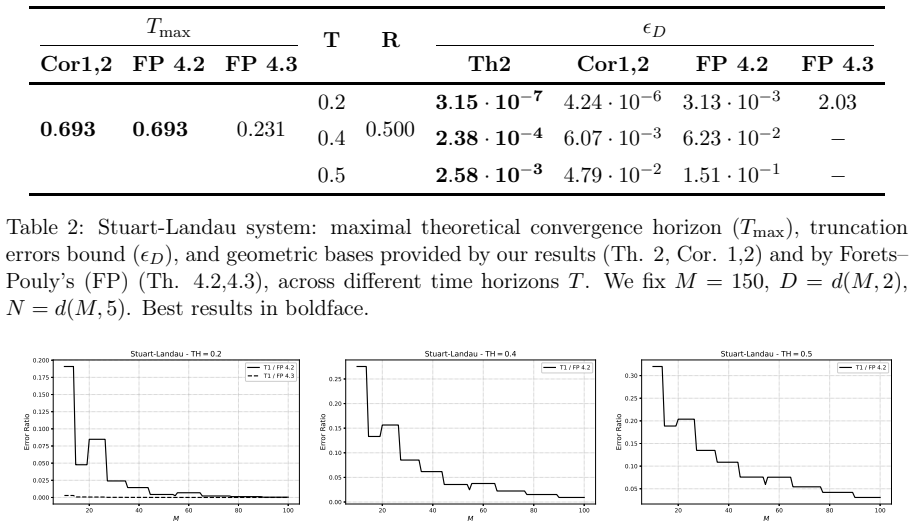
- Improved error performance appears on the Stuart-Landau and Van der Pol systems relative to prior bounds.
Reading between the lines
- The degree-aware bounds could support adaptive selection of truncation degree in numerical solvers.
- Similar expansion techniques might apply to other linearization approaches for dynamical systems.
- Certified horizons could inform verification methods in control or simulation software.
- Extensions to higher-dimensional polynomial systems would test the scalability of the estimates.
Editorial analysis
A structured set of objections, weighed in public.
Referee Report
Summary. The paper proves new error bounds for finite Carleman truncations of polynomial ordinary differential equations. The analysis works directly in the monomial basis for selected observables such as state coordinates. Using a Dyson-Duhamel expansion, it separates the degree-preserving linear part from the degree-raising nonlinear part and tracks truncation error propagation back to the observable. The resulting bounds are degree-aware, retain logarithmic-norm information from the original linear dynamics, and yield explicit finite-degree estimates with geometric convergence over certified time horizons. Comparisons with existing bounds, in particular those of Forets-Pouly, are provided on the Stuart-Landau and Van der Pol systems.
Significance. If the central claims hold, the work strengthens the theoretical foundation for Carleman linearization by delivering explicit, degree-aware error bounds that preserve logarithmic-norm data and guarantee geometric convergence on certified intervals. The direct use of the monomial basis and the clean separation via Dyson-Duhamel expansion are technically useful for verification and control applications. The explicit comparisons on standard benchmark systems add concrete evidence of improvement over prior bounds.
minor comments (3)
- The abstract and introduction should explicitly state the precise polynomial degree range for which the separation holds without additional assumptions on the linear part.
- In the comparison section, the time horizons and truncation degrees used for the Stuart-Landau and Van der Pol examples should be listed in a table for direct reproducibility of the reported error curves.
- A short remark on how the logarithmic norm is computed numerically for the linear part would help readers implement the bounds.
Simulated Author's Rebuttal
We thank the referee for the positive summary, significance assessment, and recommendation of minor revision. The referee's description of the manuscript is accurate. No major comments were provided in the report.
Circularity Check
No significant circularity; derivation self-contained
full rationale
The paper derives explicit finite-degree error bounds and geometric convergence for Carleman truncations of polynomial ODEs directly from the Dyson-Duhamel expansion applied in the monomial basis. This separates the degree-preserving linear dynamics from degree-raising nonlinear terms and tracks truncation error propagation to observables such as state coordinates, retaining logarithmic-norm information. The resulting bounds are compared against prior work (e.g., Forets-Pouly) on concrete systems but do not reduce any claimed prediction or uniqueness result to a fit, self-citation chain, or definitional equivalence. No load-bearing step invokes an ansatz or theorem whose justification collapses to the present paper's inputs.
Assumptions & free parameters
assumptions (2)
- standard math Properties of logarithmic norms for the linear dynamics
- domain assumption Validity of the Dyson-Duhamel expansion for separating degree-preserving and degree-raising terms
Cite this review
Pith. "Pith review of New convergence results for Carleman linearization." pith.science (2026). https://pith.science/paper/2IS3B2DU
@misc{pith2026260624473,
  author       = {Pith},
  title        = {Pith review of: New convergence results for Carleman linearization},
  year         = {2026},
  howpublished = {\url{https://pith.science/paper/2IS3B2DU}},
  note         = {Machine review of arXiv:2606.24473}
}
read the original abstract
We prove new error bounds for finite Carleman truncations of polynomial ordinary differential equations. The analysis works directly in the original monomial basis and for selected observables, such as state coordinates. Using a Dyson--Duhamel expansion, we separate the degree-preserving linear part from the degree-raising nonlinear part and track how truncation errors can propagate back to the observable. The resulting bounds are degree-aware and retain logarithmic-norm information from the original linear dynamics. We obtain explicit finite-degree estimates and geometric convergence over certified time horizons. Comparisons with existing bounds, in particular those of Forets--Pouly, are given on the Stuart--Landau and Van der Pol systems.
Figures

Reference graph
Works this paper leans on
-
[1]
Reachability analysis of nonlinear sy stems using conservative polynomial- ization and non-convex sets
Matthias Althoff. Reachability analysis of nonlinear sy stems using conservative polynomial- ization and non-convex sets. In Proceedings of the 16th International Conference on Hybrid Systems: Computation and Control , pages 173–182. ACM, 2013
2013
-
[2]
An introduction to CORA 2015
Matthias Althoff. An introduction to CORA 2015. In Proceedings of the Workshop on Applied Verification for Continuous and Hybrid Systems , pages 120–151, 2015
2015
-
[3]
Set p ropagation techniques for reach- ability analysis
Matthias Althoff, Goran Frehse, and Antoine Girard. Set p ropagation techniques for reach- ability analysis. Annual Review of Control, Robotics, and Autonomous Systems , 4:369–395, 2021
2021
-
[4]
Error bounds for C arleman linearization of general nonlinear systems
Arash Amini, Qiyu Sun, and Nader Motee. Error bounds for C arleman linearization of general nonlinear systems. In Proceedings of the Conference on Control and its Applicatio ns, pages 1–8. SIAM, 2021. 23
2021
-
[5]
Carle man linearization of nonlinear systems and its finite-section approximations
Arash Amini, Cong Zheng, Qiyu Sun, and Nader Motee. Carle man linearization of nonlinear systems and its finite-section approximations. Discrete and Continuous Dynamical Systems – Series B , 30(2):577–603, 2025
2025
-
[6]
Reachability of Koopman linearized syst ems using random Fourier fea- ture observables and polynomial zonotope refinement
Stanley Bak, Sergiy Bogomolov, Brandon Hencey, Niklas Koch dumper, Eric Lew, and Kos- tiantyn Potomkin. Reachability of Koopman linearized syst ems using random Fourier fea- ture observables and polynomial zonotope refinement. In Computer Aided Verification , Lecture Notes in Computer Science, pages 490–510. Springer , 2022
2022
-
[7]
Richard Bellman and J. M. Richardson. On some questions ar ising in the approximate solution of nonlinear differential equations. Quarterly of Applied Mathematics , 20(4):333– 339, 1963
1963
-
[8]
Berry, Andrew M
Dominic W. Berry, Andrew M. Childs, Aaron Ostrander, and G uoming Wang. Quantum algorithm for linear differential equations with exponenti ally improved dependence on pre- cision. Communications in Mathematical Physics , 356:1057–1081, 2017
2017
Show all 32 references
-
[9]
JuliaReach: A toolbox for set-based reachabili ty
Sergiy Bogomolov, Marcelo Forets, Goran Frehse, Kostian tyn Potomkin, and Christian Schilling. JuliaReach: A toolbox for set-based reachabili ty. In Proceedings of the 22nd ACM International Conference on Hybrid Systems: Computati on and Control , pages 39–
-
[10]
Algorithms for exact and approximate l inear abstractions of polynomial continuous systems
Michele Boreale. Algorithms for exact and approximate l inear abstractions of polynomial continuous systems. In Proceedings of the 21st International Conference on Hybrid Systems: Computation and Control , pages 1–10. ACM, 2018
2018
-
[11]
Linearization, mode l reduction and reachability in nonlinear ODEs
Michele Boreale and Luisa Collodi. Linearization, mode l reduction and reachability in nonlinear ODEs. In Reachability Problems 2022, volume 13608 of Lecture Notes in Computer Science, pages 49–66. Springer, 2022
2022
-
[12]
Linearization, mode l reduction and reachability in nonlinear ODEs
Michele Boreale and Luisa Collodi. Linearization, mode l reduction and reachability in nonlinear ODEs. Formal Methods in System Design , 66:419–454, 2025
2025
-
[13]
Application de la théorie des équati ons intégrales linéaires aux systèmes d’équations différentielles non linéaires
Torsten Carleman. Application de la théorie des équati ons intégrales linéaires aux systèmes d’équations différentielles non linéaires. Acta Mathematica, 59:63–87, 1932
1932
-
[14]
Reachability Analysis of Non-linear Hybrid Systems Using T aylor Models
Xin Chen. Reachability Analysis of Non-linear Hybrid Systems Using T aylor Models. PhD thesis, R WTH Aachen University, 2015
2015
-
[15]
Taylor model flowpipe con- struction for non-linear hybrid systems
Xin Chen, Erika Ábrahám, and Sriram Sankaranarayanan. Taylor model flowpipe con- struction for non-linear hybrid systems. In Proceedings of the IEEE Real-Time Systems Symposium, pages 183–192. IEEE, 2012
2012
-
[16]
Flow*: An analyzer for non- linear hybrid systems
Xin Chen, Erika Ábrahám, and Sriram Sankaranarayanan. Flow*: An analyzer for non- linear hybrid systems. In Computer Aided Verification , volume 8044 of Lecture Notes in Computer Science, pages 258–263. Springer, 2013
2013
-
[17]
Ordinary Differential Equations with Applications , volume 34 of Texts in Applied Mathematics
Carmen Chicone. Ordinary Differential Equations with Applications , volume 34 of Texts in Applied Mathematics. Springer, third edition, 2024
2024
-
[18]
Pedro C. S. Costa, Philipp Schleich, Mauro E. S. Morales , and Dominic W. Berry. Further improving quantum algorithms for nonlinear differential eq uations via higher-order methods and rescaling. npj Quantum Information , 11:94, 2025
2025
-
[19]
F. J. Dyson. The radiation theories of Tomonaga, Schwin ger, and Feynman. Physical Review, 75:486–502, 1949. 24
1949
-
[20]
Explicit error bounds for Carleman linearization
Marcelo Forets and Amaury Pouly. Explicit error bounds for Carleman linearization. arXiv preprint arXiv:1711.02552 , 2017
2017 arXiv
-
[21]
Reachability of weakly nonlinear systems using Car- leman linearization
Marcelo Forets and Christian Schilling. Reachability of weakly nonlinear systems using Car- leman linearization. In Reachability Problems, volume 13035 of Lecture Notes in Computer Science, pages 85–99. Springer, 2021
2021
-
[22]
SpaceEx: Scalable verification of hybrid systems
Goran Frehse, Colas Le Guernic, Alexandre Donzé, Scott Cotton, Rajarshi Ray, Olivier Lebeltel, Rodolfo Ripado, Antoine Girard, Thao Dang, and Od ed Maler. SpaceEx: Scalable verification of hybrid systems. In Computer Aided Verification , volume 6806 of Lecture Notes in Computer ...
2011
-
[23]
Reachability of uncertain linear syst ems using zonotopes
Antoine Girard. Reachability of uncertain linear syst ems using zonotopes. In Hybrid Sys- tems: Computation and Control , volume 3414 of Lecture Notes in Computer Science , pages 291–305. Springer, 2005
2005
-
[24]
Harrow, A vinatan Hassidim, and Seth Lloyd
Aram W. Harrow, A vinatan Hassidim, and Seth Lloyd. Quan tum algorithm for linear systems of equations. Physical Review Letters , 103(15):150502, 2009
2009
-
[25]
Nonlinear Dynamical Systems and Carleman Linearization
Krzysztof Kowalski and Willi-Hans Steeb. Nonlinear Dynamical Systems and Carleman Linearization. World Scientific, 1991
1991
-
[26]
Improved quantum algorithms for linear and nonlinear differential equations
Hari Krovi. Improved quantum algorithms for linear and nonlinear differential equations. Quantum, 7:913, 2023
2023
-
[27]
Krovi, Nuno F
Jin-Peng Liu, Herman Øie Kolden, Hari K. Krovi, Nuno F. L oureiro, Konstantina Trivisa, and Andrew M. Childs. Efficient quantum algorithm for dissipa tive nonlinear differential equations. Proceedings of the National Academy of Sciences , 118(35):e2026805118, 2021
2021
-
[28]
Rigorous integration of flo ws and ODEs using Taylor models
Kyoko Makino and Martin Berz. Rigorous integration of flo ws and ODEs using Taylor models. In Proceedings of the 2009 Conference on Symbolic Numeric Comp utation, pages 79–84. ACM, 2009
2009
-
[29]
Nedialkov, Kenneth R
Nedialko S. Nedialkov, Kenneth R. Jackson, and George F . Corliss. Validated solutions of initial value problems for ordinary differential equations . Applied Mathematics and Com- putation, 105(1):21–68, 1999
1999
-
[30]
Semigroups of Linear Operators and Applications to Partial Differential Equations, volume 44 of Applied Mathematical Sciences
Amnon Pazy. Semigroups of Linear Operators and Applications to Partial Differential Equations, volume 44 of Applied Mathematical Sciences . Springer, 1983
1983
-
[31]
Iterative Methods for Sparse Linear Systems
Yousef Saad. Iterative Methods for Sparse Linear Systems . SIAM, second edition, 2003
2003
-
[32]
Quantum a lgorithms for nonlinear dy- namics: Revisiting Carleman linearization with no dissipa tive conditions
Hsuan-Cheng Wu, Jingyao Wang, and Xiantao Li. Quantum a lgorithms for nonlinear dy- namics: Revisiting Carleman linearization with no dissipa tive conditions. arXiv preprint arXiv:2405.12714, 2025. 25
2025
Reviewed June 25, 2026 · model on record in the stance chip above.
Discussion (0). Continue with ORCID to comment.