REVIEW 6 major objections 5 minor 18 references
Growth Rate Analysis in $f(R,L_m)$ Gravity: A Comparative Study with \boldmath$\Lambda$CDM Cosmology
T0 review · 6 major / 5 minor · reviewed 2026-08-06 · deepseek-v4-flash
Pith's one-line read This paper claims that a non-minimal matter–curvature coupling in $f(R,L_m)$ gravity fits the growth-rate observable $f\sigma_8(z)$ better than $\Lambda$CDM at intermediate and high redshifts.
desk verdict The advertised f(R,L_m) growth-rate advantage evaporates on its own Table II: the ΛCDM reference is unphysical, the model's fσ8 values miss the data, and the growth equation has an unresolved internal inconsistency. read the letter →
The pith
A machine-rendered reading of the paper's core claim, the machinery that carries it, and where it could break.
The reading
What carries the argument
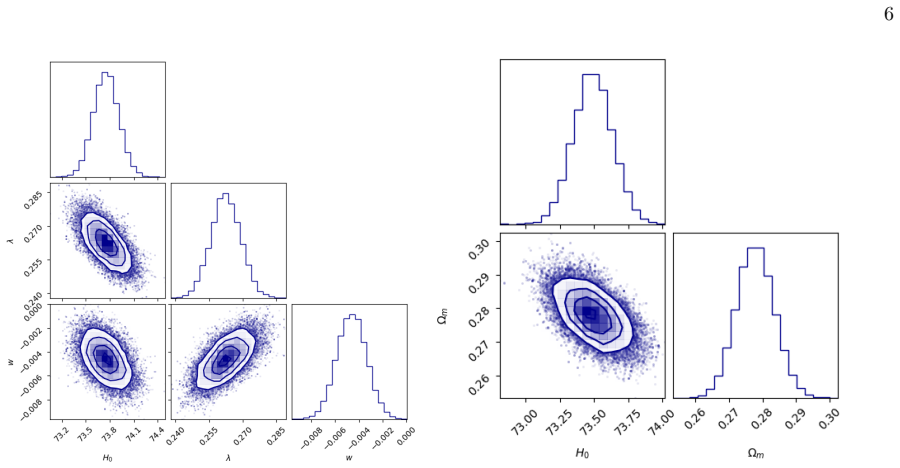
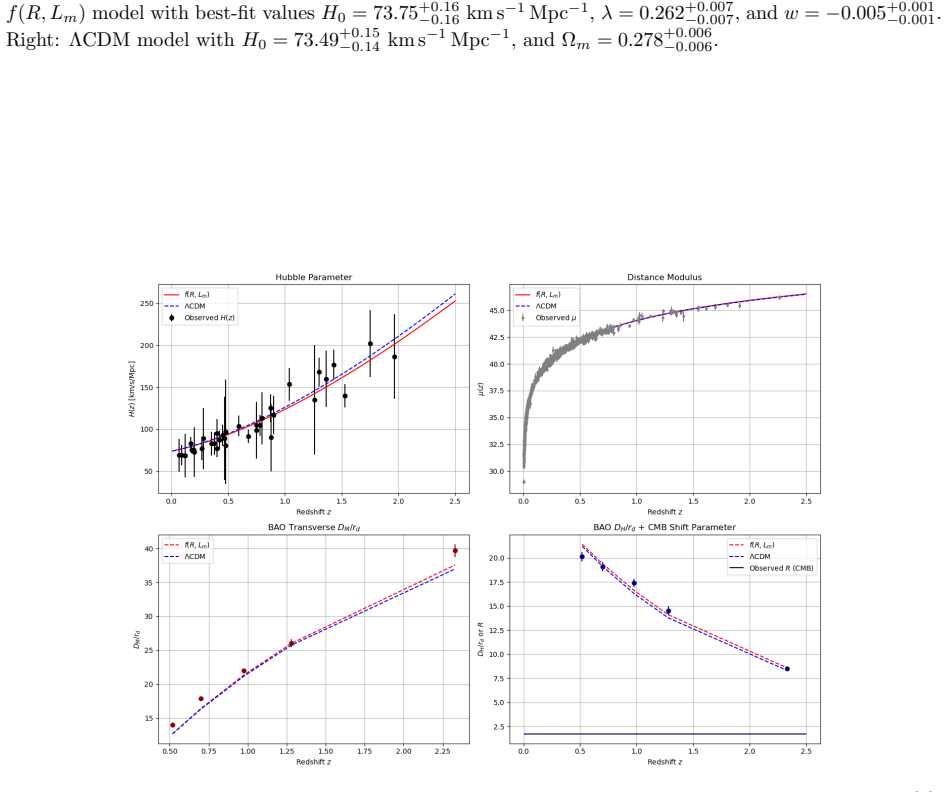
The central object is the effective gravitational coupling produced by the matter–curvature interaction. From the perturbed $(0,0)$ field equation in the Newtonian gauge, the paper obtains a modified Poisson equation $\nabla^2\Phi=\frac{1}{2}G_{\rm eff}a^2\rho\delta$ with $G_{\rm eff}=(2\beta-1)\beta\rho^{\beta-1}/\alpha$, and the numerical analysis then uses the equivalent redshift-dependent expression $G_{\rm eff}(z)=\beta\rho^{\beta-1}(z)\bigl(1+\frac{\beta-1}{2}\bigr)/(8\pi\alpha)$. This coupling enters the growth equation $\delta''(z)+\bigl(\frac{d\ln H}{d\ln(1+z)}-\frac{2}{1+z}\bigr)\delta'(z)-\frac{3}{2}\frac{G_{\rm eff}(z)\rho(z)}{H^2(z)}\delta(z)=0$, whose solution supplies $\delta(z)$, the growth rate $f(z)$, and the observable $f\sigma_8(z)$. The model is closed by the background Hubble function $H(z)=H_0\sqrt{(1-\lambda)+\lambda(1+z)^{3(1+w)}}$ and the density $\rho(z)=\bigl((\gamma+6\alpha H^2(z))/(2\beta-1)\bigr)^{1/\beta}$, with parameters fixed by the joint observational fit.
What would settle it
Recompute the model's $f\sigma_8$ values using the effective coupling derived from the Poisson equation, $G_{\rm eff}=(2\beta-1)\beta\rho^{\beta-1}/\alpha$, instead of the expression in Eq. (17), and compare the resulting curves with the same 23 RSD data points; if the difference exceeds the observational error bars, the claimed fit is not robust. A second decisive check is to recalculate the $\Lambda$CDM growth rate with initial conditions consistent with those used for $f(R,L_m)$: the paper's Table II reports negative $\Lambda$CDM $f\sigma_8$ values at low redshift, and a fair comparison requires that both models start from the same high-redshift normalization.
Extended reading notes
Core claim
Within the quasi-static, sub-horizon approximation, the non-minimal coupling between curvature and matter changes the effective gravitational coupling that appears in the linear growth equation. The paper derives a modified second-order growth equation in redshift, integrates it numerically with the best-fit background parameters, and evaluates $f\sigma_8(z)=\sigma_8(0)\,f(z)\,\delta(z)/\delta(0)$. The authors' discovery claim is that structure growth saturates earlier in the $f(R,L_m)$ model than in $\Lambda$CDM, suppressing late-time growth, and that against a 23-point compilation of RSD measurements the modified model tracks the observed $f\sigma_8$ values across intermediate and high redshifts while $\Lambda$CDM overpredicts high-redshift growth. At low redshifts the paper reports that both models underpredict the observed growth rate. The authors take these results as evidence that $f(R,L_m)$ gravity with matter–curvature coupling can serve as a viable alternative to $\Lambda$CDM for cosmic structure formation.
Load-bearing premise
The entire $f\sigma_8$ comparison rests on the quasi-static reduction in Section IV A, where the full perturbed field equations are collapsed to a modified Poisson equation with an effective gravitational coupling; if that reduction omits perturbed matter-Lagrangian and Ricci terms, or if the numerical coupling used later differs from the one derived just before it, every growth curve and $f\sigma_8$ value changes.
Editorial extensions
If this is right
- If the central claim is correct, the $f(R,L_m)$ model suppresses late-time growth, shifting $f\sigma_8$ downward exactly in the redshift range where some surveys see less clustering than $\Lambda$CDM predicts.
- The model remains compatible with the high $H_0$ favored by local measurements while fitting expansion data, so a single modified-gravity framework could address both the Hubble and $\sigma_8$ tensions.
- Future RSD surveys such as Euclid and LSST can discriminate the models by measuring $f\sigma_8$ at $z\approx1$ to $2$, where the predicted growth curves separate most strongly.
- Because $G_{\rm eff}$ depends on redshift through $\rho(z)$, growth becomes a direct probe of the matter–curvature interaction rather than a simple test of the background expansion.
Reading between the lines
- Extension: The same mechanism implies a density-dependent effective gravitational strength, so the growth rate may be scale-dependent on quasi-static sub-horizon scales; current $f\sigma_8$ analyses that average over scales could miss this, and multi-scale RSD measurements would provide a sharper test.
- Extension: The theory implies non-conservation of the matter energy-momentum tensor, which typically produces a fifth force; comparing galaxy velocities and weak-lensing signals around the same structures would isolate $G_{\rm eff}$ independently of RSD.
- Extension: The conclusion depends on the assumed constant parameters $\beta$, $\lambda$, and $w$; allowing $w$ to vary with redshift could change the predicted growth suppression, so a joint fit of expansion and growth with fully correlated parameters would be a stricter test.
- Extension: If $G_{\rm eff}$ really depends on the local matter density, voids and clusters should exhibit different effective growth histories, so void-galaxy cross-correlations could probe the coupling at low density.
Editorial analysis
A structured set of objections, weighed in public.
Referee Report
Summary. The paper studies f(R,L_m) gravity with the functional form f(R,L_m)=αR+L_m^β+γ, derives the background Friedmann equations, fits the parameters H0, λ, and w to Hubble, Pantheon+, DESI BAO, and CMB shift data, and then solves a linear growth equation to compute fσ8(z). It compares the predicted fσ8(z) with a 23-point RSD compilation and concludes that the f(R,L_m) model fits the growth data significantly better than ΛCDM at intermediate and high redshifts, potentially easing the σ8 tension. The central claim is that nonminimal matter-curvature coupling can improve the fit to RSD growth data relative to ΛCDM.
Significance. If the central claim were correct, the paper would provide evidence that f(R,L_m) gravity with matter-curvature coupling can address the σ8 tension and would justify further study of this modified-gravity class. The paper is clearly structured, uses standard cosmological datasets, and presents a useful compilation of fσ8 measurements. However, the main quantitative claim is not supported by the paper's own results: the ΛCDM column in Table II contains unphysical negative values of fσ8, the f(R,L_m) predictions miss the observed data by several standard deviations at nearly every redshift, and key equations used to generate the growth curves are internally inconsistent. The paper also does not provide any statistical measure, such as χ2, to support the claimed better fit. These issues undermine the central conclusion, so the paper cannot be accepted in its current form.
major comments (6)
- [Sec. V, Eq. (18)] The modified growth equation used for the f(R,L_m) model is not a correct transformation of Eq. (9). Equation (8) contains the damping term d(ln H)/dz, while Eq. (18) has d(ln H)/d(ln(1+z)), and these differ by a factor (1+z). Since Eq. (18) is the equation actually integrated to produce the f(R,L_m) growth curves, every fσ8 value in Table II computed from this model is suspect.
- [Sec. IV A and Sec. V C, Eqs. (9) and (17)] The effective gravitational coupling Geff is defined in Sec. IV A as Geff=(2β−1)βρ^(β−1)/α, but Eq. (17) in Sec. V C gives Geff(z)=βρ^(β−1)(1+(β−1)/2)/(8πα). These two expressions differ by a factor of order 25π for the adopted β≈1.005, not by a trivial typo. The growth equation is therefore not derived consistently, and the numerical results inherit this inconsistency.
- [Table II and Discussion] The ΛCDM column in Table II is unphysical: fσ8 is negative for all z≤0.44. For a growing perturbation f(z)=d ln δ/d ln a is positive and σ8(0) is positive, so negative fσ8 cannot occur. The Discussion acknowledges this by attributing it to 'sensitivity to initial conditions,' but that is not a valid model prediction. Comparing the f(R,L_m) model against a corrupted ΛCDM reference invalidates the stated conclusion that f(R,L_m) fits the data better.
- [Table II and Sec. V F] The f(R,L_m) predictions in Table II are far from the observed values at nearly every redshift, with no statistical measure reported. For example, at z=0.020 the model gives 0.011 versus 0.420±0.060, and at z=2.6 it gives 0.711 versus 0.420±0.090. The claim of a 'significantly better fit' at intermediate and high redshifts is not supported by these numbers, and no χ2 or likelihood calculation is presented anywhere in the paper.
- [Sec. V E, Eq. (20)] The observable fσ8(z) depends on the overall normalization σ8(0), but σ8(0) is never specified or marginalized over. If σ8(0) is set to unity or chosen arbitrarily, the model curves in Table II can be rescaled by an arbitrary constant, so the claimed agreement with the data is not a parameter-free prediction. The paper must state what value of σ8(0) was used and whether it is fixed by an external observable or fitted.
- [Sec. II A, Eq. (4) and the parameter n] The paper states that n=0 corresponds to a pressureless universe, but with the assumed barotropic relation p=(1−n)ρ, n=0 gives p=ρ, not p=0. This error affects Eq. (4), which is used to compute ρ(z) in the growth equation, and also affects the interpretation of the fitted parameter w. The consistency of the background solution with the growth calculation needs to be re-established with a correct identification of the pressureless limit.
minor comments (5)
- [Throughout] There are numerous typographical issues, including 'F riedmann' in the Section II heading, 'FLR W' for FLRW, 'thef (R, Lm)' in the abstract, and inconsistent spacing in 'f (R, Lm)' versus 'f(R,L_m)'.
- [Section headings] The section titled 'REDSHIFT-SPACE DISTORTIONS AND f σ8(z)' appears without a number, while the following section on computing fσ8 is numbered V. The organization described in the Introduction does not match the actual numbered sections.
- [Table I] Table I labels the f(R,L_m) entry as having a 'peak' at z=0 with value 1.00, but this is just the normalization point δ(z=0)/δ(0)=1, not a peak; the table and its caption should be clarified.
- [References] Reference [13] appears to be a placeholder with arXiv number 2405.12345 and should be replaced by a verifiable citation for the DESI Year 1 Bright Galaxy Sample results.
- [Eq. (18)] The notation δ''(z) is not defined; the paper should state explicitly that primes denote derivatives with respect to redshift z, and should make the corresponding change of variables clear.
Circularity Check
No circularity: background fit plus growth integration is standard; the fσ8 comparison problems are correctness errors, not circular reductions.
full rationale
The paper's derivation chain is the standard, non-circular one: it fits H0, λ, w to external background data (cosmic chronometers, Pantheon+, DESI BAO, CMB shift), then integrates the linear growth equation using those fitted parameters to compute fσ8(z) and compares with an independent RSD compilation. Fitting background parameters and then using them to predict growth is the normal structure of cosmological model tests; the RSD data are not part of the fit, so the fσ8 comparison is not statistically forced by construction. The amplitude of fσ8 does depend on σ8(0), which the paper never fixes or derives, but that is an underdetermination/correctness issue, not circularity: the paper never states that σ8(0) was fitted to the RSD data, and no single rescaling can reconcile the reported low-redshift and high-redshift model values with the observed error bars. The serious internal problems—negative ΛCDM fσ8 values at low redshift, the mismatch between Geff defined in Sec. IV A and Eq. (17), and the poor agreement of the f(R,Lm) column with the data—are correctness and consistency concerns, not reductions of a prediction to its inputs. There is no load-bearing self-citation: the theory references [1] and [15] are external, and the datasets are external. Thus no circular step can be exhibited, and the honest finding is no significant circularity.
Assumptions & free parameters
free parameters (5)
- H0 =
73.75 km/s/Mpc
- lambda =
0.262
- w =
-0.005
- sigma8(0) normalization =
not stated
- n (barotropic parameter) =
text says 0, equations imply 1
assumptions (6)
- domain assumption The Harko and Lobo f(R,Lm) field equations, Eq. (1), are correct and complete.
- domain assumption The matter Lagrangian can be set to Lm = rho.
- domain assumption Quasi-static, Newtonian-gauge perturbation reduction yields the simplified Poisson equation with an effective Geff.
- domain assumption The 23 f_sigma8 points compiled in [10] and the background datasets are reliable.
- domain assumption The analytic matter-era solution delta = 1/(1+z) provides correct initial conditions at high z.
- ad hoc to paper n=0 corresponds to a pressureless universe.
Cite this review
Pith. "Pith review of Growth Rate Analysis in $f(R,L_m)$ Gravity: A Comparative Study with \boldmath$\Lambda$CDM Cosmology." pith.science (2026). https://pith.science/paper/2LTENKRQ
@misc{pith2026250704079,
  author       = {Pith},
  title        = {Pith review of: Growth Rate Analysis in $f(R,L_m)$ Gravity: A Comparative Study with \boldmath$\Lambda$CDM Cosmology},
  year         = {2026},
  howpublished = {\url{https://pith.science/paper/2LTENKRQ}},
  note         = {Machine review of arXiv:2507.04079}
}
abstract
We investigate the evolution of cosmic structures within the framework of modified gravity, specifically focusing on theories described by the function $f(R, L_m)$, where $R$ is the Ricci scalar and $L_m$ is the matter Lagrangian. This class of models introduces a non-minimal coupling between geometry and matter, leading to modifications in the dynamics of density perturbations. We derive the linear growth equation and compute the observable growth rate $f\sigma_8(z)$, which is directly accessible from redshift-space distortion (RSD) data. Using recent observational constraints from galaxy surveys such as eBOSS and DESI, we perform a comparative analysis between predictions from $f(R, L_m)$ gravity and the standard $\Lambda$CDM model. Our results indicate that while $\Lambda$CDM remains broadly consistent with current data, the $f(R, L_m)$ framework can accommodate subtle deviations in structure growth, offering a possible resolution to existing tensions in large-scale structure observations. We also outline the implications of our findings for future surveys, including Euclid and LSST.
Figures

Figures from the paper (2 more)


Reference graph
Works this paper leans on
-
[1]
T. Harko and F. S. N. Lobo, “ f (R, Lm) gravity,” Eur. Phys. J. C70, 373 (2010), arXiv:1008.4193
arXiv 2010
-
[2]
Observational probes of cosmic acceleration,
D. H. Weinberg et al., “Observational probes of cosmic acceleration,” Phys. Rept. 530, 87–255 (2013), arXiv:1201.2434
arXiv 2013
-
[3]
Planck 2018 results. VI. Cosmological parameters,
N. Aghanim et al.[Planck Collaboration], “Planck 2018 results. VI. Cosmological parameters,”Astron. Astrophys. 641, A6 (2020), arXiv:1807.06209
arXiv 2020
-
[4]
Observational evidence from supernovae for an accelerating universe and a cosmological constant,
A. G. Riess et al., “Observational evidence from supernovae for an accelerating universe and a cosmological constant,” Astron. J. 116, 1009 (1998)
work page 1998
-
[5]
Measurements of Ω and Λ from 42 high-redshift supernovae,
S. Perlmutter et al., “Measurements of Ω and Λ from 42 high-redshift supernovae,”Astrophys. J.517, 565 (1999)
work page 1999
-
[6]
D. J. Eisenstein et al., “Detection of the Baryon Acoustic Peak in the Large-Scale Correlation Function of SDSS Luminous Red Galaxies,” Astrophys. J. 633, 560 (2005)
work page 2005
-
[7]
A comprehensive measurement of the local value of the Hubble constant,
A. G. Riess et al., “A comprehensive measurement of the local value of the Hubble constant,” Astrophys. J. Lett. 908, L6 (2021). 15
work page 2021
-
[8]
In the realm of the Hubble tension—a review of solutions,
E. Di Valentino et al., “In the realm of the Hubble tension—a review of solutions,” Class. Quantum Grav.38, 153001 (2021)
work page 2021
Show all 18 references
-
[9]
KiDS-1000 Cosmology: Multi-probe weak gravitational lensing and spectroscopic galaxy clustering constraints,
C. Heymans et al., “KiDS-1000 Cosmology: Multi-probe weak gravitational lensing and spectroscopic galaxy clustering constraints,” Astron. Astrophys.646, A140 (2021)
2021
-
[10]
Evolution of the f σ8 tension with the Planck15/ΛCDM determination and implications for modified gravity theories,
L. Kazantzidis and L. Perivolaropoulos, “Evolution of the f σ8 tension with the Planck15/ΛCDM determination and implications for modified gravity theories,” Phys. Rev. D97, 103503 (2018), arXiv:1803.01337
2018 arXiv
-
[11]
Completed SDSS-IV extended Baryon Oscillation Spectroscopic Survey: Final cosmological constraints,
S. Alam et al., “Completed SDSS-IV extended Baryon Oscillation Spectroscopic Survey: Final cosmological constraints,” Phys. Rev. D103, 083533 (2021), arXiv:2007.08991
2021 arXiv
-
[12]
The clustering of galaxies in the SDSS-III Baryon Oscillation Spectroscopic Survey,
L. Anderson et al., “The clustering of galaxies in the SDSS-III Baryon Oscillation Spectroscopic Survey,” Mon. Not. R. Astron. Soc.441, 24 (2014), arXiv:1312.4877
2014 arXiv
-
[13]
DESI Year 1 Results: Cosmology with the Bright Galaxy Sample,
DESI Collaboration, “DESI Year 1 Results: Cosmology with the Bright Galaxy Sample,” (2024), arXiv:2405.12345
2024 arXiv
-
[14]
Data Release 1,
DESI Collaboration, “Data Release 1,” https://data.desi.lbl.gov/doc/releases/dr1/
-
[15]
Linear redshift parametrization of deceleration parameter in f (R, Lm) gravity,
Y. Myrzakulov et al., “Linear redshift parametrization of deceleration parameter in f (R, Lm) gravity,” Phys. Dark Univ. 45, 101545 (2024), doi:10.1016/j.dark.2024.101545
2024
-
[16]
Unveiling the Universe with Emerging Cosmological Probes,
M. Moresco, “Unveiling the Universe with Emerging Cosmological Probes,” Universe 8, 628 (2022), arXiv:2210.13774
2022 arXiv
-
[17]
Precise cosmological parameter estimation from the latest BAO measurements,
Y. Wang et al., “Precise cosmological parameter estimation from the latest BAO measurements,” (2025), arXiv:2503.14738
2025 arXiv
-
[18]
The Pantheon+ Analysis: Cosmological Constraints,
D. Brout et al., “The Pantheon+ Analysis: Cosmological Constraints,” Astrophys. J. 938, 110 (2022), arXiv:2202.04077
2022 arXiv
Reviewed August 6, 2026 · model on record in the stance chip above.
Discussion (0). Sign in to comment.