REVIEW 3 major objections 7 minor 17 references
DeepCrossAttention: Supercharging Transformer Residual Connections
T0 review · 3 major / 7 minor · reviewed 2026-08-08 · deepseek-v4-flash
Pith's one-line read DeepCrossAttention replaces the fixed sum in transformer residual connections with learnable, input-dependent weighting of all prior layer outputs, achieving the same language-modeling perplexity up to three times faster.
desk verdict Strong empirical paper on transformer residual weighting; the DCA speedups look real, but the theoretical 'confirmation' in the abstract is not supported by the theorems, and Lemma B.1 has an arithmetic error. read the letter →
The pith
A machine-rendered reading of the paper's core claim, the machinery that carries it, and where it could break.
The reading
What carries the argument
The load-bearing object is the generalized residual stack $G_t$ and the GRN-v3 update $g_t(x) = (G_t \odot (b_t + \bar w_t))\mathbf{1}$, with $\bar w_t = \mathbf{1}\sigma(w_t^\top G_t)$; $b_t$ is per-dimension, $\bar w_t$ is input-dependent, and $\sigma = \mathrm{ReLU}$. This single identity carries both the architecture and the theory: setting the weights fixed to one recovers ResNet, a shared scalar weight vector gives GRN-v1 (DenseFormer), a per-dimension matrix gives GRN-v2, and the nonlinear input-dependent term gives GRN-v3. DCA's transformer-specific step is to place three independent GRN-v3 instances at each decoder block so that queries, keys, and values each get their own depth-wise combination of prior layers. The proofs characterize the expressible classes---identity-scaled, diagonal-plus-low-rank, plus a rank-one nonlinear term---and then bound their excess risk with the Eckart--Young--Mirsky theorem.
What would settle it
Take a trained transformer, form its residual-function Jacobians, compute the collective rank $r^* = \sum_t \mathrm{rank}(V_t)$, and compare $r^*/d$ with the thresholds in (4.1)--(4.3) using the empirical spectrum of $A-I$; the theory predicts DCA's advantage should vanish once $r^*/d$ is above threshold, so observing a 0.33x time-to-perplexity speedup in that regime would falsify the theoretical explanation.
Extended reading notes
Core claim
On its own terms, the paper's discovery is a generalization of residual learning, not of attention. Every decoder block maintains a stack $G_t$ of all previous layer outputs, and the block input is formed as $(G_t \odot (b_t + \bar w_t))\mathbf{1}$, where $b_t$ is a learned per-dimension weight and $\bar w_t = \mathbf{1}\sigma(w_t^\top G_t)$ makes the weighting input-dependent; running this same generalized residual network three times to produce queries, keys, and values yields DCA's depth-wise cross-attention. The theoretical result is that in a linear low-rank model the GRN classes strictly enlarge the representable maps, from $(I+M)x$ for ResNet to $(\alpha I + M)x$, $(D+M)x$, and beyond, and that their excess risk is smaller than ResNet's whenever the collective rank $r^*$ satisfies conditions (4.1)--(4.3). Empirically, DCA reaches the final perplexity of a 24-layer transformer in 0.33x the training steps and gives lower perplexity at matched parameter counts.
Load-bearing premise
The theoretical guarantees are proven only for a simplified linear network whose layers all have low rank, with the total rank smaller than the representation dimension, and for a target transformation whose deviation from the identity is positive semidefinite; the paper never checks whether actual transformer layers live in that regime.
Editorial extensions
If this is right
- A 24-layer 1-DCA or 2-DCA model reaches the transformer's final LM1B perplexity in 0.33x of the training time while ending at 14.48/14.41 instead of 15.14 perplexity.
- DCA is a parameter-efficient way to deepen a model: a 30-layer DCA model out-perplexities a 42-layer transformer at the same parameter budget.
- The advantage shrinks with width, from a perplexity delta of -2.82 at width 64 to -0.39 at width 1024, matching the prediction that low collective rank relative to dimension is where GRNs help.
- DCA improves perplexity on C4 across scales from 75M to 449M parameters and adds 0.7% ImageNet accuracy to ViT-S/16.
- DCA mitigates the loss spikes that appear during large-model training runs.
Reading between the lines
- Because DCA behaves identically to a residual network at initialization, the reported retrofit result suggests that any pretrained residual-style model, not only the 6-layer transformer tested, could be upgraded without changing its function at insertion time.
- The learned bias distributions, which assign negative weights to many intermediate layers, hint that DCA is partly performing per-token layer filtering; an ablation that prunes the lowest-weight layers at a fixed budget could separate that effect from richer mixing.
- The theory's rank-ratio threshold suggests a practical placement rule: estimate $r^*/d$ per block and insert GRNs only where the rank ratio is low, since both the width-scaling experiments and Theorem 4.3 predict diminishing returns in wide models.
- At very deep scales the per-dimension weights $b_t$ dominate the added parameter count, so low-rank factorizations of $b_t$ could make the overhead smaller still; the paper does not explore that direction.
Editorial analysis
A structured set of objections, weighed in public.
Referee Report
Summary. The paper introduces DeepCrossAttention (DCA), a transformer residual-connection modification in which each decoder block uses three independent Generalized Residual Network (GRN-v3) instances to generate the queries, keys, and values of the attention module from a stack of previous layer outputs. The method is motivated by three generalizations of residual networks (GRN-v1, GRN-v2, GRN-v3), and the theoretical Section 4 characterizes function classes and excess-risk/model-size trade-offs for these GRNs in a low-rank linear model, claiming to confirm an improved trade-off. Experiments on LM1B, C4, and ImageNet show that DCA reaches lower perplexity for a given training time or parameter budget compared to transformer baselines and prior residual-learning methods.
Significance. If the empirical results hold, DCA is a practically useful, low-cost architectural improvement: Table 1 reports reaching the transformer's final perplexity in 0.33x the training time, Tables 3, 5, and 6 show consistent perplexity gains over strong baselines, and Table 8 reports a 0.7% ImageNet accuracy gain. The theoretical framework for GRN-v1/v2/v3 in a low-rank linear model is an original contribution and yields interpretable conditions (4.1)-(4.3). The paper also includes an ablation (Table 7), a retrofitting experiment (Table 4), and training-stability observations. However, the connection between the theory and the DCA architecture itself is not established, and a lemma used in the main proof contains an arithmetic error; these issues are fixable but mean the abstract's 'Theoretical analysis confirms' sentence overreaches as written.
major comments (3)
- [Section 4 and Abstract] All formal results in Section 4 — Theorems 4.1, 4.2, 4.3, and Propositions 4.4 and 4.5 — analyze a single GRN-v1/v2/v3 residual combination, and Proposition 4.5 is restricted to MLP residual functions f_t(z) = V_t φ(U_t z). DCA, as defined in Section 3.2, uses three independent GRN-v3 instances per decoder block to produce the queries, keys, and values of the attention module, and no theorem or corollary analyzes this composed model class. Therefore the abstract sentence 'Theoretical analysis confirms that DCA provides an improved trade-off between accuracy and model size...' is not supported by the paper's own analysis. Please either add a theoretical argument covering DCA (for example, showing that the DCA model class is contained in one of the classes analyzed in Theorem 4.1) or substantially qualify the abstract and conclusion to state that the theory applies to the GRN component, with DCA's benefits supported empirically.
- [Appendix B, Lemma B.1] Lemma B.1 contains an arithmetic error. For x ~ N(0, I) and w = ||w|| e_1, the paper computes E[σ(w^T x)^2 ||x||^2] as ||w||^2 (d+1)/2. However, E[σ(x_1)^2 x_1^2] = 3/2 and E[σ(x_1)^2] E[Σ_{i=2}^d x_i^2] = (1/2)(d-1), so the sum is (d+2)/2, not (d+1)/2. Consequently, equation (B.6), the GRN-v3 bounds in Theorem 4.2 with denominators π(d+1), and the GRN-v3 threshold in Theorem 4.3(i) (including the definitions of η and ξ0) are numerically incorrect. The qualitative form of the results may be unchanged, but the stated constants and thresholds must be corrected.
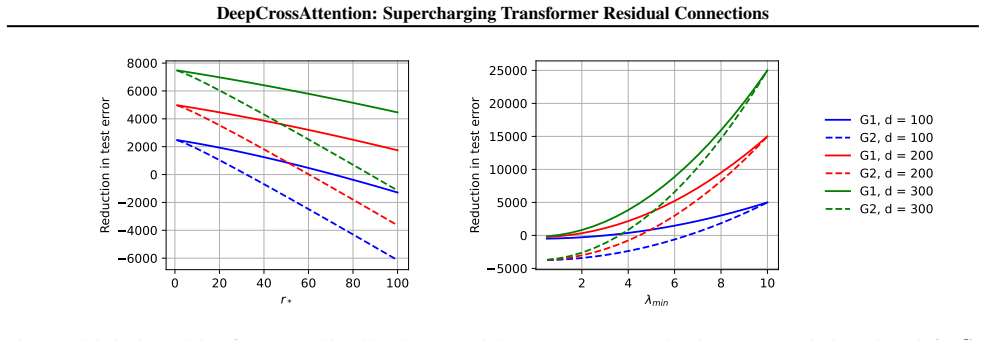
- [Section 4.1 and experiments] The theoretical results assume the collective rank condition r* = Σ_{t=1}^T rank(V_t) < d and, for Theorem 4.3, that A - I is positive semidefinite. The paper never measures r*/d or the spectral condition for the transformer models used in the experiments, and for a transformer with more than one layer and full-rank residual functions, r* can exceed d. The width-scaling experiment in Table 2 is suggestive but does not verify the theoretical conditions. The claim that the analysis 'confirms' an improved trade-off should therefore be conditioned on these assumptions, or the experimental section should provide evidence that the conditions hold (or state why the conditions are not necessary in practice).
minor comments (7)
- [Section 4.1, Theorem 4.1] The notation 'min(rt)^T_{t=1}' is ambiguous; it should be defined explicitly, for example as min_{1≤t≤T} r_t, since the proof treats it as a minimum over the layer ranks.
- [Theorem 4.2] The symbol 'Err*' appears to be a typo for 'ER*'; please use the same notation throughout.
- [Proposition 4.4] The statement introduces '˜r_*' and then defines '˜r'_*'; the notation should be made consistent.
- [Section 3.1] The memory/computation reduction for k-DCA is described only in words; a precise definition of which layer outputs are retained in G_t for a given k would improve reproducibility.
- [Table 1] The 'TIME' column is described as normalized time to reach the transformer's perplexity, but the interpolation or measurement procedure is not stated; please specify how the time is computed from the training curves.
- [Figure 5] The x-axis label 'min' in the right panel is unclear; it presumably refers to κ = λ_min/λ_max, and this should be stated explicitly.
- [Appendix H] The caption of Figure 10 describes the learned GRN-v3 weights as 'bias values,' but in the GRN-v3 definition the learned term is σ(w_t^T G_t), which is an input-dependent weight rather than a bias; please reconcile the terminology.
Circularity Check
No significant circularity found: the theoretical trade-off bounds are derived from first principles for a stylized linear model and are not fitted to or defined by the empirical claims; the caveats are scope and correctness issues, not circularity.
full rationale
The central theoretical results (Theorems 4.1-4.3, Propositions 4.4-4.5) are derived from the definitions of the GRN classes in Section 3.1. Theorem 4.1 algebraically characterizes the representable function classes; Theorem 4.2 computes excess-risk upper bounds via Eckart-Young-Mirsky and Gaussian moment estimates; Theorem 4.3 and Proposition 4.4 manipulate those bounds to obtain conditions (4.1)-(4.3). No parameter is fitted to the LM1B, C4, or ImageNet experiments, no step assumes the empirical conclusion, and the bottleneck-rank extension cites independent prior work (Jacot, 2023). The empirical speed and quality claims in Table 1 and Figures 6-7 are measured training outcomes, not predictions generated from the theory by construction. The legitimate concerns raised about this paper are not circularity: the abstract's sentence 'Theoretical analysis confirms that DCA provides an improved trade-off...' overreaches because the theorems analyze a single GRN-v1/v2/v3 residual combination in a low-rank linear model, whereas DCA composes three independent GRN-v3 instances to produce attention queries, keys, and values; and Lemma B.1's stated value (d+1)/2 for E[sigma(w^T x)^2 ||x||^2] is an arithmetic error, with the correct value (d+2)/2. These are correctness and scope issues, not derivation-by-construction, fitted-input-as-prediction, or load-bearing self-citation, so the circularity score is 0.
Assumptions & free parameters
assumptions (5)
- domain assumption Features are isotropic: E[xx^T] = I, and Lemma B.1 takes x ~ N(0,I).
- domain assumption Collective rank of all residual layers is below ambient dimension: r* = sum_t rank(V_t) < d.
- domain assumption The target linear map satisfies A - I >= 0 (positive semidefinite) with lambda_min > 0.
- standard math Bottleneck-rank subadditivity properties from Jacot (2023): rank(f∘g) <= min{rank(f), rank(g)} and rank(f+g) <= rank(f)+rank(g).
- domain assumption Each layer has rank at least one when counting parameters in Lemma C.1.
Cite this review
Pith. "Pith review of DeepCrossAttention: Supercharging Transformer Residual Connections." pith.science (2026). https://pith.science/paper/2NJO63RX
@misc{pith2026250206785,
  author       = {Pith},
  title        = {Pith review of: DeepCrossAttention: Supercharging Transformer Residual Connections},
  year         = {2026},
  howpublished = {\url{https://pith.science/paper/2NJO63RX}},
  note         = {Machine review of arXiv:2502.06785}
}
read the original abstract
Transformer networks have achieved remarkable success across diverse domains, leveraging a variety of architectural innovations, including residual connections. However, traditional residual connections, which simply sum the outputs of previous layers, can dilute crucial information. This work introduces DeepCrossAttention (DCA), an approach that enhances residual learning in transformers. DCA employs learnable, input-dependent weights to dynamically combine layer outputs, enabling the model to selectively focus on the most relevant information in any of the previous layers. Furthermore, DCA incorporates depth-wise cross-attention, allowing for richer interactions between layers at different depths. Our language modeling experiments show that DCA achieves improved perplexity for a given training time. Moreover, DCA obtains the same model quality up to 3x faster while adding a negligible number of parameters. Theoretical analysis confirms that DCA provides an improved trade-off between accuracy and model size when the ratio of collective layer ranks to the ambient dimension falls below a critical threshold.
Figures


Figures from the paper (7 more)



Reference graph
Works this paper leans on
-
[1]
Better plain vit baselines for imagenet-1k
Beyer, L., Zhai, X., and Kolesnikov, A. Better plain vit baselines for imagenet-1k. arXiv preprint arXiv:2205.01580, 2022
arXiv 2022
-
[2]
One billion word benchmark for measuring progress in statistical language modeling
Chelba, C., Mikolov, T., Schuster, M., Ge, Q., Brants, T., Koehn, P., and Robinson, T. One billion word benchmark for measuring progress in statistical language modeling. arXiv preprint arXiv:1312.3005, 2013
arXiv 2013
-
[3]
W., Sutton, C., Gehrmann, S., et al
Chowdhery, A., Narang, S., Devlin, J., Bosma, M., Mishra, G., Roberts, A., Barham, P., Chung, H. W., Sutton, C., Gehrmann, S., et al. Palm: Scaling language modeling with pathways. Journal of Machine Learning Research, 24 0 (240): 0 1--113, 2023
2023
-
[4]
An image is worth 16x16 words: Transformers for image recognition at scale
Dosovitskiy, A., Beyer, L., Kolesnikov, A., Weissenborn, D., and Zhai, X. An image is worth 16x16 words: Transformers for image recognition at scale. International Conference on Learning Representations, 2021
work page 2021
-
[5]
Ast: Audio spectrogram transformer
Gong, Y., Chung, Y.-A., and Glass, J. Ast: Audio spectrogram transformer. In Interspeech 2021, pp.\ 571--575, 2021
work page 2021
-
[6]
Deep residual learning for image recognition
He, K., Zhang, X., Ren, S., and Sun, J. Deep residual learning for image recognition. In Proceedings of the IEEE conference on computer vision and pattern recognition, pp.\ 770--778, 2016
2016
-
[7]
Huang, G., Liu, Z., Van Der Maaten, L., and Weinberger, K. Q. Densely connected convolutional networks. In Proceedings of the IEEE conference on computer vision and pattern recognition, pp.\ 4700--4708, 2017
2017
-
[8]
Implicit bias of large depth networks: a notion of rank for nonlinear functions
Jacot, A. Implicit bias of large depth networks: a notion of rank for nonlinear functions. The Eleventh International Conference on Learning Representations, 2023
work page 2023
Show all 17 references
-
[9]
L., Bahl, L
Jelinek, F., Mercer, R. L., Bahl, L. R., and Baker, J. K. Perplexity—a measure of the difficulty of speech recognition tasks. The Journal of the Acoustical Society of America, 62 0 (S1): 0 S63--S63, 1977
1977
-
[10]
and Hutter, F
Loshchilov, I. and Hutter, F. Decoupled weight decay regularization. arXiv preprint arXiv:1711.05101, 2017
2017 arXiv
-
[11]
Laurel: Learned augmented residual layer
Menghani, G., Kumar, R., and Kumar, S. Laurel: Learned augmented residual layer. In Workshop on Efficient Systems for Foundation Models II, 2024
2024
-
[12]
Denseformer: Enhancing information flow in transformers via depth weighted averaging
Pagliardini, M., Mohtashami, A., Fleuret, F., and Jaggi, M. Denseformer: Enhancing information flow in transformers via depth weighted averaging. arXiv preprint arXiv:2402.02622, 2024
2024 arXiv
-
[13]
Raffel, C., Shazeer, N., Roberts, A., Lee, K., Narang, S., Matena, M., Zhou, Y., Li, W., and Liu, P. J. Exploring the limits of transfer learning with a unified text-to-text transformer. Journal of Machine Learning Research, 21 0 (140): 0 1--67, 2020 a
2020
-
[14]
Raffel, C., Shazeer, N., Roberts, A., Lee, K., Narang, S., Matena, M., Zhou, Y., Li, W., and Liu, P. J. Exploring the limits of transfer learning with a unified text-to-text transformer. Journal of machine learning research, 21 0 (140): 0 1--67, 2020 b
2020
-
[15]
K., Greff, K., and Schmidhuber, J
Srivastava, R. K., Greff, K., and Schmidhuber, J. Training very deep networks. Advances in neural information processing systems, 28, 2015
2015
-
[16]
Attention is all you need
Vaswani, A. Attention is all you need. Advances in Neural Information Processing Systems, 2017
2017
-
[17]
Hyper-connections
Zhu, D., Huang, H., Huang, Z., Zeng, Y., Mao, Y., Wu, B., Min, Q., and Zhou, X. Hyper-connections. arXiv preprint arXiv:2409.19606, 2024
2024 arXiv
Reviewed August 8, 2026 · model on record in the stance chip above.
Discussion (0). Continue with ORCID to comment.