REVIEW 3 major objections 3 minor 26 references
Heavy-flavor production and hadronization at the LHC: experimental status and perspectives from LHC experiments
T0 review · 3 major / 3 minor · reviewed 2026-08-12 · deepseek-v4-flash
Pith's one-line read Heavy-flavor data at the LHC indicate that hadronization is not universal across collision systems.
desk verdict A competent and honest proceedings review whose central universality-breaking claim is stated more strongly than the shown cross-system comparisons can support. read the letter →
The pith
A machine-rendered reading of the paper's core claim, the machinery that carries it, and where it could break.
The reading
What carries the argument
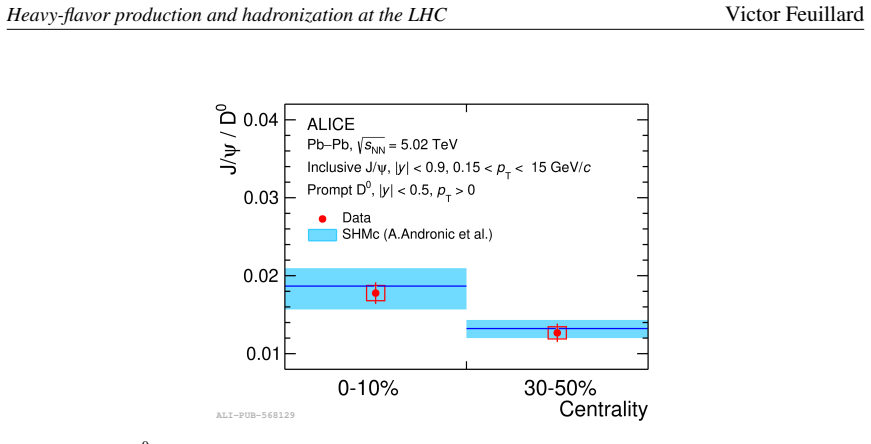
The organizing tool is the set of charm fragmentation fractions $f(c\to h)$, the probabilities that a charm quark ends up in a given hadron species, together with a set of production yield ratios: $D_s^+/(D^0+D^+)$, $\Lambda_c^+/D^0$, $\Xi_c^+/D^0$, $\Xi_c^+/\Lambda_c^+$, and $J/\psi/D^0$. Comparing fragmentation fractions across systems is what exposes the apparent non-universality; the baryon-to-meson ratios separate hadronization models because coalescence and statistical recombination enhance baryons at low and moderate $p_{\rm T}$ while vacuum fragmentation does not; and the two-muon correlation functions from the LHC are used to test whether the medium broadens the angular correlation of heavy-quark pairs. Model comparisons with a color-reconnection-tuned event generator, coalescence-plus-fragmentation transport models, and statistical hadronization models connect the observed ratios to the hadronization mechanism.
What would settle it
Take all charm fragmentation-fraction datasets and restrict them to a common $p_{\rm T}$ and rapidity window (or measure $\Lambda_c^+/D^0$ in electron-positron, electron-proton, proton-proton, proton-lead, and lead-lead collisions with identical acceptance in a single analysis); if the $\Lambda_c^+$ enhancement over $D^0$ disappears under matched kinematics, the claimed breaking of universal hadronization is refuted.
Extended reading notes
Core claim
The central claim, stated in the conclusion, is that measurements of several heavy-flavor species suggest a breaking of universal hadronization across different collision systems. Concretely, the charm fragmentation fractions extracted from proton-proton and proton-lead data are consistent with each other, but relative to electron-positron and electron-proton collisions they show an increase in $\Lambda_c^+$ production and a decrease in non-strange $D$-meson production. In lead-lead collisions the paper argues that charm hadrons at low and moderate $p_{\rm T}$ can also be produced through coalescence or statistical recombination, whereas at high $p_{\rm T}$ no significant coalescence contribution is observed. The centrality-dependent $J/\psi$ to $D^0$ ratio, which rises in the most central collisions and is described by the statistical hadronization model, is read as supporting the same picture: both open and hidden charm come from statistical hadronization of deconfined, locally thermalized charm quarks.
Load-bearing premise
The conclusion that hadronization is not universal presumes that heavy-flavor measurements taken at different collision energies, rapidities, transverse-momentum ranges, and momentum scales are directly comparable once standard corrections are applied; if those kinematic gaps are actually responsible for the apparent differences, the claimed breakdown would not follow.
Editorial extensions
If this is right
- Charm fragmentation fractions measured in proton-proton and proton-lead collisions agree, so hadron-collision fragmentation is reproducible across collision species; the discrepancy with electron-positron and electron-proton collisions means tuning on lepton collisions alone will not predict hadron-collision yields.
- In lead-lead collisions, statistical hadronization and coalescence contribute at low and moderate $p_{\rm T}$, so models that include only vacuum fragmentation will fail in that kinematic region, while high-$p_{\rm T}$ data remain described by fragmentation.
- The rising $J/\psi/D^0$ ratio with centrality is captured by statistical hadronization of deconfined charm quarks, tying open and hidden charm production to the same mechanism.
- The absence of the predicted broadening of two-muon correlation peaks from peripheral to central lead-lead collisions disfavors strong collisional broadening of heavy-quark pairs in the quark-gluon plasma as modeled.
Reading between the lines
- If hadronization is genuinely system-dependent, the fragmentation-function input to perturbative QCD factorization would itself have to become environment-dependent for heavy-ion collisions, a structural change to the framework rather than a parameter retune.
- The kinematic comparability caveat suggests a direct cross-check: re-analyze electron-positron and electron-proton datasets with the same $p_{\rm T}$ and rapidity cuts as the hadron-collision measurements to test whether the apparent non-universality is a selection effect.
- A testable consequence of the coalescence picture is that $\Lambda_c^+/D^0$ in lead-lead collisions should rise monotonically with centrality and system size; Run 3 data with finer centrality binning can look for that trend.
- The same baryon-enhancement logic could apply to beauty, where $\Lambda_b/B$ should show a similar low-$p_{\rm T}$ excess in lead-lead relative to proton-proton if recombination acts on bottom quarks too.
Editorial analysis
A structured set of objections, weighed in public.
Referee Report
Summary. This LHCP 2024 proceedings contribution summarizes recent heavy-flavor production and hadronization measurements from ALICE, ATLAS, CMS, and LHCb. It reviews strange-to-non-strange fragmentation ratios for charm and beauty, charm baryon-to-meson ratios (Lambda_c+/D0, Xi_c+/Lambda_c+), new measurements such as Sigma_c(2520) production, charm fragmentation fractions, ATLAS two-muon correlation widths, and the J/psi/D0 ratio in Pb-Pb collisions. The paper's central interpretive claim, stated in the conclusion, is that the measurements suggest a breaking of universal parton-to-hadron hadronization across collision systems, with coalescence or statistical recombination contributing to charm hadron production in Pb-Pb collisions at low and moderate pT.
Significance. If the central claim is correct, it challenges the long-standing assumption of universal fragmentation functions in pQCD factorization and has direct implications for how heavy-flavor hadronization is modeled in both small and large collision systems. The paper serves a useful function as a compact, well-referenced summary of the current experimental landscape from the four LHC experiments, and it accurately reflects the original measurements in most places, including explicit acknowledgment of large uncertainties in the strangeness-enhancement comparison. It does not present new experimental analysis, machine-checked derivations, or parameter-free predictions; its value is as a synthesis. The strength of the synthesis, however, depends critically on whether the cross-system comparisons it relies on are sufficiently controlled, which is exactly where the paper is least explicit.
major comments (3)
- [Charm fragmentation fractions, Fig. 5] The central claim that universality of hadronization is 'not generally valid' rests entirely on Fig. 5, which compares ALICE charm fragmentation fractions in pp and p-Pb with values from e+e- and ep collisions. The ALICE fractions are pT-integrated and require model-dependent extrapolation into the unmeasured low-pT region, corrections for unmeasured charm species, and feed-down subtraction, as detailed in the original ALICE publication [25]. The present paper does not report the extrapolation model, the fraction of the yield that is extrapolated, or the systematic uncertainty associated with differing pT reach, rapidity acceptance, and species coverage between systems. Without this information, the reader cannot determine whether the apparent enhancement of Lambda_c+ and suppression of non-strange D mesons is a physical property of the QCD medium or an artifact of comparing quantities extracted under different assumptions. The statement 'This indicates that the universality ... is not generally valid' is therefore stronger than the evidence shown in this paper. I ask the authors to either present the relevant systematic breakdown from [25] or soften the conclusion and explicitly list the comparability caveats.
- [Fig. 2, right panel and accompanying text] The comparison of the ALICE non-prompt Lambda_c+/D0 ratio with the LHCb Lambda_b/B ratio is used to support the claim that the non-prompt charm baryon-to-meson ratio is 'generally higher' than the beauty one. These two quantities are not directly comparable as presented: the ALICE measurement is at midrapidity (|y|<0.5) while the LHCb measurement is at forward rapidity (2.0<y<4.5), and the non-prompt Lambda_c+ sample includes decay kinematics from beauty hadrons whereas the LHCb ratio is for hadrons at production. Differences in rapidity coverage and in the relation between the measured decay products and the parent hadron can affect the comparison. The text should state these limitations explicitly, or restrict the comparison to a kinematic region and quantity where the correspondence is controlled.
- [Conclusion paragraph] The concluding sentence 'Measurements indicate that, in Pb-Pb collisions, charm hadrons can also produced through coalescence or statistical recombination at low and moderate pT, whereas no significant contribution from coalescence is observed at high pT' overstates the evidence presented in the body of the paper. The only Pb-Pb evidence discussed for strangeness enhancement, the B_s/B ratios, is explicitly noted to be 'also compatible with a scenario without strangeness enhancement' in the main text. The J/psi/D0 ratio agrees with the statistical hadronization model, but that is a single observable. The conclusion should be reworded to match the exploratory and uncertainty-limited nature of the current measurements, e.g., 'are suggestive of' rather than 'indicate'.
minor comments (3)
- [Conclusion, sentence after Fig. 7] The conclusion contains a grammatical error: 'charm hadrons can also produced' should read 'can also be produced'.
- [Fig. 4 caption] The figure caption refers to 'EPSS16', which should be 'EPPS16' (the nuclear PDF set), matching the reference list.
- [References] References [13] and [16] are the same paper, as are [15] and [17]; this duplication appears intentional in the original source, but it would be helpful to cite them uniquely in the text to avoid confusion.
Circularity Check
No significant circularity: the paper is a conference summary of experimental measurements, not a derivation that reduces to its own inputs.
full rationale
The paper is a review-style proceeding contribution that reports measurements by ALICE, ATLAS, CMS, and LHCb (e.g., D_s^+/(D0+D+) ratios, Lambda_c+/D0 ratios, Xi_c+/D0 ratios, charm fragmentation fractions, di-muon correlation widths, and J/psi/D0 ratios). No parameter is fitted and then renamed as a prediction, and no theoretical result is derived from assumptions that already contain the conclusion. The central interpretive claim, that the charm fragmentation fractions in pp and p-Pb differ from e+e- and ep values and therefore suggest a breaking of universal hadronization, rests on the measured fragmentation fractions reported in the cited ALICE analysis [25]. Those fractions are experimental inputs, not outputs of a model constructed by this paper, so the conclusion is a comparison of measurements rather than a circular reduction. Citations to prior ALICE papers are normal reporting of experimental results and are not used as an unverified substitute for an independent derivation; the same collaborations' measurements are themselves the evidence presented. The comparison across collision systems involves assumptions about kinematic coverage and extrapolation, but those are comparability concerns, not circularity. The paper does not attempt to derive, fit, or predict any quantity from its own definitions, so it receives the lowest circularity score.
Assumptions & free parameters
assumptions (3)
- domain assumption Heavy-quark production is described by perturbative QCD factorization with universal fragmentation functions at leading order, with soft non-perturbative effects encoded in fragmentation functions.
- domain assumption The statistical hadronization model and coalescence or recombination models are valid descriptions of charm hadronization in the quark-gluon plasma.
- domain assumption Reported experimental measurements from the collaborating experiments are correct within quoted uncertainties.
Cite this review
Pith. "Pith review of Heavy-flavor production and hadronization at the LHC: experimental status and perspectives from LHC experiments." pith.science (2026). https://pith.science/paper/2QRYA4YE
@misc{pith2026241201336,
  author       = {Pith},
  title        = {Pith review of: Heavy-flavor production and hadronization at the LHC: experimental status and perspectives from LHC experiments},
  year         = {2026},
  howpublished = {\url{https://pith.science/paper/2QRYA4YE}},
  note         = {Machine review of arXiv:2412.01336}
}
read the original abstract
Heavy-flavor hadrons are one of the most prominent probes to study the quark-gluon plasma and to test models based on Quantum Chromodynamics (QCD). This contribution presents the latest results regarding heavy-flavor production in ALICE, ATLAS, CMS and LHCb.
Figures


Figures from the paper (4 more)


Reference graph
Works this paper leans on
-
[25]
ALICE Collaboration, 2405.14571
-
[1]
ALICE Collaboration,JHEP 12 (2023) 086 [2308.04877]
arXiv 2023
-
[2]
ALICE Collaboration,JHEP 10 (2024) 110 [2402.16417]
arXiv 2024
-
[3]
Cacciari et al.,JHEP 10 (2012) 137 [1205.6344]
M. Cacciari et al.,JHEP 10 (2012) 137 [1205.6344]
arXiv 2012
-
[4]
CMS Collaboration,Phys. Lett. B829 (2022) 137062 [2109.01908]
work page Pith review arXiv 2022
-
[5]
ALICE Collaboration,Phys. Lett. B846 (2023) 137561 [2204.10386]
work page Pith review arXiv 2023
-
[6]
ALICE Collaboration,Phys. Lett. B827 (2022) 136986 [2110.10006]
arXiv 2022
-
[7]
ALICE Collaboration,JHEP 01 (2022) 174 [2110.09420]
arXiv 2022
Show all 26 references
-
[8]
M. He, R.J. Fries and R. Rapp,Phys. Lett. B735 (2014) 445 [1401.3817]
2014 arXiv
- [9]
-
[10]
CMS Collaboration,JHEP 01 (2024) 128 [2307.11186]
2024 arXiv
-
[11]
ALICE Collaboration,Phys. Rev. D108 (2023) 112003 [2308.04873]
2023 arXiv
-
[12]
LHCb Collaboration,Phys. Rev. D100 (2019) 031102 [1902.06794]
2019
-
[14]
Minissale, S
V. Minissale, S. Plumari and V. Greco,Phys. Lett. B821 (2021) 136622 [2012.12001]
2021
- [16]
- [17]
-
[18]
Andronic, P
A. Andronic, P. Braun-Munzinger, M.K. Köhler, K. Redlich and J. Stachel,Phys. Lett. B797 (2019) 134836 [1901.09200]
2019 arXiv
-
[19]
Belle Collaboration,Phys. Rev. D97(2018) 072005 [1706.06791]
2018 arXiv
-
[20]
ALICE Collaboration, 2405.14538
-
[21]
LHCb Collaboration,Phys. Rev. C109 (2024) 044901 [2305.06711]
2024
-
[22]
ALICE Collaboration,Phys. Rev. Lett.127 (2021) 272001 [2105.05187]
2021 arXiv
-
[23]
Eskola, P
K.J. Eskola, P. Paakkinen, H. Paukkunen and C.A. Salgado,Eur. Phys. J. C77 (2017) 163 [1612.05741]
2017 arXiv
- [24]
-
[26]
ATLAS Collaboration,Phys. Rev. Lett.132 (2024) 202301 [2308.16652]
2024 arXiv
-
[27]
Nahrgang, J
M. Nahrgang, J. Aichelin, P.B. Gossiaux and K. Werner,Phys. Rev. C90 (2014) 024907 [1305.3823]
2014 arXiv
-
[28]
ALICE Collaboration,Phys. Lett. B849 (2024) 138451 [2303.13361]. 7
2024 arXiv
Reviewed August 12, 2026 · model on record in the stance chip above.
Discussion (0). Continue with ORCID to comment.