REVIEW 4 major objections 6 minor 56 references
A $\Gamma_{3}$ modular symmetric approach for two-zero textures in left-right symmetric model
T0 review · 4 major / 6 minor · reviewed 2026-08-11 · deepseek-v4-flash
Pith's one-line read A single flavon-free A4 modular left-right symmetric model can realize all seven experimentally allowed two-zero neutrino mass textures.
desk verdict The A4 construction is explicit and the seven mass matrices are there, but the paper never diagonalizes the charged leptons, so the physical neutrino texture is not the one being fitted—the central claim is unestablished. read the letter →
The pith
A machine-rendered reading of the paper's core claim, the machinery that carries it, and where it could break.
The reading
What carries the argument
The central machinery is the assignment of $A_4$ ($\Gamma_3$) modular weights and representations to the three left-handed lepton doublets $L_L$ and right-handed singlets $L_R^c$, with Yukawa couplings promoted to modular forms of weight 4, 8 and 10. The modular forms $Y^{(k)}$ are fixed functions of the modulus $\tau$, and the rule that the modular weights in every term of the superpotential sum to zero decides which entries of the Dirac mass matrix $M_D$, the right-handed Majorana matrix $M_R$, and the left-handed Majorana matrix $M_L$ are non-zero. Combining type-I and type-II seesaw contributions, $M_\nu = M_\nu^{\mathrm{I}} + M_\nu^{\mathrm{II}}$, then produces the two-zero textures, each characterized by exactly two vanishing entries among the six independent elements of the symmetric light neutrino mass matrix.
What would settle it
Compute, for each of the seven charge and weight assignments, the lowest modular weight at which an $A_4$-invariant operator contributes to a position that the texture sets to zero; if any such operator enters at a weight that is not suppressed far below the neutrino mass scale set by the non-zero entries, the exact-zero claim fails. On the experimental side, a future neutrinoless double beta decay signal above the largest effective mass the paper predicts for the allowed classes would rule out the framework.
Extended reading notes
Core claim
Within the generic left-right symmetric model, promoting flavor symmetry to the $A_4$ modular group and choosing modular weights 4, 8 and 10 for the three left-handed lepton doublets and right-handed singlets yields a light neutrino mass matrix $M_\nu = M_\nu^{\mathrm{I}} + M_\nu^{\mathrm{II}}$ that takes exactly the seven experimentally allowed two-zero textures. The zeros are not imposed by hand: a superpotential term is present only if the $A_4$ representations combine to a singlet and the modular weights of the fields sum to zero, so the allowed entries of $M_D$, $M_R$ and $M_L$ are fixed by the symmetry. By permuting the $A_4$ charges and modular weights of the lepton fields, the paper obtains classes B2 and B1 from weight 4, classes B4, B3, A2 and A1 from weight 8, and class C from weight 10. With these mass matrices, resonant leptogenesis gives a baryon asymmetry consistent with observation for B1, B2 and C, and the computed total effective Majorana mass for neutrinoless double $\beta$ decay remains below the current experimental limit for all seven classes.
Load-bearing premise
The construction assumes that the superpotential terms written down are the only contributions to the light neutrino mass matrix, so the zero entries are exact; additional interactions or quantum corrections could fill those entries, and the paper does not estimate how large such corrections could be.
Editorial extensions
If this is right
- All seven experimentally allowed two-zero textures arise from one flavon-free modular $A_4$ LRSM, so the usual flavon alignment problem is bypassed.
- The model yields correlated predictions linking $\sum m_\nu$, $\delta_{\mathrm{CP}}$, the solar and atmospheric mixing angles, the baryon asymmetry, and the neutrinoless double beta decay effective mass, so measuring any of these sharpens the others.
- Resonant leptogenesis works only for classes B1, B2 and C in this framework, so a confirmed baryon asymmetry together with a texture from the other classes would require new ingredients.
- Every texture class survives the current neutrinoless double beta decay limit, so future experiments with improved sensitivity can distinguish the predicted total effective mass ranges among classes.
- Several classes disfavor or exclude one of the two mass orderings for particular parameters, giving a route to ordering discrimination.
Reading between the lines
- The paper never estimates how higher-order modular-invariant operators, non-minimal Kähler terms, or loop corrections fill the positions set to zero; an extension would compute the lowest modular weight that can populate each zero and translate it into a bound on the modulus $\tau$.
- The same weight-assignment scanning could be applied to other modular groups such as $S_3$, $S_4$ or $A_5$; the seven-texture classification is a property of the two-zero condition, not of $A_4$, so the method is transferable.
- The authors take the type-I and type-II seesaw terms to contribute with equal strength; relaxing this assumption would change the relative sizes of the non-zero entries and could alter which textures reproduce the baryon asymmetry, a testable difference for future leptogenesis and $0\nu\beta\beta$ analyses.
- The allowed set of seven textures is imported from current global fits; future experiments with sharper oscillation measurements may exclude some textures, which would single out a subset of the modular weight assignments and make the model more predictive.
Editorial analysis
A structured set of objections, weighed in public.
Referee Report
Summary. The manuscript constructs an A4 (Gamma3) modular-symmetric left-right symmetric model without flavon fields, assigns modular weights 4, 8 and 10 to the lepton sector, and claims to realize, one by one, the seven phenomenologically allowed two-zero textures of the light neutrino mass matrix (classes A1, A2, B1, B2, B3, B4, C). For each texture the paper scans the modular parameter and the VEV ratio, compares the resulting neutrino observables with NuFit-6.0 ranges, and then studies resonant leptogenesis and neutrinoless double beta decay. The central claims are that classes B1, B2 and C reproduce the observed baryon asymmetry and that all seven classes yield effective 0νββ masses compatible with KamLAND-Zen.
Significance. If correct, the framework would be a compact, flavon-free modular LRSM in which a small set of A4 charge and modular-weight assignments determines the entire neutrino mass matrix and yields correlated predictions for the sum of neutrino masses, Dirac CP phase, baryon asymmetry, and 0νββ. The paper has useful strengths: the mass matrices are written out explicitly, all seven two-zero classes are systematically addressed, and the phenomenological section confronts several independent constraints simultaneously. However, the central derivation contains a load-bearing algebraic inconsistency, and the flavor basis in which the textures are defined is never specified. As it stands, the claimed realization of the seven textures and the resulting phenomenological fits are not established.
major comments (4)
- [Section III, Eq. (3.8)] The light neutrino matrix in Eq. (3.8) does not follow from the preceding matrices by the stated seesaw formula. Writing a = Y_1^4 and b = Y_{1'}^4 in Eqs. (3.3), (3.5) and (3.7), a direct multiplication of M_D M_R^{-1} M_D^T gives (2,2) entry b^2/a and (2,3) entry [a^2b^2 - b^4 + a^4 + ab^3]/[ab(a+b)], whereas Eq. (3.8) has b and a respectively. The matrix in Eq. (3.8) is instead simply proportional to M_L, which would require M_D M_R^{-1} M_D^T ∝ M_L; this proportionality does not hold for the displayed matrices. Since the same computation underlies the other texture matrices in Eqs. (3.15), (3.20), (3.23), (3.26), (3.29) and (3.33), the central claim that all seven two-zero textures are realized is unsupported as written.
- [Section III, Tables III-VIII and Eqs. (3.3)-(3.33)] The charged-lepton mass matrix is never constructed. In this model the same bidoublet and the same A4 assignments generate the charged-lepton and Dirac neutrino Yukawa couplings, so the charged-lepton mass matrix is generically non-diagonal. The physical light neutrino mass matrix in the mass basis of charged leptons is U_e^T Mν U_e with a non-trivial U_e, and this rotation generically fills two-zero entries. The paper compares Mν directly with NuFit oscillation data in Figs. 1-7 without specifying or deriving such a basis, so the claimed two-zero textures are defined only in an unspecified flavor basis and the oscillation fits are not justified.
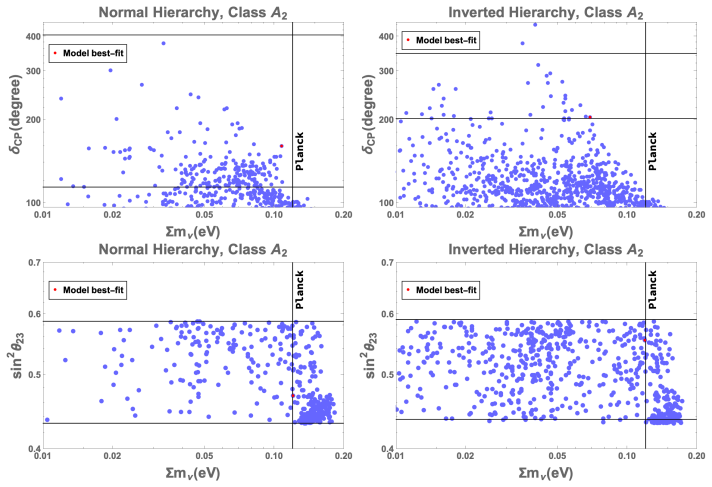
- [Section IV, Figs. 1-11 and Table IX] The numerical analysis is not documented in a reproducible way. No chi-square or likelihood function is defined, the scan ranges for the modular parameter τ, the VEV ratio v_L/v_R, and the overall mass scale are not given, and the red 'best-fit' points in the figures are not defined by any stated criterion. The text repeatedly states that data points lie inside the 3σ NuFit ranges, but without a statistical measure and a description of the sampling, the viability claims and the summary in Table IX cannot be verified or reproduced.
- [Section IV.A, Eqs. (4.1)-(4.5)] The resonant leptogenesis analysis lacks the necessary quantitative ingredients. The heavy right-handed neutrino mass spectrum is never presented, and the degeneracy condition M_i - M_j ~ Γ_i needed for resonant enhancement is asserted rather than demonstrated for the scanned parameters. Moreover, Eq. (4.2) as written is not the standard CP asymmetry formula for quasi-degenerate heavy neutrinos, since the denominator does not have the usual product (Y†Y)_ii (Y†Y)_jj structure, and the efficiency parametrization in Eq. (4.5) is introduced without derivation. Consequently the claim that classes B1, B2 and C reproduce the observed baryon asymmetry is not quantitatively supported.
minor comments (6)
- [Section II, Eq. (2.4)] The type-I seesaw term is written with a plus sign; the conventional expression is M_I = -M_D M_R^{-1} M_D^T. Please state the sign convention, since it can affect cancellations with the type-II term even when texture zeros are unchanged.
- [Section III.B, after Eq. (3.21)] The text says the assignments are 'shown in table V' a second time, but the table in question is Table VI.
- [Section III.C, Eq. (3.31)] The superpotential appears to contain a duplicated term: the same L^c_R2 iσ2 Δ_R L^c_R3 Y_1^6 contribution is written twice inside one parenthesis. Please check whether one of the fields should be L^c_R3 iσ2 Δ_R L^c_R2.
- [Section V, bullet on Class B1] The text states that sin^2θ23 data fall in the range 0.5 to 0.6 'radians'; sin^2θ23 is dimensionless, so the unit should be removed.
- [Figures 1-11] The figures would benefit from explicit axis labels, legends identifying normal versus inverted ordering in every panel, and a statement of how many scan points were used; several panels currently rely on color alone.
- [Introduction and Section III] Reference [27] realizes two-zero textures with modular A4 symmetry; the present manuscript should state more explicitly what is new relative to that work, beyond embedding the same ideas in the LRSM.
Circularity Check
No circular derivation: the two-zero textures are group-theoretic constructions, and the numerical checks are parameter-space scans against external data.
full rationale
The central derivation chain is not circular. Tables III to VIII fix A4 representations and modular weights, and the allowed superpotential terms, hence the positions of zeros in MD, MR, and ML, are determined by A4 invariant contractions; for example, the zeros in Eq. (3.8) follow from the absence of the corresponding singlet contractions in Eqs. (3.2) to (3.7). The seven-texture set is an external phenomenological input, not a model output, and the text explicitly says it constructs rather than predicts this set. The numerical analysis scans the free modular parameter and VEV ratio and tests the resulting points against NuFit, Planck, and KamLAND-Zen; several classes fail these tests, so the agreement is not enforced by construction. The self-citations to prior LRSM work provide standard mass-matrix and leptogenesis formulas and are not load-bearing for the modular texture claim. One correctness concern, but not a circularity, is that the charged-lepton mass matrix and the basis rotation U_e are never constructed, so Eqs. (3.8) to (3.33) are compared to NuFit in an unspecified flavor basis.
Assumptions & free parameters
free parameters (3)
- modular parameter τ =
not stated; red-dot best fits shown in figures
- VEV ratio v_L/v_R and overall mass scale v^2/v_R =
not stated
- per-texture modular weight and A4 representation assignments =
discrete: Tables III-VIII, weights -2, -4, -5, 0 etc.
assumptions (5)
- standard math A4/Γ3 modular-form decompositions for weights 4, 6, 8 and 10 are as stated in Eqs. (3.1), (3.16), (3.17) and (3.30).
- domain assumption The seven two-zero textures A1, A2, B1, B2, B3, B4 and C are the complete set of experimentally allowed two-zero textures.
- ad hoc to paper Type-I and type-II seesaw terms are both included with equal footing and f_L = f_R, with no other contributions to Mν.
- ad hoc to paper The superpotential terms written in Section III are the complete origin of the light neutrino mass matrix; no higher-order operators or Kähler corrections fill the texture zeros.
- domain assumption The 0νββ calculation assumes fixed inputs M_WR, M_ΔR = 3 TeV, momentum p = 180 MeV and nuclear matrix element values from Refs. [43, 53].
Cite this review
Pith. "Pith review of A $\Gamma_{3}$ modular symmetric approach for two-zero textures in left-right symmetric model." pith.science (2026). https://pith.science/paper/2SJPUXU7
@misc{pith2026260807623,
  author       = {Pith},
  title        = {Pith review of: A $\Gamma_3$ modular symmetric approach for two-zero textures in left-right symmetric model},
  year         = {2026},
  howpublished = {\url{https://pith.science/paper/2SJPUXU7}},
  note         = {Machine review of arXiv:2608.07623}
}
abstract
The observed pattern for neutrino masses and mixing provides compelling evidence for Beyond Standard Model physics which further motivates the search for predictive frameworks that can simultaneously address flavor structure and its phenomenological consequences. This work particularly investigates the realization of all possible seven two-zero neutrino mass textures within the generic left-right symmetric model with $A_{4}$ modular symmetry. By considering modular weights 4,8 and 10, we systematically construct all the possible classes of 2-0 textures without the introduction of any flavon fields which enhances the predictive power of the framework. In this work, we also identify the texture classes capable of simultaneously accommodating current neutrino data, reproducing the observed baryon asymmetry and also yielding experimentally testable results for the effective Majorana neutrino mass for new physics contributions of neutrinoless double beta decay.
Figures


Figures from the paper (8 more)



Reference graph
Works this paper leans on
-
[1]
Steven Weinberg. A model of leptons.Phys. Rev. Lett., 19:1264–1266, Nov 1967
work page 1967
-
[2]
Evidence for oscillation of atmospheric neutrinos.Phys
Y et.al Fukuda. Evidence for oscillation of atmospheric neutrinos.Phys. Rev. Lett., 81:1562–1567, Aug 1998
work page 1998
-
[3]
Jogesh C. Pati and Abdus Salam. Lepton Number as the Fourth Color.Phys. Rev. D, 10:275–289,
-
[4]
R. N. Mohapatra and Jogesh C. Pati. A Natural Left-Right Symmetry.Phys. Rev. D, 11:2558, 1975
work page 1975
-
[5]
Mohapatra and Goran Senjanovic
Rabindra N. Mohapatra and Goran Senjanovic. Neutrino Mass and Spontaneous Parity Nonconser- vation.Phys. Rev. Lett., 44:912, 1980
work page 1980
-
[6]
Spontaneous Breakdown of Parity in a Class of Gauge Theories.Nucl
Goran Senjanovic. Spontaneous Breakdown of Parity in a Class of Gauge Theories.Nucl. Phys. B, 153:334–364, 1979
work page 1979
-
[7]
Atmospheric neutrinos at Super-Kamiokande
Kate Scholberg. Atmospheric neutrinos at Super-Kamiokande. In8th International Workshop on Neutrino Telescopes, pages 183–201, 2 1999
work page 1999
- [8]
Show all 56 references
-
[9]
A. Habig. The NOvA Experiment.Nucl. Phys. B Proc. Suppl., 229-232:460–460, 2012
2012
-
[10]
Araki et al
T. Araki et al. Measurement of neutrino oscillation with KamLAND: Evidence of spectral distortion. Phys. Rev. Lett., 94:081801, 2005
2005
-
[11]
Measurement of reactor neutrino oscillation with the first JUNO data.Nature, 654(8118):343–348, 2026
Angel Abusleme et al. Measurement of reactor neutrino oscillation with the first JUNO data.Nature, 654(8118):343–348, 2026
2026
-
[12]
Francesco Capozzi, Shirley Weishi Li, Guanying Zhu, and John F. Beacom. Dune as the next- generation solar neutrino experiment.Phys. Rev. Lett., 123:131803, Sep 2019
2019
-
[13]
The Hyper-Kamiokande Experiment
Masashi Yokoyama. The Hyper-Kamiokande Experiment. InProspects in Neutrino Physics, 4 2017
2017
-
[14]
Leptogenesis.Phys
Sacha Davidson, Enrico Nardi, and Yosef Nir. Leptogenesis.Phys. Rept., 466:105–177, 2008
2008
-
[15]
Buchmuller, R
W. Buchmuller, R. D. Peccei, and T. Yanagida. Leptogenesis as the origin of matter.Ann. Rev. Nucl. Part. Sci., 55:311–355, 2005
2005
-
[16]
Benjamin J. P. Jones. The Physics of Neutrinoless Double Beta Decay: A Primer. InTheoretical Advanced Study Institute in Elementary Particle Physics: The Obscure Universe: Neutrinos and Other Dark Matters, 8 2021. 28
2021
-
[17]
J. D. Vergados, H. Ejiri, and F. Simkovic. Theory of Neutrinoless Double Beta Decay.Rept. Prog. Phys., 75:106301, 2012
2012
-
[18]
Neutrinoless Double-Beta Decay: A Roadmap for Matching Theory to Experiment
Vincenzo Cirigliano et al. Neutrinoless Double-Beta Decay: A Roadmap for Matching Theory to Experiment. 3 2022
2022
-
[19]
W. Grimus. Introduction to left-right symmetric models. In4th Hellenic School on Elementary Particle Physics, pages 619–632, 3 1993
1993
-
[20]
P. S. Bhupal Dev, Rabindra N. Mohapatra, Werner Rodejohann, and Xun-Jie Xu. Vacuum structure of the left-right symmetric model.JHEP, 02:154, 2019
2019
-
[21]
LEFT-RIGHT-SYMMETRIC MODEL BUILDING
Eric Corrigan. LEFT-RIGHT-SYMMETRIC MODEL BUILDING. Master’s thesis, Lund U., 2015
2015
-
[22]
Lepton number violation, lepton flavor violation, and baryogenesis in left-right symmetric model.Phys
Happy Borgohain and Mrinal Kumar Das. Lepton number violation, lepton flavor violation, and baryogenesis in left-right symmetric model.Phys. Rev. D, 96(7):075021, 2017
2017
-
[23]
Ferruccio Feruglio.Are neutrino masses modular forms?, pages 227–266. 2019
2019
-
[24]
Gui-Jun Ding and Stephen F. King. Neutrino mass and mixing with modular symmetry.Rept. Prog. Phys., 87(8):084201, 2024
2024
-
[25]
Modular symmetry of local- ized modes.Phys
Tatsuo Kobayashi, Hajime Otsuka, Shohei Takada, and Hikaru Uchida. Modular symmetry of local- ized modes.Phys. Rev. D, 110(12):125013, 2024
2024
-
[26]
Neutrino mass sum rules from modular A4 symmetry.Phys
Salvador Centelles Chuli´ a, Ranjeet Kumar, Oleg Popov, and Rahul Srivastava. Neutrino mass sum rules from modular A4 symmetry.Phys. Rev. D, 109(3):035016, 2024
2024
-
[27]
A modularA 4 symmetry realization of two-zero textures of the Majorana neutrino mass matrix.Nucl
Di Zhang. A modularA 4 symmetry realization of two-zero textures of the Majorana neutrino mass matrix.Nucl. Phys. B, 952:114935, 2020
2020
-
[28]
Ivan Esteban, M. C. Gonzalez-Garcia, Michele Maltoni, Ivan Martinez-Soler, Jo˜ ao Paulo Pinheiro, and Thomas Schwetz. NuFit-6.0: updated global analysis of three-flavor neutrino oscillations.JHEP, 12:216, 2024
2024
-
[29]
Aghanim et al
N. Aghanim et al. Planck 2018 results. VI. Cosmological parameters.Astron. Astrophys., 641:A6,
2018
-
[30]
Resonant leptogenesis at TeV-scale and neutrinoless double beta decay.JHEP, 09:089, 2019
Takehiko Asaka and Takahiro Yoshida. Resonant leptogenesis at TeV-scale and neutrinoless double beta decay.JHEP, 09:089, 2019
2019
-
[31]
Chacko, Solomon S
Steve Blanchet, Z. Chacko, Solomon S. Granor, and Rabindra N. Mohapatra. Probing Resonant Leptogenesis at the LHC.Phys. Rev. D, 82:076008, 2010. 29
2010
-
[32]
Paschos, Utpal Sarkar, and Jan Weiss
Marion Flanz, Emmanuel A. Paschos, Utpal Sarkar, and Jan Weiss. Baryogenesis through mixing of heavy Majorana neutrinos.Phys. Lett. B, 389:693–699, 1996
1996
-
[33]
P. S. Bhupal Dev. TeV Scale Leptogenesis.Springer Proc. Phys., 174:245–253, 2016
2016
-
[34]
Apostolos Pilaftsis and Thomas E. J. Underwood. Resonant leptogenesis.Nucl. Phys. B, 692:303–345, 2004
2004
-
[35]
A review ofµ-τflavor symmetry in neutrino physics.Rept
Zhi-zhong Xing and Zhen-hua Zhao. A review ofµ-τflavor symmetry in neutrino physics.Rept. Prog. Phys., 79(7):076201, 2016
2016
-
[36]
Baryogenesis from sphaleron decoupling.Phys
Muzi Hong, Kohei Kamada, and Jun’ichi Yokoyama. Baryogenesis from sphaleron decoupling.Phys. Rev. D, 108(6):063502, 2023
2023
-
[37]
Kolb and Michael S
Edward W. Kolb and Michael S. Turner.The Early Universe, volume 69. Taylor and Francis, 5 2019
2019
-
[38]
Buchmuller, P
W. Buchmuller, P. Di Bari, and M. Plumacher. Some aspects of thermal leptogenesis.New J. Phys., 6:105, 2004
2004
-
[39]
New aspects of leptogenesis bounds.Nucl
Steve Blanchet and Pasquale Di Bari. New aspects of leptogenesis bounds.Nucl. Phys. B, 807:155– 187, 2009
2009
-
[40]
Mohapatra and J
Rabindra N. Mohapatra and J. D. Vergados. A New Contribution to Neutrinoless Double Beta Decay in Gauge Models.Phys. Rev. Lett., 47:1713–1716, 1981
1981
-
[41]
Ram Lal Awasthi, M. K. Parida, and Sudhanwa Patra. Neutrino masses, dominant neutrinoless double beta decay, and observable lepton flavor violation in left-right models and SO(10) grand unification with low massW R, ZR bosons.JHEP, 08:122, 2013
2013
-
[42]
Neutrinoless double beta decay process in left-right symmetric models without scalar bidoublet.Phys
Sudhanwa Patra. Neutrinoless double beta decay process in left-right symmetric models without scalar bidoublet.Phys. Rev. D, 87(1):015002, 2013
2013
-
[43]
Zeen Devi, Srubabati Goswami, and Sudhanwa Patra
Joydeep Chakrabortty, H. Zeen Devi, Srubabati Goswami, and Sudhanwa Patra. Neutrinoless double- βdecay in TeV scale Left-Right symmetric models.JHEP, 08:008, 2012
2012
-
[44]
Left-Right Symmetry: from LHC to Neutrinoless Double Beta Decay.Phys
Vladimir Tello, Miha Nemevsek, Fabrizio Nesti, Goran Senjanovic, and Francesco Vissani. Left-Right Symmetry: from LHC to Neutrinoless Double Beta Decay.Phys. Rev. Lett., 106:151801, 2011
2011
-
[45]
Ram Lal Awasthi, P. S. Bhupal Dev, and Manimala Mitra. Implications of the Diboson Excess for Neutrinoless Double Beta Decay and Lepton Flavor Violation in TeV Scale Left Right Symmetric Model.Phys. Rev. D, 93(1):011701, 2016
2016
-
[46]
Lopez-Pavon
Wei-Chih Huang and J. Lopez-Pavon. On neutrinoless double beta decay in the minimal left-right 30 symmetric model.Eur. Phys. J. C, 74:2853, 2014
2014
-
[47]
Charged lepton flavour violcxmation and neutrinoless double beta decay in left-right symmetric models with type I+II seesaw.JHEP, 07:022, 2016
Debasish Borah and Arnab Dasgupta. Charged lepton flavour violcxmation and neutrinoless double beta decay in left-right symmetric models with type I+II seesaw.JHEP, 07:022, 2016
2016
-
[48]
Neutrinoless Double Beta Decay in Type I+II Seesaw Models
Debasish Borah and Arnab Dasgupta. Neutrinoless Double Beta Decay in Type I+II Seesaw Models. JHEP, 11:208, 2015
2015
-
[49]
Hirsch, H
M. Hirsch, H. V. Klapdor-Kleingrothaus, and O. Panella. Double beta decay in left-right symmetric models.Phys. Lett. B, 374:7–12, 1996
1996
-
[50]
P. S. Bhupal Dev, Srubabati Goswami, and Manimala Mitra. TeV Scale Left-Right Symmetry and Large Mixing Effects in Neutrinoless Double Beta Decay.Phys. Rev. D, 91(11):113004, 2015
2015
-
[51]
Minimal left–right symmetric model with A4 modular symmetry.Int
Ankita Kakoti, Bichitra Bijay Boruah, and Mrinal Kumar Das. Minimal left–right symmetric model with A4 modular symmetry.Int. J. Mod. Phys. A, 38(28):2350150, 2023
2023
-
[52]
Ankita Kakoti and Mrinal Kumar Das.M WR dependence of leptogenesis in minimal Left-Right Symmetric Model with different strengths of Type-II seesaw mass.JHEP, 03:132, 2024
2024
-
[53]
Lepton number and flavour violation in TeV-scale left-right symmetric theories with large left-right mixing.JHEP, 09:153, 2013
James Barry and Werner Rodejohann. Lepton number and flavour violation in TeV-scale left-right symmetric theories with large left-right mixing.JHEP, 09:153, 2013
2013
-
[54]
Abe et al
S. Abe et al. Search for Majorana Neutrinos with the Complete KamLAND-Zen Dataset.Phys. Rev. Lett., 135(26):262501, 2025. 31
2025
-
[1974]
[Erratum: Phys.Rev.D 11, 703–703 (1975)]
1975
-
[2020]
652, C4 (2021)]
[Erratum: Astron.Astrophys. 652, C4 (2021)]
2021
Reviewed August 11, 2026 · model on record in the stance chip above.
Discussion (0). Continue with ORCID to comment.