REVIEW 2 major objections 4 minor 44 references
Wormhole Geometry from a Magnetic Vortex
T0 review · 2 major / 4 minor · reviewed 2026-08-16 · deepseek-v4-flash
Pith's one-line read A single magnetic vortex realizes the exterior, core-truncated geometry of an Ellis wormhole for a Hund-coupled electron, with winding-controlled deflection and Berry-flux signatures.
desk verdict A magnetic vortex really does map onto the exterior Ellis metric, but the headline q^2/J deflection law is a metric-only result that the geometric scalar potential swamps in the physical regime. read the letter →
The pith
A machine-rendered reading of the paper's core claim, the machinery that carries it, and where it could break.
The reading
What carries the argument
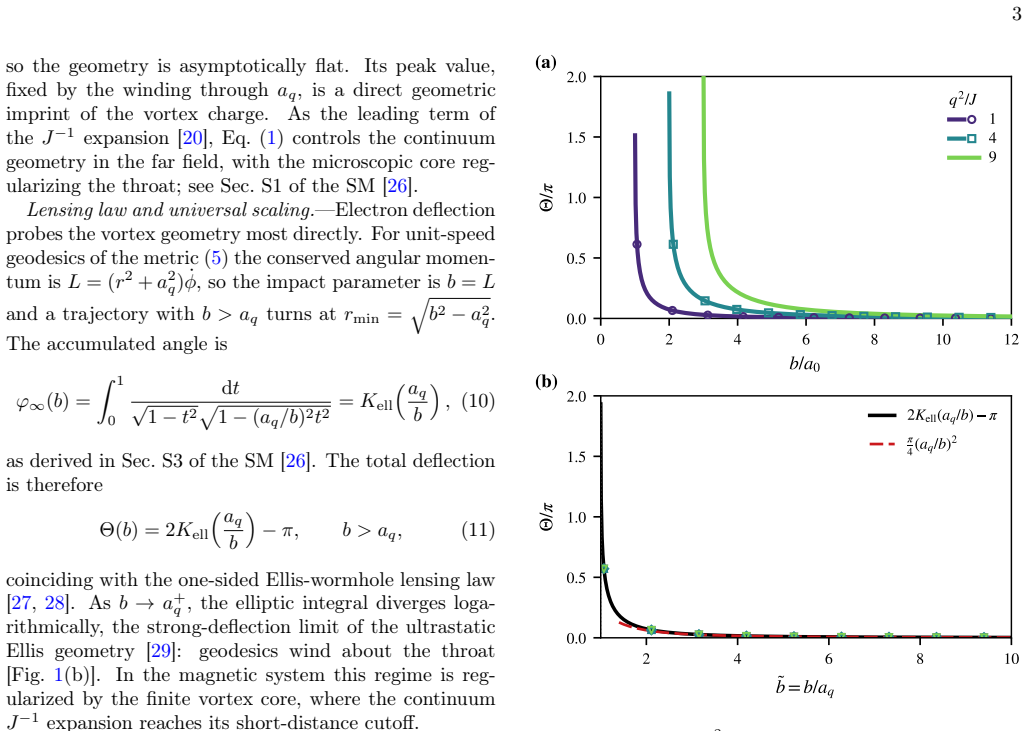
The central object is the emergent metric obtained by projecting a Hund-coupled electron onto the locally spin-aligned band, the quantum-metric correction $g_{ij} = \delta_{ij} + r_0^2\,\partial_i\Phi\,\partial_j\Phi$ with $r_0 = \hbar/(2\sqrt{mJ})$. For the vortex phase $\Psi = q\phi$, this gives the ultrastatic Ellis metric $ds^2 = dr^2 + (r^2 + a_q^2)\,d\phi^2$ with $a_q = |q| r_0$. The argument is carried by two identities: the geodesic deflection reduces to the complete elliptic integral $\Theta(b) = 2K_{\mathrm{ell}}(a_q/b) - \pi$, and the Berry connection of the planar texture yields flux $\gamma = q/2$. These two objects supply the metric-scale and Berry-flux signatures that the paper computes and tests in the lattice emulator.
What would settle it
Measure the deflection angle of electrons scattered by a magnetic vortex in the weak-field regime at fixed winding $q$ and impact parameter $b$ while changing the exchange coupling $J$ over a large range: if the geometric scalar potential dominates, the deflection will not scale as $1/J$ as the metric-only prediction requires, falsifying the universality claim. A direct measurement of the total scattering phase shift, compared with the sum of metric and scalar contributions, would decide the same question.
Extended reading notes
Core claim
In the strong-exchange limit, projecting the electron onto the locally spin-aligned band turns spatial variation of the magnetization into a correction to the effective metric, $g_{ij} = \delta_{ij} + (\hbar^2/4mJ)\,\partial_i \mathbf{S}\cdot\partial_j \mathbf{S}$. For a vortex texture of winding $q$, the resulting spatial metric is $ds^2 = dr^2 + (r^2 + a_q^2)\,d\phi^2$, which after the coordinate change $\rho = \sqrt{r^2 + a_q^2}$ becomes the ultrastatic equatorial Ellis-wormhole geometry with shape function $b(\rho) = a_q^2/\rho$. The microscopic vortex core truncates the geometry at short distances, so the electron probes only the exterior branch of the throat. The paper claims that geodesics of this metric obey the Ellis deflection law and that the Berry connection, enclosing flux $\oint A = \pi q$, produces an Aharonov--Bohm cross section proportional to $\sin^2(\pi q/2)$: maximal for odd winding, absent for even winding. The same exterior vielbein can be engineered in a honeycomb lattice, where valley-symmetrized wave packets follow the predicted geodesic.
Load-bearing premise
The paper assumes that the physically measured electron deflection is the metric geodesic deflection of Eq. (11), isolated from the geometric scalar potential $U_{\mathrm{geom}} = \hbar^2 q^2/(8mr^2)$ that the same projection produces and that dominates the scattering phase in the strong-exchange limit $J\gg E$ used throughout.
Editorial extensions
If this is right
- The deflection law is a closed-form prediction: measuring an electron's bending angle as a function of impact parameter around a vortex should reveal the curve $2K_{\mathrm{ell}}(a_q/b)-\pi$, with no free parameters beyond $a_q$.
- Configurations with the same $q^2/J$ have the same $a_q$ and therefore identical deflection in laboratory units, giving a sharp universality test that does not require rescaling.
- The Berry-phase result predicts an on/off Aharonov--Bohm pattern controlled by winding parity: odd winding gives half-flux interference, even winding suppresses it.
- The honeycomb emulator turns the metric into an engineering target, allowing wave-packet geodesics to be compared with the continuum prediction in a controlled lattice.
- The logarithmic strong-deflection divergence near the throat is regularized by the microscopic core, so the core profile determines how close to the throat the continuum Ellis law applies.
Reading between the lines
- Because the same projection also produces a repulsive $1/r^2$ scalar potential that is independent of $J$ at fixed $q$, an experiment varying $J$ at fixed $q$ and $b$ can separate metric lensing from scalar scattering: the metric contribution should fall as $1/J$ while the scalar contribution stays fixed.
- The texture--geometry dictionary suggested here is open-ended; if the vortex prediction is confirmed, the same projection method should predict distinct effective geometries for merons, skyrmions, and vortex--antivortex pairs.
- Near the throat, the marginal $1/r^2$ potential may support defect-localized resonances observable in local spectral probes, giving a spectral fingerprint that complements the deflection measurement.
- The honeycomb emulator's valley symmetrization is a lattice-specific device; a genuine magnetic sample has no valley degree of freedom, so the magnetic experiment is the direct test of the wormhole claim while the lattice serves as a quantum simulator.
Signed reviews
Editorial analysis
A structured set of objections, weighed in public.
Referee Report
Summary. The manuscript derives an effective spatial metric for a Hund-coupled electron in the field of a planar magnetic vortex, showing that for zero spiral wave vector the metric is ds^2 = -dt^2 + dr^2 + (r^2 + a_q^2) d\phi^2 with a_q = |q| \hbar/(2\sqrt{mJ}), i.e., the exterior ultrastatic Ellis wormhole geometry. It obtains the closed-form deflection law \Theta(b) = 2 K_ell(a_q/b) - \pi and its weak-field tail proportional to q^2/(J b^2), argues for a universal q^2/J collapse, and derives a Berry phase \pi q that yields a half-flux Aharonov-Bohm response with odd/even winding parity. A tight-binding emulator with suppressed tangential hoppings is shown to reproduce the valley-symmetrized metric geodesic in the exterior.
Significance. The geometric identification is elegant and, as a statement about the projected metric, algebraically clean: the vortex term in the quantum-metric correction is exactly the Ellis shape function, and the deflection integral is evaluated in closed form. The paper also provides an exact Abel-resummed Aharonov-Bohm cross section, a parity-selected Berry response, and an open, reproducible numerical pipeline with phase-shift benchmarks and geodesic-level checks, which are concrete strengths. The central physical-signature claim, however, is broader than what the calculation supports because the projected Hamiltonian contains a long-ranged geometric scalar potential whose contribution dominates in the J >> E regime used throughout.
major comments (2)
- [§4, Eq. (12), and SM §S4] The headline observable—the universal q^2/J Ellis deflection collapse—is derived from the metric alone, but the same projection produces the repulsive inverse-square potential U_geom = \hbar^2 q^2/(8 m r^2) (SM Eq. S15). For a classical trajectory of energy E, this potential gives a weak-field deflection \Theta_scalar \approx \pi \hbar^2 q^2/(16 m E b^2), which is a factor J/E larger than \Theta_metric from Eq. (12) in the strong-exchange limit J >> E used throughout the paper. Thus the total deflection of the projected electron does not collapse as claimed: the paired configurations (q,J) = (1,J0) and (2,4J0) share the metric scale a_q but have scalar deflections differing by q^2 = 4. The statement in SM §S4 that the scalar term dominates the asymptotic quantum-scattering phase while "the geodesic deflection remains a clean probe" is not supported unless the scalar contribution is explicitly removed. The manuscript should either present the measured deflection as the metric contribution after a concrete subtraction protocol (for example, measuring the J-difference at fixed q), or restrict the claims to the metric-only contribution and state clearly that the physical vortex deflection contains an additional dominant term.
- [§5 and SM §S6] The designer honeycomb emulator sets the on-site scalar potential to zero (SM §S6) and therefore validates the engineered metric's geodesic response, but it does not validate the magnetic-vortex observable. In the magnetic system U_geom is an unavoidable part of the same adiabatic projection, so the emulator is not an end-to-end analogue of the proposed magnetic experiment. The text should state this scope limitation in the main text and avoid implying that the valley-symmetrized wave-packet simulation confirms the magnetic deflection signature.
minor comments (4)
- [§4 (Scattering and Berry phase)] The notation "H A = \pi q" in the scattering section should be written as "\oint A = \pi q" to make clear that a closed-loop Berry phase is being evaluated.
- [Fig. 2 caption] In the Fig. 2(b) caption, the normalized impact parameter is denoted both as "\tilde b" and as "b = b/a_q"; please use a single, consistent symbol such as \tilde b throughout the caption and text.
- [Abstract and §4] The phrase "half-flux Aharonov-Bohm response" should specify that this is half of the 2\pi emergent Berry flux, not a half magnetic flux quantum, to avoid confusion with ordinary electromagnetic Aharonov-Bohm effects.
- [References] Reference [26] to the Supplemental Material lacks author and version information; if possible, provide a stable citation or DOI for the SM and for the code repository.
Circularity Check
No significant circularity: the wormhole metric, deflection law, and Berry-phase signatures are derived from the openly cited quantum-metric formula and computed, not fitted.
full rationale
The derivation chain is self-contained and non-circular. The emergent metric (Eq. 1) is taken from the openly cited external quantum-metric result of Ref. [20]; the paper then computes the vortex phase gradient, obtains the Ellis form (Eqs. 5-6), derives the Ricci scalar, solves the geodesic equation to get the deflection law (Eqs. 10-12), and derives the Berry flux gamma = q/2 from the standard Berry connection of spin coherent states. Each of these steps is a calculation from stated inputs; no parameter is fitted to the predicted observable, and the Ellis scale a_q = |q| hbar/(2 sqrt(mJ)) is set by q and J before any deflection is computed. The geometric scalar potential U_geom is derived and explicitly separated from the metric lensing; whether U_geom dominates the full scattering amplitude in the J >> E regime is a physics-correctness question, not a circularity. The designer honeycomb emulator is a programmed consistency check: the hopping profile is engineered to reproduce the target vielbein, and the wave-packet simulation then independently verifies that the valley-symmetrized centroid follows the continuum geodesic. There is no load-bearing self-citation, no uniqueness theorem imported from the authors' prior work, and no renaming of a known empirical pattern. The only external input is the cited quantum-metric formula, which is independent support rather than a self-referential premise.
Assumptions & free parameters
assumptions (7)
- domain assumption Quantum-metric correction g_ij = delta_ij + (hbar^2/4mJ) partial_i S . partial_j S (Eq. 1)
- domain assumption Strong-exchange projection: J >> E and slowly varying texture
- domain assumption Planar easy-plane vortex texture S = (cos q phi, -sin q phi, 0) with k = 0
- domain assumption Microscopic vortex core supplies a short-distance cutoff and does not alter the exterior metric
- ad hoc to paper The observable electron deflection is governed by the metric geodesics alone, with the geometric scalar potential U_geom separable or negligible
- domain assumption Engineered honeycomb hoppings reproduce the inverse vielbein of the core-regularized Ellis metric in the continuum limit
- standard math Ellis wormhole lensing law and shape function are standard results
Cite this review
Pith. "Pith review of Wormhole Geometry from a Magnetic Vortex." pith.science (2026). https://pith.science/paper/2T2U2RW7
@misc{pith2026260812285,
  author       = {Pith},
  title        = {Pith review of: Wormhole Geometry from a Magnetic Vortex},
  year         = {2026},
  howpublished = {\url{https://pith.science/paper/2T2U2RW7}},
  note         = {Machine review of arXiv:2608.12285}
}
read the original abstract
Strong coupling to a magnetic texture makes an electron propagate through an emergent curved space. We show that an elementary vortex realizes the exterior spatial geometry of an Ellis wormhole: an ultrastatic throat with radius fixed by the topological charge and Hund exchange, cut off at short distances by the microscopic core. Two separable signatures follow directly: the electron deflection collapses onto a single Ellis curve governed by the vortex winding and exchange coupling, while the spin Berry phase produces a half-flux Aharonov--Bohm response switched on and off by winding parity. The same metric can be emulated in a designer honeycomb lattice, where the valley-symmetrized wave-packet response follows the predicted exterior geodesic. These signatures are accessible through real-space electron deflection and scattering, providing experimentally distinct probes of the emergent geometry and Berry flux. The magnetic vortex thus turns a topological defect into a tunable curved-space lens for electrons in quantum materials and designer lattices.
Figures


Reference graph
Works this paper leans on
-
[1]
M. V. Berry, Quantal phase factors accompanying adia- batic changes, Proceedings of the Royal Society of Lon- don A392, 45 (1984)
work page 1984
-
[2]
J. P. Provost and G. Vallee, Riemannian structure on manifolds of quantum states, Communications in Math- ematical Physics76, 289 (1980)
1980
-
[3]
R. Resta, The insulating state of matter: a geometrical theory, European Physical Journal B79, 121 (2011)
work page 2011
-
[4]
P.Törmä,Essay: Wherecanquantumgeometryleadus?, Physical Review Letters131, 240001 (2023)
work page 2023
-
[5]
W. G. Unruh, Experimental black-hole evaporation?, Physical Review Letters46, 1351 (1981)
work page 1981
-
[6]
C. Barceló, S. Liberati, and M. Visser, Analogue gravity, Living Reviews in Relativity14, 3 (2011)
work page 2011
-
[7]
J. González, F. Guinea, and M. A. H. Vozmediano, The electronic spectrum of fullerenes from the dirac equa- tion, Nuclear Physics B406, 771 (1993), arXiv:cond- mat/9208004
-
[8]
Electronic properties of curved graphene sheets
A. Cortijo and M. A. H. Vozmediano, Electronic proper- 6 ties of curved graphene sheets, Europhysics Letters77, 47002 (2007), arXiv:cond-mat/0603717
work page Pith review arXiv 2007
Show all 44 references
-
[9]
M. A. H. Vozmediano, M. I. Katsnelson, and F. Guinea, Gauge fields in graphene, Physics Reports496, 109 (2010)
2010
-
[10]
F.deJuan, A.Cortijo,andM.A.H.Vozmediano,Charge inhomogeneities due to smooth ripples in graphene sheets, Physical Review B76, 165409 (2007)
2007
-
[11]
N. Levy, S. A. Burke, K. L. Meaker, M. Panlasigui, A. Zettl, F. Guinea, A. H. Castro Neto, and M. F. Crom- mie, Strain-induced pseudo-magnetic fields greater than 300 tesla in graphene nanobubbles, Science329, 544 (2010)
2010
-
[12]
de Juan, M
F. de Juan, M. Sturla, and M. A. H. Vozmediano, Space dependent fermi velocity in strained graphene, Physi- cal Review Letters108, 227205 (2012), arXiv:1201.2656 [cond-mat.mes-hall]
2012 arXiv
-
[13]
Wagner, F
G. Wagner, F. de Juan, and D. X. Nguyen, Landau lev- els in curved space realized in strained graphene, Sci- Post Physics Core5, 029 (2022), arXiv:1911.02028 [cond- mat.mes-hall]
2022
-
[14]
Boada, A
O. Boada, A. Celi, J. I. Latorre, and M. Lewenstein, Dirac equation for cold atoms in artificial curved space- times, New Journal of Physics13, 035002 (2011)
2011
-
[15]
D. A. Genov, S. Zhang, and X. Zhang, Mimicking celes- tial mechanics in metamaterials, Nature Physics5, 687 (2009)
2009
-
[16]
Könye, L
V. Könye, L. Mertens, C. Morice, D. Chernyavsky, A. G. Moghaddam, J. van Wezel, and J. van den Brink, Anisotropic optics and gravitational lensing of tilted Weyl fermions, Phys. Rev. B107, L201406 (2023)
2023
-
[17]
Könye, C
V. Könye, C. Morice, D. Chernyavsky, A. G. Moghad- dam, J. van den Brink, and J. van Wezel, Horizon physics of quasi-one-dimensional tilted Weyl cones on a lattice, Phys. Rev. Research4, 033237 (2022)
2022
-
[18]
De Beule, S
C. De Beule, S. Groenendijk, T. Meng, and T. L. Schmidt, Artificial event horizons in Weyl semimetal het- erostructures and their non-equilibrium signatures, Sci- Post Phys.11, 095 (2021)
2021
-
[19]
Argüello-Luengo, U
J. Argüello-Luengo, U. Bhattacharya, A. Celi, R. W. Chhajlany, T. Grass, M. Plodzien, D. Rakshit, T. Sala- mon, P. Stornati, L. Tarruell, and M. Lewenstein, Syn- thetic dimensions for topological and quantum phases, Commun. Phys.7, 143 (2024)
2024
-
[20]
Onishi, N
Y. Onishi, N. Paul, and L. Fu, Emergent curved space and gravitational lensing in quantum materials, Phys. Rev. B113, 024401 (2026), arXiv:2506.04335 [cond- mat.mes-hall]
2026
-
[21]
N. D. Mermin, The topological theory of defects in or- dered media, Reviews of Modern Physics51, 591 (1979)
1979
-
[22]
H. G. Ellis, Ether flow through a drainhole - a particle modelingeneralrelativity,J.Math.Phys.14,104(1973)
1973
-
[23]
K. A. Bronnikov, Scalar-tensor theory and scalar charge, Acta Physica Polonica B4, 251 (1973)
1973
-
[24]
M. S. Morris and K. S. Thorne, Wormholes in space-time and their use for interstellar travel: A tool for teaching general relativity, Am. J. Phys.56, 395 (1988)
1988
-
[25]
Visser,Lorentzian Wormholes: From Einstein to Hawking(AIP Press, Woodbury, NY, 1995)
M. Visser,Lorentzian Wormholes: From Einstein to Hawking(AIP Press, Woodbury, NY, 1995)
1995
-
[26]
S1, the emer- gent metric and wormhole curvature; Sec
(2026), see Supplemental Material for Sec. S1, the emer- gent metric and wormhole curvature; Sec. S2, the role of the spiral wave vector; Sec. S3, the elliptic lensing inte- gral; Sec. S4, Berry flux and scalar potential; Sec. S5, the partial-wave cross section with Aharonov–B...
2026
-
[27]
Nakajima and H
K. Nakajima and H. Asada, Deflection angle of light in an Ellis wormhole geometry, Phys. Rev. D85, 107501 (2012), arXiv:1204.3710 [gr-qc]
2012 arXiv
-
[28]
Chetouani and G
L. Chetouani and G. Clément, Geometrical optics in the ellis geometry, General Relativity and Gravitation16, 111 (1984)
1984
-
[29]
Tsukamoto, Strong deflection limit analysis and grav- itational lensing of an Ellis wormhole, Phys
N. Tsukamoto, Strong deflection limit analysis and grav- itational lensing of an Ellis wormhole, Phys. Rev. D94, 124001 (2016)
2016
-
[30]
G. E. Volovik, Linear momentum in ferromagnets, J. Phys. C: Solid State Phys.20, L83 (1987)
1987
-
[31]
Aharonov and A
Y. Aharonov and A. Casher, Topological quantum ef- fects for neutral particles, Physical Review Letters53, 319 (1984)
1984
-
[32]
Aharonov and D
Y. Aharonov and D. Bohm, Significance of electromag- netic potentials in the quantum theory, Physical Review 115, 485 (1959)
1959
-
[33]
Polini, F
M. Polini, F. Guinea, M. Lewenstein, H. C. Manoha- ran, and V. Pellegrini, Artificial honeycomb lattices for electrons, atoms and photons, Nat. Nanotechnol.8, 625 (2013)
2013
-
[34]
Ozawa, H
T. Ozawa, H. M. Price, A. Amo, N. Goldman, M. Hafezi, L. Lu, M. C. Rechtsman, D. Schuster, J. Simon, O. Zil- berberg, and I. Carusotto, Topological photonics, Rev. Mod. Phys.91, 015006 (2019)
2019
-
[35]
C. H. Lee, S. Imhof, C. Berger, F. Bayer, J. Brehm, L. W. Molenkamp, T. Kiessling, and R. Thomale, Topolectrical circuits, Commun. Phys.1, 39 (2018)
2018
-
[36]
Papanicolaou and T
N. Papanicolaou and T. N. Tomaras, Dynamics of mag- netic vortices, Nucl. Phys. B360, 425 (1991)
1991
-
[37]
Shinjo, T
T. Shinjo, T. Okuno, R. Hassdorf, K. Shigeto, and T. Ono, Magnetic vortex core observation in circular dots of permalloy, Science289, 930 (2000)
2000
-
[38]
Wachowiak, J
A. Wachowiak, J. Wiebe, M. Bode, O. Pietzsch, M. Mor- genstern, and R. Wiesendanger, Direct observation of in- ternal spin structure of magnetic vortex cores, Science 298, 577 (2002)
2002
-
[39]
Nagaosa and Y
N. Nagaosa and Y. Tokura, Topological properties and dynamics of magnetic skyrmions, Nat. Nanotechnol.8, 899 (2013)
2013
-
[40]
Göbel, I
B. Göbel, I. Mertig, and O. A. Tretiakov, Beyond skyrmions: Review and perspectives of alternative mag- netic quasiparticles, Physics Reports895, 1 (2021)
2021
-
[41]
Schulz, R
T. Schulz, R. Ritz, A. Bauer, M. Halder, M. Wagner, C. Franz, C. Pfleiderer, K. Everschor, M. Garst, and A. Rosch, Emergent electrodynamics of skyrmions in a chiral magnet, Nature Physics8, 301 (2012)
2012
-
[42]
Wormhole Geometry from a Magnetic Vor- tex
D. Ðorđević, F. Molina, and V. Juričić, Code for “Wormhole Geometry from a Magnetic Vor- tex”,https://github.com/dusandjordjevic-ff/ Vortex-Wormhole-.git(2026). Supplemental Material: Wormhole Geometry from a Magnetic Vortex Dušan -Dorđević,1 Fabián Molina,2 and Vladimir Jurič...
2026
-
[43]
Onishi, N
Y. Onishi, N. Paul, and L. Fu,Emergent curved space and gravitational lensing in quantum materials, Phys. Rev. B 113, 024401 (2026)
2026
-
[44]
Wormhole Geometry from a Magnetic Vortex
Code for “Wormhole Geometry from a Magnetic Vortex”,https://github.com/dusandjordjevic-ff/ Vortex-Wormhole-.git
Reviewed August 16, 2026 · model on record in the stance chip above.
Discussion (0). Continue with ORCID to comment.