REVIEW 1 major objections 1 minor 4 cited by
UNIONS cosmic shear constrains S_8 to 0.891 with 0.79 sigma agreement to Planck in harmonic space.
Reviewed by Pith at T0; open to challenge. T0 means a machine referee read the full paper against a public rubric. the ladder, T0–T4 →
T0 review · grok-4.3
2026-06-30 21:19 UTC pith:347TYR43
load-bearing objection UNIONS supplies the first cosmic-shear S8 from its r-band data via standard pseudo-C_ell in a non-tomographic setup, with the result sitting inside existing scatter but tied to the A_IA prior. the 1 major comments →
UNIONS-3500 Weak Lensing: IV. 2D cosmological constraints in harmonic space
The pith
A machine-rendered reading of the paper's core claim, the machinery that carries it, and where it could break.
Core claim
Using the pseudo-C_ell estimator on UNIONS data in a non-tomographic setup, the analysis obtains S_8 ≡ σ_8 √(Ω_m / 0.3) = 0.891^{+0.057}_{-0.084}, consistent at 0.79 sigma with Planck and 0.87 to 1.51 sigma with other weak lensing surveys. Results are robust to analysis choices, with 2.18 sigma agreement between configuration and harmonic space from lognormal simulations. The largest uncertainty source is the degeneracy between S_8 and the intrinsic alignment amplitude A_IA.
What carries the argument
The pseudo-C_ell harmonic-space estimator of the cosmic shear signal, applied non-tomographically while marginalizing over baryonic feedback and the intrinsic alignment amplitude A_IA drawn from a direct-measurement prior.
Load-bearing premise
The prior distribution on the intrinsic alignment amplitude A_IA is accurate enough that its degeneracy with S_8 does not shift the reported central value or quoted uncertainty.
What would settle it
An independent measurement of the intrinsic alignment amplitude A_IA that lies outside the range assumed in the prior would move the inferred S_8 value beyond the reported error bars.
If this is right
- The S_8 constraint remains stable when different scale cuts and modelling choices are applied.
- Lognormal simulations confirm 2.18 sigma agreement between the harmonic-space and configuration-space statistics.
- The current 2D analysis provides the foundation for upcoming tomographic and 3x2-point cross-correlation studies that exploit UNIONS overlap with spectroscopic surveys.
Where Pith is reading between the lines
- Tighter direct measurements of A_IA could reduce the dominant uncertainty in S_8 without changing the analysis pipeline.
- The reported consistency with Planck leaves open whether larger future datasets will maintain or reduce the mild tension seen with some other weak lensing results.
- Extending the same harmonic-space pipeline to tomographic bins could test whether redshift-dependent effects alter the present S_8 central value.
Editorial analysis
A structured set of objections, weighed in public.
Referee Report
Summary. The manuscript presents a non-tomographic cosmic shear analysis of the UNIONS survey in harmonic space via the pseudo-C_ℓ estimator. Within flat ΛCDM, baryonic feedback and intrinsic alignments are modeled; PSF systematics are verified to be subdominant; scale cuts and modeling choices are tested; and lognormal simulations are used to check consistency between configuration-space and harmonic-space statistics at the 2.18σ level. The primary result is S_8 ≡ σ_8 √(Ω_m / 0.3) = 0.891^{+0.057}_{-0.084}, reported as consistent with Planck at 0.79σ and with other weak-lensing surveys at 0.87–1.51σ. The degeneracy between S_8 and A_IA (sampled from a direct-measurement prior) is identified as one of the dominant uncertainty sources.
Significance. If the central result holds, the work supplies an independent northern-sky S_8 constraint from a new photometric dataset and demonstrates the practical use of harmonic-space estimators for UNIONS data. The explicit lognormal-simulation cross-check between statistics is a constructive element that supports reproducibility. The analysis is positioned as the first step toward tomographic and 3×2-point extensions that exploit UNIONS spectroscopic overlap.
major comments (1)
- [Abstract / Results] Abstract and results section: Because the analysis is performed without tomography, the pseudo-C_ℓ signal receives comparable contributions from the lensing kernel and from intrinsic alignments, producing a strong degeneracy between S_8 and A_IA. The quoted posterior therefore depends on the accuracy of the external prior on A_IA. No explicit robustness test (e.g., re-running the chains with a widened or shifted prior on A_IA and reporting the change in the S_8 central value and credible interval) is described, leaving open the possibility that the reported asymmetric errors or central value are sensitive to the precise choice of that prior.
minor comments (1)
- [Abstract] The abstract states that PSF systematic contributions were verified not to affect the results; the corresponding quantitative test (e.g., the amplitude of the residual B-mode or the shift in S_8 when the PSF model is varied) should be shown explicitly in the methods or appendix.
Simulated Author's Rebuttal
We thank the referee for their constructive review and for recognizing the value of our non-tomographic harmonic-space analysis. We address the single major comment below.
read point-by-point responses
-
Referee: [Abstract / Results] Abstract and results section: Because the analysis is performed without tomography, the pseudo-C_ℓ signal receives comparable contributions from the lensing kernel and from intrinsic alignments, producing a strong degeneracy between S_8 and A_IA. The quoted posterior therefore depends on the accuracy of the external prior on A_IA. No explicit robustness test (e.g., re-running the chains with a widened or shifted prior on A_IA and reporting the change in the S_8 central value and credible interval) is described, leaving open the possibility that the reported asymmetric errors or central value are sensitive to the precise choice of that prior.
Authors: We agree that an explicit robustness test to the A_IA prior would strengthen the presentation. The manuscript already notes that the S_8–A_IA degeneracy is one of the dominant sources of uncertainty and adopts a prior derived from direct measurements, but we did not quantify the sensitivity of the posterior to variations in that prior. In the revised manuscript we will add this test by re-running the chains with a widened prior (e.g., doubling the standard deviation while keeping the same central value) and report the resulting shifts in the S_8 median and credible interval. revision: yes
Circularity Check
Standard data fit to pseudo-C_ℓ with external priors; derivation self-contained
full rationale
The paper performs a standard Bayesian fit of cosmological parameters (including S8) to measured pseudo-C_ℓ spectra, marginalizing over nuisance parameters with priors taken from external direct measurements (A_IA) and standard ΛCDM modeling. No equation or result is shown to reduce by construction to a quantity defined solely from the paper's own fitted values or prior self-citations; the reported posterior is obtained from the likelihood on the data. Validation steps such as lognormal simulations and scale-cut tests are independent checks rather than redefinitions of the target quantity. No self-citation load-bearing, ansatz smuggling, or uniqueness theorem from the same authors is invoked to force the central result.
Axiom & Free-Parameter Ledger
free parameters (2)
- A_IA
- baryonic feedback parameters
axioms (2)
- domain assumption Standard LambdaCDM cosmology
- domain assumption Non-tomographic 2D analysis is sufficient
read the original abstract
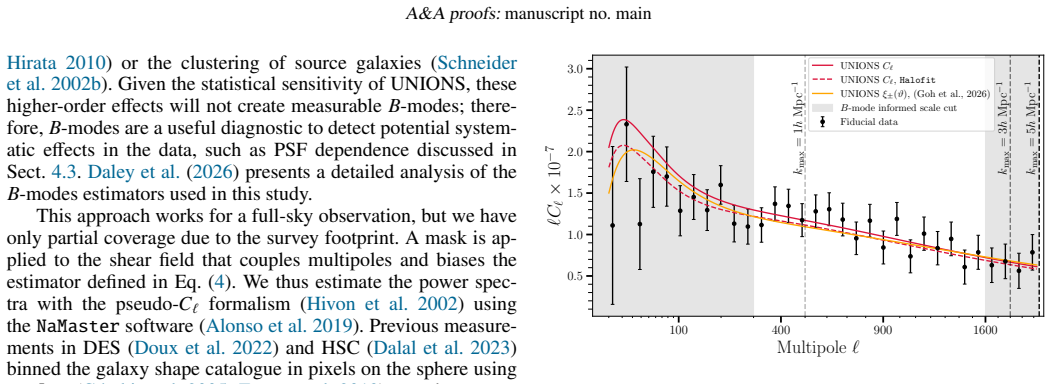
The Ultraviolet Near Infrared Optical Northern Survey (UNIONS) is a photometric survey in the northern sky. The quality of the data in the $r$ band provides precise shape measurements to measure the growth of structures using cosmic shear. This work aims to constrain cosmological parameters using a harmonic-space estimator of the cosmic shear signal, known as pseudo-$C_\ell$, in a non-tomographic analysis. We perform our analysis in the context of the standard $\Lambda$CDM cosmology. We model astrophysical systematic effects such as baryonic feedback and intrinsic alignments of galaxies. We verify that the point spread function systematic contribution does not affect our results. We assess the impact of different scale cuts and modelling choices on the constraints. We find $S_8 \equiv \sigma_8 \sqrt{\Omega_{\rm m}/0.3} = 0.891^{+0.057}_{-0.084}$, consistent at the $0.79 \, \sigma$ level with \emph{Planck} and between $0.87$ to $1.51 \, \sigma$ with other weak lensing surveys. Our results are robust to analysis choices, and we use lognormal simulations to assess the consistency between configuration and harmonic space results, finding a $2.18 \, \sigma$ agreement between the two statistics. The degeneracy between $S_8$ and the amplitude of the intrinsic alignment, $A_{\rm IA}$, sampled from a prior obtained from direct measurements, is one of the largest sources of uncertainty. This work is part of the first cosmological analysis of the UNIONS survey using cosmic shear and paves the way for future tomographic and $3 \times 2$ point cross-correlation analyses, exploiting the unique overlap of UNIONS with deep spectroscopic surveys in the northern hemisphere.
Figures





Forward citations
Cited by 4 Pith papers
-
Analytical covariances for catalogue-based pseudo-$C_\ell$s
A new analytic method computes disconnected covariance matrices for catalogue-based pseudo-Cℓ power spectra by smoothing source positions and treating self-pair shot noise exactly.
-
Assessing the large-scale angular clustering of UNIONS Lyman Break Galaxies via cross-correlations
UNIONS LBGs yield robust cross-power spectra with Planck CMB lensing and DESI/Quaia quasars at amplitudes matching theory, despite systematics that render the auto-spectrum unusable.
-
Assessing the large-scale angular clustering of UNIONS Lyman Break Galaxies via cross-correlations
UNIONS Lyman-break galaxy auto-clustering is unusable at large scales due to imaging systematics, but LBG x CMB-lensing and LBG x quasar cross-spectra are measured robustly, with amplitudes consistent with predictions.
-
Revisiting the 'Lensing is Low' Problem with UNIONS
New UNIONS galaxy-galaxy lensing data around CMASS galaxies indicates no significant lensing is low problem, with joint HOD fits to GGL and GC favoring a slightly lower matter power spectrum amplitude than Planck.
Reference graph
Works this paper leans on
-
[1]
Akeson, R., Armus, L., Bachelet, E., et al. 2019, ArXiv e-prints Alonso, D., Sanchez, J., Slosar, A., & LSST Dark Energy Science Collaboration. 2019, MNRAS, 484, 4127 Amon, A., Gruen, D., Troxel, M. A., et al. 2022, Phys. Rev. D, 105, 023514 Asgari, M., Lin, C.-A., Joachimi, B., et al. 2021, A&A, 645, A104 Bayes, T. & Price, n. 1763, Philos. Trans. R. Soc...
-
[2]
0.831+0.067 −0.078 0.265+0.130 −0.075 0.782+0.206 −0.144 1.128+0.688 −0.798 7.557+0.322 −0.127 9.50 14 kmax =5hMpc −1, ℓ max =2048 0.889+0.060 −0.075 0.218+0.150 −0.071 0.963+0.217 −0.249 1.057+0.720 −0.700 7.835+0.111 −0.302 10.02 21 kmax =3hMpc −1, ℓ max =1800 0.885+0.072 −0.078 0.208+0.162 −0.060 1.004+0.184 −0.257 1.041+0.757 −0.799 7.802+0.093 −0.340...
work page 2048
discussion (0)
Sign in with ORCID, Apple, or X to comment. Anyone can read and Pith papers without signing in.