REVIEW 4 major objections 7 minor 17 references
GreenAuto: An Automated Platform for Sustainable AI Model Design on Edge Devices
T0 review · 4 major / 7 minor · reviewed 2026-08-10 · deepseek-v4-flash
Pith's one-line read This paper claims GreenAuto, an automated pipeline, can find image classifiers for edge phones that match or beat MobileNet-V2's accuracy while using a fraction of the energy, without human intervention.
desk verdict A concrete automated energy-aware NAS demo with real measured gains on one phone; the gradient-guided search step is underspecified, so the measured results are worth more than the stated mechanism. read the letter →
The pith
A machine-rendered reading of the paper's core claim, the machinery that carries it, and where it could break.
The reading
What carries the argument
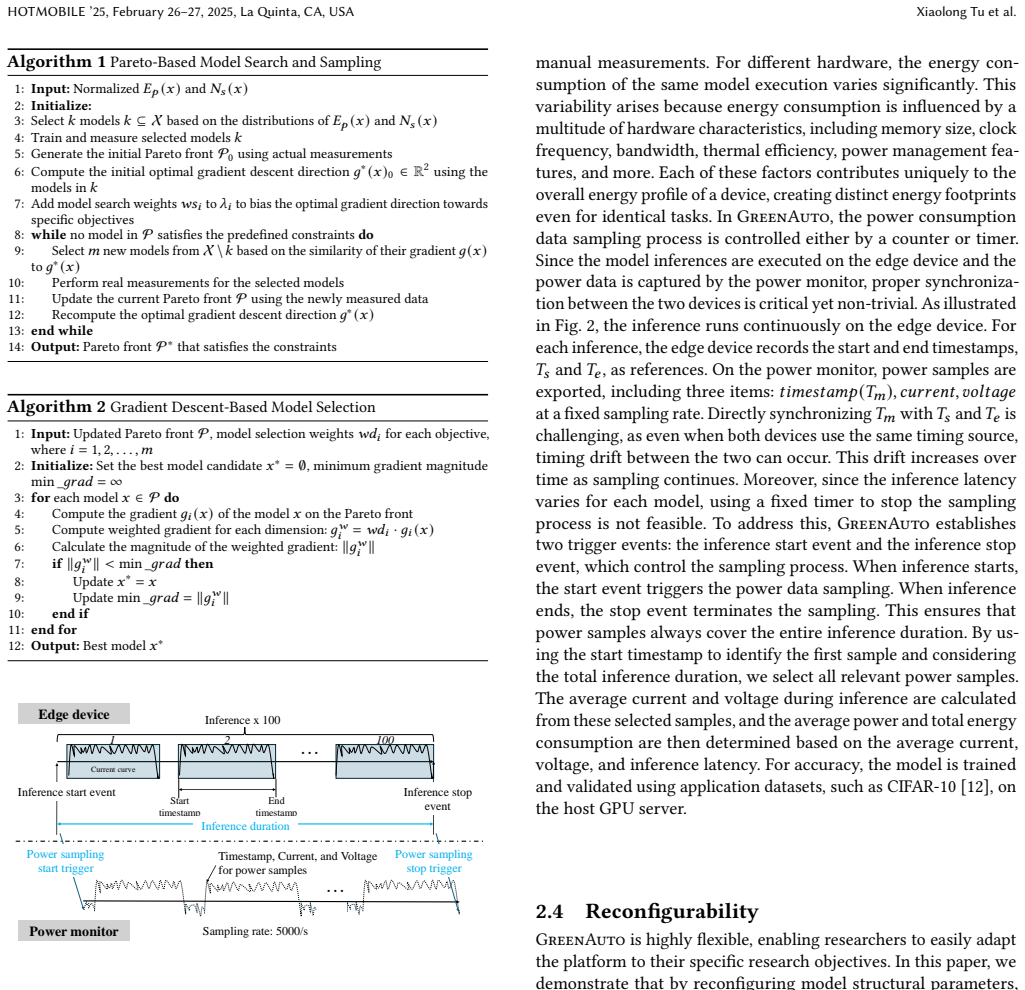
The load-bearing mechanism is a three-stage loop: an expanded NAS search space varying output channels, kernel sizes, and strides (959,417 models); a Pareto-front multi-objective search that uses kernel-level energy-predictor estimates and NASWOT accuracy scores, guided by a gradient descent direction g*(x) (a weighted combination of per-objective gradients) to sample the next model candidates; and an automated on-device energy measurement using an external power monitor synchronized by inference start and stop triggers. The iteratively updated Pareto front and a final gradient-magnitude-based selection procedure pick the best model.
What would settle it
Run the same experiment with the same 170-model training budget on the same edge device using randomly sampled architectures; if random sampling reaches comparable accuracy-energy Pareto points or finds a model with similar accuracy and energy, the claimed gradient-guided sampling efficiency is not supported.
Extended reading notes
Core claim
The paper's central claim is that an automated pipeline combining an expanded neural architecture search space, pre-trained kernel-level energy predictors, a zero-cost accuracy proxy, Pareto-front search with gradient-guided sampling, and automated on-device power measurement can efficiently identify sustainable DNN models. On CIFAR-10 with a smartphone edge device, GreenAuto reports best models of 0.93 accuracy at 4.27 mJ and 0.88 accuracy at 0.2 mJ, both outperforming MobileNet-V2's 0.88 accuracy and 7.53 mJ on the same device. The search trained only 170 models on a single GPU over roughly one week, with a per-model search carbon footprint of 0.013 kgCO2 versus 0.231 kgCO2 for the NASNet-A baseline. The authors conclude that this pipeline demonstrates efficient identification of sustainable models without human intervention.
Load-bearing premise
The search loop assumes that 'gradient descent' over a discrete set of architectural choices—output channel counts, kernel sizes, and strides—produces meaningful guidance, even though the paper does not define a differentiable parameterization of the search space.
Editorial extensions
If this is right
- Sustainable model search can run without human intervention, automating the measurement, training, and refinement loop on a target edge device.
- The search cost is drastically lower than conventional NAS: 170 trained models versus 20,000, with per-model search carbon emissions of 0.013 kgCO2 compared with 0.231 kgCO2 for NASNet-A.
- Models found by the pipeline can beat a common mobile baseline: 0.93 accuracy at 4.27 mJ and 0.88 accuracy at 0.2 mJ versus MobileNet-V2's 0.88 accuracy at 7.53 mJ.
- Because the platform is modular and reconfigurable, the same pipeline can be redirected to other objectives, hardware, or search-space definitions.
Reading between the lines
- Editorial extension: if the kernel-level energy predictors transfer to new devices without retraining, the same global-view search could be reused across hardware; the paper does not establish this transferability.
- Editorial extension: the paper never defines a differentiable relaxation of the discrete search space, so the gradient-guided sampling may be equivalent to a heuristic; a random-search or evolutionary baseline with the same measurement budget could test whether the gradients are doing real work.
- Editorial extension: the carbon comparison is per-model, not total search cost; the reported ratio depends on the number and type of GPUs used, which differ between the two searches.
- Editorial extension: the same Pareto-front pipeline could be extended to transformer-based or LLM-style models on edge devices, as the authors note in their future-work section, though energy predictors for those architectures would be needed.
Editorial analysis
A structured set of objections, weighed in public.
Referee Report
Summary. GreenAuto is an end-to-end automated platform for neural architecture search targeting energy-efficient image classifiers on edge devices. The paper expands the NAS-Bench-201 cell space by varying output channels, kernel sizes, and strides (Table 1), yielding 959,417 candidate models. A kernel-level energy predictor from the authors' prior work and the NASWOT zero-cost accuracy proxy provide initial estimates; a Pareto-front search with two proposed 'gradient descent' algorithms (Algorithms 1 and 2) iteratively selects candidates for physical training and on-device energy measurement using a Monsoon power monitor. On CIFAR-10, the platform reports a best model at 0.88 accuracy and 0.2 mJ inference energy and another at 0.93 accuracy and 4.27 mJ, both compared favorably to MobileNet-V2 (0.88, 7.53 mJ), and a carbon-footprint comparison against NASNet-A showing 0.0478% of the per-model search emissions. The paper claims the pipeline operates without human intervention.
Significance. If the results hold, GreenAuto would be a useful demonstration that an automated, hardware-aware NAS pipeline can find image classifiers with substantially lower inference energy than a common mobile baseline, and the reported physical measurements on a real device are a strength. The platform's modular design and the use of a pre-trained energy predictor with a reported Kendall's tau of 0.526 on 1,179 physically measured models provide a credible basis for further study. However, the core gradient-guided sampling mechanism is not mathematically specified for the discrete architecture space, and the external baseline comparison is not controlled; these issues currently prevent the efficiency and sustainability claims from being fully supported.
major comments (4)
- [Section 2.2, Eq. (4) and Algorithm 1] The search selects models by comparing each candidate's gradient g_i(x) with the optimal gradient direction g*(x), but the search space (Table 1) is discrete: output channels, kernel sizes, and strides take categorical values. The paper never defines a differentiable parameterization, continuous relaxation, embedding, or finite-difference rule that would make g_i(x) meaningful for an unevaluated architecture. Consequently, the inner-product similarity in line 9 is formally unspecified, and the claimed efficiency gain from gradient-guided sampling is not established. Please provide an explicit definition (e.g., a straight-through estimator over a continuous relaxation, or finite differences over the discrete configuration grid) or revise the claims to present the sampler as a heuristic.
- [Section 4, Table 2 and the carbon comparison] The comparison with NASNet-A uses different hardware (450 K40 GPUs over seven days versus a single RTX 4090 over roughly one week), different search algorithms, and different training pipelines, so the reported 0.0478% carbon-emission ratio conflates methodology with hardware generation and is not a controlled result. A fair comparison would require re-running NASNet-A (or an equivalent evolutionary baseline) on the same GPU and measurement setup, or clearly labeling the numbers as an illustrative order-of-magnitude estimate rather than a benchmark result.
- [Section 4, Fig. 3 and Table 2] The evaluation reports a single run without error bars, confidence intervals, or repeated-seed results. Since the initial k models and per-iteration samples are drawn from distributions (Algorithm 1, lines 3 and 9), the observed Pareto front and best models could be substantially affected by stochasticity. Please report variance over multiple independent runs, or at minimum a sensitivity analysis of the reported accuracy and energy values.
- [Sections 2.1 and 2.2] The energy predictor from the authors' prior work is used both as the search objective and as the guide for candidate sampling, making the search self-referential. While the final candidates are physically measured and the Kendall's tau of 0.526 on 1,179 models is an external check, the paper should clarify whether these 1,179 models are independent of the search process and discuss how predictor bias (e.g., systematic underestimation of energy for certain configurations) could affect which regions of the search space are explored. This is important because the stopping criterion and the reported best models depend on the predictor's ranking during search.
minor comments (7)
- [Fig. 3 and Section 4 text] The text states that the best model in Fig. 3d achieves 0.88 accuracy and 0.2 mJ, but the caption for (d) lists 0.88 accuracy and 1.00 mJ; additionally, the progression from iteration 5 to iteration 7 appears to increase energy, which would contradict the definition of a Pareto front. Please correct the caption or the text.
- [Section 2.2 heading] The heading contains a typo: 'Pareto fornt-Based Model Search' should read 'Pareto front-Based Model Search'.
- [Section 4, Fig. 3b] The text says 'In the first iteration, neither the Pareto front nor the best model changes,' but Fig. 3b is labeled 'Pareto Frontier for iteration 1' and 'Best Model of iteration 1'; please clarify whether these labels refer to the previous front or a new front.
- [Section 4, Table 2] The carbon-footprint notation '0.013/model1' contains a stray '1' and the metric is not defined; please clarify whether the reported value includes training energy, measurement energy, and any idle overhead.
- [Algorithm 1 and Section 2.2] The notation is inconsistent: the algorithm uses 'k' for the initial sample count and 'm' for the per-iteration sample count, while Section 4 states the opposite (initial model number m = 100, per-iteration k = 10). Please standardize the notation.
- [Section 2.2] The stopping criterion (accuracy > 0.9 and energy < 7 mJ) is introduced only in Section 4, but Algorithm 1 refers to 'predefined constraints'; the criterion should be stated in Section 2.2 where the algorithm is defined.
- [Section 2.1] The 'average prediction accuracy of 86.2%' for the energy predictor is cited from prior work but not defined; please state the metric (e.g., percentage of predictions within a tolerance band) so that the Kendall's tau value can be interpreted alongside it.
Circularity Check
No circularity found: final models are physically measured and the energy predictor is validated against measured data, so the reported results do not reduce to the search inputs.
full rationale
GreenAuto's derivation chain is: (1) a pre-trained kernel-level energy predictor from prior work [10] estimates energy and NASWOT [11] estimates accuracy; (2) these estimates guide Pareto-based sampling; (3) sampled models are trained and their real energy is measured on-device (§2.3); (4) the Pareto front is updated from these real measurements and the final best models in Table 2 are selected from that measured front. None of the reported final accuracies or energies is defined as the output of the predictor: the predictor is used only as a search heuristic, and the final candidates are physically measured. The paper also checks the predictor against real measurements (Kendall's Tau = 0.526 over 1,179 models), so the self-citation to [10] is not the sole support for the predictor's validity. The main specification gap is that Algorithm 1 uses gradients g_i(x) over a discrete architecture space without defining a relaxation or finite-difference rule, so the sampling step is underspecified; this is a correctness/completeness risk, not a circularity, because no equation or fitted parameter makes the claimed result true by construction. The stated limitation that the search space has a fixed skeleton also concerns scope, not self-reference. Therefore no circular step rises to the level of the defined patterns.
Assumptions & free parameters
free parameters (6)
- Kernel-level energy predictor parameters =
not reported here; from prior work [10]
- Search weights w_s =
w_s_acc=1, w_s_ene=3 in evaluation
- Model selection weights w_d =
configurations (10,1) and (1,10) for GD, (1,1) for WS
- Stopping criterion thresholds =
accuracy > 0.9, energy < 7 mJ
- Initial and per-iteration sample counts =
k=100 initial, m=10 per iteration
- Expanded search space ranges =
C_out in {1,2,...,10,16,32,64,128,256}, kernel sizes {1,3,5,7}, strides {1,2}
assumptions (6)
- standard math Pareto dominance and multiple gradient descent formulations in Eqs. (1) to (4)
- domain assumption Energy consumption is a practical and quantifiable proxy for sustainability
- domain assumption NASWOT score correlates with validation accuracy in the expanded search space
- domain assumption The kernel-level energy predictor generalizes to the expanded space and target device
- ad hoc to paper The discrete architecture space is differentiable enough for gradient descent
- domain assumption Monsoon power monitor measurements correctly capture inference energy on the Android device
Cite this review
Pith. "Pith review of GreenAuto: An Automated Platform for Sustainable AI Model Design on Edge Devices." pith.science (2026). https://pith.science/paper/3NS6LKOI
@misc{pith2026250114995,
  author       = {Pith},
  title        = {Pith review of: GreenAuto: An Automated Platform for Sustainable AI Model Design on Edge Devices},
  year         = {2026},
  howpublished = {\url{https://pith.science/paper/3NS6LKOI}},
  note         = {Machine review of arXiv:2501.14995}
}
read the original abstract
We present GreenAuto, an end-to-end automated platform designed for sustainable AI model exploration, generation, deployment, and evaluation. GreenAuto employs a Pareto front-based search method within an expanded neural architecture search (NAS) space, guided by gradient descent to optimize model exploration. Pre-trained kernel-level energy predictors estimate energy consumption across all models, providing a global view that directs the search toward more sustainable solutions. By automating performance measurements and iteratively refining the search process, GreenAuto demonstrates the efficient identification of sustainable AI models without the need for human intervention.
Figures


Reference graph
Works this paper leans on
-
[1]
Sustain- able AI: Environmental implications, challenges and opportunities
Carole-Jean Wu, Ramya Raghavendra, Udit Gupta, Bilge Acun, Newsha Ardalani, Kiwan Maeng, Gloria Chang, Fiona Aga, Jinshi Huang, Charles Bai, et al. Sustain- able AI: Environmental implications, challenges and opportunities. Proc. MLSys, 4:795–813, 2022
work page 2022
-
[2]
DeepEn2023: Energy Datasets for Edge Artificial Intelligence
Xiaolong Tu, Anik Mallik, Haoxin Wang, and Jiang Xie. Deepen2023: Energy datasets for edge artificial intelligence. arXiv preprint arXiv:2312.00103, 2023
work page Pith review arXiv 2023
-
[3]
Sustainable AI: AI for sustainability and the sustain- ability of AI
Aimee Van Wynsberghe. Sustainable AI: AI for sustainability and the sustain- ability of AI. AI and Ethics, 1(3):213–218, 2021
work page 2021
-
[4]
The role of artificial intelligence in achiev- ing the sustainable development goals
Ricardo Vinuesa, Hossein Azizpour, Iolanda Leite, Madeline Balaam, Virginia Dignum, Sami Domisch, Anna Felländer, Simone Daniela Langhans, Max Tegmark, and Francesco Fuso Nerini. The role of artificial intelligence in achiev- ing the sustainable development goals. Nature Communications, 11(1):1–10, 2020
work page 2020
-
[5]
Energy and the environment explained. https://www.eia.gov/energyexplained/ energy-and-the-environment/where-greenhouse-gases-come-from.php?utm_ source=chatgpt.com. Accessed on Oct. 2024
work page 2024
-
[6]
https://iot-analytics.com/number-connected-iot-devices/
State of IoT 2024. https://iot-analytics.com/number-connected-iot-devices/. Ac- cessed on Oct. 2024
work page 2024
-
[7]
Haoxin Wang, BaekGyu Kim, Jiang Xie, and Zhu Han. Energy drain of the object detection processing pipeline for mobile devices: Analysis and implications. IEEE Transactions on Green Communications and Networking , 5(1):41–60, 2020
work page 2020
-
[8]
LEAF+AIO: Edge-assisted energy-aware object detection for mobile augmented reality
Haoxin Wang, BaekGyu Kim, Jiang Xie, and Zhu Han. LEAF+AIO: Edge-assisted energy-aware object detection for mobile augmented reality. IEEE Transactions on Mobile Computing, 22(10):5933–5948, 2022
work page 2022
Show all 17 references
-
[9]
NAS-Bench-201: Extending the scope of reproducible neural architecture search
Xuanyi Dong and Yi Yang. NAS-Bench-201: Extending the scope of reproducible neural architecture search. In Proc. ICLR, 2020
2020
-
[10]
Unveiling energy efficiency in deep learning: Measurement, prediction, and scoring across edge devices
Xiaolong Tu, Anik Mallik, Dawei Chen, Kyungtae Han, Onur Altintas, Haoxin Wang, and Jiang Xie. Unveiling energy efficiency in deep learning: Measurement, prediction, and scoring across edge devices. In Proc. IEEE/ACM SEC, pages 80–93, 2023
2023
-
[11]
Neural architecture search without training
Joe Mellor, Jack Turner, Amos Storkey, and Elliot J Crowley. Neural architecture search without training. In Proc. International conference on machine learning , pages 7588–7598. PMLR, 2021
2021
-
[12]
Learning multiple layers of features from tiny images
Alex Krizhevsky, Geoffrey Hinton, et al. Learning multiple layers of features from tiny images. 2009
2009
-
[13]
https://ai.google.dev/edge/litert/models/measurement
TFLite Benchmark. https://ai.google.dev/edge/litert/models/measurement. Ac- cessed on Oct. 2024
2024
-
[14]
https://www.msoon.com/high-voltage-power-monitor
Monsoon. https://www.msoon.com/high-voltage-power-monitor. Accessed on Oct. 2024
2024
-
[15]
Regularized evolution for image classifier architecture search
Esteban Real, Alok Aggarwal, Yanping Huang, and Quoc V Le. Regularized evolution for image classifier architecture search. In Proc. AAAI Conference on GreenAuto: An Automated Platform for Sustainable AI Model Design on Edge Devices HOTMOBILE ’25, February 26–27, 2025, La Quint...
2025
-
[16]
Transformer models: an introduction and catalog
Xavier Amatriain, Ananth Sankar, Jie Bing, Praveen Kumar Bodigutla, Timothy J Hazen, and Michaeel Kazi. Transformer models: an introduction and catalog. arXiv preprint arXiv:2302.07730, 2023
2023 arXiv
-
[17]
Llama: Open and efficient foundation language models
Hugo Touvron, Thibaut Lavril, Gautier Izacard, Xavier Martinet, Marie-Anne Lachaux, Timothée Lacroix, Baptiste Rozière, Naman Goyal, Eric Hambro, Faisal Azhar, et al. Llama: Open and efficient foundation language models. arXiv preprint arXiv:2302.13971, 2023
2023 arXiv
Reviewed August 10, 2026 · model on record in the stance chip above.
Discussion (0). Continue with ORCID to comment.