REVIEW 2 major objections 3 minor 62 references
Automated discovery of high-probability heralded schemes for path-entangled states
T0 review · 2 major / 3 minor · reviewed 2026-08-01 · deepseek-v4-flash
Pith's one-line read The authors discover a 'modular comb' family of heralded linear-optical circuits that generate path-entangled NOON states with a closed-form success probability, containing the previous best constructions as limiting cases and improving on
desk verdict The core math is solid and the modular-comb family is a genuine advance over PW and ZPM, but the paper overreaches when it calls the schemes 'experimentally accessible' given that efficient |3> Fock sources do not yet exist. read the letter →
The pith
A machine-rendered reading of the paper's core claim, the machinery that carries it, and where it could break.
The reading
What carries the argument
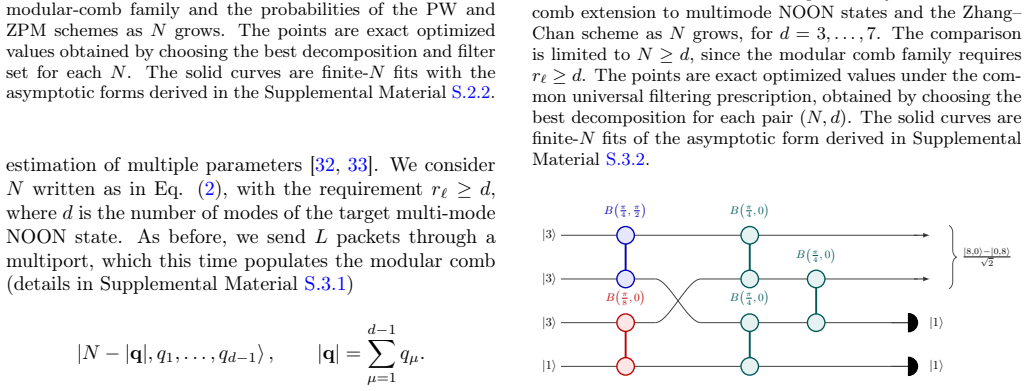
The load-bearing object is the modular comb: write the total photon number as N = Σ r_ℓ m_ℓ with r_ℓ ≥ 2, feed L bunched Fock packets |m_ℓ>^⊗r_ℓ into a Fourier multiport, and use the identity ∏_{q=0}^{r−1}(x+ζ^q y) = x^r + (−1)^{r+1} y^r so each packet populates only two-edge-type contributions. The two-mode support then becomes a comb of sectors |N−q,q> with the desired |N,0> and |0,N> edge terms plus interior terms. Each unwanted symmetric sector |N−b,b> is removed by a single-photon Fock filter: a beamsplitter tuned to t^2 = b/(b+1), an ancillary single photon, and a one-photon herald make the filter amplitude f(b) = t^{b−1}(t^2 − b s^2) vanish exactly at k=b. The surviving edge amplitude
What would settle it
Run the exact Fock-space simulation of a nontrivial modular-comb branch for large N (for example r=3, m=N/3 when 3 divides N) with ideal photon-number-resolving detectors: the ratio of the Eq. (3) success probability to the previous multiport scheme's probability must grow as 10^{cN} with the stated positive c. A tabletop version of the NOON9 circuit fed with |3,3,3,1,1> should also reproduce p_succ = 945/32768 and unit fidelity; failure of either check would overturn the family claim.
Extended reading notes
Core claim
The paper's central claim is that heralded NOON-state generation can be organized into a scalable family whose success probability is known in closed form. For any decomposition N = Σ r_ℓ m_ℓ, sending L bunched packets |m_ℓ>^⊗r_ℓ through a Fourier multiport produces a 'modular comb' of sectors |N−q,q>; symmetric single-photon Fock filters then cancel all interior sectors exactly, leaving the NOON state. The resulting probability factors into a packet term and a filter term (Eq. 3), and the construction reduces to the previous single-photon multiport scheme and the previous even-N scheme as limiting cases. Nontrivial fixed-shape branches satisfy explicit asymptotic ratios: at least exponentia
Load-bearing premise
The entire improvement is computed assuming the laboratory can supply ideal multi-photon packets—the flagship NOON9 scheme needs three-photon inputs that the paper itself concedes cannot yet be produced efficiently—so the exponential gain in heralding odds may not survive once source inefficiency is included.
Editorial extensions
If this is right
- For any photon number N, the best modular-comb decomposition and filter set give an explicitly computable heralding probability, so experimentalists can pick the optimal circuit without running a search.
- The previous best passive linear-optical NOON-state schemes are limiting cases of the new family, so the exponential and super-exponential improvements come automatically for every nontrivial branch.
- The flagship NOON9 and NOON8 circuits use fewer detectors and avoid full vacuum heralding, which the paper argues is experimentally unreliable, leading to better fidelity under imperfect detector efficiency.
- The same construction extends to d-mode NOON states with a proven improvement over the best known linear-optical scheme, and to m,m' path-entangled states with an asymptotic quadratic gain over a previously nonlinear construction.
- The automated search did not just produce isolated circuits; it revealed a general mechanism with proofs, supporting the broader claim that algorithmic discovery can yield transferable physical understanding.
Reading between the lines
- The practical payoff is gated by multiphoton Fock-source engineering more than by circuit design: if efficient sources for three-photon packets mature, the proposed 8- and 9-photon circuits could be implemented with about five beamsplitters and two detectors, a small enough footprint to be a natural near-term experiment.
- Because the modular-comb support is described by products of the form ∏(1 + (−1)^{r+1} z^r)^m, the same packet-plus-filter recipe should generalize to any path-entangled target whose unwanted amplitudes factor in that way; searching polynomial factorizations of target supports could yield further families beyond NOON states.
- The asymptotic lower bounds come from fixed-shape branches, so the true optimized envelope may be even better; a natural follow-up calculation is to characterize the optimal integer decomposition and filter set for each N and prove the exact envelope.
- The number of Fock filters on a fixed-shape branch is bounded independently of N, suggesting that optical loss overhead grows more gently than in schemes requiring O(N) filters, which would make the practical improvement larger than ideal-detector probability ratios alone indicate.
Editorial analysis
A structured set of objections, weighed in public.
Referee Report
Summary. This paper presents a family of heralded linear-optical schemes for path-entangled (NOON) states, discovered through automated optimization and then elevated to a general analytical construction. For an input of L bunched Fock packets |m_l>^{⊗r_l} plus |1> ancillas, with N=Σ r_l m_l, the authors derive a closed-form success probability p_succ (Eq. 3) after Fourier multiports, coherent collection, and single-photon Fock filters. They show that the Pryde–White and Zou–Pahlke–Mathis constructions are limiting cases, prove exponential (over PW) and super-exponential (over ZPM) improvements for fixed-shape branches, extend the construction to multimode NOON states with an exponential improvement over Zhang–Chan, and report additional numerically discovered schemes including a NOON8 example and m,m' states. The experimental-feasibility section analyzes detector inefficiency and discusses source and circuit loss.
Significance. The central analytical result, Eq. (3), is a genuine transferable insight: it is derived from a stated construction rather than fitted, it unifies previously known passive linear-optical families as special cases, and it yields concrete asymptotic bounds. This is a valuable contribution to the theory of heralded photonic entanglement generation, and the extension to multimode NOON states strengthens the claim that automated discovery can produce physical understanding rather than mere numerical circuits. The practical significance, however, is tempered by the requirement for bunched multi-photon Fock inputs; the paper acknowledges this but does not quantitatively model the source costs that determine end-to-end generation rates.
major comments (2)
- [Experimental feasibility; Eq. (3); Table III] Eq. (3) and the optimized envelope in Fig. 2 maximize p_succ conditional on possessing the bunched Fock inputs ⊗_l |m_l>^{⊗r_l} plus |1> ancillas. In the NOON9 flagship example (Table III, Fig. 1), the highest-probability branch (r,m)=(3,3) requires three |3> states, whereas PW requires only |1> states. The paper itself states that efficient generation of |3> 'has yet to be demonstrated'. Because source-preparation cost is not modeled, the end-to-end rate ordering can differ: e.g., comparing the (3,3) branch (p=2.884%) with the (3,1)+(3,2) branch (p=0.253%), the latter wins if preparing |3> is more than ~2.3× harder than preparing |2> per shot. Thus the abstract's 'substantial leap in experimentally accessible multiphoton entanglement' and the conclusion that 'high-rate generation ... is attainable' are not established by p_succ alone. Please add an end-to-end rate analysis for realistic
- [S.2.2; Fig. 2] Eq. (4) is proven for fixed-shape branches with fixed m_l, where the number of filters is bounded. The 'exact optimized envelope' plotted in Fig. 2, however, maximizes over all decompositions for each N, and the paper does not report the input Fock-state sizes (maximum m_l and r_l) of the envelope-optimal branches. If the optimum chooses m_l growing with N, the source overhead also grows, and the asymptotic lower bound for fixed-shape branches does not characterize the practical resource cost of the plotted envelope. Please report the optimal branch structure for the N values shown and discuss whether those envelope-optimal branches remain meaningful once Fock-source costs are included.
minor comments (3)
- [Fig. 2] The ratio p_succ/p_ZPM is only defined for even N, since the Zou–Pahlke–Mathis construction requires N even. Please state explicitly which N values are included in the plot and whether odd-N points are omitted.
- [S.4.1; Table I] For the NOON7 scheme, the phases are given to double precision and the simplified parameters yield (1−F)<10^{-6} rather than machine precision. Please clarify which parameter set underlies the p_succ value reported in Table I, and label the entry as numerical rather than exact if appropriate.
- [Table I; Fig. 4] The notation in the 'Detectors condition' column (e.g., 'old:|000⟩ / new:|10⟩') is terse. A one-sentence definition of the shorthand would improve readability.
Circularity Check
No significant circularity: Eq. (3) is derived analytically from a stated construction and pitted against independently published benchmarks.
full rationale
The central success-probability formula Eq. (3) is derived in S.2.1 from an explicit input state, Fourier multiport, and single-photon Fock filters, with no fitted parameters entering the expression. The claimed ratios Eq. (4) are obtained by dividing this closed-form expression by the published PW and ZPM probabilities, and the asymptotic bounds are derived from Eq. (S.2.1.1) using Stirling-type estimates. The finite-N fit coefficients in Tables II and IV are explicitly labeled as fitted curves for Figs. 2 and 3, not as predictions or as inputs to the scaling laws. Automated discovery is used only to hypothesize the modular-comb family; the family's formula is then proven independently. The experimental feasibility discussion, including the acknowledged difficulty of efficient |3> Fock-state generation, is a resource requirement external to the derivation and affects end-to-end rates rather than circularity of the probability formula. The paper's self-citations concern the broader claim that AI can produce physical understanding and are not load-bearing for Eq. (3) or Eq. (4).
Assumptions & free parameters
free parameters (3)
- collection weights lambda_l =
r_l m_l / N
- NOON7 circuit phases (phi_L, phi_R, phi_c) =
0.660468..., 2.655395..., 0.146643...
- Finite-N fit coefficients a_PW, b_PW, a_ZPM, b_ZPM, a_d, b_d =
Tables II and IV
assumptions (6)
- standard math Passive linear-optical circuits are composed of beam splitters and phase shifters; total photon number is conserved.
- domain assumption Ideal Fock-state inputs |m_l>^{⊗r_l} and |1> ancillas are available.
- domain assumption Ideal photon-number-resolving detectors with unit efficiency and no dark counts for the central formulas.
- standard math The identity product_{q=0}^{r-1} (x + zeta^q y) = x^r + (-1)^{r+1} y^r for primitive r-th roots of unity.
- standard math Any normalized row (sqrt(lambda_l)) can be completed to an L-mode passive unitary, and Reck/Clements decompositions realize arbitrary multiports.
- standard math The vacuum-extension theorem of VanMeter et al. ensures a contraction matrix can be embedded in passive linear optics.
Cite this review
Pith. "Pith review of Automated discovery of high-probability heralded schemes for path-entangled states." pith.science (2026). https://pith.science/paper/423IAMO2
@misc{pith2026260725501,
  author       = {Pith},
  title        = {Pith review of: Automated discovery of high-probability heralded schemes for path-entangled states},
  year         = {2026},
  howpublished = {\url{https://pith.science/paper/423IAMO2}},
  note         = {Machine review of arXiv:2607.25501}
}
read the original abstract
Entangled states of light lie at the heart of photonic quantum technologies, from distributed quantum communication to quantum-enhanced measurement and information processing. Their practical generation, however, remains constrained by the weak interactions between photons, which make the deterministic assembly of large multiphoton entangled states a central challenge in quantum optics. In this work, we use AI techniques to discover heralded linear-optical schemes for path-entangled states and show that the resulting solutions can be elevated from individual circuits to a new scalable family. This family contains previously known constructions as special cases while generally providing exponential and super-exponential improvements over those, and its extension to broader classes of target states shows how automated discovery can reveal transferable physical understanding. By presenting compact experimental proposals for large path-entangled states, our results provide both a theoretical advance in photonic heralding and a route towards a substantial leap in experimentally accessible multiphoton entanglement.
Figures


Figures from the paper (3 more)


Reference graph
Works this paper leans on
-
[1]
Prevedel, M
R. Prevedel, M. Aspelmeyer, C. Brukner, A. Zeilinger, and T. D. Jennewein, Journal of the Optical Society of America B24, 241 (2007)
2007
-
[2]
repeated addition
Compared with the ZPM con- struction, it uses maximum input occupation 3 instead of 4, requires two heralding detectors instead of four, and increases the success probability by approximately 500%. the discovery of the so-calledm, m′ states [25] |m, m′⟩+|m ′, m⟩√ 2 , originally introduced to makeNOONstates more ro- bust to loss. It is known in fact that a...
2018
-
[3]
Pan, Z.-B
J.-W. Pan, Z.-B. Chen, C.-Y. Lu, H. Weinfurter, A. Zeilinger, and M. Żukowski, Reviews of Modern Physics84, 777 (2012)
2012
-
[4]
Flamini, N
F. Flamini, N. Spagnolo, and F. Sciarrino, Reports on Progress in Physics82, 016001 (2019)
2019
-
[5]
Couteau, S
C. Couteau, S. Barz, T. Durt, T. Gerrits, J. Huwer, R. Prevedel, J. Rarity, A. Shields, and G. Weihs, Nature Reviews Physics5, 326 (2023)
2023
-
[6]
Couteau, S
C. Couteau, S. Barz, T. Durt, T. Gerrits, J. Huwer, R. Prevedel, J. Rarity, A. Shields, and G. Weihs, Nature Reviews Physics5, 354 (2023)
2023
-
[7]
Aspuru-Guzik and P
A. Aspuru-Guzik and P. Walther, Nature Physics8, 285 (2012)
2012
-
[8]
J. L. O’Brien, A. Furusawa, and J. Vučkovi’c, Nature Photonics3, 687 (2009)
2009
Show all 62 references
-
[9]
Forbes, F
I. Forbes, F. Ghafari, E. C. R. Deacon, S. P. Singh, E. Lavie, P. Yard, R. D. Shaw, A. Laing, and N. Tis- chler, Reports on Progress in Physics88, 086002 (2025)
2025
-
[10]
J. P. Dowling, Contemporary Physics49, 125 (2008)
2008
-
[11]
Giovannetti, S
V. Giovannetti, S. Lloyd, and L. Maccone, Nature Pho- tonics5, 222 (2011)
2011
-
[12]
Pezzè, A
L. Pezzè, A. Smerzi, M. K. Oberthaler, R. Schmied, and P. Treutlein, Reviews of Modern Physics90, 035005 (2018)
2018
-
[13]
X. B. Zou, K. Pahlke, and W. Mathis, Physical Review A66, 014102 (2002)
2002
-
[14]
P. Kok, H. Lee, and J. P. Dowling, Physical Review A 65, 052104 (2002)
2002
-
[15]
G. J. Pryde and A. G. White, Physical Review A68, 052315 (2003)
2003
-
[16]
Cable and J
H. Cable and J. P. Dowling, Physical Review Letters99, 163604 (2007)
2007
-
[17]
K. T. McCusker and P. G. Kwiat, Physical Review Let- ters103, 163602 (2009)
2009
-
[18]
Krenn, M
M. Krenn, M. Malik, R. Fickler, R. Lapkiewicz, and A.Zeilinger,PhysicalReviewLetters116,090405(2016)
2016
-
[19]
Krenn, M
M. Krenn, M. Erhard, and A. Zeilinger, Nature Reviews Physics2, 649 (2020)
2020
-
[20]
S. Arlt, M. Krenn, and X. Gu, Physical Review Research 8, L022031 (2026)
2026
-
[21]
F. V. Gubarev, I. V. Dyakonov, M. Y. Saygin, G. I. Struchalin, S. S. Straupe, and S. P. Kulik, Physical Re- view A102, 012604 (2020)
2020
-
[22]
S. A. Fldzhyan, M. Y. Saygin, and S. P. Kulik, Physical Review Research3, 043031 (2021)
2021
-
[23]
Krenn, J
M. Krenn, J. Landgraf, T. Foesel, and F. Marquardt, Physical Review A107, 010101 (2023)
2023
-
[24]
Krenn, R
M. Krenn, R. Pollice, S. Y. Guo, M. Aldeghi, A. Cervera- Lierta, P. Friederich, G. dos Passos Gomes, F. Häse, A. Jinich, A. Nigam, Z. Yao, and A. Aspuru-Guzik, Na- ture Reviews Physics4, 761 (2022)
2022
-
[25]
Zhang and K
L. Zhang and K. W. C. Chan, Scientific Reports8, 11440 (2018)
2018
-
[26]
S. D. Huver, C. F. Wildfeuer, and J. P. Dowling, Physical Review A78, 063828 (2008)
2008
-
[27]
R. T. Glasser, H. Cable, J. P. Dowling, F. De Mar- tini, F. Sciarrino, and C. Vitelli, Physical Review A78, 012339 (2008)
2008
-
[28]
M. Reck, A. Zeilinger, H. J. Bernstein, and P. Bertani, Physical Review Letters73, 58 (1994)
1994
-
[29]
W. R. Clements, P. C. Humphreys, B. J. Metcalf, W. S. Kolthammer, and I. A. Walmsley, Optica3, 1460 (2016)
2016
-
[30]
Bradbury, R
J. Bradbury, R. Frostig, P. Hawkins, M. J. John- son, C. Leary, D. Maclaurin, S. Wanderman-Milne, and Q. Zhang, JAX: composable transformations of Python+NumPy programs,https://github.com/ jax-ml/jax(2018)
2018
-
[31]
C. M. Nunn, J. D. Franson, and T. B. Pittman, Physical Review A104, 033717 (2021)
2021
-
[32]
H. W. de Regt,Understanding Scientific Understanding (Oxford University Press, Oxford, 2017)
2017
-
[33]
P. C. Humphreys, M. Barbieri, A. Datta, and I. A. Walm- sley, Physical Review Letters111, 070403 (2013)
2013
-
[34]
Yue, Y.-R
J.-D. Yue, Y.-R. Zhang, and H. Fan, Scientific Reports 4, 5933 (2014)
2014
-
[35]
M. A. Rubin and S. Kaushik, Physical Review A75, 053805 (2007)
2007
-
[36]
S. P. Singh, E. Bazzazi, D. N. Bernal-García, S. White, H. J. Latief, A. Goldingay, S. Rogge, S. Slussarenko, F. Ghafari, E. Polino, and N. Tischler, arXiv preprint arXiv:2512.08458 (2025), arXiv:2512.08458 [quant-ph]
2025 arXiv
-
[37]
L. A. Morais, T. Weinhold, M. P. d. Almeida, J. Combes, M. Rambach, A. Lita, T. Gerrits, S. W. Nam, A. G. White, and G. Gillett, Quantum8, 1355 (2024)
2024
-
[38]
Eaton, A
M. Eaton, A. Hossameldin, R. J. Birrittella, P. M. Alsing, C. C. Gerry, H. Dong, C. Cuevas, and O. Pfister, Nature Photonics17, 106 (2023)
2023
-
[39]
S. I. Davis, A. Mueller, R. Valivarthi, N. Lauk, L. Nar- vaez, B. Korzh, A. D. Beyer, O. Cerri, M. Colan- gelo, K. K. Berggren, M. D. Shaw, S. Xie, N. Sinclair, and M. Spiropulu, Physical Review Applied18, 064007 (2022)
2022
-
[40]
Stasi, T
L. Stasi, T. Taher, G. V. Resta, H. Zbinden, R. Thew, and F. Bussières, ACS Photonics12, 320 (2025)
2025
-
[41]
D. V. Reddy, R. R. Nerem, S. W. Nam, R. P. Mirin, and V. B. Verma, Optica7, 1649 (2020)
2020
-
[42]
PsiQuantum team, Nature641, 876 (2025)
2025
-
[43]
Kaneda and P
F. Kaneda and P. G. Kwiat, Science Advances5, eaaw8586 (2019)
2019
-
[44]
Ding, Y.-P
X. Ding, Y.-P. Guo, M.-C. Xu, R.-Z. Liu, G.-Y. Zou, J.- Y. Zhao, Z.-X. Ge, Q.-H. Zhang, H.-L. Liu, L.-J. Wang, M.-C. Chen, H. Wang, Y.-M. He, Y.-H. Huo, C.-Y. Lu, and J.-W. Pan, Nature Photonics19, 387 (2025)
2025
-
[45]
B. L. Glebov, J. Fan, and A. Migdall, Optics Express22, 20358 (2014)
2014
-
[46]
Engelkemeier, J
M. Engelkemeier, J. Sperling, J. Tiedau, S. Barkhofen, I. Dhand, M. B. Plenio, B. Brecht, and C. Silberhorn, Climbing the fock ladder: Advancing multiphoton state generation (2021), arXiv:2105.03720 [quant-ph]
2021 arXiv
-
[47]
E. Waks, E. Diamanti, and Y. Yamamoto, New Journal of Physics8, 4 (2006)
2006
-
[48]
Cooper, L
M. Cooper, L. J. Wright, C. Söller, and B. J. Smith, Optics Express21, 5309 (2013)
2013
-
[49]
B. Wu, L. Liu, H. Liu, X. Mao, X.-J. Wang, H. Ni, Z. Niu, and Z. Yuan, Nature Materials25, 595 (2026)
2026
-
[50]
Karli, I
Y. Karli, I. Avila Arenas, C. Schimpf, A. J. Garcia Ju- nior, S. Manna, F. Kappe, R. Schwarz, G. Undeutsch, 7 M. Aigner, M. Peter, S. F. Covre da Silva, A. Rastelli, G. Weihs, and V. Remesh, npj Quantum Information11, 139 (2025)
2025
-
[51]
Thorlabs, UV Fused Silica Broadband Plate Beamsplit- ters (600–1700 nm) (2026), accessed 27 July 2026
2026
-
[52]
Zhong, Y
H.-S. Zhong, Y. Li, W. Li, L.-C. Peng, Z.-E. Su, Y. Hu, Y.-M. He, X. Ding, W. Zhang, H. Li, L. Zhang, Z. Wang, L. You, X.-L. Wang, X. Jiang, L. Li, Y.-A. Chen, N.-L. Liu, C.-Y. Lu, and J.-W. Pan, Physical Review Letters 121, 250505 (2018)
2018
-
[53]
Wagenknecht, C.-M
C. Wagenknecht, C.-M. Li, A. Reingruber, X.-H. Bao, A. Goebel, Y.-A. Chen, Q. Zhang, K. Chen, and J.-W. Pan, Nature Photonics4, 549 (2010)
2010
-
[54]
S. Barz, G. Cronenberg, A. Zeilinger, and P. Walther, Nature Photonics4, 553 (2010)
2010
-
[55]
J.C.Matthews, A.Politi, D.Bonneau,andJ.L.O’Brien, Physical Review Letters107, 163602 (2011)
2011
-
[56]
D.R.Hamel, L.K.Shalm, H.Hübel, A.J.Miller, F.Mar- sili, V. B. Verma, R. P. Mirin, S. W. Nam, K. J. Resch, and T. Jennewein, Nature Photonics8, 801 (2014)
2014
-
[57]
Chen, L.-C
S. Chen, L.-C. Peng, Y.-P. Guo, X.-M. Gu, X. Ding, R.- Z. Liu, J.-Y. Zhao, X. You, J. Qin, Y.-F. Wang,et al., Physical Review Letters132, 130603 (2024)
2024
-
[58]
H. Cao, L. Hansen, F. Giorgino, L. Carosini, P. Zah’alka, F. Zilk, J. Loredo, and P. Walther, Physical Review Let- ters132, 130604 (2024)
2024
-
[59]
Engelkemeier, L
M. Engelkemeier, L. Lorz, S. De, B. Brecht, I. Dhand, M. B. Plenio, C. Silberhorn, and J. Sperling, Physical Review A102, 023712 (2020)
2020
- [60]
-
[61]
N. M. VanMeter, P. Lougovski, D. B. Uskov, K. Kiel- ing, J. Eisert, and J. P. Dowling, Physical Review A76, 063808 (2007). 8 Supplemental Material for: Automated discovery of high-probability heralded schemes for path-entangled states S.1 OPTIMIZA TION PROCEDURE We consider an...
2007
-
[62]
Forµ= 0,1, the collection unitary is chosen so that ˆo† ℓ,µ − → p λℓ ˆa† µ + L−1X s=1 wµ,sℓ ˆg† µ,s
We choose real weightsλℓ ≥0such that LX ℓ=1 λℓ = 1. Forµ= 0,1, the collection unitary is chosen so that ˆo† ℓ,µ − → p λℓ ˆa† µ + L−1X s=1 wµ,sℓ ˆg† µ,s. The modesˆg† µ,s are additional heralding modes. The coefficientswµ,sℓ complete the normalized row p λ1, p λ2, . . . , p λL ...
Reviewed August 1, 2026 · model on record in the stance chip above.
Discussion (0). Continue with ORCID to comment.