REVIEW 3 major objections 2 minor 62 references
Role of heavy neutral lepton in lepton number violating $B$ meson decays
T0 review · 3 major / 2 minor · reviewed 2026-07-01 · grok-4.3
Pith's one-line read Heavy neutral leptons mediate lepton-number violating B-meson decays with branching ratios from 10^{-13} to 10^{-8} for benchmark mixing values.
desk verdict The paper plugs standard HNL mixing parameters into four-body LNV B_c modes and quotes BRs of 10^{-13} to 10^{-8}, but the work is incremental and the key assumption about direct parameter transfer is not obviously checked. read the letter →
The pith
A machine-rendered reading of the paper's core claim, the machinery that carries it, and where it could break.
The reading
What carries the argument
On-shell mediation by a heavy neutral lepton (HNL) in ΔL=2 amplitudes, with mixing parameters taken directly from two-body B → ℓN constraints.
What would settle it
A measured upper limit on BR(B_c^- → π^+ μ^- μ^-) below 10^{-10} at |U_μN|^2 ≈ 10^{-6} would rule out the predicted rates under the on-shell HNL assumption.
Extended reading notes
Core claim
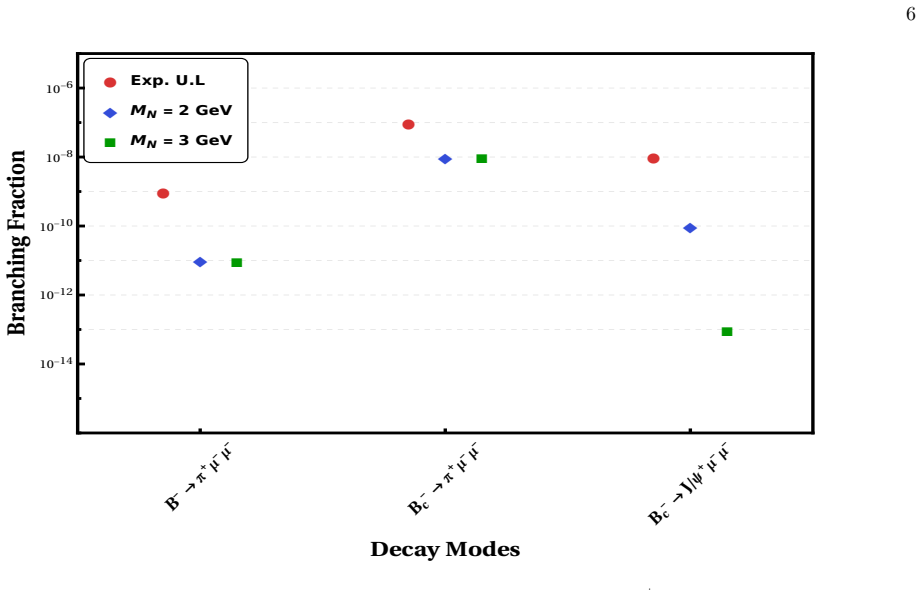
Using constraints on the mixing parameters |U_ℓN|^2 obtained from two-body decays, the paper calculates the branching ratios of lepton-number violating four-body decays mediated by an on-shell heavy neutral lepton. For |U_μN|^2 = 10^{-6} and M_N = 2–3 GeV the predicted rates lie between O(10^{-13}) and O(10^{-8}), with B_c^- → π^+ μ^- μ^- receiving the largest enhancement while B_c^- → J/ψ π^+ μ^- μ^- is strongly suppressed, demonstrating a clear dependence on the hadronic final state.
Load-bearing premise
The mixing parameters extracted from two-body B → ℓN decays can be inserted unchanged into the four-body lepton-number violating amplitudes.
Editorial extensions
If this is right
- Branching ratios for the studied lepton-number violating channels fall in the range O(10^{-13})–O(10^{-8}) for |U_μN|^2 = 10^{-6} and M_N = 2–3 GeV.
- B_c^- → π^+ μ^- μ^- exhibits the largest branching ratio among the channels considered.
- B_c^- → J/ψ π^+ μ^- μ^- is strongly suppressed relative to the other modes.
- B_c modes provide greater sensitivity to HNL effects than the corresponding B modes.
Reading between the lines
- - Prioritizing B_c decays in experimental searches would improve reach for these mixing values compared with B decays alone.
- - Non-observation of the largest predicted mode would tighten the upper bound on |U_μN|^2 more effectively than current two-body limits.
- - The same on-shell mediation framework could be applied to other charmed or bottom meson families to test consistency of the mixing parameters across decay channels.
Signed reviews
Editorial analysis
A structured set of objections, weighed in public.
Referee Report
Summary. The paper studies heavy neutral leptons (HNLs) in B-meson decays, constraining the mixing parameters |U_ℓN|^2 from existing data on B → μN and B → τN decays. These constraints are then inserted into on-shell HNL-mediated amplitudes to predict branching ratios for lepton-number violating (ΔL=2) four-body decays including B^- → π^+ μ^- μ^- and B_c^- → J/ψ π^+ μ^- μ^-. For the benchmark |U_μN|^2 = 10^{-6} and M_N = 2–3 GeV, the predicted branching ratios fall in the range O(10^{-13})–O(10^{-8}), with the largest values in the B_c^- → π^+ μ^- μ^- channel and strong suppression in the J/ψ mode.
Significance. If the parameter insertion is justified, the work supplies concrete, channel-dependent numerical predictions for LNV rates that could guide experimental searches at LHCb and Belle II. The emphasis on B_c modes as potentially more sensitive is a useful observation. The approach of deriving falsifiable predictions from existing two-body constraints is in principle a strength, but the absence of explicit formulas and checks on the insertion procedure limits the immediate utility of the results.
major comments (3)
- [Abstract] Abstract (paragraph on constraints and on-shell mediation): The manuscript states that constraints from B → μ N data are used to predict LNV rates but supplies no derivation steps, error propagation, or explicit formulas; the quoted O(10^{-13})–O(10^{-8}) range cannot be verified from the given text.
- [Four-body amplitudes] Section on four-body LNV amplitudes: The mixing parameters |U_μN|^2 extracted from two-body B → ℓ N decays are directly multiplied into the on-shell N-mediated four-body amplitudes. This procedure assumes (i) identical factorization of hadronic matrix elements, (ii) validity of the narrow-width approximation for M_N = 2–3 GeV, and (iii) absence of additional off-shell or interference corrections in the four-body phase space. No explicit verification of these assumptions is provided.
- [Predictions] Predictions paragraph: The claim that B_c^- → π^+ μ^- μ^- shows the largest enhancement while B_c^- → J/ψ π^+ μ^- μ^- is strongly suppressed is presented without the intermediate branching-ratio expressions or the numerical inputs (form factors, phase-space integrals) that produce the quoted O(10^{-8}) versus O(10^{-13}) values.
minor comments (2)
- Notation for the mixing matrix elements is introduced without a clear definition of the basis (e.g., whether |U_μN|^2 is the squared modulus in the flavor basis or after diagonalization).
- [Abstract] The abstract would benefit from a brief statement of the experimental data sets (e.g., which B → μ N branching-ratio limits) used to obtain the constraints.
Simulated Author's Rebuttal
We thank the referee for the careful reading of our manuscript and the constructive comments, which help improve the clarity of our presentation. We address each major comment below and will revise the manuscript accordingly to include the requested details.
read point-by-point responses
-
Referee: [Abstract] Abstract (paragraph on constraints and on-shell mediation): The manuscript states that constraints from B → μ N data are used to predict LNV rates but supplies no derivation steps, error propagation, or explicit formulas; the quoted O(10^{-13})–O(10^{-8}) range cannot be verified from the given text.
Authors: The abstract provides a high-level summary of the results. The explicit derivation of the constraints on |U_ℓN|^2 from B → μN and B → τN data, including comparison with experimental limits and error propagation, is given in Section 3 of the full manuscript. The LNV branching ratios are then obtained by direct substitution of these bounds into the on-shell amplitudes of Section 4. To improve verifiability as requested, we will add the key formulas for the constraint extraction and a short outline of the procedure to the abstract or introduction in the revised version. revision: yes
-
Referee: [Four-body amplitudes] Section on four-body LNV amplitudes: The mixing parameters |U_μN|^2 extracted from two-body B → ℓ N decays are directly multiplied into the on-shell N-mediated four-body amplitudes. This procedure assumes (i) identical factorization of hadronic matrix elements, (ii) validity of the narrow-width approximation for M_N = 2–3 GeV, and (iii) absence of additional off-shell or interference corrections in the four-body phase space. No explicit verification of these assumptions is provided.
Authors: The direct insertion follows from the standard on-shell HNL mediation framework, where the |U_μN|^2 factor and hadronic matrix elements factorize identically between the two-body and four-body processes. The narrow-width approximation holds because Γ_N/M_N ∼ |U|^2 ≪ 1 for the benchmark values (explicitly Γ_N ∼ 10^{-14} GeV). Off-shell and interference effects are negligible in the considered mass range. We will add an explicit paragraph verifying these approximations with numerical estimates in the revised manuscript. revision: yes
-
Referee: [Predictions] Predictions paragraph: The claim that B_c^- → π^+ μ^- μ^- shows the largest enhancement while B_c^- → J/ψ π^+ μ^- μ^- is strongly suppressed is presented without the intermediate branching-ratio expressions or the numerical inputs (form factors, phase-space integrals) that produce the quoted O(10^{-8}) versus O(10^{-13}) values.
Authors: The branching ratios follow from integrating the squared amplitudes over four-body phase space, employing standard form factors for the B_{(c)} transitions (referenced in the manuscript). The channel dependence arises from differences in available phase space and form-factor magnitudes. In the revision we will include the explicit branching-ratio expressions, the specific form-factor parametrizations, and the numerical values of the phase-space integrals that yield the quoted orders of magnitude. revision: yes
Circularity Check
No circularity; LNV rates computed from independently constrained mixing parameters
full rationale
The derivation constrains |U_ℓN|^2 from two-body B→ℓN data and inserts the values into separate four-body LNV amplitude calculations. The four-body matrix elements and phase-space integrals are structurally independent of the two-body fitting procedure and do not reduce to the input by definition. No self-citation chains, uniqueness theorems, or ansatzes are invoked as load-bearing steps. This is standard parameter-constrained phenomenology with no reduction of outputs to inputs.
Assumptions & free parameters
free parameters (2)
- |U_{\mu N}|^2 =
10^{-6}
- M_N =
2-3 GeV
assumptions (1)
- domain assumption Heavy neutral leptons mix with active neutrinos and can be produced on-shell in B decays
Cite this review
Pith. "Pith review of Role of heavy neutral lepton in lepton number violating $B$ meson decays." pith.science (2026). https://pith.science/paper/45HPHSDE
@misc{pith2026260424305,
  author       = {Pith},
  title        = {Pith review of: Role of heavy neutral lepton in lepton number violating $B$ meson decays},
  year         = {2026},
  howpublished = {\url{https://pith.science/paper/45HPHSDE}},
  note         = {Machine review of arXiv:2604.24305}
}
abstract
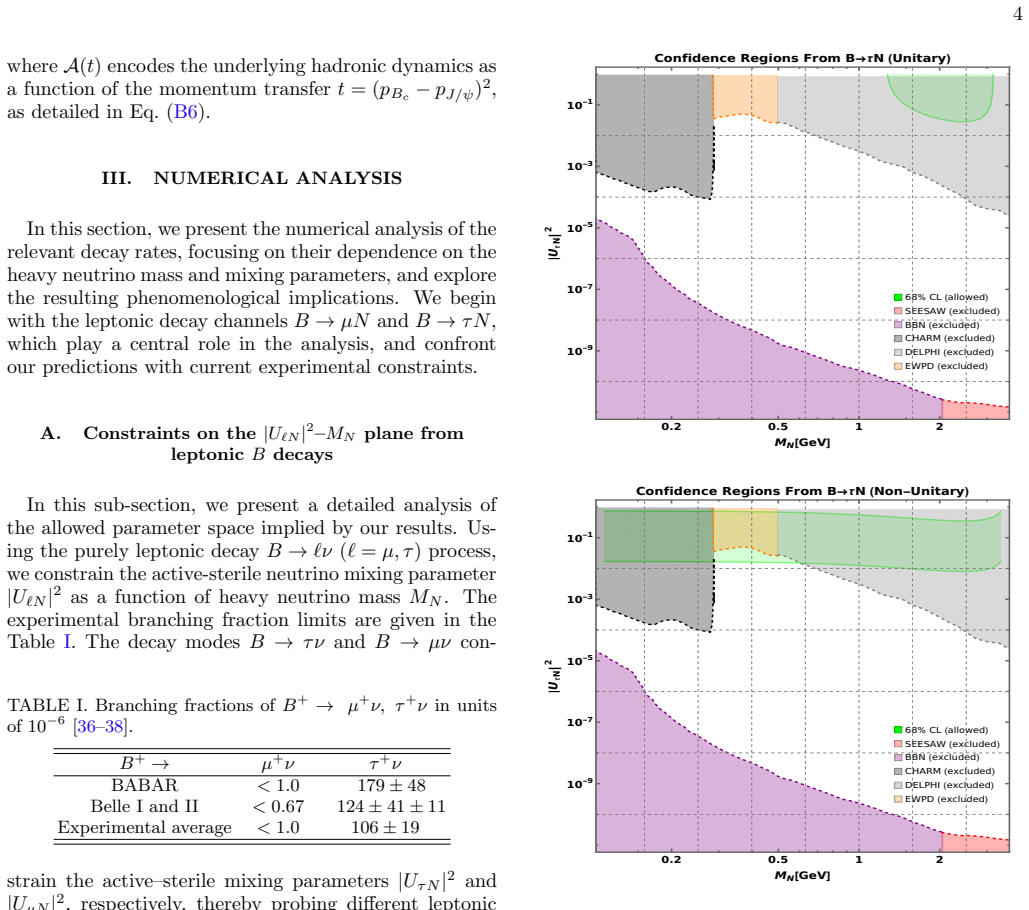
We study the phenomenology of heavy neutral leptons (HNLs) in $B$-meson decays as probes of physics beyond the Standard Model. Focusing on the leptonic channels $B \to \mu N$ and $B \to \tau N$, we constrain the allowed regions in the $M_N$--$|U_{\ell N}|^2$ plane using current experimental data. Using these constraints, we investigate lepton-number violating ($\Delta L=2$) processes mediated by on-shell HNLs, including $B_{(c)}^- \to \pi^+ \mu^- \mu^-$ and $B_c^- \to J/\psi\, \pi^+ \mu^- \mu^-$. For benchmark values $|U_{\mu N}|^2 = 10^{-6}$ and $M_N = 2$-- $3\,\mathrm{GeV}$, the predicted branching ratios lie in the range $\mathcal{O}(10^{-13})$--$\mathcal{O}(10^{-8})$. Among the channels, $B_c^- \to \pi^+ \mu^- \mu^-$ shows the largest enhancement, while $B_c^- \to J/\psi\, \pi^+ \mu^- \mu^-$ is strongly suppressed. These results indicate a clear channel dependence, with $B_c$ modes providing enhanced sensitivity to HNL effects and offering promising avenues for future searches of lepton number violation.
Figures


Figures from the paper (1 more)
Reference graph
Works this paper leans on
-
[1]
RandomW(Lower Bound) 0.25 0.25 0.25 0.25 0.27 0.28
-
[2]
Scrambled inputs0.27 0.25 0.25 0.25 0.25 0.32
-
[3]
PermutedWcolumns 0.29 0.27 0.25 0.25 0.41 0.31
-
[4]
Heuristic Depth Mean 0.25 0.25 0.25 0.25 0.25 0.25 DFA (Zero-shot)0.27 0.46 0.28 0.260.44 0.48 DFA (Best) 0.32 0.49 0.39 0.26 0.46 0.52 NAP-IG-Activations
-
[5]
RandomW(Lower Bound) 0.25 0.25 0.25 0.25 0.26 0.25
-
[6]
Scrambled inputs0.29 0.31 0.33 0.25 0.34 0.37
-
[7]
PermutedWcolumns 0.26 0.26 0.25 0.25 0.26 0.27
-
[8]
We report the zero-shot faithfulness drop under various structural corruptions using CPR
Heuristic Depth Mean 0.25 0.25 0.25 0.25 0.25 0.25 DFA (Zero-shot) 0.33 0.46 0.820.28 0.34 0.51 DFA (Best) 0.33 0.46 0.82 0.45 0.41 0.51 Table 11: Validation and Ablation Study for target model llama3-3b (source llama3-1b) by NAP and NAP-IG-Activations. We report the zero-shot faithfulness drop under various structural corruptions using CPR. Method Settin...
Show all 62 references
-
[10]
Scrambled inputs0.33 0.26 0.27 0.25 0.34 0.27
-
[11]
PermutedWcolumns 0.29 0.27 0.25 0.25 0.26 0.28
-
[12]
Heuristic Depth Mean - - - - - - DFA (Zero-shot)0.33 0.51 0.67 0.39 0.47 0.38 DFA (Best) 0.34 0.51 0.67 0.39 0.47 0.38 NAP
-
[14]
Scrambled inputs0.390.25 0.26 0.25 0.25 0.30
-
[15]
PermutedWcolumns 0.31 0.25 0.25 0.25 0.33 0.31
-
[16]
Heuristic Depth Mean - - - - - - DFA (Zero-shot)0.27 0.40 0.400.26 0.30 0.29 DFA (Best)0.33 0.46 0.40 0.33 0.49 0.53 NAP-IG-Activations
-
[18]
Scrambled inputs0.560.34 0.31 0.25 0.33 0.26
-
[19]
PermutedWcolumns 0.30 0.26 0.25 0.25 0.26 0.27
-
[20]
We report the zero-shot faithfulness drop under various structural corruptions using CPR
Heuristic Depth Mean - - - - - - DFA (Zero-shot)0.360.400.41 0.28 0.35 0.40 DFA (Best)0.43 0.40 0.41 0.28 0.35 0.40 Table 12: Validation and Ablation Study for target model llama3-8b (source llama3-1b). We report the zero-shot faithfulness drop under various structural corrupt...
-
[22]
Scrambled inputs0.28 0.28 0.25 0.27 0.29 0.49
-
[23]
PermutedWcolumns 0.25 0.26 0.25 0.25 0.27 0.26
-
[24]
Heuristic Depth Mean - - - - - - DFA (Zero-shot) 0.57 0.460.27 0.46 0.27 0.25 DFA (Best) 0.57 0.46 0.45 0.67 0.340.34 NAP
-
[25]
RandomW(Lower Bound) 0.25 0.25 0.25 0.25 0.25 0.25
-
[26]
Scrambled inputs0.26 0.26 0.25 0.26 0.250.35
-
[27]
PermutedWcolumns 0.25 0.26 0.25 0.25 0.26 0.26
-
[28]
Heuristic Depth Mean - - - - - - DFA (Zero-shot) 0.36 0.320.27 0.26 0.290.27 DFA (Best) 0.36 0.32 0.40 0.40 0.290.29 NAP-IG-Activations
-
[29]
RandomW(Lower Bound) 0.25 0.26 0.25 0.25 0.26 0.26
-
[30]
Scrambled inputs0.25 0.31 0.25 0.42 0.25 0.29
-
[31]
PermutedWcolumns 0.29 0.26 0.25 0.25 0.26 0.32
-
[32]
We report the zero-shot faithfulness drop under various structural corruptions using CPR
Heuristic Depth Mean - - - - - - DFA (Zero-shot)0.44 0.50 0.28 0.590.36 0.43 DFA (Best) 0.50 0.54 0.46 0.59 0.56 0.56 Table 13: Validation and Ablation Study for target model llama3-8b (source llama3-3b). We report the zero-shot faithfulness drop under various structural corru...
-
[34]
Scrambled inputs0.25 0.27 - 0.25 0.25 0.27
-
[35]
PermutedWcolumns 0.250.32- 0.25 0.29 0.29
-
[36]
Heuristic Depth Mean - - - - - - DFA (Zero-shot)0.26 0.25 -0.390.27 0.26 DFA (Best) 0.300.30 -0.39 0.29 0.29 NAP
-
[37]
RandomW(Lower Bound) 0.25 0.25 - 0.25 0.27 0.27
-
[38]
Scrambled inputs0.250.44-0.410.28 0.25
-
[39]
PermutedWcolumns 0.24 0.28 - 0.25 0.27 0.26
-
[40]
Heuristic Depth Mean - - - - - - DFA (Zero-shot)0.25 0.27 - 0.250.38 0.36 DFA (Best) 0.280.28 - 0.40 0.38 0.36 NAP-IG-Activations
-
[41]
RandomW(Lower Bound) 0.25 0.25 - 0.25 0.28 0.30
-
[42]
Scrambled inputs0.250.43- 0.25 0.33 0.25
-
[43]
PermutedWcolumns 0.25 0.25 - 0.25 0.26 0.25
-
[44]
We report the zero-shot faithfulness drop under various structural corruptions using CPR
Heuristic Depth Mean - - - - - - DFA (Zero-shot)0.25 0.28 -0.40 0.42 0.44 DFA (Best) 0.290.34 -0.40 0.42 0.44 Table 14: Validation and Ablation Study for target model qwen2.5-1.5b (source qwen2.5- 0.5b). We report the zero-shot faithfulness drop under various structural corrup...
-
[45]
RandomW(Lower Bound) 0.25 0.25 - 0.25 0.25 0.25
-
[46]
Scrambled inputs0.25 0.36 - 0.25 0.25 0.29
-
[47]
PermutedWcolumns 0.27 0.38- 0.250.35 0.34
-
[48]
Heuristic Depth Mean - - - - - - DFA (Zero-shot) 0.300.32 - 0.25 0.28 0.28 DFA (Best) 0.300.37 -0.260.35 0.34 NAP
-
[50]
Scrambled inputs0.250.57- 0.25 0.29 0.25
-
[51]
PermutedWcolumns 0.29 0.30 - 0.25 0.30 0.29
-
[52]
Heuristic Depth Mean - - - - - - DFA (Zero-shot) 0.320.27 - 0.24 0.32 0.35 DFA (Best) 0.320.37 -0.26 0.37 0.42 NAP-IG-Activations
-
[53]
RandomW(Lower Bound) 0.25 0.27 - 0.25 0.25 0.25
-
[54]
Scrambled inputs0.250.60- 0.25 0.24 0.25
-
[55]
PermutedWcolumns0.300.30 - 0.25 0.31 0.31
-
[56]
We report the zero-shot faithfulness drop under various structural corruptions using CPR
Heuristic Depth Mean - - - - - - DFA (Zero-shot)0.25 0.34 - 0.25 0.34 0.48 DFA (Best)0.25 0.36 -0.26 0.34 0.48 Table 15: Validation and Ablation Study for target model qwen2.5-3b (source qwen2.5-0.5b). We report the zero-shot faithfulness drop under various structural corrupti...
-
[57]
RandomW(Lower Bound) 0.25 0.28 - 0.25 0.27 0.27
-
[58]
Scrambled inputs0.260.38- 0.25 0.280.34
-
[59]
PermutedWcolumns 0.29 0.27 -0.280.31 0.30
-
[60]
Heuristic Depth Mean - - - - - - DFA (Zero-shot) 0.360.33 - 0.27 0.29 0.29 DFA (Best) 0.360.33 - 0.27 0.310.31 NAP
-
[61]
RandomW(Lower Bound) 0.25 0.34 - 0.25 0.29 0.25
-
[62]
Scrambled inputs0.25 0.41- 0.26 0.25 0.34
-
[63]
PermutedWcolumns 0.24 0.29 - 0.26 0.27 0.28
-
[64]
Heuristic Depth Mean - - - - - - DFA (Zero-shot)0.23 0.28 - 0.260.40 0.38 DFA (Best) 0.280.28 -0.27 0.40 0.38 NAP-IG-Activations
-
[65]
RandomW(Lower Bound) 0.250.39- 0.26 0.28 0.25
-
[66]
Scrambled inputs0.25 0.34 - 0.27 0.26 0.29
-
[67]
PermutedWcolumns 0.23 0.28 -0.270.27 0.27
-
[68]
We report the zero-shot faithfulness drop under various structural corruptions using CPR
Heuristic Depth Mean - - - - - - DFA (Zero-shot)0.23 0.30 - 0.260.35 0.34 DFA (Best) 0.290.30 - 0.27 0.35 0.34 Table 16: Validation and Ablation Study for target model qwen2.5-3b (source qwen2.5-1.5b). We report the zero-shot faithfulness drop under various structural corrupti...
Reviewed July 1, 2026 · model on record in the stance chip above.
Discussion (0). Continue with ORCID to comment.