REVIEW 4 major objections 8 minor 1 cited by
Diversity of disc viscosities can explain the period ratios of resonant and non-resonant systems of hot super-Earths and mini-Neptunes
T0 review · 4 major / 8 minor · reviewed 2026-08-12 · deepseek-v4-flash
Pith's one-line read This paper argues that the orbital spacing of hot super-Earth systems is set by disc viscosity: low-viscosity discs build wide resonance chains like TRAPPIST-1, high-viscosity discs the tighter Kepler packing.
desk verdict Stated diversity claim is inferred rather than tested, but the low-viscosity chain result is new, honest, and deserves a serious referee. read the letter →
The pith
A machine-rendered reading of the paper's core claim, the machinery that carries it, and where it could break.
The reading
What carries the argument
The controlling mechanism is the migration speed of growing planets and its dependence on disc viscosity, implemented through the type-I migration torque of Paardekooper et al. (2011) with a gap-opening correction from Kanagawa et al. (2018). The correction lengthens the migration timescale by a factor $\Sigma_{\mathrm{up}}/\Sigma_{\mathrm{min}} = 1 + 0.04 K_{\mathrm{mig}}$, where $K_{\mathrm{mig}} \propto (M_p/M_\star)^2 (H/r)^{-5} \alpha^{-1}$; at $\alpha = 10^{-4}$ this factor becomes large, so a few-Earth-mass planet migrates slowly, while at $\alpha = 5 \times 10^{-3}$ it barely acts. Because resonance capture depends on the relative migration velocity of converging planets, the viscosity sets which resonances form — verified by the paper's two-planet experiment of Appendix G, where increasing $\alpha$ monotonically tightens the final resonance ratio. The second stage of the argument is the post-gas instability: once eccentricity and inclination damping switch off, outer planets excite eccentricities and break or destroy the chains, and the different outer-planet populations in the two viscosity regimes determine how violent that destruction is.
What would settle it
Re-run the low-viscosity simulation suite with eccentricity and inclination damping modified by partial gap opening instead of the fixed Cresswell & Nelson (2008) formulas; if the wide 3:2 and 2:1 chains no longer form, the central mechanism fails. The paper's own caveat in Sect. 2 identifies this damping input as the step that could most plausibly change the result.
Extended reading notes
Core claim
The paper's central claim is that the period ratios of close-in super-Earth and mini-Neptune systems — both the wide resonance chains and the bulk non-resonant population — are a direct readout of disc viscosity. In simulations with $\alpha = 10^{-4}$, growing planets of a few Earth masses open partial gaps that slow their type-I migration, so converging planets trap each other into wide resonances (4:3, 3:2, and 2:1), matching the observed chains of TRAPPIST-1, TOI-178, and Kepler-223. In simulations with $\alpha = 5 \times 10^{-3}$, gap opening is suppressed, migration is faster, and the resulting chains are tighter (7:6, 5:4, and 4:3), which matches the overall Kepler period-ratio distribution. Once the gas disc dissipates, the low-viscosity chains become violently unstable: about 95% experience giant impacts, driven by massive leftover planets beyond $P > 200$ days, and about half of the final systems contain no planet interior to 200 days while all retain outer planets. The authors conclude that a mixture of viscosities is required in nature — low-viscosity discs for the observed resonant chains, high-viscosity discs for the bulk of the non-resonant census — and that the violent fate of low-viscosity inner systems may explain the scarcity of inner planets around a large fraction of Sun-like stars.
Load-bearing premise
The load-bearing premise is that eccentricity and inclination damping has the same strength at every disc viscosity, even though the partial gaps that slow migration in the low-viscosity case should alter those damping rates, and resonance capture, which sets the period ratios, depends on the balance between migration and damping.
Editorial extensions
If this is right
- Observed wide resonance chains — TRAPPIST-1, TOI-178, Kepler-223 — have a formation channel in low-viscosity discs, which the high-viscosity simulations cannot supply.
- The overall Kepler period-ratio census remains best matched by the high-viscosity simulations, so both regimes are required to explain the full sample.
- About 95% of low-viscosity resonance chains go unstable, and about half of the final systems lose all planets interior to ~200 days, offering a pathway to the observed rarity of inner planets around many Sun-like stars.
- Because the outcome depends on migration speed rather than the growth pathway, the viscosity explanation should hold whether planets grow by pebble or planetesimal accretion and for a range of initial embryo configurations.
- Surviving resonance chains most plausibly formed at low viscosity without nearby external perturbers, since perturbers efficiently destroy chains.
Reading between the lines
- A testable extension: if low-viscosity formation destroys inner systems, then stars lacking close-in super-Earths should preferentially retain outer sub-Neptunes beyond about 200 days, a correlation that transit and radial-velocity surveys could check.
- If gap-modified eccentricity and inclination damping is adopted — the paper flags this as future work — the wide 3:2 and 2:1 chains must persist for the viscosity-diversity interpretation to hold; otherwise the resonance ladder itself would shift.
- The viscosity logic also predicts a mass signature: inner planets built in low-viscosity discs grow only to the local pebble-isolation mass (roughly 3 Earth masses here), so surviving chains should be systematically less massive than the products of high-viscosity formation, which transit-timing-variation measurements could separate.
Signed reviews
Editorial analysis
A structured set of objections, weighed in public.
Referee Report
Summary. This paper uses N-body simulations of pebble-accreting planetary embryos in a low-viscosity disc (alpha = 10^-4) to study the formation of close-in super-Earth and mini-Neptune systems, and compares the outcomes with the high-viscosity (alpha = 5.4e-3) simulations of Izidoro et al. (2021). The authors find that low-viscosity discs produce wider resonant chains (4:3, 3:2, 2:1) at the end of the gas-disc phase, that about 95% of these chains become unstable after gas dispersal, and that the few surviving chains match the period ratios of observed resonant chains such as TRAPPIST-1, TOI-178, and Kepler-223 better than high-viscosity simulations do. Since low-viscosity simulations alone do not match the overall Kepler period-ratio distribution while high-viscosity simulations do, the paper proposes that a diversity of disc viscosities is needed to explain both resonant and non-resonant systems.
Significance. The hypothesis that disc viscosity, through partial gap opening and slower migration, sets the width of resonant chains is timely and physically plausible. The paper builds on established prescriptions (Paardekooper et al. 2011; Kanagawa et al. 2018; Johansen et al. 2015), includes synthetic transit observations, and provides valuable control experiments (Appendix G's two-planet migration test and Appendix D's embryo-number comparison) that support the causal role of viscosity rather than initial conditions. The honest presentation of the low-viscosity model's failures, such as the mass distribution and the overall period-ratio mismatch, is a strength. If the diversity-of-viscosity picture can be demonstrated with a quantitative joint fit, it would reconcile the existence of wide resonant chains with the broader Kepler period-ratio distribution and connect disc physics to the presence or absence of inner super-Earths. However, the paper's central claim is currently supported only by two separate subset comparisons and not by a combined model.
major comments (4)
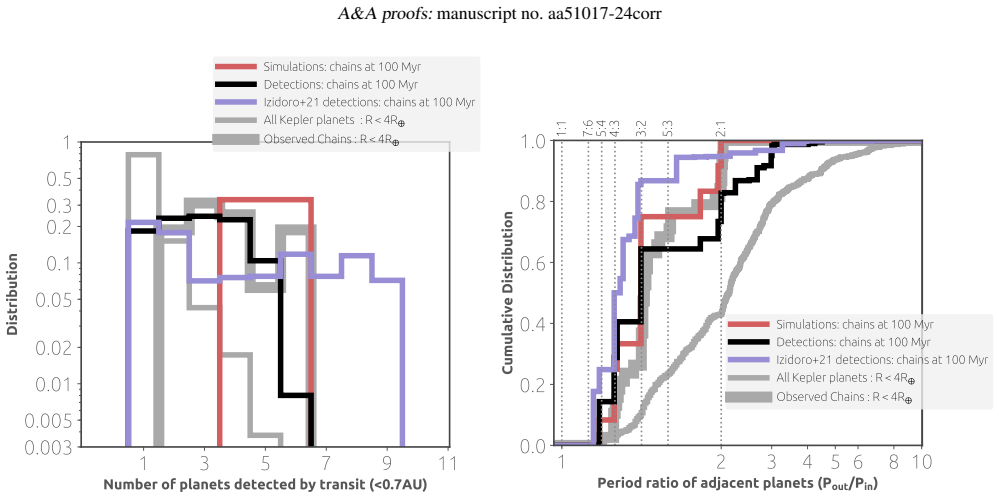
- [§3.3, §5, Appendix F] The central diversity claim is not directly tested. The paper shows that low-viscosity chains match the period ratios of observed chains (Fig. 6) and that high-viscosity simulations from Izidoro et al. (2021) match the overall Kepler period-ratio distribution (Fig. 5), but it never combines the two populations into a single mixed model and compares that model to the full Kepler sample. Appendix F mixes 2% stable with 98% unstable low-viscosity systems, not low- and high-viscosity systems, and the text states that this mixture still fails to reproduce the observed period ratios. Because the low-viscosity simulations are too tightly packed overall (Sect. 3.3) and too low in mass (Appendix E), it is not obvious that adding them to the high-viscosity sample would preserve the good overall fit. A quantitative joint fit, for example varying the low-viscosity fraction and comparing synthetic period-ratio distributions to Kepler with a two-sample test, is needed to support the title claim.
- [§3.3, Fig. 6] The stable-chain sample is very small: about 95% of the low-viscosity resonant chains become unstable (Sect. 3.3), leaving roughly 2-3 chains among 50 runs. The period-ratio match in Fig. 6 therefore rests on a handful of systems, and the sampling uncertainty is not quantified. Moreover, the left panel of Fig. 6 shows that low-viscosity chains contain only four or more planets, while the observed chain sample includes systems with two or three planets, so the match to the chain population is incomplete. A bootstrap or Poisson-resampling analysis and an explicit definition of the observed chain sample would make the comparison more convincing.
- [§2 (damping)] The eccentricity and inclination damping is implemented with the Cresswell & Nelson (2008) formulae without modification for partial gap opening, even though the central mechanism of the paper is partial gap opening at low viscosity. Resonance capture and the resulting period ratios depend on the balance between migration and damping, so a viscosity-dependent damping prescription, for example following Pichierri et al. (2023, 2024), could shift the chain outcomes. The paper acknowledges this in §2 but does not test the sensitivity. Please add a test, at least for a subset of runs or in the two-planet control of Appendix G, to show that the wider resonances at low viscosity are robust to the damping prescription.
- [Appendix E] The masses of the low-viscosity planets are systematically too low compared to the Kepler-derived masses (Fig. E.1), with most planets at or below roughly 3 Earth masses. Since the paper's target population is hot super-Earths and mini-Neptunes, the period-ratio match for the low-viscosity chains is achieved with systems that are not representative of the observed masses. The authors note this discrepancy, but the implications for the chain-match claim need to be discussed or addressed, for example by varying the pebble isolation mass prescription or including gas accretion; otherwise the low-viscosity model may explain period ratios only in a mass regime that is not the observed one.
minor comments (8)
- [§2, Appendix A, Appendix D] The high-viscosity value is written inconsistently as 5.4e-3 in Section 2, 5e-3 in Appendix D, and 0.005 in Appendix A; please unify.
- [Fig. 5 caption] The caption states that the high-viscosity simulations produce 'wider systems' after instabilities, which seems inconsistent with the text's statement that the low-viscosity systems remain too tightly packed; please clarify the intended direction of the comparison.
- [§3.3] Please define 'chains' more precisely and state how the observed chain sample is selected, including the number of planets and the resonance criterion, when the term is first used.
- [§3.3] The statement that the low-viscosity chains harbour only four or more planets, in contrast to the Kepler observations, needs a short explanation of why two- and three-planet chains are absent and whether this affects the period-ratio comparison.
- [§4.1] Baumann & Bitsch (2020) is cited in Section 4.1 but does not appear in the reference list; please add the reference or remove the citation.
- [Appendix B, Appendix F] There are minor typographical issues, including 'benefitial' in Appendix B and the spacing in the caption 'Fig. F .1'; please correct them.
- [Appendix D] The notation 'K = 5 damping' is used without definition in this paper; please define it or refer explicitly to the relevant description in Bitsch & Izidoro (2023).
- [Figs. 4-6] The 'better match' claims are based on visual comparison of cumulative distributions; reporting a quantitative goodness-of-fit statistic (for example a Kolmogorov-Smirnov test) would strengthen the conclusions.
Circularity Check
No significant circularity: the period-ratio outcomes are emergent N-body results, not fits or quantities defined by their own predictions.
full rationale
The paper's central claim is an emergent N-body result, not a fit. The low-viscosity simulations are forward FLINTSTONE integrations with alpha=1e-4, and no parameter is tuned to Kepler period ratios; the resonance widths arise from the migration and damping prescriptions (Paardekooper et al. 2011, Kanagawa et al. 2018, Cresswell & Nelson 2008). The high-viscosity comparison set is taken from Izidoro et al. (2021), a self-citation, but it is an independent published simulation set, and Appendix D reproduces the same tight-versus-wide trend with alpha=5e-3 in the same code, so the reliance is not an unverified self-citation chain. The paper explicitly states that low-viscosity runs alone do not match the overall Kepler distribution (Sect. 3.3, Fig. 5) and that the diversity conclusion is offered as a suggestion ('may suggest'), not as a fitted mixture; Appendix F mixes only stable and unstable low-viscosity runs and shows that this mixture still fails. The damping-formula limitation in Sect. 2 is an admitted modeling caveat, not a circular reduction. No equation is defined in terms of the quantity it is claimed to predict, and no fitted parameter is renamed as a prediction. The absence of a joint low-plus-high viscosity mixture test is a completeness or correctness concern, not circularity, because the paper does not claim to have performed that test. The derivation chain is therefore self-contained with respect to the target period-ratio data.
Assumptions & free parameters
free parameters (4)
- disc viscosity alpha =
1e-4 (low-viscosity runs); 5e-3 (comparison runs)
- initial embryo distribution =
30 embryos, 0.25 AU spacing from 2.75 AU
- total pebble flux =
350 Earth masses over 3 Myr
- disc age at embryo implantation =
2 Myr (Bitsch et al. 2015a disc model)
assumptions (5)
- domain assumption Type-I migration torque formula of Paardekooper et al. (2011).
- domain assumption Gap-opening reduction of migration via Kanagawa et al. (2018), with Sigma_up/Sigma_min = 1 + 0.04 K_mig.
- domain assumption Cresswell & Nelson (2008) eccentricity and inclination damping formulae, applied unchanged across viscosities.
- domain assumption Pebble isolation mass recipe of Bitsch et al. (2018b), with viscosity dependence ignored.
- domain assumption Disc dissipation timescale of 12 kyr within the last 100 kyr.
Cite this review
Pith. "Pith review of Diversity of disc viscosities can explain the period ratios of resonant and non-resonant systems of hot super-Earths and mini-Neptunes." pith.science (2026). https://pith.science/paper/45KEHA7I
@misc{pith2026241111452,
  author       = {Pith},
  title        = {Pith review of: Diversity of disc viscosities can explain the period ratios of resonant and non-resonant systems of hot super-Earths and mini-Neptunes},
  year         = {2026},
  howpublished = {\url{https://pith.science/paper/45KEHA7I}},
  note         = {Machine review of arXiv:2411.11452}
}
read the original abstract
Migration is a key ingredient for the formation of close-in super-Earth and mini-Neptune systems, as it sets in which resonances planets can be trapped. Slower migration rates result in wider resonance configurations compared to higher migration rates. We investigate the influence of different migration rates, set by the disc's viscosity, on the structure of multi-planet systems growing by pebble accretion via N-body simulations. Planets in low viscosity environments migrate slower due to partial gap opening. Thus systems formed in low viscosity environments tend to have planets trapped in wider resonant configurations (typically 4:3, 3:2 and 2:1), compared to their high viscosity counterparts (mostly 7:6, 5:4 and 4:3 resonances). After gas disc dissipation, the damping forces cease and the systems can undergo instabilities, rearranging their configurations and breaking the resonance chains. The low viscosity discs naturally account for the resonant chains like Trappist-1, TOI-178 and Kepler-223, unlike high viscosity simulations which produce relatively more compact chains. About 95% of our low viscosity resonant chains became unstable, experiencing giant impacts. Dynamical instabilities in our low viscosity simulations are more violent than those of high viscosity simulations due to the effects of leftover external perturbers (P>200 days). About 50% of our final system ended with no planets within 200 days, while all our systems have remaining outer planets. We speculate that this process could be qualitatively consistent with the lack of inner planets in a large fraction of Sun-like stars. Systems produced in low viscosity simulations alone do not match the overall period ratio distribution of observations, but give a better match to the period distributions of chains, which may suggest that systems of super-Earths and mini-Neptunes form in natal discs with a diversity of viscosities.
Figures


Figures from the paper (4 more)



Forward citations
Cited by 1 Pith paper
-
Formation of super-Earths and mini-Neptunes from rings of planetesimals
Super-Earths grow by planetesimal accretion from an inner rocky ring while mini-Neptunes grow by pebble accretion from an outer icy ring, reproducing several observed exoplanet population features.
Reference graph
Works this paper leans on
-
[1]
2018, , 615, A110
Ataiee , S., Baruteau , C., Alibert , Y., & Benz , W. 2018, , 615, A110
2018
-
[2]
2015, , 577, A42
Baraffe , I., Homeier , D., Allard , F., & Chabrier , G. 2015, , 577, A42
2015
-
[3]
& Morbidelli , A
Batygin , K. & Morbidelli , A. 2023, Nature Astronomy, 7, 330
2023
-
[4]
& Bitsch , B
Baumann , T. & Bitsch , B. 2020, A&A, 637, id.A11
2020
-
[5]
2015, Nature, 520, pp
Ben\' tez-Llambay, P., Masset, F., Koenigsberger, G., & Szul \'a gyi, J. 2015, Nature, 520, pp. 63
2015
-
[6]
2019, , 887, L14
Benneke , B., Wong , I., Piaulet , C., et al. 2019, , 887, L14
2019
-
[7]
C., & Kley , W
Bitsch , B., Boley , A. C., & Kley , W. 2013, A&A, 550, id.A52
2013
-
[8]
& Izidoro , A
Bitsch , B. & Izidoro , A. 2023, , 674, A178
2023
Show all 101 references
-
[9]
2019 a , , 623, A88
Bitsch , B., Izidoro , A., Johansen , A., et al. 2019 a , , 623, A88
2019
-
[10]
2015 a , A&A, 575, id.A28
Bitsch, B., Johansen, A., Lambrechts, M., & Morbidelli, A. 2015 a , A&A, 575, id.A28
2015
-
[11]
2015 b , A&A, 582, id.A112
Bitsch, B., Lambrechts, M., & Johansen, A. 2015 b , A&A, 582, id.A112
2015
-
[12]
2018 a , , 609, C2
Bitsch , B., Lambrechts , M., & Johansen , A. 2018 a , , 609, C2
2018
-
[13]
2018 b , A&A, 612, id.A30
Bitsch , B., Morbidelli , A., Johansen , A., et al. 2018 b , A&A, 612, id.A30
2018
-
[14]
N., Buchhave , L
Bitsch , B., Raymond , S. N., Buchhave , L. A., et al. 2021, , 649, L5
2021
-
[15]
N., & Izidoro , A
Bitsch , B., Raymond , S. N., & Izidoro , A. 2019 b , , 624, A109
2019
-
[16]
& Savvidou , S
Bitsch , B. & Savvidou , S. 2021, , 647, A96
2021
-
[17]
2020, , 643, A66
Bitsch , B., Trifonov , T., & Izidoro , A. 2020, , 643, A66
2020
-
[18]
2017, AJ, 153, id
Brasser, R., Bitsch, B., & Matsumura, S. 2017, AJ, 153, id. 222
2017
-
[19]
G., Ormel , C
Brouwers , M. G., Ormel , C. W., Bonsor , A., & Vazan , A. 2021, , 653, A103
2021
-
[20]
Chambers, J. E. 1999, MNRAS, 304, pp. 793
1999
-
[21]
E., Wetherill , G
Chambers , J. E., Wetherill , G. W., & Boss , A. P. 1996, , 119, 261
1996
-
[22]
Chatziastros , L., Bitsch , B., & Schneider , A. D. 2024, , 681, A52
2024
-
[23]
P., Kuiper , R., & Ormel , C
Cimerman , N. P., Kuiper , R., & Ormel , C. W. 2017, , 471, 4662
2017
-
[24]
Coleman , G. A. L., Leleu , A., Alibert , Y., & Benz , W. 2019, , 631, A7
2019
-
[25]
& Nelson, R
Cresswell, P. & Nelson, R. P. 2008, A&A, 482, pp.677
2008
-
[26]
& Morbidelli , A
Crida , A. & Morbidelli , A. 2007, , 377, 1324
2007
-
[27]
I., Chiang , E., & Lee , E
Dawson , R. I., Chiang , E., & Lee , E. J. 2015, , 453, 1471
2015
-
[28]
2021, , 656, A69
Emsenhuber , A., Mordasini , C., Burn , R., et al. 2021, , 656, A69
2021
-
[29]
2022, , 509, 2856
Esteves , L., Izidoro , A., Bitsch , B., et al. 2022, , 509, 2856
2022
-
[30]
N., & Bitsch , B
Esteves , L., Izidoro , A., Raymond , S. N., & Bitsch , B. 2020, , 497, 2493
2020
-
[31]
C., Bitsch , B., & Isella , A
Esteves , L., Izidoro , A., Winter , O. C., Bitsch , B., & Isella , A. 2023, , 521, 5776
2023
-
[32]
C., Lissauer , J
Fabrycky , D. C., Lissauer , J. J., Ragozzine , D., et al. 2014, , 790, 146
2014
-
[33]
J., Mulders , G
Flock , M., Turner , N. J., Mulders , G. D., et al. 2019, , 630, A147
2019
-
[34]
2013, ApJ, 766, id.81
Fressin, F., Torres, G., Charbonneau, D., et al. 2013, ApJ, 766, id.81
2013
-
[35]
J., Petigura , E
Fulton , B. J., Petigura , E. A., Howard , A. W., et al. 2017, , 154, 109
2017
-
[36]
1993, Icarus, 106, 247
Gladman , B. 1993, Icarus, 106, 247
1993
-
[37]
& Schlichting , H
Gupta , A. & Schlichting , H. E. 2019, , 487, 24
2019
-
[38]
Hansen , B. M. S. & Murray , N. 2013, , 775, 53
2013
-
[39]
& Bae , J
Hartmann , L. & Bae , J. 2018, , 474, 88
2018
-
[40]
1981, Progress of Theoretical Physics Supplement, 70, pp.35
Hayashi , C. 1981, Progress of Theoretical Physics Supplement, 70, pp.35
1981
-
[41]
Ho , C. S. K., Rogers , J. G., Van Eylen , V., Owen , J. E., & Schlichting , H. E. 2024, , 531, 3698
2024
-
[42]
& Ormel , C
Huang , S. & Ormel , C. W. 2023, , 522, 828
2023
-
[43]
A., Pichierri , G., Bitsch , B., & Batygin , K
H \"u hn , L. A., Pichierri , G., Bitsch , B., & Batygin , K. 2021, , 656, A115
2021
-
[44]
2000, ApJ, 537, pp
Ikoma, M., Nakazawa, K., & Emori, H. 2000, ApJ, 537, pp. 1013
2000
-
[45]
Inamdar, N. K. & Schlichting, H. E. 2016, ApJL, 817, id. L13
2016
-
[46]
N., et al
Izidoro , A., Bitsch , B., Raymond , S. N., et al. 2021, , 650, A152
2021
-
[47]
N., et al
Izidoro, A., Ogihara, M., Raymond, S. N., et al. 2017, MNRAS, 470, pp. 1750
2017
-
[48]
E., Isella , A., et al
Izidoro , A., Schlichting , H. E., Isella , A., et al. 2022, , 939, L19
2022
-
[49]
Jim \'e nez , M. A. & Masset , F. S. 2017, , 471, 4917
2017
-
[50]
& Mordasini , C
Jin , S. & Mordasini , C. 2018, , 853, 163
2018
-
[51]
& Lacerda, P
Johansen, A. & Lacerda, P. 2010, MNRAS, 404, pp. 475
2010
-
[52]
& Lambrechts, M
Johansen, A. & Lambrechts, M. 2017, AREP, 45
2017
-
[53]
M., Lacerda, P., & Bizzarro, M
Johansen, A., Mac Low , M. M., Lacerda, P., & Bizzarro, M. 2015, Science Advances, Vol.1, id. 1500109
2015
-
[54]
2021, Science Advances, 7, eabc0444
Johansen , A., Ronnet , T., Bizzarro , M., et al. 2021, Science Advances, 7, eabc0444
2021
-
[55]
D., Tanaka , H., & Szuszkiewicz , E
Kanagawa , K. D., Tanaka , H., & Szuszkiewicz , E. 2018, ApJ, 861, id.140
2018
-
[56]
& Nelson, R
Kley, W. & Nelson, R. P. 2012, Annual Review of Astronomy and Astrophysics, 50, p.211
2012
-
[57]
& Johansen , A
Lambrechts , M. & Johansen , A. 2012, A&A, 544, id.A32
2012
-
[58]
& Johansen, A
Lambrechts, M. & Johansen, A. 2014, A&A, 572, id.A107
2014
-
[59]
2014, A&A, 572, id
Lambrechts, M., Johansen, A., & Morbidelli, A. 2014, A&A, 572, id. A35
2014
-
[60]
& Lega , E
Lambrechts , M. & Lega , E. 2017, , 606, A146
2017
-
[61]
A., et al
Lambrechts , M., Morbidelli , A., Jacobson , S. A., et al. 2019, , 627, A83
2019
-
[62]
Lee , E. J. & Chiang , E. 2016, , 817, 90
2016
-
[63]
Leinhardt, Z. M. & Stewart, S. T. 2012, ApJ, 745, id. 79
2012
-
[64]
C., et al
Leleu , A., Alibert , Y., Hara , N. C., et al. 2021, , 649, A26
2021
-
[65]
2023, in Astronomical Society of the Pacific Conference Series, Vol
Lesur , G., Flock , M., Ercolano , B., et al. 2023, in Astronomical Society of the Pacific Conference Series, Vol. 534, Protostars and Planets VII, ed. S. Inutsuka , Y. Aikawa , T. Muto , K. Tomida , & M. Tamura , 465
2023
-
[66]
2024, , 627, 501
Liu , F., Ting , Y.-S., Yong , D., et al. 2024, , 627, 501
2024
-
[67]
Liu , S.-F., Hori , Y., Lin , D. N. C., & Asphaug , E. 2015, , 812, 164
2015
-
[68]
Lopez , E. D. & Fortney , J. J. 2014, , 792, 1
2014
-
[69]
Masset , F. S. 2017, , 472, 4204
2017
-
[70]
S., Morbidelli , A., Crida , A., & Ferreira , J
Masset , F. S., Morbidelli , A., Crida , A., & Ferreira , J. 2006, , 642, 478
2006
-
[71]
2021, , 650, A116
Matsumura , S., Brasser , R., & Ida , S. 2021, , 650, A116
2021
-
[72]
2011, ArXiv e-prints
Mayor , M., Marmier , M., Lovis , C., et al. 2011, ArXiv e-prints
2011
-
[73]
2017, , 849, L33
Millholland , S., Wang , S., & Laughlin , G. 2017, , 849, L33
2017
-
[74]
Millholland , S. C. & Winn , J. N. 2021, , 920, L34
2021
-
[75]
M., Fabrycky , D
Mills , S. M., Fabrycky , D. C., Migaszewski , C., et al. 2016, , 533, 509
2016
-
[76]
W., Kuiper , R., Kley , W., & Ormel , C
Moldenhauer , T. W., Kuiper , R., Kley , W., & Ormel , C. W. 2021, , 646, L11
2021
-
[77]
D., Pascucci , I., Apai , D., & Ciesla , F
Mulders , G. D., Pascucci , I., Apai , D., & Ciesla , F. J. 2018, , 156, 24
2018
-
[78]
M \"u ller , J., Bitsch , B., & Schneider , A. D. 2024, , 688, A139
2024
-
[79]
2018, , 56, 137
Nesvorn \'y , D. 2018, , 56, 137
2018
-
[80]
K., & Morbidelli , A
Ogihara , M., Kokubo , E., Suzuki , T. K., & Morbidelli , A. 2018, , 615, A63
2018
-
[81]
2015, , 578, A36
Ogihara , M., Morbidelli , A., & Guillot , T. 2015, , 578, A36
2015
-
[82]
2024, , 972, 181
Ogihara , M., Morbidelli , A., & Kunitomo , M. 2024, , 972, 181
2024
-
[83]
Ormel, C. W. & Klahr, H. H. 2010, A&A, 520, id.A43
2010
-
[84]
Owen , J. E. & Wu , Y. 2013, , 775, 105
2013
-
[85]
J., Baruteau , C., & Kley , W
Paardekooper , S. J., Baruteau , C., & Kley , W. 2011, MNRAS, 410, 293
2011
-
[86]
2019, , 625, A7
Pichierri , G., Batygin , K., & Morbidelli , A. 2019, , 625, A7
2019
-
[87]
2023, , 670, A148
Pichierri , G., Bitsch , B., & Lega , E. 2023, , 670, A148
2023
-
[88]
2024, , 967, 111
Pichierri , G., Bitsch , B., & Lega , E. 2024, , 967, 111
2024
-
[89]
W., & Dorn , C
Schoonenberg , D., Liu , B., Ormel , C. W., & Dorn , C. 2019, , 627, A149
2019
-
[90]
2019, , 632, A118
Schulik , M., Johansen , A., Bitsch , B., & Lega , E. 2019, , 632, A118
2019
-
[91]
2024, , 689, A285
Somigliana , A., Testi , L., Rosotti , G., et al. 2024, , 689, A285
2024
-
[92]
X., Welbanks , L., Teske , J., & Buchner , J
Sun , Q., Wang , S. X., Welbanks , L., Teske , J., & Buchner , J. 2024, , 167, 167
2024
-
[93]
P., Sumi , T., et al
Suzuki , D., Bennett , D. P., Sumi , T., et al. 2016, , 833, 145
2016
-
[94]
Tsiganis, K., Gomes, R., Morbidelli, A., & Levison, H. F. 2005, Nature, 435, pp.459
2005
-
[95]
S., et al
Van Eylen , V., Agentoft , C., Lundkvist , M. S., et al. 2018, , 479, 4786
2018
-
[96]
W., Huang , P., & Kuiper , R
Wang , Y., Ormel , C. W., Huang , P., & Kuiper , R. 2023, , 523, 6186
2023
-
[97]
Weidenschilling , S. J. 1977, , 51, 153
1977
-
[98]
M., Marcy , G
Weiss , L. M., Marcy , G. W., Petigura , E. A., et al. 2018, , 155, 48
2018
-
[99]
A., & Ford , E
Wolfgang , A., Rogers , L. A., & Ford , E. B. 2016, , 825, 19
2016
-
[100]
, " * write output.state after.block = add.period write newline
ENTRY address author booktitle chapter edition editor howpublished institution journal key month note number organization pages publisher school series title type volume year label extra.label sort.label short.list INTEGERS output.state before.all mid.sentence after.sentence a...
-
[101]
write newline
" write newline "" before.all 'output.state := FUNCTION n.dashify 't := "" t empty not t #1 #1 substring "-" = t #1 #2 substring "--" = not "--" * t #2 global.max substring 't := t #1 #1 substring "-" = "-" * t #2 global.max substring 't := while if t #1 #1 substring * t #2 gl...
Reviewed August 12, 2026 · model on record in the stance chip above.
Discussion (0). Continue with ORCID to comment.