REVIEW 3 major objections 5 minor 121 references
Investigation of full heavy $ QQQQ'\bar{Q}$ pentaquark candidates
T0 review · 3 major / 5 minor · reviewed 2026-08-07 · deepseek-v4-flash
Pith's one-line read Using the QCD sum-rule method, this paper predicts the masses and current couplings of two fully heavy pentaquarks, $cccb\bar{c}$ and $bbbc\bar{b}$, with spin-parity $1/2^-$, finding masses near 11.38 GeV and 20.99 GeV.
desk verdict Solid but unremarkable QCD sum rule extension: believable masses that match earlier predictions, undercut by omitted spectral densities and missing pole-dominance quantification. read the letter →
The pith
A machine-rendered reading of the paper's core claim, the machinery that carries it, and where it could break.
The reading
What carries the argument
The calculation is built on the QCD sum-rule framework, in which the two-point correlation function of the interpolating current is evaluated once in terms of hadronic degrees of freedom and once by an operator product expansion (OPE) in QCD. The interpolating current in Eq. (2) is chosen to carry the desired $J^P = 1/2^-$ quantum numbers and the quark content $QQQQ'\bar Q$, with the color factor $\epsilon_{ijk}$ ensuring a color-singlet combination. The OPE side uses the heavy-quark propagator of Eq. (4), which contains the perturbative term, the gluon-field-strength correction, and the quark-gluon condensate contribution. After Fourier transformation, Borel transformation, and continuum subtraction through quark-hadron duality (encoded in the threshold $s_0$), the QCD side reduces to the sum rule (5). Matching the coefficients of the $\not p$ and $\mathbb{1}$ structures with the hadronic side (10) yields the two sum rules (11) and (12), from which the mass and current coupling are obtained through Eqs. (13) and (14).
What would settle it
A lattice QCD calculation of the two-point correlator for the same quantum numbers and quark content, which does not rely on single-pole dominance, would either confirm a bound state near the predicted masses or show that the extracted ground state is a two-meson threshold; similarly, a search in the invariant mass distributions of the relevant heavy-quark final states would settle whether narrow resonances appear at roughly 11.38 GeV and 20.99 GeV.
Extended reading notes
Core claim
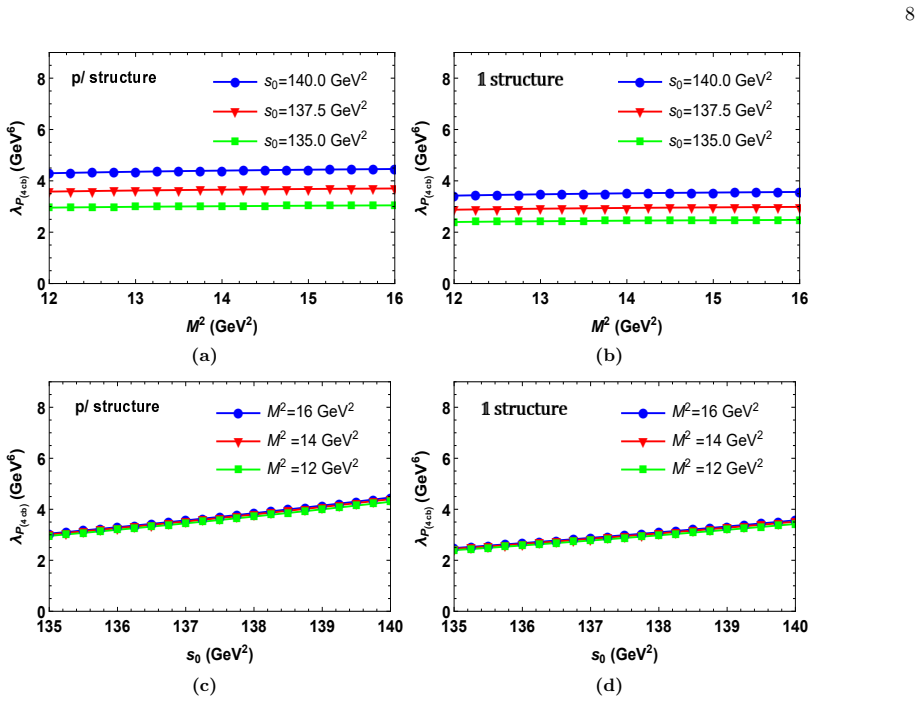
The paper's central claim is that the QCD sum-rule computation based on the interpolating current $J_{P_{(4QQ')}} = [\epsilon_{ijk} Q_i^T C \gamma_\mu Q_j \, \gamma_5 \gamma^\mu Q'_k][\bar{Q}_l i\gamma_5 Q_l]$ determines the masses and current couplings of the $J^P = 1/2^-$ pentaquarks with quark content $cccb\bar{c}$ ($P_{(4cb)}$) and $bbbc\bar{b}$ ($P_{(4bc)}$). From the coefficients of the two Lorentz structures $\not p$ and $\mathbb{1}$, the masses are $m_{P_{(4cb)}} = 11388.30 \pm 107.79$ MeV and $11368.30 \pm 112.68$ MeV, and $m_{P_{(4bc)}} = 20998.30 \pm 121.52$ MeV and $20990.50 \pm 125.87$ MeV, respectively. The corresponding current couplings are $\lambda_{P_{(4cb)}} = 3.68 \pm 0.73$ GeV$^6$ and $2.96 \pm 0.59$ GeV$^6$, and $\lambda_{P_{(4bc)}} = (1.99 \pm 0.30)\times 10^2$ GeV$^6$ and $(1.54 \pm 0.24)\times 10^2$ GeV$^6$. The two Lorentz structures yield mutually consistent results within the quoted uncertainties.
Load-bearing premise
The extraction assumes that the interpolating current couples predominantly to the intended single-pentaquark ground state, rather than to a multi-hadron scattering state or a different resonance with the same quantum numbers, so that the Borel window isolates one pole.
Editorial extensions
If this is right
- If the $P_{(4cb)}$ and $P_{(4bc)}$ states exist, their masses give direct search targets of roughly 11.38 GeV and 20.99 GeV.
- The reported current couplings set the normalization of the hadronic matrix element, making them the necessary input for decay-width computations for these pentaquarks.
- The consistency between the $\not p$ and $\mathbb{1}$ structure determinations supports the interpretation of the extracted poles as genuine $J^P = 1/2^-$ resonances rather than artifacts of a single projection.
- The new masses sit between the higher prediction of one earlier study and the lower prediction of another, so a future measurement would help select among the existing theoretical descriptions.
Reading between the lines
- Because the paper stops at masses and couplings, a natural extension is to compute the dominant decay channels with the extracted residues; the very large mass of the $bbbc\bar{b}$ state suggests it could be narrow and therefore a promising discovery channel.
- The current couplings differ by about a factor of 50 between the two states; checking whether this ratio follows a simple power of the heavy-quark masses would provide a clean test of heavy-quark symmetry in fully heavy systems.
- An independent lattice QCD determination of the same correlator would test the sum rule's pole-dominance assumption and clarify whether the predicted masses correspond to genuine bound states or to attractive thresholds.
Editorial analysis
A structured set of objections, weighed in public.
Referee Report
Summary. The manuscript studies candidate pentaquark states with quark contents cccb\bar{c} and bbbc\bar{b} and spin-parity J^P=1/2^- using QCD sum rules. The authors construct a single interpolating current, compute the operator product expansion (OPE) side, match it to the hadronic dispersion relation, and extract masses and current couplings from two Lorentz structures. They report m_P(4cb)=11388.30±107.79 MeV and 11368.30±112.68 MeV from the slashed-p and identity structures, respectively, and m_P(4bc)=20998.30±121.52 MeV and 20990.50±125.87 MeV, together with the corresponding current couplings in Table II. The paper compares these results with earlier model predictions and finds consistency with one of them.
Significance. If the extracted masses are reliable, the paper provides potentially useful predictions for future experimental searches of fully heavy pentaquarks. The calculation is a standard application of the QCD sum rule method, with the positive internal check that the two Lorentz structures yield mutually consistent masses. However, the central claim is not fully supported as presented: the OPE spectral densities are not shown, and the standard pole-dominance and OPE-convergence criteria are asserted but not quantified. These omissions leave open the possibility that the quoted masses are continuum averages rather than properties of the intended 1/2^- pentaquark ground state. The significance of the paper is therefore conditional on the authors supplying the missing validation.
major comments (3)
- [Section II, Eq. (5)] The spectral densities ρ_i(s) that enter Eq. (5) are not presented; the text states on page 3 that the final expressions are too lengthy to be given explicitly. Since these densities are the only input to the mass formula (13) and to the coupling formula (14), the central numerical results in Table II cannot be reproduced or independently checked from the manuscript. The authors should either present the full expressions or make them available in an appendix or as a supplementary file.
- [Section III, Borel windows] In the paragraph following Eq. (16), the paper claims that the Borel windows in Eqs. (17) and (18) are fixed by OPE convergence, pole dominance, and stability, but no quantitative measures are reported. The standard criteria—for instance, the pole contribution fraction defined as the ratio of the ground-state pole term to the total Borel-transformed correlator, and the relative size of the leading condensate contributions to the perturbative term—should be displayed as functions of M^2 for both states and both Lorentz structures. Without such checks, Eq. (13) may be returning a continuum average rather than the mass of the 1/2^- pentaquark, especially given that the quark threshold (4m_Q + m_Q') lies well below the extracted masses for both states.
- [Section III, threshold parameter] The continuum threshold ranges in Eqs. (15) and (16) are chosen by reference to the energy of the first excited state, but no estimate of that excitation energy is provided. The paper should quantify the sensitivity of the extracted masses to the s0 window, for example by showing the variation over a broader s0 range and by stating explicitly how much of the quoted uncertainty in Table II originates from the s0 variation. The stability plots in Figures 1–4 are necessary but not sufficient to validate the chosen windows.
minor comments (5)
- [Notation, Eqs. (11)–(14)] The notation for the second Lorentz structure is inconsistent: the abstract calls it \mathbb{1} (the identity matrix), while the body uses "/BD" (for example in Eqs. (11)–(14) and throughout Section III). Please standardize the notation.
- [Section II, Eq. (2)] The interpolating current is stated to have J^P = 1/2^-, but no derivation of its quantum numbers is given. A brief justification of the spin-parity assignment would help the reader understand why this current is appropriate for the states under study.
- [General] There are several typographical errors, such as "vice-verse" on page 2, which should be "vice versa". A careful proofreading pass is recommended.
- [Section III, Table II] The error budget in Table II is said to include input-parameter and auxiliary-window uncertainties, but no explicit statement is made about systematic errors from the truncation of the OPE or from the pole-dominance approximation. Even a brief limitation statement would be helpful.
- [Concluding remarks] The comparison with earlier predictions in the concluding remarks is brief and qualitative. A small table summarizing the results of Refs. [107–109] alongside the present results would improve readability.
Circularity Check
No circularity: the masses are extracted from an OPE sum rule with external inputs, and the central limitation is missing spectral-density transparency, not circular reasoning.
full rationale
The derivation chain is self-contained. The masses in Table II are obtained from Eq. (13), the logarithmic derivative of the Borel-transformed OPE spectral density, with inputs limited to PDG quark masses, the standard gluon condensate, and the auxiliary parameters s0 and M2 chosen by the usual pole-dominance, OPE-convergence, and stability criteria. None of these inputs encode the final mass values, and there are no experimental masses for cccb-cbar or bbbc-bbar pentaquarks to fit, so the quoted results are genuine sum-rule outputs rather than fitted values. The interpolating current in Eq. (2) is an ansatz, but the paper does not define it in terms of the extracted mass and does not smuggle it in via self-citation; it is constructed explicitly and tested through the sum rule. Self-citations (e.g., Refs. 16, 18, 32, 65, 66, 115) appear only as contextual literature references and are not load-bearing; the method itself is anchored in the external foundational papers Refs. 116-118 and the external gluon-condensate input Ref. 119. The paper does state that the final spectral densities are too lengthy to present explicitly (Section II) and that pole dominance is imposed by standard guidelines without reporting quantitative pole fractions (Section III); this is a reproducibility and validation limitation, not circularity, because the masses still follow from the stated OPE computation. External comparisons with Refs. 107-109 provide independent context. Therefore no circular step is present.
Assumptions & free parameters
free parameters (2)
- continuum threshold s0 =
135.0-140.0 GeV^2 for P(4cb), 470.0-480.0 GeV^2 for P(4bc)
- Borel parameter M^2 =
12.0-16.0 GeV^2 for P(4cb), 22.0-26.0 GeV^2 for P(4bc)
assumptions (5)
- domain assumption The interpolating current in Eq. (2) has nonzero overlap with a physical J^P=1/2^- pentaquark state.
- domain assumption Quark-hadron duality: the hadronic spectral density can be replaced by the OPE result above the continuum threshold s0.
- domain assumption The operator product expansion is truncated at the gluon condensate term, with higher-dimensional condensates and quark condensate terms neglected.
- domain assumption The chosen auxiliary parameter windows (s0, M^2) satisfy OPE convergence and pole dominance.
- domain assumption The QCD sum rule machinery, including the Borel transform and dispersion relation, is valid for these hypothetical states.
Cite this review
Pith. "Pith review of Investigation of full heavy $ QQQQ'\bar{Q}$ pentaquark candidates." pith.science (2026). https://pith.science/paper/4HF7L3S5
@misc{pith2026250209409,
  author       = {Pith},
  title        = {Pith review of: Investigation of full heavy $ QQQQ'\barQ$ pentaquark candidates},
  year         = {2026},
  howpublished = {\url{https://pith.science/paper/4HF7L3S5}},
  note         = {Machine review of arXiv:2502.09409}
}
abstract
Recent breakthroughs in research and experimentation have led to the identification of numerous exotic states in particle physics. Each new discovery not only sparks excitement for future findings but also fuels interest in uncovering additional unknown states. Motivated by this perspective and the recent identification of both standard and exotic hadrons with an increasing number of heavy quarks, this study conducts a spectroscopic analysis of possible pentaquark candidates with spin-parity $\frac{1}{2}^-$, and quark content of $cccb\bar{c}$ and $bbbc\bar{b}$. The masses of these states are calculated by considering the relevant Lorentz structures, including $\slashed{p}$ and $\mathbbm{1}$, yielding the following results, respectively: for the $P_{(4cb)}$ state, $m_{P_{(4cb)}} = 11388.30 \pm 107.79$~MeV and $m_{P_{(4cb)}} = 11368.30 \pm 112.68$~MeV, and for the $P_{(4bc)}$ state, $m_{P_{(4bc)}} = 20998.30 \pm 121.52$~MeV and $m_{P_{(4bc)}} = 20990.50 \pm 125.87$~MeV. Additionally, the current coupling constants of these states to the vacuum, which are essential for analyzing their potential decay modes, are also provided in this study.
Figures


Figures from the paper (1 more)

Reference graph
Works this paper leans on
-
[109]
H. T. An, S. Q. Luo, Z. W. Liu and X. Liu, Phys. Rev. D 105, no.7, 074032 (2022) [arXiv:2203.03448 [hep-ph]]
arXiv 2022
-
[1]
S. K. Choi et al. [Belle Collaboration], Phys. Rev. Lett. 91, 262001 (2003) [hep-ex/0309032]
arXiv 2003
-
[2]
P. A. Zyla et al. [Particle Data Group], PTEP 2020, no.8, 083C01 (2020)
2020
-
[3]
R. Aaij et al. [LHCb Collaboration], Phys. Rev. Lett. 115, 072001 (2015) [arXiv:1507.03414 [hep-ex]]
arXiv 2015
-
[4]
R. Aaij et al. [LHCb], Phys. Rev. Lett. 117, no.8, 082003 (2016) [arXiv:1606.06999 [hep-ex]]
arXiv 2016
-
[5]
R. Aaij et al. [LHCb], Phys. Rev. Lett. 122, no.22, 222001 (2019) [arXiv:1904.03947 [hep-ex]]
arXiv 2019
-
[6]
R. Aaij et al. [LHCb], Nature Commun. 13, no.1, 3351 (2022) [arXiv:2109.01056 [hep-ex]]
arXiv 2022
-
[7]
R. Aaij et al. [LHCb], Nature Phys. 18, no.7, 751-754 (2022) [arXiv:2109.01038 [hep-ex]]
arXiv 2022
Show all 121 references
-
[8]
Aaij et al
R. Aaij et al. [LHCb], Phys. Rev. Lett. 128, no.6, 062001 (2022) [arXiv:2108.04720 [hep-ex]]
2022
-
[9]
Aaij et al
R. Aaij et al. [LHCb], Sci. Bull. 66, 1278-1287 (2021) [arXiv:2012.10380 [hep-ex]]
2021
-
[10]
Aaij et al
R. Aaij et al. [LHCb], Phys. Rev. Lett. 131, no.3, 031901 (2023) [arXiv:2210.10346 [hep-ex]]
2023 arXiv
-
[11]
Navas et al
S. Navas et al. [Particle Data Group], Phys. Rev. D 110, no.3, 030001 (2024)
2024
-
[12]
H. X. Chen, W. Chen, X. Liu, T. G. Steele and S. L. Zhu, Phys. Rev. Lett. 115, no. 17, 172001 (2015) [arXiv:1507.03717 [hep-ph]]
2015 arXiv
-
[13]
R. Chen, X. Liu, X. Q. Li and S. L. Zhu, Phys. Rev. Lett. 115, no. 13, 132002 (2015) [arXiv:1507.03704 [hep-ph]]
2015 arXiv
- [14]
-
[15]
L. Roca, J. Nieves and E. Oset, Phys. Rev. D 92, no. 9, 094003 (2015) [arXiv:1507.04249 [hep-ph]]
2015 arXiv
-
[16]
Azizi, Y
K. Azizi, Y. Sarac and H. Sundu, Phys. Rev. D 95, no. 9, 094016 (2017) [arXiv:1612.07479 [hep-ph]]
2017 arXiv
-
[17]
U. G. Meißner and J. A. Oller, Phys. Lett. B 751, 59 (2015) [arXiv:1507.07478 [hep-ph]]
2015 arXiv
-
[18]
Azizi, Y
K. Azizi, Y. Sarac and H. Sundu, Phys. Lett. B 782, 694-701 (2018) [arXiv:1802.01384 [hep-ph]]
2018 arXiv
-
[19]
H. X. Chen, Chin. Phys. C 46, no.9, 093105 (2022) [arXiv:2011.07187 [hep-ph]]
2022 arXiv
-
[20]
H. S. Li, F. Guo, Y. D. Lei and F. Gao, [arXiv:2401.14767 [hep-ph]]
-
[21]
H. S. Li, [arXiv:2401.14759 [hep-ph]] . 8 ● ● ● ● ● ● ● ● ● ● ● ● ● ● ● ● ● ▼ ▼ ▼ ▼ ▼ ▼ ▼ ▼ ▼ ▼ ▼ ▼ ▼ ▼ ▼ ▼ ▼ ■ ■ ■ ■ ■ ■ ■ ■ ■ ■ ■ ■ ■ ■ ■ ■ ■ p/ ● s0=140.0 GeV 2 ▼ s0=137.5 GeV 2 ■ s0=135.0 GeV 2 12 13 14 15 16 0 2 4 6 8 M2 (GeV2) λP4 cb (GeV6) ● ● ● ● ● ● ● ● ● ● ● ● ● ● ...
-
[22]
B. Wang, K. Chen, L. Meng and S. L. Zhu, [arXiv:2312.13591 [hep-ph]]
-
[23]
H. X. Chen, W. Chen, X. Liu and X. H. Liu, Eur. Phys. J. C 81, no.5, 409 (2021) [arXiv:2011.01079 [hep-ph]]
2021 arXiv
-
[24]
F. Z. Peng, M. J. Yan, M. S´ anchez S´ anchez and M. P. Valde rrama, Eur. Phys. J. C 81, no.7, 666 (2021) [arXiv:2011.01915 [hep-ph]]
2021 arXiv
- [25]
-
[26]
Z. G. Wang and X. Wang, Chin. Phys. C 44, 103102 (2020) [arXiv:1907.04582 [hep-ph]]
2020 arXiv
-
[27]
Z. G. Wang and Q. Xin, Chin. Phys. C 45, no.12, 123105 (2021) [arXiv:2103.08239 [hep-ph]]
2021 arXiv
-
[28]
Z. G. Wang, Int. J. Mod. Phys. A 34, no.19, 1950097 (2019) [arXiv:1806.10384 [hep-ph]]
2019 arXiv
-
[29]
M. Z. Liu, Y. W. Pan, F. Z. Peng, M. S´ anchez S´ anchez, L. S . Geng, A. Hosaka and M. Pavon Valderrama, Phys. Rev. Lett. 122, no.24, 242001 (2019) [arXiv:1903.11560 [hep-ph]]
2019 arXiv
-
[30]
M. L. Du, V. Baru, F. K. Guo, C. Hanhart, U. G. Meißner, J. A . Oller and Q. Wang, JHEP 08, 157 (2021) [arXiv:2102.07159 [hep-ph]]
2021 arXiv
-
[31]
M. Z. Liu, Y. W. Pan and L. S. Geng, [arXiv:2407.17318 [hep-ph]]
-
[32]
Azizi, Y
K. Azizi, Y. Sarac and H. Sundu, Chin. Phys. C 45, no.5, 053103 (2021) [arXiv:2011.05828 [hep-ph]]
2021 arXiv
-
[33]
R. F. Lebed, Phys. Lett. B 749, 454 (2015) [arXiv:1507.05867 [hep-ph]]
2015 arXiv
-
[34]
Maiani, A
L. Maiani, A. D. Polosa and V. Riquer, Phys. Lett. B 749, 289 (2015) [arXiv:1507.04980 [hep-ph]]
2015 arXiv
-
[35]
G. N. Li, X. G. He and M. He, JHEP 12, 128 (2015) [arXiv:1507.08252 [hep-ph]]
2015 arXiv
-
[36]
Z. G. Wang and T. Huang, Eur. Phys. J. C 76, no. 1, 43 (2016) [arXiv:1508.04189 [hep-ph]]
2016 arXiv
-
[37]
V. V. Anisovich, M. A. Matveev, J. Nyiri, A. V. Sarantsev and A. N. Semenova, arXiv:1507.07652 [hep-ph]
-
[38]
Z. G. Wang, Nucl. Phys. B 913, 163-208 (2016) [arXiv:1512.04763 [hep-ph]]
2016 arXiv
-
[39]
Z. G. Wang, Eur. Phys. J. C 76, no. 2, 70 (2016) [arXiv:1508.01468 [hep-ph]]
2016 arXiv
-
[40]
Ghosh, A
R. Ghosh, A. Bhattacharya and B. Chakrabarti, Phys. Part. Nucl. Lett. 14, no.4, 550-552 (2017) [arXiv:1508.00356 [hep-ph]]
2017 arXiv
-
[41]
Z. G. Wang, Eur. Phys. J. C 76, no.3, 142 (2016) [arXiv:1509.06436 [hep-ph]] . 9 ● ● ● ● ● ● ● ● ● ● ● ● ● ● ● ● ● ▼ ▼ ▼ ▼ ▼ ▼ ▼ ▼ ▼ ▼ ▼ ▼ ▼ ▼ ▼ ▼ ▼ ■ ■ ■ ■ ■ ■ ■ ■ ■ ■ ■ ■ ■ ■ ■ ■ ■ p/ ● s0=480 GeV 2 ▼ s0=475 GeV 2 ■ s0=470 GeV 2 22 23 24 25 26 50 100 150 200 250 300 M2 (GeV2...
2016 arXiv
-
[42]
J. X. Zhang, Z. G. Wang and Z. Y. Di, Acta Phys. Polon. B 48, 2013 (2017) [arXiv:1711.10728 [hep-ph]]
2017 arXiv
-
[43]
Z. G. Wang, H. J. Wang and Q. Xin, Chin. Phys. C 45, 063104 (2021) [arXiv:2005.00535 [hep-ph]]
2021 arXiv
-
[44]
A. Ali, I. Ahmed, M. J. Aslam, A. Parkhomenko and A. Rehma n, PoS ICHEP2020, 527 (2021) [arXiv:2012.07760 [hep-ph]]
2021 arXiv
-
[45]
G. J. Wang, R. Chen, L. Ma, X. Liu and S. L. Zhu, Phys. Rev. D 94, no. 9, 094018 (2016) [arXiv:1605.01337 [hep-ph]]
2016 arXiv
-
[46]
Z. G. Wang, Int. J. Mod. Phys. A 36, no.10, 2150071 (2021) [arXiv:2011.05102 [hep-ph]]
2021 arXiv
-
[47]
Z. G. Wang, Int. J. Mod. Phys. A 35, no.01, 2050003 (2020) [arXiv:1905.02892 [hep-ph]]
2020 arXiv
-
[48]
Zhu and C
R. Zhu and C. F. Qiao, Phys. Lett. B 756, 259 (2016) [arXiv:1510.08693 [hep-ph]]
2016 arXiv
-
[49]
N. N. Scoccola, D. O. Riska and M. Rho, Phys. Rev. D 92, no.5, 051501 (2015) [arXiv:1508.01172 [hep-ph]]
2015 arXiv
-
[50]
Liu and I
Y. Liu and I. Zahed, Phys. Rev. D 95, no.11, 116012 (2017) [arXiv:1704.03412 [hep-ph]]
2017 arXiv
-
[51]
F. K. Guo, U. G. Meißner, W. Wang and Z. Yang, Phys. Rev. D 92, no.7, 071502 (2015) [arXiv:1507.04950 [hep-ph]]
2015 arXiv
- [52]
-
[53]
F. K. Guo, U. G. Meißner, J. Nieves and Z. Yang, Eur. Phys. J. A 52, no.10, 318 (2016) [arXiv:1605.05113 [hep-ph]]
2016 arXiv
-
[54]
Bayar, F
M. Bayar, F. Aceti, F. K. Guo and E. Oset, Phys. Rev. D 94, no.7, 074039 (2016) [arXiv:1609.04133 [hep-ph]]
2016 arXiv
-
[55]
D. A. O. Co and D. L. B. Sombillo, [arXiv:2411.14044 [hep-ph]]
-
[56]
X. H. Liu, Q. Wang and Q. Zhao, Phys. Lett. B 757, 231-236 (2016) [arXiv:1507.05359 [hep-ph]]
2016 arXiv
-
[57]
X. Liu, H. Huang and J. Ping, Phys. Rev. C 102 (2020) no.2, 025204 [arXiv:2005.09646 [hep-ph]]
2020 arXiv
-
[58]
Feijoo, V
A. Feijoo, V. K. Magas, A. Ramos and E. Oset, Eur. Phys. J. C 76, no.8, 446 (2016) [arXiv:1512.08152 [hep-ph]]
2016 arXiv
-
[59]
H. X. Chen, L. S. Geng, W. H. Liang, E. Oset, E. Wang and J. J . Xie, Phys. Rev. C 93, no.6, 065203 (2016) [arXiv:1510.01803 [hep-ph]]
2016 arXiv
-
[60]
J. X. Lu, E. Wang, J. J. Xie, L. S. Geng and E. Oset, Phys. Rev. D 93, 094009 (2016) [arXiv:1601.00075 [hep-ph]]
2016 arXiv
-
[61]
Y. Irie, M. Oka and S. Yasui, Phys. Rev. D 97, no.3, 034006 (2018) [arXiv:1707.04544 [hep-ph]]
2018 arXiv
- [62]
-
[63]
R. Chen, J. He and X. Liu, Chin. Phys. C 41, no.10, 103105 (2017) [arXiv:1609.03235 [hep-ph]] . 10
2017 arXiv
-
[64]
Gutsche and V
T. Gutsche and V. E. Lyubovitskij, Phys. Rev. D 100, no.9, 094031 (2019) [arXiv:1910.03984 [hep-ph]]
2019 arXiv
-
[65]
Azizi, Y
K. Azizi, Y. Sarac and H. Sundu, Phys. Rev. D 98, no.5, 054002 (2018) [arXiv:1805.06734 [hep-ph]]
2018 arXiv
-
[66]
Azizi, Y
K. Azizi, Y. Sarac and H. Sundu, Phys. Rev. D 96, no.9, 094030 (2017) [arXiv:1707.01248 [hep-ph]]
2017 arXiv
-
[67]
X. Cao, F. K. Guo, Y. T. Liang, J. J. Wu, J. J. Xie, Y. P. Xie, Z. Yang and B. S. Zou, Phys. Rev. D 101, no.7, 074010 (2020) [arXiv:1912.12054 [hep-ph]]
2020 arXiv
-
[68]
J. R. Zhang, Phys. Rev. D 103, no.7, 074016 (2021) [arXiv:2011.04594 [hep-ph]]
2021 arXiv
-
[69]
Y. P. Xie and V. P. Goncalves, Phys. Lett. B 814, 136121 (2021) [arXiv:2012.07501 [hep-ph]]
2021 arXiv
- [70]
-
[71]
Z. Y. Wang, C. W. Xiao, Z. F. Sun and X. Liu, Phys. Rev. D 110, no.7, 076014 (2024) [arXiv:2407.13319 [hep-ph]]
2024 arXiv
-
[72]
X. Liu, Y. Tan, X. Chen, D. Chen, H. Huang and J. Ping, Phys. Rev. D 110, no.7, 074001 (2024) [arXiv:2407.05598 [hep-ph]]
2024 arXiv
-
[73]
E. Oset, L. Roca and M. Whitehead, Phys. Rev. D 110, no.3, 034016 (2024) [arXiv:2406.16504 [hep-ph]]
2024 arXiv
-
[74]
J. Song, M. Y. Duan, L. Roca and E. Oset, Eur. Phys. J. C 84, no.10, 1055 (2024) [arXiv:2406.14895 [hep-ph]]
2024 arXiv
-
[75]
Z. Y. Yang, Q. Wang and W. Chen, Phys. Rev. D 110, no.5, 056022 (2024) [arXiv:2405.09067 [hep-ph]]
2024 arXiv
-
[76]
X. W. Wang and Z. G. Wang, Int. J. Mod. Phys. A 39, no.17n18, 2450067 (2024) [arXiv:2405.00281 [hep-ph]]
2024 arXiv
-
[77]
E. Y. Paryev, [arXiv:2007.01172 [nucl-th]]
2007 arXiv
-
[78]
F. L. Wang, R. Chen and X. Liu, Phys. Rev. D 103, no.3, 034014 (2021) [arXiv:2011.14296 [hep-ph]]
2021 arXiv
-
[79]
F. B. Duan, Q. N. Wang, Z. Y. Yang, X. L. Chen and W. Chen, Phys. Rev. D 109, no.9, 094018 (2024) [arXiv:2401.10078 [hep-ph]]
2024 arXiv
-
[80]
S. Y. Kong, J. T. Zhu, S. Chen and J. He, [arXiv:2402.02703 [hep-ph]]
- [81]
-
[82]
W. X. Zhang, C. L. Liu and D. Jia, [arXiv:2312.12770 [hep-ph]]
-
[83]
Y. Yan, H. Huang, X. Zhu and J. Ping, [arXiv:2312.04977 [hep-ph]]
-
[84]
X. Liu, Y. Tan, X. Chen, D. Chen, H. Huang and J. Ping, [arXiv:2312.04390 [hep-ph]]
-
[85]
Z. Y. Wang, C. W. Xiao, Z. F. Sun and X. Liu, [arXiv:2311.17736 [hep-ph]]
-
[86]
F. L. Wang and X. Liu, Phys. Rev. D 109, no.1, 1 (2024) [arXiv:2311.13968 [hep-ph]]
2024 arXiv
-
[87]
G. Yang, J. Ping and J. Segovia, [arXiv:2311.01044 [hep-ph]]
-
[88]
X. Liu, Y. Tan, X. Chen, D. Chen, H. Huang and J. Ping, Phys. Rev. D 108, no.9, 094008 (2023)
2023
-
[89]
E. Y. Paryev, Nucl. Phys. A 1042, 122792 (2024) [arXiv:2310.04123 [hep-ph]]
2024 arXiv
-
[90]
J. X. Lin, H. X. Chen, W. H. Liang, W. Y. Liu and D. Zhou, Eur. Phys. J. A 60, no.1, 15 (2024) [arXiv:2308.01007 [hep-ph]]
2024 arXiv
-
[91]
Q. Xin, X. S. Yang and Z. G. Wang, Int. J. Mod. Phys. A 38, no.22n23, 2350123 (2023) [arXiv:2307.08926 [hep-ph]]
2023 arXiv
-
[92]
Chen and Q
R. Chen and Q. Huang, Phys. Rev. D 108, no.5, 054011 (2023) [arXiv:2307.04168 [hep-ph]]
2023 arXiv
-
[93]
X. Zhu, Y. Wu, H. Huang, J. Ping and Y. Yang, Universe 9, no.6, 265 (2023)
2023
-
[94]
Y. Yan, Y. Wu, H. Huang, J. Ping and X. Zhu, Eur. Phys. J. C 83, no.7, 610 (2023) [arXiv:2305.16609 [hep-ph]]
2023 arXiv
-
[95]
Sharma and A
A. Sharma and A. Upadhyay, Eur. Phys. J. A 60, no.11, 231 (2024) [arXiv:2405.11479 [hep-ph]]
2024 arXiv
-
[96]
C. L. Liu, W. X. Zhang and D. Jia, Chin. Phys. C 48, no.10, 103110 (2024) [arXiv:2403.13456 [hep-ph]]
2024 arXiv
-
[97]
L. Roca, J. Song and E. Oset, Phys. Rev. D 109, no.9, 094005 (2024) [arXiv:2403.08732 [hep-ph]]
2024 arXiv
-
[98]
Aaij et al
R. Aaij et al. [LHCb], Phys. Rev. Lett. 119, no.11, 112001 (2017) [arXiv:1707.01621 [hep-ex]]
2017 arXiv
-
[99]
Aaij et al
R. Aaij et al. [LHCb], Phys. Rev. Lett. 121, no.16, 162002 (2018) [arXiv:1807.01919 [hep-ex]]
2018 arXiv
-
[100]
Aaij et al
R. Aaij et al. [LHCb], Sci. Bull. 65, no.23, 1983-1993 (2020) [arXiv:2006.16957 [hep-ex]]
2020
-
[101]
Bouhova-Thacker [ATLAS], PoS ICHEP2022, 806 (2022)
E. Bouhova-Thacker [ATLAS], PoS ICHEP2022, 806 (2022)
2022
- [102]
- [103]
-
[104]
Aad et al
G. Aad et al. [ATLAS], Phys. Rev. Lett. 131, no.15, 151902 (2023) [arXiv:2304.08962 [hep-ex]]
2023 arXiv
-
[105]
Z. G. Wang, Nucl. Phys. B 973, 115579 (2021) [arXiv:2104.12090 [hep-ph]]
2021 arXiv
-
[106]
Y. Yan, Y. Wu, X. Hu, H. Huang and J. Ping, Phys. Rev. D 105, no.1, 014027 (2022) [arXiv:2110.10853 [hep-ph]]
2022 arXiv
-
[107]
W. X. Zhang, H. T. An and D. Jia, Eur. Phys. J. C 83, no.8, 727 (2023) [arXiv:2304.14876 [hep-ph]]
2023 arXiv
-
[108]
H. T. An, K. Chen, Z. W. Liu and X. Liu, Phys. Rev. D 103, no.7, 074006 (2021) [arXiv:2012.12459 [hep-ph]]
2021 arXiv
-
[110]
G. Yang, J. Ping and J. Segovia, Phys. Rev. D 106, no.1, 014005 (2022) [arXiv:2205.11548 [hep-ph]]
2022 arXiv
-
[111]
Z. B. Liang, F. X. Liu and X. H. Zhong, [arXiv:2402.17974 [hep-ph]]
-
[112]
30 ± 121
68 MeV, and for the P(4bc) state, mP(4bc) = 20998 . 30 ± 121. 52 MeV and mP(4bc) = 20990 . 50 ±
- [113]
-
[114]
Alonso-Valero, D
A. Alonso-Valero, D. Berzal-Rozal´ en, F. J. Llanes-E strada, M. C. Pardo and C. Peset, [arXiv:2410.05066 [hep-ph]]
-
[115]
Azizi, Y
K. Azizi, Y. Sarac and H. Sundu, Eur. Phys. J. C 84, no.7, 695 (2024) [arXiv:2402.19440 [hep-ph]]
2024 arXiv
-
[116]
M. C. Gordillo and J. Segovia, Phys. Rev. D 109, no.9, 094032 (2024) [arXiv:2403.15000 [hep-ph]]
2024 arXiv
-
[117]
M. A. Shifman, A. I. Vainshtein and V. I. Zakharov, Nucl. Phys. B 147, 448 (1979)
1979
-
[118]
M. A. Shifman, A. I. Vainshtein and V. I. Zakharov, Nucl. Phys. B 147, 385 (1979)
1979
-
[119]
V. M. Belyaev and B. L. Ioffe, Sov. Phys. JETP 57, 716 (1983) [Zh. Eksp. Teor. Fiz. 84, 1236 (1983)]
1983
-
[120]
B. L. Ioffe, Nucl. Phys. B 188, 317 (1981) Erratum: [Nucl. Phys. B 191, 591 (1981)]
1981
-
[125]
Additionally, the current coupling constants of the se states to the vacuum, which are essential for analyzing their potential decay modes, are al so provided in this study
87 MeV. Additionally, the current coupling constants of the se states to the vacuum, which are essential for analyzing their potential decay modes, are al so provided in this study. I. INTRODUCTION Starting from the first time that the quark model was introduced, hadrons with u...
2003
Reviewed August 7, 2026 · model on record in the stance chip above.
Discussion (0). Continue with ORCID to comment.