REVIEW 2 major objections 1 minor
Exclusive quark and gluon dijet electroproduction probes GPDs through collinear factorization at HERA and EIC energies.
Reviewed by Pith at T0; open to challenge. T0 means a machine referee read the full paper against a public rubric. the ladder, T0–T4 →
T0 review · grok-4.5
2026-07-15 10:06 UTC pith:4IQLUZJ5
load-bearing objection Incremental but timely collinear-factorization study of exclusive quark/gluon dijets as GPD probes, with HERA comparison and EIC projections; details uncheckable from abstract alone. the 2 major comments →
Exclusive Quark and Gluon Dijet Production as Probes of GPDs at Collider Energies
The pith
A machine-rendered reading of the paper's core claim, the machinery that carries it, and where it could break.
Core claim
Exclusive electroproduction of quark and gluon dijets factorizes in the collinear framework so that the measured cross sections are directly sensitive to GPDs; the quark channel receives additional leading-order pieces from helicity GPDs and from elastic form factors, while the gluon channel is calculated for the first time, with both channels confronted by HERA data and forecast for the EIC.
What carries the argument
Collinear factorization of the exclusive dijet electroproduction amplitude, which separates a hard, perturbatively calculable scattering kernel from soft matrix elements given by GPDs (and, in one quark channel, by elastic nucleon form factors).
Load-bearing premise
Collinear factorization remains valid for exclusive dijet electroproduction at the kinematics of HERA and the future EIC, so the cross sections can be related cleanly to GPDs without large higher-twist or factorization-breaking corrections.
What would settle it
A high-precision exclusive dijet cross-section measurement at HERA or the EIC that lies systematically outside the band of GPD-based predictions once the helicity, form-factor, and gluon channels are all included.
If this is right
- HERA exclusive dijet data can be re-analyzed as constraints on helicity-dependent and ordinary GPD combinations.
- The elastic-form-factor electromagnetic channel must be retained for accurate quark-dijet rate predictions.
- Exclusive gluon dijets furnish an independent experimental handle on gluon GPDs at collider scales.
- EIC measurements of both channels will extend the kinematic coverage of quark and gluon GPD extractions.
- Simultaneous quark- and gluon-dijet data can separate flavor and spin structures inside the nucleon.
Where Pith is reading between the lines
- Angular distributions of the dijets could isolate GPD moments linked to partonic orbital angular momentum if factorization holds.
- The form-factor channel may allow a joint extraction of elastic form factors and GPDs from a single exclusive process.
- The same factorization approach could be applied to exclusive multi-jet or jet-plus-meson final states at the EIC.
- A clear mismatch with HERA data would indicate the early onset of higher-twist corrections that must be controlled before EIC analyses.
Editorial analysis
A structured set of objections, weighed in public.
Referee Report
Summary. The manuscript studies exclusive electroproduction of dijets in the collinear factorization framework as a probe of generalized parton distributions (GPDs). For quark dijet production it extends prior analyses by including helicity GPDs and by assessing an additional leading-order electromagnetic channel governed by elastic nucleon form factors. Exclusive gluon dijet production is also investigated. The work reports a comparison of predictions to HERA data and provides projections for measurements at the future Electron-Ion Collider.
Significance. If the calculations hold under controlled factorization assumptions, the paper would supply a useful phenomenological link between existing HERA exclusive-dijet measurements and forthcoming EIC data, with potential sensitivity to both quark and gluon GPDs (including helicity GPDs) and a clearer separation of a form-factor-driven electromagnetic channel. The simultaneous treatment of quark and gluon channels and the EIC projections would be of direct interest to the GPD and EIC phenomenology communities. These strengths cannot be confirmed from the abstract alone.
major comments (2)
- Only the abstract is available for this review. The central claims—that the collinear-factorization calculation matches HERA data and yields useful EIC projections—depend on amplitude expressions, GPD model choices, scale/kinematic cuts, and quantitative comparison plots that cannot be inspected. Without those elements the load-bearing results cannot be verified or falsified.
- The abstract frames the entire calculation within collinear factorization for exclusive dijet electroproduction at HERA and EIC kinematics. That premise is standard in the subfield but is load-bearing: higher-twist or factorization-breaking corrections could spoil a clean GPD (and form-factor) interpretation. The abstract provides no discussion of the kinematic domain of validity or of power corrections, so this assumption remains untested in the material under review.
minor comments (1)
- The abstract does not name the specific GPD parametrizations, form-factor inputs, or kinematic cuts used for the HERA comparison and EIC projections; these should be stated clearly in the introduction and results sections of the full manuscript for reproducibility.
Circularity Check
No significant circularity detectable from abstract-only material; standard collinear-factorization GPD study with external HERA comparison.
full rationale
Only the abstract is available. It presents a standard collinear-factorization calculation of exclusive quark and gluon dijet electroproduction as a probe of GPDs, with stated extensions (helicity GPDs, an electromagnetic form-factor channel) and a comparison to external HERA data plus EIC projections. No equations, fitted parameters, uniqueness theorems, or self-citations appear in the supplied text, so none of the six circularity patterns can be exhibited by quotation and reduction. The residual risk that underlying GPD models were previously tuned on related exclusive data is a general feature of the subfield and cannot be confirmed or scored from the abstract alone. Per the hard rules, an honest non-finding with score 0 is required when the derivation cannot be shown to collapse by construction.
Axiom & Free-Parameter Ledger
free parameters (2)
- GPD model parameters (unspecified)
- Elastic nucleon form factors (input)
axioms (2)
- domain assumption Collinear factorization applies to exclusive dijet electroproduction at HERA and EIC kinematics
- domain assumption Leading-order hard-scattering kernels dominate the exclusive dijet amplitudes
read the original abstract
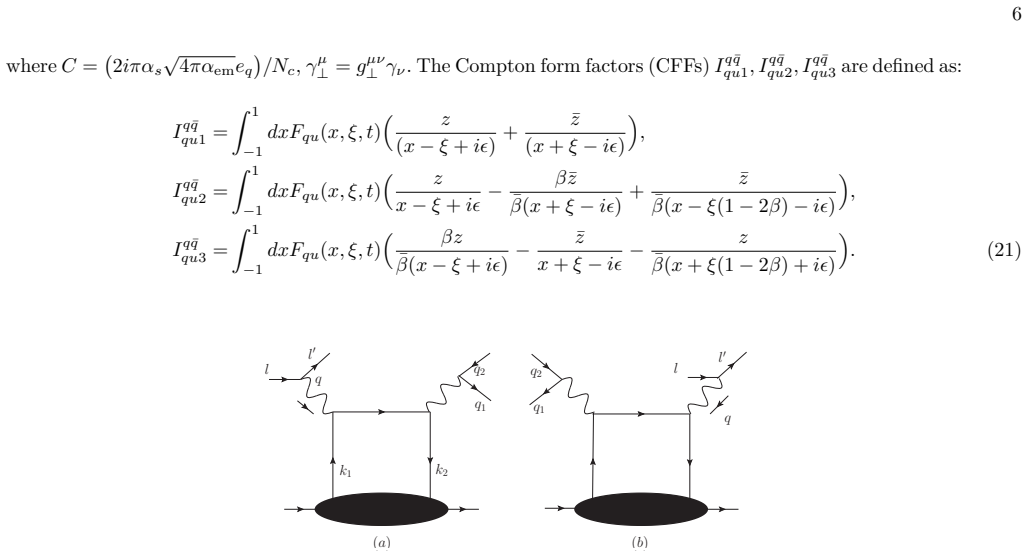
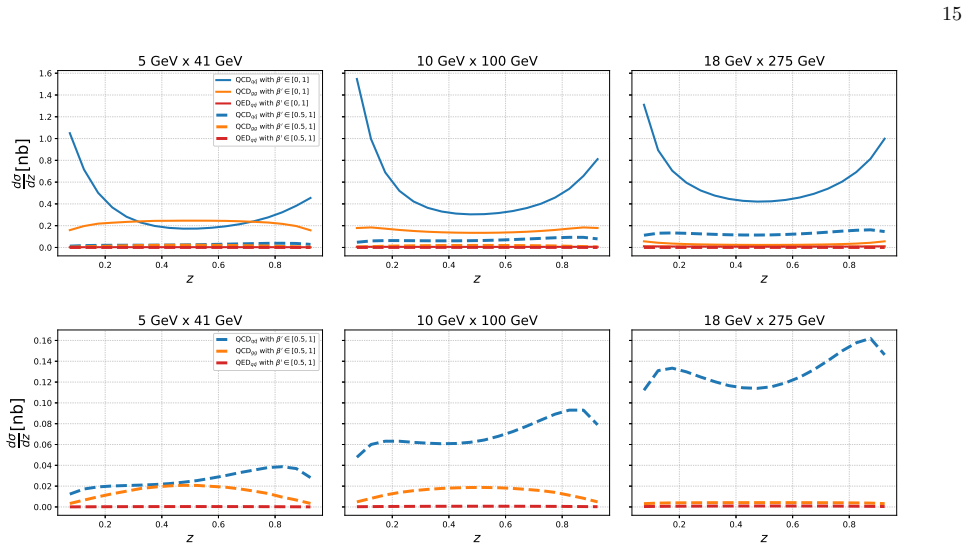
We study exclusive electroproduction of dijets in the collinear factorization framework as a probe of generalized parton distributions (GPDs). For quark dijet production, we extend previous analyses by including contributions from helicity GPDs and by assessing an additional leading-order electromagnetic channel governed by elastic nucleon form factors. Furthermore, we investigate exclusive gluon dijet production. We compare our prediction to HERA data and provide projections for measurements at the future Electron-Ion Collider.
Figures






discussion (0)
Sign in with ORCID, Apple, or X to comment. Anyone can read and Pith papers without signing in.