REVIEW 3 major objections 5 minor 60 references
The spin-dependent correction to the quark-antiquark potential in the quark-gluon plasma is complex, and its imaginary part rivals or exceeds the static potential's imaginary part for charmonium, implying channel-dependent quarkonium therma
Reviewed by Pith at T0; open to challenge. T0 means a machine referee read the full paper against a public rubric. the ladder, T0–T4 →
T0 review · deepseek-v4-flash
2026-08-01 06:52 UTC pith:4KQDDLKX
load-bearing objection First nonperturbative extraction of a thermal spin-dependent potential, with a credible complex-potential signal, but the quantitative charmonium-dominance claim rests on an untested log-sin ansatz. the 3 major comments →
Lattice study of spin interactions between heavy quarks in the quark-gluon plasma
The pith
A machine-rendered reading of the paper's core claim, the machinery that carries it, and where it could break.
Core claim
The central claim is that the 1/M^2 spin-dependent potential in the quark-gluon plasma is complex, and that its imaginary part—which controls spin-channel-dependent Landau damping—is remarkably significant: for charm quarks it dominates the imaginary part of the static potential for rT less than about 1.2, and for bottom quarks for rT less than about 0.38. This is the first nonperturbative, continuum-extrapolated and renormalized lattice determination of this spin potential, obtained from Wilson-line correlators with two chromomagnetic field insertions.
What carries the argument
The key object is the spin-dependent correlator W_BB(r,tau), built from a thermal Wilson loop with two insertions of the chromomagnetic field operator gB (clover-improved on the lattice). The authors parametrize its analytic continuation as A - V_re tau - (beta V_im/pi) log(sin(pi tau/beta)), the same functional form used for the static potential, and extract V_re and V_im by fitting continuum-extrapolated, flow-time-extrapolated, renormalized lattice data. Perturbative hard-thermal-loop and pNRQCD calculations guide the interpretation and the subtraction of short-distance divergences.
Load-bearing premise
The extraction assumes the spin correlator has the same analytic structure as the static Wilson loop—a linear term plus a logarithmic periodic term—so any additional analytic structure, such as non-logarithmic periodic contributions, would change the fitted imaginary part and shift the central significance claim.
What would settle it
Fit the same lattice spin correlators with a generalized ansatz that adds an extra periodic function (for example a second log-sin term with a different coefficient or a cosine term) and check whether the extracted imaginary part changes beyond statistical errors; if it does, the claimed imaginary potential is not uniquely determined.
If this is right
- If the central claim holds, quarkonium spectral functions become channel-dependent: the vector 1S width exceeds the pseudoscalar, even though the pseudoscalar has the larger imaginary potential, because the real part binds the pseudoscalar more strongly.
- Charmonium 1S at 470 MeV acquires a width of roughly 2.3–2.7 GeV, so it would not be a well-defined bound state in this medium; spin interactions worsen its dissolution.
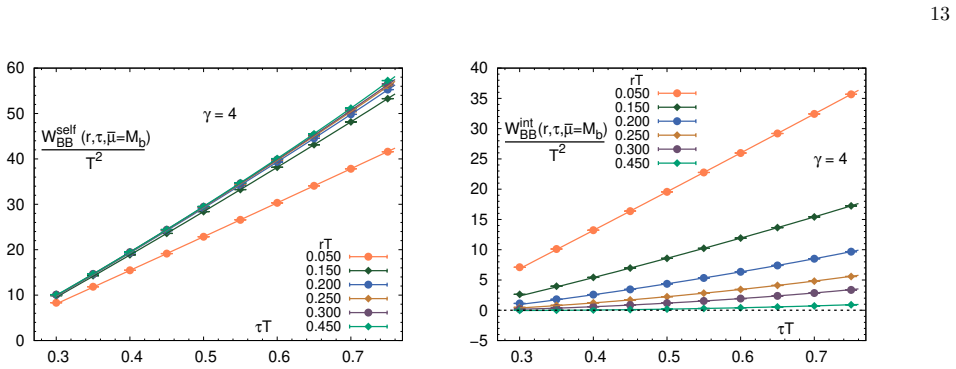
- The imaginary spin potential saturates to a constant at large r for the self part and peaks near rT ~ 0.2 for the interaction part, making the effect most relevant at separations comparable to quarkonium radii.
- A renormalization scale set by the bottom-quark mass gives multiplicative factors ~1.2 (bottom) and ~1.3 (charm), so the lattice result is quantitatively stable only after this running is included.
Where Pith is reading between the lines
- The dominance of the imaginary spin potential at short distances suggests that spin-dependent Landau damping, not just static screening, may be a primary dissolution mechanism for tightly bound charmonium, which would alter naive sequential-suppression scenarios.
- The channel asymmetry—pseudoscalar imaginary part roughly three times the vector at short distances—could show up in quarkonium polarization observables, since the vector channel is the one that produces dileptons.
- The resolution-scale dependence of the real part at rT < 0.2 indicates that quantitative short-distance predictions require a full next-to-leading-order matching; a zero-temperature subtraction using the same lattice action could remove the need for the tree-level regulator subtraction used here.
- The same Wilson-line-plus-chromomagnetic-insertion machinery could be extended to nonzero baryon density or to QCD with dynamical fermions, where the spin potential would modify in-medium heavy-quark diffusion and quarkonium transport.
Editorial analysis
A structured set of objections, weighed in public.
Referee Report
Summary. This paper computes the O(1/M^2) spin-dependent correction to the thermal heavy-quark potential in quenched SU(3) at T = 1.5 T_d ≈ 470 MeV. Starting from the NRQCD Lagrangian, the authors express the spin-dependent correlator in terms of integrated chromomagnetic-field insertions on Wilson lines (Eqs. (7),(8)), derive a leading-order HTL expression with a complex spin potential (Eqs. (19)-(21)), and discuss the short-distance pNRQCD behavior. On the lattice, they use clover-improved B-field insertions, gradient-flow renormalization, continuum estimation from N_tau = 16 and 20, zero-flow-time extrapolation, and a three-parameter fit of the integrated correlator to the ansatz Eq. (30) to extract the real and imaginary parts of the self and interaction spin potentials. They find that the imaginary part is sizable and, for charm quarks, dominates the static imaginary potential at rT ≲ 1.2. They then solve a Schrödinger equation with the complex potential to obtain quarkonium spectral functions, finding spin-dependent enhancement of widths, especially for charmonium.
Significance. If the extraction is reliable, this is the first nonperturbative determination of the 1/M^2 spin correction to the thermal QCD potential and the first demonstration of channel splitting of quarkonium thermal widths from lattice QCD, with direct phenomenological relevance. The paper is transparent: it gives explicit definitions, documents the lattice pipeline, reports fit ranges and χ² values, and states several limitations (resolution scale, NLO hard-gluon effects, short-distance extrapolation). It also provides a concrete HTL expression and a pNRQCD estimate that organize the expected behavior. The central quantitative claim, however, depends on an analytic-continuation ansatz whose validity is not established, and the headline dominance statement relies on an extrapolation beyond the measured distance range.
major comments (3)
- [Sec. V A, Eq. (30)] The ansatz is load-bearing and unsupported. W_BB(r,τ) is not the logarithm of a gauge-invariant correlator; it enters additively in Eq. (5). Unlike the static case, the spectral representation Eq. (29) is not derived from properties of log W_T. The LO HTL expression Eq. (16) contains a p0 integral over ρ_T(p0,p)/p0^2 times periodic functions, and reducing it to a single β V_im/π log sin(πτ/β) requires an additional assumption about ρ_T that is not stated. With only three fit parameters, any further periodic structure—a second logarithm, a periodic constant shift, or a non-logarithmic term—will be absorbed into V_im. The observed γ-independence in Fig. 7 shows cutoff stability, not that the fitted coefficient equals the real-time quantity defined by Eq. (10). I request a closure test: generate synthetic W_BB from Eq. (16) with a known HTL spectral function (or from Eq. (30) plus a contami
- [Sec. VI A and Fig. 9] The abstract's quantitative claim that the spin imaginary part dominates the static one for charmonium at rT ≲ 1.2 is an extrapolation beyond the measured range: the lattice data in Fig. 9 extend only to rT ≈ 0.5. The text itself calls this a 'naive extrapolation' in Sec. VI A. The uncertainty of this extrapolation is not quantified; the crossover distance could shift substantially if the interaction part decays more slowly or the static imaginary part grows faster. The abstract and Sec. VII present this as a robust finding. Please either restrict the claim to the measured range or provide a quantitative estimate of the extrapolation uncertainty.
- [Sec. V B, Eq. (33)] The continuum limit is obtained from only two lattice spacings (N_τ = 16, 20) with a linear 1/N_τ^2 fit. There is no check of the assumed O(a^2) scaling and no systematic error from the continuum-extrapolation ansatz. Since the continuum-estimated correlators are used for all subsequent extractions, the quoted errors omit this systematic uncertainty. At minimum, a third lattice spacing or a conservative estimate based on the difference between the N_τ = 16 data and the extrapolated value should be provided before the results are described as continuum estimates.
minor comments (5)
- [Eqs. (9), (34)] Several equations contain corrupted or garbled symbols (e.g., Eq. (9) around the V_self/V_int terms and Eq. (34) around the interpolation factor). These must be typeset correctly.
- [Sec. V A] The relation Eq. (29) is introduced as a 'naive' generalization; the text should state explicitly that this is a model assumption rather than a derived property, and should discuss what classes of spectral functions are consistent with it.
- [Sec. VI B / Fig. 10] For charmonium the fitted widths Γ ≈ 2.3–2.7 GeV are comparable to the peak position ω ≈ 3 GeV, so the skewed Breit-Wigner form Eq. (47) is being used far outside its natural validity. The widths should be presented with a caveat that they are effective parameters, not literal Breit-Wigner widths.
- [Appendix A 2] The renormalization of the contact term in Eq. (A8) is described compactly. Please clarify the relation between the physical coupling c_phys and the lattice-determined coefficient in Eq. (44), especially the role of Z_q and the scheme dependence.
- [Sec. IV B] The use of Coulomb-gauge Wilson-line correlators rather than gauge-invariant Wilson loops for the spin-dependent observables should be justified more explicitly; the cited arguments are for the static potential, and the spin correlator involves additional operator insertions.
Circularity Check
No significant circularity: the spin-potential extraction is an explicitly labeled ansatz fit to independent lattice correlator data; the downstream spectral functions are applications, not circular inputs.
full rationale
The paper's central claim—that the spin-dependent thermal potential has a significant imaginary part—is obtained by fitting Euclidean spin-correlator data to the parametrization W_BB(r,τ)=A_spin−V_re^spin τ−(β V_im^spin/π) log(sin(πτ/β)) (Eq. 30). The authors explicitly call this a 'naive' generalization of the static-potential ansatz (Sec. V A), and they note that 'Eq.(29) does not involve the logarithm of the W_BB correlator.' Thus the extraction is model-dependent, but it is not circular: the imaginary potential is defined independently in Eq. (10) via analytic continuation, and the fitted coefficient is not re-used to construct the input of the same fit. The HTL and pNRQCD calculations are used for motivation and qualitative comparison, not to tune the lattice numbers. The quarkonium spectral functions are downstream applications of the extracted potential, not independent predictions used to validate the fit. There are self-citations—[29,30] are cited to justify the static-potential analytic structure, and [49] (same authors) for a similar form—but these are supporting methodology, not a chain that forces the result. The main caveat is a correctness/model risk: if the true spin correlator contains additional periodic structure beyond the log-sin form, the fitted V_im would not equal the real-time potential of Eq. (10). The paper itself flags the ansatz as naive, so this is an acknowledged limitation rather than a hidden circularity. Overall, no load-bearing reduction to the inputs was found.
Axiom & Free-Parameter Ledger
free parameters (6)
- Resolution scale epsilon = gamma * Delta_tau =
gamma = 4, 5, 6 with Delta_tau T = 0.05
- Spin-correlator fit parameters A_spin(r), V_re_spin(r), V_im_spin(r) =
Fit to lattice data; values shown in Figs. 5-7
- HTL magnetic mass m_T =
m_T ~ g^2 T/pi (estimate)
- Charm quark pole mass M_c =
1.35 GeV
- Static-potential additive constant c =
Fixed by spin-averaged 1S bottomonium mass 9.4449 GeV
- Cornell zero-temperature potential parameters (alpha, sigma, c) =
Fit to lattice data at 0.75 T_d
axioms (7)
- domain assumption NRQCD hierarchy M >> T, Lambda_QCD is valid for the heavy quarks considered.
- domain assumption A thermal potential exists and is defined by the long-time limit of the analytically continued correlator.
- ad hoc to paper The spin correlator has the analytic structure of Eq. (29)-(30): linear term plus beta V_im/pi log(sin(pi tau/beta)).
- ad hoc to paper The continuum limit is dominated by O(a^2) cutoff effects, so a two-point linear fit in 1/N_tau^2 is sufficient.
- domain assumption Gradient-flow matching at NLO (Eq. (35)) and linear zero-flow-time extrapolation (Eq. (37)) correctly remove the UV regularization.
- ad hoc to paper Subtracting the tree-level divergent term of Eq. (42) removes the dominant divergence of the self spin potential; residual NLO hard-gluon effects are negligible for rT >= 0.2.
- domain assumption The pNRQCD expectation that thermal spin-potential corrections vanish linearly at short distances is used for extrapolation.
invented entities (1)
-
Non-perturbative magnetic mass m_T
no independent evidence
read the original abstract
We calculate the spin-dependent potential, which is the $\mathcal{O}(1/M^2)$ correction term to the thermal potential between a static quark-antiquark pair within non-relativistic QCD. At leading order in hard thermal loop perturbation theory, we show that this spin-dependent potential has an imaginary part which is different in magnitude for pseudoscalar and vector quarkonium states. For the first time, we extract the imaginary part non-perturbatively using lattice techniques, in the deconfined phase of quenched QCD at $T\sim 470$ MeV, after performing a continuum estimation and subsequent renormalization. We have found that the spin-dependent potential in the quark-gluon plasma phase is complex, and its imaginary part has a remarkably significant contribution over the thermal static potential for charmonium states. Consequences of this thermal spin-dependent potential on the quarkonium spectral functions are also discussed.
Figures




Reference graph
Works this paper leans on
-
[1]
Static potential We describe the details of the calculation of the thermal static heavy quark-antiquark potential and discuss how we calculate the additive constant in the real part of this potential for performing the comparison shown in Fig. 8. To ascertain the additive constant, we also need to calculate the potential at zero temperature. The ensembles...
-
[2]
The termδV(r)=c δ 3(⃗r)denotes the contact term arising from the spin interaction
Computing the spectral function In order to calculate the spectral functionρ(ω)for a quarkonium state we have to first determine the correlation function Ψ(ω; ⃗r, ⃗r′)from the following equation [31], [ω−2M+ ∇2 M −V(r)−δV(r)]Ψ(ω; ⃗r, ⃗r′)=λ δ(3)(⃗r− ⃗r′).(A3) whereλdepends on the spin structure of the state. The termδV(r)=c δ 3(⃗r)denotes the contact term...
-
[3]
D. J. Gross, R. D. Pisarski, and L. G. Yaffe, QCD and Instantons at Finite Temperature, Rev. Mod. Phys.53, 43 (1981)
1981
-
[4]
E. V. Shuryak, Correlation functions in the QCD vacuum, Rev. Mod. Phys.65, 1 (1993)
1993
-
[5]
X.-N. Wang and U. A. Wiedemann, QGP@50: More than Four Decades of Jet Quenching (2025) arXiv:2508.18794 [hep-ph]
Pith/arXiv arXiv 2025
-
[6]
J. D. Bjorken, Highly Relativistic Nucleus-Nucleus Collisions: The Central Rapidity Region, Phys. Rev. D27, 140 (1983)
1983
-
[7]
L. D. McLerran, The Physics of the Quark - Gluon Plasma, Rev. Mod. Phys.58, 1021 (1986)
1986
-
[8]
J. D. Bjorken, Energy loss of energetic partons in quark-gluon plasma: Possible extinction of high pt jets in hadron-hadron collisions, FERMILAB-PUB-82-059-THY (1982)
1982
-
[9]
Ollitrault, Anisotropy as a signature of transverse collective flow, Phys
J.-Y. Ollitrault, Anisotropy as a signature of transverse collective flow, Phys. Rev. D46, 229 (1992)
1992
-
[10]
E. V. Shuryak, Quark-Gluon Plasma and Hadronic Production of Leptons, Photons and Psions, Phys. Lett. B78, 150 (1978)
1978
-
[11]
P. Koch, B. Muller, and J. Rafelski, Strangeness in Relativistic Heavy Ion Collisions, Phys. Rept.142, 167 (1986)
1986
-
[12]
Matsui and H
T. Matsui and H. Satz, J/psi suppression by quark-gluon plasma formation, Physics Letters B178, 416 (1986)
1986
-
[13]
A. Mocsy, P. Petreczky, and M. Strickland, Quarkonia in the Quark Gluon Plasma, Int. J. Mod. Phys. A28, 1340012 (2013), arXiv:1302.2180 [hep-ph]
Pith/arXiv arXiv 2013
-
[14]
V. Khachatryanet al.(CMS), Suppression of Υ(1S),Υ(2S)and Υ(3S)production in PbPb collisions at √sNN = 2.76 TeV, Phys. Lett. B770, 357 (2017), arXiv:1611.01510 [nucl-ex]
Pith/arXiv arXiv 2017
-
[15]
B. Aboonaet al.(STAR), Observation of sequential Υ suppression in Au+Au collisions at √sNN = 200 GeV with the STAR experiment, Phys. Rev. Lett.130, 112301 (2023), arXiv:2207.06568 [nucl-ex]
arXiv 2023
-
[16]
Acharyaet al.(ALICE),ψ(2S) Suppression in Pb-Pb Collisions at the LHC, Phys
S. Acharyaet al.(ALICE),ψ(2S) Suppression in Pb-Pb Collisions at the LHC, Phys. Rev. Lett.132, 042301 (2024), arXiv:2210.08893 [nucl-ex]
Pith/arXiv arXiv 2024
-
[17]
B. A. Thacker and G. P. Lepage, Heavy quark bound states in lattice QCD, Phys. Rev. D43, 196 (1991)
1991
-
[18]
Brambilla, A
N. Brambilla, A. Pineda, J. Soto, and A. Vairo, Effective field theories for heavy quarkonium, Reviews of Modern Physics 77, 1423 (2005)
2005
-
[19]
Brambilla, A
N. Brambilla, A. Pineda, J. Soto, and A. Vairo, Potential nrqcd: An effective theory for heavy quarkonium, Nuclear Physics B566, 275 (2000)
2000
-
[20]
G. S. Bali and K. Schilling, Static quark - anti-quark potential: Scaling behavior and finite size effects in SU(3) lattice gauge theory, Phys. Rev. D46, 2636 (1992)
1992
-
[21]
G. S. Bali, QCD forces and heavy quark bound states, Phys. Rept.343, 1 (2001), arXiv:hep-ph/0001312
Pith/arXiv arXiv 2001
-
[22]
S. P. Booth, D. S. Henty, A. Hulsebos, A. C. Irving, C. Michael, and P. W. Stephenson (UKQCD), The Running coupling from SU(3) lattice gauge theory, Phys. Lett. B294, 385 (1992), arXiv:hep-lat/9209008
Pith/arXiv arXiv 1992
-
[23]
U. Glassner, S. Gusken, H. Hoeber, T. Lippert, G. Ritzenhofer, K. Schilling, G. Siegert, A. Spitz, and A. Wachter (TXL), First evidence of N(f) dependence in the QCD interquark potential, Phys. Lett. B383, 98 (1996), arXiv:hep-lat/9604014
Pith/arXiv arXiv 1996
-
[24]
Kaczmarek and F
O. Kaczmarek and F. Zantow, Static quark-antiquark interactions in zero and finite temperature qcd: I. heavy quark free energies, running coupling, and quarkonium binding, Phys. Rev. D71, 114510 (2005)
2005
-
[25]
M. B. Voloshin, Charmonium, Prog. Part. Nucl. Phys.61, 455 (2008), arXiv:0711.4556 [hep-ph]
Pith/arXiv arXiv 2008
- [26]
-
[27]
N. Brambilla, J. Ghiglieri, A. Vairo, and P. Petreczky, Static quark-antiquark pairs at finite temperature, Phys. Rev. D 78, 014017 (2008), arXiv:0804.0993 [hep-ph]
Pith/arXiv arXiv 2008
-
[28]
A. Rothkopf, T. Hatsuda, and S. Sasaki, Complex Heavy-Quark Potential at Finite Temperature from Lattice QCD, Phys. Rev. Lett.108, 162001 (2012), arXiv:1108.1579 [hep-lat]
Pith/arXiv arXiv 2012
-
[29]
Y. Burnier, O. Kaczmarek, and A. Rothkopf, Static quark-antiquark potential in the quark-gluon plasma from lattice QCD, Phys. Rev. Lett.114, 082001 (2015), arXiv:1410.2546 [hep-lat]
Pith/arXiv arXiv 2015
-
[30]
Y. Burnier, O. Kaczmarek, and A. Rothkopf, Quarkonium at finite temperature: Towards realistic phenomenology from first principles, JHEP12, 101, arXiv:1509.07366 [hep-ph]
-
[31]
D. Bala and S. Datta, Nonperturbative potential for the study of quarkonia in QGP, Phys. Rev. D101, 034507 (2020), arXiv:1909.10548 [hep-lat]
Pith/arXiv arXiv 2020
-
[32]
S. Ali, D. Bala, O. Kaczmarek, and Pavan (HotQCD), Thermal static potential and pseudoscalar quarkonium spectral functions from (2+1)-flavor lattice QCD, Phys. Rev. D112, 054510 (2025), arXiv:2505.11313 [hep-lat]
Pith/arXiv arXiv 2025
-
[33]
Y. Burnier, M. Laine, and M. Vepsalainen, Heavy quarkonium in any channel in resummed hot QCD, JHEP01, 043, arXiv:0711.1743 [hep-ph]
-
[34]
Y. Burnier, H. T. Ding, O. Kaczmarek, A. L. Kruse, M. Laine, H. Ohno, and H. Sandmeyer, Thermal quarkonium physics in the pseudoscalar channel, JHEP11, 206, arXiv:1709.07612 [hep-lat]
-
[35]
G. S. Bali, K. Schilling, and A. Wachter, Ab initio calculation of relativistic corrections to the static interquark potential. 1: SU(2) gauge theory, Phys. Rev. D55, 5309 (1997), arXiv:hep-lat/9611025. 22
Pith/arXiv arXiv 1997
-
[36]
G. S. Bali, K. Schilling, and A. Wachter, Complete O (v**2) corrections to the static interquark potential from SU(3) gauge theory, Phys. Rev. D56, 2566 (1997), arXiv:hep-lat/9703019
Pith/arXiv arXiv 1997
-
[37]
Y. Koma and M. Koma, Spin-dependent potentials from lattice QCD, Nucl. Phys. B769, 79 (2007), arXiv:hep-lat/0609078
Pith/arXiv arXiv 2007
-
[38]
A. Laschka, N. Kaiser, and W. Weise, Quark-antiquark potential to order 1/m and heavy quark masses, Phys. Rev. D83, 094002 (2011), arXiv:1102.0945 [hep-ph]
Pith/arXiv arXiv 2011
-
[39]
S. Acharyaet al.(ALICE), Measurement of the J/ψPolarization with Respect to the Event Plane in Pb-Pb Collisions at the LHC, Phys. Rev. Lett.131, 042303 (2023), arXiv:2204.10171 [nucl-ex]
Pith/arXiv arXiv 2023
-
[40]
M. E. Luke and A. V. Manohar, Reparametrization invariance constraints on heavy particle effective field theories, Phys. Lett. B286, 348 (1992), arXiv:hep-ph/9205228
Pith/arXiv arXiv 1992
-
[41]
D.-L. Yang and X. Yao, Quarkonium polarization in medium from open quantum systems and chromomagnetic correlators, Phys. Rev. D110, 074037 (2024), arXiv:2405.20280 [hep-ph]
Pith/arXiv arXiv 2024
-
[42]
N. Brambilla, S. Datta, M. Janer, V. Leino, J. Mayer-Steudte, P. Petreczky, and A. Vairo (TUMQCD), Lattice study of correlators of chromoelectric fields for heavy quarkonium dynamics in the quark-gluon plasma, Phys. Rev. D112, 074509 (2025), arXiv:2505.16603 [hep-lat]
Pith/arXiv arXiv 2025
-
[43]
A. Francis, O. Kaczmarek, M. Laine, T. Neuhaus, and H. Ohno, Critical point and scale setting in SU(3) plasma: An update, Phys. Rev. D91, 096002 (2015), arXiv:1503.05652 [hep-lat]
Pith/arXiv arXiv 2015
-
[44]
Sommer, Scale setting in lattice QCD, PoSLA TTICE2013, 015 (2014), arXiv:1401.3270 [hep-lat]
R. Sommer, Scale setting in lattice QCD, PoSLA TTICE2013, 015 (2014), arXiv:1401.3270 [hep-lat]
Pith/arXiv arXiv 2014
-
[45]
A. Ramos and S. Sint, Symanzik improvement of the gradient flow in lattice gauge theories, Eur. Phys. J. C76, 15 (2016), arXiv:1508.05552 [hep-lat]
Pith/arXiv arXiv 2016
-
[46]
L. Giusti, M. L. Paciello, C. Parrinello, S. Petrarca, and B. Taglienti, Problems on lattice gauge fixing, Int. J. Mod. Phys. A16, 3487 (2001), arXiv:hep-lat/0104012
Pith/arXiv arXiv 2001
-
[47]
Philipsen, Nonperturbative formulation of the static color octet potential, Phys
O. Philipsen, Nonperturbative formulation of the static color octet potential, Phys. Lett. B535, 138 (2002), arXiv:hep- lat/0203018
arXiv 2002
-
[48]
Philipsen, On the nonperturbative gluon mass and heavy quark physics, Nucl
O. Philipsen, On the nonperturbative gluon mass and heavy quark physics, Nucl. Phys. B628, 167 (2002), arXiv:hep- lat/0112047
arXiv 2002
-
[49]
Y. Burnier and A. Rothkopf, A hard thermal loop benchmark for the extraction of the nonperturbativeQ ¯Qpotential, Phys. Rev. D87, 114019 (2013), arXiv:1304.4154 [hep-ph]
Pith/arXiv arXiv 2013
-
[50]
D. Bala and S. Datta, Interaction potential between heavyQ Qin a color octet configuration in the QGP from a study of hybrid Wilson loops, Phys. Rev. D103, 014512 (2021), arXiv:2009.00773 [hep-lat]
Pith/arXiv arXiv 2021
-
[51]
J. Goswami, D. Bala, and O. Kaczmarek, Thermal static Potential at Finite Density in (2+1)-flavor QCD, in42th Inter- national Symposium on Lattice Field Theory(2026) arXiv:2603.29687 [hep-lat]
arXiv 2026
-
[52]
Stendebach,Perturbative analysis of operators under improved gradient flow in lattice QCD, Ph.D
S. Stendebach,Perturbative analysis of operators under improved gradient flow in lattice QCD, Ph.D. thesis, TU Darmstadt (2022)
2022
-
[53]
H. B. Meyer, Cutoff Effects on Energy-Momentum Tensor Correlators in Lattice Gauge Theory, JHEP06, 077, arXiv:0904.1806 [hep-lat]
-
[54]
D. de la Cruz, A. M. Eller, and G. D. Moore, QCD field-strength correlators on a Polyakov loop with gradient flow at next-to-leading order, Phys. Rev. D110, 094057 (2024), arXiv:2410.01578 [hep-ph]
Pith/arXiv arXiv 2024
-
[55]
N. Brambilla and X.-P. Wang, Off-lightcone Wilson-line operators in gradient flow, JHEP06, 210, arXiv:2312.05032 [hep-ph]
-
[56]
Navaset al.(Particle Data Group), Review of particle physics, Phys
S. Navaset al.(Particle Data Group), Review of particle physics, Phys. Rev. D110, 030001 (2024)
2024
-
[57]
Laine, 1-loop matching of a thermal Lorentz force, JHEP06, 139, arXiv:2103.14270 [hep-ph]
M. Laine, 1-loop matching of a thermal Lorentz force, JHEP06, 139, arXiv:2103.14270 [hep-ph]
-
[58]
L. D. McLerran and T. Toimela, Photon and dilepton emission from the quark-gluon plasma: Some general considerations, Phys. Rev. D31, 545 (1985)
1985
-
[59]
Mazuret al.(HotQCD), SIMULATeQCD: A simple multi-GPU lattice code for QCD calculations, Comput
L. Mazuret al.(HotQCD), SIMULATeQCD: A simple multi-GPU lattice code for QCD calculations, Comput. Phys. Commun.300, 109164 (2024), arXiv:2306.01098 [hep-lat]
Pith/arXiv arXiv 2024
-
[60]
R. Sommer, A New way to set the energy scale in lattice gauge theories and its applications to the static force andα s in SU(2) Yang-Mills theory, Nucl. Phys. B411, 839 (1994), arXiv:hep-lat/9310022
Pith/arXiv arXiv 1994
discussion (0)
Sign in with ORCID, Apple, or X to comment. Anyone can read and Pith papers without signing in.