REVIEW 3 major objections 5 minor 7 references
Exposure of Track Detectors in Xenon Ion Beams in NICA Accelerator Complex
T0 review · 3 major / 5 minor · reviewed 2026-08-12 · deepseek-v4-flash
Pith's one-line read By etching CR39 plastic exposed to xenon ion beams, the paper reconstructs beam profiles and intensities, finding the BM@N beam to be an ellipse with semi-axes of about 16 mm and 8 mm.
desk verdict A straightforward, useful exposure report: the Xe tracks are clearly registered, but the beam-profile numbers are uncalibrated and should be treated as preliminary. read the letter →
The pith
A machine-rendered reading of the paper's core claim, the machinery that carries it, and where it could break.
The reading
What carries the argument
The central object is the CR39 solid-state track detector, a plastic made of allyl diglycol carbonate. A passing heavy ion leaves a latent track; chemical etching erodes the damaged region faster than the undamaged plastic, producing conical pits visible under an optical microscope. A motorized Olympus BX63 microscope with panoramic stitching and focus mapping converts the etched surface into a track-density map, and the positions of track entry and exit through the 1-mm-thick plate give the incidence angle.
What would settle it
Expose a CR39 plate simultaneously with an electronic beam profile monitor (for example a scintillating screen or a wire chamber) at the same location in the same xenon beam, then compare the track-density ellipse (semi-axes, tilt) and the integrated track count with the monitor's reading.
Extended reading notes
Core claim
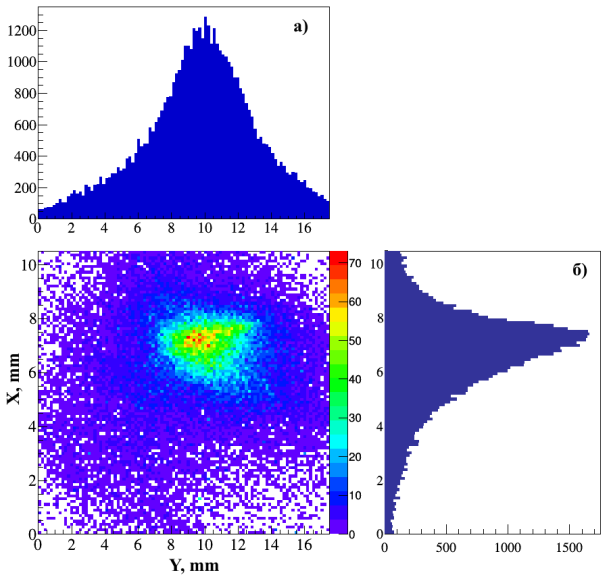
On the paper's own terms, the central claim is that the CR39 solid-state track detector, after etching in NaOH at 85 °C for 20 minutes, records individual xenon ions as ~10-micrometer pits, and automatic optical scanning converts these pits into a faithful beam profile. From the track-density map the authors read the BM@N beam ellipse (semi-axes about 16 mm and 8 mm, tilt about 45° in the XY plane) and the beam incidence angle relative to the detector normal (2.57 ± 0.12 degrees). For low-energy beams, the same technique reconstructs the focused beam profile in a single discharge cycle. The nuclear photoemulsion independently records relativistic xenon tracks and peripheral fragmentation events, providing a complementary visual record of the beam.
Load-bearing premise
The track density on the etched CR39 surface is taken to be the true spatial distribution of the beam, which requires one detectable pit per incident ion, uniform etching and scanning efficiency across the 50x50 mm sample, and no lost tracks due to overlap or saturation at fluxes around $10^{6}$ ions.
Editorial extensions
If this is right
- If the method is correct, passive film detectors can serve as a simple, high-resolution, dead-time-free beam profiler for heavy-ion beams at NICA and similar facilities.
- The measured ellipse dimensions and tilt provide direct input for beam optics tuning and for verifying the beam transport at the BM@N target point.
- The technique can be extended to other ion species and energies by adjusting etching conditions, making it a general tool for accelerator diagnostics.
- The photoemulsion records of peripheral xenon interactions will support the BECQUEREL analysis of α-particle and nucleon clustering in relativistic fragmentation.
Reading between the lines
- The paper does not compare the CR39 track map with an electronic beam monitor, so the method's quantitative accuracy remains unbenchmarked; a co-exposure experiment would settle it.
- The ~45-degree ellipse tilt and the 2.57-degree incidence angle likely reflect the beam optics or the SP41 dipole deflection, and could be used for detector alignment.
- Because track pit size depends on ionization energy loss, the CR39 data may allow charge or energy discrimination even though this paper does not exploit it.
- The 'BMN' marking artifact shows that surface markings are imaged alongside tracks, which could be turned into a coordinate reference for aligning multiple detectors.
Editorial analysis
A structured set of objections, weighed in public.
Referee Report
Summary. The paper reports the irradiation and analysis of CR39 solid-state track detectors and nuclear photoemulsion plates exposed to xenon ion beams at the NICA accelerator complex: 124Xe+28 ions at 3.2 MeV/n at the SOCHI station and 124Xe+54 ions at 3.8 GeV/n at the F3 point and the BM@N experimental area. For the relativistic beam at BM@N, the authors present a track-density map obtained from an etched CR39 sample and derive an elliptical beam core with major and minor semi-axes of about 16 mm and 8 mm, a tilt of about 45 degrees, and a beam incidence angle of 2.57 ± 0.12 degrees. For the low-energy SOCHI beam, they show a track distribution with two projections. They also show micrographs of relativistic xenon tracks in nuclear photoemulsion, including a peripheral interaction with multiple projectile fragments. The paper concludes that profiles and intensities of the low-energy beams were reconstructed and that profilometric measurements of the relativistic beams were performed.
Significance. If the quantitative claims are supported, this is a useful proof-of-principle demonstration that CR39 and nuclear photoemulsion can serve as low-cost, high-spatial-resolution beam profilers for heavy-ion beams at NICA, complementing electronic beam diagnostics. The direct visual evidence of individual xenon tracks — in both CR39 and emulsion — is convincing and documents successful detector exposure. The paper is concise and its scope is appropriate for a technical instrumentation letter. The main value is as an early benchmark for track-detector-based profilometry at NICA, and the displayed micrographs of peripheral xenon interactions will be of interest to the relativistic-fragmentation community. No machine-checked proofs or reproducible code are involved; the quantitative conclusions rest on uncalibrated track-count maps, which is the main weakness addressed below.
major comments (3)
- [Section III, Fig. 2] The quantitative beam parameters (ellipse semi-axes of about 16 mm and 8 mm, 45-degree tilt, and the 10^3 mm^-2 density contour) are read directly from the automatic track-recognition map without a calibration of detection efficiency, a threshold-dependence study, or a cross-check against electronic beam diagnostics. The quoted total flux of about 10^6 ions comes from machine parameters, not from the detector, so the track-density map is not independently normalized. At the stated core density of 10^3 pits/mm^2 with 10-µm pits, overlap losses are non-negligible (roughly 8% areal coverage), and the visible "BMN" inscription is neither masked nor subtracted. The ellipse dimensions should either be supported by an efficiency/threshold analysis or explicitly presented as preliminary estimates rather than calibrated profilometry.
- [Section III, Fig. 3] The Conclusion states that the profiles and intensities of the low-energy SOCHI beam were reconstructed, but Fig. 3 contains no color scale, no axis calibration, and the projections in the insets have no labeled axis units. As presented, the figure supports only the statement that tracks were registered. Please add quantitative color and axis scales and give the corresponding track-density values, or limit the SOCHI claim to successful track registration.
- [Section III, beam-angle measurement] The quoted angle Θ = 2.57 ± 0.12 degrees is derived from matching entry and exit tracks in a 1-mm-thick sample, but the paper does not state how this uncertainty was obtained or how systematic effects (track-position shifts during etching, stitching errors in the panoramic scan, or the matching algorithm itself) were treated. Since the angle is a quantitative result, the uncertainty budget or a statement that the value is a preliminary estimate should be provided.
minor comments (5)
- [Section IV] The text "Events of peripheral interactions of nuclei in NEE" should read "NTE" rather than "NEE".
- [References] Reference [1] lists "Picuz Jr." as an author; this appears to be a typo for "Pikuz Jr." and should be corrected.
- [Throughout] The charge notation "124Xe+28" and "124Xe+54" would be clearer as "124Xe^28+" and "124Xe^54+" to avoid confusion between charge state and mass number.
- [Section II] The phrase "absence of detector dead time and registration efficiency" is ambiguous; it should be rephrased to say that the method has no dead time and that the registration efficiency can be made high, rather than implying zero efficiency.
- [Figures] Figure 2 would benefit from an explicit scale bar and a color bar with numerical values, and Fig. 3 needs labeled axes on the projections; these additions would make the quantitative claims more transparent.
Circularity Check
No circularity: the reported beam profiles are direct track-count observations, not outputs of a derivation that reuses its inputs.
full rationale
The paper contains no fitted model, no parameter calibration, and no prediction derived from a prior result. The central quantities—the spatial track distribution in Fig. 2, the beam ellipse semi-axes of about 16 mm and 8 mm, the roughly 45-degree tilt, the rotation angle of 2.57 ± 0.12 degrees, and the low-energy SOCHI profile in Fig. 3—are read directly from microscope panoramic images of etched CR39 and from track entry/exit coordinates. The only self-citation is Ref. [4], which identifies the SOCHI station; it is background context, not a load-bearing premise. The statement that profiles and intensities were reconstructed is simply a description of automatic track recognition and plotting; no input quantity is redefined as an output. The absence of an efficiency calibration or a comparison with an electronic beam monitor is a validation concern, because pit density is assumed to map one-to-one to beam flux, but it is not a circularity: the observed pit density is the measurement itself, not a fitted parameter renamed as a prediction. The paper does not invoke any uniqueness theorem or ansatz from prior work, and it does not present a mathematical derivation whose conclusion equals its premise. Therefore the circularity score is 0.
Assumptions & free parameters
assumptions (3)
- domain assumption CR39 track density after etching is proportional to local ion fluence, with each ion producing one observable pit.
- domain assumption Etching and scanning conditions reveal the full latent track population without significant loss or overlap.
- domain assumption Nuclear photoemulsion registers relativistic Xe tracks with a recognizable delta-electron plume and peripheral interaction signature.
Cite this review
Pith. "Pith review of Exposure of Track Detectors in Xenon Ion Beams in NICA Accelerator Complex." pith.science (2026). https://pith.science/paper/4NYW5FKK
@misc{pith2026241200141,
  author       = {Pith},
  title        = {Pith review of: Exposure of Track Detectors in Xenon Ion Beams in NICA Accelerator Complex},
  year         = {2026},
  howpublished = {\url{https://pith.science/paper/4NYW5FKK}},
  note         = {Machine review of arXiv:2412.00141}
}
read the original abstract
The results of the analysis of solid-state track detectors CR39 and nuclear photoemulsion plates irradiated in beams of accelerated xenon ions with energies of 3.2 MeV/n and 3.8 GeV/n at the NICA accelerator complex are presented.
Figures


Figures from the paper (3 more)


Reference graph
Works this paper leans on
-
[1]
Picuz Jr. S.A., Skobelev I.Yu., Faenov A.Ya., Lavrinenko Ya.S., Belyaev V.S., Klyushnikov V.Yu., Matafonov A.P., Rusetsky A.S., Ryazantsev S. N. and Bakhmutova A.V. //Thermal physics of high temperatures. 2016. Vol. 54. No. 3. P. 453-474
work page 2016
-
[2]
Jadrn ´ ıˇ ckov´ a I., Spurn´ y F., Molokanov Aleksandr // Physics of Particles and Nuclei, Letters
-
[3]
Kodaira S., Yasuda N., Kawashima H., Kurano M., Hasebe N., Doke T., Ota S. and Ogura K. // Radiation measurements 2009. V. 44. No. 9-10. P. 861-864
work page 2009
-
[4]
The stack with one dump cycle turned out to be optimal in terms of the density of Xe nuclei tracks in the NTE volume. The second irradiation was carried out in the experimental zone of the BM@N facility [5] between the cathode-strip chamber and the hadron calorimeter. The irradiation was carried 5 FIG. 3. Distribution of incoming tracks of a focused beam ...
-
[5]
G. A. Filatov 1, A. A. Slivin, E. M. Syresin, A. V. Butenko, A. S. Vorozhtsov, A. V. Agapov, K. N.Shipulin, S. Yu. Kolesnikov, V. N. Karpinsky, M. I. Kuznetsov, S. V. Kirov, A. V. Sergeev, A. R. Galimov, A. M. Tikhomirov, V. And . Tyulkin, D. S. Letkin, D. Oh. Leushin, A. V. Tuzikov // Physics of Particles and Nuclei, Letters 2022. Vol. 19, No 5(244). J. 412-417
work page 2022
-
[6]
(BM@N Collaboration) // Physics of Atomic Nuclei
Mamaev M. (BM@N Collaboration) // Physics of Atomic Nuclei. 2023. V. 86. No. 6. PP. 1346-1353
work page 2023
-
[7]
Web page of the BECQUEREL experiment: becquerel.jinr.ru. 9
Reviewed August 12, 2026 · model on record in the stance chip above.
Discussion (0). Continue with ORCID to comment.