REVIEW 3 major objections 5 minor 115 references
Methane on the temperate exo-Saturn TOI-199b
T0 review · 3 major / 5 minor · reviewed 2026-08-03 · deepseek-v4-flash
Pith's one-line read A JWST transmission spectrum of the temperate exo-Saturn TOI-199 b shows a strong methane feature, the first such detection in a gas giant cooler than 400 K.
desk verdict Plausible first methane detection in a temperate gas giant, but the broken pointing and single transit mean it needs a confirmatory observation. read the letter →
The pith
A machine-rendered reading of the paper's core claim, the machinery that carries it, and where it could break.
The reading
What carries the argument
Transmission spectroscopy with JWST NIRSpec G395M (R ~ 1000) provides the measured transit-depth spectrum. The analysis relies on two independent Bayesian retrieval frameworks that convert the spectrum into gas abundances and cloud/haze properties, and on self-consistent radiative-convective-photochemical models that predict abundance profiles (e.g., CH4 vs CO, NH3 vs HCN) as functions of metallicity and vertical mixing. A common-mode noise correction, applied to data taken with a failed target acquisition, is the device that makes the extraction possible; it is also the main assumption on which the CH4 detection rests.
What would settle it
A specific test: re-reduce the raw data with a systematics model that allows the egress jump and pointing drift to vary independently per wavelength channel (no common-mode division), and check whether the 3.2–3.7 µm methane feature and its Bayes factor persist; if the feature weakens substantially, the detection is an artifact of the common-mode assumption.
Extended reading notes
Core claim
The central claim is that the 3.2–3.7 µm region of TOI-199 b's transmission spectrum is dominated by CH4 absorption, with a retrieved mixing ratio of roughly 10^-2.5 and a Bayes factor near 700 relative to a CH4-free model. The same spectrum shows an upturn near 3 µm that could be due to NH3 or, less likely, HCN; self-consistent photochemical models suggest the relative strength of these features depends on vertical mixing (Kzz), so future data can distinguish them. The paper also argues that the planet's metallicity is near 10–50 times solar, not much higher, because high metallicity would make CO and CO2 detectable, which they are not.
Load-bearing premise
The load-bearing premise is that the instrumental noise from the failed pointing is wavelength-independent (achromatic), so dividing each spectral light curve by a common-mode model removes the systematics without creating artificial spectral features; if that noise is wavelength-dependent, the methane signal near 3.3 µm could be an artifact.
Editorial extensions
If this is right
- If the methane detection holds, temperate gas giants can be characterized with transmission spectroscopy, and their carbon abundances can be measured to constrain formation pathways.
- The non-detection of CO and CO2 implies that the planet's metallicity is not extremely high, helping to discriminate between different formation and accretion scenarios.
- The 3-µm feature, once attributed to NH3 versus HCN, will directly diagnose the vertical mixing coefficient Kzz in a temperate giant for the first time.
- The updated transit-timing model reduces the mass uncertainty of the outer planet c by about 50% and improves orbital constraints, which matters for scheduling future JWST and ground-based observations.
- The predicted transit times through 2040 enable efficient planning of follow-up observations despite large transit-timing variations.
Reading between the lines
- The paper's common-mode correction could be stress-tested by re-reducing the data with a wavelength-dependent systematics model, such as per-wavelength jumps and slopes; if the CH4 signal weakens substantially, the detection would be an artifact of the achromatic-noise assumption.
- The Bayes factor of ~700 is computed against a CH4-free model that still includes clouds; a more realistic null hypothesis that also includes HCN or NH3 might lower the significance, so the detection strength may be somewhat model-dependent.
- The 3.0-µm NH3/HCN diagnostic is a promising probe of vertical mixing, but separating the two requires higher-resolution observations or broader wavelength coverage than the current single transit provides.
- A second transit observed with a successful pointing would not only confirm methane but also achieve ~0.2 dex precision on key abundances, turning this planet into a benchmark for temperate-giant atmospheric chemistry.
Editorial analysis
A structured set of objections, weighed in public.
Referee Report
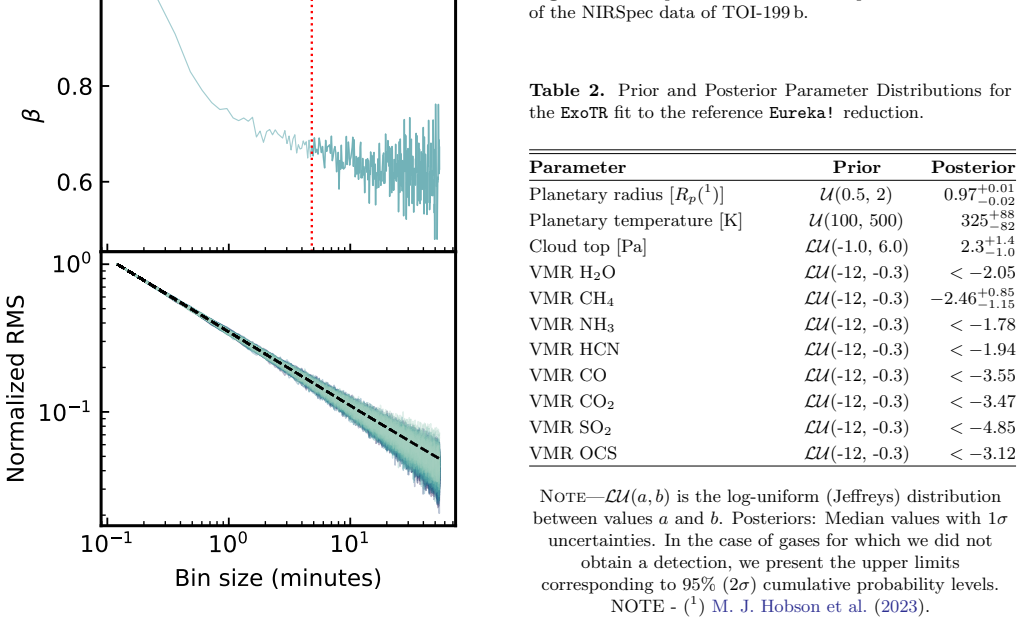
Summary. The paper presents the first JWST/NIRSpec G395M transmission spectrum of the temperate Saturn-mass exoplanet TOI-199 b, obtained despite a failed WATA that left the target outside the intended aperture and forced the team to use PSF-wing flux. Two independent reductions (Eureka! and Tswift) are compared, and Bayesian retrievals with ExoTR and Aurora both infer CH4, with Bayes factors of ~790 and ~705 in cloudy models; the paper reports that CH4 remains preferred over tholin/organic haze alternatives by roughly 8:1. The authors combine these retrievals with EPACRIS self-consistent photochemical-climate models to argue for C/H = 13(+78/-12) x solar and to disfavor high metallicity and high internal temperature. An updated TTV analysis using the JWST transit time and three new TESS transits refines the mass and eccentricity of the outer planet TOI-199 c. The failed pointing is acknowledged up front: the uncertainties are 4-5 times larger than nominal, and the paper explicitly relies on the assumption that the dominant systematic noise is achromatic.
Significance. If the CH4 detection is robust, this is the first spectral detection in a Teq<400 K gas giant, filling a key gap between hot Jupiters and solar-system giants and providing a valuable target for C/N/O and photochemistry studies. The paper's strengths are its transparency about the WATA failure, the use of two independent reductions, two retrieval codes, a broad haze-model comparison, and the release of the transmission spectra. The TTV update is a useful secondary result. However, the central detection rests on the achromaticity of systematics introduced by the failed pointing, and the statistical evidence is therefore conditional; the headline Bayes factor of ~700 does not by itself establish the detection without additional validation of the systematics correction.
major comments (3)
- [§2.1–2.2] The central claim is conditional on the assertion in §2.1 that the WATA-induced noise is 'achromatic,' justifying division of every spectroscopic lightcurve by the common-mode white-light model. §2.2, however, reports a wavelength-dependent slit loss at the integration-6340 pointing jump and fits a per-wavelength scaling factor for the post-jump data. These statements are in tension, and the agreement of the two reductions is not a sufficient check because both use parametric corrections on the same raw frames and can either absorb or generate a broad 3.3 µm feature. Please add a diagnostic that validates achromaticity—e.g., a wavelength-resolved fit of the common-mode/step model, an injection-recovery of a synthetic CH4 signal through both reductions, or a comparison of the in-transit and post-egress baseline spectra. Without this, the BF~700 is a conditional statistic, not a measuremen
- [§3.1–3.2, Table 3] The abstract quotes BF~700 in a cloudy atmosphere, but the cloudy model is not preferred over a clear one (BF=2.29), and once tholin/organic haze is included BF(CH4) drops to 16–22, with a CH4-vs-haze preference of only ~8. The text also gives '471 for soot' while Table 3 lists 47.1. The paper's conclusion is still defensible, but the reporting should be quantitative over the full model family; as written, the headline BF~700 overstates the robustness of the CH4 detection relative to the haze-degenerate cases.
- [§4.3, Table 4 and §6.1] The statement that metallicities ≳50× solar are disfavored is based on forward models, yet Table 4 shows that all tested models fit almost equally well (χ2/dof from 1.0451 to 1.0459), and no model with M/H>10 is shown. The retrieval upper limits on CO/CO2 are consistent with both M/H=1 and M/H=10. The claim should be softened to 'not preferred by the current data' or supported by an explicit high-metallicity model comparison.
minor comments (5)
- [Figure 7 caption] 'ExoTR etrieved MAP model' should be 'ExoTR retrieved MAP model'.
- [§3.1 and Table 3] The text gives '471 for soot' but Table 3 lists 47.1; please reconcile. The layout of the first block of Table 3 is also ambiguous—the rows do not clearly align which Bayes factor refers to which baseline.
- [§5] The TTV analysis uses the JWST transit time derived from the mispointed observation; a caveat that this time may carry additional unmodeled systematic uncertainty should be stated explicitly.
- [References] There are two Hobson et al. 2023 entries in the reference list, one with incomplete arXiv information; please merge or deduplicate.
- [§2.2] Minor typography: 'Matérn' should be typeset with the accent; 'Matern-3/2' is informal.
Circularity Check
No significant circularity: the CH4 detection is a direct Bayesian retrieval model comparison, and forward photochemical models are used for interpretation rather than to set detection thresholds.
full rationale
The paper's central claim—CH4 in TOI-199 b's transmission spectrum with Bayes factor ~700–790—is obtained by Bayesian model comparison against observed spectra, using two independent retrieval frameworks (ExoTR and Aurora). In both cases the evidence is computed relative to a CH4-free model, and the paper explicitly reports that CH4 remains preferred even when haze prescriptions are added (e.g., BF drops from 291 to 22–16 for tholin/organic hazes but the CH4 model is still favored by a factor of ~8). No step in the retrieval defines the detection in terms of the conclusion; the molecular opacities and line lists are external inputs, and the null model does not include CH4. The self-consistent EPACRIS photochemical models are used after the retrieval to interpret the retrieved abundances and to argue that high metallicity is disfavored by CO/CO2 upper limits; these models do not enter the detection threshold. Self-citations exist (ExoTR, EPACRIS, R. Hu et al. 2024, 2025), but they are code/method citations with stated assumptions, not uniqueness theorems or alternatives-forbidding premises. The failed-WATA common-mode correction is an important data-quality assumption that could introduce systematic error, but it is not circular: assuming the noise is achromatic does not define or presuppose the CH4 signal at 3.2–3.7 µm. The TTV analysis is an independent fit to new transit times and does not reduce to its inputs. Overall, the derivation chain is self-contained against directly observed data and independent retrieval codes, so no circular step is identified.
Assumptions & free parameters
free parameters (5)
- CH4 volume mixing ratio (log10) =
-2.46 (+0.85/-1.15)
- Cloud-top pressure (log10 Pa) =
2.3 (+1.4/-1.0)
- Atmospheric temperature (isothermal, K) =
325 (+88/-82)
- Haze abundance and particle diameter =
log10 haze abundance ~ -5.7 to -6.6; log10 diameter ~ -1 to -0.9
- Forward-model scenario grid (M/H, C/O, Tint, Kzz) =
M/H = 1 or 10; C/O = 0.59 or 1.1; Tint = 50–200 K; multiple Kzz profiles
assumptions (5)
- domain assumption Common-mode noise correction is achromatic and removes systematics without distorting the spectrum
- domain assumption H2-dominated atmosphere with hydrostatic equilibrium and isothermal or parameterized T-P structure
- domain assumption Photochemical network (EPACRIS, Yang & Hu 2024) correctly predicts CO/CH4 and NH3/HCN partitioning
- domain assumption Stellar parameters (Teff, log g, [Fe/H]) and planet mass/radius from Hobson et al. (2023)
- domain assumption Kzz vertical mixing profiles follow Lindzen (1981) scaling above the convective region, with chosen deep values
Cite this review
Pith. "Pith review of Methane on the temperate exo-Saturn TOI-199b." pith.science (2026). https://pith.science/paper/4O4IABPX
@misc{pith2026251115835,
  author       = {Pith},
  title        = {Pith review of: Methane on the temperate exo-Saturn TOI-199b},
  year         = {2026},
  howpublished = {\url{https://pith.science/paper/4O4IABPX}},
  note         = {Machine review of arXiv:2511.15835}
}
abstract
Temperate ($T_{\rm eq}<400$ K) gas giants represent an unexplored frontier in exoplanet atmospheric spectroscopy. Orbiting a G-type star every $\sim100$ days, the Saturn-mass exoplanet TOI-199 b ($T_{\rm eq}=350$ K) is one of the most favorable low-temperature gas giants for atmospheric study. Here, we present its transmission spectrum from a single transit observed with JWST's NIRSpec G395M mode. Despite lower-than-nominal precision due to a pointing misalignment, the spectrum reveals the presence of CH$_4$ (Bayes factor of $\sim$700 in a cloudy atmosphere), corresponding to a metallicity of $\rm{C/H}=13^{+78}_{-12}\times$ solar, although the absence of detectable CO and CO$_2$ at the current precision disfavors metallicities $\gtrsim50\times$ solar. We also tested several haze prescriptions (Titan-like tholin, soot, and water-rich tholin), but the preference for these models is weak (Bayes factors of $\sim 2$ relative to the clear case). The spectrum also shows an increase in transit depth near 3 $\mu$m, which our self-consistent models attribute to either NH$_3$ or, less likely, HCN. Follow-up observations could distinguish between these species, helping determine the planet's vertical mixing regime. The TOI-199 system exhibits strong transit timing variations (TTVs) due to an outer non-transiting giant planet. For planet c, our TTV analysis reduces its mass uncertainty by 50% and prefers a slightly longer orbital period (but still within the conservative habitable zone) and higher eccentricity relative to previous studies. TOI-199 b serves as the first data point for studying clouds and hazes in temperate gas giants, with the detection of spectral features in its transmission spectrum indicating that temperate gas giants are promising targets for detailed atmospheric characterization.
Figures


Figures from the paper (12 more)


Reference graph
Works this paper leans on
-
[1]
I., et al
Acuna, L., Berardo, D., Espinoza-Retamal, J. I., et al. 2025, All you need is Love numbers: simultaneous measurement of the oblateness and atmospheric composition of a warm gas giant,, JWST Proposal. Cycle 4, ID. #7188
2025
-
[2]
Agol, E., Dorn, C., Grimm, S. L., et al. 2021, PSJ, 2, 1, doi: 10.3847/PSJ/abd022
-
[3]
2016, Nature Geoscience, 9, 452
Danchi, W. 2016, Nature Geoscience, 9, 452
2016
-
[4]
K., Kirk, J., Dressing, C
Alam, M. K., Kirk, J., Dressing, C. D., et al. 2022, The Astrophysical Journal Letters, 927, L5
2022
-
[5]
R., Alam, M
Alderson, L., Wakeford, H. R., Alam, M. K., et al. 2023, Nature, 614, 664
2023
-
[6]
2017, Monthly Notices of the Royal Astronomical Society, 467, 2845
Ali-Dib, M. 2017, Monthly Notices of the Royal Astronomical Society, 467, 2845
2017
-
[7]
Asplund, M., Amarsi, A. M., & Grevesse, N. 2021, A&A, 653, A141, doi: 10.1051/0004-6361/202140445
-
[8]
Asplund, M., Grevesse, N., Sauval, A. J., & Scott, P. 2009, ARA&A, 47, 481, doi: 10.1146/annurev.astro.46.060407.145222
arXiv 2009
Show all 115 references
-
[9]
J., Strange, J
Barber, R. J., Strange, J. K., Hill, C., et al. 2014, MNRAS, 437, 1828, doi: 10.1093/mnras/stt2011
2014 doi
-
[10]
E., Mandell, A., Pontoppidan, K., et al
Batalha, N. E., Mandell, A., Pontoppidan, K., et al. 2017, Publications of the Astronomical Society of the Pacific, 129, 064501
2017
-
[11]
R., France, K., Brown, A., et al
Behr, P. R., France, K., Brown, A., et al. 2023, AJ, 166, 35, doi: 10.3847/1538-3881/acdb70
2023 doi
-
[12]
A., Giles, H
Beichman, C. A., Giles, H. A. C., Akeson, R., et al. 2018, AJ, 155, 158, doi: 10.3847/1538-3881/aaaeb6
2018 doi
-
[13]
2022, The Journal of Open Source Software, 7, 4503, doi: 10.21105/joss.04503
Bell, T., Ahrer, E.-M., Brande, J., et al. 2022, The Journal of Open Source Software, 7, 4503, doi: 10.21105/joss.04503
2022 doi
-
[14]
J., Welbanks, L., Schlawin, E., et al
Bell, T. J., Welbanks, L., Schlawin, E., et al. 2023, Nature, 623, 709, doi: 10.1038/s41586-023-06687-0
2023 doi
-
[15]
A., et al
Bello-Arufe, A., Damiano, M., Bennett, K. A., et al. 2025, ApJL, 980, L26, doi: 10.3847/2041-8213/adaf22
2025 doi
- [16]
-
[17]
M., Ferruit, P., Giardino, G., et al
Birkmann, S. M., Ferruit, P., Giardino, G., et al. 2022, A&A, 661, A83, doi: 10.1051/0004-6361/202142592
2022 doi
-
[18]
L., Wong, M
Bjoraker, G. L., Wong, M. H., de Pater, I., et al. 2018, AJ, 156, 101
2018
-
[19]
J., Kreidberg, L., et al
Brande, J., Crossfield, I. J., Kreidberg, L., et al. 2023, arXiv preprint arXiv:2310.07714
2023 arXiv
-
[20]
2014, A&A, 564, A125, doi: 10.1051/0004-6361/201322971
Buchner, J., Georgakakis, A., Nandra, K., et al. 2014, A&A, 564, A125, doi: 10.1051/0004-6361/201322971
2014 doi
-
[21]
2024, JWST Calibration Pipeline, 1.15.1 Zenodo, doi: 10.5281/zenodo.12692459
Bushouse, H., Eisenhamer, J., Dencheva, N., et al. 2024, JWST Calibration Pipeline, 1.15.1 Zenodo, doi: 10.5281/zenodo.12692459
2024 doi
-
[22]
2025, arXiv e-prints, arXiv:2511.02067, doi: 10.48550/arXiv.2511.02067
Cassese, B., Kipping, D., Changeat, Q., et al. 2025, arXiv e-prints, arXiv:2511.02067, doi: 10.48550/arXiv.2511.02067
2025 doi
-
[23]
L., Rocchetto, M., Yurchenko, S
Chubb, K. L., Rocchetto, M., Yurchenko, S. N., et al. 2021, A&A, 646, A21, doi: 10.1051/0004-6361/202038350
2021 doi
-
[24]
J., van Dishoeck, E
Cridland, A. J., van Dishoeck, E. F., Alessi, M., & Pudritz, R. E. 2019, Astronomy & Astrophysics, 632, A63
2019
-
[25]
J., van Dishoeck, E
Cridland, A. J., van Dishoeck, E. F., Alessi, M., & Pudritz, R. E. 2020, Astronomy & Astrophysics, 642, A229
2020
-
[26]
2024, ApJL, 968, L22, doi: 10.3847/2041-8213/ad5204
Damiano, M., Bello-Arufe, A., Yang, J., & Hu, R. 2024, ApJL, 968, L22, doi: 10.3847/2041-8213/ad5204
2024 doi
- [27]
-
[28]
S., & Agol, E
Eastman, J., Gaudi, B. S., & Agol, E. 2013, Publications of the Astronomical Society of the Pacific, 125, 83–112, doi: 10.1086/669497
2013 doi
-
[29]
Ehrenreich, D., Lovis, C., Allart, R., et al. 2020, Nature, 580, 597, doi: 10.1038/s41586-020-2107-1 21 10.0 7.5 5.0 2.5 0.0 log10(H2O) 10.0 7.5 5.0 2.5 0.0 log10(CH4) 10.0 7.5 5.0 2.5 0.0 log10(NH3) 10.0 7.5 5.0 2.5 0.0 log10(HCN) 10.0 7.5 5.0 2.5 0.0 log10(CO) 10.0 7.5 5.0 2...
2020 doi
-
[30]
2017, The Astrophysical Journal Letters, 838, L9
Murray-Clay, R. 2017, The Astrophysical Journal Letters, 838, L9
2017
-
[31]
D., Radica, M., Welbanks, L., et al
Feinstein, A. D., Radica, M., Welbanks, L., et al. 2023, Nature, 614, 670
2023
-
[32]
P., & Bridges, M
Feroz, F., Hobson, M. P., & Bridges, M. 2009, Monthly Notices of the Royal Astronomical Society, 398, 1601, doi: 10.1111/j.1365-2966.2009.14548.x
2009
-
[33]
B., Ragozzine, D., Rowe, J
Ford, E. B., Ragozzine, D., Rowe, J. F., et al. 2012, ApJ, 756, 185, doi: 10.1088/0004-637X/756/2/185
2012 doi
-
[34]
2018, Research Notes of the American Astronomical Society, 2, 31, doi: 10.3847/2515-5172/aaaf6c
Foreman-Mackey, D. 2018, Research Notes of the American Astronomical Society, 2, 31, doi: 10.3847/2515-5172/aaaf6c
2018 doi
-
[35]
2017, AJ, 154, 220, doi: 10.3847/1538-3881/aa9332
Foreman-Mackey, D., Agol, E., Ambikasaran, S., & Angus, R. 2017, AJ, 154, 220, doi: 10.3847/1538-3881/aa9332
2017 doi
-
[36]
W., Lang, D., & Goodman, J
Foreman-Mackey, D., Hogg, D. W., Lang, D., & Goodman, J. 2013, PASP, 125, 306, doi: 10.1086/670067
2013 doi
-
[37]
L., Fu, G., et al
Fortney, J., Bean, J. L., Fu, G., et al. 2023, C,N,O in a Temperate Jupiter: Bridging the Gap Between Solar-System and Exoplanet Atmospheres,, JWST Proposal. Cycle 2, ID. #3235
2023
-
[38]
J., Visscher, C., Marley, M
Fortney, J. J., Visscher, C., Marley, M. S., et al. 2020, The Astronomical Journal, 160, 288
2020
-
[39]
K., et al
Fu, G., Espinoza, N., Sing, D. K., et al. 2022, ApJL, 940, L35, doi: 10.3847/2041-8213/ac9977
2022 doi
-
[40]
2024, Nature, 632, 752, doi: 10.1038/s41586-024-07760-y
Fu, G., Welbanks, L., Deming, D., et al. 2024, Nature, 632, 752, doi: 10.1038/s41586-024-07760-y
2024 doi
-
[41]
R., Allen, M., & Yung, Y
Gladstone, G. R., Allen, M., & Yung, Y. 1996, Icarus, 119, 1
1996
-
[42]
E., Rothman, L
Gordon, I. E., Rothman, L. S., Hargreaves, R. J., et al. 2022, JQSRT, 277, 107949, doi: 10.1016/j.jqsrt.2021.107949
2022
-
[43]
Pierrehumbert, R. T. 2021, PSJ, 2, 207, doi: 10.3847/PSJ/ac214c
2021 doi
-
[44]
Grant, D., & Wakeford, H. R. 2022, Exo-TiC/ExoTiC-LD: ExoTiC-LD v3.0.0, v3.0.0 Zenodo, doi: 10.5281/zenodo.7437681 22
2022 doi
-
[45]
K., Wakeford, H
Grant, D., Lewis, N. K., Wakeford, H. R., et al. 2023, The Astrophysical Journal Letters, 956, L29
2023
-
[46]
A., Levine, W
Greklek-McKeon, M., Knutson, H. A., Levine, W. G., et al. 2025a, AJ, 170, 65, doi: 10.3847/1538-3881/addf2d
-
[47]
A., et al
Greklek-McKeon, M., Vissapragada, S., Knutson, H. A., et al. 2025b, AJ, 169, 292, doi: 10.3847/1538-3881/adc0fe
-
[48]
J., Gordon, I
Hargreaves, R. J., Gordon, I. E., Rey, M., et al. 2020, ApJS, 247, 55, doi: 10.3847/1538-4365/ab7a1a
2020 doi
-
[49]
E., et al
He, C., Radke, M., Moran, S. E., et al. 2024, Nature Astronomy, 8, 182, doi: 10.1038/s41550-023-02140-4
2024 doi
-
[50]
2018, ApJS, 237, 29, doi: 10.3847/1538-4365/aad199
Heng, K., Malik, M., & Kitzmann, D. 2018, ApJS, 237, 29, doi: 10.3847/1538-4365/aad199
2018 doi
-
[51]
1998, Bulletin of the American Meteorological Society, 79, 831 , doi: 10.1175/1520-0477(1998)079 ⟨0831: OPOAAC⟩2.0.CO;2
Hess, M., Koepke, P., & Schult, I. 1998, Bulletin of the American Meteorological Society, 79, 831 , doi: 10.1175/1520-0477(1998)079 ⟨0831: OPOAAC⟩2.0.CO;2
1998 doi
-
[52]
2019, Monthly Notices of the Royal Astronomical Society, 487, 2242
Hobbs, R., Shorttle, O., Madhusudhan, N., & Rimmer, P. 2019, Monthly Notices of the Royal Astronomical Society, 487, 2242
2019
-
[53]
J., Trifonov, T., Henning, T., et al
Hobson, M. J., Trifonov, T., Henning, T., et al. 2023, AJ, 166, 201, doi: 10.3847/1538-3881/acfc1d
2023 doi
-
[54]
J., Trifonov, T., Henning, T., et al
Hobson, M. J., Trifonov, T., Henning, T., et al. 2023, arXiv e-prints, arXiv
2023
-
[55]
2016, ApJS, 225, 9, doi: 10.3847/0067-0049/225/1/9
Holczer, T., Mazeh, T., Nachmani, G., et al. 2016, ApJS, 225, 9, doi: 10.3847/0067-0049/225/1/9
2016 doi
-
[56]
2021, The Astrophysical Journal, 921, 27
Hu, R. 2021, The Astrophysical Journal, 921, 27
2021
-
[57]
2024, Nature, 630, 609, doi: 10.1038/s41586-024-07432-x
Hu, R., Bello-Arufe, A., Zhang, M., et al. 2024, Nature, 630, 609, doi: 10.1038/s41586-024-07432-x
2024 doi
- [58]
-
[59]
O., Wende-von Berg, S., Dreizler, S., et al
Husser, T. O., Wende-von Berg, S., Dreizler, S., et al. 2013, A&A, 553, A6, doi: 10.1051/0004-6361/201219058
2013 doi
-
[60]
2022, A&A, 661, A80, doi: 10.1051/0004-6361/202142663
Jakobsen, P., Ferruit, P., Alves de Oliveira, C., et al. 2022, A&A, 661, A80, doi: 10.1051/0004-6361/202142663
2022 doi
-
[61]
M., Twicken, J
Jenkins, J. M., Twicken, J. D., McCauliff, S., et al. 2016, in Society of Photo-Optical Instrumentation Engineers (SPIE) Conference Series, Vol. 9913, Software and Cyberinfrastructure for Astronomy IV, ed. G. Chiozzi & J. C. Guzman, 99133E, doi: 10.1117/12.2233418
2016 doi
-
[62]
2018, The Astrophysical Journal, 853, 7
Kawashima, Y., & Ikoma, M. 2018, The Astrophysical Journal, 853, 7
2018
-
[63]
N., Sagan, C., Arakawa, E
Khare, B. N., Sagan, C., Arakawa, E. T., et al. 1984, Icarus, 60, 127, doi: 10.1016/0019-1035(84)90142-8
1984 doi
-
[64]
Kipping, D. M. 2013, MNRAS, 435, 2152, doi: 10.1093/mnras/stt1435
2013 doi
-
[65]
A., Charbonneau, D., Allen, L
Knutson, H. A., Charbonneau, D., Allen, L. E., et al. 2007, Nature, 447, 183, doi: 10.1038/nature05782
2007 doi
-
[66]
2015, PASP, 127, 1161, doi: 10.1086/683602 Lecavelier Des Etangs, A., Pont, F., Vidal-Madjar, A., &
Kreidberg, L. 2015, PASP, 127, 1161, doi: 10.1086/683602 Lecavelier Des Etangs, A., Pont, F., Vidal-Madjar, A., &
2015 doi
-
[67]
2008, A&A, 481, L83, doi: 10.1051/0004-6361:200809388
Sing, D. 2008, A&A, 481, L83, doi: 10.1051/0004-6361:200809388
2008 doi
- [68]
-
[69]
Lindzen, R. S. 1981, Journal of Geophysical Research: Oceans, 86, 9707
1981
-
[70]
R., & Parmentier, V
Line, M. R., & Parmentier, V. 2016, ApJ, 820, 78, doi: 10.3847/0004-637X/820/1/78
2016 doi
-
[71]
Yung, Y. L. 2011, The Astrophysical Journal, 738, 32
2011
-
[72]
2012, The Astrophysical Journal, 761, 122, doi: 10.1088/0004-637x/761/2/122
Lithwick, Y., Xie, J., & Wu, Y. 2012, The Astrophysical Journal, 761, 122, doi: 10.1088/0004-637x/761/2/122
2012 doi
-
[73]
J., & Madhusudhan, N
MacDonald, R. J., & Madhusudhan, N. 2017, MNRAS, 469, 1979, doi: 10.1093/mnras/stx804
2017 doi
-
[74]
2023, ApJL, 956, L13, doi: 10.3847/2041-8213/acf577
Madhusudhan, N., Sarkar, S., Constantinou, S., et al. 2023, ApJL, 956, L13, doi: 10.3847/2041-8213/acf577
2023 doi
-
[75]
2009, ApJ, 707, 24, doi: 10.1088/0004-637X/707/1/24
Madhusudhan, N., & Seager, S. 2009, ApJ, 707, 24, doi: 10.1088/0004-637X/707/1/24
2009 doi
-
[76]
2015, A&A, 573, A90, doi: 10.1051/0004-6361/201423804
Magic, Z., Chiavassa, A., Collet, R., & Asplund, M. 2015, A&A, 573, A90, doi: 10.1051/0004-6361/201423804
2015 doi
-
[77]
2016, A&A, 590, A112, doi: 10.1051/0004-6361/201526357 Molli` ere, P., Wardenier, J
Mancini, L., Lillo-Box, J., Southworth, J., et al. 2016, A&A, 590, A112, doi: 10.1051/0004-6361/201526357 Molli` ere, P., Wardenier, J. P., van Boekel, R., et al. 2019, A&A, 627, A67, doi: 10.1051/0004-6361/201935470 Molli` ere, P., Stolker, T., Lacour, S., et al. 2020, A&A, 6...
2016 doi
-
[78]
2016, The Astrophysical Journal, 832, 41
Benneke, B. 2016, The Astrophysical Journal, 832, 41
2016
-
[79]
2005, Journal of Geophysical Research: Planets, 110
Moses, J., Fouchet, T., B´ ezard, B., et al. 2005, Journal of Geophysical Research: Planets, 110
2005
-
[80]
I., Visscher, C., Keane, T
Moses, J. I., Visscher, C., Keane, T. C., & Sperier, A. 2010, Faraday Discussions, 147, 103, doi: 10.1039/c003954c
2010 doi
-
[81]
2019, A&A, 622, A172, doi: 10.1051/0004-6361/201834063
Murgas, F., Chen, G., Pall´ e, E., Nortmann, L., & Nowak, G. 2019, A&A, 622, A172, doi: 10.1051/0004-6361/201834063
2019 doi
-
[82]
C., Welbanks, L., McGill, P., & Kempton, E
Nixon, M. C., Welbanks, L., McGill, P., & Kempton, E. M. R. 2024, ApJ, 966, 156, doi: 10.3847/1538-4357/ad354e ¨Oberg, K. I., Murray-Clay, R., & Bergin, E. A. 2011, The Astrophysical Journal Letters, 743, L16
2024 doi
-
[83]
Ohno, K., & Fortney, J. J. 2023, The Astrophysical Journal, 946, 18
2023
-
[84]
2022, ApJ, 937, 36, doi: 10.3847/1538-4357/ac8b11
Pacetti, E., Turrini, D., Schisano, E., et al. 2022, ApJ, 937, 36, doi: 10.3847/1538-4357/ac8b11
2022 doi
-
[85]
2015, Monthly Notices of the Royal Astronomical Society, 453, 3822–3827, doi: 10.1093/mnras/stv1857 23
Parviainen, H., & Aigrain, S. 2015, Monthly Notices of the Royal Astronomical Society, 453, 3822–3827, doi: 10.1093/mnras/stv1857 23
2015 doi
-
[86]
E., Rothman, L
Richard, C., Gordon, I. E., Rothman, L. S., et al. 2012, JQSRT, 113, 1276, doi: 10.1016/j.jqsrt.2011.11.004
2012 doi
-
[87]
B., & Rugheimer, S
Rimmer, P. B., & Rugheimer, S. 2019, Icarus, 329, 124
2019
-
[88]
S., Gordon, I
Rothman, L. S., Gordon, I. E., Barber, R. J., et al. 2010, JQSRT, 111, 2139, doi: 10.1016/j.jqsrt.2010.05.001
2010 doi
-
[89]
V., & Fonnesbeck, C
Salvatier, J., Wiecki, T. V., & Fonnesbeck, C. 2016, PeerJ Computer Science, 2, e55
2016
-
[90]
P., Lewis, N
Showman, A. P., Lewis, N. K., & Fortney, J. J. 2015, ApJ, 801, 95, doi: 10.1088/0004-637X/801/2/95
2015 doi
-
[91]
K., Fortney, J
Sing, D. K., Fortney, J. J., Nikolov, N., et al. 2016, Nature, 529, 59, doi: 10.1038/nature16068
2016 doi
-
[92]
Speagle, J. S. 2020, MNRAS, 493, 3132, doi: 10.1093/mnras/staa278
2020 doi
-
[93]
N., Al-Refaie, A
Tennyson, J., Yurchenko, S. N., Al-Refaie, A. F., et al. 2016, Journal of Molecular Spectroscopy, 327, 73, doi: 10.1016/j.jms.2016.05.002
2016 doi
-
[94]
P., Sing, D
Thorngren, D. P., Sing, D. K., & Mukherjee, S. 2025, arXiv e-prints, arXiv:2510.00169, doi: 10.48550/arXiv.2510.00169
2025 doi
-
[95]
K., Powell, D., et al
Tsai, S.-M., Lee, E. K., Powell, D., et al. 2023, Nature, 617, 483
2023
-
[96]
2021, ApJ, 909, 40, doi: 10.3847/1538-4357/abd6e5
Turrini, D., Schisano, E., Fonte, S., et al. 2021, ApJ, 909, 40, doi: 10.3847/1538-4357/abd6e5
2021 doi
-
[97]
S., Tennyson, J., Yurchenko, S
Underwood, D. S., Tennyson, J., Yurchenko, S. N., et al. 2016, Monthly Notices of the Royal Astronomical Society, 459, 3890, doi: 10.1093/mnras/stw849
2016 doi
-
[98]
2019, Icarus, 324, 120
Lavvas, P. 2019, Icarus, 324, 120
2019
-
[99]
I., & Mousis, O
Wang, D., Lunine, J. I., & Mousis, O. 2016, Icarus, 276, 21
2016
-
[100]
2019, AJ, 157, 206, doi: 10.3847/1538-3881/ab14de
Welbanks, L., & Madhusudhan, N. 2019, AJ, 157, 206, doi: 10.3847/1538-3881/ab14de
2019 doi
-
[101]
2021, ApJ, 913, 114, doi: 10.3847/1538-4357/abee94
Welbanks, L., & Madhusudhan, N. 2021, ApJ, 913, 114, doi: 10.3847/1538-4357/abee94
2021 doi
-
[102]
2022, ApJ, 933, 79, doi: 10.3847/1538-4357/ac6df1
Welbanks, L., & Madhusudhan, N. 2022, ApJ, 933, 79, doi: 10.3847/1538-4357/ac6df1
2022 doi
-
[103]
J., Beatty, T
Welbanks, L., Bell, T. J., Beatty, T. G., et al. 2024, Nature, 630, 836, doi: 10.1038/s41586-024-07514-w
2024 doi
-
[104]
C., McGill, P., et al
Welbanks, L., Nixon, M. C., McGill, P., et al. 2025, arXiv e-prints, arXiv:2504.21788, doi: 10.48550/arXiv.2504.21788
2025 doi
-
[105]
S., Gordon, I
Wilzewski, J. S., Gordon, I. E., Kochanov, R. V., Hill, C., & Rothman, L. S. 2016, JQSRT, 168, 193 , doi: https://doi.org/10.1016/j.jqsrt.2015.09.003
2016 doi
-
[106]
N., Holman, M
Winn, J. N., Holman, M. J., Torres, G., et al. 2008, ApJ, 683, 1076, doi: 10.1086/589737
2008 doi
-
[107]
2025, RMG-generated Chemical Network for H2O-rich atmospheres (Yang and Hu, 2024), Zenodo, doi: 10.5281/zenodo.16750016
Yang, J. 2025, RMG-generated Chemical Network for H2O-rich atmospheres (Yang and Hu, 2024), Zenodo, doi: 10.5281/zenodo.16750016
2025 doi
-
[108]
2024a, The Astrophysical Journal, 966, 189, doi: 10.3847/1538-4357/ad35c8
Yang, J., & Hu, R. 2024a, The Astrophysical Journal, 966, 189, doi: 10.3847/1538-4357/ad35c8
-
[109]
2024b, The Astrophysical Journal Letters, 971, L48, doi: 10.3847/2041-8213/ad6b25
Yang, J., & Hu, R. 2024b, The Astrophysical Journal Letters, 971, L48, doi: 10.3847/2041-8213/ad6b25
-
[110]
Yang, J., Hyder, A., Hu, R., & Lunine, J. I. 2025, arXiv preprint arXiv:2508.05007
2025
-
[111]
I., Fortney, J
Yu, X., Moses, J. I., Fortney, J. J., & Zhang, X. 2021, The Astrophysical Journal, 914, 38
2021
-
[112]
N., Barber, R
Yurchenko, S. N., Barber, R. J., & Tennyson, J. 2011, MNRAS, 413, 1828, doi: 10.1111/j.1365-2966.2011.18261.x
2011
-
[113]
N., & Tennyson, J
Yurchenko, S. N., & Tennyson, J. 2014, MNRAS, 440, 1649, doi: 10.1093/mnras/stu326
2014 doi
-
[114]
Zhang, X., & Showman, A. P. 2018, The Astrophysical Journal, 866, 1
2018
-
[115]
Zilinskas, M., van Buchem, C. P. A., Zieba, S., et al. 2025, A&A, 697, A34, doi: 10.1051/0004-6361/202554062
2025 doi
Reviewed August 3, 2026 · model on record in the stance chip above.
Discussion (0). Continue with ORCID to comment.