REVIEW 3 major objections 6 minor 49 references
Quantum algorithms for second-order boundary value problems
T0 review · 3 major / 6 minor · reviewed 2026-07-14 · grok-4.5
Pith's one-line read Second-order boundary value problems become quantum circuits when discrete differential operators are written as local star updates instead of assembled matrices.
desk verdict Solid DEC-to-circuit packaging for regular meshes; the reusable architecture is real but the demos and unstructured-mesh claims are thinner than the abstract suggests. read the letter →
The pith
A machine-rendered reading of the paper's core claim, the machinery that carries it, and where it could break.
The reading
What carries the argument
The star-local update rule (equation 12) together with the star-oracle S that maps a cell index to the signed bounding-chain Star₁ of its star. The star replaces the virtual neighbourhood of continuous differentiation; the oracle generates that data on the fly so the circuit never accesses a globally assembled matrix DᵀHD.
What would settle it
Run the claimed one-step curl–curl or div–grad circuit in state-vector simulation on a regularly indexed complex, read the designated output subspace after applying known normalization and interference factors, and check whether the resulting cochain matches the classical star-local update (equation 12) entrywise to numerical precision; a systematic mismatch falsifies the compilation claim.
Extended reading notes
Core claim
Finite-dimensional counterparts of continuous second-order operators built from the exterior derivative, its adjoint, and Hodge-type maps act as star-local updates whose support is the star of the cell carrying the degree of freedom. These updates compile, via explicit star-oracles rather than stored incidence matrices, into simple uniform quantum circuits that implement one relaxation step; the same architecture covers div–grad and curl–curl on regularly indexed complexes and thereby gives a systematic route from continuous boundary value problems to quantum circuits.
Load-bearing premise
The simple closed-form star-oracles and uniform scalable circuits require regularly indexed meshes with cyclic coordinate symmetry and padded dummy indices; without that regularity the local operator still exists but needs stored incidence data.
Editorial extensions
If this is right
- One circuit architecture implements a relaxation step for both div–grad and curl–curl by changing only the star-oracle and cochain degree.
- Index-register cost grows only logarithmically with the number of indexed degrees of freedom on regularly padded complexes.
- Any second-order operator that can be written as a star-local update from exterior calculus can reuse the same oracle–block-encoding–interference template.
- Combinatorial incidence data and metric/material Hodge weights stay separate, so material variation enters only through block-encoded coefficients.
- The same geometric viewpoint points toward quantum algorithms for covariant exterior derivatives and continuum-mechanics problems.
Reading between the lines
- If closed-form oracles can be built for a wider family of structured meshes, many multiphysics solvers could avoid matrix assembly while keeping the same circuit skeleton.
- The encode–evolve–measure–reinitialise loop is likely to dominate cost before oracle depth does, so practical impact hinges on state preparation and sign-safe readout as much as on star design.
- Separating fixed combinatorial stars from variable Hodge weights suggests hybrid schemes that deform geometry classically while reusing one quantum oracle.
- Classical lattice methods already use similar local updates; the exterior-calculus framing may unify those methods with quantum PDE algorithms more tightly than matrix-based linear-system approaches.
Editorial analysis
A structured set of objections, weighed in public.
Referee Report
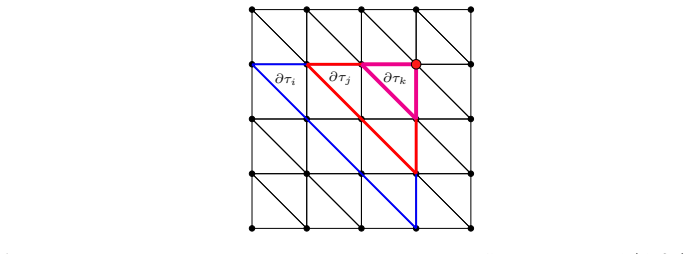
Summary. The paper proposes a structure-first route from continuous second-order boundary-value problems to quantum circuits. Starting from Stokes duality, the exterior derivative, its adjoint, and Hodge-type constitutive maps on primal–dual cell complexes, it derives finite-dimensional second-order operators and rewrites them as star-local relaxation updates (Eqs. 8–12) rather than as assembled matrices DᵀHD. These updates are compiled into a reusable circuit architecture—star-oracle, block encoding of weights, and interference-based summation—illustrated for div–grad on regular triangular complexes and curl–curl on regular hexahedral complexes (Figs. 6–7, Eqs. 14, 16, 18, 32). The outer solver is an encode–evolve–measure–reinitialise loop with classical enforcement of boundary conditions and constraints. The authors present qualitative field plots (Figs. 10–11) and argue that the same star-local compilation principle yields a systematic framework for quantum algorithms for PDEs.
Significance. If the compilation is verified and the scope is stated carefully, the work is a genuine contribution to quantum scientific computing: it organizes circuit locality around the geometric support of discrete exterior-calculus operators rather than around a generic sparse-matrix oracle. The separation of combinatorial star data from metric/Hodge weights, the explicit closed-form oracles for regularly indexed complexes (Appendix A), and the common architecture for node-based and edge-based unknowns are concrete strengths. The approach is complementary to HHL-style and Hamiltonian-simulation PDE methods and to quantum lattice-Boltzmann schemes. It does not claim quantum advantage; its value is architectural and structural. Credit is due for the detailed indexing conventions, boundary-aware star formulas, and the honest discussion of regular-indexing and readout limitations in §4.5 and Appendices B–C.
major comments (3)
- [§3.4–3.7, Figs. 6–7, 10–11; Appendix B.1] The load-bearing claim that the circuits implement the star-local update (Eq. 12 / 14 / 16) is not numerically verified. Figs. 10–11 show qualitative field structure after the full encode–evolve–measure–reinitialise loop, but there is no side-by-side check that the designated output subspace of one circuit execution equals the classical star-local update up to the tracked normalization, block-encoding, and Hadamard prefactors (Appendix B.1). Without that equality test—even on a small regularly indexed patch—the compilation remains an architectural sketch rather than a verified implementation of the finite-dimensional operator.
- [Abstract; §1; §3.1–3.2; §4.5; Appendix A] The abstract and introduction present “simple, uniform, and scalable” circuits and a principle that “extends across different operators, cell complexes, and manifold dimensions,” yet the closed-form star-oracles and uniform register design require regularly indexed complexes with cyclic coordinate symmetry and padded dummy indices (§3.1–3.2, Appendix A). On unstructured meshes the star-local operator still exists, but the oracle needs stored incidence data (§4.5). The limitation is acknowledged late; the abstract and framing claims should be scoped to regularly indexed complexes, or the paper should supply a concrete oracle construction (or complexity statement) for unstructured incidence data.
- [§3.8; §4.5–4.6; Appendix B.5, B.8] Each relaxation step is embedded in a classical encode–evolve–measure–reinitialise loop (§3.8, Appendix B.5). State preparation and readout are left unoptimized and are identified as dominant costs (Appendix B.8), yet the broader claim of a “systematic route to quantum algorithms for PDEs” is not accompanied by even a schematic resource accounting for T iterations (preparation + circuit depth + measurement per step). A short complexity sketch—gate cost of the star-oracle and block-encoding stages versus preparation/readout, and how T scales with mesh size for Jacobi-type relaxation—would make the algorithmic claim proportionate to what is actually constructed.
minor comments (6)
- [Fig. 6; §3.7] Figure 6 is dense and stacked; a single end-to-end schematic with qubit counts and which subspace holds Λ^{s+1} would help readers verify the interference stage against Eq. (16).
- [§3.2, Eq. (20)] The packed iterate Λ^s = [A_x, A_y, A_z, J_z, J_y, J_x]^T and the reversed source ordering (§3.2) are bookkeeping-heavy; a short table mapping selector/label basis states to physical components would reduce ambiguity.
- [§2.1.1] Eq. (14) notes coincidence with classical Lattice Boltzmann; a one-sentence clarification of what is shared (local averaging stencil) versus what is new (exterior-calculus derivation and quantum compilation) would prevent over-reading that remark.
- [Appendix C] Appendix C on metric variation is useful but ends without a circuit-level demonstration; either mark it clearly as outlook or add a minimal coefficient-oracle sketch consistent with Fig. 6.
- [§3.1; Appendix D] Minor notation consistency: Star_1(e) vs Star1(e), and mixed use of φ/ϕ for the scalar potential in the div–grad sections and appendices.
- [§1; §4.4] References to related quantum PDE and quantum-walk literature are adequate; a brief pointer to other DEC-based classical solvers beyond the authors’ geometric electromagnetism line would situate the finite-dimensional construction more broadly.
Circularity Check
No load-bearing circularity: the star-local update and circuit architecture are constructed explicitly from exterior-calculus incidence and Hodge data, not recovered by fitting or self-definitional renaming of the target claim.
full rationale
The derivation chain is constructive and self-contained. Continuous second-order operators are introduced via Stokes duality and the pair (d, igstar) (Eqs. 1–2); finite-dimensional counterparts are obtained from incidence matrices D on primal–dual complexes and the diagonal Hodge H (Eqs. 6–9), then rewritten by isolating the self-term to produce the star-local relaxation (Eq. 12). The quantum architecture (star-oracle generating Star1(e) by closed-form index shifts, block encoding of the scalar weights, interference summation) is defined to implement precisely those local contributions (Sec. 3, Eqs. 17–18, 32). No free parameters are fitted to data and then re-presented as predictions; no uniqueness theorem is imported from prior author work to forbid alternatives; the regular-indexing restriction is acknowledged as a scope limitation (Sec. 4.5) rather than hidden. Self-citations (Bossavit–Kettunen discrete exterior calculus, related lattice-Boltzmann circuits) supply standard background tools that the paper re-derives or re-uses, but the central claim—that the same star-local compilation yields reusable circuits for div–grad and curl–curl—does not reduce by construction to those citations. Qualitative demos (Figs. 10–11) illustrate the outer encode–evolve–measure loop; they do not constitute circular “predictions.” Residual ordinary reuse of the authors’ geometric toolkit warrants at most a score of 1, not higher.
Assumptions & free parameters
free parameters (3)
- relaxation parameter β =
0 < β < 1 (hand-chosen)
- padding size / dummy-index count to next power of two
- directional constant offsets for non-negative encoding
assumptions (5)
- standard math Stokes duality identifies the exterior derivative with the boundary operator on chains; discrete d is incidence D.
- domain assumption Hodge-type constitutive law may be realized by a diagonal generalized finite-difference map between paired primal and dual cells (Eq. 6).
- domain assumption For trivial topology, closed forms are exact so f=dΛ; nontrivial topology needs extra homology constraints.
- ad hoc to paper Regularly indexed simplicial/hexahedral complexes with cyclic coordinate symmetry admit closed-form star-oracles via shifts and phases.
- domain assumption One quantum circuit execution implements one classical-style relaxation step inside an encode–evolve–measure–reinitialize loop with classical BC/gauge handling.
invented entities (2)
-
star-oracle S: e ↦ Star₁(e)
-
packed iterate vector Λˢ = [Aₓ, Aᵧ, A_z, J_z, J_y, J_x]ᵀ with cyclic π action
Cite this review
Pith. "Pith review of Quantum algorithms for second-order boundary value problems." pith.science (2026). https://pith.science/paper/4OI5AVGT
@misc{pith2026260711410,
  author       = {Pith},
  title        = {Pith review of: Quantum algorithms for second-order boundary value problems},
  year         = {2026},
  howpublished = {\url{https://pith.science/paper/4OI5AVGT}},
  note         = {Machine review of arXiv:2607.11410}
}
read the original abstract
Second-order boundary value problems are central to computational science, yet standard matrix-based numerical formulations can obscure the local geometric structure that quantum circuits may exploit. Here we introduce a framework for explicitly constructing finite-dimensional counterparts of continuous differential operators in a form compatible with quantum computation. Starting from the exterior derivative, its adjoint, and the Hodge operator, we derive discrete realizations of second-order operators on primal--dual cell complexes and reformulate them as star-local update rules expressed through explicit functions that return the relevant bounding chains rather than through matrix representations. This yields simple, uniform, and scalable quantum circuits. We demonstrate the construction for div--grad and curl--curl operators, showing that the same star-local compilation principle extends across different operators, cell complexes, and manifold dimensions within a common framework. More generally, the framework provides a systematic route to quantum algorithms for partial differential equations.
Figures


Figures from the paper (10 more)


Reference graph
Works this paper leans on
-
[1]
Ciarlet P G 1978 The Finite Element Method for Elliptic Problems (Amsterdam: North-Holland)
1978
-
[2]
Yee K 1966 IEEE Transactions on Antennas and Propagation14302–307
1966
-
[3]
Generalized finite differences
Bossavit A 2001 “Generalized finite differences” in computational electromagnetics Progress in Electromagnetics Research, PIER vol 32 ed Teixeira F L (Cambridge, MA: EMW) pp 45–64
2001
-
[4]
Montanaro A 2016 npj Quantum Information215023
2016
-
[5]
Harrow A W, Hassidim A and Lloyd S 2009 Physical Review Letters103150502
2009
-
[6]
Clader B D, Jacobs B C and Sprouse C R 2013 Physical Review Letters110250504
2013
-
[7]
Childs A M, Kothari R and Somma R D 2017 SIAM Journal on Computing461920–1950
2017
-
[8]
Childs A M, Liu J P and Ostrander A 2021 Quantum5574
2021
Show all 49 references
-
[9]
Morales M E S, Pira L, Schleich P, Koor K, Costa P C S, An D, Aspuru-Guzik A, Lin L, Rebentrost P and Berry D W 2023 Quantum linear systems algorithms: a survey of algorithms and applications (Preprint2305.01199)
2023 arXiv
-
[10]
Budinski L 2021 Quantum Information Processing2057 26
2021
-
[11]
2026 Quantum algorithm for the lattice boltzmann method with applications on real quantum devices (Preprint2603.02127)
Bastida-Zamora A, Budinski L, Kerppo O, Lahtinen V, Niemim¨ aki O, Steadman W, Zamora-Zamora R, Sagaut P, Bohun V, Koch-Janusz M et al. 2026 Quantum algorithm for the lattice boltzmann method with applications on real quantum devices (Preprint2603.02127)
2026
-
[12]
Bossavit A 1998 Journal of Japan Society of Applied Electromagnetism and Mechanics6114–123
1998
-
[13]
Flanders H 1989 Differential Forms with Applications to the Physical Sciences revised edition ed (New York: Dover Publications)
1989
-
[14]
Baez J C and Muniain J P 1994 Gauge Fields, Knots and Gravity (Series on Knots and Everything vol 4) (Singapore: World Scientific)
1994
-
[15]
Frankel T 2012 The Geometry of Physics: An Introduction 3rd ed (Cambridge: Cambridge Univer- sity Press)
2012
-
[16]
Tarhasaari T, Kettunen L and Bossavit A 1999 IEEE Transactions on Magnetics351494–1497
1999
-
[17]
Bossavit A and Kettunen L 1999 International Journal of Numerical Modelling: Electronic Networks, Devices and Fields12129–142
1999
-
[18]
Munkres J R 1984 Elements of Algebraic Topology (Menlo Park, CA: Addison-Wesley)
1984
-
[19]
Kettunen L, Kurz S, Tarhasaari T, R¨ ais¨ anen V, Stenvall A and Suuriniemi S 2014IEEE Transactions on Magnetics501–10
-
[20]
Whitney H 1957 Geometric Integration Theory (Princeton, NJ: Princeton University Press)
1957
-
[21]
Hodge W V D 1934 Proceedings of the London Mathematical Society36257–303
1934
-
[22]
Hodge W V D 1941 The Theory and Applications of Harmonic Integrals (Cambridge: Cambridge University Press)
1941
-
[23]
Weiland T 1984 Particle Accelerator15245–292
1984
-
[24]
Bossavit A 1997 Computational Electromagnetism: Variational Formulations, Complementarity, Edge Elements (San Diego: Academic Press)
1997
-
[25]
thesis California Institute of Technology Pasadena, CA
Hirani A N 2003 Discrete exterior calculus Ph.D. thesis California Institute of Technology Pasadena, CA
2003
-
[26]
Bossavit A 1988 IEE Proceedings A135179–187
1988
-
[27]
Suuriniemi S, Tarhasaari T and Kettunen L 2002 IEEE Transactions on Magnetics38525–528
2002
-
[28]
thesis Tampere University of Technology, Department of Electrical Engineering Tampere, Finland
Suuriniemi S 2004 Homological Computations in Electromagnetic Modeling Ph.d. thesis Tampere University of Technology, Department of Electrical Engineering Tampere, Finland
2004
-
[29]
Pellikka M, Suuriniemi S and Kettunen L 2010 Boundary Value Problems2010381953
2010
-
[30]
Pellikka M, Suuriniemi S, Kettunen L and Geuzaine C 2013 SIAM Journal on Scientific Computing 351195–1214
2013
-
[31]
Krueger T, Kusumaatmaja H, Kuzmin A, Shardt O, Silva G and Viggen E 2016 The Lattice Boltzmann Method: Principles and Practice Graduate Texts in Physics (Cham: Springer)
2016
-
[32]
Mohamad A A 2019 Lattice Boltzmann Method: Fundamentals and Engineering Applications with Computer Codes (London: Springer)
2019
-
[33]
Albanese R and Rubinacci G 1988 IEE Proceedings A (Physical Science, Measurement and Instrumentation)135457–463
1988
-
[34]
Venegas-Andraca S E 2012 Quantum Information Processing111015–1106
2012
-
[35]
Shakeel A 2020 Quantum Information Processing19
2020
-
[36]
Budinski L, Niemim¨ aki O, Zamora-Zamora R and Lahtinen V 2023 Quantum Science and Technology8045031 27
2023
-
[37]
Shende V V, Bullock S S and Markov I L 2006 IEEE Transactions on Computer-Aided Design of Integrated Circuits and Systems251000–1010
2006
-
[38]
Iten R, Colbeck R, Kukuljan I, Home J and Christandl M 2016 Physical Review A93032318
2016
-
[39]
Camps D and Van Beeumen R 2022 FABLE: Fast approximate quantum circuits for block-encodings (Preprint2205.00081)
2022 arXiv
-
[40]
Camps D, Lin L, Van Beeumen R and Yang C 2024 SIAM Journal on Matrix Analysis and Applications45801–827 (Preprint2203.10236)
2024 arXiv
-
[41]
Poutala A, Tarhasaari T and Kettunen L 2016 International Journal for Numerical Methods in Engineering105723–746
2016
-
[42]
thesis Uni- versit´ e Paris-Saclay
de Brugi` ere T G 2020Methods for optimizing the synthesis of quantum circuits Ph.D. thesis Uni- versit´ e Paris-Saclay
-
[43]
Kerppo O, Steadman W, Niemim¨ aki O and Lahtinen V 2025 Minimizing entanglement entropy for enhanced quantum state preparation (Preprint2507.22562)
2025 arXiv
-
[44]
Yang C, Li Z, Yao H, Fan Z, Zhang G and Liu J 2025 Quantum91805
2025
-
[45]
S¨ underhauf C, Campbell E and Camps J 2024 Quantum81226
2024
-
[46]
Karuppasamy K, Puram V, Johnson S and Thomas J P 2025 Quantum Reports7
2025
-
[47]
Duncan R, Kissinger A, Perdrix S and van de Wetering J 2020 Quantum4279
2020
-
[48]
Iten R, Moyard R, Metger T, Sutter D and Woerner S 2022 ACM Transactions on Quantum Computing3
2022
-
[49]
Vale R, Azevedo T M D, Ara´ ujo I, Araujo I F and Silva A J 2023 Decomposition of multi-controlled special unitary single-qubit gates (Preprint2302.06377) 28
2023 arXiv
Reviewed July 14, 2026 · model on record in the stance chip above.
Discussion (0). Continue with ORCID to comment.