REVIEW 3 major objections 5 minor 1 cited by
Observational constraints on phenomenological emergent dark energy and barotropic dark matter characterized by a constant equation of state parameter
T0 review · 3 major / 5 minor · reviewed 2026-08-06 · deepseek-v4-flash
Pith's one-line read The paper reports a statistically significant positive dark matter equation of state, implying a small positive sound speed, when dark matter is modeled as a barotropic fluid and dark energy as phenomenological emergent dark energy.
desk verdict A workmanlike constraint update: the claimed positive DM EoS is really a positive sound speed under the barotropic ansatz, and the model still loses badly to LambdaCDM on Bayesian evidence. read the letter →
The pith
A machine-rendered reading of the paper's core claim, the machinery that carries it, and where it could break.
The reading
What carries the argument
The load-bearing piece is the identification of dark matter as a barotropic fluid with a single number controlling both pressure and perturbations: $w_{\rm dm}=c_{s,\rm dm}^2=c_{ad,\rm dm}^2$, with non-adiabatic sound speed and viscosity set to zero. In the perturbed FRW equations this puts a term $w_{\rm dm} k^2 \delta_{\rm dm}/(1+w_{\rm dm})$ into the DM velocity-divergence equation, so a positive $w_{\rm dm}$ acts as a pressure gradient that resists gravitational collapse and suppresses the small-scale matter power spectrum. The dark energy side is the PEDE parameterization $\Omega_{\rm de}(z)=\Omega_{\rm de0}[1-\tanh(\log_{10}(1+z))]$, whose equation of state approaches $-1$ in the future but is phantom-like today; PEDE has the same number of free parameters as flat $\Lambda$CDM, which keeps the model comparison clean.
What would settle it
Measure the dark-matter-induced matter power spectrum or $f\sigma_8$ at several wavenumbers and check whether the suppression has the scale dependence predicted by a constant barotropic sound speed $c_s^2\approx4\times10^{-7}$; alternatively, fit the same data with a generalized dark matter model that allows a free non-adiabatic sound speed and viscosity and see whether the positive $w_{\rm dm}$ signal survives.
Extended reading notes
Core claim
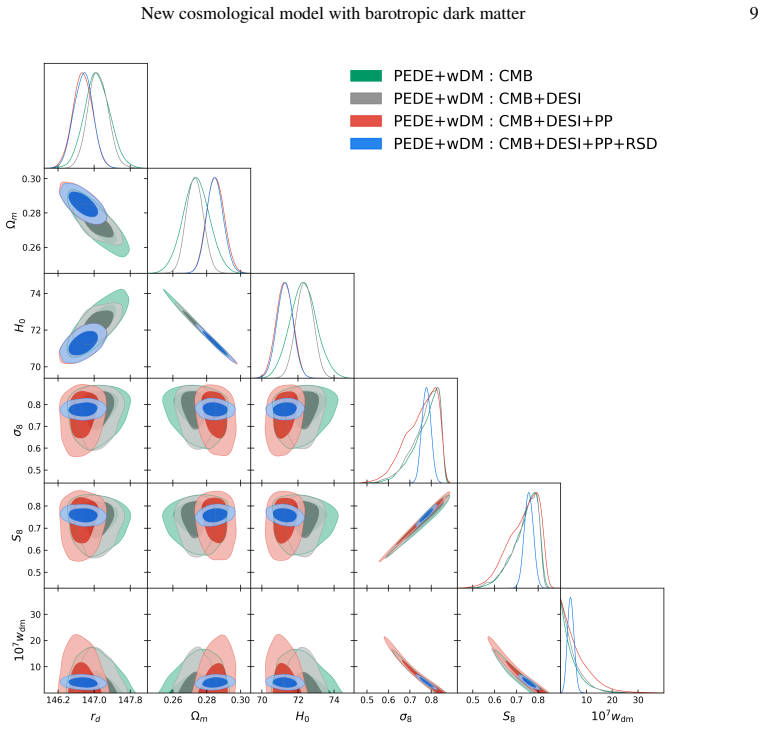
The central claim is that current cosmological data, when the dark energy sector is taken to be phenomenological emergent dark energy, prefer a dark matter sector that is not perfectly cold: a barotropic DM fluid with constant equation of state $w_{\rm dm}$ whose rest-frame sound-speed squared equals it, $c_{s,\rm dm}^2 = c_{ad,\rm dm}^2 = w_{\rm dm}$, with zero non-adiabatic sound speed and zero viscosity. For the data combination CMB+DESI+PP+RSD the posterior is $10^7 w_{\rm dm} = 4.0^{+2.5}_{-2.3}$ at 95% confidence, so $w_{\rm dm}$ is positive at roughly $4\times10^{-7}$. This positive barotropic pressure suppresses the matter power spectrum at small scales and lowers $\sigma_8$ and $S_8$ compared with the same model at $w_{\rm dm}=0$; the redshift-space distortion data are what drive the detection, since they prefer a lower $S_8$ than CMB alone. At the same time, the model comparison gives $\ln B = -25.14$ relative to $\Lambda$CDM, which the paper reads as very strong evidence against the PEDE+$w_{\rm DM}$ model despite the within-model signal.
Load-bearing premise
The detection hinges on treating dark matter as exactly barotropic, with zero non-adiabatic sound speed and zero viscosity, so that every small-scale suppression is attributed to a positive equation-of-state parameter; if dark matter has any entropy pressure or viscosity, the inferred $w_{\rm dm}$ would not isolate the equation of state.
Editorial extensions
If this is right
- If the positive signal is real, cold dark matter is not exactly pressureless: a barotropic sound speed near $4\times10^{-7}$ suppresses low-mass structure formation, offering a physical route to address small-scale problems without invoking warm or interacting dark matter.
- The addition of RSD data is what turns an upper limit into a detection: with CMB, CMB+DESI, and CMB+DESI+PP alone the 95% interval for $10^7w_{\rm dm}$ is consistent with zero, while including Gold2018 $f\sigma_8$ data gives the positive value.
- Within this model, a positive equation of state lowers $\sigma_8$ and $S_8$: for CMB+DESI+PP+RSD the fit gives $\sigma_8=0.778\pm0.021$ and $S_8=0.758\pm0.021$ versus $\sigma_8=0.8532\pm0.0060$ and $S_8=0.8261\pm0.0094$ for PEDE with cold dark matter.
- Bayesian evidence still prefers $\Lambda$CDM very strongly over PEDE+$w_{\rm DM}$ for the datasets that include Pantheon Plus, so the detection is a feature within a model that is overall disfavored.
Reading between the lines
- If dark matter has any non-adiabatic pressure, viscosity, or a redshift-dependent equation of state, the inferred positive $w_{\rm dm}$ would soak up those effects; fitting a generalized dark matter model with separate non-adiabatic sound speed and viscosity to the same data is the direct test of the barotropic assumption.
- The sign flip from a negative dark-matter equation of state in an earlier zero-sound-speed analysis to a positive one here suggests that the constraint is model-dependent, and future datasets that sharpen $S_8$ will determine whether the positive pressure is preferred.
- A barotropic sound speed of order $10^{-7}$ suppresses structure over a specific range of scales; high-resolution small-scale probes such as Lyman-$\alpha$ forest or galaxy clustering at high $k$ could confirm or falsify that scale dependence.
- The Bayesian penalty against the model comes from both the extra parameter and the worse fit; if future data keep the $S_8$ deficit, the balance could shift.
Editorial analysis
A structured set of objections, weighed in public.
Referee Report
Summary. This paper studies a cosmological model in which dark energy is described by phenomenological emergent dark energy (PEDE) and dark matter is treated as a barotropic fluid with a constant equation-of-state parameter wdm equal to the square of its rest-frame sound speed (c_s,dm^2 = wdm). The authors implement the model in CLASS/MontePython and fit it to Planck 2018 CMB, DESI BAO, Pantheon Plus, and Gold-2018 RSD data. For the combined CMB+DESI+PP+RSD dataset they report a positive wdm at 95% confidence (10^7 wdm = 4.0^{+2.5}_{-2.3}) and a Δχ^2 improvement of about 11 over PEDE, but Bayesian evidence strongly favors ΛCDM over PEDE+wDM (ln B = -25.14). The paper also compares PEDE and PEDE+wDM and discusses the effect of wdm on σ8 and S8.
Significance. If the reported signal were robust, it would indicate a small positive sound speed for dark matter, which suppresses small-scale matter fluctuations and is relevant to dark-matter microphysics. The study is a competent application of standard cosmological perturbation theory and MCMC techniques, using public codes and reporting Bayesian evidence, which is a strength. However, the physical interpretation is limited by the model's built-in identity wdm = c_s^2: the data are sensitive almost exclusively to the sound-speed term at perturbations, while the background EoS effect is negligible at wdm ~ 10^-7. The detection appears only after RSD data are added and is influenced by the prior truncation at wdm ≥ 0. Moreover, the model as a whole is very strongly disfavored relative to ΛCDM, so the significance is confined to a parameter within a non-preferred model. The paper's main value is as a phenomenological constraint, but the headline claim overstates what is actually measured.
major comments (3)
- [Section 2 and Abstract] The principal claim that the data measure a positive dark matter equation of state relies on the imposed identity c_s,dm^2 = wdm (with c_nad,dm = 0). The perturbation equations (10)-(11) show that the observable effect on the matter power spectrum enters through the k^2 wdm/(1+wdm) δdm term in the Euler equation, i.e., through the sound speed, while the background effect of wdm ~ 10^-7 in Eq. (1) is negligible. The authors themselves state in Section 4 that the reductions of σ8 and S8 "mainly originate from the effects of a non-zero mean value of DM sound speed squared rather than directly from the effects of a DM EoS parameter." Therefore the abstract's wording "statistically significant signal for positive dark matter equation of state and square of sound speed wdm = c_s^2" overstates what is actually constrained: the data constrain c_s^2 under the barotropic ansatz, and the positive EoS conclusion is a restatement of the ansatz. To support the EoS claim, the authors should either fit wdm and c_s^2 as independent parameters (e.g., in the GDM framework) or explicitly rephrase the result as a constraint on the barotropic sound speed.
- [Section 3 (Table 1) and Section 4] The flat prior wdm ∈ [0, 100] × 10^-6 imposes a hard lower bound at zero. For the CMB, CMB+DESI, and CMB+DESI+PP datasets, the 95% intervals are 0 < 10^7 wdm < 13.1, 13.2, and 17.6, respectively, i.e., the posterior is cut at the prior boundary. The "detection" in the full CMB+DESI+PP+RSD combination (10^7 wdm = 4.0^{+2.5}_{-2.3}) arises only after including RSD, which favors smaller S8. Because the one-sided nature of the prior influences the posterior shape, the authors should quantify the sensitivity of the detection to the prior (e.g., by using a different lower bound or a prior that permits c_s^2 < 0 with a Jeans-type stabilization) and should interpret the result as a one-sided measurement rather than a two-sided detection. Without this, the statement "statistically significant signal" is not robust.
- [Section 2, Eqs. (14)-(15)] The initial conditions for the dark matter perturbations are set by assuming a "density-infinitesimal CDM component" with zero velocity divergence. This is an ad hoc prescription; the paper does not show that these are the growing-mode adiabatic initial conditions for a fluid with wdm ≠ 0 in the synchronous gauge. Since the claimed signal is driven by the perturbation-level sound-speed term, the analysis should validate this choice (e.g., by comparing with a full multi-fluid initial-condition solver or by testing the sensitivity of the wdm posterior to alternative initial conditions). At minimum, the caveat should be stated.
minor comments (5)
- [Section 2, Eq. (4)] Equation (4) is missing a factor 1/3: from Eq. (3) the correct relation is wde = -1 + (1/3)(1+z) d ln Ωde/dz. As written, Eq. (4) is inconsistent with Eq. (5), which is the standard PEDE expression. Please correct Eq. (4).
- [Section 4] There are several typos and grammatical errors, including "signifiant" (twice), "increasd", "vaules", and "ofwdm"; a careful proofread is needed.
- [Section 4] The phrase "seemingly opposite" is imprecise: the previous paper (Yao et al. 2024) fixed c_s^2 = 0, so the difference in results is expected given the different model assumptions. The authors should clarify this point more directly.
- [Section 3] The RSD likelihood description states that k is fixed at 0.1 Mpc for f σ8; please clarify whether this is the same convention as the Gold-2018 public likelihood and whether the scale dependence of f in Eq. (17) is consistently evaluated.
- [Tables 3 and 4] The large asymmetric errors on σ8 and S8 for PEDE+wDM (e.g., σ8 = 0.776^{+0.077}_{-0.029}) reflect the truncated wdm posterior; reporting the posterior mode or median in addition to the mean would help interpret the non-Gaussian distributions.
Circularity Check
No circularity: wdm is a fitted parameter, and the barotropic identification c_s^2=wdm is a stated modeling assumption, not a derived prediction.
full rationale
The central result is a Bayesian parameter constraint on wdm, not a quantity derived from assumptions that already contain it. The model sets c_nad,dm=0 and viscosity zero, so c_s,dm^2=c_ad,dm^2=wdm; this is the definition of the barotropic ansatz (Section 2), not a hidden use of the target result. The data (CMB, DESI, PP, RSD) are external, and the posterior for wdm is a fitted output; the positive 95% interval for CMB+DESI+PP+RSD is not imposed by the prior, since the lower endpoint 1.7e-7 exceeds the wdm>=0 boundary. The paper also honestly states that the sigma8/S8 shift comes from the sound-speed term, not the EoS term, and reports ln B = -25.14 disfavoring the model versus LambdaCDM using an independent evidence calculation. The only self-citation (Yao et al. 2024) motivates the PEDE background and contrasts a previous negative-wdm result; it is not load-bearing for the new fit. Thus no circular step meets the quoted-evidence standard.
Assumptions & free parameters
free parameters (2)
- wdm (DM EoS = squared sound speed) =
10^7 wdm = 4.0 (+2.5, -2.3) at 95% CL for CMB+DESI+PP+RSD
- Standard baseline parameters (omega_b, omega_dm, 100 theta_s, ln(10^10 As), ns, tau_reio) =
Values in Table 3 for each dataset combination
assumptions (6)
- domain assumption Spatially flat FRW spacetime with GR, minimal coupling, and non-gravitationally interacting fluids
- domain assumption PEDE density parameterization Omega_de(z) = Omega_de0 [1 - tanh(log10(1+z))]
- domain assumption Dark matter is barotropic with c_s,dm^2 = wdm and zero non-adiabatic sound speed
- domain assumption Dark energy rest-frame sound speed squared c_s,de = 1
- ad hoc to paper Initial conditions fixed using a density-infinitesimal CDM component with zero velocity divergence in synchronous gauge
- domain assumption Neutrinos treated as two massless species plus one massive species with M_nu = 0.06 eV
Cite this review
Pith. "Pith review of Observational constraints on phenomenological emergent dark energy and barotropic dark matter characterized by a constant equation of state parameter." pith.science (2026). https://pith.science/paper/4R5BV4SO
@misc{pith2026250716147,
  author       = {Pith},
  title        = {Pith review of: Observational constraints on phenomenological emergent dark energy and barotropic dark matter characterized by a constant equation of state parameter},
  year         = {2026},
  howpublished = {\url{https://pith.science/paper/4R5BV4SO}},
  note         = {Machine review of arXiv:2507.16147}
}
abstract
While cold dark matter is widely supported by a range of cosmological observations, it encounters several difficulties at smaller scales. These issues have prompted the investigation of various alternative dark matter candidates, leaving the question "What is dark matter?" still open. In this work, we propose a new cosmological model that considers dark matter as a barotropic fluid with a constant equation of state parameter and interprets dark energy as the phenomenological emergent dark energy rather than a cosmological constant. We then place constraints on our new model using the Planck 2018 Cosmic Microwave Background (CMB) anisotropy measurements, Baryon Acoustic Oscillation (BAO) measurements from the Dark Energy Spectroscopic Instrument (DESI), the Pantheon Plus (PP) compilation of Type Ia supernovae (Ia SNe), and the Redshift Space Distortions (RSD) data from Gold2018. The results show statistically significant signal for positive dark matter equation of state and square of sound speed $w_{\rm dm}=c_{\rm s,dm}^2$ ($10^{7}w_{\rm dm}$ = $4.0^{+2.5}_{-2.3}$ at the 95\% confidence level) for the data combination CMB+DESI+PP+RSD. However, Bayesian evidence indicates that this data combination favors the $\Lambda$CDM model with very strong evidence.
Figures


Forward citations
Cited by 1 Pith paper
-
Is Dark Matter Really Matter?
Using DESI DR2, DES supernovae, and two CMB likelihoods, the authors find wDM about 0.001 and wDE about -0.94 when varied jointly, a roughly 2-sigma joint preference away from Lambda-CDM, with a non-phantom Pade-w plu...
Reference graph
Works this paper leans on
-
[1]
2024a, arXiv preprint arXiv:2404.03000 6
Adame, A., Aguilar, J., Ahlen, S., et al. 2024a, arXiv preprint arXiv:2404.03000 6
-
[2]
2024b, arXiv preprint arXiv:2404.03001 6
Adame, A., Aguilar, J., Ahlen, S., et al. 2024b, arXiv preprint arXiv:2404.03001 6
-
[3]
2024c, arXiv preprint arXiv:2404.03002 5, 6
Adame, A., Aguilar, J., Ahlen, S., et al. 2024c, arXiv preprint arXiv:2404.03002 5, 6
-
[4]
2017, Monthly Notices of the Royal Astronomical Society, 470, 2617 2
Alam, S., Ata, M., Bailey, S., et al. 2017, Monthly Notices of the Royal Astronomical Society, 470, 2617 2
work page 2017
-
[5]
Armendariz-Picon, C., & Neelakanta, J. T. 2014, Journal of Cosmology and Astroparticle Physics, 2014, 049 2
work page 2014
-
[6]
2013, Journal of Cosmology and Astroparticle Physics, 2013, 001 6
Audren, B., Lesgourgues, J., Benabed, K., & Prunet, S. 2013, Journal of Cosmology and Astroparticle Physics, 2013, 001 6
work page 2013
-
[7]
2012, Monthly Notices of the Royal Astronomical Society, 425, 405 6
Blake, C., Brough, S., Colless, M., et al. 2012, Monthly Notices of the Royal Astronomical Society, 425, 405 6
work page 2012
-
[8]
Blake, C., Baldry, I. K., Bland-Hawthorn, J., et al. 2013, Monthly Notices of the Royal Astronomical Society, 436, 3089 6
work page 2013
Show all 63 references
-
[9]
2011, Journal of Cosmology and Astroparticle Physics, 2011, 034 6
Blas, D., Lesgourgues, J., & Tram, T. 2011, Journal of Cosmology and Astroparticle Physics, 2011, 034 6
2011
-
[10]
R., Pagels, H., & Primack, J
Blumenthal, G. R., Pagels, H., & Primack, J. R. 1982, Nature, 299, 37 2
1982
-
[11]
P., & Turok, N
Bode, P., Ostriker, J. P., & Turok, N. 2001, The Astrophysical Journal, 556, 93 2
2001
-
[12]
S., & Kaplinghat, M
Boylan-Kolchin, M., Bullock, J. S., & Kaplinghat, M. 2012, Monthly Notices of the Royal Astronomical Society, 422, 1203 2
2012
-
[13]
2019, Physics of the Dark Universe, 24, 100260 6
Brinckmann, T., & Lesgourgues, J. 2019, Physics of the Dark Universe, 24, 100260 6
2019
-
[14]
2016, Monthly Notices of the Royal Astronomical Society, 461, 3781 6
Chuang, C.-H., Prada, F., Pellejero-Ibanez, M., et al. 2016, Monthly Notices of the Royal Astronomical Society, 461, 3781 6
2016
-
[15]
L., et al
Davis, M., Nusser, A., Masters, K. L., et al. 2011, Monthly Notices of the Royal Astronomical Society, 413, 2906 6 Di Valentino, E., Mena, O., Pan, S., et al. 2021a, Class. Quant. Grav., 38, 153001 2 Di Valentino, E., et al. 2021b, Astropart. Phys., 131, 102605 2
2011
-
[16]
2011, The Astrophysical Journal, 739, 52 2
Dunkley, J., Hlozek, R., Sievers, J., et al. 2011, The Astrophysical Journal, 739, 52 2
2011
-
[17]
2015, Physical Review Letters, 115, 011301 6
Feix, M., Nusser, A., & Branchini, E. 2015, Physical Review Letters, 115, 011301 6
2015
-
[18]
Gelman, A., & Rubin, D. B. 1992, Statistical science, 7, 457 6
1992
-
[19]
2017a, arXiv preprint arXiv:1704.03472 6
Heavens, A., Fantaye, Y ., Mootoovaloo, A., et al. 2017a, arXiv preprint arXiv:1704.03472 6
-
[20]
2017b, Physical review letters, 119, 101301 6 Hern´andez-Almada, A., Leon, G., Maga˜na, J., Garc´ıa-Aspeitia, M
Heavens, A., Fantaye, Y ., Sellentin, E., et al. 2017b, Physical review letters, 119, 101301 6 Hern´andez-Almada, A., Leon, G., Maga˜na, J., Garc´ıa-Aspeitia, M. A., & Motta, V . 2020, Monthly Notices of the Royal Astronomical Society, 497, 1590 2
2020
-
[21]
2013, The Astrophysical Journal Supplement Series, 208, 19 2
Hinshaw, G., Larson, D., Komatsu, E., et al. 2013, The Astrophysical Journal Supplement Series, 208, 19 2
2013
-
[22]
J., Samushia, L., Percival, W
Howlett, C., Ross, A. J., Samushia, L., Percival, W. J., & Manera, M. 2015, Monthly Notices of the Royal Astronomical Society, 449, 848 6
2015
-
[23]
1998, The Astrophysical Journal, 506, 485 2
Hu, W. 1998, The Astrophysical Journal, 506, 485 2
1998
-
[24]
2000, Physical Review Letters, 85, 1158 2
Hu, W., Barkana, R., & Gruzinov, A. 2000, Physical Review Letters, 85, 1158 2
2000
-
[25]
2024, arXiv:2410.06053 2
Huang, L., Cai, R.-G., Wang, S.-J., Liu, J.-Q., & Yao, Y .-H. 2024, arXiv:2410.06053 2
2024 arXiv
-
[26]
2022, Sci
Huang, L., Huang, Z., Zhou, H., & Li, Z. 2022, Sci. China Phys. Mech. Astron., 65, 239512 2
2022
-
[27]
2025, Sci
Huang, L., Wang, S.-J., & Yu, W.-W. 2025, Sci. China Phys. Mech. Astron., 68, 220413 2 New cosmological model with barotropic dark matter 13
2025
-
[28]
J., & Turnbull, S
Hudson, M. J., & Turnbull, S. J. 2012, The Astrophysical Journal Letters, 751, L30 6
2012
-
[29]
L., Scolnic, D
Huterer, D., Shafer, D. L., Scolnic, D. M., & Schmidt, F. 2017, Journal of Cosmology and Astroparticle Physics, 2017, 015 6 Ili´c, S., Kopp, M., Skordis, C., & Thomas, D. B. 2021, Physical Review D, 104, 043520 2
2017
-
[30]
E., & Raftery, A
Kass, R. E., & Raftery, A. E. 1995, Journal of the american statistical association, 90, 773 7
1995
-
[31]
V ., Valenzuela, O., & Prada, F
Klypin, A., Kravtsov, A. V ., Valenzuela, O., & Prada, F. 1999, The Astrophysical Journal, 522, 82 2
1999
-
[32]
B., & Ili´c, S
Kopp, M., Skordis, C., Thomas, D. B., & Ili´c, S. 2018, Physical Review Letters, 120, 221102 2
2018
-
[33]
C., & Yadav, S
Kumar, S., Nunes, R. C., & Yadav, S. K. 2019, Monthly Notices of the Royal Astronomical Society, 490, 1406 2, 4
2019
-
[34]
2014, Physics Letters B, 737, 244 2
Kumar, S., & Xu, L. 2014, Physics Letters B, 737, 244 2
2014
-
[35]
2011, arXiv preprint arXiv:1104.2932 6
Lesgourgues, J. 2011, arXiv preprint arXiv:1104.2932 6
2011 arXiv
-
[36]
2019, The Astrophysical Journal Letters, 883, L3 2, 3
Li, X., & Shafieloo, A. 2019, The Astrophysical Journal Letters, 883, L3 2, 3
2019
-
[37]
2020, The Astrophysical Journal, 902, 58 2
Li, X., & Shafieloo, A. 2020, The Astrophysical Journal, 902, 58 2
2020
-
[38]
2020, Sci
Liu, M., Huang, Z., Luo, X., et al. 2020, Sci. China Phys. Mech. Astron., 63, 290405 2
2020
-
[39]
2020, Astrophys
Luo, X., Huang, Z., Qian, Q., & Huang, L. 2020, Astrophys. J., 905, 53 2
2020
-
[40]
J., & Silk, J
Marsh, D. J., & Silk, J. 2014, Monthly Notices of the Royal Astronomical Society, 437, 2652 2
2014
-
[41]
Mueller, C. M. 2005, Physical Review D, 71, 047302 2
2005
-
[42]
2016, Publications of the Astronomical Society of Japan, 68, 38 6
Okumura, T., Hikage, C., Totani, T., et al. 2016, Publications of the Astronomical Society of Japan, 68, 38 6
2016
-
[43]
N., & Yang, W
Pan, S., Saridakis, E. N., & Yang, W. 2018, Physical Review D, 98, 063510 6
2018
-
[44]
F., & Silk, J
Pan, S., Yang, W., Di Valentino, E., Mota, D. F., & Silk, J. 2023, Journal of Cosmology and Astroparticle Physics, 2023, 064 2
2023
-
[45]
2020, Journal of Cosmology and Astroparticle Physics, 2020, 062 2, 3
Pan, S., Yang, W., Di Valentino, E., Shafieloo, A., & Chakraborty, S. 2020, Journal of Cosmology and Astroparticle Physics, 2020, 062 2, 3
2020
-
[46]
1999, The Astrophysical Journal, 517, 565 2
Perlmutter, S., Aldering, G., Goldhaber, G., et al. 1999, The Astrophysical Journal, 517, 565 2
1999
-
[47]
2017, Astronomy & Astrophysics, 604, A33 6
Pezzotta, A., de La Torre, S., Bel, J., et al. 2017, Astronomy & Astrophysics, 604, A33 6
2017
-
[48]
G., Filippenko, A
Riess, A. G., Filippenko, A. V ., Challis, P., et al. 1998, The Astronomical Journal, 116, 1009 2
1998
-
[49]
2018, Physical Review D, 98, 083543 6
Sagredo, B., Nesseris, S., & Sapone, D. 2018, Physical Review D, 98, 083543 6
2018
-
[50]
J., & Raccanelli, A
Samushia, L., Percival, W. J., & Raccanelli, A. 2012, Monthly Notices of the Royal Astronomical Society, 420, 2102 6 S´anchez, A. G., Montesano, F., Kazin, E. A., et al. 2014, Monthly Notices of the Royal Astronomical Society, 440, 2692 6 Sch¨oneberg, N., Franco Abell´an, G., ...
2012
-
[51]
2022, The Astrophysical Journal, 938, 113 6
Scolnic, D., Brout, D., Carr, A., et al. 2022, The Astrophysical Journal, 938, 113 6
2022
-
[52]
2021, Astron
Shah, P., Lemos, P., & Lahav, O. 2021, Astron. Astrophys. Rev., 29, 9 2
2021
-
[53]
Song, Y .-S., & Percival, W. J. 2009, Journal of Cosmology and Astroparticle Physics, 2009, 004 6 14 J.-Q. Liu et al
2009
-
[54]
N., & Steinhardt, P
Spergel, D. N., & Steinhardt, P. J. 2000, Physical review letters, 84, 3760 2
2000
-
[55]
2008, Monthly Notices of the Royal Astronomical Society, 391, 1685 2
Springel, V ., Wang, J., V ogelsberger, M., et al. 2008, Monthly Notices of the Royal Astronomical Society, 391, 1685 2
2008
-
[56]
2015, The Astrophysical Journal, 810, 50 2
Story, K., Hanson, D., Ade, P., et al. 2015, The Astrophysical Journal, 810, 50 2
2015
-
[57]
A., MacCrann, N., Zuntz, J., et al
Troxel, M. A., MacCrann, N., Zuntz, J., et al. 2018, Physical Review D, 98, 043528 2
2018
-
[58]
J., Hudson, M
Turnbull, S. J., Hudson, M. J., Feldman, H. A., et al. 2012, Monthly Notices of the Royal Astronomical Society, 420, 447 6
2012
-
[59]
H., Strigari, L
Wang, M.-Y ., Peter, A. H., Strigari, L. E., et al. 2014, Monthly Notices of the Royal Astronomical Society, 445, 614 2
2014
-
[60]
2021, Physical Review D, 104, 063521 2
Yang, W., Di Valentino, E., Pan, S., Shafieloo, A., & Li, X. 2021, Physical Review D, 104, 063521 2
2021
-
[61]
2019, Physical Review D, 100, 023522 6
Yang, W., Shahalam, M., Pal, B., Pan, S., & Wang, A. 2019, Physical Review D, 100, 023522 6
2019
-
[62]
2024, Physical Review D, 109, 063502 2, 8, 11
Yao, Y .-H., Wang, J.-C., & Meng, X.-H. 2024, Physical Review D, 109, 063502 2, 8, 11
2024
-
[63]
2019, Monthly Notices of the Royal Astronomical Society, 482, 3497 6
Zhao, G.-B., Wang, Y ., Saito, S., et al. 2019, Monthly Notices of the Royal Astronomical Society, 482, 3497 6
2019
Reviewed August 6, 2026 · model on record in the stance chip above.
Discussion (0). Sign in to comment.