REVIEW 1 major objections 1 minor 1 cited by
Linear feedback cooling brings a levitated milligram gravity sensor below 2 picometer amplitude in two modes at once.
Reviewed by Pith at T0; open to challenge. T0 means a machine referee read the full paper against a public rubric. the ladder, T0–T4 →
T0 review · grok-4.3
2026-07-02 23:14 UTC pith:4VBLFXVD
load-bearing objection They cooled two modes of a milligram levitated magnet to sub-2 pm amplitude and sub-10 mK simultaneously using feedback in a superconducting trap, which is a concrete experimental step, though the isolation claim needs a direct check against residual vibrations. the 1 major comments →
Picometer control of a levitating milligram gravity sensor
The pith
A machine-rendered reading of the paper's core claim, the machinery that carries it, and where it could break.
Core claim
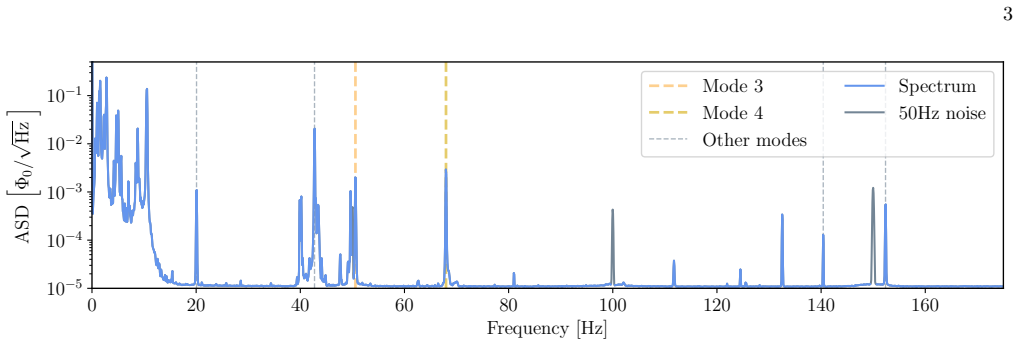
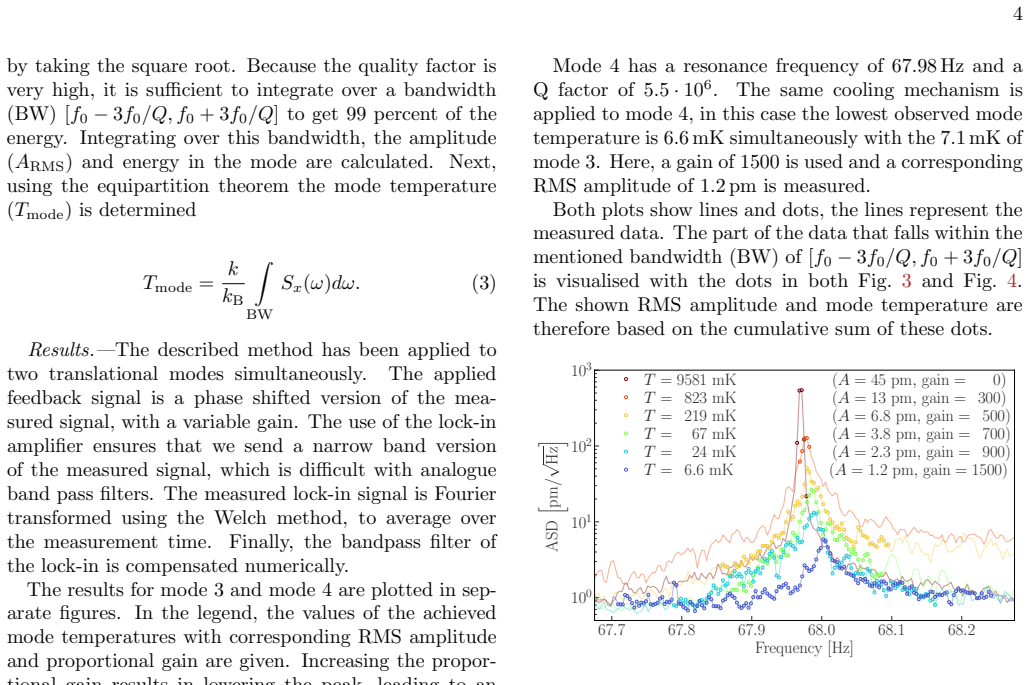
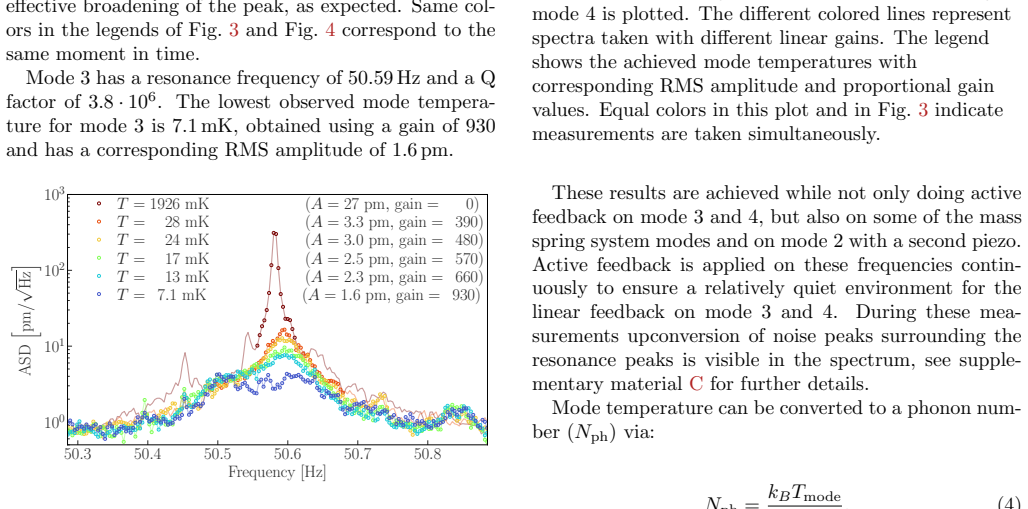
By sending the position signal from a DC SQUID to a lock-in amplifier and then to a piezoelectric actuator, linear feedback simultaneously damps the 50.6 Hz and 68.0 Hz translational modes of a levitating permanent magnet in a type-I superconducting trap to below 2 pm rms amplitude and below 10 mK effective temperature, while the modes retain Q factors of 3.8 million and 5.5 million inside a dry dilution refrigerator.
What carries the argument
Linear feedback loop that uses the SQUID readout of the levitated magnet's motion to drive a piezoelectric actuator at the two resonance frequencies.
Load-bearing premise
The 110-130 dB vibrational isolation of the dilution refrigerator keeps external seismic and acoustic noise from setting the floor for the cooled amplitudes at 50.6 Hz and 68.0 Hz.
What would settle it
A direct measurement of the position spectral density with feedback engaged that shows rms amplitudes remaining above 2 picometers at either resonance frequency.
If this is right
- The same readout and actuator chain can in principle address all six degrees of freedom of the levitated magnet.
- The demonstrated Q factors above three million imply energy decay times long enough to support many oscillation cycles at the cooled amplitudes.
- Further reduction of the effective temperature toward the quantum ground state is stated as the next target once additional improvements are made.
- The sensor has already been shown to function as a gravitational detector, so the cooled state directly improves its force sensitivity.
- The approach combines existing milligram levitation, high-Q mechanics, and low-noise SQUID detection in one cryogenic platform.
Where Pith is reading between the lines
- If ground-state cooling succeeds, the same device could serve as a testbed for whether macroscopic objects can maintain quantum coherence while sensing gravity.
- Picometer-level control at milligram mass may allow gravity-gradient or Casimir-force measurements that were previously limited by thermal motion.
- The feedback architecture could be transferred to other levitated systems that use optical or electrical readout instead of SQUIDs.
- Success at these low frequencies suggests the method may scale to higher-frequency modes once the trap geometry is adjusted.
Editorial analysis
A structured set of objections, weighed in public.
Referee Report
Summary. The manuscript reports linear feedback cooling of two translational modes (x and y) of a magnetically levitated milligram permanent magnet gravity sensor to amplitudes below 2 picometers and mode temperatures below 10 millikelvin simultaneously. The sensor is a permanent magnet in a type-I superconducting trap with six resonance frequencies read out via a superconducting coil coupled to a DC SQUID; the signal is processed by a lock-in amplifier to generate feedback applied to a piezoelectric actuator. Resonances at 50.6 Hz and 68.0 Hz exhibit Q factors of 3.8×10^6 and 5.5×10^6, respectively, with the apparatus mounted in a dry dilution refrigerator providing 110-130 dB vibrational attenuation at these frequencies. Future improvements toward quantum ground-state cooling are discussed.
Significance. If the central experimental claims hold, the work demonstrates a concrete advance in controlling levitated milligram-scale mechanical resonators at the picometer and millikelvin level. It integrates high-Q magnetic levitation, SQUID-based readout, and linear feedback within a cryogenically isolated environment, building directly on prior gravitational-sensing demonstrations with the same platform. This supplies a practical benchmark for the field and identifies specific technical steps needed for ground-state cooling in quantum gravity sensor applications.
major comments (1)
- [cryostat mounting and isolation performance] In the section describing the cryostat mounting and isolation performance, the assertion that 110-130 dB attenuation at 50.6 Hz and 68.0 Hz keeps external seismic/acoustic noise below the reported cooled amplitudes lacks a direct supporting measurement (e.g., base-plate vibration spectrum converted to equivalent displacement at the magnet) showing residual drive lies below the 2 pm variance. Without this comparison, it remains possible that the observed floor is set by imperfect isolation rather than by the linear feedback itself.
minor comments (1)
- [results] The abstract states measured Q factors, resonance frequencies, isolation levels, and achieved amplitudes/temperatures but does not reference accompanying data tables, error bars, or example time traces; adding these in the results section would allow independent verification that the reported values are mode temperatures.
Simulated Author's Rebuttal
We thank the referee for their careful reading of the manuscript and for the constructive comment. We address the point below and have revised the manuscript to strengthen the supporting evidence for the isolation performance.
read point-by-point responses
-
Referee: In the section describing the cryostat mounting and isolation performance, the assertion that 110-130 dB attenuation at 50.6 Hz and 68.0 Hz keeps external seismic/acoustic noise below the reported cooled amplitudes lacks a direct supporting measurement (e.g., base-plate vibration spectrum converted to equivalent displacement at the magnet) showing residual drive lies below the 2 pm variance. Without this comparison, it remains possible that the observed floor is set by imperfect isolation rather than by the linear feedback itself.
Authors: We agree that a direct comparison between the residual seismic drive and the cooled amplitudes provides stronger evidence. The quoted 110-130 dB attenuation was obtained from direct measurements of the cryostat mounting and suspension system at the relevant frequencies. To address the concern, the revised manuscript now includes an explicit conversion of the measured base-plate acceleration spectrum (taken with an accelerometer during operation) to equivalent displacement at the magnet, using the known mechanical transfer function of the levitation trap. This shows the residual external drive lies below 0.2 pm rms—more than an order of magnitude below the reported 2 pm cooled amplitudes—confirming that the amplitude floor is set by the feedback cooling. The updated isolation section contains the spectrum, conversion details, and direct comparison. revision: yes
Circularity Check
No circularity: experimental results are direct measurements
full rationale
The paper presents experimental measurements of resonance frequencies, Q factors, feedback cooling performance, and resulting amplitudes/temperatures for a levitated magnet. No derivation, prediction, or first-principles result is claimed that reduces by construction to fitted parameters, self-citations, or ansatzes from the same work. The central claims rest on observed data from the lock-in amplifier and SQUID readout rather than any tautological loop. Self-citations (e.g., prior gravitational sensing) are peripheral and not load-bearing for the cooling results.
Axiom & Free-Parameter Ledger
axioms (2)
- domain assumption The position signal from the superconducting coil is linearly proportional to the magnet's displacement at the amplitudes achieved.
- domain assumption The dilution refrigerator provides 110-130 dB attenuation at 50-68 Hz without introducing additional noise that would limit the cooled amplitudes.
read the original abstract
Due to their exceptional isolation from the environment, magnetically levitated particles are explored as extremely sensitive mechanical sensors. For future gravity experiments on quantum superpositions, such systems need to be cooled close to their ground state. To demonstrate the combination of state of the art vibration isolation, milligram levitated high Q mechanical resonators and position detection with low noise, we present linear feedback cooling of a magnetically levitated gravity sensor to below 2 picometer amplitude and below 10 millikelvin mode temperature for two translational modes (the x- and y-mode) simultaneously. The sensor is a levitating permanent magnet in a type I superconducting trap, where its six resonance frequencies are measured with a superconducting coil coupled to a DC SQUID. This signal is measured with a lock-in amplifier and a feedback signal is sent to a piezoelectric actuator, allowing the cooling of resonant modes at 50.6 and 68.0 Hz simultaneously. These two translational modes have Q factors of $3.8 \cdot 10^6$ and $5.5 \cdot 10^6$ respectively. The experiment is mounted inside a dry dilution refrigerator where it is vibrationally attenuated with 110-130 dB at these frequencies. In this work, we discuss future improvements on the setup which may enable quantum ground state cooling on a magnetically levitated particle, that has previously been shown to be a gravitational sensor.
Figures

Forward citations
Cited by 1 Pith paper
-
Magnetic Dipole in a Cuboidal Superconducting Trap
Derives exact image-dipole potential in cuboidal superconducting trap, reduces centered dipole energy to Epstein-zeta lattice sums, and shows alignment with short axis over finite aspect ratio ranges verified to 0.16% by FEM.
Reference graph
Works this paper leans on
-
[1]
Quantum ground state and single- phonon control of a mechanical resonator,
A. D. O’Connell, M. Hofheinz, M. Ansmann, R. C. Bial- czak, M. Lenander, E. Lucero, M. Neeley, D. Sank, H. Wang, M. Weides, J. Wenner, J. M. Martinis, and A. N. Cleland, “Quantum ground state and single- phonon control of a mechanical resonator,” Nature464, 697 (2010)
work page 2010
-
[2]
Sideband cooling of micromechanical motion to the quantum ground state,
J. D. Teufel, T. Donner, D. Li, J. W. Harlow, M. S. Allman, K. Cicak, A. J. Sirois, J. D. Whittaker, K. W. Lehnert, and R. W. Simmonds, “Sideband cooling of micromechanical motion to the quantum ground state,” Nature475, 359 (2011)
work page 2011
-
[3]
Laser cooling of a nanomechanical oscillator into its quantum ground state,
J. Chan, T. P. Alegre, A. H. Safavi-Naeini, J. T. Hill, A. Krause, S. Gr¨ oblacher, M. Aspelmeyer, and O. Painter, “Laser cooling of a nanomechanical oscillator into its quantum ground state,” Nature478, 89 (2011)
work page 2011
-
[4]
Observation of quantum motion of a nanomechanical resonator,
A. H. Safavi-Naeini, J. Chan, J. T. Hill, T. P. Alegre, A. Krause, and O. Painter, “Observation of quantum motion of a nanomechanical resonator,” Physical Review Letters108(2012), 10.1103/PhysRevLett.108.033602
-
[5]
Sympathetic cooling of a membrane oscillator in a hybrid mechanical-atomic sys- tem,
A. J¨ ockel, A. Faber, T. Kampschulte, M. Korppi, M. T. Rakher, and P. Treutlein, “Sympathetic cooling of a membrane oscillator in a hybrid mechanical-atomic sys- tem,” Nature Nanotechnology10, 55 (2015)
work page 2015
-
[6]
Laser cooling to the zero-point energy of mo- tion,
F. Diedrich, J. C. Bergquist, W. M. Itano, and D. J. Wineland, “Laser cooling to the zero-point energy of mo- tion,” Physical Review Letters62, 403 (1989)
work page 1989
-
[7]
Resolved- sideband raman cooling of a bound atom to the 3d zero- point energy,
C. Monroe, D. M. Meekhof, B. E. King, S. R. Jefferts, W. M. Itano, D. J. Wineland, and P. Gould, “Resolved- sideband raman cooling of a bound atom to the 3d zero- point energy,” Physical Review Letters75, 4011 (1995)
work page 1995
-
[8]
Quantum dynamics of sin- gle trapped ions,
D. Leibfried and R. Blatt, “Quantum dynamics of sin- gle trapped ions,” Reviews of Modern Physics75, 281 (2003)
work page 2003
-
[9]
Cooling of a levitated nanoparticle to the motional quantum ground state,
U. Deli´ c, M. Reisenbauer, K. Dare, D. Grass, V. Vuleti´ c, N. Kiesel, and M. Aspelmeyer, “Cooling of a levitated nanoparticle to the motional quantum ground state,” Sci- ence367, 892 (2020)
work page 2020
-
[10]
Quantum control of a nanopar- ticle optically levitated in cryogenic free space,
F. Tebbenjohanns, M. L. Mattana, M. Rossi, M. Frim- mer, and L. Novotny, “Quantum control of a nanopar- ticle optically levitated in cryogenic free space,” Nature 595, 378 (2021)
work page 2021
-
[11]
Real-time optimal quantum control of mechanical motion at room temperature,
L. Magrini, P. Rosenzweig, C. Bach, A. Deutschmann- Olek, S. G. Hofer, S. Hong, N. Kiesel, A. Kugi, and M. Aspelmeyer, “Real-time optimal quantum control of mechanical motion at room temperature,” Nature595, 373 (2021)
work page 2021
-
[12]
Simul- taneous ground-state cooling of two mechanical modes of a levitated nanoparticle,
J. Piotrowski, D. Windey, J. Vijayan, C. Gonzalez- Ballestero, A. de los R´ ıos Sommer, N. Meyer, R. Quidant, O. Romero-Isart, R. Reimann, and L. Novotny, “Simul- taneous ground-state cooling of two mechanical modes of a levitated nanoparticle,” Nature Physics19, 1009 (2023)
work page 2023
-
[13]
van Waarde,The lead zeppelin: a force sensor without 6 a handle, Ph.D
B. van Waarde,The lead zeppelin: a force sensor without 6 a handle, Ph.D. thesis, Leiden University (2016)
work page 2016
-
[14]
Chip-based superconducting traps for levitation of micrometer-sized particles in the meissner state,
M. G. Latorre, J. Hofer, M. Rudolph, and W. Wiec- zorek, “Chip-based superconducting traps for levitation of micrometer-sized particles in the meissner state,” Superconductor Science and Technology33(2020), 10.1088/1361-6668/aba6e1
-
[15]
A chip-based superconducting magnetic trap for levitating superconducting microparti- cles,
M. G. Latorre, A. Paradkar, D. Hambraeus, G. Hig- gins, and W. Wieczorek, “A chip-based superconducting magnetic trap for levitating superconducting microparti- cles,” IEEE Transactions on Applied Superconductivity 32(2022), 10.1109/TASC.2022.3147730
-
[16]
J. Hofer, R. Gross, G. Higgins, H. Huebl, O. F. Kieler, R. Kleiner, D. Koelle, P. Schmidt, J. A. Slater, M. Trupke, K. Uhl, T. Weimann, W. Wiec- zorek, and M. Aspelmeyer, “High- q magnetic levi- tation and control of superconducting microspheres at millikelvin temperatures,” Physical Review Letters131 (2023), 10.1103/PhysRevLett.131.043603
-
[17]
M. G. Latorre, G. Higgins, A. Paradkar, T. Bauch, and W. Wieczorek, “Superconducting microsphere magnet- ically levitated in an anharmonic potential with inte- grated magnetic readout,” Physical Review Applied19 (2023), 10.1103/PhysRevApplied.19.054047
-
[18]
Remote sensing of a levitated superconductor with a flux-tunable microwave cavity,
P. Schmidt, R. Claessen, G. Higgins, J. Hofer, J. J. Hansen, P. Asenbaum, M. Zemlicka, K. Uhl, R. Kleiner, R. Gross, H. Huebl, M. Trupke, and M. Aspelmeyer, “Remote sensing of a levitated superconductor with a flux-tunable microwave cavity,” Physical Review Applied 22(2024), 10.1103/PhysRevApplied.22.014078
-
[19]
A. Paradkar, P. Nicaise, K. Dakroury, F. Resare, and W. Wieczorek, “Superconducting flip-chip devices us- ing indium microspheres on au-passivated nb or nbn as under-bump metallization layer,” Applied Physics Let- ters126(2025), 10.1063/5.0235266
-
[20]
Opti- cal interferometric readout of a magnetically levitated superconducting microsphere,
J. J. Hansen, S. Minniberger, D. Ilk, P. Asenbaum, G. Higgins, R. G. Povey, P. Schmidt, J. Hofer, R. Claessen, M. Aspelmeyer, and M. Trupke, “Opti- cal interferometric readout of a magnetically levitated superconducting microsphere,” Physical Review Applied 25, 044080 (2026)
work page 2026
-
[21]
Acceleration sensing with magnetically levitated oscillators above a superconductor,
C. Timberlake, G. Gasbarri, A. Vinante, A. Setter, and H. Ulbricht, “Acceleration sensing with magnetically levitated oscillators above a superconductor,” Applied Physics Letters115(2019), 10.1063/1.5129145
-
[22]
Ultralow me- chanical damping with meissner-levitated ferromagnetic microparticles,
A. Vinante, A. Vinante, P. Falferi, G. Gasbarri, A. Set- ter, C. Timberlake, and H. Ulbricht, “Ultralow me- chanical damping with meissner-levitated ferromagnetic microparticles,” Physical Review Applied13(2020), 10.1103/PhysRevApplied.13.064027
-
[23]
A. Vinante, C. Timberlake, and H. Ulbricht, “Levitated micromagnets in superconducting traps: A new platform for tabletop fundamental physics experiments,” Entropy 24, 1642 (2022)
work page 2022
-
[24]
Linear cool- ing of a levitated micromagnetic cylinder by vibration,
C. Timberlake, E. Simcox, and H. Ulbricht, “Linear cool- ing of a levitated micromagnetic cylinder by vibration,” Physical Review Research6(2024), 10.1103/PhysRevRe- search.6.033345
-
[25]
Measuring gravity with milligram levi- tated masses,
T. M. Fuchs, D. G. Uitenbroek, J. Plugge, N. V. Hal- teren, P. V. Soest, A. Vinante, H. Ulbricht, and T. H. Oosterkamp, “Measuring gravity with milligram levi- tated masses,” Science Advances2949, 1 (2024)
work page 2024
-
[26]
Using permanent magnets at low temperature,
S. R. Trout and S. Constantinides, “Using permanent magnets at low temperature,” TECHNotes Arnold Mag- netic Technologies0302, 1 (2003)
work page 2003
-
[27]
Sub-khz mechanical resonator passively cooled to 6 mk,
L. van Everdingen, J. Plugge, T. M. Fuchs, G. L. van de Stolpe, D. Benali, T. de Jong, J. Bijl, W. A. Bosch, and T. H. Oosterkamp, “Sub-khz mechanical resonator passively cooled to 6 mk,” Physical Review Research8, L022004 (2026)
work page 2026
-
[28]
Vibration isolation with high thermal conductance for a cryogen-free dilution refrigera- tor,
M. D. Wit, G. Welker, K. Heeck, F. M. Buters, H. J. Eerkens, G. Koning, H. V. der Meer, D. Bouwmeester, and T. H. Oosterkamp, “Vibration isolation with high thermal conductance for a cryogen-free dilution refrigera- tor,” Review of Scientific Instruments90, 015112 (2019)
work page 2019
-
[29]
First search for ultralight dark matter using a magnetically levitated particle,
D. W. Amaral, D. G. Uitenbroek, T. H. Oosterkamp, and C. D. Tunnell, “First search for ultralight dark matter using a magnetically levitated particle,” Physical Review Letters134(2025), 10.1103/PhysRevLett.134.251001
-
[30]
Levitated ferromagnetic magnetometer with energy resolution well below,
F. Ahrens, W. Ji, D. Budker, C. Timberlake, H. Ulbricht, and A. Vinante, “Levitated ferromagnetic magnetometer with energy resolution well below,” Physical Review Let- ters134(2025), 10.1103/PhysRevLett.134.110801
-
[31]
A. Vinante, C. Timberlake, D. Budker, D. F. Kimball, A. O. Sushkov, and H. Ulbricht, “Surpassing the en- ergy resolution limit with ferromagnetic torque sensors,” Physical Review Letters127(2021), 10.1103/Phys- RevLett.127.070801
-
[32]
Magnetic dipole trapping potential be- tween infinite superconducting plates,
F. J. Headley, “Magnetic dipole trapping potential be- tween infinite superconducting plates,” Physica Scripta 100(2025), 10.1088/1402-4896/adeeda. 7 Supplementary Material: Picometer control of a levitating milligram gravity sensor Dennis G. Uitenbroek, Jurriaan Langendorff, and Tjerk H. Oosterkamp A. Mode identification Currently, for our system, assign...
discussion (0)
Sign in with ORCID, Apple, or X to comment. Anyone can read and Pith papers without signing in.