REVIEW 2 major objections 3 minor 10 references
Black Holes Rule Out Heavy Tachyons
T0 review · 2 major / 3 minor · reviewed 2026-08-10 · deepseek-v4-flash
Pith's one-line read Observed black holes rule out tachyons heavier than about 3 billion GeV.
desk verdict A clean analytic estimate with a potentially important bound, but the 'rule out' claim outruns the curved-space derivation. read the letter →
The pith
A machine-rendered reading of the paper's core claim, the machinery that carries it, and where it could break.
The reading
What carries the argument
The load-bearing object is the flat-space blackbody emission formula for a thermal free gas, Eq. (21), adapted to tachyon kinematics: the dispersion $E=\sqrt{p^2-m^2}$ with momentum restricted to $p\ge m$ and energy $E\ge0$. Using the black hole area $A=16\pi G^2M^2$ and Hawking temperature $T=1/(8\pi GM)$, integrating over the exterior of the momentum-space 3-ball yields the exact powers in Eqs. (24)--(25); in the heavy limit the $m^2T^2$ term dominates, producing the lifetime bound. The paper also invokes a nonlocal Hamiltonian (Appendix A) whose extra $\tilde{J},J$ kernels cut out momenta $p<m$, defining a stable vacuum so that the emission calculation is internally consistent.
What would settle it
A definitive check would be a Bogoliubov-coefficient calculation of tachyon emission from the Appendix A Hamiltonian in Schwarzschild spacetime: if the heavy-mass radiated power does not scale as $g A m^2 T^2$ times an order-one prefactor, the flat-space formula and the $3\times10^9$ GeV bound fail. Alternatively, a confidently aged observed black hole near $3.3\,M_\odot$ that survived much longer than the predicted lifetime for a claimed tachyon mass would directly falsify the exclusion.
Extended reading notes
Core claim
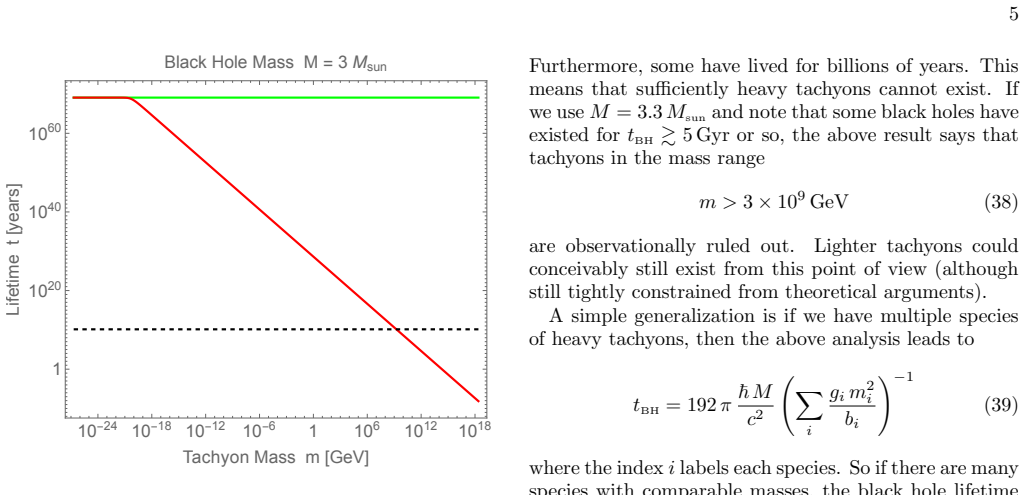
The paper's central claim is that the Hawking radiation of tachyons from a Schwarzschild black hole is not exponentially suppressed like that of ordinary massive particles, but enhanced by a factor $\sim m^2/T^2$ relative to massless particles. For a heavy tachyon of mass $m\gg T$, the emitted power is $P = g A m^2 T^2/48$ for bosons and $g A m^2 T^2/96$ for fermions, and integrating $dM/dt$ gives the lifetime $t_{\rm BH}\approx 192\pi b_{B,F}\hbar M/(g c^2 m^2)$, with $b_{B,F}=1,2$. Because the observed black hole of mass $M\simeq3.3\,M_\odot$ has lived for at least $\sim5$ Gyr, the paper concludes that any tachyon with one bosonic degree of freedom and $m\gtrsim3\times10^9$ GeV is observationally ruled out, with multi-species generalizations only strengthening the bound.
Load-bearing premise
The derivation assumes that Hawking emission near the horizon is faithfully described by the flat-space blackbody formula at temperature $T=1/(8\pi GM)$ for the nonlocal tachyon field, without a full curved-space mode decomposition; if curvature or nonlocality changes the near-horizon mode structure, the $m^2T^2$ enhancement and the derived mass bound could shift.
Editorial extensions
If this is right
- A single bosonic tachyon heavier than about $3\times10^9$ GeV is incompatible with observed black holes of a few solar masses that have lived for billions of years.
- Tachyons at grand-unification ($10^{15}$--$10^{16}$ GeV) or quantum-gravity ($10^{18}$--$10^{19}$ GeV) masses are excluded by these observations.
- If several heavy tachyon species exist, the bound is stronger: the lifetime scales as $\left(\sum_i g_i m_i^2 / b_i\right)^{-1}$.
- For primordial black holes with masses $10^{17}$--$10^{21}$ g surviving to today, tachyon masses down to $7$--$700$ GeV would be ruled out.
Reading between the lines
- The paper's flat-space emission step is a leading approximation; a full curved-space Bogoliubov calculation for the nonlocal Appendix A Hamiltonian is the natural check on whether the $m^2T^2$ enhancement survives or acquires order-one (or exponential) corrections.
- The same blackbody-integral method could bound other superluminal or exotic dispersion relations by requiring that known black hole ages be compatible with their emission.
- If asteroid-mass primordial black holes are confirmed with ages at least the age of the universe, the tachyon mass ceiling drops to hundreds of GeV, a range where collider searches could independently probe the same particles.
Editorial analysis
A structured set of objections, weighed in public.
Referee Report
Summary. The paper derives an observational upper bound on the mass of Lorentz-invariant tachyons from the survival of astrophysical black holes. It introduces a tachyon action and kinematics, argues classically that tachyons do not enter or escape Schwarzschild black holes in finite coordinate time, and then estimates the Hawking emission rate using a flat-space blackbody formula with the tachyon dispersion relation E(p)=sqrt(p^2-m^2) and momentum domain p>=m. The resulting power scales as m^2 T^2 for heavy tachyons, leading to the black-hole lifetime t_BH ~ 192 pi hbar M/(g c^2 m^2) and to the claimed exclusion of tachyons with m > 3 x 10^9 GeV. The same framework gives a lifetime formula for massless particles and a multi-species generalization.
Significance. If the central estimate holds, the paper provides a direct, parameter-free observational constraint on tachyons that is complementary to theoretical causality arguments, and it would rule out tachyons at unification or quantum-gravity scales. The algebraic derivation is transparent: the thermal integrals in Section IV are evaluated exactly, the heavy-mass limits are clean, and the lifetime-bound logic is falsifiable. The paper also usefully clarifies the distinction between a vacuum-instability 'tachyon' and a genuine superluminal particle in the field-theory appendix. The main limitation, discussed below, is that the flat-space thermal formula is used without a curved-space derivation for the nonlocal tachyon field theory, so the headline mass bound rests on an unproven assumption.
major comments (2)
- [Sec. IV, Eq. (21)] The central enhancement in Eq. (28) and the mass bound in Eq. (38) are obtained from the flat-space blackbody formula (21), applied to the nonlocal tachyon Hamiltonian of Appendix A. The phase-space restriction p >= m and the kernels J and J-tilde in Eqs. (A17)-(A18) are defined through Fourier transforms in a global Minkowski frame; in Schwarzschild spacetime there is no global plane-wave basis, and no unique covariant generalization of these nonlocal kernels is given. The paper does not compute mode functions or Bogoliubov coefficients for the nonlocal theory, and the equivalence-principle argument preceding Eq. (21) does not by itself justify applying the same thermal occupation to modes whose dynamical equation is nonlocal over scales of order 1/m. If the near-horizon mode structure suppresses the low-energy modes that dominate Eq. (23), the m^2 T^2 enhancement and the resulting 3 x 10^9 GeV bound could shift substantially. I ask for a curved-space derivation, or at minimum an explicit covariant prescription and an estimate of the error, before the bound is presented as a definitive exclusion.
- [Sec. III and Appendix A] The classical analysis in Section III is based on the point-particle action (2), while the Hawking calculation is based on the nonlocal field theory of Appendix A. The paper does not establish the relation between these two descriptions: if the field theory is genuinely nonlocal, it is not obvious that the point-particle trajectories of Section III describe the same degrees of freedom, and conversely. This does not directly invalidate the lifetime bound, which rests on the field-theoretic calculation, but the manuscript should state explicitly whether the point-particle and field-theoretic descriptions are intended to be equivalent and, if so, how the nonlocal kernel is to be coupled to the Schwarzschild metric.
minor comments (3)
- [Abstract and Sec. IV title] The phrase 'we compute the Hawking radiation' overstates what is done: Eq. (21) is assumed as a leading flat-space blackbody approximation, not derived from a Hawking-mode calculation. I suggest rewording to 'estimate' or 'model' in the abstract and at the start of Section IV.
- [Sec. V, Eq. (38)] The quoted numerical bound 3 x 10^9 GeV corresponds to one bosonic degree of freedom. For fermions, the prefactor b_F = 2 in Eq. (35) shifts the excluded mass by a factor of sqrt(2), and for multiple species the combined bound in Eq. (39) changes accordingly. This is an O(1) effect, but the text could state the convention explicitly at the point of the bound.
- [Eq. (18)] The symbol Delta_epsilon is used before it is defined in Eq. (19). Moving the definition earlier would improve readability.
Circularity Check
No circularity: the tachyon lifetime bound follows directly from the stated tachyon dispersion relation, the free-field Hamiltonian of Appendix A, and the standard Hawking temperature, with no fitted parameters and no load-bearing self-citations.
full rationale
The paper's derivation chain is explicit and self-contained. Starting from the tachyon action, Eq. (2), it obtains the dispersion relation E = sqrt(p^2 - m^2) and the allowed domain p >= m, Eqs. (8) and (10). Appendix A constructs a free-field Hamiltonian whose spectrum is, by construction, E(p) with p >= m; this is a model input, not a quantity fitted to black-hole data. The emission power, Eq. (21), is the ordinary blackbody flux formula for a free thermal gas at the Hawking temperature T = 1/(8 pi G M), Eq. (20). The enhanced heavy-tachyon result, Eq. (28), P proportional to g A m^2 T^2, is obtained by evaluating that integral with the tachyon dispersion relation; it is a mathematical consequence of the stated inputs, not an independent prediction that is then used to define those inputs. The lifetime, Eq. (33), is obtained by integrating P = dM/dt, and the observational bound, Eq. (38), is obtained by comparing that lifetime with observed black-hole masses and ages. No parameter is fitted to the astrophysical observations; m is the constrained variable, and the data enter only through the inequality t_bh(M, m) > observed age. There are no self-citations from the present authors, no imported uniqueness theorem, and no ansatz smuggled in via citation; the use of Hawking's temperature is an external, standard result. The main caveat, acknowledged in Section IV, is that flat-space thermodynamics is used near the horizon without a full curved-space mode calculation for the nonlocal tachyon Hamiltonian. That is an approximation or correctness risk, not a circular reduction, since the formula does not assume the conclusion it claims to establish. Therefore the paper exhibits no significant circularity.
Assumptions & free parameters
free parameters (1)
- g, number of tachyon degrees of freedom =
set to 1 for the quoted bound
assumptions (3)
- ad hoc to paper The correct Lorentz-invariant theory of tachyons is the nonlocal field theory of Appendix A with spectrum p >= m and E >= 0 and a stable vacuum.
- domain assumption Hawking radiation of tachyons is described by the flat-space blackbody formula Eq. (21) at temperature T = 1/(8 pi G M) with zero chemical potential.
- domain assumption Some observed stellar-mass black holes have existed for at least about 5 Gyr without accreting enough matter to offset tachyon evaporation.
invented entities (1)
-
Nonlocal tachyon field theory with momentum cutoff |p| >= m and nonlocal kernels J and J-tilde (Appendix A)
Cite this review
Pith. "Pith review of Black Holes Rule Out Heavy Tachyons." pith.science (2026). https://pith.science/paper/4XRPZFFG
@misc{pith2026250111606,
  author       = {Pith},
  title        = {Pith review of: Black Holes Rule Out Heavy Tachyons},
  year         = {2026},
  howpublished = {\url{https://pith.science/paper/4XRPZFFG}},
  note         = {Machine review of arXiv:2501.11606}
}
abstract
We present direct observational constraints on tachyons; particles with group velocity greater than $c$ in vacuum in a Lorentz invariant theory. Since tachyons may have no direct couplings to Standard Model particles, the most robust and model independent constraints come from gravitational effects, especially black holes. We compute the Hawking radiation of tachyons from black holes, finding it to be significantly enhanced in the presence of heavy tachyons. For a black hole of mass $M$ and tachyons of mass $m$ with $g$ degrees of freedom, the black hole lifetime is found to be $t_{bh} \approx 192 \pi \hbar M/(g c^2 m^2)$ (or doubled for fermions). This implies that the observation of black holes of a few solar masses, with lifetime of several billion years, rules out tachyons of mass $m > 3 \times 10^9$ GeV. This means there cannot exist any tachyons associated with unification scales or quantum gravity. So while there already exists theoretical reasons to be skeptical of tachyons, our work provides a complementary direct observational constraint.
Figures

Reference graph
Works this paper leans on
-
[1]
Possibility of Faster-Than-Light Particles,
G. Feinberg, “Possibility of Faster-Than-Light Particles,” Phys. Rev. 159, 1089-1105 (1967)
work page 1967
-
[2]
Life on a closed timelike curve
L. Gavassino, “Life on a closed timelike curve,” Class. Quant. Grav. 42, 015002 (2024) [arXiv:2405.18640 [gr- qc]]
work page Pith review arXiv 2024
-
[3]
Measurement of the neutrino velocity with the OPERA detector in the CNGS beam,
T. Adam et al.[OPERA], “Measurement of the neutrino velocity with the OPERA detector in the CNGS beam,” JHEP 10, 093 (2012) [arXiv:1109.4897 [hep-ex]]
arXiv 2012
-
[4]
Observational evidence for stellar-mass black holes,
J. Casares, “Observational evidence for stellar-mass black holes,” IAU Symp. 238, 3-12 (2007) [arXiv:astro- ph/0612312 [astro-ph]]
-
[5]
Observational Evi- dence for Black Holes,
R. Narayan and J. E. McClintock, “Observational Evi- dence for Black Holes,” [arXiv:1312.6698 [astro-ph.HE]]
-
[6]
Fifty Years After the Discovery of the First Stellar-Mass Black Hole: A Review of Cyg X-1
J. Jiang, “Fifty Years After the Discovery of the First Stellar-Mass Black Hole: A Review of Cyg X-1,” Galaxies 12, no.6, 80 (2024) [arXiv:2411.12507 [astro-ph.HE]]
work page Pith review arXiv 2024
-
[7]
Black hole explosions,
S. W. Hawking, “Black hole explosions,” Nature 248, 30-31 (1974)
1974
-
[8]
Particle Creation by Black Holes,
S. W. Hawking, “Particle Creation by Black Holes,” Commun. Math. Phys. 43, 199-220 (1975) [erratum: Commun. Math. Phys. 46, 206 (1976)]
1975
Show all 10 references
-
[9]
Dis- covery of a Candidate Black Hole - Giant Star Binary System in the Galactic Field,
T. A. Thompson, C. S. Kochanek, K. Z. Stanek, C. Badenes, R. S. Post, T. Jayasinghe, D. W. Latham, A. Bieryla, G. A. Esquerdo and P. Berlind, et al. “Dis- covery of a Candidate Black Hole - Giant Star Binary System in the Galactic Field,” [arXiv:1806.02751 [astro- ph.HE]]
-
[10]
The History of Primordial Black Holes,
B. J. Carr and A. M. Green, “The History of Primordial Black Holes,” [arXiv:2406.05736 [astro-ph.CO]]
Reviewed August 10, 2026 · model on record in the stance chip above.
Discussion (0). Continue with ORCID to comment.