REVIEW 3 major objections 5 minor 9 references
Gauss Circle Primes
T0 review · 3 major / 5 minor · reviewed 2026-08-09 · deepseek-v4-flash
Pith's one-line read The paper claims that the count of radii r ≤ n for which the lattice-point number C(r) is prime is asymptotic to n/log n, the same density as ordinary primes.
desk verdict A tidy empirical observation about a new prime-counting sequence, with a plausible but untested heuristic that is oversold as a 'result'. read the letter →
The pith
A machine-rendered reading of the paper's core claim, the machinery that carries it, and where it could break.
The reading
What carries the argument
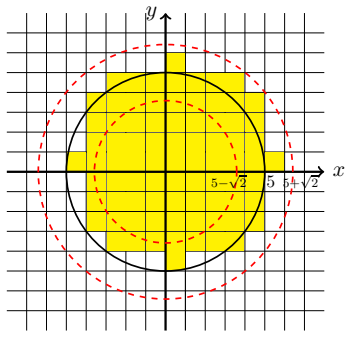
The central object is the sequence $C(r)$, the number of lattice points in a circle of integer radius $r$. Its two defining properties carry the argument: the classical error bound gives $C(r)\approx\pi r^2$, and a symmetry count gives $C(r)\equiv 1\pmod 4$. The heuristic then replaces $C(r)$ by an independent random odd integer of that size and sums conditional prime probabilities, reducing $\kappa(n)$ to $\sum_{r=1}^n 2/\log C(r)\approx\sum_{r=1}^n 1/\log r\approx n/\log n$.
What would settle it
Run the linear-time count for $n=10^8$ or $10^9$ and compare $\kappa(n)/(n/\log n)$ with $\pi(n)/(n/\log n)$: if $\kappa$'s ratio drifts away from 1 while $\pi$'s ratio approaches 1, the asymptotic claim fails. Separately, tabulate $C(r)$ modulo 3, 5, and 7 up to $r=10^6$; residues that deviate from uniform distribution over the odd classes would contradict the random-odd premise.
Extended reading notes
Core claim
The central claim is that the Gauss Circle Primes—values of $C(r)$ that are prime—satisfy $\kappa(n)\sim n/\log n$, matching $\pi(n)$. Tables 2 and 3 show $\kappa(n)$ close to $\pi(n)$ throughout the computed range up to $2\times 10^6$, and Table 4 shows $\pi(n)/\kappa(n)$ closer to 1 than $\pi(n)/(n/\log n)$. Heuristic Result 3.1 states the stronger claim $\kappa(n)\approx\pi(n)$ for all $n$. The mechanism is that each $C(k)$ is odd (indeed $1\bmod 4$), so under the Prime Number Theorem its conditional probability of being prime is about $2/\log C(k)$; using $C(k)\approx\pi k^2$ turns the sum into about $n/\log n$.
Load-bearing premise
The argument assumes that the values $C(r)$ behave like independent random odd integers with no hidden divisibility or correlation patterns; if $C(r)$ has such patterns, the count of primes among them could differ systematically from the prime count among the integers.
Editorial extensions
If this is right
- If $\kappa(n)\sim n/\log n$, then the circle-lattice construction is a geometric sequence that produces primes at the same asymptotic density as the integers themselves.
- The congruence $C(r)\equiv 1\pmod 4$ means every Gauss Circle Prime is a prime of the form $1\bmod 4$; the claimed density is what the Prime Number Theorem predicts for a fixed odd residue class.
- The same heuristic implies there are infinitely many Gauss Circle Primes, and gives a concrete analogue of the twin-prime conjecture: $C(r)$ and $C(r+1)$ should both be prime infinitely often.
- Because $C(r)$ is computable in time linear in $r$, the claimed pattern offers a fast way to generate many prime candidates of size roughly $\pi r^2$ near any target magnitude.
Reading between the lines
- The paper does not stress that its entire sequence lies in one residue class: since $C(r)\equiv 1\pmod 4$, the natural null model is primes congruent to $1\bmod 4$, not all primes; the $2/\log C(r)$ factor already accounts for this, so the $1\bmod 4$ restriction is compatible with $\kappa(n)\approx\pi(n)$.
- If the heuristic survives larger scales, $C(r)$ becomes a deterministic pseudo-random prime generator whose values are explicit and cheap to compute; testing primes around $10^{12}$–$10^{18}$ would be a direct stress test.
- A sharper test of the randomness assumption is to count correlations: the random-odd model predicts the number of $r\leq n$ with both $C(r)$ and $C(r+s)$ prime to be roughly $\sum_{r=1}^n 4/(\log C(r)\log C(r+s))$; any systematic geometric covariance between consecutive values would show up as a deviation.
- One can also check whether $C(r)$ has arithmetic structure by residue of $r$: if $C(r)$ is composite for all $r$ in some arithmetic progression, the claimed global density would split unevenly and the simple heuristic would fail.
Editorial analysis
A structured set of objections, weighed in public.
Referee Report
Summary. The paper studies the sequence C(r), the number of lattice points inside the circle of integer radius r centered at the origin. It proves the elementary congruence C(r) ≡ 1 mod 4 (Theorem 2.1), computes κ(n), the number of r ≤ n for which C(r) is prime, up to n = 2×10^6, and compares κ(n) with π(n) and n/log n. The empirical tables show that κ(n) is of order n/log n and numerically close to π(n) in the computed range. The paper then presents a heuristic argument (Heuristic Result 3.1) that κ(n) ≈ π(n) for all n, based on treating C(k) as independent random odd integers of size about πk^2 and applying the Prime Number Theorem.
Significance. If the heuristic claim κ(n) ≈ π(n) were established rigorously, it would be an interesting first example of a geometric counting function producing primes at the natural density predicted by the Prime Number Theorem, possibly connecting the Gauss circle problem with the distribution of primes. The paper's strengths include a correct and clean proof of the congruence C(r) ≡ 1 mod 4 and a substantial computational dataset (Tables 2 and 3) that documents the phenomenon for n up to 2×10^6. The heuristic is plausible and worth recording. However, the central claim is not a theorem: the randomness assumption on C(k) is untested, and the heuristic proof is informal and does not quantitatively match the data when properly evaluated. The contribution is therefore a conjecture with supporting data rather than a rigorous result.
major comments (3)
- [Section 3, Heuristic Result 3.1] The heuristic depends entirely on treating C(k) as independent random odd integers of size about πk^2, so that the probability C(k) is prime is approximately 2/log(πk^2). This randomness assumption is load-bearing: the paper provides no evidence that C(k) behaves like random odd integers. In particular, there is no analysis of the distribution of C(k) modulo small primes (e.g., mod 3 or mod 5) or of serial correlations in the primality indicators. Since the claim κ(n) ≈ π(n) is extrapolated beyond the computed range n ≤ 2×10^6, the author should either add such statistical tests or explicitly label the statement as a conjecture rather than a 'Heuristic Result' with a proof.
- [Section 3, displayed sum] The derivation in the proof of Heuristic Result 3.1 actually yields κ(n) ≈ Σ_{k=2}^n 1/log k ≈ li(n), not κ(n) ≈ π(n) as a numerical approximation. The replacement li(n) ≈ π(n) is only first-order, and the difference is about n/log^2 n. At n = 2×10^6, li(2×10^6) ≈ 148,900 while Table 3 gives κ(2×10^6) = 143,082, a discrepancy of about 4%. The paper does not compute the heuristic sum or compare it with the data; doing so is necessary to validate the randomness model. As written, the heuristic overestimates κ(n) in the computed range, and the claim that it explains the observed κ(n) ≈ π(n) is not quantitatively supported.
- [Section 2, statement following Tables 2 and 3] The assertion that 'Beginning at n = 167, the values satisfy the inequality π(n) > κ(n) > n/log n' is presented without a table entry at n = 167 and without a proof. This is an empirical observation and should be described as such. More importantly, the sentence continues 'This continues to hold at least up to n = 2·10^6', which is supported by the data but does not justify any extrapolation beyond that range. The universal phrasing in Heuristic Result 3.1 ('for all n') should be tempered to a conjecture unless the heuristic can be justified by additional evidence.
minor comments (5)
- [Tables 2 and 3] The notation ⌊n/log n⌉ is used but never defined; it appears to denote the nearest integer and should be explicitly stated.
- [Section 1, Theorem 1.1 proof] The geometric proof of Gauss’ bound is correct but could be clearer: the number of lattice points on the axes in Theorem 2.1 should be described as points of the form (±x, 0) and (0, ±x) with x = 1, ..., r, which are r points on each half-axis plus the origin.
- [Section 2, algorithm description] The paper mentions a Java program that runs in linear time but does not provide the code or pseudocode. Including it, or at least describing the counting method, would improve reproducibility of Tables 2 and 3.
- [Section 4, Question 4.3] The text refers to 'Skewe’s constant'; the standard term is 'Skewes’ number' or 'Skewes’s number'.
- [Section 1, introductory paragraph] The statement that the Iwaniec–Mozzochi bound is 'related to the Riemann hypothesis' is vague; it would be more precise to say that the conjectured bound O(x^{1/4+ε}) is connected to the Riemann hypothesis or to known results on exponential sums.
Circularity Check
No circularity: the empirical κ(n) data are independently computed, and the heuristic uses external inputs (PNT and Gauss's lattice-point asymptotics), neither of which is defined in terms of κ(n).
full rationale
No circular steps were found. The central claim, that κ(n) ≈ π(n), is supported in two independent ways. First, the paper reports direct computations of κ(n) for n ≤ 2×10^6, obtained by a linear-time Java program, and compares them with π(n); this empirical comparison is not derived from any model and does not fit any parameter to the κ-data. Second, the heuristic in Section 3 uses the Prime Number Theorem's prime density 1/log a, the elementary fact C(r) ≡ 1 mod 4, and Gauss's asymptotic C(k) ≈ π k^2 to estimate the expected number of primes among C(1),…,C(n). Neither input is defined in terms of κ(n), and no fitted parameter is renamed as a prediction. The heuristic's assumption that the deterministic values C(k) behave like independent random odd integers is an unvalidated modeling assumption; that is a correctness or validity risk, not a circular reduction, because the conclusion would fail only if the deterministic sequence carries hidden biases, which is an empirical possibility rather than a definitional equivalence. All cited results are standard external theorems, and the paper contains no self-citations that carry the argument. The 'Heuristic Result' label is honest, and the derivation chain is not equivalent to its inputs by construction.
Assumptions & free parameters
assumptions (4)
- standard math The Prime Number Theorem (pi(n) ~ n/log n)
- standard math Gauss's circle error bound, |C(r) - pi r^2| < 2 sqrt(2) pi r + 2 pi
- domain assumption Randomness assumption: the values C(k) behave like independent random odd integers of size about pi k^2
- domain assumption The empirical range n <= 2 x 10^6 is representative of the asymptotic behavior
Cite this review
Pith. "Pith review of Gauss Circle Primes." pith.science (2026). https://pith.science/paper/4Y4GMXVU
@misc{pith2026250206804,
  author       = {Pith},
  title        = {Pith review of: Gauss Circle Primes},
  year         = {2026},
  howpublished = {\url{https://pith.science/paper/4Y4GMXVU}},
  note         = {Machine review of arXiv:2502.06804}
}
abstract
Given a circle of radius $r$ centered at the origin, the Gauss Circle Problem concerns counting the number of lattice points $C(r)$ within this circle. It is known that as $r$ grows large, the number of lattice points approaches $\pi r^2$, that is, the area of the circle. The present research is to study how often $C(r)$ will return a prime number of lattice points for $r \leq n$. The Prime Number Theorem predicts that the number of primes less than or equal to $n$ is asymptotic to $\frac{n}{\log n}$. We find that the number of Gauss Circle Primes for $r \leq n$ is also of order $\frac{n}{\log n}$ for $n \leq 2 \times 10^6$. We include a heuristic argument that the Gauss Circle Primes can be approximated by $\frac{n}{\log n}$.
Figures

Reference graph
Works this paper leans on
-
[1]
Euclid, Euclid’s Elements, 200 BCE
-
[2]
Carl F. Gauss, “De nexu inter multitudinem classium, in quas formae binari ae secundi gradus distribuuntur, earumque determinantem”, Commentatio pri or Societati Regiae Exhibita 1834, in Werke, Vol. 2 (K¨ oniglichen Gesellschaft der Wissenschaft en), G¨ ottingen, 1876, 269–291
-
[3]
Sur la distribution des z´ eros de la fonction ζ(s) et ses cons´ equences artim´ etiques
Jacques Hadamard, “Sur la distribution des z´ eros de la fonction ζ(s) et ses cons´ equences artim´ etiques”,Bull. Soc. Math France 24 (1896), 199–220
-
[4]
On the divisor and circle problems
C. J. Mozzochi and H. Iwaniec, “On the divisor and circle problems”, J. Number Theory 29 (1988), 60–93
work page 1988
-
[5]
Sur la distribution des nombres premiers
J. E. Littlewood, “Sur la distribution des nombres premiers”, Comptes Rendus 158 (1914), 1869–1872
work page 1914
-
[6]
Hans Riesel, En Bok om Primtal (A book on prime numbers), Studentlitterat ure, Denmark, 1968
work page 1968
-
[7]
Recherches nouvelle sur les nombres premiers
Alphonse de Polignac, “Recherches nouvelle sur les nombres premiers”, Comptes Rendus 29 (1849), 397–401. 7
-
[8]
S. Skewes, “On the difference π(x) − li(x)”, J. London Math. Soc. 8 (1933), 277–283
work page 1933
Show all 9 references
-
[9]
Recherches analytiques sur la th´ eorie des nombres premie rs
C. J. de la V all ´ ee Poussin, “Recherches analytiques sur la th´ eorie des nombres premie rs”, Ann. Soc. Sci. Bruxelles 20 (1896), 183–256. Thomas Ehrenborg, Department of Mathematics, Cornell Univ ersity, Ithaca NY 14853, USA tre26@cornell.edu 8
Reviewed August 9, 2026 · model on record in the stance chip above.
Discussion (0). Continue with ORCID to comment.