REVIEW 3 major objections 4 minor 39 references
Dynamic Circuits for the Quantum Lattice-Boltzmann Method
T0 review · 3 major / 4 minor · reviewed 2026-08-09 · deepseek-v4-flash
Pith's one-line read The paper claims a dynamic-circuit quantum lattice-Boltzmann collision that is fully unitary, needs no reinitialization between time steps, and reproduces digital LBM solutions for the advection-diffusion equation in one and two dimensions.
desk verdict Real algorithmic improvement for QLBM, but the 'fully unitary' claim is false as written and the multi-step estimator needs an explicit derivation. read the letter →
The pith
A machine-rendered reading of the paper's core claim, the machinery that carries it, and where it could break.
The reading
What carries the argument
Square-root equilibrium encoding plus a dynamic circuit block. Each lattice cell's density is stored as an amplitude √ρ, and RY gates with angles θ0 = 2 arccos(√w0) and θ1 = 2 arccos(√((1 + u/$c_s^{2}$)/2)) build amplitudes proportional to √(w_i ρ (1 ± c_i·u/$c_s^{2}$)). A mid-circuit measurement on the ancilla qubit decides which population is active; the state is renormalized, a uniformly controlled RY (UCRY) applies the velocity-dependent rotation to the active pair of opposite directions, and a streaming circuit shifts only that pair. The density operator σ = Σ_j p_j |Ψ_j⟩⟨Ψ_j| with p_j = w_j formalizes the ensemble of branches, so that LBM weights become branch probabilities. This machinery carries the argument by making the collision a deterministic unitary on each branch while preserving the LBM weights as measurement probabilities.
What would settle it
Enumerate every possible mid-circuit measurement branch of the D1Q3 block on one lattice cell for two time steps, using a velocity field with different u values at neighboring cells; compute the shot-averaged density by summing branch probabilities times outcomes and compare it exactly to the digital LBM update rho(x, t+2). Any systematic difference, or any case where the error does not shrink as shot count grows, would show that the multi-time-step stochastic estimator is biased rather than equivalent to the LBM.
Extended reading notes
Core claim
On the paper's own terms, the central discovery is that the linearized BGK collision for the advection-diffusion equation, under the assumption Δt/τ = 1, can be re-expressed as a product of RY rotations acting on the square roots of the equilibrium populations, so that the non-unitary LBM update becomes a probabilistic mixture of unitary branches selected by mid-circuit measurement. After a measurement fixes which population, or which pair of opposite populations, is active, the circuit streams only that population, and the next time step repeats the same block. The authors claim that this yields the exact LBM density evolution after shot averaging, with no probabilistic failure, no dependence of the ancilla count on the velocity set, and no requirement of state reinitialization or full measurement between steps. They further demonstrate that a classical preprocessing step can generate the branch sequence in advance, reducing the number of mid-circuit measurements needed.
Load-bearing premise
The algorithm assumes that after the circuit randomly chooses one velocity population per cell and renormalizes the rest, the average over many shots exactly reproduces the classical LBM evolution, even when the advection velocity varies from cell to cell.
Editorial extensions
If this is right
- Repeated time steps need no full-state measurement or reinitialization: the same dynamic block is reapplied, so total circuit cost scales linearly with the number of time steps.
- Because the collision is unitary, no shot is discarded for a failed ancilla measurement, eliminating the probabilistic failure rate of LCU-based collision operators.
- The ancilla register stays at one qubit for any velocity set; only the RY-sequence angles change when moving from D1Q3 to D2Q9, so streaming acts on log2(NxNyNz) qubits instead of log2(q Nx Ny Nz).
- Shot-averaged QLBM results converge toward the digital LBM reference as shot count increases, in one dimension (D1Q3) and two dimensions (D2Q9), including a double-vortex velocity field.
- The hybrid preprocessing variant replaces most mid-circuit measurements with classical random sampling, cutting the number of dynamic decisions needed per time step.
Reading between the lines
- Editorial inference: the square-root-encoding trick is not limited to advection-diffusion; the same 'sample one population, stream it, repeat' pattern could be applied to other kinetic schemes, but the unbiasedness of the shot-average must be re-proven for each new collision operator.
- Editorial inference: the method's practical value hinges on whether classical shot-noise overhead stays below a quantum advantage threshold; with 10^7 shots per simulation and small grids, the demonstrated cases are validation, not yet a scaling advantage.
- Editorial inference: dynamic circuits depend on fast mid-circuit measurements and resets; on current hardware, reset and measurement errors will likely dominate over the algorithmic savings, so the next testable extension is a noise-model study of the same circuits with measured reset fidelities.
- Editorial inference: a testable extension is to vary the relaxation time τ instead of fixing Δt/τ = 1; if the unitary branch structure survives a τ-dependent angle, the method would move from advection-diffusion toward full BGK flows.
Editorial analysis
A structured set of objections, weighed in public.
Referee Report
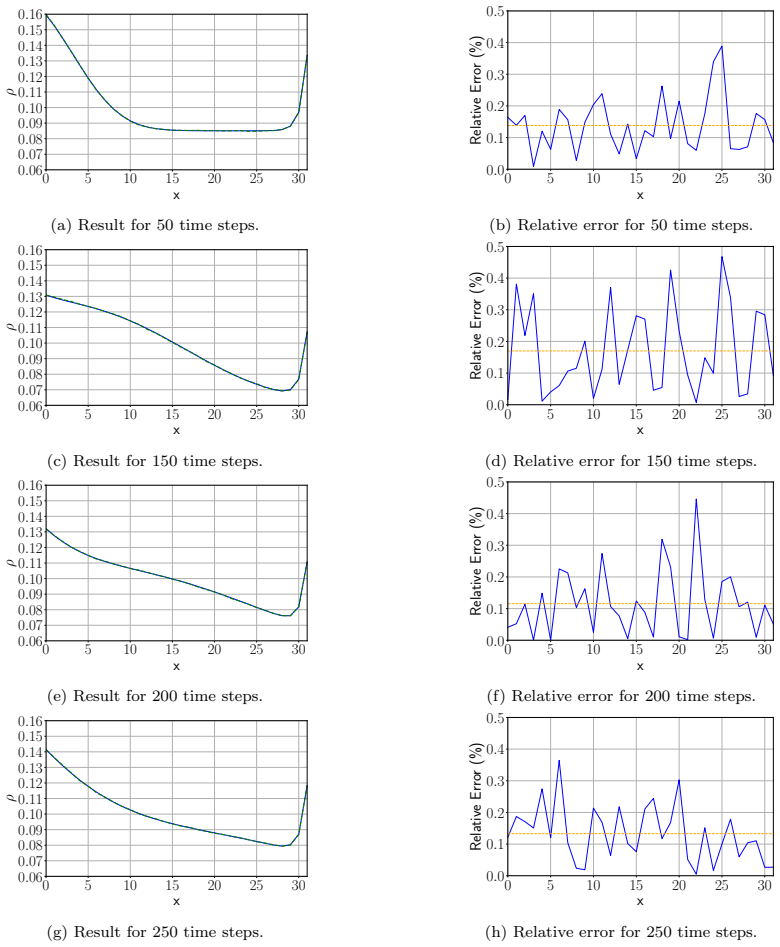
Summary. The paper proposes a dynamic-circuit implementation of the lattice-Boltzmann collision step for the linear advection-diffusion equation. The collision is built from amplitude-encoded square-root equilibrium populations, with branch selection performed by mid-circuit measurements and classical feedforward; the streaming step then moves the selected population. The authors claim that this collision is a fully unitary operator, that it avoids the probabilistic failure rate of earlier LCU-based collisions, that only one ancilla is needed independently of the velocity set, and that multiple time steps can be iterated without state reinitialization. Validation against a digital LBM is reported for D1Q3 and D2Q9 in one and two dimensions, including tests up to 250 time steps, and a hybrid classical-quantum variant is proposed to replace some mid-circuit measurements by classical sampling.
Significance. If the claims are correct, the paper offers a practically useful reduction in qubit count and circuit depth for quantum LBM, and the multi-time-step demonstration is a notable step beyond single-step collision validation. The empirical study is reasonably thorough for a proof-of-concept: MAPE is reported versus shot count, multi-time-step results are compared with a digital solver in 1D and 2D, and the hybrid variant is tested. The central theoretical characterization, however, is overstated: the block in Fig. 2 is not a unitary operator because it contains mid-circuit measurements, resets, and feedforward. The multi-time-step unbiasedness is asserted rather than derived. Both issues are fixable and do not invalidate the underlying algorithmic idea, which appears to be a valid stochastic channel implementation of the linear LBM update.
major comments (3)
- [Abstract, §3.2, Fig. 2, §5] The statement that the collision algorithm is 'implemented as a fully unitary operator' is not correct as written. The block in Fig. 2 contains a mid-circuit measurement of the ancilla, a reset, a classically conditioned UCRY application, and a second mid-circuit measurement determining which streaming circuit is applied. Such a block realizes a completely positive trace-preserving quantum channel, not a unitary operator. This matters because the paper's claimed advantage over LCU-based collisions is framed in terms of unitarity and the absence of probabilistic failure. The algorithm can be coherently described as a measurement-conditioned dynamic circuit with no post-selected failure branches, but the abstract and conclusion should be corrected to say that, instead of claiming the collision block is fully unitary. This is a load-bearing characterization issue, not a wording nicety.
- [§3.3, Eqs. (27)–(29)] The multi-time-step correctness is not proven. Equations (27)–(29) argue by linearity of the LBM operator on the three distribution functions, but the actual quantum circuit, after streaming, carries only one sampled population amplitude, not the full density distribution ρ(x,t). The next collision step then applies branch probabilities that depend on the local velocity at the new spatial position. The paper needs an explicit channel-level derivation showing that the shot-averaged density after one block equals the LBM update Lρ, and that iteration gives L^Tρ0 by induction, with the conditional renormalization factors telescoping. I checked this for D1Q3 and the one-step map is indeed exactly the linear LBM density update; the concern about bias for non-uniform velocity does not ultimately land. But the manuscript does not supply this derivation, and without it the central claim of multiple time steps without reinitialization is unsupported by the text.
- [§3.4 and Appendix A] The claimed extension to arbitrary spatial dimensions and velocity sets is under-specified. Section 3.4 states that one sets p_j = w_j and that the system is projected onto one subsystem by RY-gates, resets, and tracing out, but it does not give the general construction of the RY sequence or prove that the measurement probabilities reproduce w_i(1 + c_i·u/c_s^2) for arbitrary velocity sets. The D2Q9 parameters in Appendix A are concrete, but the general statement 'extension to arbitrary dimensions and velocity sets is straightforward' goes beyond what is shown. The authors should either state the general recursive probability construction formally or restrict the claim to the demonstrated D1Q3/D2Q9 cases.
minor comments (4)
- [§4.1, Eq. (35)] The initial condition contains what appears to be a typo: H(x − x/2 + 3) should likely be H(x − L/2 + 3) (or an analogous expression involving the domain center). As written, the boxcar definition is not meaningful.
- [§2.2, Eqs. (13)–(16)] The text says θ1 is derived under the assumption of a constant and uniform macroscopic velocity, while Section 3 later uses a spatially varying u(x). This is not an error, but the transition should be explained so the reader understands that the site-dependent angles are obtained by evaluating the same formula locally.
- [§2.2, Eq. (19) and Fig. 1] The state labels in Eq. (19) (|10> for f1, |11> for f2) differ from the labels in Eq. (11) (|01> for f1, |10> for f2). The text notes that labels can be adjusted with CNOTs, but the circuit in Fig. 1 does not show the final relabeling gates; this should be made explicit for reproducibility.
- [§5] The conclusion says that 'the same dynamic circuit is repeated for each time step,' but the hybrid variant described in §3.5 constructs different circuits for different shots based on precomputed random sequences. The wording should be qualified to distinguish the dynamic-circuit implementation from the hybrid sampling variant.
Circularity Check
No significant circularity: the collision parameters are an open construction from the target equilibrium, and the multi-time-step channel is unbiased by linearity; self-citations are not load-bearing.
full rationale
The paper makes no hidden fit-to-prediction move. Equations (13)-(14) define the RY angles directly from the D1Q3 weights and the linearized equilibrium, and Eq. (19) is therefore the target equilibrium by construction; this is an explicit implementation device, not a parameter fitted to the validation data. The one-step dynamic block is a CPTP channel whose branch probabilities reproduce the linear LBM density update exactly, including for non-uniform velocity: the |0> branch occurs with weight w0, and after the 1/3-measurement branch the +u and -u directions occur with probabilities (1+u)/2 and (1-u)/2, giving total weights w1(1+u) and w2(1-u). Since the channel is linear, iterating the block gives LBM^t by induction; the 250-step tests are consistency checks against the digital LBM, not circular predictions. The citations to the authors' prior work ([35], [36]) supply circuit building blocks and streaming, but the equations in Sections 2-3 are self-contained and do not import a uniqueness theorem or an ansatz that secretly contains the target result. The abstract's 'fully unitary operator' wording is inaccurate because the block contains mid-circuit measurements, resets, and feedforward and realizes a non-unitary CPTP map; that is a correctness/accuracy defect, not a circularity, and it does not affect the unbiasedness argument. No fitted input is relabeled as a prediction, so no circular step is present.
Assumptions & free parameters
free parameters (2)
- D1Q3 RY angles theta0, theta1 =
2 arccos(sqrt(2/3)), 2 arccos(sqrt((1+u/cs^2)/2))
- D2Q9 RY sequence angles =
[2 arccos(sqrt(4/9)), 2 arccos(sqrt(2/5)), 2 arccos(sqrt(2/3)), 2 arccos(sqrt(1/2))]
assumptions (4)
- domain assumption The BGK LBM with dt/tau = 1 replaces the post-collision distribution by the equilibrium distribution fi = fi^eq.
- domain assumption The equilibrium distribution is non-negative so that its square root is real: 1 + ci.u/cs^2 >= 0.
- standard math Amplitude encoding with the square root of the density is a valid and sufficient representation of the macroscopic field.
- ad hoc to paper The ensemble expectation over an arbitrary number of shots reproduces the deterministic LBM solution for multiple time steps.
Cite this review
Pith. "Pith review of Dynamic Circuits for the Quantum Lattice-Boltzmann Method." pith.science (2026). https://pith.science/paper/5AI5NMWU
@misc{pith2026250202131,
  author       = {Pith},
  title        = {Pith review of: Dynamic Circuits for the Quantum Lattice-Boltzmann Method},
  year         = {2026},
  howpublished = {\url{https://pith.science/paper/5AI5NMWU}},
  note         = {Machine review of arXiv:2502.02131}
}
read the original abstract
We propose a quantum algorithm for the linear advection-diffusion equation (ADE) Lattice-Boltzmann method (LBM) that leverages dynamic circuits. Dynamic quantum circuits allow for an optimized collision-operator quantum algorithm, introducing partial measurements as an integral step. Efficient adaptation of the quantum circuit during execution based on digital information obtained through mid-circuit measurements is achieved. The proposed new collision algorithm is implemented as a fully unitary operator, which facilitates the computation of multiple time steps without state reinitialization. Unlike previous quantum collision operators that rely on linear combinations of unitaries, the proposed algorithm does not exhibit a probabilistic failure rate. Moreover, additional qubits no longer depend on the chosen velocity set, which reduces both qubit overhead and circuit complexity. Validation of the quantum collision algorithm is performed by comparing results with digital LBM in one and two dimensions, demonstrating excellent agreement. Performance analysis for multiple time steps highlights advantages compared to previous methods. As an additional variant, a hybrid quantum-digital approach is proposed, which reduces the number of mid-circuit measurements, therefore improving the efficiency of the quantum collision algorithm.
Figures


Figures from the paper (7 more)



Reference graph
Works this paper leans on
-
[36]
D. Wawrzyniak, J. Winter, S. Schmidt, T. Indinger, Hybrid quantum algorithm for the lattice-boltzmann method (2024)
work page 2024
-
[1]
M. A. Nielsen, I. L. Chuang, Quantum computation and quantum in- formation, Cambridge university press, 2010
work page 2010
-
[2]
A. W. Harrow, A. Hassidim, S. Lloyd, Quantum algorithm for linear systems of equations, Physical review letters 103 (15) (2009) 150502
work page 2009
- [3]
-
[4]
M. Gopalakrishnan Meena, K. C. Gottiparthi, J. G. Lietz, A. Geor- giadou, E. A. Coello P´ erez, Solving the hele–shaw flow using the harrow– hassidim–lloyd algorithm on superconducting devices: A study of effi- ciency and challenges, Physics of Fluids 36 (10) (2024)
work page 2024
-
[5]
L. Lapworth, A hybrid quantum-classical cfd methodology with bench- mark hhl solutions, arXiv preprint arXiv:2206.00419 (2022)
arXiv 2022
-
[6]
F. Oz, R. K. Vuppala, K. Kara, F. Gaitan, Solving burgers’ equa- tion with quantum computing, Quantum Information Processing 21 (1) (2022) 30
work page 2022
-
[7]
Y. Liu, Z. Chen, C. Shu, P. Rebentrost, Y. Liu, S. Chew, B. Khoo, Y. Cui, A variational quantum algorithm-based numerical method for solving potential and stokes flows, Ocean Engineering 292 (2024) 116494
work page 2024
Show all 39 references
-
[8]
Jaksch, P
D. Jaksch, P. Givi, A. J. Daley, T. Rung, Variational quantum algo- rithms for computational fluid dynamics, AIAA journal 61 (5) (2023) 1885–1894
2023
-
[9]
Ingelmann, S
J. Ingelmann, S. S. Bharadwaj, P. Pfeffer, K. R. Sreenivasan, J. Schu- macher, Two quantum algorithms for solving the one-dimensional advection–diffusion equation, Computers & Fluids 281 (2024) 106369
2024
-
[10]
Pfeffer, F
P. Pfeffer, F. Heyder, J. Schumacher, Hybrid quantum-classical reservoir computing of thermal convection flow, Physical Review Research 4 (3) (2022) 033176. 31
2022
-
[11]
Lallemand, L.-s
P. Lallemand, L.-s. Luo, M. Krafczyk, W.-A. Yong, The lattice boltz- mann method for nearly incompressible flows, Journal of Computational Physics 431 (2021) 109713
2021
-
[12]
B. M. Boghosian, W. Taylor IV, Quantum lattice-gas model for the many-particle schr¨ odinger equation in d dimensions, Physical Review E 57 (1) (1998) 54
1998
-
[13]
D. A. Meyer, From quantum cellular automata to quantum lattice gases, Journal of Statistical Physics 85 (1996) 551–574
1996
-
[14]
D. A. Meyer, Quantum computing classical physics, Philosophical Trans- actions of the Royal Society of London. Series A: Mathematical, Physical and Engineering Sciences 360 (1792) (2002) 395–405
2002
-
[15]
Yepez, Quantum lattice-gas model for computational fluid dynamics, Physical Review E 63 (4) (2001) 046702
J. Yepez, Quantum lattice-gas model for computational fluid dynamics, Physical Review E 63 (4) (2001) 046702
2001
-
[16]
Yepez, Type-ii quantum computers, International Journal of Modern Physics C 12 (09) (2001) 1273–1284
J. Yepez, Type-ii quantum computers, International Journal of Modern Physics C 12 (09) (2001) 1273–1284
2001
-
[17]
A. D. B. Zamora, L. Budinski, O. Niemim¨ aki, V. Lahtinen, Efficient quantum lattice gas automata, Computers & Fluids 286 (2025) 106476
2025
-
[18]
Mezzacapo, M
A. Mezzacapo, M. Sanz, L. Lamata, I. Egusquiza, S. Succi, E. Solano, Quantum simulator for transport phenomena in fluid flows, Scientific reports 5 (1) (2015) 1–7
2015
-
[19]
B. N. Todorova, R. Steijl, Quantum algorithm for the collisionless boltz- mann equation, Journal of Computational Physics 409 (2020) 109347
2020
-
[20]
M. A. Schalkers, M. M¨ oller, Efficient and fail-safe collisionless quantum boltzmann method, arXiv preprint arXiv:2211.14269 (2022)
2022 arXiv
-
[21]
Budinski, Quantum algorithm for the advection–diffusion equation simulated with the lattice boltzmann method, Quantum Information Processing 20 (2) (2021) 1–17
L. Budinski, Quantum algorithm for the advection–diffusion equation simulated with the lattice boltzmann method, Quantum Information Processing 20 (2) (2021) 1–17
2021
-
[22]
L. Budinski, Quantum algorithm for the navier–stokes equations by us- ing the streamfunction-vorticity formulation and the lattice boltzmann method, International Journal of Quantum Information 20 (02) (2022) 2150039. 32
2022
-
[23]
Sanavio, S
C. Sanavio, S. Succi, Lattice boltzmann–carleman quantum algorithm and circuit for fluid flows at moderate reynolds number, A VS Quantum Science 6 (2) (2024)
2024
-
[24]
P. L. Bhatnagar, E. P. Gross, M. Krook, A model for collision pro- cesses in gases. i. small amplitude processes in charged and neutral one- component systems, Physical review 94 (3) (1954) 511
1954
-
[25]
Kr¨ uger, H
T. Kr¨ uger, H. Kusumaatmaja, A. Kuzmin, O. Shardt, G. Silva, E. M. Viggen, The lattice boltzmann method, Springer International Publish- ing 10 (978-3) (2017)
2017
-
[26]
Mohamad, Lattice boltzmann method, Vol
A. Mohamad, Lattice boltzmann method, Vol. 70, Springer, 2011
2011
-
[27]
S. Chen, G. D. Doolen, Lattice boltzmann method for fluid flows, Annual review of fluid mechanics 30 (1) (1998) 329–364
1998
-
[28]
G. R. McNamara, G. Zanetti, Use of the boltzmann equation to simulate lattice-gas automata, Phys. Rev. Lett. 61 (1988) 2332–2335. doi:10. 1103/PhysRevLett.61.2332
1988
-
[29]
Higuera, S
F. Higuera, S. Succi, R. Benzi, Lattice gas dynamics with enhanced collisions, Europhysics letters 9 (4) (1989) 345
1989
-
[30]
H. Chen, S. Chen, W. H. Matthaeus, Recovery of the navier-stokes equa- tions using a lattice-gas boltzmann method, Physical review A 45 (8) (1992) R5339
1992
-
[31]
M. Junk, S. R. Rao, A new discrete velocity method for navier–stokes equations, Journal of computational physics 155 (1) (1999) 178–198
1999
-
[32]
He, L.-S
X. He, L.-S. Luo, A priori derivation of the lattice boltzmann equation, Physical Review E 55 (6) (1997) R6333
1997
-
[33]
He, L.-S
X. He, L.-S. Luo, Theory of the lattice boltzmann method: From the boltzmann equation to the lattice boltzmann equation, Physical review E 56 (6) (1997) 6811
1997
-
[34]
Abe, Derivation of the lattice boltzmann method by means of the discrete ordinate method for the boltzmann equation, Journal of Com- putational Physics 131 (1) (1997)
T. Abe, Derivation of the lattice boltzmann method by means of the discrete ordinate method for the boltzmann equation, Journal of Com- putational Physics 131 (1) (1997). 33
1997
-
[35]
Wawrzyniak, J
D. Wawrzyniak, J. Winter, S. Schmidt, T. Indinger, C. F. Janßen, U. Schramm, N. A. Adams, A quantum algorithm for the lattice- boltzmann method advection-diffusion equation, Computer Physics Communications 306 (2025) 109373
2025
-
[37]
Shende, S
V. Shende, S. Bullock, I. Markov, Synthesis of quantum-logic cir- cuits, IEEE Transactions on Computer-Aided Design of Integrated Cir- cuits and Systems 25 (6) (2006) 1000–1010. doi:10.1109/TCAD.2005. 855930
2006 doi
-
[38]
Bergholm, J
V. Bergholm, J. J. Vartiainen, M. M¨ ott¨ onen, M. M. Salomaa, Quan- tum circuits with uniformly controlled one-qubit gates, Physical Review A—Atomic, Molecular, and Optical Physics 71 (5) (2005) 052330
2005
-
[39]
Budinski, O
L. Budinski, O. Niemim¨ aki, R. Zamora-Zamora, V. Lahtinen, Efficient parallelization of quantum basis state shift, Quantum Science and Tech- nology 8 (4) (2023) 045031. 34
2023
Reviewed August 9, 2026 · model on record in the stance chip above.
Discussion (0). Continue with ORCID to comment.