REVIEW 3 major objections 7 minor 136 references
Restricted Phase Space Thermodynamics of 4D Dyonic AdS Black Holes: Insights from Kaniadakis Statistics and Emergence of Superfluid $\lambda$-Phase Transition
T0 review · 3 major / 7 minor · reviewed 2026-08-11 · deepseek-v4-flash
Pith's one-line read This paper claims that a dyonic AdS black hole, when its entropy is replaced by Kaniadakis entropy, undergoes a second-order superfluid $\lambda$ phase transition in the fixed electric-potential/magnetic-charge ensemble, and that the…
desk verdict A careful but incremental RPST/Kaniadakis calculation whose headline 'superfluid lambda transition' is an over-reading of specific-heat divergences; the paper is refereeable if the central claim is reframed as a lambda-like anomaly. read the letter →
The pith
A machine-rendered reading of the paper's core claim, the machinery that carries it, and where it could break.
The reading
What carries the argument
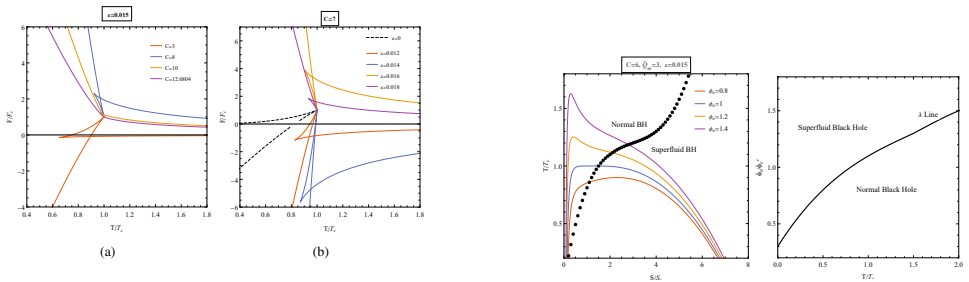
The load-bearing object is the Kaniadakis entropy $S_K=(1/\kappa)\sinh(\kappa S_{\rm BH})$, with $S_{\rm BH}$ the Bekenstein-Hawking entropy and $\kappa$ the deformation parameter, together with its small-$\kappa$ series expansion used to write the mass in eqs. (14)-(16). The restricted phase space first law $dM=TdS+\tilde{\Phi}_e d\tilde{Q}_e+\tilde{\Phi}_m d\tilde{Q}_m+\mu dC$, with central charge $C$ and chemical potential $\mu$, supplies the ensemble framework, and the fixed-potential ensemble with $\tilde{\Phi}_e$ and $\tilde{Q}_m$ held fixed is where the $\lambda$ phase transition is claimed to appear. The critical structure is extracted from $\partial T/\partial S=0$ and $\partial^2 T/\partial S^2=0$, giving the critical line plotted in Fig. 7b. The deformation parameter $\kappa$ is what generates the ultra-large unstable branch and the specific-heat divergence identified as a superfluid $\lambda$ transition.
What would settle it
Recompute the fixed-potential specific heat at $C=6$, $\tilde{Q}_m=3$, $\kappa=0.015$ using the exact Kaniadakis mass of eq. (15) rather than the small-$\kappa$ series of eq. (16): if the divergence at $S=S_c$ disappears or the $\lambda$ line in Fig. 7b does not appear, the claimed superfluid transition is an artifact of the truncation. Alternatively, a Landau free-energy construction in the entropy that shows no symmetry-breaking order parameter would also settle whether the transition is genuinely second-order.
Extended reading notes
Core claim
The central claim is that in the restricted phase space description of a 4D dyonic AdS black hole, replacing the Bekenstein-Hawking entropy by the Kaniadakis entropy $S_K=(1/\kappa)\sinh(\kappa S_{\rm BH})$ changes the phase structure qualitatively. At fixed electric potential $\tilde{\Phi}_e$ and magnetic charge $\tilde{Q}_m$, the specific heat diverges along a line of critical points, the $\lambda$ line, separating normal and superfluid black hole phases in a continuous second-order transition; the coexistence plot is shown in Fig. 7b. The Kaniadakis deformation parameter $\kappa$ introduces an unstable ultra-large black hole branch in almost every process, so the phase diagram contains small, intermediate, large, and ultra-large branches. Turning off the magnetic charge removes the Hawking-Page transition and flips whether the van der Waals transition occurs for subcritical or supercritical electric charge. The paper further reports that plots in $\kappa$ match plots in $C$, suggesting a correspondence between the deformation parameter and the central charge, and that the $\mu$-$C$ process is universal across entropy models while homogeneity is preserved, with mass scaling to first order and all other quantities to zeroth order.
Load-bearing premise
The load-bearing premise is that the Kaniadakis entropy formula and its small-$\kappa$ series expansion faithfully represent the black hole's microstates at the $\kappa$ values used, and that a specific-heat divergence in a fixed-potential ensemble is a genuine second-order phase transition rather than a mathematical artifact.
Editorial extensions
If this is right
- In the fixed-potential ensemble, the dyonic AdS black hole acquires a continuous second-order phase transition with a $\lambda$-shaped specific-heat divergence, and the coexistence curve separates normal and superfluid black hole phases.
- The Kaniadakis deformation parameter $\kappa$ adds an unstable ultra-large black hole branch to the $T$-$S$ and $F$-$T$ phase diagrams, a branch absent in the $\kappa\to0$ Boltzmann-Gibbs limit.
- Setting the magnetic charge to zero removes the Hawking-Page and non-equilibrium transitions and reverses whether the van der Waals transition occurs below or above the critical electric charge.
- Varying $\kappa$ produces the same changes as varying the central charge $C$, so the deformation parameter may act like an effective number of degrees of freedom.
- The $\mu$-$C$ process is universal, with the same branch structure appearing across black hole systems and entropy models within the restricted phase space approach.
Reading between the lines
- If the superfluid $\lambda$ identification survives contact with the exact, unexpanded Kaniadakis mass, the fixed-potential ensemble becomes a concrete gravitational laboratory for continuous quantum phase transitions, with the $\lambda$ line playing the role of a quantum critical line that could be probed through holographic conductivities or sound modes.
- The reported $\kappa$-versus-$C$ correspondence suggests a renormalization-group reading: increasing $\kappa$ moves the system toward fewer effective degrees of freedom, so $\kappa$ could be traded for a running central charge; a direct test would be to compare the free-energy scaling exponent along the $\lambda$ line for different $\kappa$ and $C$.
- Because the ultra-large branch traces back to the small-$\kappa$ expansion, the next check is whether higher-order terms in $\kappa$ move, merge, or eliminate the branch; if the branch persists only in the truncated series, the claimed new feature is an artifact of series truncation.
Editorial analysis
A structured set of objections, weighed in public.
Referee Report
Summary. The paper studies the restricted phase space thermodynamics (RPST) of 4D dyonic AdS black holes using Kaniadakis entropy. It derives mass, temperature, free energy, and other thermodynamic quantities from a small-κ expansion of the mass formula, then investigates phase transitions in several ensembles. The main claimed novelties are an unstable 'ultra-large black hole' branch induced by the Kaniadakis parameter, a reversal of the Van der Waals transition when the magnetic charge is turned off, an extra 'Hawking-Page' transition in the F–T plot, a 'superfluid λ phase transition' in the mixed (Φ_e,Q_m) ensemble, and a universal μ–C process.
Significance. If correct, the paper would extend RPST to non-extensive statistics and identify a new superfluid-type continuous transition in black hole thermodynamics. The algebraic homogeneity check and the explicit formulas are useful and appear internally consistent. However, the central 'superfluid λ phase transition' is identified only from specific-heat divergences and a ∂T/∂S criterion, with no order parameter, free-energy analysis, or microscopic derivation; the same line is also described as a two-phase coexistence curve, which is inconsistent with a second-order transition. The small-κ expansion is used in the regime where the ultra-large branch appears, raising concerns that this branch is an artifact of the truncation.
major comments (3)
- [§3.2, Eqs. (38)–(42), Fig. 7] The central claim of a 'superfluid λ phase transition of order two' is not supported by the evidence presented. The only mathematical criterion used is Eq. (20), ∂T/∂S=0 and ∂²T/∂S²=0, applied to T(Φ_e,Q_m,C,S). A divergence or cusp of the fixed-potential specific heat at such points can also indicate a spinodal, where the free energy remains analytic. The text simultaneously calls the dashed line in Fig. 7b a 'line of critical points' ('continuous second order λ phase transition') and a 'coexistence plot... In the λ line both the black holes can exist simultaneously hence called the coexists line.' This is internally inconsistent: a genuine second-order λ transition has no two-phase coexistence region. No order parameter, Landau free energy, or analysis of F(T) across the line is provided. Since the λ transition is the paper's stated novelty, this is the most load-bearing weakness and must be resolved.
- [§3, Eqs. (15)–(16), Figs. 1, 3, 7] The mass formula is series-expanded in the Kaniadakis parameter κ and truncated at order κ². The new 'ultra-large black hole' branch appears at large values of S/S_c (up to roughly 20–25 in Figs. 1c and 7c). For κ ≈ 0.015–0.018 and S/S_c ~ 20, the dimensionless product κS is not small (κS ~ 0.3–0.45, κ²S² ~ 0.1–0.2), so the truncation error is uncontrolled. The exact expression (15) contains sinh^{-1}(κS), which grows logarithmically in S; the polynomial truncation can therefore produce qualitatively wrong large-S behavior. The paper gives no error bound or comparison with the exact mass. Because the existence of the ultra-large branch is one of the paper's main claims, this truncation issue is load-bearing.
- [§3.3, Eqs. (53)–(56), Fig. 13] The claimed universal μ–C curve appears to be inconsistent with the preceding expression for μ. For fixed S, Q_e, Q_m, and κ, Eq. (53) has the form μ = a/C + b/C². Its extremum with respect to C gives C_max = -2b/a and μ/μ_max = 2/c − 1/c², with c = C/C_max. The paper instead states Eq. (56), m = (3c−1)√c/(2c²), which is a different functional form. Equation (54) for C_max also does not follow algebraically from Eq. (53). The derivation of the 'universal' curve is not shown, and this inconsistency undermines the universality claim, even though this claim is secondary to the main λ-transition result.
minor comments (7)
- [§3.1, text after Fig. 1] The sentence 'All the plots are plots at the critical electric charge Q̃m' is unclear; presumably it should be 'at fixed Q̃m' or 'at the critical electric charge Q̃e'.
- [Fig. 8 caption] Figure 8 is titled 'T−S plots', but panels (a)–(c) appear to be μ–T plots. Please correct the caption.
- [§3.2] The term 'double-superfluid λ phase transition' is never explained. The text and figures show only one λ line, so the 'double' terminology is confusing.
- [§3.1, Fig. 9] The 'Specific heat' plotted in Fig. 9 is not defined anywhere. The authors should state the ensemble in which C_{...} is computed (e.g., fixed Φ_e, Q_m, C) and give the formula.
- [Eq. (13)] The Gibbs–Duhem relation contains a typo: the electric potential term is written twice ('−Qe dΦe − Qe dΦe') and the magnetic term is missing.
- [Introduction] The reference list contains broken placeholders such as '[? ?]' in the Introduction, and several citations are incomplete. The manuscript needs a thorough editorial pass.
- [§3.1, Figs. 2 and 4] The identification of the purple branch in Fig. 2a as a 'Hawking–Page phase transition' is not justified: the free energy of thermal AdS is not included, and a local loop in F(T) for a charged black hole is not the same as the Hawking–Page transition.
Circularity Check
No significant circularity: the phase structure follows algebraically from the assumed Kaniadakis entropy, and the superfluid-λ label is an interpretation rather than a circular step.
full rationale
The derivation chain is self-contained. Starting from the RN-AdS line element (5)-(10), the RPST rescaled charges, central charge and first law (11)-(12), and the Kaniadakis entropy ansatz S = (1/kappa) sinh(kappa S_BH) (14), the paper algebraically obtains the mass, temperature, potentials and chemical potential (15)-(19), and all subsequent phase diagrams are generated from the extremum conditions dT/dS = 0 and d^2T/dS^2 = 0 in Eq. (20). No parameter is fitted to data and no target phase structure is inserted into the equations of state, so the claimed van der Waals, Hawking-Page, ultra-large-branch and lambda-like features are consequences of the stated model rather than reverse-engineered inputs. The self-citations (refs. 74, 75, 93, 138) are used for background or comparison, not as load-bearing premises, and no uniqueness theorem is imported from them. The mu-C 'universality' in Eq. (56) is an algebraic consequence of the two-term form of mu(C) and the chosen normalization; noting its parameter-independence is a mathematical observation, not a fitted input or a renamed prediction. The identification of the dashed critical line in Fig. 7b as a 'superfluid lambda phase transition' is an interpretation imposed on the solutions of Eq. (20); whether that line is a genuine second-order transition, a spinodal, or a coexistence boundary is a physical-correctness concern (the text even describes it as a coexistence line), but it is not a circularity of the derivation chain.
Assumptions & free parameters
free parameters (1)
- Kaniadakis deformation parameter kappa
assumptions (4)
- domain assumption Kaniadakis entropy S = (1/kappa)sinh(kappa S_BH) is the correct entropy of the black hole (eq. 14).
- ad hoc to paper The mass formula is series-expanded in small kappa and truncated at order kappa^2 (eqs. 15-19).
- domain assumption The RPST first law dM = TdS + Phi_e dQ_e + Phi_m dQ_m + mu dC and the identification C = l^2/G are adopted (eqs. 11-12).
- domain assumption Stability and phase order are inferred from the sign of specific heat and from branches in F-T plots.
Cite this review
Pith. "Pith review of Restricted Phase Space Thermodynamics of 4D Dyonic AdS Black Holes: Insights from Kaniadakis Statistics and Emergence of Superfluid $\lambda$-Phase Transition." pith.science (2026). https://pith.science/paper/5EUGU7AY
@misc{pith2026241204375,
  author       = {Pith},
  title        = {Pith review of: Restricted Phase Space Thermodynamics of 4D Dyonic AdS Black Holes: Insights from Kaniadakis Statistics and Emergence of Superfluid $\lambda$-Phase Transition},
  year         = {2026},
  howpublished = {\url{https://pith.science/paper/5EUGU7AY}},
  note         = {Machine review of arXiv:2412.04375}
}
abstract
We study the thermodynamics of $4D$ dyonic AdS black hole in the Kaniadakis statistics framework using the Restricted Phase Space (RPST) formalism. This framework provides a non-extensive extension of classical statistical mechanics, drawing inspiration from relativistic symmetries and presenting a fresh perspective on black hole thermodynamics. Our study analyzes how including Kaniadakis entropy modifies the phase transition of the dyonic black holes. We consider the central charge $C$ and its conjugate chemical potential $\mu$ as the thermodynamic variable along with others except the pressure and volume. Due to the addition of the magnetic charge $\tilde{Q}_m$, the study of the phase transition becomes much richer by obtaining a non-equilibrium phase transition from an unstable small black hole to a stable large black hole along with the Van der Waals phase transition in the $T-S$ processes. In the $F-T$ plot, we get an extra Hawking-Page phase transition. Including the deformation parameter $\kappa$ introduces an unstable (ultra-large BH) branch seen in almost all the plots. Turning off the magnetic charge flips the direction of the phase transition seen during its presence. We observe a novel phenomenon that is the superfluid $\lambda$ phase transition in the mixed $(\tilde{\Phi}_e,\tilde{Q}_m)$ which is due to the additional $\tilde{Q}_m$ inclusion. Also, in the plots varying $\kappa$ match with the plot varying $C$ which underlines some sort of correspondence in its meaning which is not possible to observe in Gibbs-Boltzmann statistics. As the entropy models change the homogeneity is not lost where mass is of the first order and the rest is zeroth order. Finally, the $\mu-C$ processes in quite similar across black hole systems and entropy formulation marking some kind of universality of this process.
Figures


Figures from the paper (7 more)



Reference graph
Works this paper leans on
-
[1]
Berkenstein, Black holes and the second law , Lett
J.D. Berkenstein, Black holes and the second law , Lett. Nuovo. Cim. 4 (1972) 737-740
1972
-
[2]
Berkenstein, Black holes and entropy , Phys
J.D. Berkenstein, Black holes and entropy , Phys. Rev. D 7 (1973) 2333 [INSPIRE]
1973
-
[3]
Hawking, Particle creation by black holes , Commun
S.W. Hawking, Particle creation by black holes , Commun. Math. Phys. 43 (1975) 199
1975
-
[4]
J. M. Bardeen, B. Carter, S. W. Hawking, The four laws of black hole mechanics, Commun. Math. Phys. 31 (1973) 161-170
1973
-
[5]
S. W. Hawking, Gravitational radiation from colliding black holes, Phys. Rev. Lett. 26, 1344-1346 (1971) doi:10.1103/PhysRevLett.26.1344
-
[6]
S. W. Hawking, Black hole explosions , Nature 248, 30-31 (1974) doi:10.1038/248030a0
doi:10.1038/248030a0 1974
-
[7]
R. M. Wald, Entropy and black-hole thermodynamics , Phys. Rev. D 20, 1271-1282 (1979) doi:10.1103/PhysRevD.20.1271
-
[8]
J. D. Bekenstein. Black-hole thermodynamics , Physics Today , 33(1):24–31, 1980
1980
Show all 136 references
-
[9]
R. M. Wald, The thermodynamics of black holes , Living Rev. Rel. 4, 6 (2001) doi:10.12942/lrr-2001-6 [arXiv:gr-qc/9912119 [gr-qc]]
2001 arXiv
-
[10]
Hawking and D
S.W. Hawking and D. N. Page, Thermodynamics of black holes in Anti-de Sitter space, Commun. Math. Phys. 87 (1983) 577 [INSPIRE]
1983
-
[11]
S.Carlip, Black Hole Thermodynamics, Int. J. Mod. Phys. D 23, 1430023 (2014) doi:10.1142/S0218271814300237 [arXiv:1410.1486 [gr-qc]]
2014 arXiv
-
[12]
A.C.Wall, A Survey of Black Hole Thermodynamics , [arXiv:1804.10610 [gr-qc]]
-
[13]
P.Candelas and D.W.Sciama, Irreversible Thermodynamics of Black Holes, Phys. Rev. Lett. 38, 1372-1375 (1977) doi:10.1103
1977
-
[14]
J Sadeghi, MR Alipour, MAS Afshar, S Noori Gashti,Exploring the phase transition in charged Gauss–Bonnet black holes: a holographic ther- modynamics perspectives, General Relativity and Gravitation 56 (8), 93 (2024)
2024
-
[15]
J Sadeghi, MAS Afshar, MR Alipour, SN Gashti, Phase Transition Dy- namics of Black Holes Influenced by Kaniadakis and Barrow Statistics , arXiv preprint arXiv:2407.20779 (2024)
2024 arXiv
-
[16]
J Sadeghi, MAS Afshar, SN Gashti, MR Alipour, Kramer’s Escape Rate and Phase Transition Dynamics in AdS Black Holes with Dark Structures, arXiv preprint arXiv:2404.17849 (2024)
2024 arXiv
-
[17]
Chao Wang, Bin Wu, Zhen Ming Xu, Wen Li Yang, Ther- modynamic geometry of the RN-AdS black hole and non-local observables,[arXiv:2210.08718 ]
-
[18]
Yuchen Huang, Jun Tao, Peng Wang, Shuxuan Ying, Phase transitions and thermodynamic geometry of a Kerr-Newman black hole in a cav- ity, Eur.Phys.J.Plus138, 265 (2023)[https://doi.org/10.1140/epjp/s13360- 023-03858-w]
2023 doi
-
[19]
Wen-Xiang Chen, Yao-Guang Zheng, Thermodynamic geometric analy- sis of BTZ black hole under f(R) gravity, [arXiv:2112.15032 ]
-
[20]
Peng Wang, Feiyu Yao, Thermodynamic Geometry of Black Holes En- closed by a Cavity in Extended Phase Space , Nulc. Phys. B, 976 (2022) 115715 [https://doi.org/10.1016/j.nuclphysb.2022.115715]
2022
-
[21]
Amin Dehyadegari, Ahmad Sheykhi, Thermodynamic geometry and phase transition of spinning AdS black holes, Phys. Rev. D, 104, 104066, (2021) [doi:10.1103/PhysRevD.104.104066]
2021 doi
-
[22]
Shao-Wen Wei, Yu-Xiao Liu General thermodynamic geometry approach for rotating Kerr anti-de Sitter black holes , Phys. Rev. D, 104, 084087 (2021) [10.1103/PhysRevD.104.084087]– 26
2021 doi
-
[23]
Seyed Ali Hosseini Mansoori, Thermodynamic geometry of the novel 4- D Gauss Bonnet AdS Black Hole , Phys.Dark Univ., 31 (2021) 100776 [doi:10.1016/j.dark.2021.100776]
2021
-
[24]
Aritra Ghosh, Chandrasekhar Bhamidipati, Thermodynamic geometry for charged Gauss-Bonnet black holes in AdS spacetimes, Phys. Rev. D 101, 046005 (2020),[doi:10.1103/PhysRevD.101.046005]
2020 doi
-
[25]
Topological phantom AdS black holes in F(R) gravity , Eur
Panah, B.E., Rodrigues, M.E. Topological phantom AdS black holes in F(R) gravity , Eur. Phys. J. C 83, 237 (2023). https://doi.org/10.1140/epjc/s10052-023-11402-4
2023 doi
-
[26]
Eslam Panah, Effects of energy dependent spacetime on geometrical thermodynamics and heat engine of black holes: gravity’s rainbow Phys
B. Eslam Panah, Effects of energy dependent spacetime on geometrical thermodynamics and heat engine of black holes: gravity’s rainbow Phys. Lett. B 787 (2018) 45. [ 10.1016/j.physletb.2018.10.042]
2018 doi
-
[27]
Jafarzade, J
Kh. Jafarzade, J. Sadeghi, B. Eslam Panah, and S. H. Hendi, ”Geomet- rical thermodynamics and P-V criticality of charged accelerating AdS black holes” , Annals of Physics 432, 168577 (2021)
2021
-
[28]
Topology of black hole thermodynam- ics., Phys
Shao-Wen Wei and Yu-Xiao Liu. Topology of black hole thermodynam- ics., Phys. Rev. D 105:104003, (2022)
2022
-
[29]
Shao-Wen Wei, Yu-Xiao Liu, and Robert B. Mann. Black hole solutions as topological thermodynamic defects , Phys. Rev. Lett. , 129:191101,(2022)
2022
-
[30]
Hazarika and P
B. Hazarika and P. Phukon, Thermodynamic topology of black holes in f(R) gravity, Progress of Theoretical and Experimental Physics, 4, (2024), https://doi.org/10.1093/ptep/ptae035 [arXiv:2401.16756 [hep-th]]
2024 arXiv
-
[31]
N. J. Gogoi and P. Phukon, Thermodynamic topology of 4D Euler- Heisenberg-AdS black hole in di fferent ensembles ,[arXiv:2312.13577 [hep-th]]
-
[32]
Hazarika and P
B. Hazarika and P. Phukon, Thermodynamic Topology of D= 4,5 Horava Lifshitz Black Hole in Two Ensembles,[arXiv:2312.06324 [hep-th]]
-
[33]
Hazarika, N
B. Hazarika, N. J. Gogoi and P. Phukon, Revisiting thermo- dynamic topology of Hawking-Page and Davies type phase transitions,[arXiv:2404.02526 [hep-th]]
-
[34]
Di Wu, Topological classes of rotating black holes , Phys. Rev. D 107 (2023) 024024, arXiv: 2211.15151
2023 arXiv
-
[35]
Di Wu, Shuang-Qing Wu, Topological classes of thermodynamics of rotating AdS black holes , Phys. Rev. D 107 (2023) 084002, arXiv: 2301.03002
2023 arXiv
-
[36]
Di Wu, Consistent thermodynamics and topological classes for the four- dimensional Lorentzian charged Taub-NUT spacetimes , Eur. Phys. J. C 83 (2023) 589, arXiv: 2306.02324
2023 arXiv
-
[37]
Di Wu, Topological classes of thermodynamics of the four-dimensional static accelerating black holes, Phys. Rev. D 108 (2023) 084041, arXiv: 2307.02030
2023 arXiv
-
[38]
Di Wu, Shuang-Yong Gu, Xiao-Dan Zhu, Qing-Quan Jiang, Shu-Zheng Yang, Topological classes of thermodynamics of the static multi-charge AdS black holes in gauged supergravities: Novel temperature-dependent thermodynamic topological phase transition, JHEP 06 (2024) 213, arXiv: 2...
2024 arXiv
-
[39]
Behzad Eslam Panah, Analytic Electrically Charged Black Holes in F(R)-ModMax Theory , Progress of Theoretical and Experimen- tal Physics , V olume 2024, Issue 2, February 2024, 023E01, https://doi.org/10.1093/ptep/ptae012
2024 doi
-
[40]
Eslam Panah, Prabwal Phukon, Thermodynamic topology of topological charged dilatonic black holes [ arXiv:2407.05325v1]
Bidyut Hazarika, B. Eslam Panah, Prabwal Phukon, Thermodynamic topology of topological charged dilatonic black holes [ arXiv:2407.05325v1]
- [41]
-
[42]
Di Wu, Classifying topology of consistent thermodynamics of the four- dimensional neutral Lorentzian NUT-charged spacetimes, Eur. Phys. J. C 83 (2023) 365, arXiv: 2302.01100
2023 arXiv
-
[43]
Xiao-Dan Zhu, Di Wu, Dan Wen, Topological classes of thermodynamics of the rotating charged AdS black holes in gauged supergravities , Phys. Lett. B 856 (2024) 138919, arXiv: 2402.15531
2024 arXiv
-
[44]
J Sadeghi, MAS Afshar, SN Gashti, MR Alipour Thermodynamic topol- ogy of black holes from bulk-boundary, extended, and restricted phase space perspectives , Annals of Physics 460, 169569 (2024)Annals of Physics 460, 169569 (2024)
2024
-
[45]
J Sadeghi, MAS Afshar, SN Gashti, MR Alipour, Thermodynamic topol- ogy and photon spheres in the hyperscaling violating black holes , As- troparticle Physics 156, 102920 (2024)
2024
-
[46]
J Sadeghi, MAS Afshar, SN Gashti, MR Alipour, Topology of Hayward- AdS black hole thermodynamics, Physica Scripta 99 (2), 025003 (2024)
2024
-
[47]
J Sadeghi, SN Gashti, MR Alipour, MAS Afshar, Bardeen black hole thermodynamics from topological perspective , Annals of Physics , 169391(2023)
2023
-
[48]
Mann, Novel Topologi- cal Classes in Black Hole Thermodynamics, arXiv: 2411.10102
Di Wu, Wentao Liu, Shuang-Qing Wu, Robert B. Mann, Novel Topologi- cal Classes in Black Hole Thermodynamics, arXiv: 2411.10102
-
[49]
Xiao-Dan Zhu, Wentao Liu, Di Wu, Universal thermodynamic topologi- cal classes of rotating black holes, Phys. Lett. B 860 (2025) 139163
2025
-
[50]
Wentao Liu, Li Zhang, Di Wu, Jieci Wang, Thermodynamic topological classes of the rotating, accelerating black holes, arXiv: 2409.11666
-
[51]
Dark Univ
Hao Chen, Di Wu, Meng-Yao Zhang, Hassan Hassanabadi, Zheng-Wen Long, Thermodynamic topology of phantom AdS black holes in massive gravity, Phys. Dark Univ. 46 (2024) 101617
2024
-
[52]
Witten, Anti-de Sitter space and holography, Adv
E. Witten, Anti-de Sitter space and holography, Adv. Theor. Math. Phys. 2 (1998) 253 11
1998
-
[53]
Kubiznak and R.B
D. Kubiznak and R.B. Mann, P-V criticality of charged AdS black holes, JHEP 07 (2012)033 [arXiv:1205.0559] [INSPIRE]
2012 arXiv
-
[54]
Dolan, Pressure and volume in the first law of black hole thermo- dynamics, Class
B.P. Dolan, Pressure and volume in the first law of black hole thermo- dynamics, Class. Quant. Grav. 28 (2011) 235017 [arXiv:1106.6260] [IN- SPIRE]
2011 arXiv
-
[55]
Dolan, The cosmological constant and the black hole equation of state, Class
B.P. Dolan, The cosmological constant and the black hole equation of state, Class. Quant. Grav. 28 (2011) 125020 [arXiv:1008.5023] [IN- SPIRE]
2011 arXiv
-
[56]
Dolan, Compressibility of rotating black holes, Phys. Rev. D. 84 (2011) 127503 [arXiv:1109.0198]
2011 arXiv
-
[57]
Cai, L.-M
R.-G. Cai, L.-M. Cao, L. Li, R.-Q. Yang, P-V criticality in the extended phase space of Gauss-Bonnet black holes in AdS space, JHEP (2013) 005 [arXiv:1306.6233]
2013 arXiv
-
[58]
S. H. Hendi, S. Panahiyan, and B. Eslam Panah, P-V criticality and geometrothermodynamics of black holes with Born-Infeld type non- linear electrodynamics , Int. J. Mod. Phys. D 25 (2016) 1650010. [10.1142/S0218271816500103]
2016 doi
-
[59]
S. H. Hendi, B. Eslam Panah, and S. Panahiyan, Einstein-Born-Infeld- Massive Gravity: adS-Black Hole Solutions and their Thermodynamical properties, JHEP 11 (2015) 157. ArXiv: arXiv:1508.01311
2015 arXiv
-
[60]
S. H. Hendi, R. B. Mann, S. Panahiyan, and B. Eslam Panah, van der Waals like behaviour of topological AdS black holes in massive gravity , Phys. Rev. D 95, 021501(R) (2017). ArXiv: arXiv:1702.00432
2017 arXiv
-
[63]
Johnson, Holographic heat engines, Class
C.V . Johnson, Holographic heat engines, Class. Quant. Grav. 31 (2014) 205002 [arXiv:1404.5982] [INSPIRE]
2014 arXiv
-
[64]
H. Xu, Y . Sun, L. Zhao, Black hole thermodynamics and heat engines in conformal gravity , Int. J. Mod. Phys. D 26 (2017) no.13, 1750151 [arXiv:1706.06442]
2017 arXiv
-
[65]
Chamblin, R
A. Chamblin, R. Emparan, C. V . Jhonson and R. C. Myers, Charged AdS black holes and catastrophic holography, Phys. Rev. D 60 (1999) 064018 [hep-th/9902170] [INSPIRE]
1999 arXiv
-
[66]
Chamblin, R
A. Chamblin, R. Emparan, C. V . Jhonson and R. C. Myers, Holography, thermodynamics and fluctuations of charged AdS black holes, Phys. Rev. D 60 (1999) 104026 [hep-th/9904197] [INSPIRE]
1999 arXiv
-
[67]
Cveti ˇc and S.S
M. Cveti ˇc and S.S. Gubser, Phases of R charged black holes, spinning branes and strongly coupled gauge theories , JHEP 04 (1999)024 [hep- th/9902195] [INSPIRE]
1999
-
[68]
Dolan, A
B.P. Dolan, A. Kostouki, D. Kubiznak and R.B. Mann, Isolated criti- cal point from Lovelock gravity , Class. Quant. Grav. 31 (2014)242001 [arXiv:1407.4783] [INSPIRE]
2014 arXiv
-
[69]
Kubiznak and R.B
N Altamirano, D. Kubiznak and R.B. Mann, Reentrant phase transition in rotating Anti-de Sitter black holes , Phys. Rev. D 88 (2013)101502 [arXiv:1306.5756] [INSPIRE]
2013 arXiv
-
[70]
Frassino, D
A.M. Frassino, D. Kubiznak, R.B. Mann and F. Simovic, Multiple reen- trant phase transitions and triple points in Lovelock thermodynamics , JHEP 09 (2014)080 [arXiv:1406.7015] [INSPIRE]
2014 arXiv
-
[71]
Altamirano, D
N. Altamirano, D. Kubiznak, R.B. Mann and Z. Sherkatghanad, Kerr- AdS analogue of triple point and solid/liquid/gas phase transition, Class. Quant. Grav. 31 (2014)042001 [arXiv:1308.2672] [INSPIRE]
2014 arXiv
-
[72]
Wei and Y .-X
S.-W. Wei and Y .-X. Liu, Triple points and phase diagrams in the ex- tended phase of charged Gauss-Bonnet black holes in AdS space , Phys. Rev. D 90 (2014)044057 [arXiv:1402:2837] [INSPIRE]
2014
-
[73]
Hennigar, R.B
R.A. Hennigar, R.B. Mann and E. Tjoa, Superfluid black holes, Phys. Rev. Lett. 118 (2017) 021301 [arXiv:1402.2837] [INSPIRE]
2017 arXiv
- [74]
-
[75]
Abhishek Baruah, Prabwal Phukon, Holographic CFT phase transitions for 4-D Dyonic AdS Black Holes, arXiv:2407.11058
-
[76]
Kubiznak, R.B
D. Kubiznak, R.B. Mann and M. Teo, Black hole chemistry: ther- modynamics with Lambda , Class. Quant. Grav. 34 (2017) 063001 [arXiv:1608.06147] [INSPIRE]
2017 arXiv
-
[77]
Visser, Holographic thermodynamics requires a chemical poten- tial for color, Phys
M.R. Visser, Holographic thermodynamics requires a chemical poten- tial for color, Phys. Rev. D 105 (2022) 106014 [arXiv:2101.04145] [IN- SPIRE]
2022 arXiv
-
[78]
Maldacena, The large N limit of superconformal field theories and supergravity, Int
J.M. Maldacena, The large N limit of superconformal field theories and supergravity, Int. J. Theor. Phys.43 (1999) 1113 [Adv. Theor. Math. Phys. 43 (1998) 231] [hep-th/971120][INSPIRE]
1999
-
[79]
Kastor, S
D. Kastor, S. Ray and J. Traschen, Enthalphy and the mechanics of AdS black holes, Class. Quant. Grav. 26 (2009) 195011 [arXiv:0904.2765] [INSPIRE]
2009 arXiv
-
[80]
W. Cong, D. Kubiznak and R.B. Mann, Thermodynamics of AdS Black Holes: Central Charge Criticality , Phys. Rev. Lett. 127 (2021) 091301 [arXiv:2105.02223] [INSPIRE]
2021 arXiv
-
[81]
R. B. Alfaia, I. P. Lobo, L. C. T. Brito, Central charge criticality of charged AdS black hole surrounded by different fluids, Eur. Phys. J. Plus 137 (2022) 402 [arXiv:2109.06599 ] [hep-th]
2022 arXiv
-
[82]
Cveti ˇc, G.W
M. Cveti ˇc, G.W. Gibbons, D. Kubiznak and C.N. Pope, Black hole en- thalpy and an entropy inequality for the thermodynamic volume , Phys. Rev. D 84 (2011) 024037 [arXiv:1012.2888] [INSPIRE]
2011 arXiv
-
[83]
Kubiznak and R.B
D. Kubiznak and R.B. Mann, Black hole chemistry , Can. J. Phys. 93 (2015) 999 [arXiv:1404.2126] [INSPIRE]
2015 arXiv
-
[84]
Dolan, Bose condensation and branes , JHEP 10 (2014) 179 [arXiv:1406.7267] [INSPIRE]
B.P. Dolan, Bose condensation and branes , JHEP 10 (2014) 179 [arXiv:1406.7267] [INSPIRE]
2014 arXiv
-
[85]
Zhang, R.-G
J.-L. Zhang, R.-G. Cai and H. Yu, Phase transition and thermodynami- cal geometry for Schwarzschild AdS black hole in AdS 5 × S 5 spacetime, JHEP 02 (2015) 143 [arXiv:1409.5305] [INSPIRE]
2015 arXiv
-
[86]
Zhang, R.-G
J.-L. Zhang, R.-G. Cai and H. Yu, Phase transition and thermodynami- cal geometry of Reissner-Nordstr¨ om-AdS black holes in extended phase space, Phys. Rev. D 91 (2015) 044028 [arXiv:1502.01428] [INSPIRE]
2015 arXiv
-
[87]
Dolan, Pressure and compressibility of conformal field theories from the AdS/CFT correspondence, Entropy 18 (2016) 169 [arXiv:1603.06279] [INSPIRE]
B.P. Dolan, Pressure and compressibility of conformal field theories from the AdS/CFT correspondence, Entropy 18 (2016) 169 [arXiv:1603.06279] [INSPIRE]
2016 arXiv
-
[88]
J Sadeghi, SN Gashti, MR Alipour, MAS Afshar, Weak Cosmic Cen- sorship and Weak Gravity Conjectures in CFT Thermodynamics , arXiv preprint arXiv:2404.15981 (2024) Holographic Black Hole Chemistry, arXiv:1510.02472 [hep-th] 2) Gener- alized Euler Equation from E ffective Action...
2024 arXiv
-
[89]
Z. Gao, L. Zhao, Restricted phase space thermodynamics for AdS black holes via holography , Classical And Quantum Gravity. , 39, 075019 (2022)
2022
-
[90]
Thermodynamics of Kerr-AdS black holes in the restricted phase space , Eur
Gao, Z., Kong, X., Zhao, L. Thermodynamics of Kerr-AdS black holes in the restricted phase space , Eur. Phys. J. C 82, 112 (2022). https://doi.org/10.1140/epjc/s10052-022-10080-y
2022 doi
- [91]
-
[92]
Ghosh, Anzhong Wang, Thermody- namics of Kerr-Sen-AdS black holes in the restricted phase space [https://doi.org/10.48550/arXiv.2308.00489]
Md Sabir Ali, Sushant G. Ghosh, Anzhong Wang, Thermody- namics of Kerr-Sen-AdS black holes in the restricted phase space [https://doi.org/10.48550/arXiv.2308.00489]
- [93]
-
[94]
Ladghami, B
Y . Ladghami, B. Asfour, A. Bouali, A. Errahmani, T. Ouali, 4D-EGB black holes in RPS thermodynamics , Physics of the Dark Universe , 41, 2023, 101261, https://doi.org/10.1016/j.dark.2023.101261
2023
-
[95]
J Sadeghi, M Shokri, SN Gashti, MR Alipour, RPS Thermodynamics of Taub-NUT AdS Black Holes in the Presence of Central Charge and the Weak Gravity Conjecture, General Relativity and Gravitation 54 (129) (2022)
2022
-
[96]
Afshar, Bulk-boundary and RPS Thermodynamicsfrom Topology perspective, Chinese Physics C 48, 095106
J Sadeghi, MR Alipour, S Noori Gashti, MA S. Afshar, Bulk-boundary and RPS Thermodynamicsfrom Topology perspective, Chinese Physics C 48, 095106
-
[97]
MR Alipour, j Sadeghi, S Noori Gashti, MAS Afshar, The interplay of WGC and WCCC via charged scalar field fluxes in the RPST framework, arXiv preprint arXiv:2406.13784 (2024)
2024 arXiv
-
[98]
Dutta, A
S. Dutta, A. Jain and R. Soni, Dyonic black hole and holography, JHEP 60 (2013) 07 [arXiv:1310.1748]
2013 arXiv
-
[99]
S. A. Hartnoll, C. P. Herzog and G. T. Horowitz, Building an AdS /CFT superconductor, Phys. Rev. Lett. 101 (2008) 031601 [arXiv:0803.3295] [hep-th]
2008 arXiv
-
[100]
S. A. Hartnoll, C. P. Herzog and G. T. Horowitz,Holographic Supercon- ductors, JHEP 0812 (2008) 015 [arXiv:0810.1563] [hep-th]
2008 arXiv
-
[101]
S. A. Hartnoll, P. Kovtum, Hall conductivity from dyonic black holes , 12 Phys. Rev. D. 76 (2007) 066001 [arXiv:0704.1160] [hep-th]
2007 arXiv
-
[102]
M. M. Caldarelli, O. J. C. Dias and D. Klemm, Dyonic AdS black holes from magnetohydrodynamics, JHEP 0903 (2009) 025 [arXiv:0812.0801] [hep-th]
2009 arXiv
-
[103]
Quasi-normal modes of dyonic black holes and magneto-hydrodynamics , J
Jeong, HS., Kim, KY ., Sun, YW. Quasi-normal modes of dyonic black holes and magneto-hydrodynamics , J. High Energ. Phys. , 65 (2022). https://doi.org/10.1007/JHEP07(2022)065
2022 doi
-
[104]
Ahn, Y .j., Baggioli, M., Huh, KB. et al. Holography and magnetohydro- dynamics with dynamical gauge fields , J. High Energ. Phys., 12 (2023). https://doi.org/10.1007/JHEP02(2023)012
2023 doi
-
[105]
Thermodynamics of a static electric- magnetic black hole in Einstein-Born-Infeld-AdS theory with dif- ferent horizon geometries , Gen Relativ Gravit
Tataryn, M.B., Stetsko, M.M. Thermodynamics of a static electric- magnetic black hole in Einstein-Born-Infeld-AdS theory with dif- ferent horizon geometries , Gen Relativ Gravit. 53, 72 (2021). https://doi.org/10.1007/s10714-021-02842-y
2021 doi
-
[106]
AdS Dyonic Black Hole and its Thermodynamics,
H. L ¨u, Y . Pang and C. N. Pope, “AdS Dyonic Black Hole and its Thermodynamics,” JHEP 11 (2013), 033 doi:10.1007/JHEP11(2013)033 [arXiv:1307.6243 [hep-th]]
2013 arXiv
-
[107]
S. A. Hartnoll, P. K. Kovtun, M. Muller, S. Sachdev,Theory of the Nernst effect near quantum phase transitions in condensed matter, and in dyonic black holes , Phys. Rev. B. 76 (2007) 144502 [arXiv:0706.3215] [cond- mat.str-el]
2007 arXiv
-
[108]
Nojiri, S
S. Nojiri, S. D. Odintsov and V . Faraoni, Phys. Rev. D 105 (2022) no.4, 044042 doi:10.1103/PhysRevD.105.044042 [arXiv:2201.02424 [gr-qc]]
2022 arXiv
-
[109]
Nojiri, S
S. Nojiri, S. D. Odintsov and T. Paul, Phys. Lett. B 831 (2022), 137189 doi:10.1016/j.physletb.2022.137189 [arXiv:2205.08876 [gr-qc]]
2022
-
[110]
Nojiri, S
S. Nojiri, S. D. Odintsov and T. Paul, Phys. Lett. B 847 (2023), 138321 doi:10.1016/j.physletb.2023.138321 [arXiv:2311.03848 [gr-qc]]
2023
-
[111]
Nojiri and S
S. Nojiri and S. D. Odintsov, Phys. Lett. B 845 (2023), 138130 doi:10.1016/j.physletb.2023.138130 [arXiv:2304.09014 [gr-qc]]
2023
-
[112]
Relativistic correction to black hole entropy , Gen
Kumar, N. Relativistic correction to black hole entropy , Gen. Relativ. Gravit. 56, 47 (2024). https://doi.org/10.1007/s10714-024-03228-6
2024 doi
-
[113]
Black hole thermodynamical entropy
Tsallis, C., Cirto, L.J.L. Black hole thermodynamical entropy. Eur. Phys. J. C 73, 2487 (2013). https://doi.org/10.1140/epjc/s10052-013-2487-6
2013 doi
-
[114]
Bialas, W
A. Bialas, W. Czyz Renyi entropies of a black hole from Hawking radi- ation, EPL 83 60009 (2008)
2008
-
[115]
Huang and Y
X. Huang and Y . Zhou, JHEP 02 (2015), 068 doi:10.1007/JHEP02(2015)068 [arXiv:1408.3393 [hep-th]]
2015 arXiv
-
[116]
Brustein and A
R. Brustein and A. J. M. Medved, Phys. Rev. D 91 (2015) no.8, 084062 doi:10.1103/PhysRevD.91.084062 [arXiv:1407.4914 [hep-th]]
2015 arXiv
-
[117]
Nishioka, JHEP 07 (2014), 061 doi:10.1007 /JHEP07(2014)061 [arXiv:1401.6764 [hep-th]]
T. Nishioka, JHEP 07 (2014), 061 doi:10.1007 /JHEP07(2014)061 [arXiv:1401.6764 [hep-th]]
2014 arXiv
-
[118]
V . G. Czinner and H. Iguchi, Phys. Lett. B 752 (2016), 306-310 doi:10.1016/j.physletb.2015.11.061 [arXiv:1511.06963 [gr-qc]]
2016 arXiv
-
[119]
Dong, Nature Commun
X. Dong, Nature Commun. 7 (2016), 12472 doi:10.1038 /ncomms12472 [arXiv:1601.06788 [hep-th]]
2016 arXiv
-
[120]
W. Y . Wen, Int. J. Mod. Phys. D 26 (2017) no.10, 1750106 doi:10.1142/S0218271817501061 [arXiv:1602.08848 [gr-qc]]
2017 arXiv
-
[121]
V . G. Czinner and H. Iguchi, Eur. Phys. J. C 77, no.12, 892 (2017) doi:10.1140/epjc/s10052-017-5453-x [arXiv:1702.05341 [gr-qc]]
2017 arXiv
-
[122]
Qolibikloo and A
S. Qolibikloo and A. Ghodsi, Eur. Phys. J. C 79 (2019) no.5, 406 doi:10.1140/epjc/s10052-019-6927-9 [arXiv:1811.04980 [hep-th]]
2019 arXiv
-
[123]
C. V . Johnson, Int. J. Mod. Phys. D 28 (2019) no.07, 1950091 doi:10.1142/S0218271819500913 [arXiv:1807.09215 [hep-th]]
2019 arXiv
-
[124]
Tannukij, P
L. Tannukij, P. Wongjun, E. Hirunsirisawat, T. Deesuwan and C. Prom- siri, Eur. Phys. J. Plus 135 (2020) no.6, 500 doi:10.1140 /epjp/s13360- 020-00517-2 [arXiv:2002.00377 [gr-qc]]
2020 arXiv
-
[125]
Promsiri, E
C. Promsiri, E. Hirunsirisawat and W. Liewrian, Phys. Rev. D 102 (2020) no.6, 064014 doi:10.1103 /PhysRevD.102.064014 [arXiv:2003.12986 [hep-th]]
2020 arXiv
- [126]
-
[127]
Ren, JHEP 05 (2021), 080 doi:10.1007 /JHEP05(2021)080 [arXiv:2012.12892 [hep-th]]
J. Ren, JHEP 05 (2021), 080 doi:10.1007 /JHEP05(2021)080 [arXiv:2012.12892 [hep-th]]
2021 arXiv
-
[128]
Mejrhit and R
K. Mejrhit and R. Hajji, Eur. Phys. J. C 80, no.11, 1060 (2020) doi:10.1140/epjc/s10052-020-08632-1
2020 doi
-
[129]
Nakarachinda, E
R. Nakarachinda, E. Hirunsirisawat, L. Tannukij and P. Wongjun, Phys. Rev. D 104, no.6, 064003 (2021) doi:10.1103 /PhysRevD.104.064003 [arXiv:2106.02838 [gr-qc]]
2021 arXiv
-
[130]
E. M. C. Abreu and J. Ananias Neto, EPL 133, no.4, 49001 (2021) doi:10.1209/0295-5075/133/49001
2021 doi
-
[131]
Nojiri, S
S. Nojiri, S. D. Odintsov and V . Faraoni, Phys. Rev. D 104 (2021) no.8, 084030 doi:10.1103/PhysRevD.104.084030 [arXiv:2109.05315 [gr-qc]]
2021 arXiv
-
[132]
R ´enyi, Proceedings of the Fourth Berkeley Symposium on Mathe- matics, Statistics and Probability, University of California Press (1960), 547-56
A. R ´enyi, Proceedings of the Fourth Berkeley Symposium on Mathe- matics, Statistics and Probability, University of California Press (1960), 547-56
1960
-
[133]
Tsallis, C, Journal of Statistical Physics
C. Tsallis, C, Journal of Statistical Physics. 52 (1-2) (1988), 479-487 doi:10.1007/BF01016429
1988 doi
-
[134]
J. D. Barrow, Phys. Lett. B 808 (2020), 135643 doi:10.1016/j.physletb.2020.135643 [arXiv:2004.09444 [gr-qc]]
2020
-
[135]
Sayahian Jahromi, S
A. Sayahian Jahromi, S. A. Moosavi, H. Moradpour, J. P. Morais Gra¸ca, I. P. Lobo, I. G. Salako and A. Jawad, Phys. Lett. B 780 (2018), 21-24 doi:10.1016/j.physletb.2018.02.052 [arXiv:1802.07722 [gr-qc]]
2018 arXiv
-
[136]
Kaniadakis, Statistical mechanics in the context of special relativity II Phys
G. Kaniadakis, Statistical mechanics in the context of special relativity II Phys. Rev. E 72 (2005), 036108 [doi:10.1103 /PhysRevE.72.036108] [arXiv:cond-mat/0507311 [cond-mat]]
2005 arXiv
-
[137]
Drepanou, A
N. Drepanou, A. Lymperis, E. N. Saridakis and K. Yesmakhanova, [arXiv:2109.09181 [gr-qc]]
-
[138]
Abhishek Baruah, Prabwal Phukon, Restricted Phase Space Thermody- namics of Dyonic AdS Black Holes: Comparative Analysis Using Di ffer- ent Entropy Models, arXiv:2411.02273 13
Reviewed August 11, 2026 · model on record in the stance chip above.
Discussion (0). Continue with ORCID to comment.