REVIEW 3 major objections 4 minor 48 references
An angular momentum approach to quantum insertion errors
T0 review · 3 major / 4 minor · reviewed 2026-08-05 · deepseek-v4-flash
Pith's one-line read The paper proposes a two-stage syndrome measurement of total angular momentum and its z-projection modulo the code gap to correct single insertion errors on gapped permutation-invariant codes, with teleportation-based recovery.
desk verdict Syndrome extraction is a solid new piece; the recovery protocol's logical-X changes the syndrome sector, so the central correction claim is not supported as written. read the letter →
The pith
A machine-rendered reading of the paper's core claim, the machinery that carries it, and where it could break.
The reading
What carries the argument
The machinery is angular-momentum coupling plus two projective measurements. The encoded state is a spin-N/2 object; an inserted qubit is a spin-1/2 object, so angular-momentum addition forces the whole system into total angular momentum j=N+1/2 (symmetric) or j=N-1/2 (mixed-symmetry). The projector P_j selects one of these sectors, and P^w_j selects states whose magnetic quantum number m satisfies j+m≡w mod g. Schur-Weyl duality provides the basis in which these projections dephase the state, and Clebsch-Gordan coefficients carry the position dependence. The equal-norm Lemma 1 is the identity that turns the projected states into orthonormal logical codewords, which is what allows a single t
What would settle it
Simulate the full recovery on the four-qubit code (g=n=2,u=1) for every insertion position a=0,...,4: prepare a logical state, insert a qubit, measure J^2 then J_z mod 2, run the proposed logical-CNOT teleportation with a |+_L> ancilla, and compare the final register with the original logical state after the known correction. If the logical CNOT's action depends on a, if the mixed-symmetry branch produces nonzero weight for a syndrome outside {0,g-1}, or if Lemma 1's equal-norm condition fails numerically, the central claim is false. This is a finite, directly checkable calculation.
Extended reading notes
Core claim
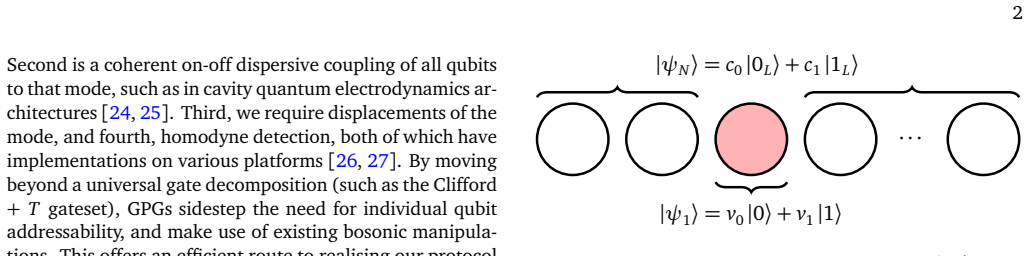
For a gnu code on N=gnu qubits, a single inserted qubit is treated as a spin-1/2 particle coupled to the logical state's spin N/2. Measuring J^2 then J_z modulo the code gap g projects the post-insertion state onto one of four syndromes—(j,w) with j=N+1/2, w=0,1 or j=N-1/2, w=0,g-1—and, crucially, Lemma 1 shows the two projected logical codewords for each syndrome have equal norm, so they genuinely encode a qubit. A logical-CNOT teleportation circuit, implemented with geometric phase gates, then maps that projected spin code back to a permutation-invariant code on the desired number of qubits. The four-qubit gnu code with g=n=2,u=1 is worked out explicitly.
Load-bearing premise
The recovery step assumes that the logical controlled-NOT gate treats the projected post-insertion state identically no matter where the extra qubit was inserted, and that a conditional logical-X gate can be built for odd code gaps; both are asserted without derivation, and if either is false the teleportation recovery fails.
Editorial extensions
If this is right
- Single insertion errors on any gnu code with gap g are correctable with a two-bit syndrome, making decoding a lookup rather than a search.
- When the first measurement gives j=N+1/2, the projected state already lives in the symmetric space on N+1 qubits, so the protocol can switch to a permutation-invariant code with better error-correction properties instead of merely undoing the insertion.
- When it gives j=N-1/2, the teleportation step can map to either N or N+1 qubits, giving flexible code-length recovery.
- Because every stage is expressible with geometric phase gates, the protocol does not require individual qubit addressability, which matters for photonic and bosonic hardware.
- The four-qubit code example exhibits the general syndrome patterns, showing the framework is not vacuous at the smallest code size.
Reading between the lines
- The same J^2, J_z mod g syndrome is a plausible candidate for detecting and correcting deletion errors too, since a missing qubit also changes the total angular momentum sector; if that holds, it would give a unified insertion-deletion framework without relying on the classical Levenshtein equivalence.
- The position-independence of the logical CNOT is the one step a numerical simulation should probe first: check the action of the logical CNOT on the projected states for every insertion position on a small gnu code; if it misbehaves, a Schur-transform-based recovery could replace the teleportation step.
- Lemma 1's proof only needs the squared Clebsch-Gordan coefficients to be linear in the Dicke index, so the equal-norm property may extend to other permutation-invariant code families with affine weight profiles; verifying the norm-preserving condition for those families would test this.
- The odd-gap requirement for the conditional logical-X gate suggests an open design question: either devise a modified recovery for even-gap gnu codes or prove that the two-measurement syndrome cannot support teleportation recovery there.
Editorial analysis
A structured set of objections, weighed in public.
Referee Report
Summary. The paper proposes a quantum error-correction protocol for single insertion errors on a family of permutation-invariant codes called gnu codes. After an insertion error increases the qubit count from N to N+1, the authors measure the total angular momentum J^2 and the magnetic quantum number J_z modulo the code gap g. They claim that these two measurements yield a two-bit syndrome (j,w) with j=N±1/2 and w restricted to two possible values, and that the post-measurement state is a valid quantum code on N+1 qubits. The central technical lemma (Lemma 1) asserts equality of the norms of the two projected logical codewords, which is proved in the appendix using Clebsch-Gordan identities, Vandermonde's identity, and binomial sums. The paper then describes a teleportation-based recovery protocol, using an ancilla in a gnu code, a logical controlled-NOT, and a conditional logical-X gate, intended to map the projected state back to a permutation-invariant code on the desired number of qubits.
Significance. If the protocol were correct, it would be the first general angular-momentum-based QEC protocol for single quantum insertion errors. The syndrome extraction stage is worked out in non-trivial detail: the post-insertion projections onto the symmetric and mixed-symmetry sectors are computed explicitly, and Lemma 1 is a substantive norm-equality result with a self-contained proof. The approach is parameter-free and uses only standard CG and binomial identities. However, the recovery stage as written is not sound. The logical-X gate defined in Eq. (18) does not preserve the syndrome sector of the projected code, so the logical-CNOT of Eq. (19) can move the target state out of its code subspace, and the subsequent logical-Z measurement on that subspace is not a valid measurement of the resulting state. Because the abstract's central claim ('we detail a QEC protocol that can correct single insertion errors') depends on this recovery procedure, the paper needs a major revision before it can be accepted.
major comments (3)
- [Recovery, Eq. (18) and Fig. 3] The logical-X gate X_L: |j,m>_p -> |j,-m>_p is not a logical operator on the syndrome-(j,w) code. The code subspace is defined by j+m≡w (mod g). Under X_L, a state with quantum number m maps to m'=-m, so j+m' = 2j-w (mod g). For j=N+1/2, 2j = gnu+1 ≡ 1 (mod g), hence w' = 1-w and X_L swaps w=0 and w=1. For j=N-1/2, 2j ≡ -1 (mod g), hence w' = -1-w and X_L swaps w=0 and w=g-1. Thus X_L maps the code to an orthogonal syndrome sector, not to itself. Consequently, in the CNOT of Eq. (19), when the control qubit is in the logical |1> component, the target leaves its codespace. The subsequent measurement of register B in the logical-Z basis of the original sector is then undefined or has nonzero probability of projecting onto the complement, and the teleportation protocol of Fig. 3 does not implement the claimed recovery. The statement that a conditional logical-X is 'possible for odd code gap
- [Fig. 3 caption and Recovery paragraph] The caption asserts that 'The logical controlled-NOT gate CAXB acts identically on |Ψ^{a,w}_j> for all a=0,...,N.' While this is plausible for the symmetric sector j=N+1/2, where the post-insertion state is independent of a, the mixed-symmetry codewords |x^{a,w}_{N-1/2}> defined in the appendix explicitly depend on a through the coefficients d_{a,p} and β_{k,l}. No proof is given that a fixed logical CNOT is well-defined across all insertion positions. If X_L is replaced by a code-preserving logical-X (as required by the previous comment), this point may become straightforward, but as written the claim is unsupported and essential to the recovery argument.
- [Recovery section, second paragraph] The statement 'Such a unitary exists by the Knill-Laflamme QEC criterion' is not justified. The Knill-Laflamme condition gives a necessary and sufficient condition for a set of errors to be correctable by some recovery operation, but it does not by itself assert the existence of a unitary that maps one specific code space to another. If the authors intend to use a known result or construction, they should cite it; otherwise the claim should be removed or replaced with an explicit construction.
minor comments (4)
- [Main text, Lemma 1] Lemma 1 states 'Proof. Omitted for brevity.' but a proof is provided in the appendix. This is harmless, but the statement should read 'Proof: see Appendix' to avoid confusion.
- [Eq. (14) and surrounding text] The protocol is described as yielding a 'two-bit syndrome' although w takes g possible values. The paper correctly notes that only two values of w have non-zero projection, but this is an important structural fact; it would help to state explicitly that the syndrome is effectively two bits because the two possible w values depend on j and the code gap.
- [Appendix, Eqs. (35)-(37) and (55)] The index notation in the norm computations is dense and occasionally ambiguous (e.g., the use of k, l, l' and the CG-coefficient subscripts). A short explanation of the summation ranges and the orthogonalization of the SCB would improve readability.
- [Example 1, Eq. (16)] The normalization of the displayed states in Eq. (16) is not immediately obvious; a brief comment confirming that the states are normalized and orthogonal would be useful.
Circularity Check
No significant circularity; the derivation is self-contained.
full rationale
The paper's syndrome extraction and recovery protocol rest on explicit angular-momentum decompositions, Clebsch-Gordan coefficients, and standard binomial identities; no parameter is fitted to data and no predicted quantity is defined in terms of the target result. The norm equalities in Lemma 1 are proved in the appendix using O'Hara's theorem, a standard CG recursion, Vandermonde's identity, and [29, Eq. (12)] as a parameter-free binomial identity with independent published support—this is not the paper's target result and does not make the argument circular. Self-citations to [20], [29], and [35] provide background and code-family definitions, but the central derivation does not reduce to those citations. The unsupported assertions about the logical-CNOT acting identically for all insertion positions and the conditional logical-X for odd gaps are correctness concerns, not circularity: they do not define the syndrome or recovery in terms of the claimed outcome. No load-bearing step is equivalent to its input by construction.
Assumptions & free parameters
assumptions (7)
- standard math Schur-Weyl duality decomposes the (N+1)-qubit Hilbert space into irreducible representations of S_{N+1} and SU(2).
- standard math Clebsch-Gordan coefficient identities, including O'Hara's theorem [44] and recursion [45, Eq. (3.369)], are correct and applicable.
- standard math Vandermonde identity and binomial sum identities, including [29, Eq. (12)], hold.
- domain assumption Geometric phase gates can implement the required measurements of J^2 and J_z mod g, and the logical gates X_L and CNOT.
- domain assumption gnu codes from [29] exist with the stated coefficient structure and distance min(g,n).
- ad hoc to paper The logical CNOT gate CAXB acts identically on |Psi_{a,w}> for all insertion positions a=0,...,N.
- ad hoc to paper The conditional logical-X gate X_L is implementable for odd code gaps g.
Cite this review
Pith. "Pith review of An angular momentum approach to quantum insertion errors." pith.science (2026). https://pith.science/paper/5OFKODL3
@misc{pith2026250903413,
  author       = {Pith},
  title        = {Pith review of: An angular momentum approach to quantum insertion errors},
  year         = {2026},
  howpublished = {\url{https://pith.science/paper/5OFKODL3}},
  note         = {Machine review of arXiv:2509.03413}
}
abstract
Quantum insertion errors are a class of errors that increase the number of qubits in a quantum system. Despite a wealth of research on classical insertion errors, there has been limited progress towards a general framework for correcting quantum insertion errors. We detail a quantum error correction protocol that can correct single insertion errors on a class of gapped permutation-invariant codes. We provide a simple two-stage syndrome extraction protocol that yields a two-bit syndrome, by measuring the total angular momentum and its projection along the $z$-axis (modulo the code gap) of the post-insertion state. We demonstrate that these measurements project the state onto a new codespace, and we detail a teleportation protocol to map the projected state back to a permutation-invariant code on the desired number of qubits.
Figures


Reference graph
Works this paper leans on
-
[29]
M. B. Ruskai, Phys. Rev. Lett.85, 194 (2000)
work page 2000
-
[1]
Permutation-invariant quantum coding for quantum deletion channels
Y. Ouyang, in 2021 IEEE International Symposium on Information Theory (ISIT) (2021) pp. 1499–1503, arXiv:2102.02494 [quant-ph]
work page Pith review arXiv 2021
-
[2]
Here, the subscript zero emphasises that |j, k + m− N/2〉0 depends on position a = 0
By angular momenta coupling laws, we obtain |Ψ0〉 = X j,k,m αmβkC j,k+m− N 2 1 2 ,m; N 2 ,k− N 2 |j, k + m− N/2〉0 , (21) where j = N±1 2 . Here, the subscript zero emphasises that |j, k + m− N/2〉0 depends on position a = 0. This basis is non-orthogonal, so we move to the Schur-Weyl basis [40] |j, k + m− N/2〉0 = X p d0,p|j, k + m− N/2〉p , (22) where 1≤ p≤ N...
-
[3]
S. E. Vinay and P . Kok, Physical Review A97, 10.1103/Phys- RevA.97.042335 (2018)
doi:10.1103/phys- 2018
-
[4]
N. Jain, B. Stiller, I. Khan, V . Makarov, C. Marquardt, and G. Leuchs, IEEE Journal of Selected Topics in Quantum Elec- tronics 21, 168–177 (2015)
work page 2015
-
[5]
A. Navarrete and M. Curty , Quantum Science and Technology 7, 035021 (2022)
work page 2022
-
[6]
B. Nasedkin, F . Kiselev, I. Filipov, D. Tolochko, A. Ismag- ilov, V . Chistiakov, A. Gaidash, A. Tcypkin, A. Kozubov, and V . Egorov, Physical Review Applied20, 014038 (2023)
work page 2023
-
[7]
V . I. Levenshtein, Soviet physics. Doklady10, 707 (1966)
work page 1966
Show all 48 references
-
[8]
L. J. Schulman and D. Zuckerman, IEEE Trans. Inf. Theor.45, 2552–2557 (1999)
1999
-
[9]
Haeupler and A
B. Haeupler and A. Shahrasbi, in Proceedings of the 49th An- nual ACM SIGACT Symposium on Theory of Computing (STOC ’17) (2017) p. 33–46
2017
-
[10]
T . D. Duc, S. Liu, I. Tjuawinata, and C. Xing, IEEE Transac- tions on Information Theory 67, 2808 (2021)
2021
-
[11]
Y. M. Chee, H. M. Kiah, A. Vardy , V . K. Vu, and E. Yaakobi, Coding for racetrack memories (2017), arXiv:1701.06874 [cs.IT]
2017 arXiv
-
[12]
Buschmann and L
T . Buschmann and L. Bystrykh, BMC Bioinformatics14, 272 (2013)
2013
-
[13]
Nakayama and M
A. Nakayama and M. Hagiwara, IEICE Communications Ex- press 9, 100 (2020)
2020
-
[14]
Nakayama and M
A. Nakayama and M. Hagiwara, Single quantum dele- tion error-correcting codes (2020), arXiv:2004.00814 [quant-ph]
2020 arXiv
-
[15]
Shibayama and M
T . Shibayama and M. Hagiwara, in 2021 IEEE International Symposium on Information Theory (ISIT) (2021) pp. 1493– 1498
2021
-
[16]
Leahy , D
J. Leahy , D. Touchette, and P . Yao, Quantum insertion-deletion channels (2019), arXiv:1901.00984 [quant-ph]
2019 arXiv
-
[17]
Hagiwara, IEICE Communications Express 10, 10.1587/comex.2020XBL0191 (2021)
M. Hagiwara, IEICE Communications Express 10, 10.1587/comex.2020XBL0191 (2021)
2021 doi
-
[18]
Shibayama and M
T . Shibayama and M. Hagiwara, in 2022 IEEE International Symposium on Information Theory (ISIT) (2022) pp. 2957– 2962
2022
-
[19]
Shibayama and Y
T . Shibayama and Y. Ouyang, in2021 IEEE Information The- ory Workshop (ITW) (2021) pp. 1–6
2021
-
[20]
Shibayama, Necessary and sufficient condition for con- structing a single qudit insertion /deletion code and its de- coding algorithm (2025), arXiv:2501.07027 [quant-ph]
T . Shibayama, Necessary and sufficient condition for con- structing a single qudit insertion /deletion code and its de- coding algorithm (2025), arXiv:2501.07027 [quant-ph]
2025 arXiv
-
[21]
Ouyang and G
Y. Ouyang and G. K. Brennen, Finite-round quantum er- ror correction on symmetric quantum sensors (2025), arXiv:2212.06285 [quant-ph]
2025 arXiv
-
[22]
Luis, Journal of Physics A: Mathematical and General 34, 7677 (2001)
A. Luis, Journal of Physics A: Mathematical and General 34, 7677 (2001)
2001
-
[23]
Wang and P
X. Wang and P . Zanardi, Phys. Rev. A65, 032327 (2002)
2002
-
[24]
M. T . Johnsson, N. R. Mukty , D. Burgarth, T . Volz, and G. K. Brennen, Phys. Rev. Lett. 125, 190403 (2020)
2020
-
[25]
Eickbusch, V
A. Eickbusch, V . Sivak, A. Z. Ding, S. S. Elder, S. R. Jha, J. Venkatraman, B. Royer, S. M. Girvin, R. J. Schoelkopf, and M. H. Devoret, Nature Physics 18, 1464 (2022)
2022
-
[26]
Y. Wang, Y. Wang, S. van Geldern, T . Connolly , A. A. Clerk, and C. Wang, Science Advances 10, eadj8796 (2024)
2024
-
[27]
Maioli, T
P . Maioli, T . Meunier, S. Gleyzes, A. Auffeves, G. Nogues, M. Brune, J. M. Raimond, and S. Haroche, Phys. Rev. Lett. 94, 113601 (2005)
2005
-
[28]
J. Du, T . Vogt, and W . Li, Phys. Rev. Lett.130, 143004 (2023)
2023
-
[30]
Ouyang, Physical Review A 90, 062317 (2014), arXiv:1302.3247 [quant-ph]
Y. Ouyang, Physical Review A 90, 062317 (2014), arXiv:1302.3247 [quant-ph]
2014 arXiv
-
[31]
Pollatsek and M
H. Pollatsek and M. B. Ruskai, Permutationally in- variant codes for quantum error correction (2004), arXiv:quant-ph/0304153 [quant-ph]
2004 arXiv
-
[32]
Ouyang and J
Y. Ouyang and J. Fitzsimons, Phys. Rev. A 93, 042340 (2016), arXiv:1512.02469 [quant-ph]
2016 arXiv
-
[33]
Ouyang, Linear Algebra and its Applications 532, 43–59 (2017), arXiv:1604.07925 [quant-ph]
Y. Ouyang, Linear Algebra and its Applications 532, 43–59 (2017), arXiv:1604.07925 [quant-ph]
2017 arXiv
-
[34]
Hagiwara and A
M. Hagiwara and A. Nakayama, A four-qubits code that is a quantum deletion error-correcting code with the optimal length (2020), arXiv:2001.08405 [quant-ph]
2020 arXiv
-
[35]
Aydin, M
A. Aydin, M. A. Alekseyev, and A. Barg, Quantum 8, 1321 (2024), arXiv:2310.05358 [quant-ph]
2024 arXiv
-
[36]
Ouyang, Y
Y. Ouyang, Y. Jing, and G. K. Brennen, Measurement-free code-switching for low overhead quantum computation us- 14 ing permutation invariant codes (2025), arXiv:2411.13142 [quant-ph]
2025
-
[37]
Plesch and C
M. Plesch and C. Brukner, Physical Review A 83, 032302 (2011)
2011
-
[38]
Bärtschi and S
A. Bärtschi and S. Eidenbenz, Deterministic preparation of dicke states, in Fundamentals of Computation Theory (Springer International Publishing, 2019) p. 126–139
2019
-
[39]
Havlíˇcek, S
V . Havlíˇcek, S. Strelchuk, and K. Temme, Phys. Rev. A 99, 062336 (2019)
2019
-
[40]
Wills and S
A. Wills and S. Strelchuk, Generalised coupling and an ele- mentary algorithm for the quantum schur transform (2024), arXiv:2305.04069 [quant-ph]
2024 arXiv
-
[41]
Bacon, I
D. Bacon, I. L. Chuang, and A. W . Harrow, Phys. Rev. Lett. 97, 170502 (2006)
2006
-
[42]
A. W . Harrow, Applications of coherent classical communica- tion and the schur transform to quantum information theory (2005), arXiv:quant-ph/0512255 [quant-ph]
2005 arXiv
-
[43]
Havlíˇcek and S
V . Havlíˇcek and S. Strelchuk, Phys. Rev. Lett. 121, 060505 (2018)
2018
-
[44]
R. D. P . East, G. Alonso-Linaje, and C. Park, All you need is spin: Su(2) equivariant variational quantum circuits based on spin networks (2023), arXiv:2309.07250 [quant-ph]
2023
-
[45]
O’Hara, Clebsch-gordan coefficients and the binomial dis- tribution (2001), arXiv:quant-ph/0112096 [quant-ph]
P . O’Hara, Clebsch-gordan coefficients and the binomial dis- tribution (2001), arXiv:quant-ph/0112096 [quant-ph]
2001 arXiv
-
[46]
J. J. Sakurai and J. Napolitano,Modern Quantum Mechanics, 3rd ed. (Cambridge University Press, 2020)
2020
-
[47]
X. Zhou, D. W . Leung, and I. L. Chuang, Phys. Rev. A 62, 052316 (2000)
2000
-
[48]
Knill and R
E. Knill and R. Laflamme, Phys. Rev. A 55, 900 (1997), arXiv:quant-ph/9604034 [quant-ph]
1997 arXiv
Reviewed August 5, 2026 · model on record in the stance chip above.
Discussion (0). Continue with ORCID to comment.