REVIEW 3 major objections 4 minor 110 references
Circumbinary accretion as a diagnostic for binary--disc misalignment
T0 review · 3 major / 4 minor · reviewed 2026-08-11 · deepseek-v4-flash
Pith's one-line read Accretion patterns around an eccentric binary fall into three classes that reveal the initial disc tilt: alternating for prograde, none for polar or retrograde, and temporary alternating for near-critical discs that break.
desk verdict A systematic 0-180 degree SPH survey of circumbinary accretion onto an eccentric binary, showing a clean three-way mapping between initial misalignment and accretion alternation, with a temporary alternating phase in breaking discs near the critical tilt; the main caveats are unresolved accretion streams and an untested R_in dependence. read the letter →
The pith
A machine-rendered reading of the paper's core claim, the machinery that carries it, and where it could break.
The reading
What carries the argument
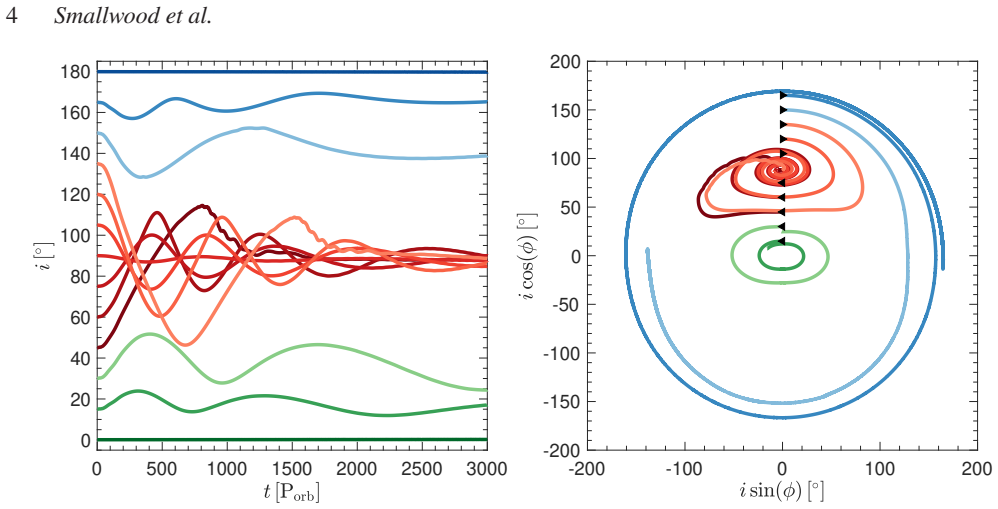
The argument is carried by a suite of 3D smoothed-particle hydrodynamics simulations of a live equal-mass eccentric binary with a weakly viscous disc in the bending-wave regime (aspect ratio 0.1, alpha-viscosity parameter 0.01), run for thirteen initial tilts between 0° and 180°. The central object is the inner disc's eccentricity: alternating preferential accretion appears precisely when the inner disc is significantly eccentric, either because the prograde coplanar disc's apsidal precession distorts it, or because a near-critical disc breaks and leaves an eccentric inner fragment, and disappears when the disc is circular. The analytic libration boundary, about 38° and 142° for these parameters, separates the three dynamical classes, so the accretion pattern becomes a proxy for which class the system is in.
What would settle it
Rerun the same tilt suite at higher resolution (or with smaller sink radii) and check whether the prograde-coplanar models still show antiphase alternating accretion and whether the 45° and 135° models still break; and rerun the 45° model with the initial inner disc radius moved from 4a to 2a and 6a — if the disc break moves with the initial inner radius instead of staying at the physically selected warp radius, the temporary alternating phase is an initial-condition artifact rather than a reliable diagnostic.
Extended reading notes
Core claim
Using 3D hydrodynamical simulations of an equal-mass eccentric binary (initial eccentricity 0.5) fed by a locally isothermal circumbinary disc, this paper tracks the accretion rate onto each star for initial disc tilts from 0° to 180° in 15° steps. It finds that the accretion rate evolution sorts into three classes that match the disc's final alignment: discs that align prograde-coplanar show alternating preferential accretion, with the primary and secondary accreting in antiphase on the disc's apsidal precession timescale; discs that align polar show no alternating preferential accretion, except for the 45° and 135° cases, where the initial tilt lies close to the critical libration boundary, the disc warps strongly and breaks, the inner disc becomes eccentric and drives a temporary alternating phase, and accretion returns to non-alternating as the break propagates outward and the disc recircularizes; and discs that align retrograde-coplanar never show alternating preferential accretion. The paper concludes that the presence, absence, or temporary appearance of alternating preferential accretion can be used as a diagnostic of the initial binary–disc misalignment.
Load-bearing premise
The load-bearing premise is that the alternating-versus-non-alternating character of the accretion pattern is unaffected by the unresolved gas dynamics right next to each star; the paper states that the accreting streams are not well resolved and that the absolute accretion rates are resolution-dependent, but it does not show a resolution study of the pattern itself.
Editorial extensions
If this is right
- An observed pattern of alternating preferential accretion onto a binary star indicates that its circumbinary disc is on a prograde orbit and aligning toward coplanar, or, if the pattern is temporary, that the disc is near the critical misalignment and has broken during polar alignment.
- A steady, non-alternating accretion signal is consistent with either polar alignment or retrograde coplanar alignment, so the accretion pattern alone cannot separate those two classes.
- Because the simulations are scale-free, the same classification can in principle diagnose misalignment around supermassive black hole binaries as well as stellar binaries.
- The return from alternating back to non-alternating accretion in the near-critical models is a direct signature of the disc re-circularizing after a break, and could be looked for as a temporal sequence in long monitoring campaigns.
Reading between the lines
- If the alternating pattern is as reliable as the paper claims, the diagnostic is one-sided: non-alternating accretion cannot tell a polar disc from a retrograde coplanar disc, so observers would need resolved disc geometry to break that degeneracy.
- The paper's own note that the disc break occurs at the initial inner radius (4a) suggests a cheap numerical control: varying the starting inner radius in the 45° and 135° runs would test whether the break and the temporary alternating phase are physical or set by the initial condition.
- Because the stars are treated as sink particles and circumstellar discs are not resolved, the buffering effect of real circumstellar discs could smooth or delay the alternating signal; this is a testable prediction for future simulations that resolve those discs.
Editorial analysis
A structured set of objections, weighed in public.
Referee Report
Summary. The paper presents a suite of smoothed-particle hydrodynamics simulations of circumbinary discs around a live, equal-mass, eccentric (e_b=0.5) binary, with initial disc tilts from 0 to 180 degrees in 15-degree increments. The central claim is that the time-dependent accretion pattern onto the two stars can serve as a diagnostic of the initial binary-disc misalignment: discs aligning prograde coplanar show alternating preferential accretion; discs aligning polar show no alternating accretion except for the near-critical 45 and 135 degree cases, which break and temporarily alternate while the inner disc is eccentric; and discs aligning retrograde coplanar show no alternation. The paper connects these patterns to the disc warp, eccentricity, and breaking evolution, and discusses observational applications to systems such as TWA 3A.
Significance. If the central claim is correct, the paper provides a falsifiable, observationally accessible diagnostic: the presence or absence of alternating preferential accretion onto the binary components, together with any temporary alternating phase, encodes the initial misalignment basin of the circumbinary disc. The strengths of the paper are its systematic 13-run tilt sweep, the use of a live binary with directly measured accretion rates, the internally consistent qualitative narrative connecting disc warping and eccentricity to accretion modulation, and consistency with prior work on coplanar and polar circumbinary discs. The proposed mapping between accretion pattern and misalignment class is a genuine contribution that could motivate long-term monitoring campaigns of T Tauri and other young binaries.
major comments (3)
- [Section 4.2] The claim that "our results on preferential accretion alternation are not affected by the low resolution" is asserted without demonstration. The text admits that the gaseous streams accreting onto the binary components are not well resolved and that the magnitude of the accretion rates is resolution-dependent. Since the diagnostic is defined by whether the accretion-rate time series alternates between primary and secondary, unresolved stream dynamics could, in principle, change the classification. No resolution study of the alternation pattern is shown. Please provide a convergence test (e.g., a run with a larger particle number or a smaller sink radius) demonstrating that the alternating/non-alternating character of the time series is stable, or explicitly restrict the diagnostic claim to the resolved outer flow.
- [Section 4.1 and Fig. 6] The break in the 45-degree and 135-degree runs occurs at approximately 4a, which is exactly the chosen initial inner radius R_in = 4a. The authors acknowledge this coincidence but do not test whether the disc breaking and the temporary alternating-accretion phase persist when R_in is changed. Because the proposed diagnostic for near-critical misalignment relies on this temporary phase, an additional experiment with a different initial inner radius (e.g., 2a or 5a) is needed to distinguish a physical break from a numerical artifact associated with the initial condition.
- [Section 3.3 and Figs. 8-10] The classification into "alternating preferential accretion" versus "non-alternating" accretion is made by eye, with no quantitative criterion or statistical threshold. No periodogram, cross-correlation, or threshold on |dot M1 - dot M2| is used to define the classes. An objective metric would make the three-class diagnostic reproducible and would allow the reader to assess borderline cases, such as the 150-degree run with warping-induced oscillations. Please define and apply a quantitative classification, or provide the specific metric used to separate the classes.
minor comments (4)
- [Section 3.2] The text says the 45-degree model breaks at r ~ 2a, but later in the same section and in Fig. 6 the break is located at ~4a; please reconcile these values.
- [Equations (2) and (14)] There are LaTeX artifacts in the text: Eq. (14) contains a corrupted integral symbol ("/uni222B.dsp") and Eq. (2) is missing a period after "dimensions of velocity"; please clean these up.
- [Figure 8] The panels in Fig. 8 are small and the accretion-rate curves are difficult to read; a larger figure or separate panels with a common y-axis would make the claimed alternation pattern more visible.
- [Section 4.3] In the discussion of 2M1222-57, the text says simulations predict a dominant period of 5 Porb and then attributes the 5 Porb variability to inner-edge motion; please clarify which model is being compared to the observed period and why the 5 Porb modulation is expected.
Circularity Check
No circularity: the accretion-pattern diagnostic is a direct simulation readout, not a fitted or definitional result.
full rationale
The derivation chain is not circular. The paper's target result—whether preferential accretion onto an eccentric binary alternates as a function of initial disc tilt—is read directly from the SPH accretion-rate time series (Fig. 8), which are independent simulation outputs. The analytic formulas (Eq. 12 for the libration boundary and Eqs. 15–18 for alignment timescales) are used only to predict and interpret which alignment basin each initial tilt falls into and why the observed evolution proceeds on a given timescale; the accretion-pattern classification is not an input to those formulas, and no parameter is fitted to the accretion data and then renamed a prediction. Self-citations to Smallwood et al. (2019, 2022, 2023) supply context, a comparison polar-disc result, and resolution background, but they are not invoked as a uniqueness theorem or as the sole justification forbidding alternative interpretations. The paper's own admitted caveats—unresolved accreting streams (Section 4.2) and the coincidence between the break radius and the initial inner radius (Section 4.1)—are numerical and robustness limitations rather than demonstrations that any claimed result equals its input by construction. Accordingly, no circular step is identified.
Assumptions & free parameters
free parameters (8)
- initial binary eccentricity e_b0 =
0.5
- binary mass ratio M2/M1 =
1.0
- Shakura-Sunyaev viscosity alpha_SS =
0.01
- disc aspect ratio H/R at inner edge =
0.1
- initial disc inner radius R_in =
4a
- sink accretion radius R_acc =
0.25a
- initial angular momentum ratio J_d/J_b =
0.0106
- initial SPH particle number =
1e6
assumptions (6)
- standard math Critical tilt for circulation vs libration is given by Eq. 12 from Martin & Lubow 2019.
- domain assumption The disc is in the bending-wave regime because H/R > alpha_SS.
- domain assumption The locally isothermal equation of state of Farris et al. 2014 captures the temperature structure.
- domain assumption Unresolved circumstellar discs and accretion streams at the sink scale do not change whether accretion alternates.
- domain assumption Disc breaking at about 4a is a physical result rather than a consequence of choosing R_in = 4a.
- standard math Alignment timescales are described by linear warp theory Eqs. 15-17.
Cite this review
Pith. "Pith review of Circumbinary accretion as a diagnostic for binary--disc misalignment." pith.science (2026). https://pith.science/paper/5RU7G34W
@misc{pith2026241210653,
  author       = {Pith},
  title        = {Pith review of: Circumbinary accretion as a diagnostic for binary--disc misalignment},
  year         = {2026},
  howpublished = {\url{https://pith.science/paper/5RU7G34W}},
  note         = {Machine review of arXiv:2412.10653}
}
abstract
Binary star systems can accrete material originating from a circumbinary disc. Since it is common for the circumbinary disc to be tilted with respect to the binary orbital plane, we test whether the accretion dynamics can be a diagnostic for binary-disc misalignment. We present hydrodynamical simulations to model the accretion flow from a circumbinary disc around an eccentric binary with initial tilts ranging from $0^\circ$ to $180^\circ$ in increments of $15^\circ$. Based on the initial tilt, the circumbinary disc will align towards three different configurations: prograde coplanar, polar, or retrograde coplanar. For discs with initial tilts evolving towards prograde coplanar alignment, the accretion rates onto the primary and secondary stars exhibit alternating preferential accretion. Circumbinary discs evolving towards polar alignment exhibit no alternating preferential accretion onto the binary unless the initial tilt is close to the critical tilt that sets the boundary between coplanar or polar alignment. Such cases cause strong disc warping, leading to disc breaking. The inner disc becomes eccentric, leading to alternating preferential accretion onto the binary. As the break propagates outward, the disc tilt damps towards a polar state and the disc eccentricity decreases. As the disc re-circularizes, the accretion rate transitions back from alternating preferential accretion to non-alternating accretion. Lastly, no alternating preferential accretion exists for discs undergoing retrograde coplanar alignment. From the summary of the accretion rates from our suite of SPH simulations, it is evident that the accretion rate evolution can be affected by the initial tilt and subsequent evolution of the circumbinary disc.
Figures


Figures from the paper (7 more)


Reference graph
Works this paper leans on
-
[1]
write newline
" write newline "" before.all 'output.state := FUNCTION fin.entry write newline FUNCTION new.block output.state before.all = 'skip after.block 'output.state := if FUNCTION new.sentence output.state after.block = 'skip output.state before.all = 'skip after.sentence 'output.state := if if FUNCTION not #0 #1 if FUNCTION and 'skip pop #0 if FUNCTION or pop #1...
-
[2]
Alcal \'a J. M., et al., 2014, @doi [ ] 10.1051/0004-6361/201322254 , https://ui.adsabs.harvard.edu/abs/2014A&A...561A...2A 561, A2
-
[3]
Alves F. O., Caselli P., Girart J. M., Segura-Cox D., Franco G. A. P., Schmiedeke A., Zhao B., 2019, @doi [Science] 10.1126/science.aaw3491 , https://ui.adsabs.harvard.edu/abs/2019Sci...366...90A 366, 90
-
[4]
Aly H., Lodato G., 2020, @doi [ ] 10.1093/mnras/stz3633 , https://ui.adsabs.harvard.edu/abs/2020MNRAS.492.3306A 492, 3306
-
[5]
Ansdell M., et al., 2018, @doi [ ] 10.3847/1538-4357/aab890 , https://ui.adsabs.harvard.edu/abs/2018ApJ...859...21A 859, 21
-
[6]
H., 1994, @doi [ApJ] 10.1086/173679 , http://adsabs.harvard.edu/abs/1994ApJ...421..651A 421, 651
Artymowicz P., Lubow S. H., 1994, @doi [ApJ] 10.1086/173679 , http://adsabs.harvard.edu/abs/1994ApJ...421..651A 421, 651
doi:10.1086/173679 1994
-
[7]
H., 1996, @doi [ApJl] 10.1086/310200 , http://adsabs.harvard.edu/abs/1996ApJ...467L..77A 467, L77
Artymowicz P., Lubow S. H., 1996, @doi [ApJl] 10.1086/310200 , http://adsabs.harvard.edu/abs/1996ApJ...467L..77A 467, L77
doi:10.1086/310200 1996
-
[8]
Bate M. R., Bonnell I. A., 1997, @doi [ ] 10.1093/mnras/285.1.33 , https://ui.adsabs.harvard.edu/abs/1997MNRAS.285...33B 285, 33
Show all 110 references
-
[9]
R., Bonnell I
Bate M. R., Bonnell I. A., Price N. M., 1995, @doi [ ] 10.1093/mnras/277.2.362 , https://ui.adsabs.harvard.edu/abs/1995MNRAS.277..362B 277, 362
1995 doi
-
[10]
R., Bonnell I
Bate M. R., Bonnell I. A., Clarke C. J., Lubow S. H., Ogilvie G. I., Pringle J. E., Tout C. A., 2000, @doi [ ] 10.1046/j.1365-8711.2000.03648.x , http://adsabs.harvard.edu/abs/2000MNRAS.317..773B 317, 773
2000
-
[11]
R., Bonnell I
Bate M. R., Bonnell I. A., Bromm V., 2002, @doi [ ] 10.1046/j.1365-8711.2002.05775.x , https://ui.adsabs.harvard.edu/abs/2002MNRAS.336..705B 336, 705
2002
-
[12]
Bell C. P. M., Mamajek E. E., Naylor T., 2015, @doi [ ] 10.1093/mnras/stv1981 , https://ui.adsabs.harvard.edu/abs/2015MNRAS.454..593B 454, 593
2015 doi
-
[13]
J., et al., 2022, @doi [ ] 10.1051/0004-6361/202142070 , https://ui.adsabs.harvard.edu/abs/2022A&A...658A.183B 658, A183
Bohn A. J., et al., 2022, @doi [ ] 10.1051/0004-6361/202142070 , https://ui.adsabs.harvard.edu/abs/2022A&A...658A.183B 658, A183
2022 doi
-
[14]
Calvet N., Gullbring E., 1998, @doi [ ] 10.1086/306527 , https://ui.adsabs.harvard.edu/abs/1998ApJ...509..802C 509, 802
1998 doi
-
[15]
L., Gordon K
Calvet N., Muzerolle J., Brice \ n o C., Hern \'a ndez J., Hartmann L., Saucedo J. L., Gordon K. D., 2004, @doi [ ] 10.1086/422733 , http://adsabs.harvard.edu/abs/2004AJ....128.1294C 128, 1294
2004 doi
-
[16]
Casassus S., et al., 2015, @doi [ ] 10.1088/0004-637X/811/2/92 , http://adsabs.harvard.edu/abs/2015ApJ...811...92C 811, 92
2015 doi
-
[17]
J., 2022, @doi [ ] 10.1093/mnras/stac1390 , https://ui.adsabs.harvard.edu/abs/2022MNRAS.514..906C 514, 906
Ceppi S., Cuello N., Lodato G., Clarke C., Toci C., Price D. J., 2022, @doi [ ] 10.1093/mnras/stac1390 , https://ui.adsabs.harvard.edu/abs/2022MNRAS.514..906C 514, 906
2022 doi
-
[18]
H., 2023, @doi [ ] 10.1093/mnras/stad444 , https://ui.adsabs.harvard.edu/abs/2023MNRAS.520.5817C 520, 5817
Ceppi S., Longarini C., Lodato G., Cuello N., Lubow S. H., 2023, @doi [ ] 10.1093/mnras/stad444 , https://ui.adsabs.harvard.edu/abs/2023MNRAS.520.5817C 520, 5817
2023 doi
-
[19]
J., Elsender D., Bate M
Ceppi S., Cuello N., Lodato G., Longarini C., Price D. J., Elsender D., Bate M. R., 2024, @doi [ ] 10.1051/0004-6361/202348375 , https://ui.adsabs.harvard.edu/abs/2024A&A...682A.104C 682, A104
2024 doi
-
[20]
M., Hillenbrand L
Cody A. M., Hillenbrand L. A., 2010, @doi [ ] 10.1088/0067-0049/191/2/389 , https://ui.adsabs.harvard.edu/abs/2010ApJS..191..389C 191, 389
2010 doi
-
[21]
Corporaal A., Kluska J., Van Winckel H., Bollen D., Kamath D., Min M., 2021, @doi [ ] 10.1051/0004-6361/202141154 , https://ui.adsabs.harvard.edu/abs/2021A&A...650L..13C 650, L13
2021 doi
-
[22]
J., Alexander R
Cuadra J., Armitage P. J., Alexander R. D., Begelman M. C., 2009, @doi [ ] 10.1111/j.1365-2966.2008.14147.x , https://ui.adsabs.harvard.edu/abs/2009MNRAS.393.1423C 393, 1423
2009
-
[23]
A., 2019, @doi [ ] 10.1051/0004-6361/201833976 , https://ui.adsabs.harvard.edu/abs/2019A&A...628A.119C 628, A119
Cuello N., Giuppone C. A., 2019, @doi [ ] 10.1051/0004-6361/201833976 , https://ui.adsabs.harvard.edu/abs/2019A&A...628A.119C 628, A119
2019 doi
-
[24]
M., Jensen E
Czekala I., Chiang E., Andrews S. M., Jensen E. L. N., Torres G., Wilner D. J., Stassun K. G., Macintosh B., 2019, @doi [ ] 10.3847/1538-4357/ab287b , https://ui.adsabs.harvard.edu/abs/2019ApJ...883...22C 883, 22
2019 doi
-
[25]
M., Espaillat C
Czekala I., Ribas \'A ., Cuello N., Chiang E., Mac \' as E., Duch \^e ne G., Andrews S. M., Espaillat C. C., 2021, @doi [ ] 10.3847/1538-4357/abebe3 , https://ui.adsabs.harvard.edu/abs/2021ApJ...912....6C 912, 6
2021 doi
-
[26]
J., Haiman Z., MacFadyen A., 2013, @doi [ ] 10.1093/mnras/stt1787 , https://ui.adsabs.harvard.edu/abs/2013MNRAS.436.2997D 436, 2997
D'Orazio D. J., Haiman Z., MacFadyen A., 2013, @doi [ ] 10.1093/mnras/stt1787 , https://ui.adsabs.harvard.edu/abs/2013MNRAS.436.2997D 436, 2997
2013 doi
- [27]
-
[28]
I., 2022, @doi [ ] 10.1093/mnras/stac858 , https://ui.adsabs.harvard.edu/abs/2022MNRAS.512.6078D 512, 6078
Deng H., Ogilvie G. I., 2022, @doi [ ] 10.1093/mnras/stac858 , https://ui.adsabs.harvard.edu/abs/2022MNRAS.512.6078D 512, 6078
2022 doi
-
[29]
J., 2015, @doi [ ] 10.1093/mnras/stv347 , http://adsabs.harvard.edu/abs/2015MNRAS.449.1251D 449, 1251
Do g an S., Nixon C., King A., Price D. J., 2015, @doi [ ] 10.1093/mnras/stv347 , http://adsabs.harvard.edu/abs/2015MNRAS.449.1251D 449, 1251
2015 doi
-
[30]
J., King A
Do g an S., Nixon C. J., King A. R., Pringle J. E., 2018, @doi [ ] 10.1093/mnras/sty155 , https://ui.adsabs.harvard.edu/abs/2018MNRAS.476.1519D 476, 1519
2018 doi
-
[31]
C., Nixon C
Drewes N. C., Nixon C. J., 2021, @doi [ ] 10.3847/1538-4357/ac2609 , https://ui.adsabs.harvard.edu/abs/2021ApJ...922..243D 922, 243
2021 doi
-
[32]
C., D'Orazio D., Derdzinski A., Haiman Z., MacFadyen A., Rosen A
Duffell P. C., D'Orazio D., Derdzinski A., Haiman Z., MacFadyen A., Rosen A. L., Zrake J., 2020, @doi [ ] 10.3847/1538-4357/abab95 , https://ui.adsabs.harvard.edu/abs/2020ApJ...901...25D 901, 25
2020 doi
- [33]
-
[34]
C., Cuadra J., Dougados C., 2015, @doi [ ] 10.1093/mnras/stv284 , http://adsabs.harvard.edu/abs/2015MNRAS.448.3545D 448, 3545
Dunhill A. C., Cuadra J., Dougados C., 2015, @doi [ ] 10.1093/mnras/stv284 , http://adsabs.harvard.edu/abs/2015MNRAS.448.3545D 448, 3545
2015 doi
-
[35]
Duquennoy A., Mayor M., 1991, , http://adsabs.harvard.edu/abs/1991A
1991
-
[36]
Facchini S., Juh \'a sz A., Lodato G., 2018, @doi [ ] 10.1093/mnras/stx2523 , https://ui.adsabs.harvard.edu/abs/2018MNRAS.473.4459F 473, 4459
2018 doi
-
[37]
W., Ogilvie G
Fairbairn C. W., Ogilvie G. I., 2021, @doi [ ] 10.1093/mnras/stab2717 , https://ui.adsabs.harvard.edu/abs/2021MNRAS.508.2426F 508, 2426
2021 doi
-
[38]
D., Duffell P., MacFadyen A
Farris B. D., Duffell P., MacFadyen A. I., Haiman Z., 2014, @doi [ ] 10.1088/0004-637X/783/2/134 , https://ui.adsabs.harvard.edu/abs/2014ApJ...783..134F 783, 134
2014 doi
-
[39]
H., Martin R
Franchini A., Lubow S. H., Martin R. G., 2019, @doi [ ] 10.3847/2041-8213/ab2fd8 , https://ui.adsabs.harvard.edu/abs/2019ApJ...880L..18F 880, L18
2019 doi
-
[40]
Franchini A., Sesana A., Dotti M., 2021, @doi [ ] 10.1093/mnras/stab2234 , https://ui.adsabs.harvard.edu/abs/2021MNRAS.507.1458F 507, 1458
2021 doi
-
[41]
Franchini A., Lupi A., Sesana A., 2022, @doi [ ] 10.3847/2041-8213/ac63a2 , https://ui.adsabs.harvard.edu/abs/2022ApJ...929L..13F 929, L13
2022 doi
-
[42]
Franchini A., Lupi A., Sesana A., Haiman Z., 2023, @doi [ ] 10.1093/mnras/stad1070 , https://ui.adsabs.harvard.edu/abs/2023MNRAS.522.1569F 522, 1569
2023 doi
- [43]
-
[44]
Gullbring E., Hartmann L., Brice \ n o C., Calvet N., 1998, @doi [ ] 10.1086/305032 , https://ui.adsabs.harvard.edu/abs/1998ApJ...492..323G 492, 323
1998 doi
-
[45]
Hanawa T., Ochi Y., Ando K., 2010, @doi [ ] 10.1088/0004-637X/708/1/485 , https://ui.adsabs.harvard.edu/abs/2010ApJ...708..485H 708, 485
2010 doi
-
[46]
Hartmann L., Calvet N., Gullbring E., D'Alessio P., 1998, @doi [ ] 10.1086/305277 , http://adsabs.harvard.edu/abs/1998ApJ...495..385H 495, 385
1998 doi
-
[47]
M., Nixon C
Heath R. M., Nixon C. J., 2020, @doi [ ] 10.1051/0004-6361/202038548 , https://ui.adsabs.harvard.edu/abs/2020A&A...641A..64H 641, A64
2020 doi
-
[48]
F., Hernquist L., Cox T
Hopkins P. F., Hernquist L., Cox T. J., Di Matteo T., Robertson B., Springel V., 2006, @doi [ ] 10.1086/499298 , https://ui.adsabs.harvard.edu/abs/2006ApJS..163....1H 163, 1
2006 doi
-
[49]
Hueso R., Guillot T., 2005, @doi [ ] 10.1051/0004-6361:20041905 , https://ui.adsabs.harvard.edu/abs/2005A&A...442..703H 442, 703
2005 doi
-
[50]
Ingleby L., et al., 2013, @doi [ ] 10.1088/0004-637X/767/2/112 , https://ui.adsabs.harvard.edu/abs/2013ApJ...767..112I 767, 112
2013 doi
-
[51]
Jensen E. L. N., Dhital S., Stassun K. G., Patience J., Herbst W., Walter F. M., Simon M., Basri G., 2007, @doi [ ] 10.1086/518408 , https://ui.adsabs.harvard.edu/abs/2007AJ....134..241J 134, 241
2007 doi
-
[52]
M., et al., 2019, @doi [Nature Astronomy] 10.1038/s41550-018-0667-x , https://ui.adsabs.harvard.edu/abs/2019NatAs...3..230K 3, 230
Kennedy G. M., et al., 2019, @doi [Nature Astronomy] 10.1038/s41550-018-0667-x , https://ui.adsabs.harvard.edu/abs/2019NatAs...3..230K 3, 230
2019 doi
-
[53]
Kraus S., et al., 2017, @doi [ ] 10.3847/2041-8213/835/1/L5 , https://ui.adsabs.harvard.edu/abs/2017ApJ...835L...5K 835, L5
2017 doi
-
[54]
Kraus S., et al., 2020, @doi [Science] 10.1126/science.aba4633 , https://ui.adsabs.harvard.edu/abs/2020Sci...369.1233K 369, 1233
2020 doi
-
[55]
M., 2013, @doi [ ] 10.1093/mnras/stt365 , https://ui.adsabs.harvard.edu/abs/2013MNRAS.431.2673K 431, 2673
Kurosawa R., Romanova M. M., 2013, @doi [ ] 10.1093/mnras/stt365 , https://ui.adsabs.harvard.edu/abs/2013MNRAS.431.2673K 431, 2673
2013 doi
-
[56]
J., 2023, @doi [ ] 10.1146/annurev-astro-052622-022933 , https://ui.adsabs.harvard.edu/abs/2023ARA&A..61..517L 61, 517
Lai D., Mu \ n oz D. J., 2023, @doi [ ] 10.1146/annurev-astro-052622-022933 , https://ui.adsabs.harvard.edu/abs/2023ARA&A..61..517L 61, 517
2023 doi
-
[57]
Li D., Zhou J.-L., Zhang H., 2014, @doi [ ] 10.1093/mnras/stt2181 , https://ui.adsabs.harvard.edu/abs/2014MNRAS.437.3832L 437, 3832
2014 doi
-
[58]
J., 2010, @doi [MNRAS] 10.1111/j.1365-2966.2010.16526.x , http://adsabs.harvard.edu/abs/2010MNRAS.405.1212L 405, 1212
Lodato G., Price D. J., 2010, @doi [MNRAS] 10.1111/j.1365-2966.2010.16526.x , http://adsabs.harvard.edu/abs/2010MNRAS.405.1212L 405, 1212
2010
-
[59]
E., 2007, @doi [ ] 10.1111/j.1365-2966.2007.12332.x , http://adsabs.harvard.edu/abs/2007MNRAS.381.1287L 381, 1287
Lodato G., Pringle J. E., 2007, @doi [ ] 10.1111/j.1365-2966.2007.12332.x , http://adsabs.harvard.edu/abs/2007MNRAS.381.1287L 381, 1287
2007
-
[60]
H., Artymowicz P., 2000, in Mannings V., Boss A
Lubow S. H., Artymowicz P., 2000, in Mannings V., Boss A. P., Russell S. S., eds, Protostars and Planets IV. p. 731
2000
-
[61]
H., Martin R
Lubow S. H., Martin R. G., 2018, @doi [ ] 10.1093/mnras/stx2643 , http://adsabs.harvard.edu/abs/2018MNRAS.473.3733L 473, 3733
2018 doi
-
[62]
H., Ogilvie G
Lubow S. H., Ogilvie G. I., 2000, @doi [ ] 10.1086/309101 , http://adsabs.harvard.edu/abs/2000ApJ...538..326L 538, 326
2000 doi
-
[63]
H., Martin R
Lubow S. H., Martin R. G., Nixon C., 2015, @doi [ApJ] 10.1088/0004-637X/800/2/96 , http://adsabs.harvard.edu/abs/2015ApJ...800...96L 800, 96
2015 doi
-
[64]
I., Milosavljevi \'c M., 2008, @doi [ ] 10.1086/523869 , https://ui.adsabs.harvard.edu/abs/2008ApJ...672...83M 672, 83
MacFadyen A. I., Milosavljevi \'c M., 2008, @doi [ ] 10.1086/523869 , https://ui.adsabs.harvard.edu/abs/2008ApJ...672...83M 672, 83
2008 doi
-
[65]
F., Robberto M., Da Rio N., Lodato G., Hillenbrand L
Manara C. F., Robberto M., Da Rio N., Lodato G., Hillenbrand L. A., Stassun K. G., Soderblom D. R., 2012, @doi [ ] 10.1088/0004-637X/755/2/154 , https://ui.adsabs.harvard.edu/abs/2012ApJ...755..154M 755, 154
2012 doi
-
[66]
F., Fedele D., Herczeg G
Manara C. F., Fedele D., Herczeg G. J., Teixeira P. S., 2016, @doi [ ] 10.1051/0004-6361/201527224 , https://ui.adsabs.harvard.edu/abs/2016A&A...585A.136M 585, A136
2016 doi
-
[67]
F., et al., 2017, @doi [ ] 10.1051/0004-6361/201630147 , https://ui.adsabs.harvard.edu/abs/2017A&A...604A.127M 604, A127
Manara C. F., et al., 2017, @doi [ ] 10.1051/0004-6361/201630147 , https://ui.adsabs.harvard.edu/abs/2017A&A...604A.127M 604, A127
2017 doi
-
[68]
G., Lubow S
Martin R. G., Lubow S. H., 2017, @doi [ ] 10.3847/2041-8213/835/2/L28 , http://adsabs.harvard.edu/abs/2017ApJ...835L..28M 835, L28
2017 doi
-
[69]
G., Lubow S
Martin R. G., Lubow S. H., 2019, @doi [ ] 10.1093/mnras/stz2670 , https://ui.adsabs.harvard.edu/abs/2019MNRAS.490.1332M 490, 1332
2019 doi
-
[70]
Miranda R., Lai D., 2015, @doi [ ] 10.1093/mnras/stv1450 , http://adsabs.harvard.edu/abs/2015MNRAS.452.2396M 452, 2396
2015 doi
-
[71]
J., Lai D., 2017, @doi [ ] 10.1093/mnras/stw3189 , https://ui.adsabs.harvard.edu/abs/2017MNRAS.466.1170M 466, 1170
Miranda R., Mu \ n oz D. J., Lai D., 2017, @doi [ ] 10.1093/mnras/stw3189 , https://ui.adsabs.harvard.edu/abs/2017MNRAS.466.1170M 466, 1170
2017 doi
-
[72]
J., Lai D., 2016, @doi [ ] 10.3847/0004-637X/827/1/43 , https://ui.adsabs.harvard.edu/abs/2016ApJ...827...43M 827, 43
Mu \ n oz D. J., Lai D., 2016, @doi [ ] 10.3847/0004-637X/827/1/43 , https://ui.adsabs.harvard.edu/abs/2016ApJ...827...43M 827, 43
2016 doi
-
[73]
J., Lithwick Y., 2020, @doi [ ] 10.3847/1538-4357/abc74c , https://ui.adsabs.harvard.edu/abs/2020ApJ...905..106M 905, 106
Mu \ n oz D. J., Lithwick Y., 2020, @doi [ ] 10.3847/1538-4357/abc74c , https://ui.adsabs.harvard.edu/abs/2020ApJ...905..106M 905, 106
2020 doi
-
[74]
J., Miranda R., Lai D., 2019, @doi [ ] 10.3847/1538-4357/aaf867 , https://ui.adsabs.harvard.edu/abs/2019ApJ...871...84M 871, 84
Mu \ n oz D. J., Miranda R., Lai D., 2019, @doi [ ] 10.3847/1538-4357/aaf867 , https://ui.adsabs.harvard.edu/abs/2019ApJ...871...84M 871, 84
2019 doi
-
[75]
J., Lai D., Kratter K., Mirand a R., 2020, @doi [ ] 10.3847/1538-4357/ab5d33 , https://ui.adsabs.harvard.edu/abs/2020ApJ...889..114M 889, 114
Mu \ n oz D. J., Lai D., Kratter K., Mirand a R., 2020, @doi [ ] 10.3847/1538-4357/ab5d33 , https://ui.adsabs.harvard.edu/abs/2020ApJ...889..114M 889, 114
2020 doi
-
[76]
J., Nixon C
Nealon R., Price D. J., Nixon C. J., 2015, @doi [ ] 10.1093/mnras/stv014 , http://adsabs.harvard.edu/abs/2015MNRAS.448.1526N 448, 1526
2015 doi
-
[77]
Nealon R., Ragusa E., Gerosa D., Rosotti G., Barbieri R., 2022, @doi [ ] 10.1093/mnras/stab3328 , https://ui.adsabs.harvard.edu/abs/2022MNRAS.509.5608N 509, 5608
2022 doi
-
[78]
J., 2012, @doi [MNRAS] 10.1111/j.1365-2966.2012.21072.x , http://adsabs.harvard.edu/abs/2012MNRAS.423.2597N 423, 2597
Nixon C. J., 2012, @doi [MNRAS] 10.1111/j.1365-2966.2012.21072.x , http://adsabs.harvard.edu/abs/2012MNRAS.423.2597N 423, 2597
2012
-
[79]
Nixon C., King A., Price D., 2013, @doi [MNRAS] 10.1093/mnras/stt1136 , http://adsabs.harvard.edu/abs/2013MNRAS.434.1946N 434, 1946
2013 doi
-
[80]
Ochi Y., Sugimoto K., Hanawa T., 2005, @doi [ ] 10.1086/428601 , https://ui.adsabs.harvard.edu/abs/2005ApJ...623..922O 623, 922
2005 doi
-
[81]
Papaloizou J. C. B., Lin D. N. C., 1995, @doi [ ] 10.1086/175127 , http://adsabs.harvard.edu/abs/1995ApJ...438..841P 438, 841
1995 doi
-
[82]
Papaloizou J. C. B., Nelson R. P., Masset F., 2001, @doi [A&A] 10.1051/0004-6361:20000011 , http://adsabs.harvard.edu/abs/2001A
2001 doi
-
[83]
J., et al., 2018, @doi [ ] 10.1017/pasa.2018.25 , https://ui.adsabs.harvard.edu/abs/2018PASA...35...31P 35, e031
Price D. J., et al., 2018, @doi [ ] 10.1017/pasa.2018.25 , https://ui.adsabs.harvard.edu/abs/2018PASA...35...31P 35, e031
2018 doi
-
[84]
G., 2023, @doi [arXiv e-prints] 10.48550/arXiv.2310.00459 , https://ui.adsabs.harvard.edu/abs/2023arXiv231000459R p
Rabago I., Zhu Z., Lubow S., Martin R. G., 2023, @doi [arXiv e-prints] 10.48550/arXiv.2310.00459 , https://ui.adsabs.harvard.edu/abs/2023arXiv231000459R p. arXiv:2310.00459
-
[85]
R., 2016, @doi [ ] 10.3847/0004-637X/830/1/7 , https://ui.adsabs.harvard.edu/abs/2016ApJ...830....7R 830, 7
Rafikov R. R., 2016, @doi [ ] 10.3847/0004-637X/830/1/7 , https://ui.adsabs.harvard.edu/abs/2016ApJ...830....7R 830, 7
2016 doi
-
[86]
J., 2016, @doi [ ] 10.1093/mnras/stw1081 , https://ui.adsabs.harvard.edu/abs/2016MNRAS.460.1243R 460, 1243
Ragusa E., Lodato G., Price D. J., 2016, @doi [ ] 10.1093/mnras/stw1081 , https://ui.adsabs.harvard.edu/abs/2016MNRAS.460.1243R 460, 1243
2016 doi
-
[87]
J., 2020, @doi [ ] 10.1093/mnras/staa2954 , https://ui.adsabs.harvard.edu/abs/2020MNRAS.499.3362R 499, 3362
Ragusa E., Alexander R., Calcino J., Hirsh K., Price D. J., 2020, @doi [ ] 10.1093/mnras/staa2954 , https://ui.adsabs.harvard.edu/abs/2020MNRAS.499.3362R 499, 3362
2020 doi
-
[88]
J., Do g an S., 2021, @doi [ ] 10.3847/1538-4357/abdc24 , https://ui.adsabs.harvard.edu/abs/2021ApJ...909...81R 909, 81
Raj A., Nixon C. J., Do g an S., 2021, @doi [ ] 10.3847/1538-4357/abdc24 , https://ui.adsabs.harvard.edu/abs/2021ApJ...909...81R 909, 81
2021 doi
-
[89]
M., Covino E., Stelzer B., 2012, @doi [ ] 10.1051/0004-6361/201219832 , https://ui.adsabs.harvard.edu/abs/2012A&A...548A..56R 548, A56
Rigliaco E., Natta A., Testi L., Randich S., Alcal \`a J. M., Covino E., Stelzer B., 2012, @doi [ ] 10.1051/0004-6361/201219832 , https://ui.adsabs.harvard.edu/abs/2012A&A...548A..56R 548, A56
2012 doi
-
[90]
Roedig C., Sesana A., Dotti M., Cuadra J., Amaro-Seoane P., Haardt F., 2012, @doi [ ] 10.1051/0004-6361/201219986 , https://ui.adsabs.harvard.edu/abs/2012A&A...545A.127R 545, A127
2012 doi
-
[91]
I., Sunyaev R
Shakura N. I., Sunyaev R. A., 1973, A&A, http://adsabs.harvard.edu/abs/1973A
1973
-
[92]
H., Lubow S
Shi J.-M., Krolik J. H., Lubow S. H., Hawley J. F., 2012, @doi [ApJ] 10.1088/0004-637X/749/2/118 , http://adsabs.harvard.edu/abs/2012ApJ...749..118S 749, 118
2012 doi
-
[93]
J., Hernquist L., 2023, @doi [ ] 10.1093/mnras/stac3263 , https://ui.adsabs.harvard.edu/abs/2023MNRAS.518.5059S 518, 5059
Siwek M., Weinberger R., Mu \ n oz D. J., Hernquist L., 2023, @doi [ ] 10.1093/mnras/stac3263 , https://ui.adsabs.harvard.edu/abs/2023MNRAS.518.5059S 518, 5059
2023 doi
-
[94]
L., Lubow S
Smallwood J. L., Lubow S. H., Franchini A., Martin R. G., 2019, @doi [ ] 10.1093/mnras/stz994 , http://adsabs.harvard.edu/abs/2019MNRAS.486.2919S 486, 2919
2019 doi
-
[95]
L., Franchini A., Chen C., Becerril E., Lubow S
Smallwood J. L., Franchini A., Chen C., Becerril E., Lubow S. H., Yang C.-C., Martin R. G., 2020, @doi [ ] 10.1093/mnras/staa654 , https://ui.adsabs.harvard.edu/abs/2020MNRAS.494..487S 494, 487
2020 doi
-
[96]
L., Nealon R., Chen C., Martin R
Smallwood J. L., Nealon R., Chen C., Martin R. G., Bi J., Dong R., Pinte C., 2021a, @doi [ ] 10.1093/mnras/stab2624 , https://ui.adsabs.harvard.edu/abs/2021MNRAS.508..392S 508, 392
-
[97]
L., Martin R
Smallwood J. L., Martin R. G., Lubow S. H., 2021b, @doi [ ] 10.3847/2041-8213/abd4d6 , https://ui.adsabs.harvard.edu/abs/2021ApJ...907L..14S 907, L14
-
[98]
L., Lubow S
Smallwood J. L., Lubow S. H., Martin R. G., 2022, @doi [ ] 10.1093/mnras/stac1416 , https://ui.adsabs.harvard.edu/abs/2022MNRAS.514.1249S 514, 1249
2022 doi
-
[99]
L., Martin R
Smallwood J. L., Martin R. G., Lubow S. H., 2023, @doi [ ] 10.1093/mnras/stad338 , https://ui.adsabs.harvard.edu/abs/2023MNRAS.520.2952S 520, 2952
2023 doi
-
[100]
G., Torres G., Kounkel M., Feliz D
Stassun K. G., Torres G., Kounkel M., Feliz D. L., Bouma L. G., Howell S. B., Gnilka C. L., Furlan E., 2022, @doi [ ] 10.3847/1538-4357/aca32e , https://ui.adsabs.harvard.edu/abs/2022ApJ...941..125S 941, 125
2022 doi
-
[101]
Thun D., Kley W., Picogna G., 2017, @doi [ ] 10.1051/0004-6361/201730666 , https://ui.adsabs.harvard.edu/abs/2017A&A...604A.102T 604, A102
2017 doi
-
[102]
Tiede C., Zrake J., MacFadyen A., Haiman Z., 2020, @doi [ ] 10.3847/1538-4357/aba432 , https://ui.adsabs.harvard.edu/abs/2020ApJ...900...43T 900, 43
2020 doi
-
[103]
M., Mathieu R
Tofflemire B. M., Mathieu R. D., Johns-Krull C. M., 2019, @doi [ ] 10.3847/1538-3881/ab4f7d , https://ui.adsabs.harvard.edu/abs/2019AJ....158..245T 158, 245
2019 doi
-
[104]
A., Basri G., Johns C
Valenti J. A., Basri G., Johns C. M., 1993, @doi [ ] 10.1086/116783 , https://ui.adsabs.harvard.edu/abs/1993AJ....106.2024V 106, 2024
1993 doi
-
[105]
Venuti L., et al., 2014, @doi [ ] 10.1051/0004-6361/201423776 , https://ui.adsabs.harvard.edu/abs/2014A&A...570A..82V 570, A82
2014 doi
-
[106]
Vernet J., et al., 2011, @doi [ ] 10.1051/0004-6361/201117752 , https://ui.adsabs.harvard.edu/abs/2011A&A...536A.105V 536, A105
2011 doi
-
[107]
J., Ghez A
White R. J., Ghez A. M., 2001, @doi [ ] 10.1086/321542 , https://ui.adsabs.harvard.edu/abs/2001ApJ...556..265W 556, 265
2001 doi
-
[108]
K., Stevenson S., Nixon C
Young A. K., Stevenson S., Nixon C. J., Rice K., 2023, @doi [ ] 10.1093/mnras/stad2451 , https://ui.adsabs.harvard.edu/abs/2023MNRAS.525.2616Y 525, 2616
2023 doi
-
[109]
Zhu Z., 2019, @doi [ ] 10.1093/mnras/sty3358 , https://ui.adsabs.harvard.edu/abs/2019MNRAS.483.4221Z 483, 4221
2019 doi
-
[110]
write newline
" write newline "" before.all 'output.state := FUNCTION fin.entry write newline FUNCTION new.block output.state before.all = 'skip after.block 'output.state := if FUNCTION new.sentence output.state after.block = 'skip output.state before.all = 'skip after.sentence 'output.stat...
Reviewed August 11, 2026 · model on record in the stance chip above.
Discussion (0). Continue with ORCID to comment.