REVIEW 4 major objections 4 minor 53 references
Quantum telepathy provably beats classical coordination
Reviewed by Pith at T0; open to challenge. T0 means a machine referee read the full paper against a public rubric. the ladder, T0–T4 →
T0 review · deepseek-v4-flash
2026-08-03 02:30 UTC pith:6EFLAAEV
load-bearing objection A clear, honestly-labeled review of Bell-game applications; the packaging is new but the advantage claims outrun the evidence—the toy models are openly toy, and the hardware feasibility rests on a self-cited preprint. the 4 major comments →
Quantum Telepathy: A Quantum Technology with Near-Term Applications
The pith
A machine-rendered reading of the paper's core claim, the machinery that carries it, and where it could break.
Core claim
The central claim: real-world coordination problems with restricted communication can be modeled as nonlocal games, and quantum entanglement yields a provably higher expected utility than any classical strategy. It models high-frequency trading between colocated exchange servers as a CHSH game, with trading signals as inputs and buy/sell orders as outputs; the quantum strategy lowers hedging risk beyond the classical bound. It likewise maps ad hoc network load balancing to the CHSH game under a stated channel-capacity inequality. Because Bell inequalities bound all classical strategies but are violated by quantum strategies, the advantage is unconditional. Existing hardware—entangled photon
What carries the argument
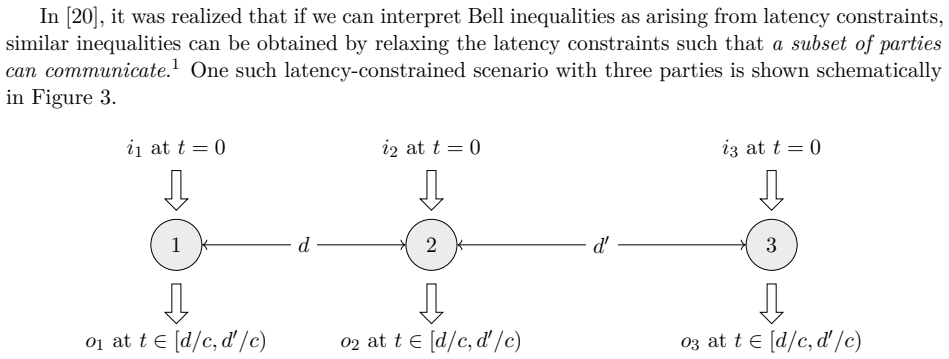
The central object is the nonlocal game—a tuple of input sets, output sets, a utility function, and an input distribution—with Bell inequality violation as the proof mechanism. The CHSH game is the flagship example: two parties each receive a bit and output a bit, with a parity-based winning condition. The paper also employs latency-constrained (LC) games, generalizing to cases where a subset of parties may communicate. The machinery converts a real-world coordination problem into a game whose classical value c* is provably less than its quantum value q*, guaranteeing a quantum advantage.
Load-bearing premise
The mapping from a real-world problem to a nonlocal game is faithful: actual input distributions, utility functions, and physical latency or isolation constraints must match the game's assumptions (such as uniform inputs and the channel-capacity inequality), and the hardware calculation must hold under loophole-free conditions.
What would settle it
A loophole-free Bell test at trading-relevant distances (tens of kilometers) with microsecond-scale settings that fails to produce a statistically significant violation using current heralded-entanglement hardware would falsify the claim that existing hardware is sufficient. Alternatively, evidence that real trading or network signals do not satisfy the games' input-uniformity or parameter assumptions would show the proposed advantage does not apply in those unmodified settings.
If this is right
- High-frequency trading servers could coordinate hedging decisions at microsecond timescales, beating the speed-of-light communication limit and reducing risk beyond any classical strategy.
- Ad hoc networks could balance data loads using fewer channels, without real-time knowledge of other transmitters' data rates, via the CHSH protocol.
- The quantum advantage is inherently noise-tolerant: any nonzero Bell violation suffices, unlike the exact state preparation required for quantum computing.
- Near-term hardware—MHz-rate entangled photon sources and fast single-qubit measurements—supports the required distances and latencies for data-center-scale applications without quantum memories.
- Isolated-party scenarios such as rendezvous also gain a quantum advantage, though they would require long-lived quantum memories not expected soon.
Where Pith is reading between the lines
- The paper's noise-robustness argument could be quantified: a systematic analysis of how violation magnitude degrades with detector efficiency and decoherence would show whether the advantage survives in practical settings; the paper does not provide such a quantitative robustness threshold.
- Real-world input signals are unlikely to be uniform as in the CHSH mapping; extending the modeling to latency-constrained games with non-uniform priors and partial communication is a natural next step, and the advantage may persist only in certain parameter regimes.
- A concrete benchmark experiment—a loophole-free Bell test at the latency-relevant distance and timescale with the proposed heralded entanglement scheme—would directly test the central hardware claim.
Editorial analysis
A structured set of objections, weighed in public.
Referee Report
Summary. The paper proposes 'quantum telepathy' as a technology for coordination tasks in which communication between parties is restricted by latency or isolation. It defines two-party nonlocal games in terms of a utility function and an input distribution, reviews the classical/quantum value distinction, and uses the CHSH game as the main example. The paper then presents two latency-constrained application scenarios (high-frequency trading and load balancing in ad hoc networks), an isolated-party scenario (rendezvous on graphs), and argues that the same quantum advantage can be realized with existing or near-term hardware. The mathematical definitions in Section 2 are standard and correct. The application sections, however, rely on explicitly acknowledged toy models with special parameter choices, and the hardware-feasibility claims are imported from the authors' preprints [20, 24] without reproduction.
Significance. If the central claims were fully established, the paper would be significant: it would identify a provable, Bell-theorem-based quantum advantage for practical coordination problems using very modest quantum hardware, in contrast to fault-tolerant quantum computing. The paper is clearly written and the exposition of nonlocal games in Section 2 is a useful pedagogical bridge. The paper also correctly points out that the quantum advantage is not complexity-theoretic and can be demonstrated with simple entangled states. However, the manuscript's headline claim that quantum telepathy 'can directly solve real-world problems' goes beyond what is actually shown: the HFT and load-balancing examples are toy models with hand-picked parameters, the noise-robustness argument is oversimplified, and the hardware-feasibility assertion rests on an unreproduced back-of-the-envelope calculation in an unpublished preprint. The paper contains no new theorem, no new experiment, and no validated end-to-end application. Its value is therefore as a perspective/overview, and it needs substantial revision to bring its claims in line with its evidence.
major comments (4)
- [Sec. 3.1 (HFT)] The claim that the trading scenario is 'exactly modeled by the CHSH game' requires uniform input distribution and the specific success condition in the displayed equation for p_success. The paper itself footnotes that the scenario 'should be interpreted as a toy model.' No argument is given that real market signals are uniform, or that the payoff of trade decisions is symmetric across the four input pairs. In particular, for inputs 01 and 10, counting equal outputs as success is assumed, not derived from a hedging objective. If the input distribution is biased or the utility is asymmetric, the optimal quantum strategy for the abstract CHSH game need not maximize realized utility, and the Bell-theorem advantage may not survive. The abstract's 'directly solve real-world problems' is not supported by this toy model.
- [Sec. 3.2 (Load balancing)] The mapping from load balancing to CHSH is exact only under the special condition r+r' < r* < 2r', with two discrete, equally likely data rates, and a binary utility that equals 1 exactly when the capacity constraint is respected and the number of channels is minimized. The paper does not show that these conditions hold for real ad hoc traffic, where rates are typically continuous and the objectives may be multi-objective or non-binary. Without a method to validate or enforce the required parameter regime, the claim that quantum entanglement provides better load balancing in real distributed systems is not established; what is established is a quantum advantage for a constructed toy game.
- [Sec. 1 (noise robustness)] The argument that 'we only need to obtain a nonzero violation' and therefore the objective is 'inherently robust to noise' is not correct as stated. A Bell violation is defined as exceeding the classical value c*; if noise lowers the quantum average utility below c*, the advantage disappears. The threshold for advantage is c*, not zero. While it is true that one does not need to achieve the exact maximum quantum value, one does need a positive gap over the classical bound, and the size of that gap matters for statistical significance in experiments. The paper should either state the gap q* - c* and the noise threshold explicitly or substantially qualify the robustness claim.
- [Secs. 1 and 3.1 (hardware feasibility)] The claim that 'current hardware capabilities can already support quantum-enhanced HFT' is imported from the authors' preprint [24] without reproducing the calculation. The concrete numbers — 56.3 km, 188 microseconds, 1 microsecond trade time — are given, but the timing budget, the heralded-entanglement scheme, and the quantum-memory requirements are not analyzed here. Since [24] is a preprint and is also a self-citation, the reader cannot independently verify the feasibility claim. A concise but self-contained estimate, or a citation to a peer-reviewed and independently reproduced study, is needed to support the abstract's statement that the advantage 'can be physically realized with existing or near-term quantum hardware.'
minor comments (4)
- [Sec. 2] In the definition of a behavior, the text says 'where i_j ∈ I_j, o_j ∈ I_j'; the second condition should be 'o_j ∈ O_j'.
- [Sec. 3.2] 'multiple work have considered' should be 'multiple works have considered.'
- [Fig. 7 caption] Typo: 'Each transmitter has a certain date rate' should be 'data rate.'
- [Sec. 5] The paper already states that 'for actual industrial applications, the nonlocal game (or LC game) should be defined using real-world data instead of a simple toy model.' This admission should be reflected in the abstract and introduction, which currently claim the problems are 'directly solved.' Please make the headline claims consistent with the body's caveats.
Circularity Check
The HFT and load-balancing 'quantum advantages' are the CHSH advantage restated via self-chosen payoffs, and the hardware-feasibility claim rests on an unreproduced self-cited calculation; Bell/CHSH mathematics itself is external.
specific steps
-
renaming known result
[Section 3.1, High frequency trading, Eq. (3.1) and footnote 3]
"Note that this trading scenario is considerably simplified and should be interpreted as a toy model. ... If we assume both servers need to look for this signal to conclude that the stocks' correlation has indeed flipped and that the signals are uniform, this trading scenario is exactly modeled by the CHSH game: p_success = 1/4[p(o1=o2|i1=0,i2=0)+p(o1=o2|i1=0,i2=1)+p(o1=o2|i1=1,i2=0)+p(o1≠o2|i1=1,i2=1)]."
The HFT utility and input distribution are chosen so that success equals CHSH success; no step derives this payoff from a hedging or risk objective. The paper itself labels the scenario a toy model. Therefore the conclusion that quantum strategies give a provably higher average return is the standard CHSH advantage expressed in trading vocabulary, not a prediction about a previously independent real-world problem.
-
fitted input called prediction
[Section 3.2, Distributed systems / load balancing]
"For simplicity, let the utility function U yield 1 if the transmitters choose channels such that the threshold is not exceeded for every channel and the number of channels is minimized, and let it yield 0 otherwise. In the case of two transmitters, two channels, and two possible data rates r,r' with equal probability for each transmitter, where r<r', if r+r'<r*<2r', then the load balancing problem exactly corresponds to the CHSH game."
The real-world objective is simplified to a binary function and the rate parameters are constrained so the problem becomes CHSH. The asserted better load balancing using entanglement is then the CHSH quantum advantage by construction; the paper does not show that actual ad hoc network traffic satisfies equal-probability rates and the stated r* condition.
-
self citation load bearing
[Section 1, Introduction; Section 3.1 physical implementation]
"In [24], a back-of-the-envelope calculation showed that our current hardware capabilities can already support quantum-enhanced HFT between a trading server at the New York Stock Exchange (NYSE) and a trading server at NASDAQ dozens of kilometers away."
The hardware-feasibility conclusion is load-bearing for the abstract's claim that the quantum advantage 'can be physically realized with existing or near-term quantum hardware.' [24] is an unreproduced prior preprint by the present first author; no calculation, error budget, or independent verification appears in this paper. The argument thus reduces, at this step, to a self-citation.
full rationale
The Bell/CHSH mathematics itself is standard external content and is not circular: the quantum value exceeding the classical value for CHSH is a theorem independent of this paper. The circularity is in the application packaging. In the HFT example, the payoff and input prior are defined so that p_success is literally the CHSH success expression, with the paper's own footnote conceding it is a toy model; the load-balancing example does the same under the condition r+r'<r*<2r' and equal-probability rates. In both cases, the 'real-world' problem is constructed to be CHSH, so the claimed quantum advantage is the known CHSH advantage renamed. The hardware claim similarly rests on the authors' own [24] back-of-the-envelope calculation rather than a reproduced derivation. The paper's Discussion partially concedes the gap: 'for actual industrial applications, the nonlocal game (or LC game) should be defined using real-world data instead of a simple toy model.' There is no imported uniqueness theorem, and no attempt is made to suppress the toy-model status, so this is not total circularity. Score 6 reflects the central examples reducing by construction plus one load-bearing self-citation, while acknowledging the underlying Bell result is real evidence.
Axiom & Free-Parameter Ledger
free parameters (2)
- Channel-capacity inequality r+r' < r* < 2r' =
inequality (no specific numbers)
- Uniform input distribution in HFT/load-balancing toy models =
p=1/4 for each input pair
axioms (4)
- domain assumption Quantum mechanics is correct and Bell inequality violations are physically realizable
- ad hoc to paper The latency-constrained game framework of ref [20] correctly captures scenarios where a subset of parties can communicate
- domain assumption Existing entanglement-distribution hardware (MHz sources, fiber, quantum memories) can close the relevant loopholes at application distances
- domain assumption The utility function U in a nonlocal game adequately captures real-world payoff or risk
read the original abstract
Quantum telepathy is the concept of using quantum entanglement to solve real-world problems involving decision coordination between parties with restricted communication. One possible reason for this restriction is a latency constraint: some pairs of parties do not have enough time to communicate with each other before they have to produce their outputs. Example scenarios include high frequency trading and distributed systems. Another reason is physical or operational isolation: for some pairs of parties, there is an obstacle to communication. Example scenarios include locating a stray traveler by a rescue team and coordination within a network where nodes are owned by competing firms. In this paper we give a concise overview of the different application areas of quantum telepathy. We find that these real-world problems can be modeled as a nonlocal game or its generalizations. We also discuss possible physical implementations. Quantum telepathy guarantees a quantum advantage via Bell's theorem and can directly solve real-world problems, such as reducing risk in high frequency trading or balancing data loads efficiently in ad hoc networks. Moreover, this quantum advantage can be physically realized with existing or near-term quantum hardware.
Figures




Reference graph
Works this paper leans on
-
[1]
IBM releases first-ever 1,000-qubit quantum chip.Nature, 624(7991):238– 238, 2023
Davide Castelvecchi. IBM releases first-ever 1,000-qubit quantum chip.Nature, 624(7991):238– 238, 2023
2023
-
[2]
Satellite-based entanglement distribution over 1200 kilometers
Juan Yin, Yuan Cao, Yu-Huai Li, Sheng-Kai Liao, Liang Zhang, Ji-Gang Ren, Wen-Qi Cai, Wei- Yue Liu, Bo Li, Hui Dai, et al. Satellite-based entanglement distribution over 1200 kilometers. Science, 356(6343):1140–1144, 2017
2017
-
[3]
Quantum error correction below the surface code threshold.Nature, 638(8052):920–926, 2025
Google Quantum AI. Quantum error correction below the surface code threshold.Nature, 638(8052):920–926, 2025
2025
-
[4]
Craig Gidney. How to factor 2048 bit RSA integers with less than a million noisy qubits.arXiv preprint arXiv:2505.15917, 2025
Pith/arXiv arXiv 2048
-
[5]
Quantum computing in the NISQ era and beyond.Quantum, 2:79, 2018
John Preskill. Quantum computing in the NISQ era and beyond.Quantum, 2:79, 2018
2018
-
[6]
The vast world of quantum advantage.arXiv preprint arXiv:2508.05720, 2025
Hsin-Yuan Huang, Soonwon Choi, Jarrod R McClean, and John Preskill. The vast world of quantum advantage.arXiv preprint arXiv:2508.05720, 2025
Pith/arXiv arXiv 2025
-
[7]
Yuexun Huang, Delaney Smith, Pei Zeng, Debayan Bandyopadhyay, Junyu Liu, Rana X Adhikari, and Liang Jiang. A comprehensive characterization of the vacuum beam guide and its applications.arXiv preprint arXiv:2511.20031, 2025
arXiv 2025
-
[8]
Thomas R Beauchamp, Scarlett Gauthier, and Stephanie Wehner. White paper on quantum internet computer science research challenges.arXiv preprint arXiv:2511.16745, 2025
arXiv 2025
-
[9]
Towards a common framework for quantum information networking
Thomas R Beauchamp, Alberto Sebastián-Lombraña, Scarlett Gauthier, Juan Jose Romero, Vicente Martin, Stephanie Wehner, and Laura Ortiz. Towards a common framework for quantum information networking. InProceedings of the 2nd Workshop on Quantum Networks and Distributed Quantum Computing, pages 56–59, 2025. 14
2025
-
[10]
Arqon suite of quantum network control applications
Scarlett Gauthier, Thomas R Beauchamp, and Stephanie Wehner. Arqon suite of quantum network control applications. InProceedings of the 2nd Workshop on Quantum Networks and Distributed Quantum Computing, pages 49–52, 2025
2025
-
[11]
Existing quantum devices could be used to disrupt the stock market
Karmela Padavic-Callaghan. Existing quantum devices could be used to disrupt the stock market. https://www.newscientist.com/article/2443170-existing-quantum-devices -could-be-used-to-disrupt-the-stock-market/, 2024. Online; accessed 5 January 2026
arXiv 2024
-
[12]
Matt Swayne. ‘Quantum Telepathy’ Could Give Traders an Edge, or Push The Market Off The Ledge, Researchers Report.https://thequantuminsider.com/2024/08/12/quantum-t elepathy-could-give-traders-an-edge-or-push-the-market-off-the-ledge-researc hers-report/, 2024. Online; accessed 5 January 2026
2024
-
[13]
Quantum Systems Show Advantage Over Classical Ones Under Latency Con- straints
Matt Swayne. Quantum Systems Show Advantage Over Classical Ones Under Latency Con- straints. https://thequantuminsider.com/2025/11/08/quantum-systems-show-advanta ge-over-classical-ones-under-latency-constraints/ , 2025. Online; accessed 5 January 2026
2025
-
[14]
Cisco Quantum Labs Reveals New Software As Part Of Its ‘Full-Stack’ Networking Approach
Gina Narcisi. Cisco Quantum Labs Reveals New Software As Part Of Its ‘Full-Stack’ Networking Approach. https://www.crn.com/news/networking/2025/cisco-quantum-labs-reveals -new-software-as-part-of-full-stack-networking-approach , 2025. Online; accessed 5 January 2026
2025
-
[15]
On the Einstein Podolsky Rosen paradox.Physics Physique Fizika, 1(3):195, 1964
John S Bell. On the Einstein Podolsky Rosen paradox.Physics Physique Fizika, 1(3):195, 1964
1964
-
[16]
Experimental test of local hidden-variable theories
Stuart J Freedman and John F Clauser. Experimental test of local hidden-variable theories. Physical Review Letters, 28(14):938, 1972
1972
-
[17]
Experimental test of local hidden-variable theories
Edward S Fry and Randall C Thompson. Experimental test of local hidden-variable theories. Physical Review Letters, 37(8):465, 1976
1976
-
[18]
Experimental test of Bell’s inequalities using time-varying analyzers.Physical Review Letters, 49(25):1804, 1982
Alain Aspect, Jean Dalibard, and Gérard Roger. Experimental test of Bell’s inequalities using time-varying analyzers.Physical Review Letters, 49(25):1804, 1982
1982
-
[19]
Violation of Bell’s inequality under strict Einstein locality conditions.Physical Review Letters, 81(23):5039, 1998
Gregor Weihs, Thomas Jennewein, Christoph Simon, Harald Weinfurter, and Anton Zeilinger. Violation of Bell’s inequality under strict Einstein locality conditions.Physical Review Letters, 81(23):5039, 1998
1998
-
[20]
Quantum nonlocality under latency constraints.arXiv preprint arXiv:2510.26349, 2025
Dawei Ding, Zhengfeng Ji, Pierre Pocreau, Mingze Xu, and Xinyu Xu. Quantum nonlocality under latency constraints.arXiv preprint arXiv:2510.26349, 2025
Pith/arXiv arXiv 2025
-
[21]
Quantum communication complexity.Foundations of Physics, 33(11):1593– 1616, 2003
Gilles Brassard. Quantum communication complexity.Foundations of Physics, 33(11):1593– 1616, 2003
2003
-
[22]
Adam Brandenburger and Pierfrancesco La Mura. Team decision problems with classical and quantum signals.Philosophical Transactions of the Royal Society A: Mathematical, Physical and Engineering Sciences, 374(2058):20150096, 2016
2058
-
[23]
Systems and methods for coordinating decisions between non-communicating parties, December 17 2020
Mario Szegedy, Dawei Ding, and Yaoyun Shi. Systems and methods for coordinating decisions between non-communicating parties, December 17 2020. US Patent 11676104B2. 15
2020
-
[24]
Coordinating decisions via quantum telepathy.arXiv preprint arXiv:2407.21723, 2024
Dawei Ding and Liang Jiang. Coordinating decisions via quantum telepathy.arXiv preprint arXiv:2407.21723, 2024
Pith/arXiv arXiv 2024
-
[25]
15 Crucial Data Center Statistics to Know in 2024.https://techjury.net /blog/data-center-statistics/, 2024
Raj Vardhman. 15 Crucial Data Center Statistics to Know in 2024.https://techjury.net /blog/data-center-statistics/, 2024. Online; accessed 21 June 2024
2024
-
[26]
Quantum-assisted loan balancing in communication-constrained wide-area physical networks, November 24 2016
Adam Brandenburger and Pierfrancesco La Mura. Quantum-assisted loan balancing in communication-constrained wide-area physical networks, November 24 2016. US Patent 10056983B2
2016
-
[27]
Quantum load balancing in ad hoc networks.Quantum Information Processing, 16(6):148, 2017
Masoud Hasanpour, Shahin Shariat, Payam Barnaghi, Seyed Amir Hoseinitabatabaei, Seiamak Vahid, and Rahim Tafazolli. Quantum load balancing in ad hoc networks.Quantum Information Processing, 16(6):148, 2017
2017
-
[28]
Entanglement improves coordination in distributed systems
Francisco Ferreira da Silva and Stephanie Wehner. Entanglement improves coordination in distributed systems. InProceedings of the 2nd Workshop on Quantum Networks and Distributed Quantum Computing, pages 14–20, 2025
2025
-
[29]
Faster-than-light coordination for networked systems with quantum non-local games
Venkat Arun, Vijay Chidambaram, and Scott Aaronson. Faster-than-light coordination for networked systems with quantum non-local games. InProceedings of the 24th ACM Workshop on Hot Topics in Networks, pages 10–18, 2025
2025
-
[30]
John Gardiner, Orlando Romero, Brendan Tivnan, Nicolò Dal Fabbro, and George J Pappas. Learning to coordinate via quantum entanglement in multi-agent reinforcement learning.arXiv preprint arXiv:2602.08965, 2026
arXiv 2026
-
[31]
Entangled rendezvous: a possible application of Bell non-locality for mobile agents on networks.New Journal of Physics, 25(1):013023, 2023
Piotr Mironowicz. Entangled rendezvous: a possible application of Bell non-locality for mobile agents on networks.New Journal of Physics, 25(1):013023, 2023
2023
-
[32]
Clauser, Michael A
John F. Clauser, Michael A. Horne, Abner Shimony, and Richard A. Holt. Proposed experiment to test local hidden-variable theories.Physical Review Letters, 23:880–884, Oct 1969
1969
-
[33]
The Nobel prize in physics 2022.Nobel Prize Official Website, 2022
Alain Aspect, John F Clauser, and Anton Zeilinger. The Nobel prize in physics 2022.Nobel Prize Official Website, 2022
2022
-
[34]
Loophole-free Bell inequality violation using electron spins separated by 1.3 kilometres.Nature, 526(7575):682–686, 2015
Bas Hensen, Hannes Bernien, Anaïs E Dréau, Andreas Reiserer, Norbert Kalb, Machiel S Blok, Just Ruitenberg, Raymond FL Vermeulen, Raymond N Schouten, Carlos Abellán, et al. Loophole-free Bell inequality violation using electron spins separated by 1.3 kilometres.Nature, 526(7575):682–686, 2015
2015
-
[35]
Strong loophole-free test of local realism.Physical Review Letters, 115(25):250402, 2015
Lynden K Shalm, Evan Meyer-Scott, Bradley G Christensen, Peter Bierhorst, Michael A Wayne, Martin J Stevens, Thomas Gerrits, Scott Glancy, Deny R Hamel, Michael S Allman, et al. Strong loophole-free test of local realism.Physical Review Letters, 115(25):250402, 2015
2015
-
[36]
Significant-loophole-free test of bell’s theorem with entangled photons.Physical Review Letters, 115(25):250401, 2015
Marissa Giustina, Marijn AM Versteegh, Sören Wengerowsky, Johannes Handsteiner, Armin Hochrainer, Kevin Phelan, Fabian Steinlechner, Johannes Kofler, Jan-Åke Larsson, Carlos Abellán, et al. Significant-loophole-free test of bell’s theorem with entangled photons.Physical Review Letters, 115(25):250401, 2015
2015
-
[37]
The New Internet, AI Agents, and Quantum Networks
Vijoy Pandey. The New Internet, AI Agents, and Quantum Networks. IT Visionaries interview, 2025. 16
2025
-
[38]
A symbolic analysis of relay and switching circuits.Electrical Engineering, 57(12):713–723, 1938
Claude E Shannon. A symbolic analysis of relay and switching circuits.Electrical Engineering, 57(12):713–723, 1938
1938
-
[39]
Extending and characterizing quantum magic games.arXiv:1209.3819, 2012
Alex Arkhipov. Extending and characterizing quantum magic games.arXiv:1209.3819, 2012
Pith/arXiv arXiv 2012
-
[40]
Going beyond Bell’s theorem
Daniel M Greenberger, Michael A Horne, and Anton Zeilinger. Going beyond Bell’s theorem. InBell’s theorem, quantum theory and conceptions of the universe, pages 69–72. Springer, 1989
1989
-
[41]
Patience and finance.https://www.bis.org/review/r100909e.pdf, 2010
Andrew Haldane. Patience and finance.https://www.bis.org/review/r100909e.pdf, 2010. Online; accessed 16 February 2024
2010
-
[42]
Long-distance quantum communication with atomic ensembles and linear optics.Nature, 414(6862):413–418, 2001
L-M Duan, Mikhail D Lukin, J Ignacio Cirac, and Peter Zoller. Long-distance quantum communication with atomic ensembles and linear optics.Nature, 414(6862):413–418, 2001
2001
-
[43]
Multiphoton entanglement and interferometry.Reviews of Modern Physics, 84(2):777–838, 2012
Jian-Wei Pan, Zeng-Bing Chen, Chao-Yang Lu, Harald Weinfurter, Anton Zeilinger, and Marek Żukowski. Multiphoton entanglement and interferometry.Reviews of Modern Physics, 84(2):777–838, 2012
2012
-
[44]
New techniques and ideas in quantum measurement theory.New York Academy of Science, New York, pages 422–427, 1986
ND Mermin. New techniques and ideas in quantum measurement theory.New York Academy of Science, New York, pages 422–427, 1986
1986
-
[45]
An entangled web of crime: Bell’s theorem as a short story.American Journal of Physics, 73(10):932–937, 2005
Kurt Jacobs and Howard M Wiseman. An entangled web of crime: Bell’s theorem as a short story.American Journal of Physics, 73(10):932–937, 2005
2005
-
[46]
Physicists triumph at guess my number.Physics Today, 53(2):35–39, 2000
Andrew M Steane and Wim van Dam. Physicists triumph at guess my number.Physics Today, 53(2):35–39, 2000
2000
-
[47]
Quantum bidding in bridge.Physical Review X, 4(2):021047, 2014
Sadiq Muhammad, Armin Tavakoli, Maciej Kurant, Marcin Pawłowski, Marek Żukowski, and Mohamed Bourennane. Quantum bidding in bridge.Physical Review X, 4(2):021047, 2014
2014
-
[48]
Quantum blackjack: Advantages offered by quantum strategies in communication-limited games.Physical Review A, 102(1):012425, 2020
Joseph X Lin, Joseph A Formaggio, Aram W Harrow, and Anand V Natarajan. Quantum blackjack: Advantages offered by quantum strategies in communication-limited games.Physical Review A, 102(1):012425, 2020
2020
-
[49]
The rendezvous search problem.SIAM Journal on Control and Optimization, 33(3):673–683, 1995
Steve Alpern. The rendezvous search problem.SIAM Journal on Control and Optimization, 33(3):673–683, 1995
1995
-
[50]
Quantum strategies for rendezvous and domination tasks on graphs with mobile agents.Physical Review A, 109(4):042201, 2024
Giuseppe Viola and Piotr Mironowicz. Quantum strategies for rendezvous and domination tasks on graphs with mobile agents.Physical Review A, 109(4):042201, 2024
2024
-
[51]
Quantum-assisted rendezvous on graphs: explicit algorithms and quantum computer simulations.New Journal of Physics, 26(9):093038, 2024
Joshua Tucker, Paul Strange, Piotr Mironowicz, and Jorge Quintanilla. Quantum-assisted rendezvous on graphs: explicit algorithms and quantum computer simulations.New Journal of Physics, 26(9):093038, 2024
2024
-
[52]
Belief-invariant and quantum equilibria in games of incomplete information.Theoretical Computer Science, 895:151–177, 2021
Vincenzo Auletta, Diodato Ferraioli, Ashutosh Rai, Giannicola Scarpa, and Andreas Winter. Belief-invariant and quantum equilibria in games of incomplete information.Theoretical Computer Science, 895:151–177, 2021
2021
-
[53]
Quantum prisoner’s dilemma and high frequency trading on the quantum cloud.Frontiers in Artificial Intelligence, 4:769392, 2021
Faisal Shah Khan and Ning Bao. Quantum prisoner’s dilemma and high frequency trading on the quantum cloud.Frontiers in Artificial Intelligence, 4:769392, 2021. 17
2021
discussion (0)
Sign in with ORCID, Apple, or X to comment. Anyone can read and Pith papers without signing in.