REVIEW 4 major objections 4 minor 1 cited by
Mobile impurity interacting with a Hubbard chain and the role of Friedel oscillations
T0 review · 4 major / 4 minor · reviewed 2026-08-03 · deepseek-v4-flash
Pith's one-line read In a small open Hubbard chain, a mobile impurity's ground state splits into five regimes, including a hole phase separation driven by particle-hole symmetry and localizations induced by Friedel oscillations.
desk verdict The hPS result is real and clean; the Friedel regimes are suggestive but the paper overclaims its 'any finite U/t' generality given the small-system evidence. read the letter →
The pith
A machine-rendered reading of the paper's core claim, the machinery that carries it, and where it could break.
The reading
What carries the argument
The central object is the three-component Fermi-Hubbard Hamiltonian on an open chain, with one mobile impurity and N_up = N_down fermions, plus its particle-hole symmetry. In the tight-binding limit the balanced Hubbard model obeys n_sigma(i; UfI, nu_f) + n_sigma(i; -UfI, 1-nu_f) = 1 for each spin and n_I(i; UfI, nu_f) = n_I(i; -UfI, 1-nu_f) for the impurity, which forces attractive and repulsive regimes at complementary fillings. The second ingredient is the bath's Friedel oscillations — boundary-induced density waves with peaks (for nu_f < 1/2) or dips (for nu_f > 1/2) whose position depends on U — which act as an effective periodic potential for the impurity. Exact diagonalization of the
What would settle it
A systematic finite-size scaling of the phase diagram for M = 6, 8, 10, 12, 14, 16 at quarter filling would settle the claim: if the hPS or FA regions shrink and vanish as M grows, the central assertion fails. Alternatively, an ultracold-atom experiment in a 1D optical lattice with V0/ER ≈ 4 and adjustable impurity-bath scattering length could directly image the impurity density; observing the impurity at the edges for strong attraction (hPS) and at sites 2 and M-1 for intermediate attraction (FA) would confirm the paper's prediction.
Extended reading notes
Core claim
Using exact diagonalization of a three-component Fermi-Hubbard Hamiltonian with open boundaries, the authors find that for quarter filling (and, by particle-hole symmetry, three-quarter filling) the ground state of one mobile impurity plus a balanced spin-1/2 fermion bath crosses through five interaction regimes for any finite U/t > 0. For strong repulsive impurity-bath coupling the impurity phase-separates from the fermions (pPS), while for strong attraction it phase-separates from the fermionic holes (hPS) — the impurity concentrates at the two edge sites while fermions and holes sort themselves accordingly, a direct consequence of the particle-hole symmetry of the Hubbard model. At interm
Load-bearing premise
The few-site exact-diagonalization results (M = 8, 10, 12 with at most three fermions per spin) are assumed to represent the physics of larger or continuous systems, with no systematic finite-size scaling shown for the phase boundaries; in particular the FR regime disappears for M = 8 and M = 10.
Editorial extensions
If this is right
- The same five regimes appear at both quarter and three-quarter filling, with attractively and repulsively induced phases exchanged, because of particle-hole symmetry; experiments can accordingly look for hPS at either sign of the interaction depending on filling.
- The impurity's localizations at sites i=2 and i=M-1 for intermediate attraction (FA) and at the sites between Friedel peaks (FR) offer a direct way to image the bath's Friedel oscillations: the impurity density pattern is a readout of the bath density.
- A continuous optical-lattice calculation confirms the hPS and FA regimes survive for lattice depths V0/ER ≳ 2, meaning the results are not purely an artifact of the tight-binding model, and suggests feasible parameters for ultracold-atom experiments.
- The von Neumann entropy of the impurity peaks at the transition points between regimes, giving a measurable entanglement signature of the phase boundaries beyond density measurements.
Reading between the lines
- If the hPS and FA regimes persist under finite-size scaling, similar impurity-hole separation should appear in other particle-hole-symmetric lattice fermion models beyond the single-band Hubbard chain — e.g., in the t-J model or in fermionic mixtures with longer-range interactions, where the particle-hole relation is modified.
- The role of the open boundary as the source of the Friedel oscillations suggests that in a closed ring or in a bulk system the intermediate regimes would vanish, leaving only miscible and phase-separated phases; a direct comparison between open and periodic boundary conditions would cleanly test this.
- Since the FA regime behaves like a local hPS with the impurity pinned next to the boundary, the paper implicitly predicts that the local double-occupation maximum at sites 2 and M-1 reaches about 1.5; an experimental measurement of the on-site pair correlation at those sites would distinguish FA from hPS.
- The phase diagram is computed for balanced baths; an imbalanced bath or higher filling (e.g., nu_f = 1/3) would likely shift the Friedel peak positions and could either widen or destroy the FR/FA windows, providing a control knob for the intermediate regimes.
Signed reviews
Editorial analysis
A structured set of objections, weighed in public.
Referee Report
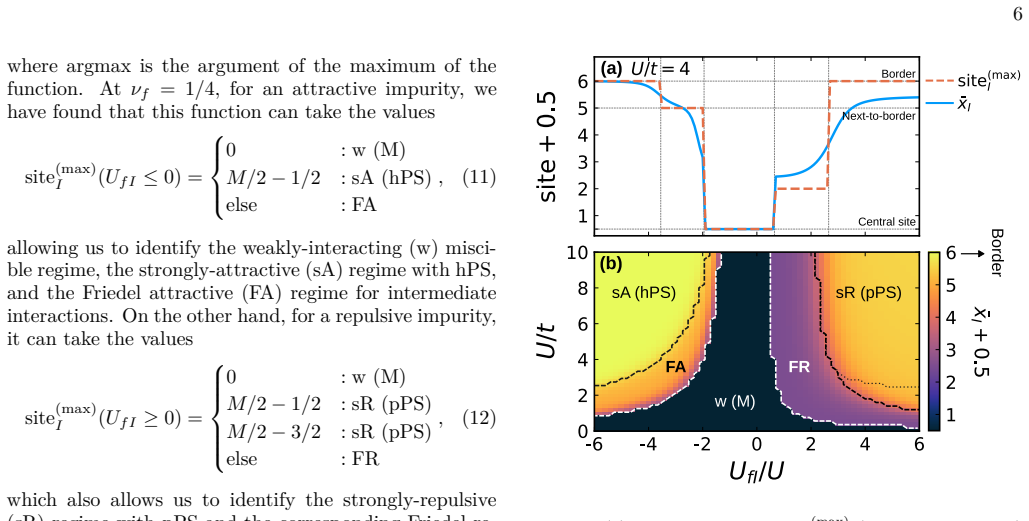
Summary. The paper studies the ground state of a single mobile impurity immersed in a balanced spin-1/2 Fermi gas on a one-dimensional open Hubbard chain, using exact diagonalization for M = 8, 10, and 12 sites. By varying the impurity-bath interaction U_fI for fixed bath interaction U, the authors identify five regimes: a weakly interacting miscible phase, particle phase separation (pPS), hole phase separation (hPS), and two intermediate regimes (F_A, FR) in which the impurity density is claimed to be shaped by Friedel oscillations of the finite bath. The hPS regime is derived from the particle-hole symmetry relations Eqs. (7)-(8), and the phase diagram is summarized in Fig. 4(b). The paper also examines two-body correlations, von Neumann entanglement, and a continuum-lattice check in Appendix C.
Significance. If the claims are established, the paper would add a genuinely new symmetry-enforced phase-separation channel (hPS) to the impurity-in-lattice literature and would propose the impurity as a local probe of Friedel oscillations. The manuscript has clear strengths: the particle-hole symmetry relations (7)-(8) are exact and provide an internal consistency check that the reported quarter/three-quarter data respect; the numerics are standard, transparent ED with explicit Hilbert-space construction; and the diagnostics (double occupations, Schmidt gap, von Neumann entropy) are appropriate for few-body systems. The continuous-model appendix provides a useful check that the tight-binding conclusions survive in deep lattices. However, the central qualitative claims are extracted from very small systems, and the universality statement 'the five configurations appear for any finite U/t > 0' is not supported by any finite-size scaling and is contradicted by the paper's own Appendix B for M = 8 and M = 10.
major comments (4)
- [Sec. III C / Fig. 4(b) / App. B] The statement in Sec. III C that 'the five configurations appear for any finite U/t > 0' is load-bearing but not established. The phase diagram in Fig. 4(b) is built almost entirely from M = 12 with N_f = 3 fermions per spin, while Appendix B explicitly states that M = 8 and M = 10 do not support the FR regime because they have only two fermions per spin. These two sizes mix a change in M with a change in N_f (and at M = 10 also a change in filling from ν_f = 1/4 to 1/5), so they cannot be used to argue either that FR is generic or that it is an N_f = 3 artifact. A clean finite-size study at fixed ν_f = 1/4 would require M = 16, 20, ... with N_f = 4, 5, ..., or a DMRG/iDMRG calculation. Without such data, the claim that the Friedel-induced regimes are generic, and not a special few-fermion effect, remains unsupported. This is central because the abstract and title advertise Friedel-induc
- [Sec. III B 3-4, Figs. 2-3] The causal attribution to Friedel oscillations is not uniquely supported by the data. In Fig. 3(bottom), for U/t = 0.5 the non-interacting bath has its largest Friedel maxima at i = 3 and M-2, yet the impurity at intermediate attraction still localizes at i = 2 and M-1, and the fermionic peaks move there. The text itself states in Sec. III B 4 that 'the impurity changes the pattern of the Friedel oscillations.' This is more naturally read as a self-consistent impurity-induced rearrangement of the bath, rather than the impurity passively following pre-existing Friedel oscillations. The F_A regime is also called a 'phase separation induced by Friedel oscillations,' but Fig. 5(a) shows the total impurity-fermion double occupation in F_A is about 1.5, not 0 as in pPS, so the overlap is substantial and the terminology overstates the case. Please separate the existence of the density-localizat
- [Sec. III C/E, Fig. 4(a)/Fig. 6] The phase boundaries in Fig. 4 are defined by a discrete observable, site_max(I), whose jumps can be artifacts of discreteness, as the authors acknowledge in Sec. III E. However, the entanglement diagnostic only partly rescues the identification: the von Neumann entropy shows a change in slope at the sA/FA, FA/w, and FR/sR transitions, but the w/FR transition has no entropy signature and the correlations (Fig. 5) are smooth across it. Thus the FR regime is identified by one discrete criterion and is exactly the regime whose existence is most size-sensitive (App. B). The paper should provide an additional, continuously varying order parameter (e.g., participation ratio of n_I, impurity-hole overlap, or low-lying energy crossings) that marks the FR region, or explicitly state that this regime is defined only by the position of the maximum of n_I.
- [App. C / Sec. V] The continuum-model check in Appendix C uses M = 8, the one lattice size for which Appendix B reports no FR regime. Therefore the continuous-model data cannot validate the FR claim; they can only validate F_A, pPS, and hPS (and indeed hPS is shown to require V_0/E_R ≳ 2). This limitation should be stated where the continuous check is summarized in Sec. V. In addition, the abstract and conclusions present hPS as a general finding without the tight-binding/deep-lattice caveat that the authors themselves establish in App. C; since particle-hole symmetry is a property of the Hubbard model, the hPS claim should be qualified in the abstract by 'in the tight-binding regime' to avoid overgeneralization.
minor comments (4)
- [Sec. II B, Eq. (13)] The definition of \bar{x}_I in Eq. (13) is not normalized explicitly; since n_I is normalized to one, the formula is fine, but a parenthetical noting \sum_i n_I(i)=1 would improve clarity.
- [Sec. III A] The statement that the change of the largest Friedel peak from i = 3 to i = 2 occurs around U ≈ 1.8t would benefit from a reference or a brief derivation; as written it appears as an unexplained numerical observation.
- [App. C] The convergence test in Appendix C is described only by the statement that M_σ = n M modes are needed; please specify how many bands n were used for the data in Figs. 13-14 and whether convergence was checked in U_fI and V_0 as well as in the densities.
- [Figs. 3 and 8] In the color density plots, the color scale is not defined in the caption. Adding a colorbar or stating the normalized density range would make the figures interpretable.
Circularity Check
No circularity: direct ED survey with analytically derived particle-hole symmetry; self-citations are contextual and size/depth limitations are explicit.
full rationale
The central claims are based on exact diagonalization expectation values, not on fitted parameters. The particle-hole relations (7)-(8) are obtained by applying the explicit transformation c†_{i,σ} -> c_{i,σ} to Hamiltonian (1), so using them to relate νf=1/4 and νf=3/4 (Sec. IV) is a derived symmetry, not a premise. The five regimes in Fig. 4(b) are classified a posteriori from the impurity density's site(max)_I and average position; no target quantity is fitted and then renamed a prediction. The Friedel attribution is an interpretation supported by comparison with the UfI=0 bath profiles (Eq. (9) from Ref. [51]), not a quantity defined in terms of itself. Appendix C is an independent continuous-model check and explicitly notes that hPS disappears in shallow lattices; Appendix B openly states that M=8,10 do not support FR because Nf=2. These are size/depth robustness limitations, not circular reductions. Self-citations ([36], [37], etc.) appear only as background for bosonic phase separation and are not load-bearing for the fermionic results. No uniqueness theorem or ansatz is imported from prior work by the same authors. Hence no claimed derivation reduces to its input by construction.
Assumptions & free parameters
free parameters (3)
- U/t values =
0.5, 1, 4 (representative; continuous scan for phase diagram)
- U_fI/U transition thresholds =
e.g., hPS for U_fI/U ≲ -4, F_A for -4 ≲ U_fI/U ≲ -2, pPS for U_fI/U ≳ 3 at U/t=4, M=12
- Lattice size M and filling ν_f =
M=8,10,12; ν_f=1/4, 1/3, 1/6, 1/2, 3/4, 1/5
assumptions (4)
- domain assumption The system is described by the single-band three-component Fermi-Hubbard Hamiltonian (Eq. 1) with open boundary conditions and equal hopping t for all species.
- domain assumption The fermionic bath is balanced (N↑=N↓) and the impurity-fermion interaction is equal for both spins, with no spin-flip or longer-range terms.
- domain assumption Ground-state properties from exact diagonalization at fixed particle numbers capture the physically relevant physics of small optical-lattice systems.
- domain assumption The continuous model (App. C) with lowest-band truncation and contact interactions faithfully represents a shallow optical lattice with the same filling.
Cite this review
Pith. "Pith review of Mobile impurity interacting with a Hubbard chain and the role of Friedel oscillations." pith.science (2026). https://pith.science/paper/6GCVUAHR
@misc{pith2026260206169,
  author       = {Pith},
  title        = {Pith review of: Mobile impurity interacting with a Hubbard chain and the role of Friedel oscillations},
  year         = {2026},
  howpublished = {\url{https://pith.science/paper/6GCVUAHR}},
  note         = {Machine review of arXiv:2602.06169}
}
abstract
This work examines a mobile impurity interacting with a bath of a few spin-$\uparrow$ and spin-$\downarrow$ fermions in a small one-dimensional open lattice system. We study ground-state properties using the exact diagonalization method, where the system is modeled by a three-component Fermi Hubbard Hamiltonian. We find that in addition to the standard phase separation between a strongly repulsive impurity and the bath, a strongly-attractive impurity also phase separates with the fermionic holes due to the particle-hole symmetry. Furthermore, we find that the impurity can show an oscillatory pattern in its density for intermediate attractive and repulsive bath-impurity interactions, which are induced by Friedel oscillations in the finite-size fermionic bath. This rich behavior of the impurity could be probed with fermionic ultracold mixtures in optical lattices.
Figures


Figures from the paper (11 more)


Forward citations
Cited by 1 Pith paper
-
Lattice polarons with extended interactions
Extended nearest-neighbor interactions in 2D lattice polarons generate dark impurity states with nontrivial internal structure beyond the usual attractive and repulsive branches.
Reference graph
Works this paper leans on
-
[1]
2(a) and 2(d)], the impurity is weakly-interacting, and thus the overall behavior of the system is similar to that of the non-interacting limit Uf I = 0
Weakly-interacting impurity and miscibility For small |Uf I|/U [Figs. 2(a) and 2(d)], the impurity is weakly-interacting, and thus the overall behavior of the system is similar to that of the non-interacting limit Uf I = 0. Here, the impurity (orange circles) shows a sine- like profile, with its peak at the center of the lattice. Note that, in both panels,...
-
[2]
In the case of strong repulsion [Fig
Strongly-interacting impurity and phase separation We can now examine the regime of a strongly- interacting impurity. In the case of strong repulsion [Fig. 2(c)], we observe that the impurity localizes at the borders of the lattice, having a vanishing occupation at the center. In contrast, the fermionic bath occupies the central sites, decreasing its occu...
-
[3]
This contrasts with the previously examined cases, where these oscillations do not play an important role or are de- stroyed
Intermediate interactions and Friedel oscillations In addition to the previous configurations, we observe that for intermediate interactions, the impurity becomes influenced by the Friedel oscillations of the fermions. This contrasts with the previously examined cases, where these oscillations do not play an important role or are de- stroyed. Firstly, for i...
-
[4]
Dependence on the interaction strengths Having reported representative profiles of the different configurations, we now examine the dependence of the profiles on the interactions. In Fig. 3, we report profiles of the impurity (left panels) and of the fermions (right panels) as a function of Uf I. For the previously exam- ined case of U/t = 4 (top panels), the ...
-
[5]
We focus on two-body correlations of the form Cf I(i) = ∑ σ=↑,↓ ⟨ˆc† i,σˆci,σˆa† i ˆai⟩
Fermion-impurity double occupation Having shown that the system supports different con- figurations depending on the fermion-impurity interac- tion Uf I, we can now further characterize the system by examining how the fermions and impurity correlate. We focus on two-body correlations of the form Cf I(i) = ∑ σ=↑,↓ ⟨ˆc† i,σˆci,σˆa† i ˆai⟩. (14) This correspon...
-
[6]
This is defined by ChI (i) = ∑ σ=↑,↓ ⟨ˆci,σˆc† i,σˆa† i ˆai⟩, (15) where holes are created instead of fermions
Hole-impurity double occupation Additional information can be obtained for the dou- ble occupation between holes and the impurity. This is defined by ChI (i) = ∑ σ=↑,↓ ⟨ˆci,σˆc† i,σˆa† i ˆai⟩, (15) where holes are created instead of fermions. By construc- tion, the double occupations satisfy M∑ i=1 (Cf I(i) + ChI (i)) = 2 , (16) showing that they are compl...
-
[7]
Landau and S
L. Landau and S. Pekar, Zh. Eksp. Teor. Fiz 18, 419 (1948)
1948
-
[8]
Bardeen, G
J. Bardeen, G. Baym, and D. Pines, Physical Review 156, 207 (1967)
1967
Show all 66 references
-
[9]
A. S. Alexandrov, R. Hull, R. M. Osgood, J. Parisi, and H. Warlimont, eds., Polarons in Advanced Materials , Springer Series in Materials Science, Vol. 103 (Springer Netherlands, Dordrecht, 2007)
2007
-
[10]
Franchini, M
C. Franchini, M. Reticcioli, M. Setvin, and U. Diebold, Nature Reviews Materials 6, 560 (2021)
2021
-
[11]
Tajima, H
H. Tajima, H. Moriya, W. Horiuchi, E. Nakano, and K. Iida, AAPPS Bulletin 34, 9 (2024)
2024
-
[12]
Baroni, G
C. Baroni, G. Lamporesi, and M. Zaccanti, Nature Re- views Physics 6, 736 (2024)
2024
-
[13]
Massignan, M
P. Massignan, M. Zaccanti, and G. M. Bruun, Reports on Progress in Physics 77, 034401 (2014)
2014
-
[14]
Grusdt, N
F. Grusdt, N. Mostaan, E. Demler, and L. A. Peña Ardila, Reports on Progress in Physics 88, 066401 (2025)
2025
-
[15]
Massignan, R
P. Massignan, R. Schmidt, G. E. Astrakharchik, A. mamoglu, M. Zwierlein, J. J. Arlt, and G. M. Bruun, Polarons in atomic gases and two-dimensional semicon- ductors (2025), arXiv:2501.09618
2025 arXiv
-
[16]
C. Chin, R. Grimm, P. Julienne, and E. Tiesinga, Re- views of Modern Physics 82, 1225 (2010)
2010
-
[17]
Schirotzek, C.-H
A. Schirotzek, C.-H. Wu, A. Sommer, and M. W. Zwier- lein, Physical Review Letters 102, 230402 (2009)
2009
-
[18]
Nascimbène, N
S. Nascimbène, N. Navon, K. J. Jiang, L. Tarruell, M. Te- ichmann, J. McKeever, F. Chevy, and C. Salomon, Phys- ical Review Letters 103, 170402 (2009)
2009
-
[19]
Kohstall, M
C. Kohstall, M. Zaccanti, M. Jag, A. Trenkwalder, P. Massignan, G. M. Bruun, F. Schreck, and R. Grimm, Nature 485, 615 (2012)
2012
-
[20]
Koschorreck, D
M. Koschorreck, D. Pertot, E. Vogt, B. Fröhlich, M. Feld, and M. Köhl, Nature 485, 619 (2012)
2012
-
[21]
Scazza, G
F. Scazza, G. Valtolina, P. Massignan, A. Recati, A. Am- ico, A. Burchianti, C. Fort, M. Inguscio, M. Zaccanti, and G. Roati, Physical Review Letters 118, 083602 (2017)
2017
-
[22]
M.-G. Hu, M. J. Van de Graaff, D. Kedar, J. P. Corson, E. A. Cornell, and D. S. Jin, Physical Review Letters 117, 055301 (2016)
2016
-
[23]
N. B. Jørgensen, L. Wacker, K. T. Skalmstang, M. M. Parish, J. Levinsen, R. S. Christensen, G. M. Bruun, and J. J. Arlt, Physical Review Letters 117, 055302 (2016)
2016
-
[24]
Z. Z. Yan, Y. Ni, C. Robens, and M. W. Zwierlein, Sci- ence 368, 190 (2020)
2020
-
[25]
M. G. Skou, T. G. Skov, N. B. Jørgensen, K. K. Nielsen, A. Camacho-Guardian, T. Pohl, G. M. Bruun, and J. J. Arlt, Nature Physics 17, 731 (2021)
2021
-
[26]
K. F. Mak and J. Shan, Nature Nanotechnology 17, 686 (2022)
2022
-
[27]
Chernikov, T
A. Chernikov, T. C. Berkelbach, H. M. Hill, A. Rigosi, Y. Li, B. Aslan, D. R. Reichman, M. S. Hybertsen, and T. F. Heinz, Physical Review Letters 113, 076802 (2014)
2014
-
[28]
Courtade, M
E. Courtade, M. Semina, M. Manca, M. M. Glazov, C. Robert, F. Cadiz, G. Wang, T. Taniguchi, K. Watan- 15 abe, M. Pierre, W. Escoffier, E. L. Ivchenko, P. Renucci, X. Marie, T. Amand, and B. Urbaszek, Physical Review B 96, 085302 (2017)
2017
-
[29]
Sidler, P
M. Sidler, P. Back, O. Cotlet, A. Srivastava, T. Fink, M. Kroner, E. Demler, and A. Imamoglu, Nature Physics 13, 255 (2017)
2017
-
[30]
L. B. Tan, O. Cotlet, A. Bergschneider, R. Schmidt, P. Back, Y. Shimazaki, M. Kroner, and A. mamolu, Phys- ical Review X 10, 021011 (2020)
2020
-
[31]
L. B. Tan, O. K. Diessel, A. Popert, R. Schmidt, A. Imamoglu, and M. Kroner, Physical Review X 13, 031036 (2023)
2023
-
[32]
Lewenstein, A
M. Lewenstein, A. Sanpera, and V. Ahufinger, Ultracold atoms in optical lattices: simulating quantum many-body systems, 1st ed. (Oxford University Press, Oxford, 2012)
2012
-
[33]
Gross and I
C. Gross and I. Bloch, Science 357, 995 (2017)
2017
-
[34]
F. Wu, T. Lovorn, E. Tutuc, and A. MacDonald, Physical Review Letters 121, 026402 (2018)
2018
-
[35]
Y. Tang, L. Li, T. Li, Y. Xu, S. Liu, K. Barmak, K. Watanabe, T. Taniguchi, A. H. MacDonald, J. Shan, and K. F. Mak, Nature 579, 353 (2020)
2020
-
[36]
Pasek and G
M. Pasek and G. Orso, Physical Review B 100, 245419 (2019)
2019
-
[37]
Keiler, S
K. Keiler, S. I. Mistakidis, and P. Schmelcher, New Jour- nal of Physics 22, 083003 (2020)
2020
-
[38]
Colussi, F
V. Colussi, F. Caleffi, C. Menotti, and A. Recati, Physical Review Letters 130, 173002 (2023)
2023
-
[39]
S. Ding, G. A. Domínguez-Castro, A. Julku, A. Camacho-Guardian, and G. M. Bruun, SciPost Physics 14, 143 (2023)
2023
-
[40]
Santiago-García, S
M. Santiago-García, S. G. Castillo-López, and A. Camacho-Guardian, New Journal of Physics 26, 063015 (2024)
2024
-
[41]
Gómez-Lozada, H
F. Gómez-Lozada, H. Hiyane, T. Busch, and T. Fogarty, Physical Review Research 7, 023053 (2025)
2025
-
[42]
Isaule, A
F. Isaule, A. Rojo-Francàs, and B. Juliá-Díaz, SciPost Physics Core 7, 049 (2024)
2024
-
[43]
Isaule, A
F. Isaule, A. Rojo-Francàs, L. Morales-Molina, and B. Juliá-Díaz, Physical Review Letters 135, 023404 (2025)
2025
-
[44]
Alhyder, V
R. Alhyder, V. Colussi, M. ufar, J. Brand, A. Recati, and G. M. Bruun, SciPost Physics 19, 002 (2025)
2025
-
[45]
Hiyane, T
H. Hiyane, T. Fogarty, J. C. Pelayo, and T. Busch, New Journal of Physics 27, 124502 (2025)
2025
-
[46]
Hartweg, T
T. Hartweg, T. Gupta, and G. Pupillo, Physical Review B 112, L220201 (2025)
2025
-
[47]
Christ, P
J.-P. Christ, P. Bermes, and F. Grusdt, Physical Review A 112, 033317 (2025)
2025
-
[48]
G. A. Domínguez-Castro, L. Santos, and L. A. Peña Ardila, Physical Review B 113, 035111 (2026)
2026
-
[49]
Zhang, The fate of a single impurity in the Bose- Hubbard model (2026), arXiv:2601.11058 [cond-mat]
C. Zhang, The fate of a single impurity in the Bose- Hubbard model (2026), arXiv:2601.11058 [cond-mat]
2026
-
[50]
Amelio, G
I. Amelio, G. Mazza, and N. Goldman, Physical Review B 110, 235302 (2024)
2024
-
[51]
Amelio and N
I. Amelio and N. Goldman, SciPost Physics 16, 056 (2024)
2024
-
[52]
H. Hu, J. Wang, and X.-J. Liu, Physical Review A 110, 023314 (2024)
2024
-
[53]
H. Hu, J. Wang, and X.-J. Liu, Physical Review Letters 134, 153403 (2025)
2025
-
[54]
Liu and H
X.-J. Liu and H. Hu, AAPPS Bulletin 35, 9 (2025)
2025
-
[55]
Pascual, J
G. Pascual, J. Boronat, and K. Van Houcke, Physical Review Research 7, L042024 (2025)
2025
-
[56]
Friedel, The London, Edinburgh, and Dublin Philo- sophical Magazine and Journal of Science 43, 153 (1952)
J. Friedel, The London, Edinburgh, and Dublin Philo- sophical Magazine and Journal of Science 43, 153 (1952)
1952
-
[57]
Bedürftig, B
G. Bedürftig, B. Brendel, H. Frahm, and R. M. Noack, Physical Review B 58, 10225 (1998)
1998
-
[58]
H. Lin, J. Gubernatis, H. Gould, and J. Tobochnik, Com- puters in Physics 7, 400 (1993)
1993
-
[59]
Sharma and M
M. Sharma and M. Ahsan, Computer Physics Communi- cations 193, 19 (2015)
2015
-
[60]
F. H. L. Essler, ed., The one-dimensional Hubbard model (Cambridge University Press, Cambridge New York, 2005)
2005
-
[61]
T. B. Ottenstein, T. Lompe, M. Kohnen, A. N. Wenz, and S. Jochim, Physical Review Letters 101, 203202 (2008)
2008
-
[62]
J. H. Huckans, J. R. Williams, E. L. Hazlett, R. W. Stites, and K. M. OHara, Physical Review Letters 102, 165302 (2009)
2009
-
[63]
G. L. Schumacher, J. T. Mäkinen, Y. Ji, G. G. T. As- sumpção, J. Chen, S. Huang, F. J. Vivanco, and N. Navon, Nature Communications 17, 174 (2026)
2026
-
[64]
Amico, R
L. Amico, R. Fazio, A. Osterloh, and V. Vedral, Reviews of Modern Physics 80, 517 (2008)
2008
-
[65]
Richaud and V
A. Richaud and V. Penna, Physical Review A 100, 013609 (2019)
2019
-
[66]
T. D. Anh-Tai, T. Fogarty, S. De María-García, T. Busch, and M. A. García-March, Physical Review Research 6, 043042 (2024)
2024
Reviewed August 3, 2026 · model on record in the stance chip above.
Discussion (0). Continue with ORCID to comment.