REVIEW 2 major objections 6 minor 75 references
Dynamic Zoom Simulations of structure formation beyond standard cosmology
T0 review · 2 major / 6 minor · reviewed 2026-08-03 · deepseek-v4-flash
Pith's one-line read Dynamic Zoom Simulations — merging particles outside the observer's past lightcone into coarse tracers — are shown to reproduce lightcone observables to about 0.1% accuracy and save up to ~50% runtime in modified-gravity and dark-scattering
desk verdict Useful, honest port of DZS to f(R) and dark-scattering codes, with transparent validation; the MG-F5 accuracy caveat is real but disclosed. read the letter →
The pith
A machine-rendered reading of the paper's core claim, the machinery that carries it, and where it could break.
The reading
What carries the argument
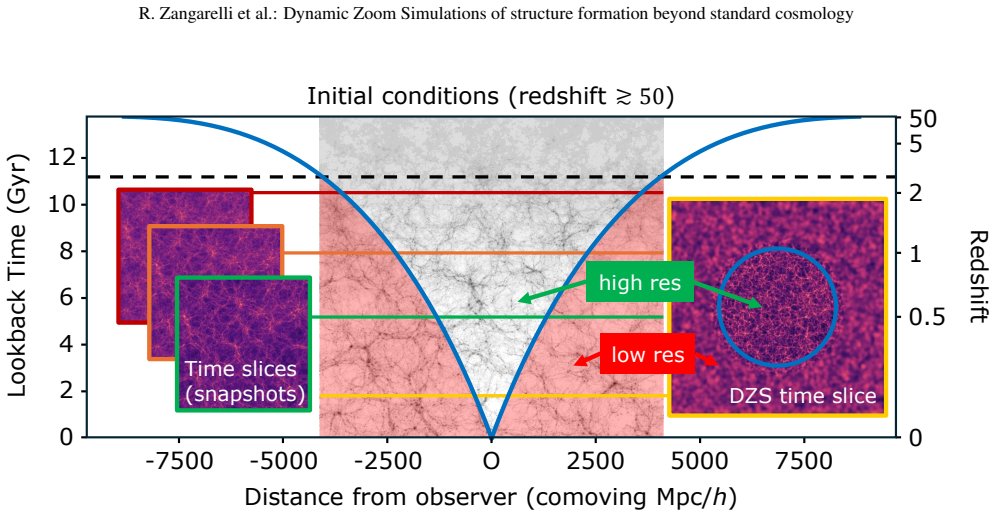
The central mechanism is oct-tree derefinement: on each global timestep, a tree walk flags tree nodes outside the lightcone that satisfy the geometric criterion L/(|s| - (R_lc + b)) < θ_geom, then replaces the node's particle content with a single merged 'fictitious' particle carrying the node's mass, center of mass, and center-of-mass velocity. Nodes are merged only up to a maximum size L_max = 4 r_mean, so the external large-scale gravitational field is preserved at a resolution at most 64 times coarser. The algorithm rides on the existing treePM gravity solver without modifying it, and in the f(R) implementation the same oct-tree serves as the adaptive multi-grid for solving the scalar-fi
What would settle it
Run an MG-F5 (strong f(R)) twin pair at survey-grade resolution — particle mass near 10^9 M_sun/h — and compare the high-mass end of the lightcone halo mass function and the l ≳ 1000 weak-lensing convergence power: if deviations exceed the ~0.1–1% range, or the ~2% tail seen in the paper's own MG-F5 case grows, the central claim fails. A more direct check is to compute the f(R) acceleration on identical particles with and without DZS and verify that the per-particle differences are within the force solver's own tolerance.
Extended reading notes
Core claim
The paper demonstrates that DZS is not tied to ΛCDM: when particles outside the lightcone are merged using the oct-tree, the resulting simulations reproduce the full-resolution lightcone halo mass function, projected mass maps, matter angular power spectrum, and weak-lensing convergence spectrum to ~0.1% or better in most tested configurations, while saving up to ~50% of runtime in the largest validation boxes and an estimated ~65–75% in rescaled state-of-the-art setups. The largest deviations appear in the f(R) model with |f_R0| = 10^-5, where the node-level modified-gravity force responds to tiny DZS-induced particle displacements; even there, halo counts differ by at most ~2% at the highe
Load-bearing premise
The load-bearing premise is that merging particles outside the lightcone does not systematically bias the modified-gravity force computed on the oct-tree's multi-grid cells; if it does at a level above ~0.1%, the headline accuracy claim for beyond-ΛCDM runs would need qualification.
Editorial extensions
If this is right
- If DZS holds at the claimed accuracy, large Gpc-scale simulations of f(R) gravity and dark-scattering cosmologies become tractable at state-of-the-art resolution, including model-comparison suites that were previously prohibitive.
- The ~0.1% accuracy level sits well below the ~1% target of next-generation weak-lensing surveys, so DZS-generated lightcones can be used to build mock catalogs for pipeline validation and model discrimination.
- Runtime savings grow with volume and resolution and are largest for the most expensive solvers: up to ~53% for strong f(R) in an 8192 cMpc/h box, with rescaled estimates of ~65–75% for flagship-like volumes.
- Because the algorithm requires no modification to the N-body solver and its own operations add only ~0.1% overhead, it is a generic add-on for any treePM code that produces lightcone output.
- Physical differences between cosmologies — including the f(R) power boost and dark-scattering suppression patterns — survive DZS at percent level, allowing the technique to be used for actual model comparison rather than only for single-model production runs.
Reading between the lines
- A natural but untested extension is DZS with baryonic hydrodynamics: merging particles would destroy gas content outside the lightcone, so a practical implementation would need to carry coarse baryon fields or restrict merging to collisionless components, and the accuracy trade-off is unknown.
- A concrete mitigation suggested by the paper's own node-level sensitivity discussion: freeze or smooth the multi-grid cell hierarchy outside the lightcone before merging particles, or compute f_R accelerations on a fixed coarse grid; this could remove most of the observed ~2% high-mass tail while keeping most of the speedup.
- A caution for survey use: since DZS accuracy improves with resolution in some models but not in others (the paper notes no worsening, but no consistent improvement in MG-F5 and DS-THAW), the safest validation strategy is to run twin DZS/full simulations at the target resolution for each model rather than interpolating from lower-resolution tests.
- A further optimization suggested by the workload-balance analysis: dynamic repartitioning or mid-run changes in the number of tasks could convert some of the observed 1.5–3x imbalances into additional savings, potentially pushing real gains beyond the reported ~50%.
Editorial analysis
A structured set of objections, weighed in public.
Referee Report
Summary. The paper presents implementations of the Dynamic Zoom Simulations (DZS) technique in two codes beyond ΛCDM: MG-Arepo for f(R) gravity and PANDA-Gadget4 for dark-sector scattering. The method derefines the simulation outside the observer's past lightcone to save computational cost. The authors validate accuracy by comparing twin simulations with and without DZS across four box/resolution configurations and five cosmological models, finding that most lightcone halo mass functions, sky-projected mass maps, matter angular power spectra, and weak-lensing convergence power spectra agree to about 0.1% or better, with the MG-F5 model showing larger deviations (up to ~2% in the high-mass LCHMF, ~1% in the convergence spectrum, and >1% in 0.9% of map pixels). Runtime savings in the test suite reach ~50%, and a rescaled-lightcone estimate suggests up to ~75% savings at flagship-like resolutions.
Significance. If fully established, the result is significant: it would extend a proven computational acceleration technique from ΛCDM to two classes of non-standard cosmologies, enabling larger or more numerous simulations for survey interpretation. The validation design is methodologically sound: the comparison is against independent twin standard runs, and the DZS control parameters are inherited from prior work rather than tuned on these runs. The authors are also transparent about the MG-F5 node-level effect and about the approximate nature of the high-resolution extrapolation. The principal limitation is that the f(R) implementation carries a systematic that is not controlled by the usual DZS accuracy parameters, so the headline '0.1%' claim needs to be qualified for the strongest modified-gravity case.
major comments (2)
- [§3.2, Figs. 5, 7, 9; abstract] The central accuracy claim is overstated for the f(R) implementation. In the MG-F5 model, 0.9% of sky pixels show >1% relative deviations, the weak-lensing C_kappa(l) reaches ~1%, and the high-mass LCHMF shows ~2% deviations — all larger than the abstract's '≃0.1% or higher'. The paper explains (§3.2) that the MG contribution is computed at node level and that tiny DZS-induced displacements can change particle-to-node assignment, altering particle-level MG accelerations. This is a systematic that the DZS control parameters (θ_geom, b, L_max) do not govern, since those parameters control tree-force accuracy, not the multi-grid node assignment. The authors should provide either a direct comparison of the MG acceleration field between dzs and std runs inside the lightcone, or an explicit MG-specific error budget. The resolution comparison (medium vs mediumHR) shows no improvement for MG-F5,
- [§3.1, Fig. 4] The LCHMF relative-difference panels have no error bars. The paper states that the ~2% MG-F5 deviations occur 'at the highest masses where only a handful of halos are detected'. Without Poisson uncertainties on the halo counts, the reader cannot distinguish a genuine systematic DZS bias from small-number statistics. This is load-bearing because the paper itself suggests that 'a larger halo statistics might very well improve this result'. The authors should add Poisson (or jackknife) error bars to the N_LC ratios, or otherwise quantify the statistical uncertainty, so that the MG-F5 accuracy statement is not ambiguous.
minor comments (6)
- [Abstract and §5] The phrase 'accuracy of ≃0.1% or higher' is ambiguous. It should be reworded to something like 'accuracy of ≃0.1% or better in most observables' with explicit exceptions noted.
- [§3.4] The text says DZS 'only operates at redshift ≲0.69', but Table 1 gives the lightcone entry redshift for the medium box as ~0.36. One of these is a typo; please correct.
- [§3.1, Fig. 4 caption] The caption refers to 'the middle left panel of Fig. 3' when discussing the MG-F5 LCHMF; the relevant panels are in Fig. 4, not Fig. 3.
- [§3.2, Fig. 3] The relative-difference panels in Fig. 3 use an 'arbitrarily set' y-axis scale. Please use a consistent scale across panels so the reader can compare the magnitude of deviations across models and resolutions.
- [§4] The rescaled-lightcone performance estimate is clearly labeled as approximate, but it would help to state explicitly that the rescaling changes the relative size of the lightcone while keeping the density field of the 100 cMpc/h box, so the estimate does not capture large-scale-mode effects on time-stepping or workload imbalance. This is already implied, but should be stated as a formal limitation.
- [General] No code or data availability statement is provided. Given that Arepo is a developer version and PANDA-Gadget4 is 'in preparation', a statement on what can be released would strengthen reproducibility.
Circularity Check
No significant circularity: the DZS accuracy claim rests on direct comparison with twin standard runs, not on fitted inputs or self-referential definitions.
full rationale
The central accuracy claim is established by running paired 'std' and 'dzs' simulations from identical initial conditions and comparing lightcone observables (LCHMF, massmaps, C(l), C_kappa(l)); this is an external, twin-run benchmark rather than a prediction derived from fitted parameters. The DZS control parameters (theta_geom=0.1, b=5 r_mean, L_max=4 r_mean) are inherited from Garaldi et al. (2020), whose author list overlaps with the present work, but they are not fitted to the validation data here and the accuracy is re-measured against independent std runs, so this self-citation is not load-bearing. The high-resolution performance gain estimate in Section 4 is explicitly described as 'approximate' and based on rescaled-lightcone simulations, not presented as a derived theorem. The MG-F5 node-level sensitivity of the f(R) force is acknowledged in Section 3.2 as a source of percent-level differences; this is an honest limitation and a correctness/accuracy concern, not a circular reduction. No step in the paper reduces to its input by construction.
Assumptions & free parameters
free parameters (3)
- DZS derefinement threshold θ_geom =
0.1
- DZS buffer length b =
5 r_mean
- DZS maximum derefinable node size L_max =
4 r_mean
assumptions (4)
- domain assumption Newtonian gravity with instantaneous force propagation is a valid approximation for cosmological LSS simulations.
- domain assumption The Hu-Sawicki f(R) model is parametrized by fR0 with n=1 and its MG force is computed on the oct-tree multi-grid solver inherited from Arnold et al. (2019).
- domain assumption The dark-scattering momentum-exchange model A(z) of Eq. (4), with the DESI and Lodha et al. w_DE(z) parameterizations, is correctly implemented in PANDA-Gadget4.
- ad hoc to paper The DZS derefinement parameters (θ_geom, b, L_max) preserve the large-scale gravitational field sufficiently for sub-0.1% accuracy inside the lightcone.
Cite this review
Pith. "Pith review of Dynamic Zoom Simulations of structure formation beyond standard cosmology." pith.science (2026). https://pith.science/paper/6OVUKNZP
@misc{pith2026260206133,
  author       = {Pith},
  title        = {Pith review of: Dynamic Zoom Simulations of structure formation beyond standard cosmology},
  year         = {2026},
  howpublished = {\url{https://pith.science/paper/6OVUKNZP}},
  note         = {Machine review of arXiv:2602.06133}
}
abstract
(Abridged) A thorough interpretation of the current and upcoming generation of cosmological observations requires unprecedented large-scale, high-resolution simulations spanning multiple cosmological models and parameters. The realization of these computationally demanding simulations poses a crucial technical challenge. We present beyond - $\Lambda$CDM implementations of the Dynamic Zoom Simulations (DZS) method, a performance-enhancing technique tailored for large-scale simulations that produce lightcone-like outputs. This approach dynamically decreases the resolution of a simulation in the regions that are not in causal connection with the observer, saving computational resources without directly affecting the physical properties within the lightcone. We implemented the DZS algorithm in two state-of-the-art codes supporting non-standard cosmologies, namely modified $f(R)$ gravity in Arepo and dark sector interactions in Gadget4. We analyzed result accuracy and performance gains across resolution, simulation volume and model by comparing runs performed with and without the DZS algorithm. Our DZS reproduce the lightcone halo mass function, sky-projected massmaps, and matter and weak lensing convergence power spectra with an accuracy of $\simeq$ 0.1% or higher in most cases. In terms of performance, DZS runs in our test simulations can save up to $\sim$ 50% runtime compared to the non-DZS counterparts. A scaling to larger simulated volumes suggests that performance gains could improve by an additional $\sim$ 20% at the resolution levels of current state-of-the-art simulations. The validation of the DZS algorithm in non-standard models demonstrates that this technique can enable cost effective, large-scale ($\gtrsim$ 1 cGpc/h) simulations with state-of-the-art resolution, providing the computational framework needed to constrain and help the interpretation of forthcoming data.
Figures


Figures from the paper (7 more)


Reference graph
Works this paper leans on
-
[1]
, " * write output.state after.block = add.period write newline
ENTRY address archiveprefix author booktitle chapter edition editor howpublished institution eprint journal key month note number organization pages publisher school series title type volume year label extra.label sort.label short.list INTEGERS output.state before.all mid.sentence after.sentence after.block FUNCTION init.state.consts #0 'before.all := #1 ...
-
[2]
write newline
" write newline "" before.all 'output.state := FUNCTION n.dashify 't := "" t empty not t #1 #1 substring "-" = t #1 #2 substring "--" = not "--" * t #2 global.max substring 't := t #1 #1 substring "-" = "-" * t #2 global.max substring 't := while if t #1 #1 substring * t #2 global.max substring 't := if while FUNCTION word.in bbl.in " " * FUNCTION format....
-
[3]
2025, , 112, 083515
Abdul Karim , M., Aguilar , J., Ahlen , S., et al. 2025, , 112, 083515
2025
-
[4]
2012, arXiv e-prints, arXiv:1206.2838
Alimi , J.-M., Bouillot , V., Rasera , Y., et al. 2012, arXiv e-prints, arXiv:1206.2838
arXiv 2012
-
[5]
2000, , 62, 043511
Amendola , L. 2000, , 62, 043511
2000
-
[6]
Angulo , R. E. & Hahn , O. 2022, Living Reviews in Computational Astrophysics, 8, 1
2022
-
[7]
E., Springel , V., White , S
Angulo , R. E., Springel , V., White , S. D. M., et al. 2012, , 426, 2046
2012
-
[8]
2019, Nature Astronomy, 3, 945
Arnold , C., Leo , M., & Li , B. 2019, Nature Astronomy, 3, 945
2019
Show all 75 references
-
[9]
Bagla , J. S. 2002, Journal of Astrophysics and Astronomy, 23, 185
2002
-
[10]
& Simpson , F
Baldi , M. & Simpson , F. 2015, , 449, 2239
2015
-
[11]
& Simpson , F
Baldi , M. & Simpson , F. 2017, , 465, 653
2017
-
[12]
& Hut , P
Barnes , J. & Hut , P. 1986, , 324, 446
1986
-
[13]
Berlind , A. A. & Weinberg , D. H. 2002, , 575, 587
2002
-
[14]
P., & Xu , G
Bode , P., Ostriker , J. P., & Xu , G. 2000, , 128, 561
2000
-
[15]
A., Keane , E., & Wagg , J
Braun , R., Bourke , T., Green , J. A., Keane , E., & Wagg , J. 2015, in Advancing Astrophysics with the Square Kilometre Array (AASKA14), 174
2015
-
[16]
M., Hoffman , M., & Trodden , M
Carroll , S. M., Hoffman , M., & Trodden , M. 2003, , 68, 023509
2003
-
[17]
Chisari , N. E. & Zaldarriaga , M. 2011, , 83, 123505
2011
-
[18]
2013, Python and HDF5 (O'Reilly)
Collette, A. 2013, Python and HDF5 (O'Reilly)
2013
-
[19]
H., & Kravtsov , A
Conroy , C., Wechsler , R. H., & Kravtsov , A. V. 2006, , 647, 201
2006
-
[20]
2025, , 2025, 052
Cruickshank , N., Crittenden , R., Koyama , K., & Bruni , M. 2025, , 2025, 052
2025
-
[21]
S., & White , S
Davis , M., Efstathiou , G., Frenk , C. S., & White , S. D. M. 1985, , 292, 371
1985
-
[22]
2016 a , arXiv e-prints, arXiv:1611.00036
DESI Collaboration , Aghamousa , A., Aguilar , J., et al. 2016 a , arXiv e-prints, arXiv:1611.00036
2016 arXiv
-
[23]
2016 b , arXiv e-prints, arXiv:1611.00037
DESI Collaboration , Aghamousa , A., Aguilar , J., et al. 2016 b , arXiv e-prints, arXiv:1611.00037
2016 arXiv
-
[24]
2025 a , , 695, A230
Euclid Collaboration , Adamek , J., Fiorini , B., et al. 2025 a , , 695, A230
2025
-
[25]
2020, , 642, A191
Euclid Collaboration , Blanchard , A., Camera , S., et al. 2020, , 642, A191
2020
-
[26]
J., Fosalba , P., et al
Euclid Collaboration , Castander , F. J., Fosalba , P., et al. 2025 b , , 697, A5
2025
-
[27]
2025 c , , 697, A1
Euclid Collaboration , Mellier , Y., Abdurro'uf , et al. 2025 c , , 697, A1
2025
-
[28]
E., MacFarland , T
Evrard , A. E., MacFarland , T. J., Couchman , H. M. P., et al. 2002, , 573, 7
2002
-
[29]
Farrar , G. R. & Peebles , P. J. E. 2004, , 604, 1
2004
-
[30]
T., Springel , V., et al
Ferlito , F., Davies , C. T., Springel , V., et al. 2024, , 533, 3209
2024
-
[31]
J., & Manera , M
Fosalba , P., Gazta \ n aga , E., Castander , F. J., & Manera , M. 2008, , 391, 435
2008
-
[32]
2020, , 499, 2685
Garaldi , E., Nori , M., & Baldi , M. 2020, , 499, 2685
2020
-
[33]
M., Hivon , E., Banday , A
G \'o rski , K. M., Hivon , E., Banday , A. J., et al. 2005, , 622, 759
2005
-
[34]
2019, , 486, 3927
Hagstotz , S., Costanzi , M., Baldi , M., & Weller , J. 2019, , 486, 3927
2019
-
[35]
& Abel , T
Hahn , O. & Abel , T. 2011, , 415, 2101
2011
-
[36]
Henriques , B. M. B., White , S. D. M., Thomas , P. A., et al. 2015, , 451, 2663
2015
-
[37]
2016, , 461, 1760
Hirschmann , M., De Lucia , G., & Fontanot , F. 2016, , 461, 1760
2016
-
[38]
& Sawicki , I
Hu , W. & Sawicki , I. 2007, , 76, 064004
2007
-
[39]
Hunter , J. D. 2007, Computing in Science and Engineering, 9, 90
2007
-
[40]
M., Tyson , J
Ivezi \'c , Z ., Kahn , S. M., Tyson , J. A., et al. 2019, , 873, 111
2019
-
[41]
Klypin , A. A. & Shandarin , S. F. 1983, , 204, 891
1983
-
[42]
G., Baugh , C
Lacey , C. G., Baugh , C. M., Frenk , C. S., et al. 2016, , 462, 3854
2016
-
[43]
2011, arXiv e-prints, arXiv:1110.3193
Laureijs , R., Amiaux , J., Arduini , S., et al. 2011, arXiv e-prints, arXiv:1110.3193
2011 arXiv
-
[44]
2017, arXiv e-prints, arXiv:1709.04703
Llinares , C. 2017, arXiv e-prints, arXiv:1709.04703
2017 arXiv
-
[45]
L., et al
Lodha , K., Calderon , R., Matthewson , W. L., et al. 2025, , 112, 083511
2025
-
[46]
1993, in Supercomputing '93: Proceedings of the 1993 ACM / IEEE Conference on Supercomputing , 878--883
Message Passing Interface Forum . 1993, in Supercomputing '93: Proceedings of the 1993 ACM / IEEE Conference on Supercomputing , 878--883
1993
-
[47]
2013, arXiv e-prints, arXiv:1306.2307
Nandra , K., Barret , D., Barcons , X., et al. 2013, arXiv e-prints, arXiv:1306.2307
2013 arXiv
-
[48]
2019, Computational Astrophysics and Cosmology, 6, 2
Nelson , D., Springel , V., Pillepich , A., et al. 2019, Computational Astrophysics and Cosmology, 6, 2
2019
-
[49]
2008, , 78, 123523
Oyaizu , H. 2008, , 78, 123523
2008
-
[50]
P., et al
Pakmor , R., Springel , V., Coles , J. P., et al. 2023, , 524, 2539
2023
-
[51]
2020, , 641, A6
Planck Collaboration , Aghanim , N., Akrami , Y., et al. 2020, , 641, A6
2020
-
[52]
2017, Computational Astrophysics and Cosmology, 4, 2
Potter , D., Stadel , J., & Teyssier , R. 2017, Computational Astrophysics and Cosmology, 4, 2
2017
-
[53]
& Tram , T
Pourtsidou , A. & Tram , T. 2016, , 94, 043518
2016
-
[54]
Primack , J. R. 2024, Annual Review of Nuclear and Particle Science, 74, 173
2024
-
[55]
2013, , 436, 348
Puchwein , E., Baldi , M., & Springel , V. 2013, , 436, 348
2013
-
[56]
2010, , 82, 083505
Simpson , F. 2010, , 82, 083505
2010
-
[57]
P., Chen , H.-Y., Holz , D
Singer , L. P., Chen , H.-Y., Holz , D. E., et al. 2016, , 829, L15
2016
-
[58]
Singer , L. P. & Price , L. R. 2016, , 93, 024013
2016
-
[59]
Somerville , R. S. & Dav \'e , R. 2015, , 53, 51
2015
-
[60]
S., Popping , G., & Trager , S
Somerville , R. S., Popping , G., & Trager , S. C. 2015, , 453, 4337
2015
-
[61]
2015, arXiv e-prints, arXiv:1503.03757
Spergel , D., Gehrels , N., Baltay , C., et al. 2015, arXiv e-prints, arXiv:1503.03757
2015 arXiv
-
[62]
2005, , 364, 1105
Springel , V. 2005, , 364, 1105
2005
-
[63]
2010, , 401, 791
Springel , V. 2010, , 401, 791
2010
-
[64]
2012, Astronomische Nachrichten, 333, 515
Springel , V. 2012, Astronomische Nachrichten, 333, 515
2012
-
[65]
2021, , 506, 2871
Springel , V., Pakmor , R., Zier , O., & Reinecke , M. 2021, , 506, 2871
2021
-
[66]
C., & Varoquaux , G
Van Der Walt , S., Colbert , S. C., & Varoquaux , G. 2011, Computing in Science and Engineering, 13, 22
2011
-
[67]
2005, , 71, 023515
Vikman , A. 2005, , 71, 023515
2005
-
[68]
E., et al
Virtanen , P., Gommers , R., Oliphant , T. E., et al. 2020, Nature Medicine, 17, 261
2020
-
[69]
2020, Nature Reviews Physics, 2, 42
Vogelsberger , M., Marinacci , F., Torrey , P., & Puchwein , E. 2020, Nature Reviews Physics, 2, 42
2020
-
[70]
2020, , 248, 32
Weinberger , R., Springel , V., & Pakmor , R. 2020, , 248, 32
2020
-
[71]
1995, , 301, 321
Wetterich , C. 1995, , 301, 321
1995
-
[72]
Will , C. M. 2014, Living Reviews in Relativity, 17, 4
2014
-
[73]
A., Schmidt , F., Barreira , A., et al
Winther , H. A., Schmidt , F., Barreira , A., et al. 2015, , 454, 4208
2015
-
[74]
1995, , 98, 355
Xu , G. 1995, , 98, 355
1995
-
[75]
2019, The Journal of Open Source Software, 4, 1298
Zonca , A., Singer , L., Lenz , D., et al. 2019, The Journal of Open Source Software, 4, 1298
2019
Reviewed August 3, 2026 · model on record in the stance chip above.
Discussion (0). Continue with ORCID to comment.