REVIEW 2 major objections 4 minor 50 references
Production of leptonium in heavy quarkonium decays
T0 review · 2 major / 4 minor · reviewed 2026-08-16 · deepseek-v4-flash
Pith's one-line read This paper shows that the never-observed ortho-dimuonium atom, a bound muon-antimuon pair, should be produced in J/psi decays with inclusive branching fraction 1.5e-12, enough for discovery at the future Super Tau-Charm Facility.
desk verdict A solid NRQED/NRQCD calculation that genuinely adds the four-lepton leptonium channels and the Upsilon/tauonium analysis; the headline ortho-dimuonium rate is labeled inclusive but is really a sum of two exclusive channels, so the STCF projection needs a hadronic-channel caveat. read the letter →
The pith
A machine-rendered reading of the paper's core claim, the machinery that carries it, and where it could break.
The reading
What carries the argument
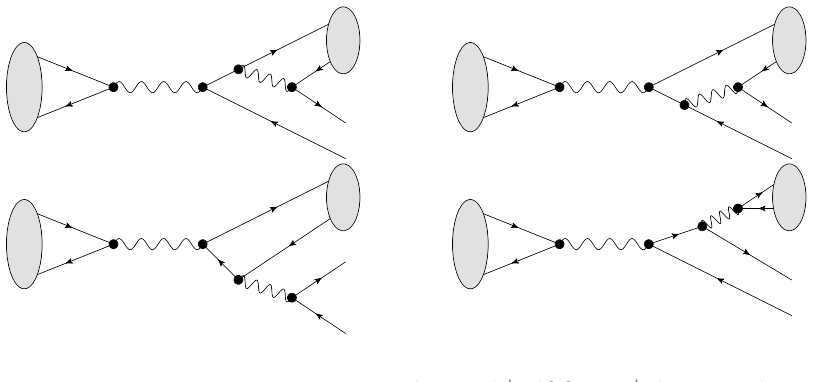
The machinery is non-relativistic QED/QCD factorization. Each bound state is represented by its S-wave radial wavefunction at the origin, $R(0)^2$ (or $|\Psi(0)|^2$), which for leptonium carries the Coulombic $\alpha^3$ suppression that sets the overall $10^{-13}$–$10^{-11}$ scale, and spin projectors convert free-particle amplitudes into bound-state amplitudes. The load-bearing identities are the C-parity selection rules: in the radiative channel the leptonium must be the ${}^1S_0$ para state, and in the four-body diagrams the third diagram vanishes for ${}^3S_1$ while the fourth vanishes for ${}^1S_0$; this is why ortho states dominate in channels where the surviving diagram contributes at leading order in $m_l/m_J$. The $J/\psi$ wavefunction is not fitted freely but extracted from the measured $\mathrm{Br}(J/\psi\to\mu^+\mu^-)$ through the leading-order width formula.
What would settle it
A dedicated search at the future Super Tau-Charm Facility for $e^+e^-$ pairs with invariant mass near $2m_\mu$ and a displaced vertex from $(\mu^+\mu^-)[{}^3S_1]\to e^+e^-(\gamma)$ should see about five events per year if the claim is right; a null result with sensitivity better than a few times $10^{-12}$, or an observed rate significantly above $1.5\times10^{-12}$, would rule out the inclusive prediction.
Extended reading notes
Core claim
On the paper's own terms, the discovery is that C-parity and angular-momentum selection rules split leptonium production cleanly: the radiative channel $J/\psi \to (\mu^+\mu^-)[{}^1S_0]+\gamma$ is allowed, while the radiative channel for the triplet ${}^3S_1$ state vanishes because the $J/\psi$ has $J^{PC}=1^{--}$ and the photon channel forces the leptonium into $0^{-+}$. Ortho-dimuonium must therefore be produced through the four-body channels $J/\psi \to (\mu^+\mu^-)[{}^3S_1] + e^+e^-$ or $+ \mu^+\mu^-$, where different Feynman diagram topologies dominate for the two spin states. Summing the radiative and four-body contributions with $X = \gamma$ or a charged lepton pair, the paper obtains $\mathrm{Br}(J/\psi \to (\mu^+\mu^-)[{}^3S_1]+X)=1.5\times10^{-12}$, together with $\mathrm{Br}(J/\psi \to (e^+e^-)[{}^3S_1]+X)=1.7\times10^{-11}$ and $\mathrm{Br}(J/\psi \to (\mu^+\mu^-)[{}^1S_0]+X)=4.2\times10^{-13}$. With $3.4\times10^{12}$ $J/\psi$ events per year, the paper concludes that ortho-dimuonium should be discoverable at the future Super Tau-Charm Facility through its dominant decay $(\mu^+\mu^-)[{}^3S_1] \to e^+e^-(\gamma)$.
Load-bearing premise
The headline 'inclusive' branching fractions count only leptonium accompanied by one photon or one charged lepton pair, and the paper gives no argument that other companions, such as hadrons or additional photons, are negligible.
Editorial extensions
If this is right
- At the Super Tau-Charm Facility's planned $3.4\times10^{12}$ $J/\psi$ per year, the predicted $1.5\times10^{-12}$ branching fraction yields roughly five raw ortho-dimuonium events per year before detection efficiency, making a first observation plausible.
- Ortho-positronium and muonium come out easier: $\mathrm{Br}(J/\psi\to(e^+e^-)[{}^3S_1]+X)=1.7\times10^{-11}$ and $\mathrm{Br}(J/\psi\to(\mu^+e^-)[{}^3S_1]+e^+\mu^-)=1.5\times10^{-11}$.
- The ground-state-only radiative rate $\mathrm{Br}(J/\psi\to(\mu^+\mu^-)[{}^1S_0]+\gamma)=3.93\times10^{-13}$ is lower than the all-excited-state Green-function result by the factor $\zeta(3)\approx1.2$, so excited leptonium levels contribute about 20% of the radiative channel.
- For $\Upsilon$ decays the largest tauonium channels are $\mathrm{Br}(\Upsilon\to(\tau^+e^-)[{}^3S_1]+e^+\tau^-)=1.08\times10^{-10}$ and $\mathrm{Br}(\Upsilon\to(\tau^+e^-)[{}^1S_0]+e^+\tau^-)=3.63\times10^{-11}$, but with about $10^8$ $\Upsilon$ events such rates are not yet observable.
- The predicted ratio $\mathrm{Br}(J/\psi\to\mu^+\mu^-\gamma)/\mathrm{Br}(J/\psi\to e^+e^-\gamma)=0.33$ is a large, clean mass-hierarchy effect that existing charmonium data can test.
Reading between the lines
- A measurement of the full ortho-dimuonium yield at the Super Tau-Charm Facility that comes out noticeably above $1.5\times10^{-12}$ would quantify the importance of $X$ channels the paper did not include, such as hadrons or additional photons.
- The same selection rules and NRQED/NRQCD amplitudes can be carried over to other vector quarkonia such as $\psi(2S)$ or $\Upsilon(2S)$; the larger phase space should rescale the branching fractions, giving a systematic test of the mechanism.
- A dedicated lineshape analysis of the $e^+e^-$ invariant-mass spectrum near $2m_\mu$ with displaced-vertex cuts could separate ortho-dimuonium decays from prompt backgrounds even with partial data, sharpening the discovery projection.
Signed reviews
Editorial analysis
A structured set of objections, weighed in public.
Referee Report
Summary. The paper computes rates for leptonium production in J/psi and Upsilon decays. It treats radiative channels Q -> (l+l-)[1S0] + gamma and four-lepton channels Q -> (l1+ l2-)[n] + l1- l2+ using NRQED/NRQCD with spin projectors and wavefunctions at the origin, presenting branching fractions and invariant-mass distributions. The headline result is Br(J/psi -> (mu+mu-)[3S1] + X) = 1.5e-12, obtained by summing the X = e+e- and X = mu+mu- exclusive channels, which the paper claims makes ortho-dimuonium potentially discoverable at the future STCF with 3.4e12 J/psi per year. Similar inclusive sums are given for other leptonia in J/psi and Upsilon decays.
Significance. If the inclusive interpretation is validated, the paper provides a concrete new search channel for true muonium, a state that has not yet been observed, and the STCF discovery projection is of genuine interest to the community. The radiative calculation is cross-checked against the Green-function method of Ref. [27], with the zeta(3) factor and the (1 - m_l^2/m_c^2) phase-space factor accounted for, which gives confidence in that part of the computation. The paper also provides many differential distributions that could be useful for experimental studies. However, the key inclusive claim is currently an exclusive sum, and the missing-X issue means the headline branching fraction is not demonstrated as an inclusive rate.
major comments (2)
- [Section II, Eqs. (47)-(50)] The 'inclusive' branching fraction Br(J/psi -> (mu+mu-)[3S1] + X) = 1.5e-12 is obtained by summing only the exclusive channels X = e+e- and X = mu+mu- (Eqs. (38) and (44)), since X = gamma vanishes for the triplet. The text defines X as 'gamma or charged leptons', but an inclusive branching fraction must account for all other final states. In particular, hadronic X such as pi0 or multi-pion systems are not forbidden by C-parity: the J/psi has C = -1, the 3S1 leptonium has C = -1, so X must have C = +1, which pi0 satisfies. The same off-shell photon mechanism that produces the lepton pair X could produce hadronic X, and the paper provides no estimate or bound for these channels. The central discovery projection for ortho-dimuonium at STCF therefore rests on an unjustified identification of 'inclusive' with a two-channel sum. The authors should either relabel these as exclusive branching fractions or provide a quantitative estimate of the hadronic and multi-photon X contributions. The same issue affects the Upsilon inclusive results in Eqs. (86)-(91).
- [Section II, Eqs. (37)-(46)] The four-lepton branching fractions and widths are quoted without uncertainties, and it is not stated whether the numerical values are obtained from the full amplitudes or from the approximate amplitudes in the m_e^2 << m_J/psi^2 limit. Since these results scale as R^2_J/psi(0), which carries a relative uncertainty of about 2% from Eq. (9), the numerical precision of the central values is not documented. While the order-of-magnitude discovery projection is robust to this uncertainty, the presentation should state the source of the quoted numbers and propagate the input uncertainties.
minor comments (4)
- [Abstract and Introduction] The abstract and introduction state that the radiative processes Q -> (l1+ l2-)[n] + gamma are considered for l1,2 = tau, mu, e, which implies unlike-flavor radiative channels such as (mu+ e-) + gamma. The body of the paper, in Sections II.D and III.C, only treats same-flavor (l+l-)[1S0] + gamma. The authors should either discuss the unlike-flavor radiative channels or explicitly state that they are omitted and explain why, since the text currently gives an inaccurate picture of the paper's scope.
- [Section II.E] The numerical integration over the three-body phase space is not described in detail. For each process, it would be helpful to state which expression (full or approximate) was integrated, the phase-space cuts applied, and how the integration was performed, to aid reproducibility.
- [Throughout] There are several typographical and notation issues: 'muonim' appears in the text of Section II; the subscript 'the' in Eq. (7) is unusual; and in Eqs. (29)-(46) the branching fractions are given without any uncertainty, whereas the radiative results in Eqs. (21)-(22) include uncertainties. A careful proofread would improve the presentation.
- [Section II.D, Eq. (24)] The comparison with Ref. [27] is explained clearly, but the statement that Eq. (24) differs from the first line of Eq. (32) of Ref. [27] by a factor of (1 - m_l^2/m_c^2) zeta(3) could be made even more explicit by displaying the corresponding expression from Ref. [27] itself. As written, the reader has to consult the cited paper to verify the factor.
Circularity Check
No significant circularity; the leptonium predictions are independent QED calculations with standard external inputs, and the quoted "inclusive" rate is the explicit sum of the computed exclusive channels.
full rationale
The derivation chain is self-contained: the only external inputs are the measured J/psi and Upsilon leptonic widths, from which the quarkonium radial wavefunctions at the origin are extracted (Eqs. (6), (9), and (55)); this is a standard normalization procedure and not a fit to the leptonium branching fractions that are later predicted. The leptonium decay widths are then obtained from explicit NRQED/NRQCD Feynman-diagram amplitudes (Eqs. (19), (20), and (27)-(46)), with no parameter adjusted to reproduce the target rates. The headline number Br(J/psi -> (mu+mu-)[3S1] + X) = 1.5e-12 is obtained by adding the computed e+e- and mu+mu- channels, Eqs. (38) and (44), since the radiative channel vanishes for the triplet; the text explicitly defines X as "gamma or charged leptons mu±, e±". Calling this an "inclusive" branching fraction is a completeness caveat rather than circularity: the value is not equivalent by construction to its inputs, but is a genuine prediction for the channels that were computed. The radiative 1S0 result is cross-checked against the independent Green-function calculation of Ref. [27], with the known zeta(3) difference from excited-state summation explained explicitly. No load-bearing self-citation chain or fitted-parameter-renamed-as-prediction appears in the paper, so the circularity score is 0.
Assumptions & free parameters
free parameters (2)
- R_J/psi(0)^2 =
0.5599 +/- 0.0107 GeV^3
- R_Upsilon(0)^2 =
5.06 +/- 0.14 GeV^3
assumptions (4)
- domain assumption Leptonium is described by NRQED with a Coulomb Schrodinger wavefunction, with |Psi(0)|^2 = (alpha ml)^3/(8 pi n^3).
- domain assumption NRQCD factorization with color-singlet spin projectors at LO in v^2 (q=0) describes the quarkonium bound state.
- ad hoc to paper Inclusive leptonium production is saturated by the exclusive channels with X = gamma or a charged lepton pair.
- standard math C-parity conservation restricts radiative leptonium to 1S0 for same-flavor pairs and selects which Feynman diagrams contribute.
Cite this review
Pith. "Pith review of Production of leptonium in heavy quarkonium decays." pith.science (2026). https://pith.science/paper/6UWNLLYR
@misc{pith2026250502676,
  author       = {Pith},
  title        = {Pith review of: Production of leptonium in heavy quarkonium decays},
  year         = {2026},
  howpublished = {\url{https://pith.science/paper/6UWNLLYR}},
  note         = {Machine review of arXiv:2505.02676}
}
abstract
Lepton pairs with opposite charges can form bound states known as ``leptonium'' through quantum electrodynamic interactions. Heavy quarkonia such as $J/\psi$ are abundantly produced at facilities like BESIII and the future Super Tau-Charm Facility (STCF). In this work, we investigate leptonium production in heavy quarkonium decays, specifically focusing on the processes ${\cal{Q}} \longrightarrow (l_1^+ l_2^-)[n] +\gamma$ ($l_{1,2}= \tau,\, \mu,\, e$) and ${\cal{Q}} \longrightarrow (l_1^+ l_2^-)[n] + l_1^- l_2^+$. Here, ${\cal{Q}}$ denotes the heavy quarkonium $J/\psi$ or $\Upsilon$, while $n=$ ${^1S_0}$ or $^3S_1$ corresponds to para-leptonium and ortho-leptonium, respectively. With an annual production of $3.4 \times 10^{12}$ $J/\psi$ events at STCF, there is significant potential to observe positronium $(e^+e^-)$, muonium $(\mu^+e^-)$, and dimuonium $(\mu^+\mu^-)$. In particular, the ortho-dimuonium $(\mu^+\mu^-)[^3S_1]$ may be discovered at the future STCF, with an inclusive branching fraction of $Br(J/\psi \longrightarrow (\mu^+\mu^-)[^3S_1] +X) = 1.5 \times 10^{-12}$.
Figures


Figures from the paper (10 more)



Reference graph
Works this paper leans on
-
[27]
L. D. Landau, On the angular momentum of a system of two photons, Dokl. Akad. Nauk SSSR 60, 207 (1948)
work page 1948
-
[1]
+s2 2(s1− 3m2 µ)− 4(m2 µ−s1)3 +s2 2 2m2 µs1− 3m4 µ− 3s2 1 +s3 2 m2 µ−s1 − 4s1s2 m2 µ−s1 2 − 2 m2 µ−s1 4i . (36) The squared amplitudes for 3S1 states differ significantly from those for 1S0 states due to their distinct Feynman diagram topologies. This indicates that the 3rd diagram in Fig. 3 contributes at leading order ( ml mJ/ψ )2, while the 4th diagram...
-
[2]
+s3 1s2 , (27) |M|2 ((µ+e−)[3S1])≈ 1024π2α7m2 µRJ/ψ(0)2 9m3 J/ψ s2−m2 µ 2 s1−m2 µ 3 3m4 J/ψ s1−m2 µ s2−m2 µ −m2 J/ψ 2m4 µ(s1 + 2s2) +m2 µ(s2 1−s2 2− 12s1s2) + 2s1s2(s1 + 2s2) −9m8 µ− 3m6 µ(s1−s2) +m4 µ(7s2 1 + 21s1s2 + 2s2 2) −m2 µ(2s3 1 + 10s2 1s2 + 11s1s2 2 +s3
-
[3]
and dipositronium molecule ( e+e−)(e+e−) [4] have also been successfully produced. The spectroscopic notation n 2S+1LJ is used to describe the quantum numbers of lepto- nium. Here, n denotes the principal quantum number, S is the spin, L represents the orbital angular momentum (with L = 0, 1, 2,... corresponding to S, P, D, ... waves), andJ =L+S is the to...
-
[4]
+s1s2(s2 1 + 2s2 2) , (28) wheres1 = (p1 +p2)2 ands2 = (p2 +p3)2. Retaining only the leading terms proportional to m4 J/ψ and m8 µ within the square brackets, the squared amplitude for the 3S1 state in Eq. (28) is three times that of the 1S0 state in Eq. (27). Integrating over the 3-body phase space (as defined in Eq. (10)), we obtain the total decay widt...
-
[5]
+s1(2s1 +s2)2 +s1 4m2 µ−s1−s2 16m4 µ− 8m2 µs1 + 2s2 1 + 2s1s2 +s2 2 . (34) 15 ForJ/ψ−→(e+e−)[n] +µ+µ− in the m2 e≪m2 J/ψ limit, the squared amplitudes are: |M|2 ((e+e−)[1S0] +µ+µ−)≈ 1024π2e2 Qα7RJ/ψ(0)2 mJ/ψs2 2 m2 J/ψ +s2 2 me mJ/ψ 2 × m4 J/ψ 2m2 µ +s2 − 2m2 J/ψs2 m2 µ +s1 +s2 +s2 2(m2 µ−s1)2 + 2s1s2 +s2 2 , (35) |M|2 ((e+e−)[3S1] +µ+µ−)≈ 128π2e2 Qα7RJ/ψ...
-
[6]
Deutsch, Evidence for the Formation of Positronium in Gases, Phys
M. Deutsch, Evidence for the Formation of Positronium in Gases, Phys. Rev. 82, 455 (1951)
work page 1951
-
[7]
V. W. Hughes, D. W. McColm, K. Ziock, and R. Prepost, Formation of Muonium and Observation of its Larmor Precession, Phys. Rev. Lett. 5, 63 (1960)
work page 1960
Show all 50 references
-
[8]
Coombes et al., Detection of pi mu Coulomb Bound States, Phys
R. Coombes et al., Detection of pi mu Coulomb Bound States, Phys. Rev. Lett. 37, 249 (1976)
1976
-
[9]
D. B. Cassidy and A. P. Mills, The production of molecular positronium, Nature 449, 195 (2007)
2007
-
[10]
d’Enterria, R
D. d’Enterria, R. Perez-Ramos, and H.-S. Shao, Ditauonium spectroscopy, Eur. Phys. J. C 82, 923 (2022), arXiv:2204.07269 [hep-ph]
2022 arXiv
-
[11]
Ablikim et al
M. Ablikim et al. (BESIII), Number of J/ψ events at BESIII, Chin. Phys. C 46, 074001 (2022), arXiv:2111.07571 [hep-ex]
2022 arXiv
-
[12]
Achasov et al., STCF conceptual design report (Volume 1): Physics & detector, Front
M. Achasov et al., STCF conceptual design report (Volume 1): Physics & detector, Front. Phys. (Beijing) 19, 14701 (2024), arXiv:2303.15790 [hep-ex]
2024
-
[13]
Brodzicka et al
J. Brodzicka et al. (Belle), Physics Achievements from the Belle Experiment, PTEP2012, 04D001 (2012), arXiv:1212.5342 [hep-ex]
2012 arXiv
-
[14]
A. J. Krasznahorkay et al., Observation of Anomalous Internal Pair Creation in Be8 : A Possible Indication of a Light, Neutral Boson, Phys. Rev. Lett. 116, 042501 (2016), arXiv:1504.01527 [nucl-ex]
2016 arXiv
-
[15]
S. R. Gevorkian, E. A. Kuraev, A. Schiller, V. G. Serbo, and A. V. Tarasov, Production of relativistic positronium in collisions of photons and electrons with nuclei and atoms, Phys. Rev. A 58, 4556 (1998), arXiv:hep-ph/9804264
1998 arXiv
-
[16]
Yu and Y.-D
G.-M. Yu and Y.-D. Li, Photoproduction of large transverse momentum dimuonium (mu+ mu-) in relativistic heavy ion collisions, Chin. Phys. Lett. 30, 011201 (2013)
2013
-
[17]
Francener, V
R. Francener, V. P. Goncalves, and B. D. Moreira, Photoproduction of relativistic QED 29 bound states in hadronic collisions, Eur. Phys. J. A 58, 35 (2022), arXiv:2110.03466 [hep- ph]
2022 arXiv
-
[18]
I. F. Ginzburg, U. D. Jentschura, S. G. Karshenboim, F. Krauss, V. G. Serbo, and G. Soff, Production of bound mu+ mu- systems in relativistic heavy ion collisions, Phys. Rev. C 58, 3565 (1998), arXiv:hep-ph/9805375
1998 arXiv
-
[19]
Azevedo, V
C. Azevedo, V. P. Gon¸ calves, and B. D. Moreira, True muonium production in ultrape- ripheral PbPb collisions, Phys. Rev. C 101, 024914 (2020), arXiv:1911.10861 [hep-ph]
2020 arXiv
-
[20]
G. Yu, Z. Zhao, Y. Cai, Q. Gao, Q. Hu, and H. Yang, Production of exotic electromagnetic bound systems in ultra-peripheral heavy ion collisions with two-photon processes, (2022), arXiv:2209.11439 [hep-ph]
2022 arXiv
-
[21]
d’Enterria and H.-S
D. d’Enterria and H.-S. Shao, Observing true tauonium via two-photon fusion at e+e- and hadron colliders, Phys. Rev. D 105, 093008 (2022), arXiv:2202.02316 [hep-ph]
2022 arXiv
-
[22]
d’Enterria and H.-S
D. d’Enterria and H.-S. Shao, Prospects for ditauonium discovery at colliders, Phys. Lett. B 842, 137960 (2023), arXiv:2302.07365 [hep-ph]
2023 arXiv
-
[23]
Chen and P
Y. Chen and P. Zhuang, Dimuonium ( µ+µ−) Production in a Quark-Gluon Plasma, (2012), arXiv:1204.4389 [hep-ph]
2012 arXiv
-
[24]
J. W. Moffat, Does a Heavy Positronium Atom Exist?, Phys. Rev. Lett. 35, 1605 (1975)
1975
-
[25]
S. J. Brodsky and R. F. Lebed, Production of the Smallest QED Atom: True Muonium (mu+ mu-), Phys. Rev. Lett. 102, 213401 (2009), arXiv:0904.2225 [hep-ph]
2009 arXiv
-
[26]
Gargiulo, S
R. Gargiulo, S. Palmisano, E. Di Meco, E. Diociaiuti, I. Sarra, and D. Paesani, True muonium resonant production at e+e− colliders with standard crossing angle, J. Phys. G 51, 045004 (2024), arXiv:2309.11683 [hep-ph]
2024 arXiv
-
[28]
Yang, Selection Rules for the Dematerialization of a Particle Into Two Photons, Phys
C.-N. Yang, Selection Rules for the Dematerialization of a Particle Into Two Photons, Phys. Rev. 77, 242 (1950)
1950
-
[29]
Cid Vidal, P
X. Cid Vidal, P. Ilten, J. Plews, B. Shuve, and Y. Soreq, Discovering True Muonium at LHCb, Phys. Rev. D 100, 053003 (2019), arXiv:1904.08458 [hep-ph]. 30
2019 arXiv
-
[30]
Ji and H
Y. Ji and H. Lamm, Discovering True Muonium in KL→ (µ+µ−)γ, Phys. Rev. D 98, 053008 (2018), arXiv:1706.04986 [hep-ph]
2018 arXiv
-
[31]
Fael and T
M. Fael and T. Mannel, On the decays B→ K(∗)+ leptonium, Nucl. Phys. B 932, 370 (2018), arXiv:1803.08880 [hep-ph]
2018 arXiv
-
[32]
Dai, H.-B
J.-P. Dai, H.-B. Li, S. Zhao, and Z.-Y. Zheng, Creating true muonium via charmonium radiative decay, (2024), arXiv:2412.12592 [hep-ph]
2024 arXiv
-
[33]
d’Enterria and V
D. d’Enterria and V. D. Le, Rare and exclusive few-body decays of the Higgs, Z, W bosons, and the top quark, J. Phys. G 52, 053001 (2025), arXiv:2312.11211 [hep-ph]
2025
-
[34]
F. A. Martynenko, A. P. Martynenko, and A. V. Eskin, Production of dileptonic bound states in the Higgs boson decay, Phys. Rev. D 110, 056016 (2024), arXiv:2405.00829 [hep-ph]
2024
-
[35]
S. G. Karshenboim, Precision physics of simple atoms: QED tests, nuclear structure and fundamental constants, Phys. Rept. 422, 1 (2005), arXiv:hep-ph/0509010
2005 arXiv
-
[36]
Bernreuther, U
W. Bernreuther, U. Low, J. P. Ma, and O. Nachtmann, How to Test CP, T and CPT Invariance in the Three Photon Decay of Polarized s Wave Triplet Positronium, Z. Phys. C 41, 143 (1988)
1988
-
[37]
Yamazaki, T
T. Yamazaki, T. Namba, S. Asai, and T. Kobayashi, Search for CP violation in Positro- nium Decay, Phys. Rev. Lett. 104, 083401 (2010), [Erratum: Phys.Rev.Lett. 120, 239902 (2018)], arXiv:0912.0843 [hep-ex]
2010 arXiv
-
[38]
Bogomyagkov, V
A. Bogomyagkov, V. Druzhinin, E. Levichev, A. Milstein, and S. Sinyatkin, Low-energy electron-positron collider to search and study (\muˆ+\muˆ-) bound state, EPJ Web Conf. 181, 01032 (2018), arXiv:1708.05819 [physics.acc-ph]
2018 arXiv
-
[39]
W. E. Caswell and G. P. Lepage, Effective Lagrangians for Bound State Problems in QED, QCD, and Other Field Theories, Phys. Lett. B 167, 437 (1986)
1986
-
[40]
Sommerfeld, ¨Uber die Beugung und Bremsung der Elektronen, Annalen Phys
A. Sommerfeld, ¨Uber die Beugung und Bremsung der Elektronen, Annalen Phys. 403, 257 (1931)
1931
-
[41]
A. D. Sakharov, Interaction of an Electron and Positron in Pair Production, Zh. Eksp. Teor. Fiz. 18, 631 (1948). 31
1948
-
[42]
J. S. Schwinger, PARTICLES, SOURCES AND FIELDS. VOLUME II (1973)
1973
-
[43]
V. S. Fadin and V. A. Khoze, Threshold Behavior of Heavy Top Production in e+ e- Collisions, JETP Lett. 46, 525 (1987)
1987
-
[44]
V. S. Fadin, V. A. Khoze, and T. Sjostrand, On the Threshold Behavior of Heavy Top Production, Z. Phys. C 48, 613 (1990)
1990
-
[45]
G. T. Bodwin, E. Braaten, and G. P. Lepage, Rigorous QCD analysis of inclusive anni- hilation and production of heavy quarkonium, Phys. Rev. D 51, 1125 (1995), [Erratum: Phys.Rev.D 55, 5853 (1997)], arXiv:hep-ph/9407339
1995 arXiv
-
[46]
G. T. Bodwin, D. K. Sinclair, and S. Kim, Quarkonium decay matrix elements from quenched lattice QCD, Phys. Rev. Lett. 77, 2376 (1996), arXiv:hep-lat/9605023
1996 arXiv
-
[47]
E. J. Eichten and C. Quigg, Quarkonium wave functions at the origin, Phys. Rev. D 52, 1726 (1995), arXiv:hep-ph/9503356
1995 arXiv
-
[48]
Petrelli, M
A. Petrelli, M. Cacciari, M. Greco, F. Maltoni, and M. L. Mangano, NLO production and decay of quarkonium, Nucl. Phys. B 514, 245 (1998), arXiv:hep-ph/9707223
1998 arXiv
-
[49]
Navas et al
S. Navas et al. (Particle Data Group), Review of particle physics, Phys. Rev. D 110, 030001 (2024)
2024
-
[50]
Ablikim et al
M. Ablikim et al. (BESIII), Observation of Structures in the Processes e+e- →ωχc1 and ωχc2, Phys. Rev. Lett. 132, 161901 (2024), arXiv:2401.14720 [hep-ex]. 32
2024
Reviewed August 16, 2026 · model on record in the stance chip above.
Discussion (0). Continue with ORCID to comment.