REVIEW 4 major objections 3 minor 1 cited by
A neural network that learns the field derivative of the effective potential directly from the fRG flow equation reproduces the O(N) model's flow in all phases and finds the Wilson-Fisher fixed point without shooting.
Reviewed by Pith at T0; open to challenge. T0 means a machine referee read the full paper against a public rubric. the ladder, T0–T4 →
T0 review · deepseek-v4-flash
2026-08-02 17:41 UTC pith:6VJ3V4PN
load-bearing objection A useful hybrid large-N + PINN solver for continuum fRG flows that matches benchmark solvers, but the 'no boundary conditions' claim needs a well-posedness or selection-mechanism discussion before I'd trust it beyond the tested cases. the 4 major comments →
Solving Functional Renormalization Group Equations with Neural Networks
The pith
A machine-rendered reading of the paper's core claim, the machinery that carries it, and where it could break.
Core claim
The central claim is that a neural network parameterization of the field derivative of the effective potential, trained solely on the residual of the Wetterich flow equation, is a complete numerical method for fRG problems in the local potential approximation. The paper demonstrates this for finite-temperature O(N) theory by decomposing the solution as an analytic large-N baseline plus a learned finite-N correction, which removes most of the stiffness caused by convexity restoration. The neural results match finite-difference and discontinuous-Galerkin benchmarks to an absolute error below about 4e-5 in the potential derivative, and extracted observables such as the order parameter and the s
What carries the argument
The central object is the decomposition V'_k(ρ) = V'_{LN,k}(ρ) + ΔV'_θ(t,ρ), where V'_{LN,k} is the analytically known large-N solution obtained by the method of characteristics and the network learns only the finite-N correction. The loss is the mean squared residual of the discretized fRG flow equation, and the output is multiplied by the RG time t so that the UV condition ΔV'(t=0)=0 is enforced exactly; no boundary condition is imposed in the field direction.
Load-bearing premise
The load-bearing premise is that minimizing the flow-equation residual on a finite grid, with no explicit boundary conditions in the field direction and only the t=0 condition enforced, uniquely selects the physical solution of the fRG flow; the paper shows agreement with benchmarks but gives no proof that the learned branch is unique.
What would settle it
Train the same network on the O(4) flow at T=100 MeV from several random initializations and with different field-domain truncations; if the residual can be driven to near zero by solutions that disagree in the small-field plateau or the running minimum, the no-boundary-condition selection claim fails. A sharper test is to compare the learned Wilson-Fisher u'(ρ) for N=3 against an independent adaptive high-precision integrator on a much larger field domain; any growing mismatch at large ρ would show that the learned asymptotic behavior is not the physical one.
If this is right
- Trained network parameters at one temperature transfer to neighboring temperatures, so systematic scans across a phase diagram become much cheaper.
- Because the field-direction boundary condition is not imposed, the method can be applied to problems where the large-field asymptotic behavior is not known analytically.
- The same residual-loss framework handles both scale-dependent flows and stationary fixed-point equations, unifying two classes of fRG calculations that normally require different numerical treatments.
- The continuous and differentiable network representation gives direct access to field derivatives, so observables such as the sigma mass at the running minimum are obtained without interpolation artifacts.
- The architecture extends to multi-field effective potentials and vertex expansions, where conventional grid-based discretization becomes computationally prohibitive.
Where Pith is reading between the lines
- Editorial: If the residual alone truly selects the physical solution, then fRG flows belong to a class of PDEs where physics-informed residual minimization implicitly encodes the correct branch, which would justify dropping explicit boundary conditions in other renormalization-group settings.
- Editorial: The large-N baseline is not just an accelerator; the fixed-point variant shows that any exactly solvable limit of an RG flow can serve as a prior, suggesting a general recipe for stiff functional equations.
- Editorial: A seed-dependence test, in which the same flow is trained from many random initializations and the resulting small-field plateaus are compared, would reveal whether the physical-branch selection is robust or an artifact of the optimization trajectory.
Editorial analysis
A structured set of objections, weighed in public.
Referee Report
Summary. The paper introduces a physics-driven neural network representation for the field derivative of the effective potential in the functional renormalization group, applied to the O(N) scalar theory in the local potential approximation. The network is trained by minimizing only the residual of the fRG flow PDE, with the UV condition encoded by multiplying the output by t, and the solution is decomposed into an analytic large-N baseline plus a learned finite-N correction. Results are presented for the finite-temperature O(4) flow in symmetric, broken, and critical regimes, benchmarked against finite-difference BDF and local discontinuous Galerkin solvers, and for the d=3 Wilson-Fisher fixed point for N=1,2,3,4, benchmarked against RadauIIA5 shooting. The paper claims accurate, continuous solutions without explicit field-direction boundary conditions and emphasizes transfer learning across temperatures.
Significance. If the claims are established, the method is a useful addition to the fRG numerical toolkit: it provides a differentiable, grid-free representation of the effective potential, handles the stiffness of convexity restoration in the broken phase, and unifies scale-dependent flow and fixed-point calculations in one framework. The independent validation against LDG, BDF, and RadauIIA5 shooting is a genuine strength, and the public code is an asset. The reported agreement, including the explicit statement that absolute errors remain below 4e-5 at T=100 MeV, gives confidence in the benchmarking itself. However, the paper's stronger methodological claim—that residual-only training with no field-direction boundary conditions selects the correct physical branch—is not presently supported by a well-posedness argument or by ablation studies.
major comments (4)
- [§IV.A, Eqs. (10), (16)–(17)] The central claim that no boundary conditions are needed in the field direction is not established. For finite N, differentiating Eq. (10) with respect to rho gives a second-order parabolic PDE for V': the sigma-mode term contains V''' after differentiation, equivalently V'' in Eq. (10) itself. On the truncated domain rho in [0,0.15], t in [-4,0], a parabolic PDE with only data at t=0 is not well-posed; boundary conditions at rho=0 and rho=rho_max are needed. The multiplicative t factor enforces Delta V'(0,rho)=0 but supplies no boundary information in rho, and the finite-difference stencil also requires an edge treatment that is not specified. The large-N initialization may be what selects the physical branch. Please (i) state the edge treatment, (ii) test sensitivity to rho_max and grid resolution, and (iii) provide random-initialization studies or a mathematical argument that residual
- [§IV.B.4 and Eq. (A11)] The fixed-point problem has the same issue in sharper form. Eq. (A11) is a second-order ODE; without boundary conditions it has a two-parameter family of solutions. The paper states that the large-N decomposition 'biases the network toward the physically relevant Wilson-Fisher branch', which is an optimization-selection statement, not a uniqueness result. The agreement with RadauIIA5 shooting is evidence that the obtained branch is physical at the tested parameters, but it does not show that residual-only training would find that branch from generic initialization or on a different truncated domain. Please add ablation studies: vary the field cutoff, use random initializations without the large-N baseline, and report whether the same fixed point is obtained. If the physical branch is selected only because of the large-N initialization, the conclusion should be reworded accordingly.
- [§IV.A and §IV.B.2] The large-N decomposition is described as a key innovation and is stated to be 'essential' and to 'substantially stabilize' training, but no ablation is shown in which the network is trained without the large-N baseline. Given that the baseline also carries the physical large-field asymptotics and convexity-restoration structure, this is a load-bearing part of the method. Please provide a direct comparison: train the same architecture with and without the decomposition, and report the resulting accuracy and training stability. This is needed to support the claim that the decomposition, rather than the network capacity or the loss landscape, is responsible for the reported performance.
- [Abstract and §IV.B.4] The abstract promises that 'a composite small- and large-field ansatz further improves accuracy, extending the method to problems without an analytically solvable limit', and the text mentions that for fixed points 'the large-field asymptotic form alone can replace the exact large-N reference'. I could not find either of these constructions or their results in the body of the paper. Section IV.B.4 only presents the large-N-reference correction. Please either add the promised composite ansatz and the corresponding numerical comparison, or remove these statements from the abstract and introduction. As written, the abstract advertises a capability that the manuscript does not document.
minor comments (3)
- [§IV.B.2, Fig. 4] The statement that 'absolute errors remain below 4e-5' lacks a precise definition. Please specify the error norm (L_infinity or L_2), the set of scales and field points over which it is computed, and how the LDG/BDF reference solutions are interpolated for the comparison.
- [§IV.B.3, Fig. 8] The text acknowledges a deviation between the neural network and LDG at T=10 MeV in the deep infrared, but it does not quantify the deviation. Please report a numerical bound or an error estimate for this case, since the claimed agreement is otherwise stated in absolute terms.
- [§IV.B.1] The training discussion reports loss values but not the random seed or the number of independent runs. Since the method is stochastic, a brief statement about run-to-run variability would help assess robustness.
Circularity Check
No circularity: the neural network is trained on the fRG residual with a separately derived large-N analytic baseline and validated against independent numerical solvers.
full rationale
The central derivation is self-contained: the network parameters are determined by minimizing the residual of the fRG flow equation (Eqs. 16-17) and the fixed-point ODE, not by fitting the benchmark data or the physical observables. The large-N expressions (Eq. 12 for the flow and Eq. 14 for the fixed point) are separately derived analytic inputs obtained by taking the N→∞ limit of the same flow equations; they do not encode the finite-N results that constitute the actual predictions. The t=0 condition is enforced structurally by the multiplicative t factor in the output layer, so the initial condition is an explicitly supplied physical input, not a learned target. Comparisons with LDG, finite-difference BDF, and the RadauIIA5 shooting method are independent validations; the self-citation [66] provides a reproducible numerical solver and is not used as a uniqueness theorem or as the source of the ansatz. The genuine concern is mathematical rather than circular: residual-only training without explicit field-direction boundary conditions is not proven to select the physical branch uniquely, and the large-N baseline may bias branch selection for the Wilson-Fisher problem. This is a well-posedness/correctness gap, not a reduction of the claimed result to its inputs. No quoted equation is equivalent by construction to the final solution or the benchmark quantities.
Axiom & Free-Parameter Ledger
free parameters (3)
- UV initial condition of V'(Λ,ρ) =
not explicitly stated; inferred ρ0(Λ)≈0.071 from Fig. 7
- Network hyperparameters (width, depth, learning rate, grid) =
256 hidden units, 3 hidden layers plus 256-unit encoder, lr=5e-4, grid 201×501 (2001×501 for T=10 MeV)
- Denominator regularization ε =
1e-13
axioms (7)
- domain assumption The Wetterich equation (Eq. 5) is the exact flow equation for the effective action.
- domain assumption Local potential approximation: truncate the effective action to Z=1 and a scale-dependent potential V_k(ρ), dropping O(∂^2) terms.
- domain assumption The optimized Litim regulator (Eq. 4) is the regulator used throughout.
- domain assumption Finite-temperature O(N) dynamics are captured by the Model A flow equation (Eq. 7), obtained from the Schwinger-Keldysh formalism in the purely dissipative/high-temperature limit.
- standard math The analytic large-N solutions (Eqs. 12 and 14) are correct.
- ad hoc to paper Minimizing only the PDE residual (Eq. 16), with no field-direction boundary conditions and no explicit initial condition beyond t=0, yields the physical solution.
- domain assumption The Wilson-Fisher fixed point is the physically relevant solution selected by the large-N decomposition.
read the original abstract
We employ deep neural networks to represent the field derivative of the scale-dependent effective potential in the functional renormalization group (fRG) framework for nonperturbative quantum field theory. By embedding the fRG flow equations directly into the loss function, the network parameters are determined so as to provide a continuous and differentiable representation of the scale- and field-dependent effective potential without relying on precomputed training data. Focusing on the $O(N)$ scalar field theory within the local potential approximation at finite temperature, we demonstrate that this neural network representation accurately captures the renormalization group flow across symmetric, broken, and critical regimes. A key ingredient is a decomposition of the representation into an analytically known large-$N$ contribution and a learned finite-$N$ correction, which efficiently mitigates numerical stiffness associated with convexity restoration in the broken phase. The physics-driven solutions show excellent agreement with established finite-difference and discontinuous Galerkin methods. We further apply the same strategy to the Wilson--Fisher fixed-point equation in three dimensions, illustrating that neural network representations provide a unified framework for both scale-dependent flows and fixed-point problems. For fixed points, the large-field asymptotic form alone can replace the exact large-$N$ reference, while a composite small- and large-field ansatz further improves accuracy, extending the method to problems without an analytically solvable limit. Our results indicate that physics-driven deep learning offers a robust and flexible numerical tool for functional renormalization group studies.
Figures




Forward citations
Cited by 1 Pith paper
-
Diffusion Models for Sampling Near Criticality in Lattice Field Theories
Fully convolutional diffusion models trained on small lattices transfer to unseen larger volumes for 2D/3D phi^4 sampling across phases, matching or beating same-size training on most observables.
Reference graph
Works this paper leans on
-
[1]
We find that the training results are largely insensitive to the choice of learning rate within a reason- able range
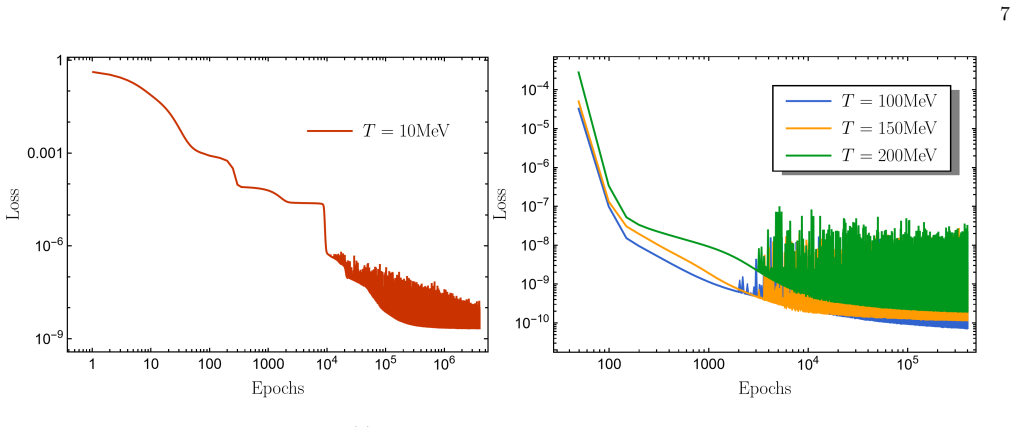
Training convergence and optimization strategy The optimization of the neural network parameters employs the Adam optimizer with a fixed learning rate of 5×10 −4. We find that the training results are largely insensitive to the choice of learning rate within a reason- able range. 7 FIG. 3. Training loss convergence for theO(4) model. Left panel: Loss evol...
-
[2]
4 presents the field derivative of the rescaled effective potential ˆV ′ k(ˆρ) for theO(4) model atT= 100 MeV, which lies below the critical temperatureT c ≈ 150 MeV
Effective potential in the broken phase Fig. 4 presents the field derivative of the rescaled effective potential ˆV ′ k(ˆρ) for theO(4) model atT= 100 MeV, which lies below the critical temperatureT c ≈ 150 MeV. The left panel displays the evolution at high RG scales (k= 1000,800,500,100 MeV), where the po- tential derivative varies smoothly from negative...
-
[3]
Physical observables Beyond the full field-dependent effective potential, we also extract physical observables that characterize the thermodynamic state of the system. We present the RG evolution of the order parameter ˆρ0 (the location of the potential minimum) and the sigma mass squared ˆm 2 σ = ˆV ′(ˆρ0) + 2ˆρ0 ˆV ′′(ˆρ0) evaluated at this minimum in F...
-
[4]
Wilson-Fisher fixed point As a further application of the neural network method- ology, we solve for the Wilson-Fisher fixed point of the O(N) model ind= 3 dimensions within the LPA (η= 0). The Wilson-Fisher fixed point governs the universal crit- ical behavior of second-order phase transitions in the O(N) universality class, and accurate determination of...
-
[5]
Zero-temperature flow equation Applying the Wetterich equation (5) to theO(N) model in the LPA at zero temperature in Euclidean spacetime yields: ∂tVk(ρ) =Ck d " 1 1 + ¯m2 σ,k + N−1 1 + ¯m2 π,k # .(A1) This equation serves as the basis for the fixed point anal- ysis in Sec. III C. The dimensionless form, obtained by in- troducing ¯ρ=k −(d−2)Zϕ,kρandu(¯ρ) ...
-
[6]
Finite temperature flow via Schwinger-Keldysh formalism For a complete treatment of finite temperature dy- namics, we employ the real-time functional renormaliza- tion group formulated on the Schwinger-Keldysh contour. The Schwinger-Keldysh formalism introduces two field components: the classical fieldϕ c (forward time branch) and the quantum fieldϕ q (di...
-
[7]
Method of characteristics for large-N solution The large-Nflow equation (11) can be solved exactly using the method of characteristics. Taking the field derivative yields: ∂kV ′ k(ρ) =−CT kd+1 N−1 (k2 +V ′ k(ρ))2 V ′′ k (ρ).(A6) DefiningU k(ρ) =V ′ k(ρ) and rescalingρ→ρ/(CT(N− 1)), we obtain: ∂kUk(ρ) =−k d+1 1 (k2 +U k(ρ))2 U ′ k(ρ).(A7) This quasi-linear...
-
[8]
(A2), is a differential algebraic equa- tion of index 1
Fixed point ODE The fixed point equation (13), obtained by setting ∂tu= 0 in Eq. (A2), is a differential algebraic equa- tion of index 1. Differentiating with respect to ¯ρyields a second-order ODE foru ′(¯ρ): C " − 3u(2) + 2¯ρu(3) 1 +u ′ + 2¯ρu(2) 2 −(N−1) u(2) (1 +u ′)2 # + (−2 +η)u ′ + (d−2 +η)¯ρu (2) = 0.(A11) This ODE, with appropriate boundary condi...
-
[9]
Wetterich, Exact evolution equation for the effective potential, Phys
C. Wetterich, Exact evolution equation for the effective potential, Phys. Lett. B301, 90 (1993)
1993
-
[10]
K. G. Wilson, Renormalization group and critical phe- nomena. 1. Renormalization group and the Kadanoff scaling picture, Phys. Rev. B4, 3174 (1971)
1971
-
[11]
K. G. Wilson, Renormalization group and critical phe- nomena. 2. Phase space cell analysis of critical behavior, Phys. Rev. B4, 3184 (1971)
1971
-
[12]
K. G. Wilson and M. E. Fisher, Critical exponents in 3.99 dimensions, Phys. Rev. Lett.28, 240 (1972)
1972
-
[13]
K. G. Wilson and J. B. Kogut, The Renormalization group and the epsilon expansion, Phys. Rept.12, 75 (1974)
1974
- [14]
-
[15]
L. Canet and H. Chate, Non-perturbative Approach to Critical Dynamics, J. Phys.40, 1937 (2007), arXiv:cond- mat/0610468
arXiv 1937
-
[16]
L. Canet, H. Chate, and B. Delamotte, General frame- work of the non-perturbative renormalization group for non-equilibrium steady states, J. Phys. A44, 495001 (2011), arXiv:1106.4129 [cond-mat.stat-mech]
Pith/arXiv arXiv 2011
-
[17]
D. Mesterh´ azy, J. H. Stockemer, L. F. Palhares, and J. Berges, Dynamic universality class of Model C from the functional renormalization group, Phys. Rev. B88, 174301 (2013), arXiv:1307.1700 [cond-mat.stat-mech]
Pith/arXiv arXiv 2013
-
[18]
M. Bluhm, Y. Jiang, M. Nahrgang, J. M. Pawlowski, F. Rennecke, and N. Wink, Time-evolution of fluctu- ations as signal of the phase transition dynamics in a QCD-assisted transport approach,Proceedings, 27th International Conference on Ultrarelativistic Nucleus- Nucleus Collisions (Quark Matter 2018): Venice, Italy, May 14-19, 2018, Nucl. Phys. A982, 871 (...
Pith/arXiv arXiv 2018
-
[19]
J. V. Roth and L. von Smekal, Critical dynamics in a real-time formulation of the functional renormalization group, JHEP10, 065, arXiv:2303.11817 [hep-ph]
-
[20]
Y.-y. Tan, Y.-r. Chen, W.-j. Fu, and W.-J. Li, Universal- ity of pseudo-Goldstone damping near critical points, Na- ture Commun.16, 2916 (2025), arXiv:2403.03503 [hep- th]
Pith/arXiv arXiv 2025
-
[21]
Y.-r. Chen, Y.-y. Tan, and W.-j. Fu, Critical dynamics of model H within the real-time FRG approach, Phys. Rev. D111, 094025 (2025), arXiv:2406.00679 [hep-ph]
Pith/arXiv arXiv 2025
-
[22]
J. V. Roth, Y. Ye, S. Schlichting, and L. von Smekal, Dy- namic critical behavior of the chiral phase transition from the real-time functional renormalization group, JHEP 01, 118, arXiv:2403.04573 [hep-ph]
-
[23]
J. V. Roth, Y. Ye, S. Schlichting, and L. von Smekal, Uni- versal critical dynamics near the chiral phase transition and the QCD critical point, Phys. Rev. D111, L111901 (2025), arXiv:2409.14470 [hep-ph]
Pith/arXiv arXiv 2025
-
[24]
J. Braun, L. Fister, J. M. Pawlowski, and F. Rennecke, From Quarks and Gluons to Hadrons: Chiral Symmetry Breaking in Dynamical QCD, Phys. Rev. D94, 034016 (2016), arXiv:1412.1045 [hep-ph]
Pith/arXiv arXiv 2016
-
[25]
M. Mitter, J. M. Pawlowski, and N. Strodthoff, Chiral symmetry breaking in continuum QCD, Phys. Rev. D 91, 054035 (2015), arXiv:1411.7978 [hep-ph]
Pith/arXiv arXiv 2015
-
[26]
Rennecke, Vacuum structure of vector mesons in QCD, Phys
F. Rennecke, Vacuum structure of vector mesons in QCD, Phys. Rev. D92, 076012 (2015), arXiv:1504.03585 [hep- ph]
Pith/arXiv arXiv 2015
-
[27]
A. K. Cyrol, L. Fister, M. Mitter, J. M. Pawlowski, and N. Strodthoff, Landau gauge Yang-Mills correlation func- tions, Phys. Rev. D94, 054005 (2016), arXiv:1605.01856 [hep-ph]
Pith/arXiv arXiv 2016
-
[28]
A. K. Cyrol, M. Mitter, J. M. Pawlowski, and N. Strodthoff, Nonperturbative finite-temperature Yang- Mills theory, Phys. Rev. D97, 054015 (2018), arXiv:1708.03482 [hep-ph]
Pith/arXiv arXiv 2018
-
[29]
A. K. Cyrol, M. Mitter, J. M. Pawlowski, and N. Strodthoff, Nonperturbative quark, gluon, and me- son correlators of unquenched QCD, Phys. Rev. D97, 054006 (2018), arXiv:1706.06326 [hep-ph]. 15
Pith/arXiv arXiv 2018
-
[30]
W.-j. Fu, J. M. Pawlowski, and F. Rennecke, QCD phase structure at finite temperature and density, Phys. Rev. D101, 054032 (2020), arXiv:1909.02991 [hep-ph]
Pith/arXiv arXiv 2020
-
[31]
J. Braun, W.-j. Fu, J. M. Pawlowski, F. Rennecke, D. Rosenbl¨ uh, and S. Yin, Chiral susceptibility in ( 2+1 )-flavor QCD, Phys. Rev. D102, 056010 (2020), arXiv:2003.13112 [hep-ph]
Pith/arXiv arXiv 2020
-
[32]
F. Ihssen, J. M. Pawlowski, F. R. Sattler, and N. Wink, Towards quantitative precision in functional QCD I (2024), arXiv:2408.08413 [hep-ph]
Pith/arXiv arXiv 2024
-
[33]
J. M. Pawlowski, F. Rennecke, and F. R. Sattler, In- homogeneous instabilities in high-density QCD (2025), arXiv:2512.20510 [hep-ph]
arXiv 2025
-
[34]
Y.-y. Tan, S. Yin, Y.-r. Chen, C. Huang, and W.-j. Fu, Real-time evolution of critical modes in the QCD phase diagram, (2025), arXiv:2512.03614 [hep-ph]
arXiv 2025
-
[35]
J. M. Pawlowski, Aspects of the functional renormalisa- tion group, Annals Phys.322, 2831 (2007), arXiv:hep- th/0512261 [hep-th]
arXiv 2007
-
[36]
Braun, Fermion Interactions and Universal Behavior in Strongly Interacting Theories, J
J. Braun, Fermion Interactions and Universal Behavior in Strongly Interacting Theories, J. Phys. G39, 033001 (2012), arXiv:1108.4449 [hep-ph]
Pith/arXiv arXiv 2012
-
[37]
N. Dupuis, L. Canet, A. Eichhorn, W. Metzner, J. M. Pawlowski, M. Tissier, and N. Wschebor, The nonper- turbative functional renormalization group and its ap- plications, Phys. Rept.910, 1 (2021), arXiv:2006.04853 [cond-mat.stat-mech]
Pith/arXiv arXiv 2021
-
[38]
Fu, QCD at finite temperature and density within the fRG approach: an overview, Commun
W.-j. Fu, QCD at finite temperature and density within the fRG approach: an overview, Commun. Theor. Phys. 74, 097304 (2022), arXiv:2205.00468 [hep-ph]
Pith/arXiv arXiv 2022
-
[39]
Boehnleinet al., Colloquium: Machine learning in nuclear physics, Rev
A. Boehnleinet al., Colloquium: Machine learning in nuclear physics, Rev. Mod. Phys.94, 031003 (2022), arXiv:2112.02309 [nucl-th]
Pith/arXiv arXiv 2022
-
[40]
K. Zhou, L. Wang, L.-G. Pang, and S. Shi, Explor- ing QCD matter in extreme conditions with Machine Learning, Prog. Part. Nucl. Phys.135, 104084 (2024), arXiv:2303.15136 [hep-ph]
Pith/arXiv arXiv 2024
-
[41]
G. Aarts, K. Fukushima, T. Hatsuda, A. Ipp, S. Shi, L. Wang, and K. Zhou, Physics-driven learning for in- verse problems in quantum chromodynamics, Nature Rev. Phys.7, 154 (2025), arXiv:2501.05580 [hep-lat]
Pith/arXiv arXiv 2025
-
[42]
D. Boydaet al., Applications of Machine Learning to Lat- tice Quantum Field Theory, inSnowmass 2021(2022) arXiv:2202.05838 [hep-lat]
Pith/arXiv arXiv 2021
-
[43]
K. Cranmer, G. Kanwar, S. Racani` ere, D. J. Rezende, and P. E. Shanahan, Advances in machine-learning-based sampling motivated by lattice quantum chromodynam- ics, Nature Rev. Phys.5, 526 (2023), arXiv:2309.01156 [hep-lat]
Pith/arXiv arXiv 2023
-
[44]
L. Wang, G. Aarts, and K. Zhou, Diffusion models as stochastic quantization in lattice field theory, JHEP05, 060, arXiv:2309.17082 [hep-lat]
-
[45]
L. Wang, G. Aarts, and K. Zhou, Generative Diffu- sion Models for Lattice Field Theory, in37th Confer- ence on Neural Information Processing Systems(2023) arXiv:2311.03578 [hep-lat]
Pith/arXiv arXiv 2023
-
[46]
Q. Zhu, G. Aarts, W. Wang, K. Zhou, and L. Wang, Diffusion models for lattice gauge field simulations, in Machine Learning and the Physical Sciences: Workshop at NeurIPS 2024(2024) arXiv:2410.19602 [hep-lat]
Pith/arXiv arXiv 2024
-
[47]
Q. Zhu, G. Aarts, W. Wang, K. Zhou, and L. Wang, Physics-Conditioned Diffusion Models for Lattice Gauge Theory, Journal of High Energy Physics (2025), arXiv:2502.05504 [hep-lat]
arXiv 2025
- [48]
-
[49]
Raissi, P
M. Raissi, P. Perdikaris, and G. Karniadakis, Physics- informed neural networks: A deep learning framework for solving forward and inverse problems involving nonlinear partial differential equations, Journal of Computational Physics378, 686 (2019)
2019
-
[50]
G. E. Karniadakis, I. G. Kevrekidis, L. Lu, P. Perdikaris, S. Wang, and L. Yang, Physics-informed machine learn- ing, Nature Reviews Physics3, 10.1038/s42254-021- 00314-5 (2021)
-
[51]
T. Yokota, Physics-informed neural networks for solving functional renormalization group on a lattice, Phys. Rev. B109, 214205 (2024), arXiv:2312.16038 [cond-mat.dis- nn]
Pith/arXiv arXiv 2024
-
[52]
T. Miyagawa and T. Yokota, Physics-informed Neural Networks for Functional Differential Equations: Cylin- drical Approximation and Its Convergence Guarantees, in38th conference on Neural Information Processing Sys- tems(2024) arXiv:2410.18153 [math.NA]
Pith/arXiv arXiv 2024
-
[53]
R. C. Terin, Physics-informed neural networks view- point for solving the Dyson-Schwinger equations of quan- tum electrodynamics, SciPost Phys. Core8, 054 (2025), arXiv:2411.02177 [hep-ph]
Pith/arXiv arXiv 2025
-
[54]
R. Carmo Terin, Spectral functions in Minkowski quan- tum electrodynamics from neural reconstruction: Bench- marking against dispersive Dyson–Schwinger integral equations (2025), arXiv:2510.24728 [hep-ph]
Pith/arXiv arXiv 2025
-
[55]
D. F. Litim, Optimization of the exact renormaliza- tion group, Phys. Lett. B486, 92 (2000), arXiv:hep- th/0005245 [hep-th]
arXiv 2000
-
[56]
D. F. Litim, Optimized renormalization group flows, Phys. Rev. D64, 105007 (2001), arXiv:hep-th/0103195 [hep-th]
Pith/arXiv arXiv 2001
-
[57]
J. M. Pawlowski, M. M. Scherer, R. Schmidt, and S. J. Wetzel, Physics and the choice of regulators in func- tional renormalisation group flows, Annals Phys.384, 165 (2017), arXiv:1512.03598 [hep-th]
Pith/arXiv arXiv 2017
-
[58]
I. Balog, H. Chat´ e, B. Delamotte, M. Marohnic, and N. Wschebor, Convergence of Nonperturbative Approxi- mations to the Renormalization Group, Phys. Rev. Lett. 123, 240604 (2019), arXiv:1907.01829 [cond-mat.stat- mech]
Pith/arXiv arXiv 2019
-
[59]
G. De Polsi, I. Balog, M. Tissier, and N. Wschebor, Precision calculation of critical exponents in theO(N) universality classes with the nonperturbative renor- malization group, Phys. Rev. E101, 042113 (2020), arXiv:2001.07525 [cond-mat.stat-mech]
Pith/arXiv arXiv 2020
-
[60]
D. F. Litim, Critical exponents from optimized renor- malization group flows, Nucl. Phys. B631, 128 (2002), arXiv:hep-th/0203006
Pith/arXiv arXiv 2002
-
[61]
J. Borchardt and B. Knorr, Global solutions of functional fixed point equations via pseudospectral methods, Phys. Rev. D91, 105011 (2015), [Erratum: Phys.Rev.D 93, 089904 (2016)], arXiv:1502.07511 [hep-th]
Pith/arXiv arXiv 2015
-
[62]
J. Borchardt and B. Knorr, Solving functional flow equa- tions with pseudo-spectral methods, Phys. Rev. D94, 025027 (2016), arXiv:1603.06726 [hep-th]
Pith/arXiv arXiv 2016
-
[63]
Y.-r. Chen, R. Wen, and W.-j. Fu, Critical behav- iors of the O(4) and Z(2) symmetries in the QCD phase diagram, Phys. Rev. D104, 054009 (2021), arXiv:2101.08484 [hep-ph]. 16
Pith/arXiv arXiv 2021
-
[64]
E. Grossi and N. Wink, Resolving phase transitions with discontinuous Galerkin methods, SciPost Phys. Core6, 071 (2023), arXiv:1903.09503 [hep-th]
Pith/arXiv arXiv 2023
-
[65]
F. R. Sattler and J. M. Pawlowski, DiFfRG: A Discreti- sation Framework for functional Renormalisation Group flows (2024), arXiv:2412.13043 [hep-ph]
Pith/arXiv arXiv 2024
-
[66]
N. Zorbach, A. Koenigstein, and J. Braun, Functional Renormalization Group meets Computational Fluid Dy- namics: RG flows in a multi-dimensional field space (2024), arXiv:2412.16053 [cond-mat.stat-mech]
Pith/arXiv arXiv 2024
-
[67]
W.-j. Fu, C. Huang, J. M. Pawlowski, and Y.-y. Tan, Four-quark scatterings in QCD I, SciPost Phys.14, 069 (2023), arXiv:2209.13120 [hep-ph]
Pith/arXiv arXiv 2023
-
[68]
W.-j. Fu, C. Huang, J. M. Pawlowski, Y.-y. Tan, and L.-j. Zhou, Four-quark scatterings in QCD III, Phys. Rev. D 112, 054047 (2025), arXiv:2502.14388 [hep-ph]
Pith/arXiv arXiv 2025
-
[69]
Y.-y. Tan, Y.-r. Chen, and W.-j. Fu, Real-time dynam- ics of theO(4) scalar theory within the fRG approach, SciPost Phys.12, 026 (2022), arXiv:2107.06482 [hep-ph]
Pith/arXiv arXiv 2022
-
[70]
Hohenberg and B
P. Hohenberg and B. Halperin, Theory of Dynamic Crit- ical Phenomena, Rev. Mod. Phys.49, 435 (1977)
1977
-
[71]
P.-H. Chiu, J. C. Wong, C. Ooi, M. H. Dao, and Y.- S. Ong, Can-pinn: A fast physics-informed neural net- work based on coupled-automatic–numerical differentia- tion method, Computer Methods in Applied Mechanics and Engineering395, 114909 (2022)
2022
-
[72]
PhysicsNeMo Contributors, NVIDIA PhysicsNeMo: An open-source framework for physics-based deep learning in science and engineering (2023), software
2023
-
[73]
Falcon and The PyTorch Lightning team, PyTorch Lightning (2019), version 1.4, software
W. Falcon and The PyTorch Lightning team, PyTorch Lightning (2019), version 1.4, software
2019
-
[74]
Y.-y. Tan, C. Huang, Y.-r. Chen, and W.-j. Fu, Criticality of the O(N) universality via global solutions to nonper- turbative fixed-point equations, Eur. Phys. J. C84, 897 (2024), arXiv:2211.10249 [hep-ph]
Pith/arXiv arXiv 2024
-
[75]
Tancik, P
M. Tancik, P. P. Srinivasan, B. Mildenhall, S. Fridovich- Keil, N. Raghavan, U. Singhal, R. Ramamoorthi, J. T. Barron, and R. Ng, Fourier features let networks learn high frequency functions in low dimensional domains, inAdvances in Neural Information Processing Systems (NeurIPS)(Curran Associates, Inc., 2020)
2020
-
[76]
L. Lu, P. Jin, G. Pang, Z. Zhang, and G. E. Karniadakis, Learning nonlinear operators via deeponet based on the universal approximation theorem of operators, Nature Machine Intelligence3, 218 (2021)
2021
-
[77]
Z. Li, N. Kovachki, K. Azizzadenesheli, B. Liu, K. Bhat- tacharya, A. Stuart, and A. Anandkumar, Fourier neu- ral operator for parametric partial differential equations (2021), arXiv:2010.08895 [cs.LG]
Pith/arXiv arXiv 2021
-
[78]
F. Ihssen and J. M. Pawlowski, Physics-informed renor- malisation group flows, Annals Phys.481, 170177 (2025), arXiv:2409.13679 [hep-th]
Pith/arXiv arXiv 2025
- [79]
-
[80]
F. Ihssen and J. M. Pawlowski, Physics-informed opera- tor flows and observables (2025), arXiv:2507.13011 [hep- th]
Pith/arXiv arXiv 2025
discussion (0)
Sign in with ORCID, Apple, or X to comment. Anyone can read and Pith papers without signing in.