REVIEW 7 minor 1 cited by
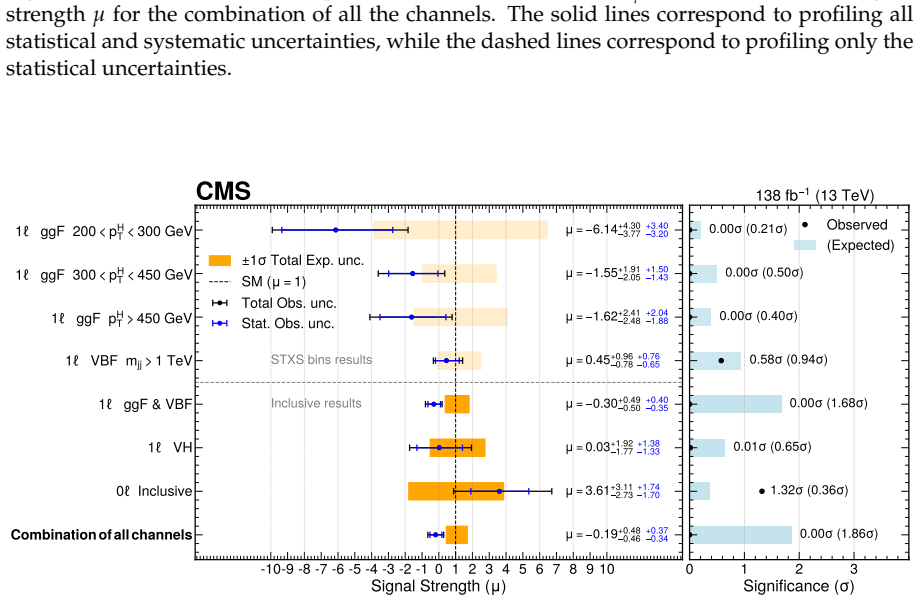
A dedicated search for highly Lorentz-boosted Higgs bosons decaying to W boson pairs finds no excess over background, with the measured signal strength at −0.19 +0.48/−0.46 times the standard-model expectation.
Reviewed by Pith at T0; open to challenge. T0 means a machine referee read the full paper against a public rubric. the ladder, T0–T4 →
T0 review · deepseek-v4-flash
2026-08-04 05:41 UTC pith:6VOCG6HS
load-bearing objection A solid, first-of-its-kind null search for boosted H→WW; the analysis is careful, the main risk is the 0ℓ background transfer function, and the VH top normalization deserves a hard look.
Search for Higgs boson production at high transverse momentum in the WW decay channel in proton-proton collisions at sqrt{s} = 13 TeV
The pith
A machine-rendered reading of the paper's core claim, the machinery that carries it, and where it could break.
Core claim
The central claim is that, in the high-transverse-momentum regime where both W bosons fit inside a single large-radius jet, the H to WW production rate is consistent with the standard-model background prediction. The combined fit to the 0-lepton and 1-lepton channels gives a signal strength of −0.19 +0.48/−0.46, corresponding to an observed significance of 0.0 sigma and an expected significance of 1.86 sigma; when negative signal strengths are allowed, the observed result lies 2.1 standard deviations below the standard-model expectation. The paper thus establishes that no excess of boosted H to WW events appears in the data, and interprets the measurement as the first dedicated study of this
What carries the argument
The load-bearing object is the single large-radius jet that contains the merged decay products of the two W bosons. To recognize the H to WW substructure, the analysis uses PART, a transformer-based self-attention tagger that classifies jets into categories by quark flavor and prong multiplicity; in the 1-lepton channel the tagger is fine-tuned on the lepton-in-jet topology. Signal efficiency is calibrated with Lund-jet-plane reweighting, which rescales simulated jet-splitting densities using W-to-qq data. For semileptonic decays, the candidate mass is reconstructed by adding the missing transverse momentum to the jet under the assumption that the neutrino is collinear with the jet. The domi
Load-bearing premise
The 0-lepton result assumes that the QCD multijet background shape in the signal regions is a smooth, low-order polynomial rescaling of the control-region shape, with no sharp or non-monotonic features near 125 GeV that the fitted transfer functions cannot capture.
What would settle it
In the public data release, compare the post-fit background prediction with the observed data in the 110–140 GeV window of each 0-lepton signal region, and repeat the combined fit with the Bernstein polynomial order increased by one: if a systematic residual appears in several bins around 125 GeV, or if the signal strength shifts by more than roughly 0.3 relative to the published value, the background-only conclusion would not be robust.
If this is right
- The measurement places the first dedicated constraint on boosted H to WW production; even without an excess, it demonstrates the channel's sensitivity and provides a benchmark for future searches in this topology.
- The unfolded simplified-template cross sections in the gluon-fusion transverse-momentum bins and the vector-boson-fusion mass bin give generator-level comparisons for higher-order QCD predictions, which are especially uncertain in the boosted regime.
- The transfer-learning recipe—pre-training a broad jet classifier, then fine-tuning on the narrow lepton-in-jet topology—yields roughly 60% higher signal efficiency at 1% background efficiency, a gain that directly improves the search's expected significance.
- The 0-lepton channel's data-driven background method shows that fully hadronic and non-isolated-lepton WW decays can be included in a boosted-Higgs search, extending coverage beyond the single-isolated-lepton topology.
- The use of the common simplified-template phase-space binning allows this measurement to be combined with other boosted Higgs channels and other decay modes in a joint high-transverse-momentum cross-section extraction.
Where Pith is reading between the lines
- The authors do not stress it, but the negative central signal strength, while consistent with background, is also consistent with a mild suppression of the Higgs rate at high transverse momentum; combining this channel with existing boosted H to bb, tau tau, and gamma gamma measurements in a common fit would sharpen that test.
- The neutrino-collinear mass correction assumes the neutrino shares the jet's pseudorapidity; a closure study in semileptonic top-quark events, where the neutrino momentum can be constrained, would directly quantify any bias in the reconstructed Higgs mass peak near 125 GeV. The paper does not report such a dedicated test.
- The Bernstein transfer functions are fit with unconstrained coefficients in the signal regions, so their fitted shapes can partially absorb smooth data fluctuations near the Higgs mass; an independent background estimate using a high-score sideband in data, rather than a polynomial extrapolation, would be a useful cross-check of the 0-lepton result.
- A natural extension is to apply the same fine-tuned tagger and calibration procedure to the larger dataset now being collected; with more luminosity the expected 1.86 sigma sensitivity would grow, and the currently inclusive 0-lepton channel could be split by production process.
Editorial analysis
A structured set of objections, weighed in public.
Referee Report
Summary. This manuscript reports a search for highly Lorentz-boosted Higgs boson production in the H→WW decay channel using 138 fb^-1 of 13 TeV proton-proton collisions recorded by CMS. Events are classified into a 0-lepton channel (fully hadronic and semileptonic WW decays with nonisolated leptons) and a 1-lepton channel (semileptonic WW decays with an isolated lepton). The Higgs boson is reconstructed as a single large-radius jet, identified with the transformer-based PART tagger, with a fine-tuned variant for the 1-lepton channel and Lund-jet-plane reweighting for signal-efficiency calibration. Backgrounds are estimated via data-driven transfer functions for QCD multijet events in the 0-lepton channel and via simulation with control-region normalizations in the 1-lepton channel. The combined signal strength relative to the standard model expectation is μ = -0.19 +0.48/-0.46, giving no evidence of a signal; the expected significance is 1.86σ and the observed significance is 0.0σ. Results are also presented as simplified template cross sections.
Significance. If correct, this is the first dedicated measurement of highly boosted H→WW production, extending differential Higgs measurements at high transverse momentum to a previously unexplored final state. The analysis is carefully executed: the systematic uncertainty tables are detailed (Table 3), the LJP calibration uncertainty is decomposed into statistical, modeling, and extrapolation components, and the background estimates are cross-checked in data. The paper is honest in reporting a null result and the low expected sensitivity of the 0-lepton channel. The HEPData record supports future combinations. The central null result is robust to plausible uncertainties in the 0-lepton QCD background model because that channel contributes only 0.36σ to the expected combined significance; the 1-lepton channels drive the sensitivity.
minor comments (7)
- [Section 6.2.1, Eqs. (1)–(2)] The notation 'TFia' is undefined and potentially confusing: clarify that the a-type transfer function is shared between TF1a and TF2a, while TF1b and TF2b are independent. In addition, because the transfer-function coefficients are unconstrained and fitted simultaneously with the signal, please state whether any signal-injection closure test was performed to check that the Bernstein polynomial cannot absorb a narrow H→WW peak near 125 GeV. The current text relies on the post-fit pulls and on the Fisher F-test, but a direct statement of the closure would strengthen the dominant 0-lepton systematic.
- [Section 5, LJP calibration] The extrapolation of LJP corrections measured on W→qq decays in data to 3- and 4-prong H→WW signal jets is a core assumption of the signal-efficiency calibration. The tt validation is described, but the paper should explicitly discuss the expected size of non-universality effects (e.g., color connection, subjet matching, or quark flavor) and justify that the quoted 9–27% uncertainty envelope covers these effects.
- [Section 9] The statement that the observed result lies 2.1 standard deviations below the SM expectation should define the test statistic used (e.g., sqrt(t_1) with the uncapped negative-μhat region) and should be reconciled with the quoted asymmetric uncertainty of μ = -0.19 +0.48/-0.46. As written, this claim is easy to misinterpret and should be clarified or softened.
- [Section 3] The sentence 'Parton showering, fragmentation, and hadronization are modeled with PYTHIA8.230 ...' appears twice in Section 3. Also, the statement that electroweak V+2j production corresponds to O(alpha_S^4) seems inconsistent with an electroweak process; please check the coupling order.
- [Table 4] The multi-level column headers for signal strength and significance are difficult to parse. Consider splitting the observed/expected signal strength and the observed/expected significance into separate tables or using clearer column spans.
- [Section 7.1] When more than one AK8 jet satisfies P(H1l)>0.75, the H-candidate jet is not uniquely defined. Please state the selection rule explicitly (presumably the jet with the highest PART score or the one closest to the lepton).
- [Introduction] The claim that this is the 'first dedicated study' of highly Lorentz-boosted H→WW decays should be substantiated with a brief statement confirming the absence of prior dedicated measurements in this exact final state, since the cited differential H→WW measurement [15] does not use the single-jet topology.
Circularity Check
No significant circularity: the signal extraction is a direct likelihood fit to data with external signal templates and data-driven backgrounds.
full rationale
The paper's central claim, mu = -0.19 +0.48/-0.46, is obtained from a binned maximum-likelihood fit in which the signal templates come from SM simulation normalized to published cross sections, not from the data being fitted. The PART tagger is calibrated using Lund jet plane reweighting corrections measured in W->qq data (Ref. [89]), and its residual uncertainties are propagated as nuisance parameters; this is independent of the H->WW signal hypothesis. The 0-lepton QCD multijet background uses Eq. (1), N_SR = N_CR * TF, where the Bernstein polynomial coefficients are treated as unconstrained profiled nuisance parameters determined in the fit. While this means the background shape is not fully independent of the signal region, it is an explicit background-modeling choice with the associated uncertainty quoted as the dominant 0l systematic, not a circular prediction: the coefficients are not defined by the signal strength, and the signal is extracted as a resonance on top of a flexible smooth background. Self-citations such as Refs. [29] and [89] document tagger performance and the calibration method, but the central result does not reduce to an unverified self-citation; the measurement is a direct fit to collision data with externally calibrated inputs. Therefore no circular step can be exhibited under the required standard, and the circularity score is 0.
Axiom & Free-Parameter Ledger
free parameters (5)
- Signal strength mu (combined) =
-0.19 +0.48/-0.46
- QCD transfer-function Bernstein coefficients a_l (0l channel) =
Not quoted; TF degree 3 for SR1a/SR2a and degree 6 for SR1b/SR2b
- W(lv)+jets normalization scale factor (1l channel) =
0.89 +0.13/-0.12
- Top-quark normalization scale factors (1l channel) =
0.97 +0.17/-0.14 (ggF/VBF), 2.01 +0.38/-0.31 (VH)
- LJP signal-efficiency scale factors =
0.84-0.98 (central)
axioms (6)
- domain assumption Standard Model Higgs production cross sections and branching fractions from the LHC Higgs Cross Section Working Group [32] are correct.
- domain assumption Monte Carlo event generators (POWHEG, MadGraph, Sherpa, PYTHIA) plus GEANT4 detector simulation accurately model data after the applied corrections.
- ad hoc to paper The QCD multijet background shape in the 0l signal regions is a smooth low-order Bernstein polynomial extrapolated from control regions with P(H0l) < 0.92.
- ad hoc to paper Lund-jet-plane reweighting corrections measured on W->qq subjets in data apply to H->WW signal jets with two, three, or four quark prongs.
- domain assumption For the 1l signal, the neutrino is collinear with the H-candidate jet axis (eta_nu = eta_j) and p_miss is due solely to the neutrino.
- domain assumption Control regions used to constrain W+jets and top backgrounds contain negligible signal contamination.
read the original abstract
A search for Higgs boson (H) production at high transverse momentum ($p_\mathrm{T}$) in the WW decay channel is presented. The analysis uses proton-proton collisions at $\sqrt{s}$ = 13 TeV recorded by the CMS experiment in 2016$-$2018, corresponding to an integrated luminosity of 138 fb$^{-1}$. The visible decay products of the Higgs boson are reconstructed as a single large-radius jet with one isolated lepton or none (1$\ell$ and 0$\ell$, respectively; $\ell$ = e, $\mu$). The H-candidate jets are identified using an advanced transformer-based algorithm and are calibrated with the Lund jet plane reweighting technique. The 1$\ell$ channel is further split into gluon fusion, vector boson fusion, and associated production with hadronically decaying vector boson categories, while the 0$\ell$ channel considers all production processes inclusively. The measured cross section times the H $\to$ WW branching fraction relative to the standard model expectation is $\mu$ = $-$0.19 $^{+0.48}_{-0.46}$, indicating no evidence of a signal above the background. This measurement represents the first dedicated study of highly Lorentz-boosted H $\to$ WW decays, complementing earlier searches for high-$p_\mathrm{T}$ Higgs boson in other decay channels.
Figures



Forward citations
Cited by 1 Pith paper
-
Particle-Lund Multimodality in Jet Taggers
PLuM multimodal transformer improves top and H->bb jet tagging by jointly processing particle constituents and Lund plane splittings, yielding 25% higher background rejection at 25% di-Higgs efficiency.
Reference graph
Works this paper leans on
-
[1]
ATLAS Collaboration, “Observation of a new particle in the search for the standard model Higgs boson with the ATLAS detector at the LHC”,Phys. Lett. B716(2012) 1, doi:10.1016/j.physletb.2012.08.020,arXiv:1207.7214
Pith/arXiv arXiv 2012
-
[2]
Observation of a new boson at a mass of 125 GeV with the CMS experiment at the LHC
CMS Collaboration, “Observation of a new boson at a mass of 125 GeV with the CMS experiment at the LHC”,Phys. Lett. B716(2012) 30, doi:10.1016/j.physletb.2012.08.021,arXiv:1207.7235
Pith/arXiv arXiv 2012
-
[3]
Observation of a new boson with mass near 125 GeV in pp collisions at √s=7 and 8 TeV
CMS Collaboration, “Observation of a new boson with mass near 125 GeV in pp collisions at √s=7 and 8 TeV”,JHEP06(2013) 081, doi:10.1007/JHEP06(2013)081,arXiv:1303.4571
Pith/arXiv arXiv 2013
-
[4]
A detailed map of Higgs boson interactions by the ATLAS experiment ten years after the discovery
G. Aad et al., “A detailed map of Higgs boson interactions by the ATLAS experiment ten years after the discovery”,Nature607(2022) 52, doi:10.1038/s41586-022-04893-w,arXiv:2207.00092. [Erratum: doi:10.1038/s41586-023-06248-5]
Pith/arXiv arXiv 2022
-
[5]
A portrait of the Higgs boson by the CMS experiment ten years after the discovery
CMS Collaboration, “A portrait of the Higgs boson by the CMS experiment ten years after the discovery”,Nature607(2022) 60,doi:10.1038/s41586-022-04892-x, arXiv:2207.00043. [Corrigendum:doi:10.1038/s41586-023-06164-8]. 26
Pith/arXiv arXiv 2022
-
[6]
Precise predictions for boosted Higgs production
K. Becker et al., “Precise predictions for boosted Higgs production”,SciPost Phys. Core 7(2024) 001,doi:10.21468/SciPostPhysCore.7.1.001,arXiv:2005.07762
Pith/arXiv arXiv 2024
-
[7]
Very boosted Higgs in gluon fusion
C. Grojean, E. Salvioni, M. Schlaffer, and A. Weiler, “Very boosted Higgs in gluon fusion”,JHEP05(2014) 22,doi:10.1007/jhep05(2014)022,arXiv:1312.3317
Pith/arXiv arXiv 2014
-
[8]
M. Schlaffer et al., “Boosted Higgs shapes”,Eur. Phys. J. C74(2014) 3120, doi:10.1140/epjc/s10052-014-3120-z,arXiv:1405.4295
Pith/arXiv arXiv 2014
-
[9]
Usefulness of effective field theory for boosted Higgs production
S. Dawson, I. M. Lewis, and M. Zeng, “Usefulness of effective field theory for boosted Higgs production”,Phys. Rev. D91(2015) 074012, doi:10.1103/physrevd.91.074012,arXiv:1501.04103
Pith/arXiv arXiv 2015
-
[10]
Modeling BSM effects on the Higgs transverse-momentum spectrum in an EFT approach
M. Grazzini, A. Ilnicka, M. Spira, and M. Wiesemann, “Modeling BSM effects on the Higgs transverse-momentum spectrum in an EFT approach”,JHEP03(2017) 115, doi:10.1007/jhep03(2017)115,arXiv:1612.00283
Pith/arXiv arXiv 2017
-
[11]
F. Maltoni, K. Mawatari, and M. Zaro, “Higgs characterisation via vector-boson fusion and associated production: NLO and parton-shower effects”,Eur. Phys. J. C74(2014) 2710,doi:10.1140/epjc/s10052-013-2710-5,arXiv:1311.1829
Pith/arXiv arXiv 2014
-
[12]
C. Degrande et al., “Electroweak Higgs boson production in the standard model effective field theory beyond leading order in QCD”,Eur. Phys. J. C77(2017) 262, doi:10.1140/epjc/s10052-017-4793-x,arXiv:1609.04833
Pith/arXiv arXiv 2017
-
[13]
CMS Collaboration, “Measurement and interpretation of differential cross sections for Higgs boson production at √s=13 TeV”,Phys. Lett. B792(2019) 369, doi:10.1016/j.physletb.2019.03.059,arXiv:1812.06504
Pith/arXiv arXiv 2019
-
[14]
CMS Collaboration, “Measurement of the Higgs boson inclusive and differential fiducial production cross sections in the diphoton decay channel with pp collisions at√s=13 TeV”,JHEP07(2023) 091,doi:10.1007/JHEP07(2023)091, arXiv:2208.12279
Pith/arXiv arXiv 2023
-
[15]
CMS Collaboration, “Measurement of the inclusive and differential Higgs boson production cross sections in the leptonic WW decay mode at √s=13 TeV”,JHEP03 (2021) 003,doi:10.1007/JHEP03(2021)003,arXiv:2007.01984
Pith/arXiv arXiv 2021
-
[16]
CMS Collaboration, “Measurement of the inclusive and differential Higgs boson production cross sections in the decay mode to a pair ofτleptons in pp collisions at√s=13 TeV”,Phys. Rev. Lett.128(2022) 081805, doi:10.1103/PhysRevLett.128.081805,arXiv:2107.11486
Pith/arXiv arXiv 2022
-
[17]
CMS Collaboration, “Measurements of inclusive and differential cross sections for the Higgs boson production and decay to four-leptons in proton-proton collisions at√s=13 TeV”,JHEP08(2023) 040,doi:10.1007/JHEP08(2023)040, arXiv:2305.07532
Pith/arXiv arXiv 2023
-
[18]
Inclusive search for a highly boosted Higgs boson decaying to a bottom quark-antiquark pair
CMS Collaboration, “Inclusive search for a highly boosted Higgs boson decaying to a bottom quark-antiquark pair”,Phys. Rev. Lett.120(2018) 071802, doi:10.1103/physrevlett.120.071802,arXiv:1709.05543
Pith/arXiv arXiv 2018
-
[19]
CMS Collaboration, “Inclusive search for highly boosted Higgs bosons decaying to bottom quark-antiquark pairs in proton-proton collisions at √s=13 TeV”,JHEP12 (2020) 085,doi:10.1007/jhep12(2020)085,arXiv:2006.13251. References 27
Pith/arXiv arXiv 2020
-
[20]
CMS Collaboration, “Search for a boosted Higgs boson decaying to bottom quark pairs in association with a W or Z boson in proton-proton collisions at √s=13 TeV”, 2026. arXiv:2601.05362. Submitted toPhys. Lett. B
Pith/arXiv arXiv 2026
-
[21]
ATLAS Collaboration, “Constraints on Higgs boson production with large transverse momentum using H→b b decays in the ATLAS detector”,Phys. Rev. D105(2022) 092003,doi:10.1103/PhysRevD.105.092003,arXiv:2111.08340
Pith/arXiv arXiv 2022
-
[22]
ATLAS Collaboration, “Study of high-transverse-momentum Higgs boson production in association with a vector boson in the qqbb final state with the ATLAS detector”, Phys. Rev. Lett.132(2024) 131802,doi:10.1103/PhysRevLett.132.131802, arXiv:2312.07605
Pith/arXiv arXiv 2024
-
[23]
CMS Collaboration, “Measurement of the production cross section of a Higgs boson with large transverse momentum in its decays to a pair ofτleptons in proton-proton collisions at √s=13 TeV”,Phys. Lett. B857(2024) 138964, doi:10.1016/j.physletb.2024.138964,arXiv:2403.20201
arXiv 2024
-
[24]
Precision luminosity measurement in proton-proton collisions at√s=13 TeV in 2015 and 2016 at CMS
CMS Collaboration, “Precision luminosity measurement in proton-proton collisions at√s=13 TeV in 2015 and 2016 at CMS”,Eur. Phys. J. C81(2021) 800, doi:10.1140/epjc/s10052-021-09538-2,arXiv:2104.01927
Pith/arXiv arXiv 2015
-
[25]
CMS luminosity measurement for the 2017 data-taking period at√s=13 TeV
CMS Collaboration, “CMS luminosity measurement for the 2017 data-taking period at√s=13 TeV”, CMS Physics Analysis Summary CMS-PAS-LUM-17-004, 2018
2017
-
[26]
CMS luminosity measurement for the 2018 data-taking period at√s=13 TeV
CMS Collaboration, “CMS luminosity measurement for the 2018 data-taking period at√s=13 TeV”, CMS Physics Analysis Summary CMS-PAS-LUM-18-002, 2019
2018
-
[27]
Particle transformer for jet tagging
H. Qu, C. Li, and S. Qian, “Particle transformer for jet tagging”, inProc. 39th Int. Conf. on Machine Learning, K. Chaudhuri et al., eds., volume 162, p. 18281. 2022. arXiv:2202.03772
Pith/arXiv arXiv 2022
-
[28]
A. Vaswani et al., “Attention is all you need”, inAdvances in Neural Information Processing Systems, I. Guyon et al., eds., volume 30. 2017.arXiv:1706.03762
Pith/arXiv arXiv 2017
-
[29]
Particle transformers for identifying Lorentz-boosted Higgs bosons decaying to a pair of W bosons
CMS Collaboration, “Particle transformers for identifying Lorentz-boosted Higgs bosons decaying to a pair of W bosons”, CMS Physics Analysis Summary CMS-PAS-JME-25-001, 2025
2025
-
[30]
ParticleNet: Jet tagging via particle clouds
H. Qu and L. Gouskos, “ParticleNet: Jet tagging via particle clouds”,Phys. Rev. D101 (2020) 056019,doi:10.1103/PhysRevD.101.056019,arXiv:1902.08570
Pith/arXiv arXiv 2020
-
[31]
CMS Collaboration, “Identification of heavy, energetic, hadronically decaying particles using machine-learning techniques”,JINST15(2020) P06005, doi:10.1088/1748-0221/15/06/P06005,arXiv:2004.08262
Pith/arXiv arXiv 2020
-
[32]
Handbook of LHC Higgs Cross Sections: 4. Deciphering the nature of the Higgs sector
LHC Higgs Cross Section Working Group, “Handbook of LHC Higgs Cross Sections: 4. Deciphering the nature of the Higgs sector”,CERN Y ellow Rep. Monogr.2(2017) doi:10.23731/CYRM-2017-002,arXiv:1610.07922
Pith/arXiv arXiv 2017
-
[33]
Simplified template cross sections — Stage 1.1 and 1.2
LHC Higgs Cross Section Working Group, “Simplified template cross sections — Stage 1.1 and 1.2”, Public Note LHCHWG-INT-2025-001, 2025
2025
-
[34]
HEPData record for this analysis
“HEPData record for this analysis”, 2026.doi:10.17182/hepdata.167419. 28
-
[35]
The CMS experiment at the CERN LHC
CMS Collaboration, “The CMS experiment at the CERN LHC”,JINST3(2008) S08004, doi:10.1088/1748-0221/3/08/S08004
-
[36]
Development of the CMS detector for the CERN LHC Run 3
CMS Collaboration, “Development of the CMS detector for the CERN LHC Run 3”, JINST19(2024) P05064,doi:10.1088/1748-0221/19/05/P05064, arXiv:2309.05466
Pith/arXiv arXiv 2024
-
[37]
Performance of the CMS Level-1 trigger in proton-proton collisions at √s=13 TeV
CMS Collaboration, “Performance of the CMS Level-1 trigger in proton-proton collisions at √s=13 TeV”,JINST15(2020) P10017, doi:10.1088/1748-0221/15/10/P10017,arXiv:2006.10165
Pith/arXiv arXiv 2020
-
[38]
CMS Collaboration, “The CMS trigger system”,JINST12(2017) P01020, doi:10.1088/1748-0221/12/01/P01020,arXiv:1609.02366
Pith/arXiv arXiv 2017
-
[39]
Performance of the CMS high-level trigger during LHC Run 2
CMS Collaboration, “Performance of the CMS high-level trigger during LHC Run 2”, JINST19(2024) P11021,doi:10.1088/1748-0221/19/11/P11021, arXiv:2410.17038
Pith/arXiv arXiv 2024
-
[40]
Electron and photon reconstruction and identification with the CMS experiment at the CERN LHC
CMS Collaboration, “Electron and photon reconstruction and identification with the CMS experiment at the CERN LHC”,JINST16(2021) P05014, doi:10.1088/1748-0221/16/05/P05014,arXiv:2012.06888
Pith/arXiv arXiv 2021
-
[41]
CMS Collaboration, “Performance of the CMS muon detector and muon reconstruction with proton-proton collisions at √s=13 TeV”,JINST13(2018) P06015, doi:10.1088/1748-0221/13/06/P06015,arXiv:1804.04528
Pith/arXiv arXiv 2018
-
[42]
Description and performance of track and primary-vertex reconstruction with the CMS tracker
CMS Collaboration, “Description and performance of track and primary-vertex reconstruction with the CMS tracker”,JINST9(2014) P10009, doi:10.1088/1748-0221/9/10/P10009,arXiv:1405.6569
Pith/arXiv arXiv 2014
-
[43]
Merging H/W/Z + 0 and 1 jet at NLO with no merging scale: a path to parton shower + NNLO matching
K. Hamilton, P . Nason, C. Oleari, and G. Zanderighi, “Merging H/W/Z + 0 and 1 jet at NLO with no merging scale: a path to parton shower + NNLO matching”,JHEP05 (2013) 082,doi:10.1007/JHEP05(2013)082,arXiv:1212.4504
Pith/arXiv arXiv 2013
-
[44]
NLO Higgs+jet production at large transverse momenta including top quark mass effects
T. Neumann, “NLO Higgs+jet production at large transverse momenta including top quark mass effects”,J. Phys. Commun.2(2018) 095017, doi:10.1088/2399-6528/aadfbf,arXiv:1802.02981
Pith/arXiv arXiv 2018
-
[45]
NLO Higgs boson production via vector-boson fusion matched with shower inPOWHEG
P . Nason and C. Oleari, “NLO Higgs boson production via vector-boson fusion matched with shower inPOWHEG”,JHEP02(2010) 037,doi:10.1007/JHEP02(2010)037, arXiv:0911.5299
Pith/arXiv arXiv 2010
-
[46]
HW±/HZ + 0 and 1 jet at NLO with thePOWHEG BOXinterfaced to GOSAMand their merging within MINLO
G. Luisoni, P . Nason, C. Oleari, and F. Tramontano, “HW±/HZ + 0 and 1 jet at NLO with thePOWHEG BOXinterfaced to GOSAMand their merging within MINLO”,JHEP 10(2013) 083,doi:10.1007/JHEP10(2013)083,arXiv:1306.2542
Pith/arXiv arXiv 2013
-
[47]
Higgs boson production in association with top quarks in thePOWHEG BOX
H. B. Hartanto, B. Jager, L. Reina, and D. Wackeroth, “Higgs boson production in association with top quarks in thePOWHEG BOX”,Phys. Rev. D91(2015) 094003, doi:10.1103/PhysRevD.91.094003,arXiv:1501.04498
Pith/arXiv arXiv 2015
-
[48]
A general framework for implementing NLO calculations in shower Monte Carlo programs: thePOWHEG BOX
S. Alioli, P . Nason, C. Oleari, and E. Re, “A general framework for implementing NLO calculations in shower Monte Carlo programs: thePOWHEG BOX”,JHEP06(2010) 043, doi:10.1007/JHEP06(2010)043,arXiv:1002.2581. References 29
Pith/arXiv arXiv 2010
-
[49]
On the spin and parity of a single-produced resonance at the LHC
S. Bolognesi et al., “On the spin and parity of a single-produced resonance at the LHC”, Phys. Rev. D86(2012) 095031,doi:10.1103/PhysRevD.86.095031, arXiv:1208.4018
Pith/arXiv arXiv 2012
-
[50]
T. Sj ¨ostrand et al., “An introduction toPYTHIA8.2”,Comput. Phys. Commun.191(2015) 159,doi:10.1016/j.cpc.2015.01.024,arXiv:1410.3012
Pith/arXiv arXiv 2015
-
[51]
J. Alwall et al., “The automated computation of tree-level and next-to-leading order differential cross sections, and their matching to parton shower simulations”,JHEP07 (2014) 079,doi:10.1007/JHEP07(2014)079,arXiv:1405.0301
Pith/arXiv arXiv 2014
-
[52]
Event generation withSHERPA1.1
T. Gleisberg et al., “Event generation withSHERPA1.1”,JHEP02(2009) 007, doi:10.1088/1126-6708/2009/02/007,arXiv:0811.4622
Pith/arXiv arXiv 2009
-
[53]
Event Generation withSHERPA2.2
Sherpa Collaboration, “Event Generation withSHERPA2.2”,SciPost Phys.7(2019) 034, doi:10.21468/SciPostPhys.7.3.034,arXiv:1905.09127
Pith/arXiv arXiv 2019
-
[54]
COMIX, a new matrix element generator
T. Gleisberg and S. Hoeche, “COMIX, a new matrix element generator”,JHEP12(2008) 039,doi:10.1088/1126-6708/2008/12/039,arXiv:0808.3674
Pith/arXiv arXiv 2008
-
[55]
J. Alwall et al., “Comparative study of various algorithms for the merging of parton showers and matrix elements in hadronic collisions”,Eur. Phys. J. C53(2008) 473, doi:10.1140/epjc/s10052-007-0490-5,arXiv:0706.2569
Pith/arXiv arXiv 2008
-
[56]
QCD matrix elements + parton showers: The NLO case
S. Hoeche, F. Krauss, M. Schonherr, and F. Siegert, “QCD matrix elements + parton showers: The NLO case”,JHEP04(2013) 027,doi:10.1007/JHEP04(2013)027, arXiv:1207.5030
Pith/arXiv arXiv 2013
-
[57]
Merging meets matching inMC@NLO
R. Frederix and S. Frixione, “Merging meets matching inMC@NLO”,JHEP12(2012) 061,doi:10.1007/JHEP12(2012)061,arXiv:1209.6215
Pith/arXiv arXiv 2012
-
[58]
NLO electroweak automation and precise predictions for W+multijet production at the LHC
S. Kallweit et al., “NLO electroweak automation and precise predictions for W+multijet production at the LHC”,JHEP04(2015) 012,doi:10.1007/JHEP04(2015)012, arXiv:1412.5157
Pith/arXiv arXiv 2015
-
[59]
NLO QCD+EW predictions for V+jets including off-shell vector-boson decays and multijet merging
S. Kallweit et al., “NLO QCD+EW predictions for V+jets including off-shell vector-boson decays and multijet merging”,JHEP04(2016) 021, doi:10.1007/JHEP04(2016)021,arXiv:1511.08692
Pith/arXiv arXiv 2016
-
[60]
NLO QCD+EW automation and precise predictions for V+multijet production
S. Kallweit et al., “NLO QCD+EW automation and precise predictions for V+multijet production”, inProc. 50th Int. Conf. Rencontres de Moriond on QCD and High Energy Interactions, p. 121. 2015.arXiv:1505.05704
Pith/arXiv arXiv 2015
-
[61]
Precise predictions for V+jets dark matter backgrounds
J. M. Lindert et al., “Precise predictions for V+jets dark matter backgrounds”,Eur. Phys. J. C77(2017) 829,doi:10.1140/epjc/s10052-017-5389-1, arXiv:1705.04664
Pith/arXiv arXiv 2017
-
[62]
A new method for combining NLO QCD with shower Monte Carlo algorithms
P . Nason, “A new method for combining NLO QCD with shower Monte Carlo algorithms”,JHEP11(2004) 040,doi:10.1088/1126-6708/2004/11/040, arXiv:hep-ph/0409146
Pith/arXiv arXiv 2004
-
[63]
Matching NLO QCD computations with parton shower simulations: the POWHEG method
S. Frixione, P . Nason, and C. Oleari, “Matching NLO QCD computations with parton shower simulations: the POWHEG method”,JHEP11(2007) 070, doi:10.1088/1126-6708/2007/11/070,arXiv:0709.2092. 30
Pith/arXiv arXiv 2007
-
[64]
Hadronic top-quark pair-production with one jet and parton showering
S. Alioli, S.-O. Moch, and P . Uwer, “Hadronic top-quark pair-production with one jet and parton showering”,JHEP01(2012) 137,doi:10.1007/JHEP01(2012)137, arXiv:1110.5251
Pith/arXiv arXiv 2012
-
[65]
NLO single-top production matched with shower inPOWHEG:s- andt-channel contributions
S. Alioli, P . Nason, C. Oleari, and E. Re, “NLO single-top production matched with shower inPOWHEG:s- andt-channel contributions”,JHEP09(2009) 111, doi:10.1088/1126-6708/2009/09/111,arXiv:0907.4076. [Erratum: doi:10.1007/JHEP02(2010)011]
Pith/arXiv arXiv 2009
-
[66]
Single-topt-channel hadroproduction in the four-flavour scheme withPOWHEGand aMC@NLO
R. Frederix, E. Re, and P . Torrielli, “Single-topt-channel hadroproduction in the four-flavour scheme withPOWHEGand aMC@NLO”,JHEP09(2012) 130, doi:10.1007/JHEP09(2012)130,arXiv:1207.5391
Pith/arXiv arXiv 2012
-
[67]
MCFMfor the Tevatron and the LHC
J. M. Campbell and R. K. Ellis, “MCFMfor the Tevatron and the LHC”,Nucl. Phys. Proc. Suppl.205(2010) 10,doi:10.1016/j.nuclphysbps.2010.08.011, arXiv:1007.3492
Pith/arXiv arXiv 2010
-
[68]
Extraction and validation of a new set of CMSPYTHIA8 tunes from underlying-event measurements
CMS Collaboration, “Extraction and validation of a new set of CMSPYTHIA8 tunes from underlying-event measurements”,Eur. Phys. J. C80(2020) 4, doi:10.1140/epjc/s10052-019-7499-4,arXiv:1903.12179
Pith/arXiv arXiv 2020
-
[69]
Parton distributions from high-precision collider data
NNPDF Collaboration, “Parton distributions from high-precision collider data”,Eur. Phys. J. C77(2017) 663,doi:10.1140/epjc/s10052-017-5199-5, arXiv:1706.00428
Pith/arXiv arXiv 2017
-
[70]
GEANT4 Collaboration, “GEANT4—a simulation toolkit”,Nucl. Instrum. Meth. A506 (2003) 250,doi:10.1016/S0168-9002(03)01368-8
-
[71]
GEANT4 developments and applications
J. Allison et al., “GEANT4 developments and applications”,IEEE T rans. Nucl. Sci.53 (2006) 270,doi:10.1109/TNS.2006.869826
arXiv 2006
-
[72]
Particle-flow reconstruction and global event description with the CMS detector
CMS Collaboration, “Particle-flow reconstruction and global event description with the CMS detector”,JINST12(2017) P10003,doi:10.1088/1748-0221/12/10/p10003, arXiv:1706.04965
Pith/arXiv arXiv 2017
-
[73]
Technical proposal for the Phase-II upgrade of the Compact Muon Solenoid
CMS Collaboration, “Technical proposal for the Phase-II upgrade of the Compact Muon Solenoid”, CMS Technical Proposal CERN-LHCC-2015-010, CMS-TDR-15-02, 2015
2015
-
[74]
The anti-kT jet clustering algorithm
M. Cacciari, G. P . Salam, and G. Soyez, “The anti-kT jet clustering algorithm”,JHEP04 (2008) 063,doi:10.1088/1126-6708/2008/04/063,arXiv:0802.1189
Pith/arXiv arXiv 2008
-
[75]
M. Cacciari, G. P . Salam, and G. Soyez, “FastJet user manual”,Eur. Phys. J. C72(2012) 1896,doi:10.1140/epjc/s10052-012-1896-2,arXiv:1111.6097
Pith/arXiv arXiv 2012
-
[76]
Pileup mitigation at CMS in 13 TeV data
CMS Collaboration, “Pileup mitigation at CMS in 13 TeV data”,JINST15(2020) P09018, doi:10.1088/1748-0221/15/09/p09018,arXiv:2003.00503
Pith/arXiv arXiv 2020
-
[77]
Pileup per particle identification
D. Bertolini, P . Harris, M. Low, and N. Tran, “Pileup per particle identification”,JHEP 10(2014) 059,doi:10.1007/JHEP10(2014)059,arXiv:1407.6013
Pith/arXiv arXiv 2014
-
[78]
Jet energy scale and resolution in the CMS experiment in pp collisions at 8 TeV
CMS Collaboration, “Jet energy scale and resolution in the CMS experiment in pp collisions at 8 TeV”,JINST12(2017) P02014, doi:10.1088/1748-0221/12/02/P02014,arXiv:1607.03663. References 31
Pith/arXiv arXiv 2017
-
[79]
Jet algorithms performance in 13 TeV data
CMS Collaboration, “Jet algorithms performance in 13 TeV data”, CMS Physics Analysis Summary CMS-PAS-JME-16-003, 2017
2017
-
[80]
CMS Collaboration, “Performance of missing transverse momentum reconstruction in proton-proton collisions at √s=13 TeV using the CMS detector”,JINST14(2019) P07004,doi:10.1088/1748-0221/14/07/P07004,arXiv:1903.06078
Pith/arXiv arXiv 2019
discussion (0)
Sign in with ORCID, Apple, or X to comment. Anyone can read and Pith papers without signing in.