REVIEW 5 major objections 4 minor 49 references
From Search To Sampling: Generative Models For Robust Algorithmic Recourse
T0 review · 5 major / 4 minor · reviewed 2026-08-15 · deepseek-v4-flash
Pith's one-line read The paper claims that algorithmic recourse should be modeled as a conditional sampling distribution, and that training a generator on cost-weighted positive pairs produces recourse that is more valid, more plausible, and less costly than…
desk verdict A genuinely new and empirically strong recourse generator, but the consistency proof covers a different sampler than the one actually trained; treat it as an engineering contribution, not a theoretical one. read the letter →
The pith
A machine-rendered reading of the paper's core claim, the machinery that carries it, and where it could break.
The reading
What carries the argument
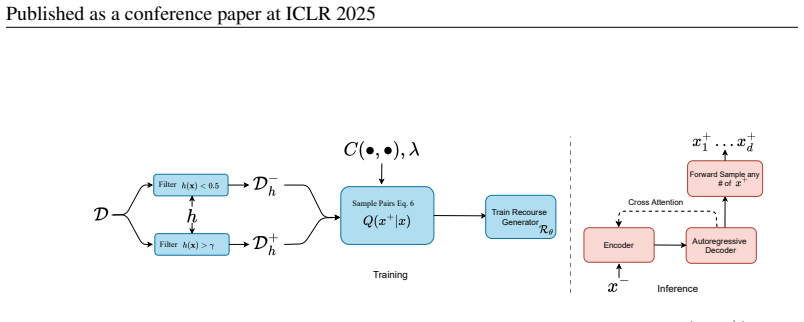
The argument turns on the ideal recourse distribution R(x+|x) ∝ exp(-λ C(x,x+)) P(x+|y+) V(x+), and on the empirical proposal Q(x+|x) that replaces it during training. Q puts probability on high-confidence positive instances proportional to exp(-λ cost); the proof that Q is a consistent, self-normalized importance-sampling estimate of R is what licenses training a likelihood model on pairs and then only sampling at inference. The model itself is an autoregressive encoder-decoder transformer whose final layer outputs a kernel mixture per feature, which lets sampling proceed feature-by-feature.
What would settle it
On synthetic data with a known true model P(y+|x), train the classifier to be imperfectly calibrated and set the pair filter threshold γ above 0.5; because Q assigns zero probability to genuinely valid positives whose true P(y+|x) lies between 0.5 and γ, the importance-sampling support condition fails, and one should observe the sampled recourse's validity drop below what Theorem 4.1 predicts as γ increases. Measuring that drop would settle the role of the classifier fidelity assumption.
Extended reading notes
Core claim
The central claim is that a conditional recourse likelihood model R_θ(x+|x) can be trained to output the ideal recourse distribution exp(-λ C(x,x+)) P(x+|y+) V(x+), where C is the cost of moving from x to x+, P(x+|y+) is the density of plausible positives, and V(x+) indicates that the outcome flips. The paper constructs an empirical sampling distribution Q(x+|x) over positives h-calibrated above a threshold, weighted by exp(-λ C(x,x+)), and proves via self-normalized importance sampling that training on pairs from Q is consistent—with error in the expected recourse instance decreasing at rate 1/N+—when the classifier h agrees with the true conditional probability on which points are favorable. The trained model is an autoregressive transformer with per-feature kernel-density outputs, so inference is forward sampling; empirically on Adult Income, COMPAS, and HELOC, GenRe achieves the best combined validity, plausibility, and cost among nine methods, with scores near the theoretical maximum of 2 on every dataset.
Load-bearing premise
All guarantees and much of the empirical success depend on the classifier h being a faithful proxy for the true probability of a favorable outcome, so that the high-confidence positives it selects are genuinely valid and the final sampled recourse truly flips the decision.
Editorial extensions
If this is right
- Once GenRe is trained, a new denial gets recourse by a single forward pass, so per-user response time and cost drop dramatically compared with iterative optimization.
- Sampling gives users a menu of recourse options—potentially diverse in which features change—so the user can pick the action they can actually implement.
- The training procedure requires only unpaired labeled data, a cost function, and a classifier, so it transfers to any setting where these three are available without needing recourse examples.
- Because the objectives are fused during training rather than at inference, GenRe's behavior degrades gracefully as the cost weight λ changes, unlike inference-time joint optimization which shows sharp swings in validity and plausibility.
- The consistency theorem ties the quality of sampling-based recourse to the fidelity of the classifier, giving a concrete quantity (the agreement between h and P(y+|x)) that practitioners can audit before deploying the recourse model.
Reading between the lines
- A testable extension is to apply the same pair-sampling recipe to high-dimensional data (images, text) with a continuous decoder; the consistency argument should survive, but the support condition on Q becomes harder to satisfy as the positive manifold grows sparse.
- The paper never reports the exact value of γ it used; an immediate experiment is to sweep γ between 0.5 and higher values and check whether validity or the 1/N+ convergence rate degrades, which would indicate the thresholding is actively discarding valid positives.
- The nearest-neighbor ablation suggests the learned model's advantage lies in interpolating between training positives; if so, GenRe should show larger gains over NNR on datasets where positive regions are sparsely populated, a prediction that could be tested by subsampling D+_h.
- Amortizing recourse into a trained sampler fits a broader 'inference = one forward pass' trend; if this holds, recourse could be offered in real-time interactive settings, and the training data could be updated as the deployed model drifts, yielding a form of recourse lifelong learning.
Signed reviews
Editorial analysis
A structured set of objections, weighed in public.
Referee Report
Summary. The paper proposes GenRe, an autoregressive conditional generative model for algorithmic recourse. Training pairs are synthesized from unpaired labeled data by pairing each negative instance x with positive instances x+ weighted by exp(-lambda C(x,x+)) among classifier-confident positives (D_h^+). The model is trained with a kernel-mixture cross-entropy loss, and at inference recourse is obtained by forward sampling, followed by selecting the sample with the highest classifier probability. The authors prove, under an idealized assumption that h matches P(y+|x), that the empirical pairing distribution Q consistently estimates an ideal recourse density R, and they report experiments on Adult, COMPAS, and HELOC against eight baselines, claiming that GenRe achieves the best composite score and the best cost-validity-plausibility trade-off.
Significance. If the central claims hold, the paper offers a useful alternative to inference-time optimization for recourse: a conditional recourse likelihood model that can be sampled from directly, which is conceptually cleaner and avoids brittle gradient-based search. The empirical study is broad (three datasets, eight baselines, a separate random-forest gold classifier, sensitivity analyses over lambda, temperature, and kernel width, plus a comparison against diffusion models with guidance), and the code is released. The main theoretical contribution, however, is currently a consistency result for the synthesized pair distribution Q rather than for the trained generator R_theta, and several implementation details (gamma, K) needed to connect the theory to the experiments are not reported. These gaps affect the strength of the headline claims but appear addressable.
major comments (5)
- [Section 4.4, Theorem 4.1] Theorem 4.1 establishes only that the empirical conditional distribution Q(x+|x) is a consistent self-normalized importance-sampling estimate of the ideal R(x+|x). It does not establish that the trained autoregressive model R_theta converges to R. The training loss in Eqs. (7)-(8) is a likelihood-type objective on pairs drawn from Q_trunc, but no generalization bound, universal-consistency argument, or sample-complexity statement connects R_theta to R. The conclusion states "We proved these pairs are consistent, and hence GenRe's method of training on them is consistent with the ideal recourse objective," which is a non sequitur unless R_theta is assumed to fit the sampled pairs perfectly. Because the abstract's consistency claim refers to GenRe's training, this gap is load-bearing.
- [Section 4.1 and Theorem 4.1] The support condition for the importance-sampling argument is not satisfied by the implemented sampler. D_h^+ is defined with h(x)>gamma for a chosen gamma>=0.5, while the proof sets V(x+)=delta(P(y+|x)>0.5) and, in Eq. (9), sums the numerator over D1 but the denominator over D_h^+. If gamma>0.5, instances with 0.5<P(y+|x)<=gamma are in the target support (V=1) but have zero probability under Q, violating the proposal-support condition for self-normalized importance sampling. The manuscript never reports the gamma value used in any experiment. If gamma=0.5 was used, the support condition is restored, but the text and Algorithm 1 must say so; otherwise the consistency guarantee does not apply to the implemented sampler.
- [Algorithm 1 and Appendix C.2] Algorithm 1 does not sample from Q: line 3 defines Q_trunc by TopK truncation, and line 6 draws training pairs from Q_trunc. Neither K nor the truncation step appears in Theorem 4.1, and with a fixed K the asymptotic consistency and the O(1/N+) rate in Theorem 4.2 do not follow. K is not listed among the hyperparameters in Appendix C.2. The paper should either prove a statement for the truncated proposal, report K and justify its value empirically, or explicitly reposition the theory as applying to an untruncated idealized version of the training procedure.
- [Theorem 4.2 and Section 5.1] The rate claim in Theorem 4.2 is stated "when h(x) is the actual conditional distribution P(Y|X)", but in the experiments h is a three-layer ANN with accuracies of 77.33%, 69.60%, and 74.23% on the three datasets (Table 1), and the gold labels come from a separate calibrated Random Forest. The paper provides no misspecification analysis, so the consistency and rate results do not directly cover the experimental regime. At minimum, the theoretical section should be reframed as an idealized analysis, and the experiments should report the agreement or calibration between h and the gold classifier that is needed to connect the two.
- [Table 2 and Section 5.2] The composite metric Score=Val+LOF-Cost/d is used to support the headline claim that GenRe provides the best overall trade-off. Dividing cost by d makes the cost term negligible when d is large (d=21 for HELOC), and the equal additive combination of validity and LOF is arbitrary. Moreover, on cost alone GenRe is worse than Wachter and DICE on Adult (0.69 vs 0.31 and 0.22, respectively), so the abstract's phrase "superior performance across multiple metrics" is not literally accurate as stated. I recommend reporting the trade-offs with a cost-weight sweep, or using a composite metric whose functional form is justified.
minor comments (4)
- [Section 5.1] The text says eight prior recourse methods are compared but then lists nine names (Wachter, GS, DICE, ROAR, PROBE, REVISE, CRUDS, CCHVAE, and TAP); Table 2 contains no REVISE row. Please clarify which methods are actually reported.
- [Section 5.1 and Algorithm 2] Section 5.1 reports tau=10.00 and sigma=0.00, but Algorithm 2 samples x'_j = mu_{j,k}+sigma_{j,k}*epsilon and Appendix D.2 reports sigma values in {2e-7, ..., 2e-2} with no 0.00 setting. Please reconcile these settings.
- [Theorem 4.1 proof] The proof defines V(x+) as delta(P(y+|x)>0.5), which appears to be a typo for P(y+|x+) (or h(x+)); please correct the notation.
- [Figure 4] The caption states that the x-axis is on an exponential scale, but the axis labels show linear cost values; please clarify or correct the caption.
Circularity Check
No significant circularity: the consistency claim is a standard importance-sampling argument and the empirical evaluation is against an external Random Forest, not the training signal.
full rationale
GenRe's derivation chain is: define ideal recourse density R(x+|x) ∝ exp(−λC(x,x+))P(x+|y+)V(x+) (Eq. 5); construct an empirical proposal Q over high-confidence positive training examples (Eq. 6); train R_θ by MLE on pairs sampled from Q; and at inference forward-sample from R_θ. Theorem 4.1 is a self-normalized importance-sampling consistency argument: Q is the empirical plug-in version of R with the positive-class density replaced by D_h^+ and validity enforced by h. This is a standard statistical guarantee, not a fitted equation renamed as a prediction. The same classifier h appears both in constructing D_h^+ and in choosing among the 10 forward samples (Sec. 5.1), but the reported validity is evaluated with a separate calibrated Random Forest that no method sees during training, so the headline results are not forced by construction. There are no load-bearing self-citations; the only external authority invoked for the variance rate is Koller & Friedman (2009). The paper does have proof-coverage gaps—the text allows γ≥0.5 although the proof assumes agreement of h and P at 0.5, and Algorithm 1 truncates Q to TopK without a matching theorem, while γ and K are never reported—but these are correctness/reproducibility concerns, not cases where a result reduces to its own input by definition. Accordingly, no circular step is identified.
Assumptions & free parameters
free parameters (4)
- lambda =
5.0
- gamma =
not reported
- tau =
10.0
- sigma =
0.00
assumptions (4)
- standard math Self-normalized importance sampling yields consistent estimates when the proposal support covers the target support.
- domain assumption The classifier h is a calibrated proxy for P(y+|x), so h(x)>0.5 agrees with P(y+|x)>0.5 and D+_h covers the valid region.
- ad hoc to paper The ideal recourse objective has the form R(x+|x) proportional to exp(-lambda C(x,x+)) P(x+|y+) V(x+).
- domain assumption LOF inlier fraction is a valid measure of recourse plausibility.
Cite this review
Pith. "Pith review of From Search To Sampling: Generative Models For Robust Algorithmic Recourse." pith.science (2026). https://pith.science/paper/735RVSCE
@misc{pith2026250507351,
  author       = {Pith},
  title        = {Pith review of: From Search To Sampling: Generative Models For Robust Algorithmic Recourse},
  year         = {2026},
  howpublished = {\url{https://pith.science/paper/735RVSCE}},
  note         = {Machine review of arXiv:2505.07351}
}
read the original abstract
Algorithmic Recourse provides recommendations to individuals who are adversely impacted by automated model decisions, on how to alter their profiles to achieve a favorable outcome. Effective recourse methods must balance three conflicting goals: proximity to the original profile to minimize cost, plausibility for realistic recourse, and validity to ensure the desired outcome. We show that existing methods train for these objectives separately and then search for recourse through a joint optimization over the recourse goals during inference, leading to poor recourse recommendations. We introduce GenRe, a generative recourse model designed to train the three recourse objectives jointly. Training such generative models is non-trivial due to lack of direct recourse supervision. We propose efficient ways to synthesize such supervision and further show that GenRe's training leads to a consistent estimator. Unlike most prior methods, that employ non-robust gradient descent based search during inference, GenRe simply performs a forward sampling over the generative model to produce minimum cost recourse, leading to superior performance across multiple metrics. We also demonstrate GenRe provides the best trade-off between cost, plausibility and validity, compared to state-of-art baselines. Our code is available at: https://github.com/prateekgargx/genre.
Figures


Figures from the paper (2 more)


Reference graph
Works this paper leans on
-
[1]
write newline
" write newline "" before.all 'output.state := FUNCTION n.dashify 't := "" t empty not t #1 #1 substring "-" = t #1 #2 substring "--" = not "--" * t #2 global.max substring 't := t #1 #1 substring "-" = "-" * t #2 global.max substring 't := while if t #1 #1 substring * t #2 global.max substring 't := if while FUNCTION format.date year duplicate empty "emp...
-
[2]
M achine B ias --- propublica.org, 2016
Julia Angwin, Jeff Larson, Lauren Kirchner, and Surya Mattu. M achine B ias --- propublica.org, 2016. [Accessed 19-08-2024]
work page 2016
-
[3]
Getting a clue: A method for explaining uncertainty estimates
Javier Antor \'a n, Umang Bhatt, Tameem Adel, Adrian Weller, and Jos \'e Miguel Hern \'a ndez-Lobato. Getting a clue: A method for explaining uncertainty estimates. arXiv preprint arXiv:2006.06848, 2020
arXiv 2006
-
[4]
Fairness and Machine Learning: Limitations and Opportunities
Solon Barocas, Moritz Hardt, and Arvind Narayanan. Fairness and Machine Learning: Limitations and Opportunities. MIT Press, 2023
2023
-
[5]
Barry Becker and Ronny Kohavi. Adult . UCI Machine Learning Repository, 1996. DOI : https://doi.org/10.24432/C5XW20
doi:10.24432/c5xw20 1996
-
[6]
Amoukou, Saumitra Mishra, Daniele Magazzeni, and Manuela Veloso
Tom Bewley, Salim I. Amoukou, Saumitra Mishra, Daniele Magazzeni, and Manuela Veloso. Counterfactual metarules for local and global recourse, 2024. URL https://arxiv.org/abs/2405.18875
arXiv 2024
-
[7]
Consistent counterfactuals for deep models
Emily Black, Zifan Wang, Matt Fredrikson, and Anupam Datta. Consistent counterfactuals for deep models. arXiv preprint arXiv:2110.03109, 2021
arXiv 2021
-
[8]
Breunig, Hans-Peter Kriegel, Raymond T
Markus M. Breunig, Hans-Peter Kriegel, Raymond T. Ng, and J\" o rg Sander. Lof: identifying density-based local outliers. SIGMOD Rec., 29 0 (2): 0 93–104, May 2000. ISSN 0163-5808. doi:10.1145/335191.335388. URL https://doi.org/10.1145/335191.335388
Show all 49 references
-
[9]
The risk to population health equity posed by automated decision systems: A narrative review
Mitchell Burger. The risk to population health equity posed by automated decision systems: A narrative review. arXiv preprint arXiv:2001.06615, 2020
2001 arXiv
-
[10]
On the adversarial robustness of causal algorithmic recourse
Ricardo Dominguez-Olmedo, Amir H Karimi, and Bernhard Sch \"o lkopf. On the adversarial robustness of causal algorithmic recourse. In International Conference on Machine Learning, pp.\ 5324--5342. PMLR, 2022
2022
-
[11]
Cruds: Counterfactual recourse using disentangled subspaces
Michael Downs, Jonathan L Chu, Yaniv Yacoby, Finale Doshi-Velez, and Weiwei Pan. Cruds: Counterfactual recourse using disentangled subspaces. ICML WHI, 2020: 0 1--23, 2020
2020
-
[12]
Bail or jail? judicial versus algorithmic decision-making in the pretrial system
Doaa Abu Elyounes. Bail or jail? judicial versus algorithmic decision-making in the pretrial system. CoLuM. SCi. & TECH. L. REv., 21: 0 376, 2019
2019
-
[13]
Fico xml challenge
FICO. Fico xml challenge. https://community.fico.com/s/explainable-machine-learning-challenge, 2018. [Accessed 14-09-2024]
2018
-
[14]
The risks of recourse in binary classification
Hidde Fokkema, Damien Garreau, and Tim van Erven. The risks of recourse in binary classification. In International Conference on Artificial Intelligence and Statistics, pp.\ 550--558. PMLR, 2024
2024
-
[15]
Trustworthy actionable perturbations, 2024
Jesse Friedbaum, Sudarshan Adiga, and Ravi Tandon. Trustworthy actionable perturbations, 2024. URL https://arxiv.org/abs/2405.11195
2024 arXiv
-
[16]
On the impact of algorithmic recourse on social segregation
Ruijiang Gao and Himabindu Lakkaraju. On the impact of algorithmic recourse on social segregation. In Proceedings of the 40th International Conference on Machine Learning, ICML'24. JMLR.org, 2024
2024
-
[17]
Robust counterfactual explanations for neural networks with probabilistic guarantees
Faisal Hamman, Erfaun Noorani, Saumitra Mishra, Daniele Magazzeni, and Sanghamitra Dutta. Robust counterfactual explanations for neural networks with probabilistic guarantees. In International Conference on Machine Learning, pp.\ 12351--12367. PMLR, 2023
2023
-
[18]
Strategic classification
Moritz Hardt, Nimrod Megiddo, Christos Papadimitriou, and Mary Wootters. Strategic classification. In Proceedings of the 2016 ACM conference on innovations in theoretical computer science, pp.\ 111--122, 2016
2016
-
[19]
Towards realistic individual recourse and actionable explanations in black-box decision making systems
Shalmali Joshi, Oluwasanmi Koyejo, Warut Vijitbenjaronk, Been Kim, and Joydeep Ghosh. Towards realistic individual recourse and actionable explanations in black-box decision making systems. arXiv preprint arXiv:1907.09615, 2019
1907 arXiv
-
[20]
Leveraging ai and ml to automate financial predictions and recommendations
Hari Prasad Josyula, Sunil Rajaram Landge, Srinivasa Rao Gunturu, Ketan Gupta, and T Kiruthiga. Leveraging ai and ml to automate financial predictions and recommendations. In 2024 2nd International Conference on Disruptive Technologies (ICDT), pp.\ 452--457. IEEE, 2024
2024
-
[21]
the right to explanation, explained
Margot E. Kaminski. “the right to explanation, explained”. btlj, 2019. doi:10.15779/Z38TD9N83H. URL https://lawcat.berkeley.edu/record/1128984
2019
-
[22]
Learning decision trees and forests with algorithmic recourse
Kentaro Kanamori, Takuya Takagi, Ken Kobayashi, and Yuichi Ike. Learning decision trees and forests with algorithmic recourse. arXiv preprint arXiv:2406.01098, 2024
2024 arXiv
-
[23]
Model-agnostic counterfactual explanations for consequential decisions
Amir-Hossein Karimi, Gilles Barthe, Borja Balle, and Isabel Valera. Model-agnostic counterfactual explanations for consequential decisions. In International conference on artificial intelligence and statistics, pp.\ 895--905. PMLR, 2020 a
2020
-
[24]
u gelgen, Bernhard Sch \
Amir-Hossein Karimi, Julius Von K \"u gelgen, Bernhard Sch \"o lkopf, and Isabel Valera. Algorithmic recourse under imperfect causal knowledge: a probabilistic approach. Advances in neural information processing systems, 33: 0 265--277, 2020 b
2020
-
[25]
A survey of algorithmic recourse: Contrastive explanations and consequential recommendations
Amir-Hossein Karimi, Gilles Barthe, Bernhard Scholkopf, and Isabel Valera. A survey of algorithmic recourse: Contrastive explanations and consequential recommendations. ACM Computing Surveys, 55: 0 1 -- 29, 2022. URL https://api.semanticscholar.org/CorpusID:232118646
2022
-
[26]
Kingma and Max Welling
Diederik P. Kingma and Max Welling. Auto-encoding variational bayes. In Yoshua Bengio and Yann LeCun (eds.), 2nd International Conference on Learning Representations, ICLR 2014, Banff, AB, Canada, April 14-16, 2014, Conference Track Proceedings , 2014. URL http://arxiv.org/abs...
2014 arXiv
-
[27]
Probabilistic graphical models: principles and techniques
Daphne Koller and Nir Friedman. Probabilistic graphical models: principles and techniques. MIT press, 2009
2009
-
[28]
Inverse classification for comparison-based interpretability in machine learning
Thibault Laugel, Marie-Jeanne Lesot, Christophe Marsala, Xavier Renard, and Marcin Detyniecki. Inverse classification for comparison-based interpretability in machine learning. arXiv preprint arXiv:1712.08443, 2017
2017 arXiv
-
[29]
Derivative-free guidance in continuous and discrete diffusion models with soft value-based decoding
Xiner Li, Yulai Zhao, Chenyu Wang, Gabriele Scalia, G \" o kcen Eraslan, Surag Nair, Tommaso Biancalani, Aviv Regev, Sergey Levine, and Masatoshi Uehara. Derivative-free guidance in continuous and discrete diffusion models with soft value-based decoding. CoRR, abs/2408.08252, ...
-
[30]
Explaining machine learning classifiers through diverse counterfactual explanations
Ramaravind K Mothilal, Amit Sharma, and Chenhao Tan. Explaining machine learning classifiers through diverse counterfactual explanations. In Proceedings of the 2020 conference on fairness, accountability, and transparency, pp.\ 607--617, 2020
2020
-
[31]
Pytorch: An imperative style, high-performance deep learning library
Adam Paszke, Sam Gross, Francisco Massa, Adam Lerer, James Bradbury, Gregory Chanan, Trevor Killeen, Zeming Lin, Natalia Gimelshein, Luca Antiga, Alban Desmaison, Andreas Kopf, Edward Yang, Zachary DeVito, Martin Raison, Alykhan Tejani, Sasank Chilamkurthy, Benoit Steiner, Lu ...
2019
-
[32]
Learning model-agnostic counterfactual explanations for tabular data
Martin Pawelczyk, Klaus Broelemann, and Gjergji Kasneci. Learning model-agnostic counterfactual explanations for tabular data. In Proceedings of the web conference 2020, pp.\ 3126--3132, 2020 a
2020
-
[33]
On counterfactual explanations under predictive multiplicity
Martin Pawelczyk, Klaus Broelemann, and Gjergji Kasneci. On counterfactual explanations under predictive multiplicity. In Conference on Uncertainty in Artificial Intelligence, pp.\ 809--818. PMLR, 2020 b
2020
-
[34]
Carla: A python library to benchmark algorithmic recourse and counterfactual explanation algorithms, 2021
Martin Pawelczyk, Sascha Bielawski, Johannes van den Heuvel, Tobias Richter, and Gjergji Kasneci. Carla: A python library to benchmark algorithmic recourse and counterfactual explanation algorithms, 2021
2021
-
[35]
Probabilistically robust recourse: Navigating the trade-offs between costs and robustness in algorithmic recourse
Martin Pawelczyk, Teresa Datta, Johannes van-den Heuvel, Gjergji Kasneci, and Himabindu Lakkaraju. Probabilistically robust recourse: Navigating the trade-offs between costs and robustness in algorithmic recourse. In 11th International Conference on Learning Representations (I...
2023
-
[36]
Pedregosa, G
F. Pedregosa, G. Varoquaux, A. Gramfort, V. Michel, B. Thirion, O. Grisel, M. Blondel, P. Prettenhofer, R. Weiss, V. Dubourg, J. Vanderplas, A. Passos, D. Cournapeau, M. Brucher, M. Perrot, and E. Duchesnay. Scikit-learn: Machine learning in P ython. Journal of Machine Learnin...
2011
-
[37]
Algorithmic recourse in the wild: Understanding the impact of data and model shifts
Kaivalya Rawal, Ece Kamar, and Himabindu Lakkaraju. Algorithmic recourse in the wild: Understanding the impact of data and model shifts. arXiv preprint arXiv:2012.11788, 2020
2012 arXiv
-
[38]
Efficiently stealing your machine learning models
Robert Nikolai Reith, Thomas Schneider, and Oleksandr Tkachenko. Efficiently stealing your machine learning models. In Proceedings of the 18th ACM Workshop on Privacy in the Electronic Society, WPES'19, pp.\ 198–210, New York, NY, USA, 2019. Association for Computing Machinery...
2019
-
[39]
why should i trust you?
Marco Tulio Ribeiro, Sameer Singh, and Carlos Guestrin. " why should i trust you?" explaining the predictions of any classifier. In Proceedings of the 22nd ACM SIGKDD international conference on knowledge discovery and data mining, pp.\ 1135--1144, 2016
2016
-
[40]
Foster, Nicholas Mattei, and John P
Candice Schumann, Jeffrey S. Foster, Nicholas Mattei, and John P. Dickerson. We need fairness and explainability in algorithmic hiring. In Adaptive Agents and Multi-Agent Systems, 2020
2020
-
[41]
Generating interpretable counterfactual explanations by implicit minimisation of epistemic and aleatoric uncertainties
Lisa Schut, Oscar Key, Rory Mc Grath, Luca Costabello, Bogdan Sacaleanu, Yarin Gal, et al. Generating interpretable counterfactual explanations by implicit minimisation of epistemic and aleatoric uncertainties. In International Conference on Artificial Intelligence and Statist...
2021
-
[42]
Towards robust and reliable algorithmic recourse
Sohini Upadhyay, Shalmali Joshi, and Himabindu Lakkaraju. Towards robust and reliable algorithmic recourse. Advances in Neural Information Processing Systems, 34: 0 16926--16937, 2021
2021
-
[43]
Actionable recourse in linear classification
Berk Ustun, Alexander Spangher, and Yang Liu. Actionable recourse in linear classification. In Proceedings of the conference on fairness, accountability, and transparency, pp.\ 10--19, 2019
2019
-
[44]
Attention is all you need
Ashish Vaswani, Noam Shazeer, Niki Parmar, Jakob Uszkoreit, Llion Jones, Aidan N Gomez, ukasz Kaiser, and Illia Polosukhin. Attention is all you need. In I. Guyon, U. Von Luxburg, S. Bengio, H. Wallach, R. Fergus, S. Vishwanathan, and R. Garnett (eds.), Advances in Neural Info...
2017
-
[45]
Counterfactual explanations without opening the black box: Automated decisions and the gdpr
Sandra Wachter, Brent Mittelstadt, and Chris Russell. Counterfactual explanations without opening the black box: Automated decisions and the gdpr. Harv. JL & Tech., 31: 0 841, 2017
2017
-
[46]
Mixed-type tabular data synthesis with score-based diffusion in latent space
Hengrui Zhang, Jiani Zhang, Balasubramaniam Srinivasan, Zhengyuan Shen, Xiao Qin, Christos Faloutsos, Huzefa Rangwala, and George Karypis. Mixed-type tabular data synthesis with score-based diffusion in latent space. In The twelfth International Conference on Learning Represen...
2024
-
[47]
@esa (Ref
\@ifxundefined[1] #1\@undefined \@firstoftwo \@secondoftwo \@ifnum[1] #1 \@firstoftwo \@secondoftwo \@ifx[1] #1 \@firstoftwo \@secondoftwo [2] @ #1 \@temptokena #2 #1 @ \@temptokena \@ifclassloaded agu2001 natbib The agu2001 class already includes natbib coding, so you should ...
-
[48]
\@lbibitem[] @bibitem@first@sw\@secondoftwo \@lbibitem[#1]#2 \@extra@b@citeb \@ifundefined br@#2\@extra@b@citeb \@namedef br@#2 \@nameuse br@#2\@extra@b@citeb \@ifundefined b@#2\@extra@b@citeb @num @parse #2 @tmp #1 NAT@b@open@#2 NAT@b@shut@#2 \@ifnum @merge>\@ne @bibitem@firs...
-
[49]
Training instances are shown in light red (for ) and blue color (for )
@open @close @open @close and [1] URL: #1 \@ifundefined chapter * \@mkboth \@ifxundefined @sectionbib * \@mkboth * \@mkboth\@gobbletwo \@ifclassloaded amsart * \@ifclassloaded amsbook * \@ifxundefined @heading @heading NAT@ctr thebibliography [1] @ \@biblabel @NAT@ctr \@bibset...
Reviewed August 15, 2026 · model on record in the stance chip above.
Discussion (0). Continue with ORCID to comment.