REVIEW 3 major objections 4 minor 97 references
Lepton flavor violation in the Majorana and Dirac scotogenic models
T0 review · 3 major / 4 minor · reviewed 2026-08-08 · deepseek-v4-flash
Pith's one-line read Radiative neutrino models differ in their τ→3μ decay rates, offering a way to distinguish them in future experiments.
desk verdict A solid, useful extension of LFV calculations in the scotogenic models; the main caveat is that the numerical maxima are computed on a restricted slice of parameter space, not over the full Casas-Ibarra freedom. read the letter →
The pith
A machine-rendered reading of the paper's core claim, the machinery that carries it, and where it could break.
The reading
What carries the argument
The key objects are two related one-loop neutrino mass models: the MSM with a Z2 symmetry and the DSM with an exact U(1)_{B-L} and softly broken Z2(A). The LFV amplitudes are computed from penguin diagrams (γ, Z, H) and box diagrams. The crucial difference is the right-hand box diagram in Fig. 2, which is possible only in the MSM because it relies on the Majorana nature of the internal fermions; this diagram adds to the branching ratios of all 3-body decays in the MSM, while the DSM has only the left-hand box diagram.
What would settle it
A future experiment that probes τ→3μ to a branching ratio of $10^{-11}$ and observes no events would cast doubt on the MSM's predicted $10^{-10}$ rate, while leaving the DSM's $10^{-11}$ prediction on the edge; conversely, an observation around $10^{-10}$ with no accompanying 2-body signals would support the MSM's extra box diagram.
Extended reading notes
Core claim
The central claim is that the 3-body LFV decay τ→3μ can reach branching ratios as high as $10^{-10}$ in the Majorana scotogenic model and $10^{-11}$ in the Dirac scotogenic model, after satisfying bounds on μ→eγ, μ→3e, μ→e conversion, and perturbativity of Yukawa couplings. The MSM receives an extra box diagram contribution not present in the DSM, giving it a systematically larger τ→3μ rate. In contrast, 2-body decays like τ→eγ and τ→μγ have essentially the same maximal rates in both models because they come only from penguin diagrams with the same topology.
Load-bearing premise
The scan sets the unphysical matrices R and S to the identity and sets Majorana phases to zero, so the quoted maximal branching ratios hold only for that slice of parameter space, not for the full model.
Editorial extensions
If this is right
- The τ→3μ decay channel can discriminate between Majorana and Dirac scotogenic models, provided future experiments reach sensitivities of O(10^-10) to O(10^-11).
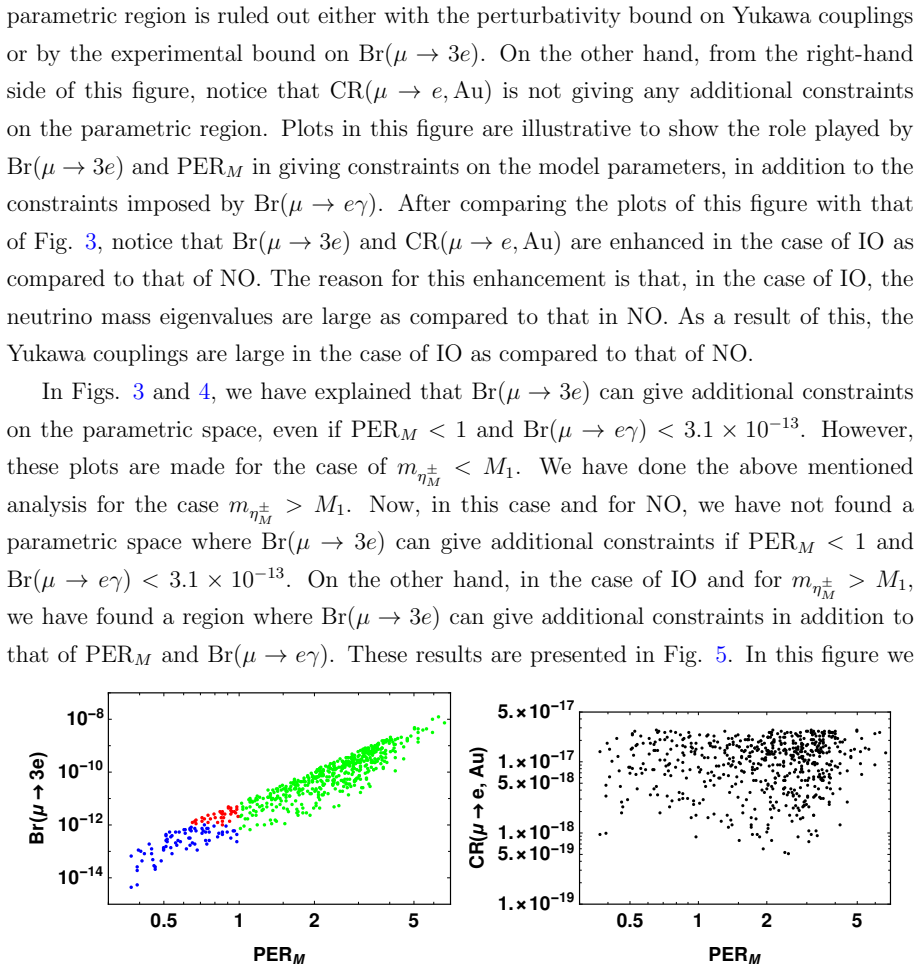
- The decay μ→3e can impose constraints on the parameter space of both models beyond those from μ→eγ, especially in the inverted neutrino mass ordering and for large Yukawa couplings.
- The μ→e conversion rate in nuclei is unlikely to give additional constraints once the bound on μ→eγ is satisfied.
- Normal neutrino mass ordering yields larger maximal branching ratios for most LFV tau decays than inverted ordering in both models.
Reading between the lines
- The paper fixes the Casas-Ibarra matrices R and S to the identity, so the quoted maximal branching ratios may not be true global maxima; exploring non-trivial R and S could either enhance or suppress the rates.
- The predicted τ→3μ rates sit at the boundary of future experimental sensitivity, so a null result in upcoming searches would not decisively rule out either model, but an observation would strongly favor the Majorana version, assuming this parameter slice is representative.
- The same box-diagram distinction could be tested in other observables, such as the lepton flavor violating decay of a Z boson or Higgs boson, where similar Majorana vs Dirac differences might appear.
- The DSM's Dirac nature and exact B-L symmetry mean neutrinoless double beta decay is absent, whereas the MSM predicts it; combining LFV rates with 0νββ searches could further separate the two models.
Editorial analysis
A structured set of objections, weighed in public.
Referee Report
Summary. The paper performs a comparative analysis of charged-lepton flavor violation in the Majorana scotogenic model (MSM) and the Dirac scotogenic model (DSM). It derives analytic expressions for the two-body radiative decays, the three-body decays, and muon-to-electron conversion in both models, emphasizing that the MSM has an additional box-diagram contribution to three-body final states. After scanning the parameter space and imposing the current bounds on μ→eγ, μ→3e, μ→e conversion, and perturbativity of the Yukawa couplings, the author reports that τ→3μ can reach branching ratios of about 10^-10 in the MSM and 10^-11 in the DSM, with the 3-body tau rates in the DSM suppressed by roughly an order of magnitude relative to the MSM.
Significance. If the reported maxima are robust, the paper gives a concrete way to distinguish the Majorana and Dirac variants of the minimal scotogenic model in upcoming τ→3μ searches, and it provides the first systematic LFV analysis of the DSM including tau decays. The structural observation that the MSM receives an extra box diagram while the two-body penguin rates coincide is well argued and is the paper's most valuable contribution. The paper also usefully emphasizes the role of Yukawa perturbativity in determining which of μ→eγ, μ→3e, and μ→e conversion actually constrain the parameter space. However, the numerical 'maximal' claims are obtained on a restricted Casas-Ibarra slice, and the paper itself flags unresolved discrepancies between its Eqs. (24) and (27) and the corresponding expressions in the literature; these issues must be addressed before the quantitative headline results can be taken as robust.
major comments (3)
- [Sec. 2.1, Eq. (8); Sec. 2.2, Eq. (15)]
- [Sec. 4.1, Eq. (24) and Eq. (27)]
- [Sec. 5.1, Figs. 6 and 7; Sec. 5.2, Figs. 9 and 10]
minor comments (4)
- [Sec. 6, Conclusions]
- [Sec. 5.2, first paragraph]
- [Fig. 3 and Fig. 5]
- [Sec. 5, neutrino input]
Circularity Check
No circularity: the LFV predictions are computed from external neutrino-oscillation data and scanned model parameters, not fitted to the LFV observables.
full rationale
The paper's derivation chain is self-contained with respect to the LFV predictions. Neutrino masses, mixing angles, and delta_CP are taken from external global fits [75]; the Yukawa couplings are fixed through the Casas-Ibarra parametrization (Eqs. (6) and (14)) with the stated simplifying choices R=I and R=S=I. These choices restrict the scanned parameter slice and therefore affect whether the quoted values are true model maxima, but they do not make the predicted branching ratios equal to an input: no LFV observable is fitted, and the tau->3mu maxima are obtained by scanning m_eta, M_k, lambda_5 or A/v subject to mu->e gamma, mu->3e, mu->e conversion, and perturbativity constraints. The MSM-versus-DSM comparison follows from an extra box diagram (Fig. 2), a structural difference, not from an input. The self-citations [50,51,71] are contextual and not load-bearing. The paper explicitly flags unresolved discrepancies with [83] in Eq. (24) and in the |A2|^2 term of Eq. (27); that is a correctness risk, not a circular construction. No equation is equivalent to another by construction, and no fitted parameter is renamed as a prediction.
Assumptions & free parameters
free parameters (5)
- λ5 (MSM quartic) =
~10^-11 to 10^-10
- A/v (DSM soft term) =
~10^-10 to 10^-9
- lightest neutrino mass =
varied in [0, √(Δm²_s)]
- M1, mη±, mχ, δM =
scan ranges, e.g. M1=5-50 TeV, mη±=0.1-1 TeV, δM=1 TeV
- R, S, Majorana phases =
R=S=I; phases=0
assumptions (5)
- domain assumption Radiative neutrino mass formulas (Eqs. 5 and 13)
- ad hoc to paper Casas-Ibarra parametrization with R=S=I
- domain assumption Perturbativity bound |f| ≤ √(4π)
- domain assumption Neglect of Z and Higgs penguin contributions
- domain assumption Mass lower bounds mR, mI, mζ ≥ 5 GeV
Cite this review
Pith. "Pith review of Lepton flavor violation in the Majorana and Dirac scotogenic models." pith.science (2026). https://pith.science/paper/73V3NV6U
@misc{pith2026250204733,
  author       = {Pith},
  title        = {Pith review of: Lepton flavor violation in the Majorana and Dirac scotogenic models},
  year         = {2026},
  howpublished = {\url{https://pith.science/paper/73V3NV6U}},
  note         = {Machine review of arXiv:2502.04733}
}
abstract
In this work we have considered two minimal versions of scotogenic models, where neutrinos acquire masses through a radiative mechanism. We call these two models as Majorana and Dirac scotogenic models. In the former model, neutrinos have Majorana nature, and in the later one, neutrinos are Dirac particles. These two models are related to each other in terms of additional fields and symmetries of the model. Hence, to compare these two models in future experiments, we have analyzed lepton flavor violating (LFV) processes in both of them, in the charged lepton sector. We have found that the 3-body LFV decays in both these models can get different contributions. Among all the LFV decays and after satisfying relevant constraints, we have found that $\tau\to3\mu$ can have a branching ratio as high as $10^{-10}(10^{-11})$ in the Majorana(Dirac) scotogenic model.
Figures


Figures from the paper (7 more)



Reference graph
Works this paper leans on
-
[83]
T. Toma and A. Vicente, Lepton Flavor Violation in the Scotogenic Model , JHEP 01 (2014) 160 [ 1312.2840]
arXiv 2014
-
[1]
Kajita, Nobel Lecture: Discovery of atmospheric neutrino oscillations , Rev
T. Kajita, Nobel Lecture: Discovery of atmospheric neutrino oscillations , Rev. Mod. Phys. 88 (2016) 030501
2016
-
[2]
McDonald, Nobel Lecture: The Sudbury Neutrino Observatory: Observation of flavor change for solar neutrinos , Rev
A.B. McDonald, Nobel Lecture: The Sudbury Neutrino Observatory: Observation of flavor change for solar neutrinos , Rev. Mod. Phys. 88 (2016) 030502
2016
-
[3]
Planck collaboration, Planck 2018 results. VI. Cosmological parameters , Astron. Astrophys. 641 (2020) A6 [ 1807.06209]
arXiv 2020
-
[4]
Beyond the Standard Model in Many Directions
C. Quigg, Beyond the standard model in many directions , in 2nd CERN-CLAF School of High Energy Physics , pp. 57–118, 4, 2004 [ hep-ph/0404228]. 36
work page Pith review arXiv 2004
-
[5]
Physics Beyond the Standard Model
J. Ellis, Physics Beyond the Standard Model , Nucl. Phys. A 827 (2009) 187C [0902.0357]
work page Pith review arXiv 2009
-
[6]
King, Neutrino mass models , Rept
S.F. King, Neutrino mass models , Rept. Prog. Phys. 67 (2004) 107 [hep-ph/0310204]
arXiv 2004
-
[7]
Models of Neutrino Masses and Mixings
G. Altarelli, Models of neutrino masses and mixings , in 61st Scottish Universities Summer School in Physics: Neutrinos in Particle Physics, Astrophysics and Cosmology (SUSSP61), pp. 91–115, 11, 2006 [ hep-ph/0611117]
work page Pith review arXiv 2006
Show all 97 references
-
[8]
Minkowski, µ → eγ at a Rate of One Out of 109 Muon Decays?, Phys
P. Minkowski, µ → eγ at a Rate of One Out of 109 Muon Decays?, Phys. Lett. B 67 (1977) 421
1977
-
[9]
Gell-Mann, P
M. Gell-Mann, P. Ramond and R. Slansky, Complex Spinors and Unified Theories , Conf. Proc. C 790927 (1979) 315 [ 1306.4669]
1979 arXiv
-
[10]
Mohapatra and G
R.N. Mohapatra and G. Senjanovic, Neutrino Mass and Spontaneous Parity Nonconservation, Phys. Rev. Lett. 44 (1980) 912
1980
-
[11]
Schechter and J.W.F
J. Schechter and J.W.F. Valle, Neutrino Masses in SU(2) x U(1) Theories , Phys. Rev. D 22 (1980) 2227
1980
-
[12]
Magg and C
M. Magg and C. Wetterich, Neutrino Mass Problem and Gauge Hierarchy , Phys. Lett. B 94 (1980) 61
1980
-
[13]
Mohapatra and G
R.N. Mohapatra and G. Senjanovic, Neutrino Masses and Mixings in Gauge Models with Spontaneous Parity Violation , Phys. Rev. D 23 (1981) 165
1981
-
[14]
Lazarides, Q
G. Lazarides, Q. Shafi and C. Wetterich, Proton Lifetime and Fermion Masses in an SO(10) Model , Nucl. Phys. B 181 (1981) 287
1981
-
[15]
R. Foot, H. Lew, X.G. He and G.C. Joshi, Seesaw Neutrino Masses Induced by a Triplet of Leptons, Z. Phys. C 44 (1989) 441
1989
-
[16]
Mohapatra, A Model for Dirac Neutrino Masses and Mixings , Phys
R.N. Mohapatra, A Model for Dirac Neutrino Masses and Mixings , Phys. Lett. B 198 (1987) 69
1987
-
[17]
Chang and R.N
D. Chang and R.N. Mohapatra, Small and Calculable Dirac Neutrino Mass , Phys. Rev. Lett. 58 (1987) 1600. 37
1987
-
[18]
Mohapatra, Left-right Symmetry and Finite One Loop Dirac Neutrino Mass , Phys
R.N. Mohapatra, Left-right Symmetry and Finite One Loop Dirac Neutrino Mass , Phys. Lett. B 201 (1988) 517
1988
-
[19]
Balakrishna and R.N
B.S. Balakrishna and R.N. Mohapatra, Radiative Fermion Masses From New Physics at Tev Scale , Phys. Lett. B 216 (1989) 349
1989
-
[20]
Ma, Radiative Quark and Lepton Masses in a Left-right Gauge Model , Phys
E. Ma, Radiative Quark and Lepton Masses in a Left-right Gauge Model , Phys. Rev. Lett. 63 (1989) 1042
1989
-
[21]
Babu and X.G
K.S. Babu and X.G. He, DIRAC NEUTRINO MASSES AS TWO LOOP RADIATIVE CORRECTIONS, Mod. Phys. Lett. A 4 (1989) 61
1989
-
[22]
Branco and C.Q
G.C. Branco and C.Q. Geng, Naturally Small Dirac Neutrino Masses in Superstring Theories, Phys. Rev. Lett. 58 (1987) 969
1987
-
[23]
Babu and E
K.S. Babu and E. Ma, Radiative Mechanisms for Generating Quark and Lepton Masses: Some Recent Developments , Mod. Phys. Lett. A 4 (1989) 1975
1989
-
[24]
Nasri and S
S. Nasri and S. Moussa, Model for small neutrino masses at the TeV scale , Mod. Phys. Lett. A 17 (2002) 771 [ hep-ph/0106107]
2002 arXiv
-
[25]
Ma, Verifiable radiative seesaw mechanism of neutrino mass and dark matter , Phys
E. Ma, Verifiable radiative seesaw mechanism of neutrino mass and dark matter , Phys. Rev. D 73 (2006) 077301 [ hep-ph/0601225]
2006 arXiv
-
[26]
Ma, Supersymmetric Model of Radiative Seesaw Majorana Neutrino Masses , Annales Fond
E. Ma, Supersymmetric Model of Radiative Seesaw Majorana Neutrino Masses , Annales Fond. Broglie 31 (2006) 285 [ hep-ph/0607142]
2006 arXiv
-
[27]
Ma and U
E. Ma and U. Sarkar, Revelations of the E(6)/U(1)(N) Model: Two-Loop Neutrino Mass and Dark Matter , Phys. Lett. B 653 (2007) 288 [ 0705.0074]
2007 arXiv
-
[28]
Ma, Z(3) Dark Matter and Two-Loop Neutrino Mass , Phys
E. Ma, Z(3) Dark Matter and Two-Loop Neutrino Mass , Phys. Lett. B 662 (2008) 49 [0708.3371]
2008 arXiv
-
[29]
Ma, SU(5) completion of the dark scalar doublet model of radiative neutrino mass, Phys
E. Ma, SU(5) completion of the dark scalar doublet model of radiative neutrino mass, Phys. Lett. B 659 (2008) 885 [ 0710.2325]
2008 arXiv
-
[30]
Ma, Supersymmetric U(1) Gauge Realization of the Dark Scalar Doublet Model of Radiative Neutrino Mass , Mod
E. Ma, Supersymmetric U(1) Gauge Realization of the Dark Scalar Doublet Model of Radiative Neutrino Mass , Mod. Phys. Lett. A 23 (2008) 721 [ 0801.2545]
2008 arXiv
-
[31]
Gu and U
P.-H. Gu and U. Sarkar, Radiative seesaw in left-right symmetric model , Phys. Rev. D 78 (2008) 073012 [ 0807.0270]. 38
2008 arXiv
-
[32]
Ma and D
E. Ma and D. Suematsu, Fermion Triplet Dark Matter and Radiative Neutrino Mass, Mod. Phys. Lett. A 24 (2009) 583 [ 0809.0942]
2009 arXiv
-
[33]
Vicente and C.E
A. Vicente and C.E. Yaguna, Probing the scotogenic model with lepton flavor violating processes, JHEP 02 (2015) 144 [ 1412.2545]
2015 arXiv
-
[34]
Molinaro, C.E
E. Molinaro, C.E. Yaguna and O. Zapata, FIMP realization of the scotogenic model , JCAP 07 (2014) 015 [ 1405.1259]
2014 arXiv
-
[35]
Lindner, M
M. Lindner, M. Platscher, C.E. Yaguna and A. Merle, Fermionic WIMPs and vacuum stability in the scotogenic model , Phys. Rev. D 94 (2016) 115027 [1608.00577]
2016 arXiv
-
[36]
Escribano, M
P. Escribano, M. Reig and A. Vicente, Generalizing the Scotogenic model, JHEP 07 (2020) 097 [ 2004.05172]
2020 arXiv
-
[37]
Sarazin, J
M. Sarazin, J. Bernigaud and B. Herrmann, Dark matter and lepton flavour phenomenology in a singlet-doublet scotogenic model , JHEP 12 (2021) 116 [2107.04613]
2021 arXiv
-
[38]
Portillo-S´ anchez, P
D. Portillo-S´ anchez, P. Escribano and A. Vicente,Ultraviolet extensions of the Scotogenic model, JHEP 08 (2023) 023 [ 2301.05249]
2023 arXiv
-
[39]
Alvarez, A
A. Alvarez, A. Banik, R. Cepedello, B. Herrmann, W. Porod, M. Sarazin et al., Accommodating muon (g − 2) and leptogenesis in a scotogenic model , JHEP 06 (2023) 163 [ 2301.08485]
2023 arXiv
-
[40]
Abada, N
A. Abada, N. Bernal, A.E. C´ arcamo Hern´ andez, S. Kovalenko, T.B. de Melo and T. Toma, Phenomenology of a scotogenic neutrino mass model at 3-loops , in 18th International Conference on Topics in Astroparticle and Underground Physics , 11, 2023 [2311.14716]
2023 arXiv
-
[41]
Ahriche, M.L
A. Ahriche, M.L. Bellilet, M.O. Khojali, M. Kumar and A.-T. Mulaudzi, The scale invariant scotogenic model: CDF-II W -boson mass and the 95˜GeV excesses , 2311.08297
-
[42]
Borah, S
D. Borah, S. Mahapatra, P.K. Paul and N. Sahu, Scotogenic U (1)Lµ−Lτ origin of (g − 2)µ, W-mass anomaly and 95 GeV excess , 2310.11953
-
[43]
Avnish, Maximum Yukawa Couplings for WIMP Majorana Dark Matter in Scotogenic Model, Phys. Part. Nucl. Lett. 20 (2023) 1146. 39
2023
-
[44]
Singh, D
L. Singh, D. Mahanta and S. Verma, Low Scale Leptogenesis in Singlet-Triplet Scotogenic Model, 2309.12755
-
[45]
Kitabayashi, Constraining scotogenic dark matter and primordial black holes using gravitational waves , 2309.01883
T. Kitabayashi, Constraining scotogenic dark matter and primordial black holes using gravitational waves , 2309.01883
-
[46]
Karan, S
A. Karan, S. Sadhukhan and J.W.F. Valle, Phenomenological profile of scotogenic fermionic dark matter , 2308.09135
-
[47]
Herms, S
J. Herms, S. Jana, V.P. K. and S. Saad, Light neutrinophilic dark matter from a scotogenic model, Phys. Lett. B 845 (2023) 138167 [ 2307.15760]
2023 arXiv
-
[48]
Ismael, G
M.S. Ismael, G. Faisel and M. Alanssari, The Impact of Dark Matter on the Related Sector of the Scotogenic Model and Its Implications , LHEP 2023 (2023) 374
2023
-
[49]
Escribano, V.M
P. Escribano, V.M. Lozano and A. Vicente, A Scotogenic explanation for the 95 GeV excesses, 2306.03735
-
[50]
Hundi, Lepton flavor violating Z and Higgs decays in the scotogenic model , Eur
R.S. Hundi, Lepton flavor violating Z and Higgs decays in the scotogenic model , Eur. Phys. J. C 82 (2022) 505 [ 2201.03779]
2022 arXiv
-
[51]
Hundi, µ→eγ in a supersymmetric radiative neutrino mass model , Phys
R.S. Hundi, µ→eγ in a supersymmetric radiative neutrino mass model , Phys. Rev. D 93 (2016) 015008 [ 1510.02253]
2016 arXiv
-
[52]
Farzan and E
Y. Farzan and E. Ma, Dirac neutrino mass generation from dark matter , Phys. Rev. D 86 (2012) 033007 [ 1204.4890]
2012 arXiv
-
[53]
Ma and O
E. Ma and O. Popov, Pathways to Naturally Small Dirac Neutrino Masses , Phys. Lett. B 764 (2017) 142 [ 1609.02538]
2017 arXiv
-
[54]
W. Wang, R. Wang, Z.-L. Han and J.-Z. Han, The B − L Scotogenic Models for Dirac Neutrino Masses , Eur. Phys. J. C 77 (2017) 889 [ 1705.00414]
2017 arXiv
-
[55]
Yao and G.-J
C.-Y. Yao and G.-J. Ding, Systematic Study of One-Loop Dirac Neutrino Masses and Viable Dark Matter Candidates , Phys. Rev. D 96 (2017) 095004 [ 1707.09786]
2017 arXiv
-
[56]
Calle, D
J. Calle, D. Restrepo, C.E. Yaguna and O. Zapata, Minimal radiative Dirac neutrino mass models , Phys. Rev. D 99 (2019) 075008 [ 1812.05523]
2019 arXiv
-
[57]
Ma, Scotogenic U (1)χ Dirac neutrinos, Phys
E. Ma, Scotogenic U (1)χ Dirac neutrinos, Phys. Lett. B 793 (2019) 411 [1901.09091]. 40
2019 arXiv
-
[58]
Ma, Scotogenic cobimaximal Dirac neutrino mixing from ∆(27) and U (1)χ, Eur
E. Ma, Scotogenic cobimaximal Dirac neutrino mixing from ∆(27) and U (1)χ, Eur. Phys. J. C 79 (2019) 903 [ 1905.01535]
2019 arXiv
-
[59]
Ma, Two-loop Z4 Dirac neutrino masses and mixing, with self-interacting dark matter, Nucl
E. Ma, Two-loop Z4 Dirac neutrino masses and mixing, with self-interacting dark matter, Nucl. Phys. B 946 (2019) 114725 [ 1907.04665]
2019 arXiv
-
[60]
Centelles Chuli´ a, R
S. Centelles Chuli´ a, R. Cepedello, E. Peinado and R. Srivastava,Systematic classification of two loop d = 4 Dirac neutrino mass models and the Diracness-dark matter stability connection , JHEP 10 (2019) 093 [ 1907.08630]
2019 arXiv
-
[61]
Jana, P.K
S. Jana, P.K. Vishnu and S. Saad, Minimal realizations of Dirac neutrino mass from generic one-loop and two-loop topologies at d = 5, JCAP 04 (2020) 018 [1910.09537]
2020 arXiv
-
[62]
Leite, A
J. Leite, A. Morales, J.W.F. Valle and C.A. Vaquera-Araujo, Scotogenic dark matter and Dirac neutrinos from unbroken gauged B − L symmetry , Phys. Lett. B 807 (2020) 135537 [ 2003.02950]
2020 arXiv
-
[63]
Guo and Z.-L
S.-Y. Guo and Z.-L. Han, Observable Signatures of Scotogenic Dirac Model , JHEP 12 (2020) 062 [ 2005.08287]
2020 arXiv
-
[64]
Bernal, J
N. Bernal, J. Calle and D. Restrepo, Anomaly-free Abelian gauge symmetries with Dirac scotogenic models, Phys. Rev. D 103 (2021) 095032 [ 2102.06211]
2021 arXiv
-
[65]
B. De, D. Das, M. Mitra and N. Sahoo, Magnetic moments of leptons, charged lepton flavor violations and dark matter phenomenology of a minimal radiative Dirac neutrino mass model , JHEP 08 (2022) 202 [ 2106.00979]
2022 arXiv
-
[66]
Mishra, N
S. Mishra, N. Narendra, P.K. Panda and N. Sahoo, Scalar dark matter and radiative Dirac neutrino mass in an extended U(1)B −L model, Nucl. Phys. B 981 (2022) 115855 [ 2112.12569]
2022 arXiv
-
[67]
Chowdhury, M
T.A. Chowdhury, M. Ehsanuzzaman and S. Saad, Dark Matter and (g - 2) µ,e in radiative Dirac neutrino mass models , JCAP 08 (2022) 076 [ 2203.14983]
2022 arXiv
-
[68]
Li, X.-Q
S.-P. Li, X.-Q. Li, X.-S. Yan and Y.-D. Yang, Scotogenic Dirac neutrino mass models embedded with leptoquarks: one pathway to address the flavor anomalies and the neutrino masses together , Eur. Phys. J. C 82 (2022) 1078 [ 2204.09201]. 41
2022 arXiv
-
[69]
Hazarika and K
N. Hazarika and K. Bora, A new viable mass region of dark matter and dirac neutrino mass generation in a scotogenic extension of SM , Int. J. Mod. Phys. A 38 (2023) 2350051 [ 2205.06003]
2023 arXiv
-
[70]
Borah, P
D. Borah, P. Das and D. Nanda, Observable ∆Neff in Dirac Scotogenic Model , 2211.13168
-
[71]
Hundi, Study on the global minimum and H →γγ in the Dirac scotogenic model, Phys
R.S. Hundi, Study on the global minimum and H →γγ in the Dirac scotogenic model, Phys. Rev. D 108 (2023) 015006 [ 2303.04655]
2023 arXiv
-
[72]
Rojas, R
N. Rojas, R. Srivastava and J.W.F. Valle, Simplest Scoto-Seesaw Mechanism, Phys. Lett. B 789 (2019) 132 [ 1807.11447]
2019 arXiv
-
[73]
Kumar, P
R. Kumar, P. Mishra, M.K. Behera, R. Mohanta and R. Srivastava, Predictions from scoto-seesaw with A4 modular symmetry , Phys. Lett. B 853 (2024) 138635 [2310.02363]
2024 arXiv
-
[74]
Kumar, N
R. Kumar, N. Nath and R. Srivastava, Cutting the scotogenic loop: adding flavor to dark matter , JHEP 12 (2024) 036 [ 2406.00188]
2024 arXiv
-
[75]
de Salas, D.V
P.F. de Salas, D.V. Forero, S. Gariazzo, P. Mart ´ ınez-Mirav´ e, O. Mena, C.A. Ternes et al., 2020 global reassessment of the neutrino oscillation picture , JHEP 02 (2021) 071 [2006.11237]
2021 arXiv
-
[76]
MEG II collaboration, A search for µ+ → e+γ with the first dataset of the MEG II experiment, Eur. Phys. J. C 84 (2024) 216 [ 2310.12614]
2024 arXiv
-
[77]
BaBar collaboration, Searches for Lepton Flavor Violation in the Decays tau+- —> e+- gamma and tau+- — > mu+- gamma , Phys. Rev. Lett. 104 (2010) 021802 [0908.2381]
2010 arXiv
-
[78]
Belle collaboration, Search for lepton-flavor-violating tau-lepton decays to ℓγ at Belle, JHEP 10 (2021) 19 [ 2103.12994]
2021 arXiv
-
[79]
SINDRUM collaboration, Search for the Decay µ+ → e+e+e−, Nucl. Phys. B 299 (1988) 1
1988
-
[80]
Hayasaka et al., Search for Lepton Flavor Violating Tau Decays into Three Leptons with 719 Million Produced Tau+Tau- Pairs , Phys
K. Hayasaka et al., Search for Lepton Flavor Violating Tau Decays into Three Leptons with 719 Million Produced Tau+Tau- Pairs , Phys. Lett. B 687 (2010) 139 [1001.3221]. 42
2010 arXiv
-
[81]
SINDRUM IIcollaboration, A Search for muon to electron conversion in muonic gold, Eur. Phys. J. C 47 (2006) 337
2006
-
[82]
SINDRUM IIcollaboration, Test of lepton flavor conservation in mu — > e conversion on titanium , Phys. Lett. B 317 (1993) 631
1993
-
[84]
Particle Data Groupcollaboration, Review of Particle Physics , PTEP 2022 (2022) 083C01
2022
-
[85]
J. Kubo, E. Ma and D. Suematsu, Cold Dark Matter, Radiative Neutrino Mass, µ → eγ, and Neutrinoless Double Beta Decay , Phys. Lett. B 642 (2006) 18 [hep-ph/0604114]
2006 arXiv
-
[86]
Kitabayashi, Primordial black holes and lepton flavor violation with scotogenic dark matter , PTEP 2022 (2022) 033B02 [ 2107.11692]
T. Kitabayashi, Primordial black holes and lepton flavor violation with scotogenic dark matter , PTEP 2022 (2022) 033B02 [ 2107.11692]
2022 arXiv
-
[87]
De Romeri, J
V. De Romeri, J. Nava, M. Puerta and A. Vicente, Dark matter in the scotogenic model with spontaneous lepton number violation , Phys. Rev. D 107 (2023) 095019 [2210.07706]
2023 arXiv
-
[88]
Verma and S
Tapender, S. Verma and S. Kumar, On lepton flavor violation and dark matter in Scotogenic model with trimaximal mixing , Eur. Phys. J. Plus 140 (2025) 43 [2402.16491]
2025 arXiv
-
[89]
Casas and A
J.A. Casas and A. Ibarra, Oscillating neutrinos and µ → e, γ, Nucl. Phys. B 618 (2001) 171 [ hep-ph/0103065]
2001 arXiv
-
[90]
Grimus and L
W. Grimus and L. Lavoura, Soft lepton flavor violation in a multi Higgs doublet seesaw model, Phys. Rev. D 66 (2002) 014016 [ hep-ph/0204070]
2002 arXiv
-
[91]
Kuno and Y
Y. Kuno and Y. Okada, Muon decay and physics beyond the standard model , Rev. Mod. Phys. 73 (2001) 151 [ hep-ph/9909265]
2001 arXiv
-
[92]
Chiang, E
H.C. Chiang, E. Oset, T.S. Kosmas, A. Faessler and J.D. Vergados, Coherent and incoherent (mu-, e-) conversion in nuclei , Nucl. Phys. A 559 (1993) 526
1993
-
[93]
Kosmas, S
T.S. Kosmas, S. Kovalenko and I. Schmidt, Nuclear muon- e- conversion in strange quark sea, Phys. Lett. B 511 (2001) 203 [ hep-ph/0102101]. 43
2001 arXiv
-
[94]
Kitano, M
R. Kitano, M. Koike and Y. Okada, Detailed calculation of lepton flavor violating muon electron conversion rate for various nuclei , Phys. Rev. D 66 (2002) 096002 [hep-ph/0203110]
2002 arXiv
-
[95]
Arganda, M.J
E. Arganda, M.J. Herrero and A.M. Teixeira, mu-e conversion in nuclei within the CMSSM seesaw: Universality versus non-universality , JHEP 10 (2007) 104 [0707.2955]
2007 arXiv
-
[96]
Belle-II collaboration, The Belle II Physics Book , PTEP 2019 (2019) 123C01 [1808.10567]
2019
-
[97]
FCC collaboration, FCC Physics Opportunities: Future Circular Collider Conceptual Design Report Volume 1 , Eur. Phys. J. C 79 (2019) 474. 44
2019
Reviewed August 8, 2026 · model on record in the stance chip above.
Discussion (0). Continue with ORCID to comment.