REVIEW 3 major objections 4 minor 64 references
Hadronic vacuum polarization contribution to the muon g-2 on Euclidean windows from tau data
T0 review · 3 major / 4 minor · reviewed 2026-08-12 · deepseek-v4-flash
Pith's one-line read Tau decay data, converted to e+e- cross sections with isospin-breaking corrections, produce Euclidean-window contributions to the muon g-2 that agree with lattice QCD, while e+e- data-driven results are in tension.
desk verdict Tau-lattice window compatibility is plausible but rests on older isospin-breaking corrections; the proceedings adds no new numbers. read the letter →
The pith
A machine-rendered reading of the paper's core claim, the machinery that carries it, and where it could break.
The reading
What carries the argument
The central objects are the Euclidean window observables, which split the hadronic vacuum polarization contribution into short-distance, intermediate, and long-distance pieces (with sizes scaling roughly as $1:10:25$), and the conversion factor that turns tau decay spectra into $e^+e^-$ cross sections. That conversion is built from the long-distance radiative correction $G_{\rm EM}(s)$ and the form-factor ratio $|F_V(s)/f_+(s)|^2$, packaged into the isospin-breaking factor $R_{\rm IB}(s)$ that appears in the relation between the $\tau$ spectral function and the $\pi^+\pi^-$ cross section. The argument works by applying this conversion to the measured tau spectra, computing the three window integrals, and comparing them with lattice QCD and $e^+e^-$ data-driven window evaluations.
What would settle it
Measure the pion form factor ratio $|F_V(s)/f_+(s)|^2$ and the radiative factor $G_{\rm EM}(s)$ independently over the window energies (for example from a high-statistics study of $\tau^-\to\pi^-\pi^0\nu_\tau\gamma$ together with a precise $\pi^+\pi^-$ cross section measurement); if the resulting $R_{\rm IB}$ differs from the value used here by more than its uncertainty, the tau-based window moves and the claimed lattice agreement would be directly tested.
Extended reading notes
Core claim
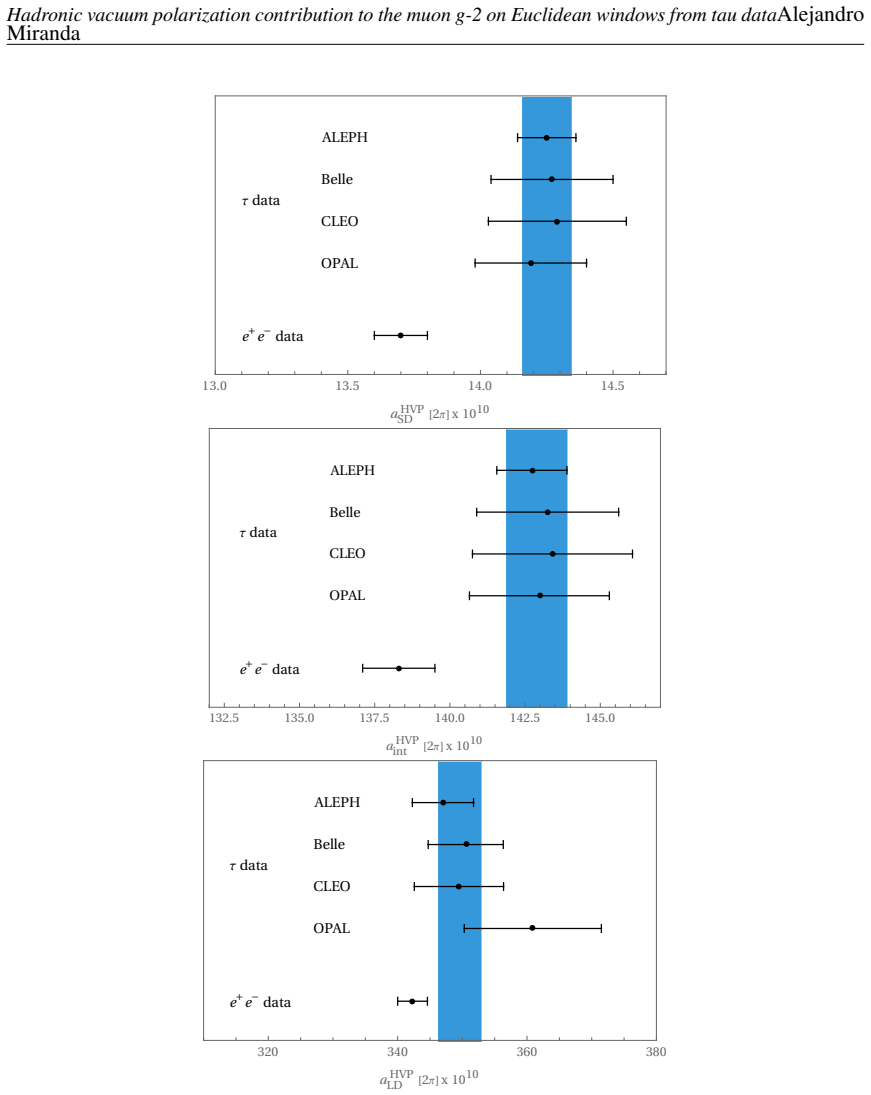
The paper's central claim is that, once isospin-breaking corrections are applied through the relation between the $\tau^-\to\pi^-\pi^0\nu_\tau$ spectral function and the $e^+e^-\to\pi^+\pi^-(\gamma)$ cross section, tau decay data produce Euclidean window integrals that sit on top of lattice QCD values. In the intermediate window the tau-based result agrees with the lattice average, while the $e^+e^-$-based result disagrees with both, and the discrepancy is almost entirely in the light-quark connected contribution dominated by the $\pi\pi$ channel. This supports the conclusion that the $e^+e^-$ data, not new physics, are the main source of the intermediate-window discrepancy affecting the interpretation of the measured $a_\mu$.
Load-bearing premise
The argument depends on the accuracy of the isospin-breaking conversion that turns tau decay spectra into $e^+e^-$ cross sections: the long-distance radiative factor $G_{\rm EM}(s)$ and the form-factor ratio $|F_V(s)/f_+(s)|^2$ must be correct over the window energies, or the tau-based windows shift and the agreement with lattice can disappear.
Editorial extensions
If this is right
- If the tau-based windows are correct, the intermediate-window tension is attributed to $e^+e^-$ data rather than to new physics in muon g-2.
- The light-quark connected $\pi\pi$ channel, which dominates the discrepancy, becomes the target for new precise $e^+e^-$ measurements around the $\rho$ peak.
- Tau-based full HVP evaluations agree with lattice QCD, providing a cross-check that does not rely on $e^+e^-$ annihilation data.
- The method can be applied to the short- and long-distance windows as lattice calculations reach comparable precision, giving a data-driven benchmark for each window.
Reading between the lines
- An implication the authors leave implicit: taking the tau-based windows at face value raises the Standard Model prediction for $a_\mu$ in the $\pi\pi$ channel by roughly $10\times10^{-10}$, shrinking the gap with the BNL/FNAL average and reducing the inferred new-physics signal.
- A testable extension is to apply the same isospin-breaking machinery to the $\tau\to K\pi\nu_\tau$ channels, producing a tau-based prediction for the strange-quark contribution to the intermediate window as an independent cross-check of lattice and $e^+e^-$ results.
- If future tau data reach percent-level precision on the $\pi\pi$ spectral function, the tau-based window method could become competitive with $e^+e^-$ data and help settle whether the CMD-3 cross section is the correct one.
Editorial analysis
A structured set of objections, weighed in public.
Referee Report
Summary. This proceedings contribution reports tau-data-driven evaluations of the short-distance (SD), intermediate (int), and long-distance (LD) Euclidean windows for the hadronic vacuum polarization (HVP) contribution to the muon g-2. The authors convert tau spectral functions into e+e- cross sections using the conserved-vector-current relation with isospin-breaking corrections from Resonance Chiral Theory, and they compare the resulting window quantities with lattice QCD and e+e- data-driven results. Their central claim is that tau-based results are compatible with the lattice evaluations in the intermediate window, whereas e+e- based results are in tension with both, suggesting that the e+e- data are the main source of the intermediate-window discrepancy rather than new physics. The results are presented graphically, with details referred to Refs. [50] and [61].
Significance. If the central claim holds, it sharpens the interpretation of the muon g-2 discrepancy: it would support the view that the intermediate-window tension originates in e+e- data rather than in new physics. The paper has the strength of being based on external tau spectra and compared with external lattice benchmarks, so the central claim is not defined into existence; it is also independently mirrored by the corroborating study of Ref. [61]. The main technical risk is the reliance on the isospin-breaking conversion factor R_IB(s), whose s-dependence could shift the window values if the more recent treatment of Ref. [49] is not propagated. Because the proceedings does not provide numeric values, uncertainties, or integration details, the quantitative strength of the compatibility claim cannot be assessed from the manuscript alone.
major comments (3)
- [Section 2, Eqs. (2)-(3)] The tau-to-e+e- conversion factor R_IB(s) is the backbone of the analysis, and the text states that the isospin-breaking correction to a_mu^HVP|pi pi lies in the range [-20.52,-6.96] x 10^-10 at 68% CL, with the parenthetical 'we are more precise in the recent [49]'. The window results shown in Figs. 2 and 3, however, are taken from Ref. [50], which uses the earlier treatment of Ref. [34]. Since R_IB(s) is s-dependent, an updated G_EM(s) or form-factor ratio can shift the window integrals by more than the quoted window uncertainties. The authors should either fold the Ref. [49] corrections into the window values or explicitly quantify that the shift is negligible; as written, the claimed compatibility with lattice in the intermediate window is not yet established at the precision implied by the figures.
- [Section 3, Fig. 2] No numerical central values or uncertainties are given for the tau-based SD, int, and LD window contributions; the comparison with lattice and e+e- results is purely graphical. Since the central claim is a quantitative compatibility statement, the reader cannot verify it (e.g., by a chi-square or pull test) from this manuscript alone. A table with the window values, statistical and systematic uncertainties, and a definition of the 'two approaches' used to assign the associated error should be added.
- [Section 3, Fig. 3] The plot mixes total intermediate-window evaluations obtained with different procedures (various tau experiments, e+e- datasets, and lattice groups), and the text says the difference between two approaches gave the associated error without specifying what those approaches are. This definition is needed to judge whether the error bars and the resulting compatibility with lattice are robust. The abstract's statement that tau-based results agree 'with the full result' is also not supported by any explicitly quoted full tau-based a_mu value in the text.
minor comments (4)
- [Fig. 1] Axis labels show 'x 10 10' instead of a formatted x10^10; please fix for readability.
- [References] References [35], [39], and [40] do not appear to be cited in the text; either cite them where S_EW and G_EM are introduced or remove them from the bibliography.
- [Eq. (4)] The Wilson coefficients epsilon_i are introduced without specifying the operator basis or renormalization scale; a sentence pointing to Ref. [11] would suffice.
- [Notation] The notation for the HVP contribution is inconsistent (e.g., 'aHVP,LO mu', 'a_mu^HVP, LO'); unify the notation throughout.
Circularity Check
No significant circularity: the tau-window values are derived from external tau spectra and compared with external lattice benchmarks; the only caveat is that the figures use the same group's older IB correction rather than their newer one.
full rationale
The central comparison is not circular. The tau-based Euclidean-window values are built from external tau spectral functions (ALEPH, Belle, CLEO, OPAL) through Eqs. (2)-(3), with the isospin-breaking factor RIB(s) computed in Resonance Chiral Theory in Refs. [9,10,34], and are then compared with lattice window values [15,57-60] and with the e+e- window evaluation of Ref. [52]. Nothing in this chain defines the tau windows in terms of the lattice values they are claimed to match: the tau spectra are experimental inputs and RIB(s) is an independent theoretical correction, not a parameter fitted to the lattice or to a_mu. The window definitions themselves come from Ref. [51]. The proceedings relies on the authors' previous work - Ref. [34] for RIB(s) and Ref. [50] for the window integrals - but this self-citation is not circular: Ref. [50] is a separate published calculation whose results the proceedings states were 'corroborated by ref. [61]', and the IB range is cross-checked against other tau-based determinations [41-48]. The relevant flagged limitation is this sentence in Sec. 2: 'with our IB contributions to a_mu^HVP|pi pi in the range [-20.52,-6.96] x 10^-10 at 68% confidence level (we are more precise in the recent [49])', together with 'In ref. [50] we applied these results to the window quantities introduced in Ref. [51]'. This means the figures shown use the older IB treatment of Ref. [34] and do not propagate the improved correction of Ref. [49]; if the s-dependent RIB(s) changes, the claimed tau-lattice compatibility in the intermediate window could shift. That is a precision/update risk, not a circularity, because Ref. [49]'s correction is not fitted to the lattice values being compared. No prediction is forced by construction, so no circular step is identified.
Assumptions & free parameters
free parameters (2)
- Resonance Chiral Theory couplings and low-energy constants entering G_EM(s)
- Isospin-breaking form-factor ratio |F_V(s)/f_+(s)|^2
assumptions (4)
- domain assumption CVC and isospin rotation relate tau spectral functions to the isovector e+e- cross section (Eq. 2)
- standard math The dispersion relation Eq. (1) with the QED kernel K(s) gives a_mu^HVP,LO from R(s)
- ad hoc to paper G_EM(s) from RChT at O(p^6) with short-distance constraints is accurate over window energies
- domain assumption Lattice QCD window results from Refs. [57-60] are correct benchmarks
Cite this review
Pith. "Pith review of Hadronic vacuum polarization contribution to the muon g-2 on Euclidean windows from tau data." pith.science (2026). https://pith.science/paper/76WWJRFB
@misc{pith2026241109811,
  author       = {Pith},
  title        = {Pith review of: Hadronic vacuum polarization contribution to the muon g-2 on Euclidean windows from tau data},
  year         = {2026},
  howpublished = {\url{https://pith.science/paper/76WWJRFB}},
  note         = {Machine review of arXiv:2411.09811}
}
abstract
We computed for the first time the $\tau$ data-driven Euclidean windows for the hadronic vacuum polarization contribution to the muon g-2. We showed that $\tau$-based results agree with the available lattice window evaluations and with the full result. On the intermediate window, where all lattice evaluations are rather precise and agree, $\tau$-based results are compatible with them. This is particularly interesting, given that the disagreement of the $e^+e^-$ data-driven result with the lattice values in this window is the main cause for their discrepancy, affecting the interpretation of the $a_\mu$ measurement in terms of possible new physics.
Figures


Reference graph
Works this paper leans on
-
[34]
J. A. Miranda and P. Roig, “New 𝜏-based evaluation of the hadronic contribution to the vacuum polarization piece of the muon anomalous magnetic moment,” Phys. Rev. D102 (2020), 114017, doi:10.1103/PhysRevD.102.114017, [arXiv:2007.11019 [hep-ph]]
arXiv 2020
-
[49]
G. L. Castro, A. Miranda and P. Roig, “Isospin breaking corrections in 2𝜋 production in tau decays and𝑒+𝑒− annihilation: consequences for the muon𝑔− 2 and CVC tests,” [arXiv:2411.07696 [hep-ph]]
-
[61]
M.Davier,A.Hoecker,A.M.Lutz,B.MalaescuandZ.Zhang,“ Tensionsin𝑒+𝑒−→𝜋+𝜋−(𝛾) measurements: the new landscape of data-driven hadronic vacuum polarization predictions for the muon𝑔− 2,” [arXiv:2312.02053 [hep-ph]]
-
[50]
𝜏 data-driven evaluation of Euclidean win- dows for the hadronic vacuum polarization ,
P. Masjuan, A. Miranda and P. Roig, “ 𝜏 data-driven evaluation of Euclidean win- dows for the hadronic vacuum polarization ,” Phys. Lett. B 850 (2024), 138492, doi:10.1016/j.physletb.2024.138492, [arXiv:2305.20005 [hep-ph]]
arXiv 2024
-
[1]
TheanomalousmagneticmomentofthemuonintheStandardModel ,
T.Aoyama,etal. “TheanomalousmagneticmomentofthemuonintheStandardModel ,”Phys. Rept. 887 (2020), 1-166, doi:10.1016/j.physrep.2020.07.006, [arXiv:2006.04822 [hep-ph]]. 5 Hadronicvacuumpolarizationcontributiontothemuong-2onEuclideanwindowsfromtaudata Alejandro Miranda RBC/UKQCD 2018 ETMC 2021 ETMC 2022 RBC/UKQCD 2023 BMW 2020 Mainz 2022 BMW 2020/KNT Colange...
arXiv 2020
-
[2]
Final Report of the Muon E821 Anoma- lous Magnetic Moment Measurement at BNL,
G. W. Bennett et al. [Muon g-2], “Final Report of the Muon E821 Anoma- lous Magnetic Moment Measurement at BNL,” Phys. Rev. D 73 (2006), 072003, doi:10.1103/PhysRevD.73.072003, [arXiv:hep-ex/0602035 [hep-ex]]
arXiv 2006
-
[3]
MeasurementofthePositiveMuonAnomalousMagneticMomentto 0.46ppm,
B.Abi etal. [Muong-2],“ MeasurementofthePositiveMuonAnomalousMagneticMomentto 0.46ppm,”Phys.Rev.Lett. 126(2021)no.14,141801,doi:10.1103/PhysRevLett.126.141801, [arXiv:2104.03281 [hep-ex]]
arXiv 2021
-
[4]
Measurement of the Positive Muon Anoma- lous Magnetic Moment to 0.20 ppm ,
D. P. Aguillard et al. [Muon g-2], “ Measurement of the Positive Muon Anoma- lous Magnetic Moment to 0.20 ppm ,” Phys. Rev. Lett. 131 (2023) no.16, 161802, doi:10.1103/PhysRevLett.131.161802, [arXiv:2308.06230 [hep-ex]]
arXiv 2023
Show all 64 references
-
[5]
New approach to the muon g-2 and EDM experiment at J-PARC,
H. Iinuma [J-PARC muon g-2/EDM], “New approach to the muon g-2 and EDM experiment at J-PARC,” J. Phys. Conf. Ser.295 (2011), 012032, doi:10.1088/1742-6596/295/1/012032
2011 doi
-
[6]
Hadronic contributions to the muon g-2 factor,
M. Gourdin and E. De Rafael, “Hadronic contributions to the muon g-2 factor,” Nucl. Phys. B 10(1969), 667-674, doi:10.1016/0550-3213(69)90333-2
1969 doi
-
[7]
SUGGESTED BOSON - LEPTON PAIR COUPLINGS AND THE ANOMALOUS MAGNETIC MOMENT OF THE MUON,
S. J. Brodsky and E. De Rafael, “SUGGESTED BOSON - LEPTON PAIR COUPLINGS AND THE ANOMALOUS MAGNETIC MOMENT OF THE MUON,” Phys. Rev.168 (1968), 1620-1622 doi:10.1103/PhysRev.168.1620
1968 doi
-
[8]
The Anomalous Magnetic Moment of the Muon,
F. Jegerlehner, “The Anomalous Magnetic Moment of the Muon,” Springer Tracts Mod. Phys. 274 (2017), pp.1-693, Springer, 2017, doi:10.1007/978-3-319-63577-4
2017 doi
-
[9]
Isospin violation and the magnetic moment of the muon,
V. Cirigliano, G. Ecker and H. Neufeld, “Isospin violation and the magnetic moment of the muon,”Phys.Lett.B 513(2001),361-370,doi:10.1016/S0370-2693(01)00764-X,[arXiv:hep- ph/0104267 [hep-ph]]. 6 Hadronicvacuumpolarizationcontributiontothemuong-2onEuclideanwindowsfromtaudata A...
2001
-
[10]
Radiativetaudecayandthemagneticmomentofthe muon,
V.Cirigliano,G.EckerandH.Neufeld,“ Radiativetaudecayandthemagneticmomentofthe muon,” JHEP08 (2002), 002, doi:10.1088/1126-6708/2002/08/002, [arXiv:hep-ph/0207310 [hep-ph]]
2002 arXiv
-
[11]
Hadronic𝜏 Decays as New Physics Probes in the LHC Era,
V. Cirigliano, A. Falkowski, M. González-Alonso and A. Rodríguez-Sánchez, “Hadronic𝜏 Decays as New Physics Probes in the LHC Era,” Phys. Rev. Lett.122 (2019) no.22, 221801, doi:10.1103/PhysRevLett.122.221801, [arXiv:1809.01161 [hep-ph]]
2019 arXiv
-
[12]
Semileptonic tau decays beyond the Standard Model,
V. Cirigliano, D. Díaz-Calderón, A. Falkowski, M. González-Alonso and A. Rodríguez- Sánchez, “Semileptonic tau decays beyond the Standard Model,” JHEP 04 (2022), 152, doi:10.1007/JHEP04(2022)152, [arXiv:2112.02087 [hep-ph]]
2022 arXiv
-
[13]
Effective-fieldtheoryanalysisofthe 𝜏−→𝜋−𝜋0𝜈𝜏 decays,
J.A.MirandaandP.Roig,“ Effective-fieldtheoryanalysisofthe 𝜏−→𝜋−𝜋0𝜈𝜏 decays,”JHEP 11 (2018), 038, doi:10.1007/JHEP11(2018)038, [arXiv:1806.09547 [hep-ph]]
2018 arXiv
-
[14]
Exclusive hadronic tau decays as probes of non-SM interactions ,
S. Gonzàlez-Solís, A. Miranda, J. Rendón and P. Roig, “ Exclusive hadronic tau decays as probes of non-SM interactions ,” Phys. Lett. B 804 (2020), 135371, doi:10.1016/j.physletb.2020.135371, [arXiv:1912.08725 [hep-ph]]
2020
-
[15]
Leading hadronic contribution to the muon magnetic moment from lattice QCD,
S. Borsanyi, et al. “Leading hadronic contribution to the muon magnetic moment from lattice QCD,” Nature 593 (2021) no.7857, 51-55 doi:10.1038/s41586-021-03418-1 [arXiv:2002.12347 [hep-lat]]
2021 arXiv
-
[16]
Measurement of the 𝑒+𝑒− → 𝜋+𝜋− cross section from threshold to 1.2 GeV with the CMD-3 detector,
F. V. Ignatovet al. [CMD-3], “Measurement of the 𝑒+𝑒− → 𝜋+𝜋− cross section from threshold to 1.2 GeV with the CMD-3 detector,” Phys. Rev. D109 (2024) no.11, 112002 doi:10.1103/PhysRevD.109.112002 [arXiv:2302.08834 [hep-ex]]
2024
-
[17]
Measurement of the Pion Form Factor with CMD-3 Detector and its Implication to the Hadronic Contribution to Muon (g-2),
F. V. Ignatovet al.[CMD-3], “Measurement of the Pion Form Factor with CMD-3 Detector and its Implication to the Hadronic Contribution to Muon (g-2),” Phys. Rev. Lett.132(2024) no.23, 231903, doi:10.1103/PhysRevLett.132.231903, [arXiv:2309.12910 [hep-ex]]
2024
-
[18]
Combination of KLOE𝜎𝑒+𝑒−→ 𝜋+𝜋−𝛾(𝛾) measurements and determination of𝑎𝜋+𝜋− 𝜇 in the energy range0.10 < 𝑠 <0.95 GeV2,
A. Anastasiet al.[KLOE-2], “Combination of KLOE𝜎𝑒+𝑒−→ 𝜋+𝜋−𝛾(𝛾) measurements and determination of𝑎𝜋+𝜋− 𝜇 in the energy range0.10 < 𝑠 <0.95 GeV2,” JHEP 03 (2018), 173, doi:10.1007/JHEP03(2018)173, [arXiv:1711.03085 [hep-ex]]
2018 arXiv
-
[19]
Precise Measurement of the 𝑒+𝑒− → 𝜋+𝜋−(𝛾) Cross Sec- tion with the Initial-State Radiation Method at BABAR,
J. P. Lees et al. [BaBar], “Precise Measurement of the 𝑒+𝑒− → 𝜋+𝜋−(𝛾) Cross Sec- tion with the Initial-State Radiation Method at BABAR,” Phys. Rev. D86 (2012), 032013, doi:10.1103/PhysRevD.86.032013, [arXiv:1205.2228 [hep-ex]]
2012 arXiv
-
[20]
High precision calculation of the hadronic vacuum polarisation contri- bution to the muon anomaly,
A. Boccaletti,et al.“High precision calculation of the hadronic vacuum polarisation contri- bution to the muon anomaly,” [arXiv:2407.10913 [hep-lat]]
-
[21]
TheRoleofResonancesinChiralPerturbation Theory,
G.Ecker,J.Gasser,A.PichandE.deRafael,“ TheRoleofResonancesinChiralPerturbation Theory,” Nucl. Phys. B321 (1989), 311-342, doi:10.1016/0550-3213(89)90346-5
1989 doi
-
[22]
ChiralLagrangiansforMassive Spin 1 Fields,
G.Ecker,J.Gasser,H.Leutwyler,A.PichandE.deRafael,“ ChiralLagrangiansforMassive Spin 1 Fields,” Phys. Lett. B223 (1989), 425-432, doi:10.1016/0370-2693(89)91627-4. 7 Hadronicvacuumpolarizationcontributiontothemuong-2onEuclideanwindowsfromtaudata Alejandro Miranda
1989 doi
-
[23]
𝑉𝑉′𝑃 form factors in resonancechiral theory and the𝜋−𝜂−𝜂′ light-by-light contribution to the muon𝑔− 2,
P. Roig, A. Guevara and G. LópezCastro, “𝑉𝑉′𝑃 form factors in resonancechiral theory and the𝜋−𝜂−𝜂′ light-by-light contribution to the muon𝑔− 2,” Phys. Rev. D89 (2014) no.7, 073016, doi:10.1103/PhysRevD.89.073016, [arXiv:1401.4099 [hep-ph]]
2014 arXiv
-
[24]
Pseudoscalar pole light-by-light contri- butions to the muon (𝑔− 2) in Resonance Chiral Theory ,
A. Guevara, P. Roig and J. J. Sanz-Cillero, “ Pseudoscalar pole light-by-light contri- butions to the muon (𝑔− 2) in Resonance Chiral Theory ,” JHEP 06 (2018), 160, doi:10.1007/JHEP06(2018)160, [arXiv:1803.08099 [hep-ph]]
2018 arXiv
-
[25]
Axial-vectorexchangecontributiontothehadroniclight-by- lightpieceofthemuonanomalousmagneticmoment ,
P.RoigandP.Sánchez-Puertas,“ Axial-vectorexchangecontributiontothehadroniclight-by- lightpieceofthemuonanomalousmagneticmoment ,”Phys.Rev.D 101(2020)no.7,074019, doi:10.1103/PhysRevD.101.074019, [arXiv:1910.02881 [hep-ph]]
2020 arXiv
-
[26]
Twoandthreepseudoscalarproductionine +e−annihilation and their contributions to (g-2)𝜇,
W.Qin,L.Y.DaiandJ.Portolés,“ Twoandthreepseudoscalarproductionine +e−annihilation and their contributions to (g-2)𝜇,” JHEP 03 (2021), 092, doi:10.1007/JHEP03(2021)092, [arXiv:2011.09618 [hep-ph]]
2021 arXiv
-
[27]
Two body final states production in electron- positron annihilation and their contributions to (g-2) 𝜇,
S. J. Wang, Z. Fang and L. Y. Dai, “ Two body final states production in electron- positron annihilation and their contributions to (g-2) 𝜇,” JHEP 07 (2023), 037, doi:10.1007/JHEP07(2023)037, [arXiv:2302.08859 [hep-ph]]
2023 arXiv
-
[28]
Electron-positron annihilation into𝐾 ¯𝐾𝜋 and their contri- butions to(𝑔− 2)𝜇,
B. H. Qin, W. Qin and L. Y. Dai, “Electron-positron annihilation into𝐾 ¯𝐾𝜋 and their contri- butions to(𝑔− 2)𝜇,” [arXiv:2403.14294 [hep-ph]]
-
[29]
Improved𝜋0,𝜂,𝜂 ′ transition form factorsinresonancechiraltheoryandtheir 𝑎HLbL 𝜇 contribution,
E. J. Estrada, S. Gonzàlez-Solís, A. Guevara and P. Roig, “Improved𝜋0,𝜂,𝜂 ′ transition form factorsinresonancechiraltheoryandtheir 𝑎HLbL 𝜇 contribution,”[arXiv:2409.10503[hep-ph]]
-
[30]
Phenomenological Lagrangians,
S. Weinberg, “Phenomenological Lagrangians,” Physica A 96 (1979) no.1-2, 327-340 doi:10.1016/0378-4371(79)90223-1
1979 doi
-
[31]
Chiral Perturbation Theory to One Loop,
J. Gasser and H. Leutwyler, “Chiral Perturbation Theory to One Loop,” Annals Phys.158 (1984), 142 doi:10.1016/0003-4916(84)90242-2
1984 doi
-
[32]
Chiral Perturbation Theory: Expansions in the Mass of the Strange Quark,
J. Gasser and H. Leutwyler, “Chiral Perturbation Theory: Expansions in the Mass of the Strange Quark,” Nucl. Phys. B250 (1985), 465-516 doi:10.1016/0550-3213(85)90492-4
1985 doi
-
[33]
Long-distance radiative corrections to the di-pion tau lepton decay,
F. Flores-Báez, A. Flores-Tlalpa, G. López Castro and G. Toledo Sánchez, “Long-distance radiative corrections to the di-pion tau lepton decay,” Phys. Rev. D74 (2006), 071301, doi:10.1103/PhysRevD.74.071301, [arXiv:hep-ph/0608084 [hep-ph]]
2006 arXiv
-
[35]
Model-dependent radiative corrections to tau to pi- pi0 nu revisited,
A.Flores-Tlalpa,F.Flores-Báez,G.LópezCastroandG.ToledoSánchez,“ Model-dependent radiative corrections to tau to pi- pi0 nu revisited,” Nucl. Phys. B Proc. Suppl.169 (2007), 250-254, doi:10.1016/j.nuclphysbps.2007.03.011, [arXiv:hep-ph/0611226 [hep-ph]]. 8 Hadronicvacuumpolariz...
2007 arXiv
-
[36]
Towards a consistent estimate of the chiral low-energy constants,
V. Cirigliano, G. Ecker, M. Eidemüller, R. Kaiser, A. Pich and J. Portolés, “Towards a consistent estimate of the chiral low-energy constants,” Nucl. Phys. B753 (2006), 139-177, doi:10.1016/j.nuclphysb.2006.07.010, [arXiv:hep-ph/0603205 [hep-ph]]
2006 arXiv
-
[37]
Resonance saturation in the odd-intrinsic parity sector of low-energy QCD,
K. Kampf and J. Novotny, “Resonance saturation in the odd-intrinsic parity sector of low-energy QCD,” Phys. Rev. D 84 (2011), 014036, doi:10.1103/PhysRevD.84.014036, [arXiv:1104.3137 [hep-ph]]
2011 arXiv
-
[38]
Consistent high-energy constraints in the anomalous QCD sector,
P. Roig and J. J. Sanz Cillero, “Consistent high-energy constraints in the anomalous QCD sector,” Phys. Lett. B 733 (2014), 158-163, doi:10.1016/j.physletb.2014.04.034, [arXiv:1312.6206 [hep-ph]]
2014 arXiv
-
[39]
Current Algebra Formulation of Radiative Corrections in Gauge Theories and the Universality of the Weak Interactions,
A. Sirlin, “Current Algebra Formulation of Radiative Corrections in Gauge Theories and the Universality of the Weak Interactions,” Rev. Mod. Phys.50 (1978), 573, [erratum: Rev. Mod. Phys. 50(1978), 905], doi:10.1103/RevModPhys.50.573
1978 doi
-
[40]
Electroweak Radiative Corrections to tau Decay,
W. J. Marciano and A. Sirlin, “Electroweak Radiative Corrections to tau Decay,” Phys. Rev. Lett. 61 (1988), 1815-1818, doi:10.1103/PhysRevLett.61.1815
1988 doi
-
[41]
Constraints on the I=1 hadronic tau decay and e+e- to hadrons data sets and implications for (g-2) of the muon ,
K. Maltman, “Constraints on the I=1 hadronic tau decay and e+e- to hadrons data sets and implications for (g-2) of the muon ,” Phys. Lett. B 633 (2006), 512-518, doi:10.1016/j.physletb.2005.12.032, [arXiv:hep-ph/0504201 [hep-ph]]
2006 arXiv
-
[42]
Isospin breaking in the relation between the𝜏−→ 𝜈𝜏𝜋−𝜋0 and𝑒+𝑒−→ 𝜋+𝜋− versions of|𝐹(𝑝𝑖)(𝑠)| 2 and implications for (g-2)(mu),
K. Maltman and C. E. Wolfe, “Isospin breaking in the relation between the𝜏−→ 𝜈𝜏𝜋−𝜋0 and𝑒+𝑒−→ 𝜋+𝜋− versions of|𝐹(𝑝𝑖)(𝑠)| 2 and implications for (g-2)(mu),” Phys. Rev. D73 (2006), 013004 doi:10.1103/PhysRevD.73.013004 [arXiv:hep-ph/0509224 [hep-ph]]
2006 arXiv
-
[43]
TheDiscrepancyBetweentauande+e-SpectralFunctionsRevisited and the Consequences for the Muon Magnetic Anomaly,
M.Davier,A.Hoecker,G.LópezCastro,B.Malaescu,X.H.Mo,G.ToledoSánchez,P.Wang, C.Z.YuanandZ.Zhang,“TheDiscrepancyBetweentauande+e-SpectralFunctionsRevisited and the Consequences for the Muon Magnetic Anomaly,” Eur. Phys. J. C66(2010), 127-136, doi:10.1140/epjc/s10052-009-1219-4, [...
2010 arXiv
-
[44]
Reevaluation of the Hadronic Contribu- tionstotheMuong-2andtoalpha( 𝑀𝑍),
M. Davier, A. Hoecker, B. Malaescu and Z. Zhang, “Reevaluation of the Hadronic Contribu- tionstotheMuong-2andtoalpha( 𝑀𝑍),”Eur.Phys.J.C 71(2011),1515,[erratum: Eur.Phys. J. C72(2012), 1874], doi:10.1140/epjc/s10052-012-1874-8, [arXiv:1010.4180 [hep-ph]]
2011 arXiv
-
[45]
Update of the ALEPH non- strange spectral functions from hadronic𝜏 decays,
M. Davier, A. Höcker, B. Malaescu, C. Z. Yuan and Z. Zhang, “Update of the ALEPH non- strange spectral functions from hadronic𝜏 decays,” Eur. Phys. J. C74 (2014) no.3, 2803, doi:10.1140/epjc/s10052-014-2803-9, [arXiv:1312.1501 [hep-ex]]
2014 arXiv
-
[46]
On isospin breaking in𝜏 decays for (𝑔− 2)𝜇 from Lattice QCD,
M. Bruno, T. Izubuchi, C. Lehner and A. Meyer, “On isospin breaking in𝜏 decays for (𝑔− 2)𝜇 from Lattice QCD,” PoSLATTICE2018 (2018), 135, doi:10.22323/1.334.0135, [arXiv:1811.00508 [hep-lat]]
2018 arXiv
-
[47]
QCDparametersandSM-highprecisionsfrome +e−→Hadrons,
S.Narison,“QCDparametersandSM-highprecisionsfrome +e−→Hadrons,”Nucl.Phys.A 1039(2023), 122744, doi:10.1016/j.nuclphysa.2023.122744, [arXiv:2306.14639 [hep-ph]]. 9 Hadronicvacuumpolarizationcontributiontothemuong-2onEuclideanwindowsfromtaudata Alejandro Miranda
2023
-
[48]
Sizing the double pole resonant enhancement in𝑒+𝑒−→𝜋0𝜋0𝛾 cross section and𝜏−→𝜋−𝜋0𝜈𝜏𝛾 decay,
L. Esparza-Arellano, A. Rojas and G. Toledo, “Sizing the double pole resonant enhancement in𝑒+𝑒−→𝜋0𝜋0𝛾 cross section and𝜏−→𝜋−𝜋0𝜈𝜏𝛾 decay,” Phys. Rev. D108 (2023) no.11, 116020, doi:10.1103/PhysRevD.108.116020, [arXiv:2308.02766 [hep-ph]]
2023 arXiv
-
[51]
Calculationofthehadronicvacuumpolarizationcontri- bution to the muon anomalous magnetic moment,
T.Blum etal. [RBCandUKQCD],“ Calculationofthehadronicvacuumpolarizationcontri- bution to the muon anomalous magnetic moment,” Phys. Rev. Lett.121 (2018) no.2, 022003, doi:10.1103/PhysRevLett.121.022003, [arXiv:1801.07224 [hep-lat]]
2018 arXiv
-
[52]
Data-driven evaluations of Euclidean windows to scrutinize hadronic vac- uum polarization,
G. Colangelo, A. X. El-Khadra, M. Hoferichter, A. Keshavarzi, C. Lehner, P. Stoffer and T. Teubner, “Data-driven evaluations of Euclidean windows to scrutinize hadronic vac- uum polarization,” Phys. Lett. B833 (2022), 137313, doi:10.1016/j.physletb.2022.137313, [arXiv:2205.129...
2022
-
[53]
Branching ratios and spectral functions of tau decays: Fi- nal ALEPH measurements and physics implications,
S. Schael et al. [ALEPH], “Branching ratios and spectral functions of tau decays: Fi- nal ALEPH measurements and physics implications,” Phys. Rept. 421 (2005), 191-284, doi:10.1016/j.physrep.2005.06.007, [arXiv:hep-ex/0506072 [hep-ex]]
2005 arXiv
-
[54]
High-Statistics Study of the tau- to pi- pi0 nu(tau) Decay,
M. Fujikawaet al.[Belle], “High-Statistics Study of the tau- to pi- pi0 nu(tau) Decay,” Phys. Rev. D78 (2008), 072006, doi:10.1103/PhysRevD.78.072006, [arXiv:0805.3773 [hep-ex]]
2008 arXiv
-
[55]
Hadronic structure in the decay tau- to pi- pi0 neutrino(tau),
S. Andersonet al.[CLEO], “Hadronic structure in the decay tau- to pi- pi0 neutrino(tau),” Phys. Rev. D61 (2000), 112002, doi:10.1103/PhysRevD.61.112002, [arXiv:hep-ex/9910046 [hep-ex]]
2000 arXiv
-
[56]
Measurement of the strong coupling constant alpha(s) and the vector and axial vector spectral functions in hadronic tau decays,
K. Ackerstaffet al.[OPAL], “Measurement of the strong coupling constant alpha(s) and the vector and axial vector spectral functions in hadronic tau decays,” Eur. Phys. J. C7 (1999), 571-593, doi:10.1007/s100529901061, [arXiv:hep-ex/9808019 [hep-ex]]
1999 arXiv
-
[57]
Window contributions to the muon hadronic vacuum polarization with twisted-mass fermions,
D. Giusti and S. Simula, “Window contributions to the muon hadronic vacuum polarization with twisted-mass fermions,” PoS LATTICE2021 (2022), 189, doi:10.22323/1.396.0189, [arXiv:2111.15329 [hep-lat]]
2022 arXiv
-
[58]
Update of Euclidean windows of the hadronic vacuum polarization,
T. Blumet al.[RBC and UKQCD], “Update of Euclidean windows of the hadronic vacuum polarization,” Phys. Rev. D108 (2023) no.5, 054507, doi:10.1103/PhysRevD.108.054507, [arXiv:2301.08696 [hep-lat]]
2023 arXiv
-
[59]
Window observable for the hadronic vacuum polarization contribution to the muon g-2 from lattice QCD,
M. Cè, A. Gérardin, G. von Hippel, R. J. Hudspith, S. Kuberski, H. B. Meyer, K. Miura, D. Mohler, K. Ottnad and P. Srijit,et al. “Window observable for the hadronic vacuum polarization contribution to the muon g-2 from lattice QCD,” Phys. Rev. D106(2022) no.11, 114502, doi:10.1...
2022 arXiv
-
[60]
Lattice calculation of the short and in- termediate time-distance hadronic vacuum polarization contributions to the muon mag- netic moment using twisted-mass fermions ,
C. Alexandrou et al. [Extended Twisted Mass], “Lattice calculation of the short and in- termediate time-distance hadronic vacuum polarization contributions to the muon mag- netic moment using twisted-mass fermions ,” Phys. Rev. D 107 (2023) no.7, 074506, doi:10.1103/PhysRevD.1...
2023 arXiv
-
[62]
Data- Driven Determination of the Light-Quark Connected Component of the Intermediate- Window Contribution to the Muon g-2,
G. Benton, D. Boito, M. Golterman, A. Keshavarzi, K. Maltman and S. Peris, “Data- Driven Determination of the Light-Quark Connected Component of the Intermediate- Window Contribution to the Muon g-2,” Phys. Rev. Lett. 131 (2023) no.25, 251803, doi:10.1103/PhysRevLett.131.25180...
2023 arXiv
-
[63]
Data-driven results for light-quark connected and strange-plus-disconnected hadronic𝑔− 2 short- and long-distance windows,
G. Benton, D. Boito, M. Golterman, A. Keshavarzi, K. Maltman and S. Peris, “Data-driven results for light-quark connected and strange-plus-disconnected hadronic𝑔− 2 short- and long-distance windows,” [arXiv:2411.06637 [hep-ph]]
-
[64]
Questforprecisioninhadroniccrosssectionsatlowenergy: MonteCarlotoolsvs. experimentaldata,
S.Actis etal. [WorkingGrouponRadiativeCorrectionsandMonteCarloGeneratorsforLow Energies],“Questforprecisioninhadroniccrosssectionsatlowenergy: MonteCarlotoolsvs. experimentaldata,”Eur.Phys.J.C 66(2010),585-686,doi:10.1140/epjc/s10052-010-1251-4, [arXiv:0912.0749 [hep-ph]]. 11
2010 arXiv
Reviewed August 12, 2026 · model on record in the stance chip above.
Discussion (0). Continue with ORCID to comment.